Project Phase – I
                             Review -III


Design and Analysis of Solar Absorption Chiller - Phase
 Change Material Integrated Technology (SAPIT) for
     cooling telecommunication shelters in India


  Undertaken by: Anirudh B                Mentored by: Dr.R.Velavan
          11MN01                             Associate Professor
                                              School of Energy
        PG Scholar                        PSG College of Technology
   ME Energy Engineering
      School of Energy
  PSG College of Technology
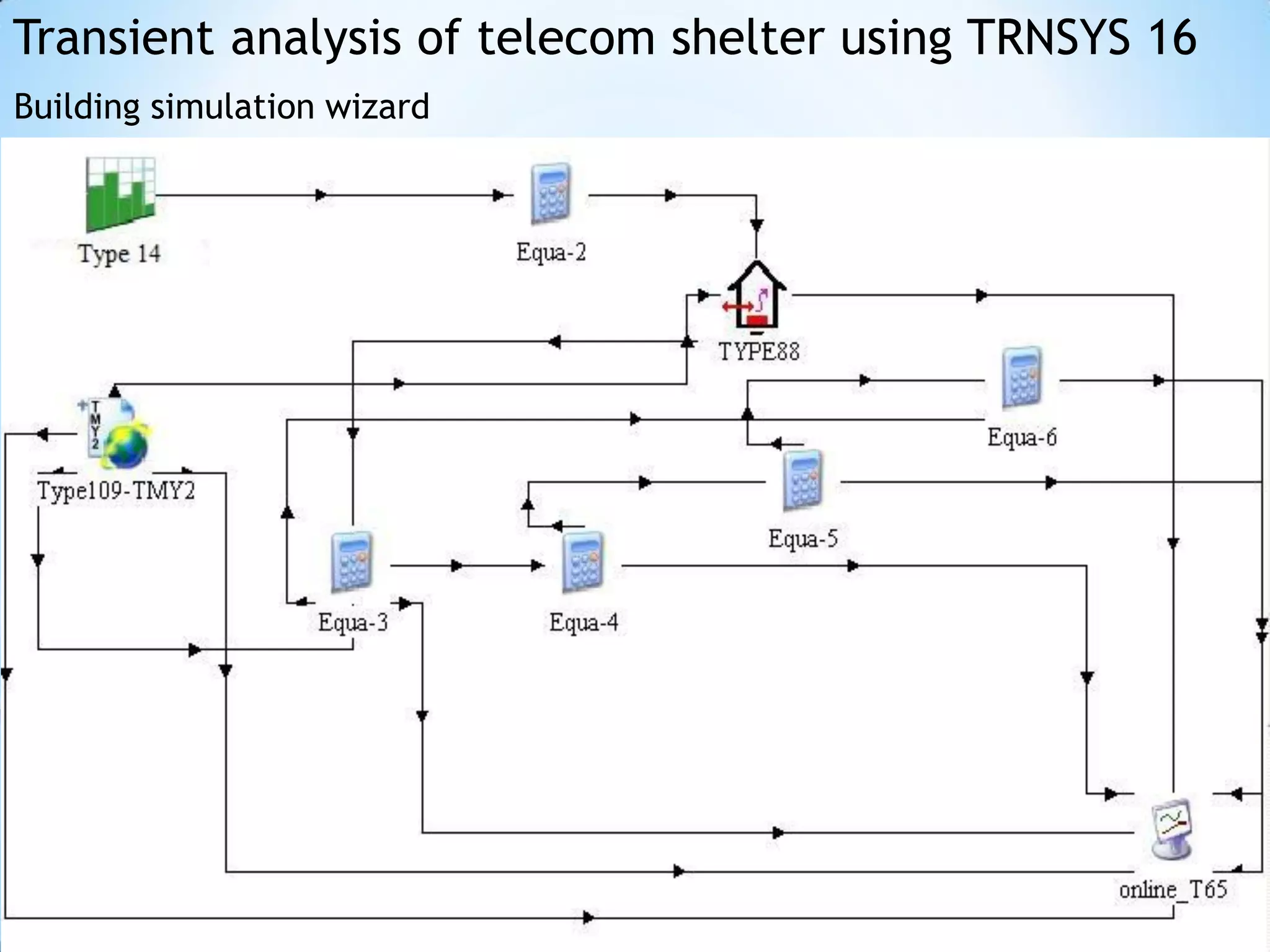
Transient analysis of telecom shelter using TRNSYS 16
Building simulation wizard
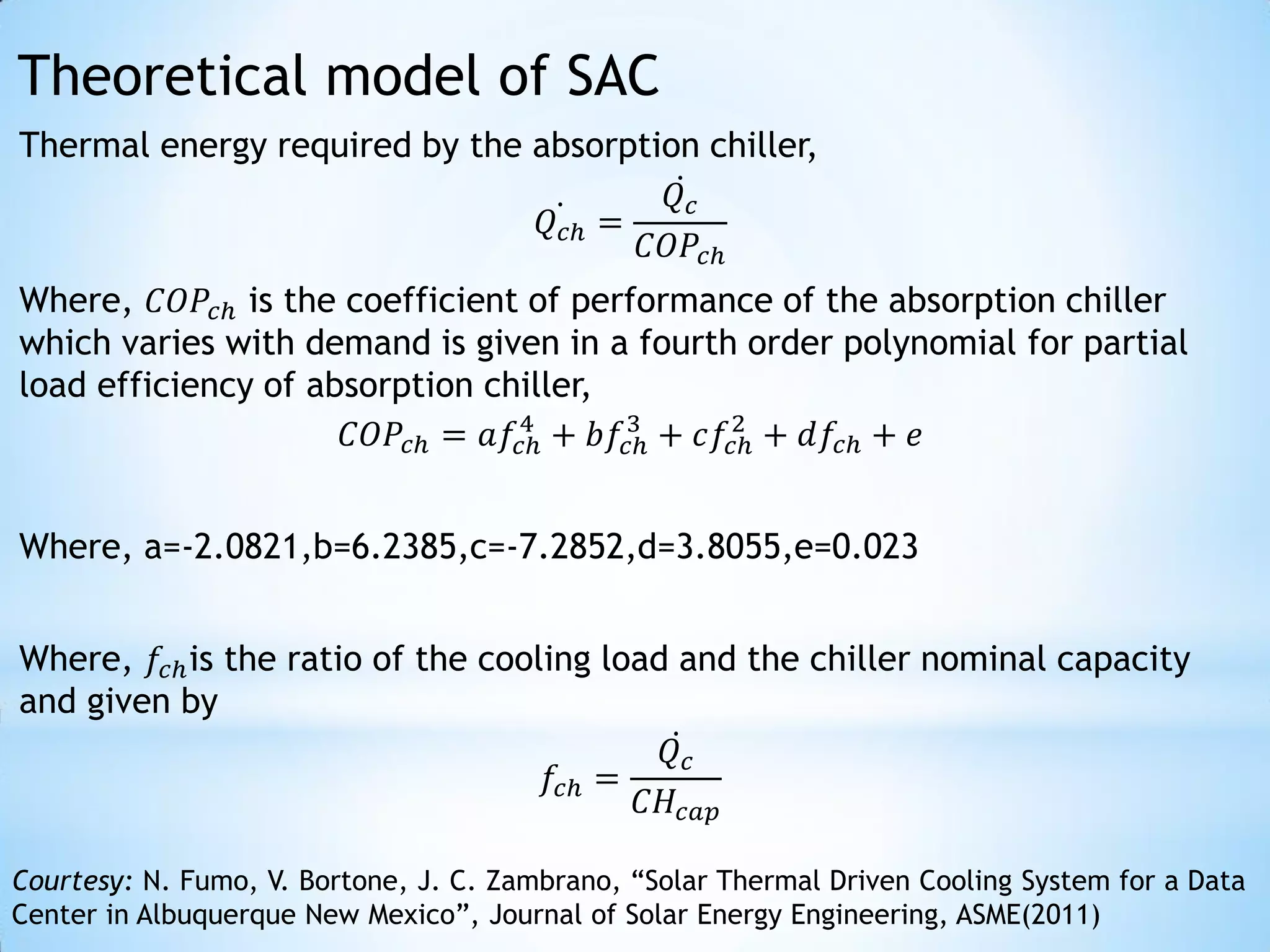
Theoretical model of SAC
Thermal energy required by the absorption chiller,
                                        𝑄𝑐
                                𝑄 𝑐ℎ =
                                       𝐶𝑂𝑃 𝑐ℎ
Where, 𝐶𝑂𝑃 𝑐ℎ is the coefficient of performance of the absorption chiller
which varies with demand is given in a fourth order polynomial for partial
load efficiency of absorption chiller,
                                4      3      2
                     𝐶𝑂𝑃 𝑐ℎ = 𝑎𝑓𝑐ℎ + 𝑏𝑓𝑐ℎ + 𝑐𝑓𝑐ℎ + 𝑑𝑓𝑐ℎ + 𝑒


Where, a=-2.0821,b=6.2385,c=-7.2852,d=3.8055,e=0.023


Where, 𝑓𝑐ℎ is the ratio of the cooling load and the chiller nominal capacity
and given by
                                           𝑄𝑐
                                   𝑓𝑐ℎ =
                                          𝐶𝐻 𝑐𝑎𝑝

Courtesy: N. Fumo, V. Bortone, J. C. Zambrano, “Solar Thermal Driven Cooling System for a Data
Center in Albuquerque New Mexico”, Journal of Solar Energy Engineering, ASME(2011)
Building simulation wizard- Time vs. Cooling load_W
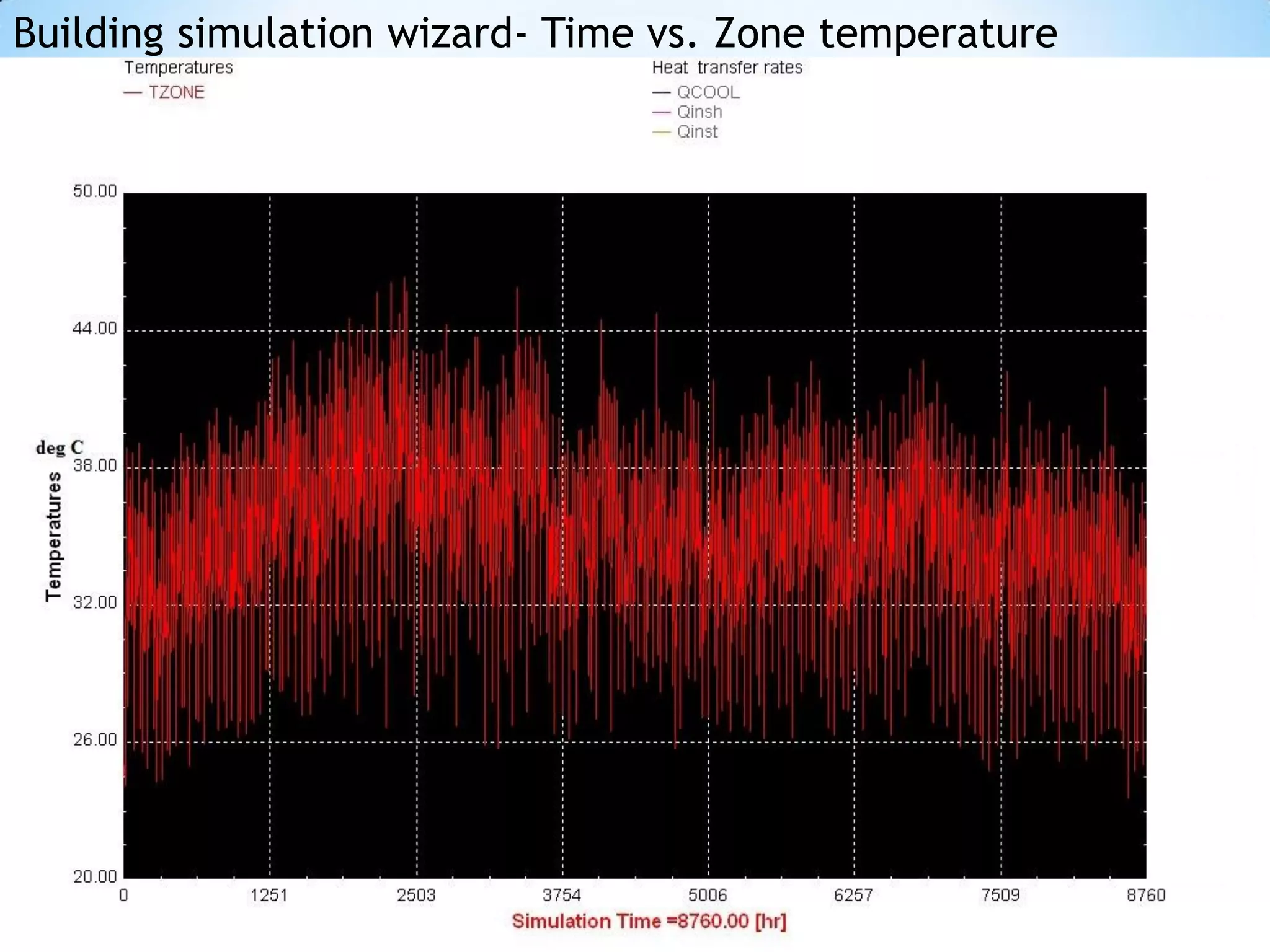
Building simulation wizard- Time vs. Zone temperature
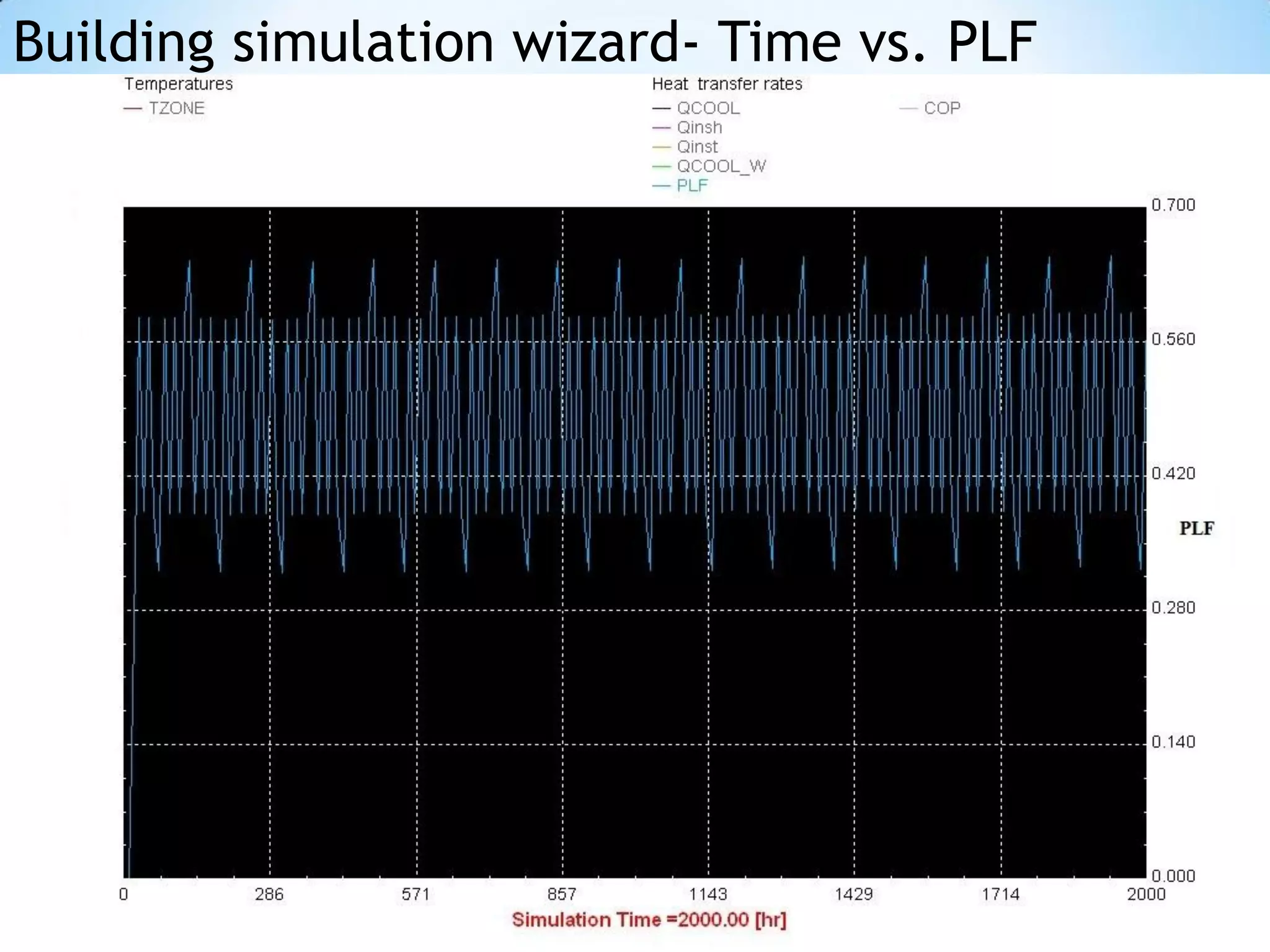
Building simulation wizard- Time vs. PLF
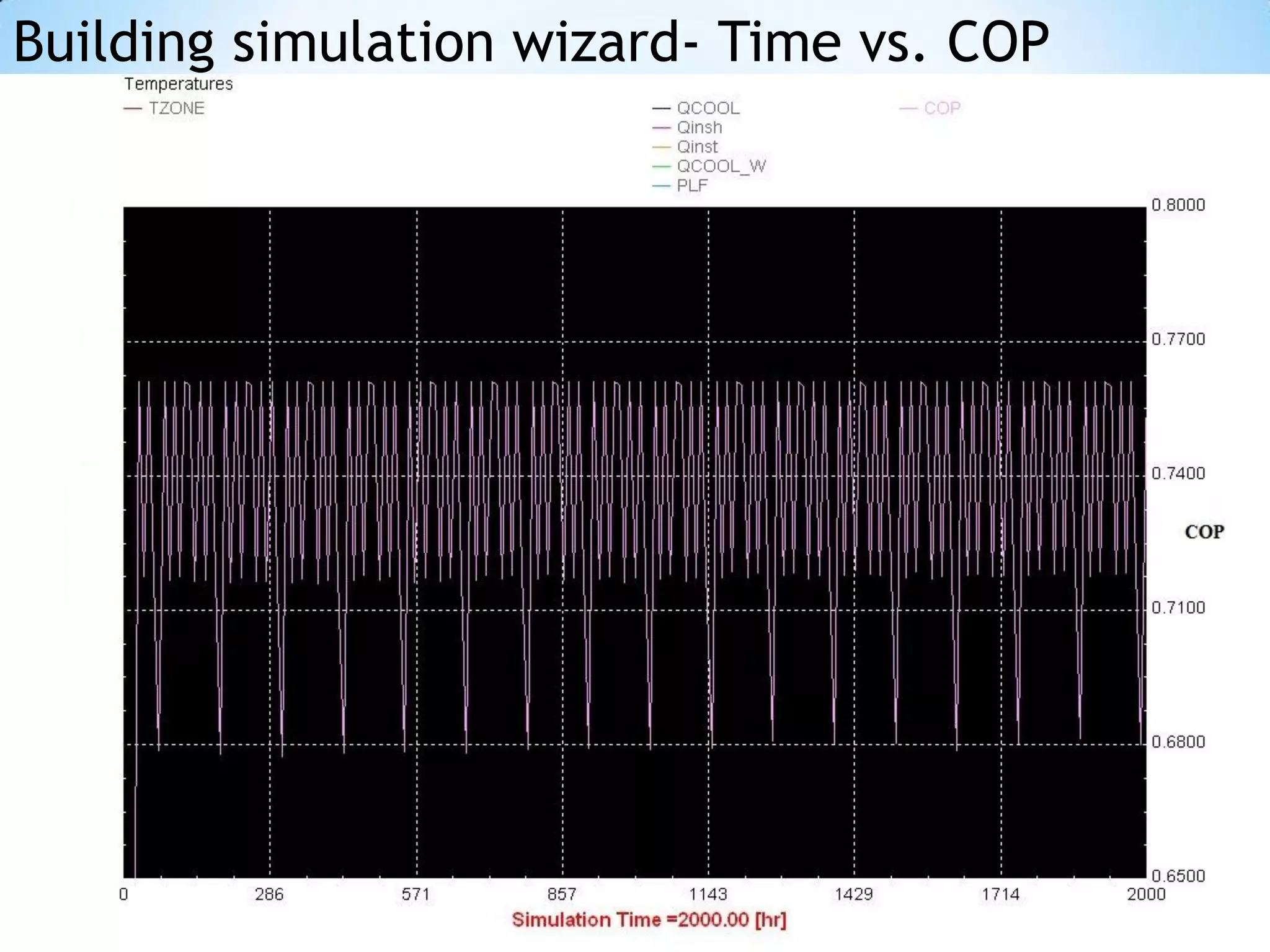
Building simulation wizard- Time vs. COP
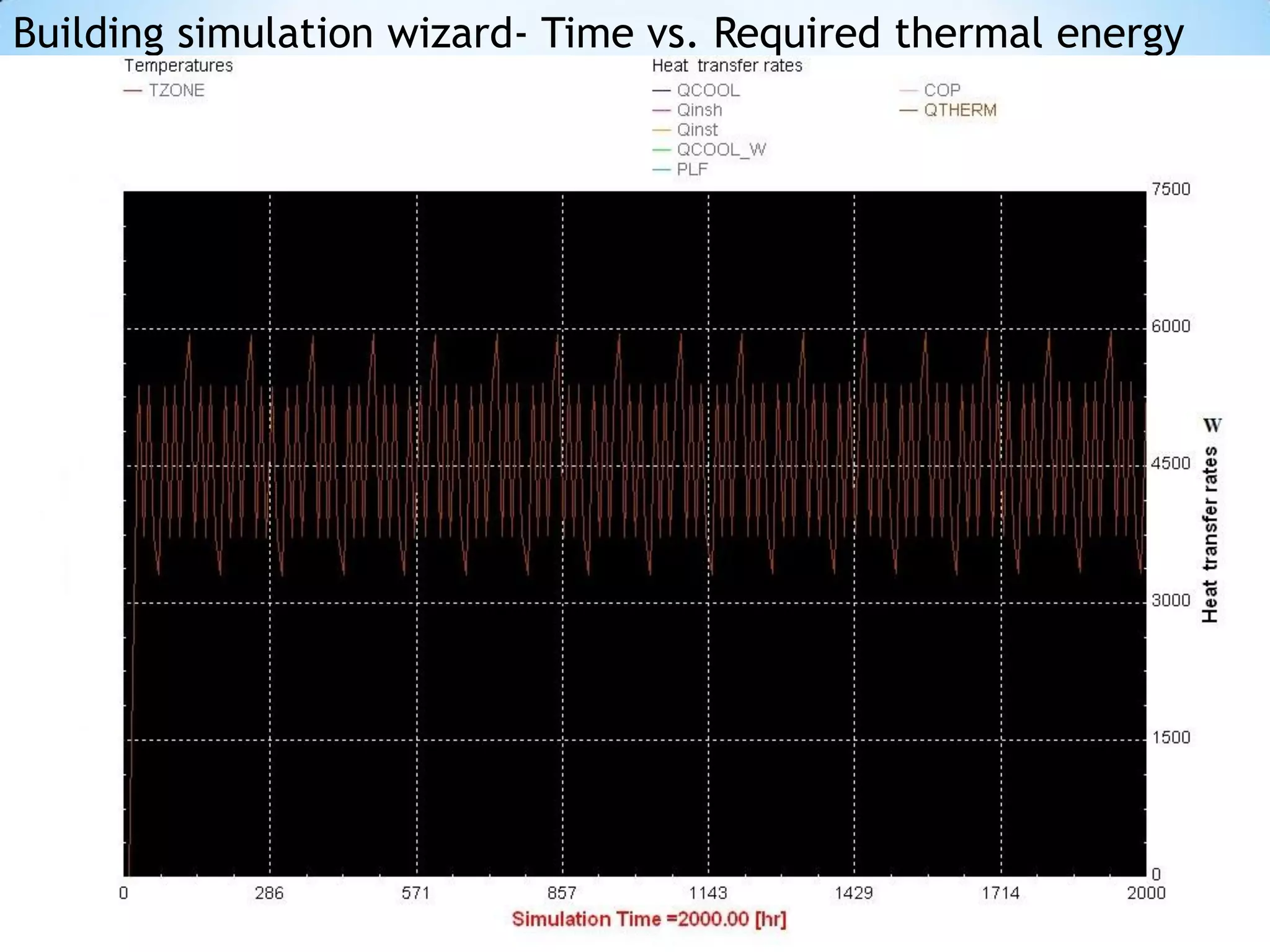
Building simulation wizard- Time vs. Required thermal energy
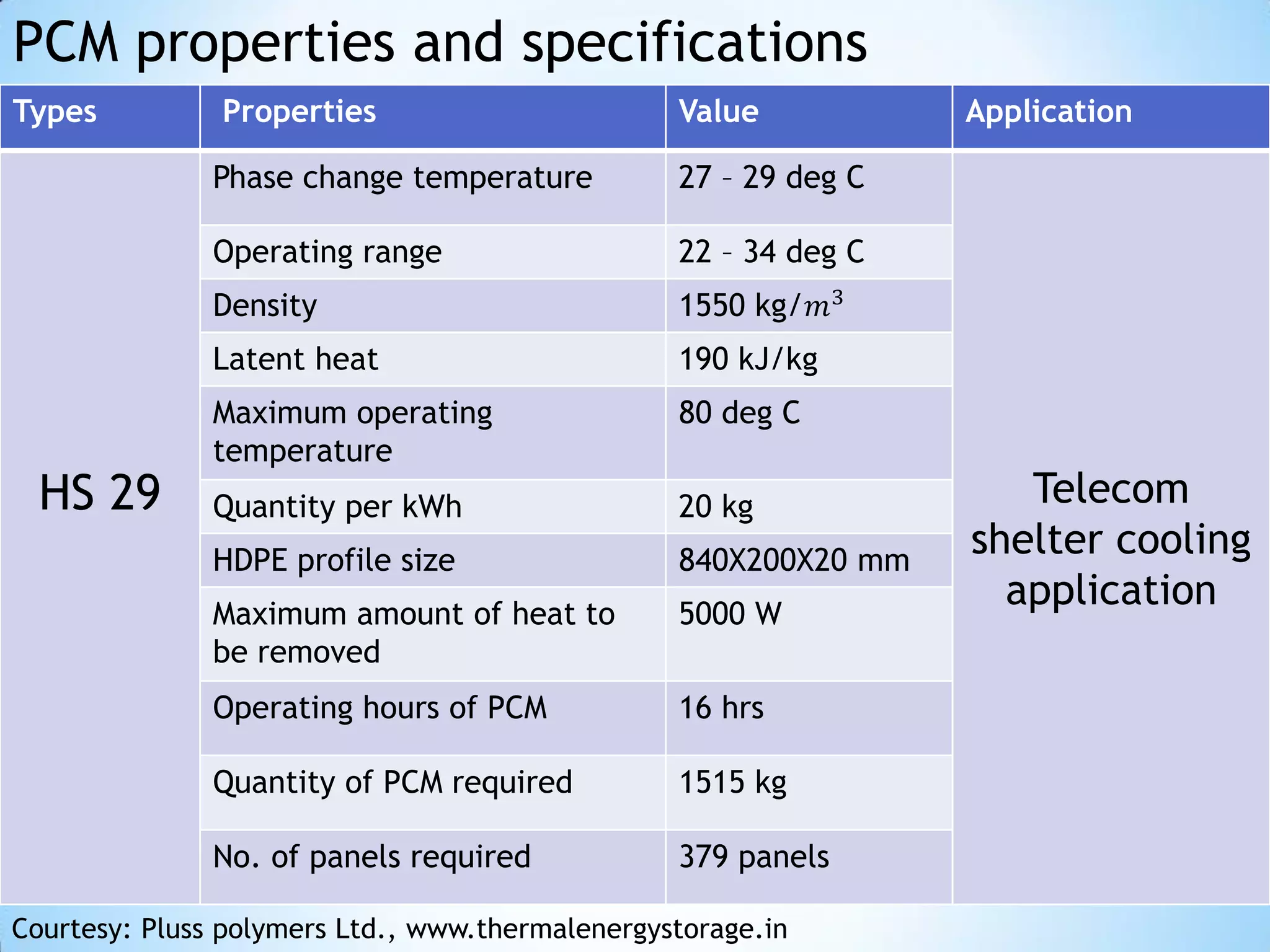
PCM properties and specifications
Types          Properties                        Value           Application

               Phase change temperature          27 – 29 deg C

               Operating range                   22 – 34 deg C
               Density                           1550 kg/𝑚3
               Latent heat                       190 kJ/kg
               Maximum operating                 80 deg C
               temperature
  HS 29        Quantity per kWh                  20 kg              Telecom
               HDPE profile size                 840X200X20 mm
                                                                 shelter cooling
               Maximum amount of heat to         5000 W
                                                                   application
               be removed
               Operating hours of PCM            16 hrs

               Quantity of PCM required          1515 kg

               No. of panels required            379 panels

Courtesy: Pluss polymers Ltd., www.thermalenergystorage.in
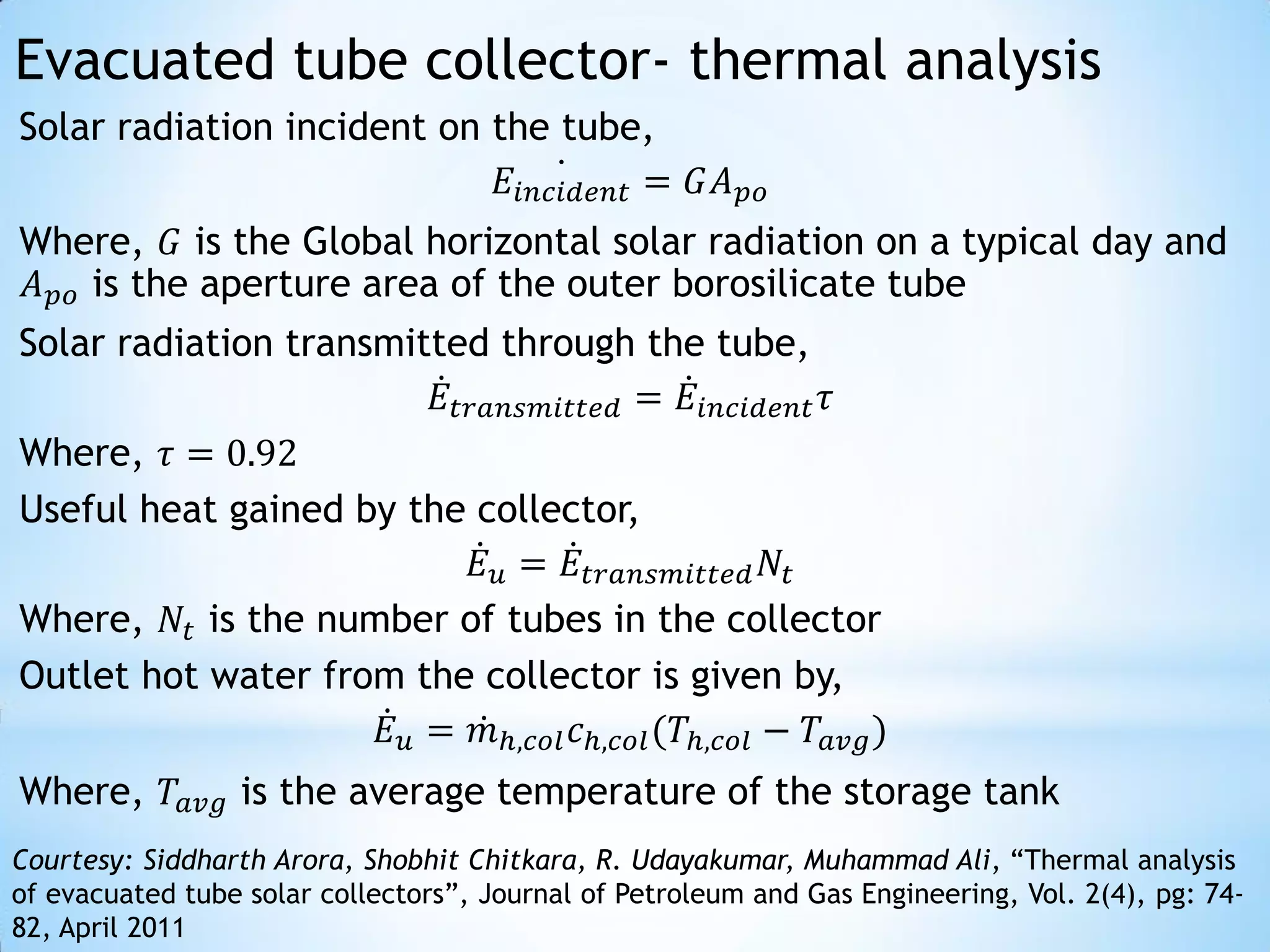
Evacuated tube collector- thermal analysis
Solar radiation incident on the tube,
                             𝐸 𝑖𝑛𝑐𝑖𝑑𝑒𝑛𝑡 = 𝐺𝐴 𝑝𝑜
Where, 𝐺 is the Global horizontal solar radiation on a typical day and
𝐴 𝑝𝑜 is the aperture area of the outer borosilicate tube
Solar radiation transmitted through the tube,
                         𝐸 𝑡𝑟𝑎𝑛𝑠𝑚𝑖𝑡𝑡𝑒𝑑 = 𝐸 𝑖𝑛𝑐𝑖𝑑𝑒𝑛𝑡 𝜏
Where, 𝜏 = 0.92
Useful heat gained by the collector,
                             𝐸 𝑢 = 𝐸 𝑡𝑟𝑎𝑛𝑠𝑚𝑖𝑡𝑡𝑒𝑑 𝑁 𝑡
Where, 𝑁 𝑡 is the number of tubes in the collector
Outlet hot water from the collector is given by,
                     𝐸 𝑢 = 𝑚ℎ,𝑐𝑜𝑙 𝑐ℎ,𝑐𝑜𝑙 (𝑇ℎ,𝑐𝑜𝑙 − 𝑇 𝑎𝑣𝑔 )
Where, 𝑇 𝑎𝑣𝑔 is the average temperature of the storage tank
Courtesy: Siddharth Arora, Shobhit Chitkara, R. Udayakumar, Muhammad Ali, “Thermal analysis
of evacuated tube solar collectors”, Journal of Petroleum and Gas Engineering, Vol. 2(4), pg: 74-
82, April 2011
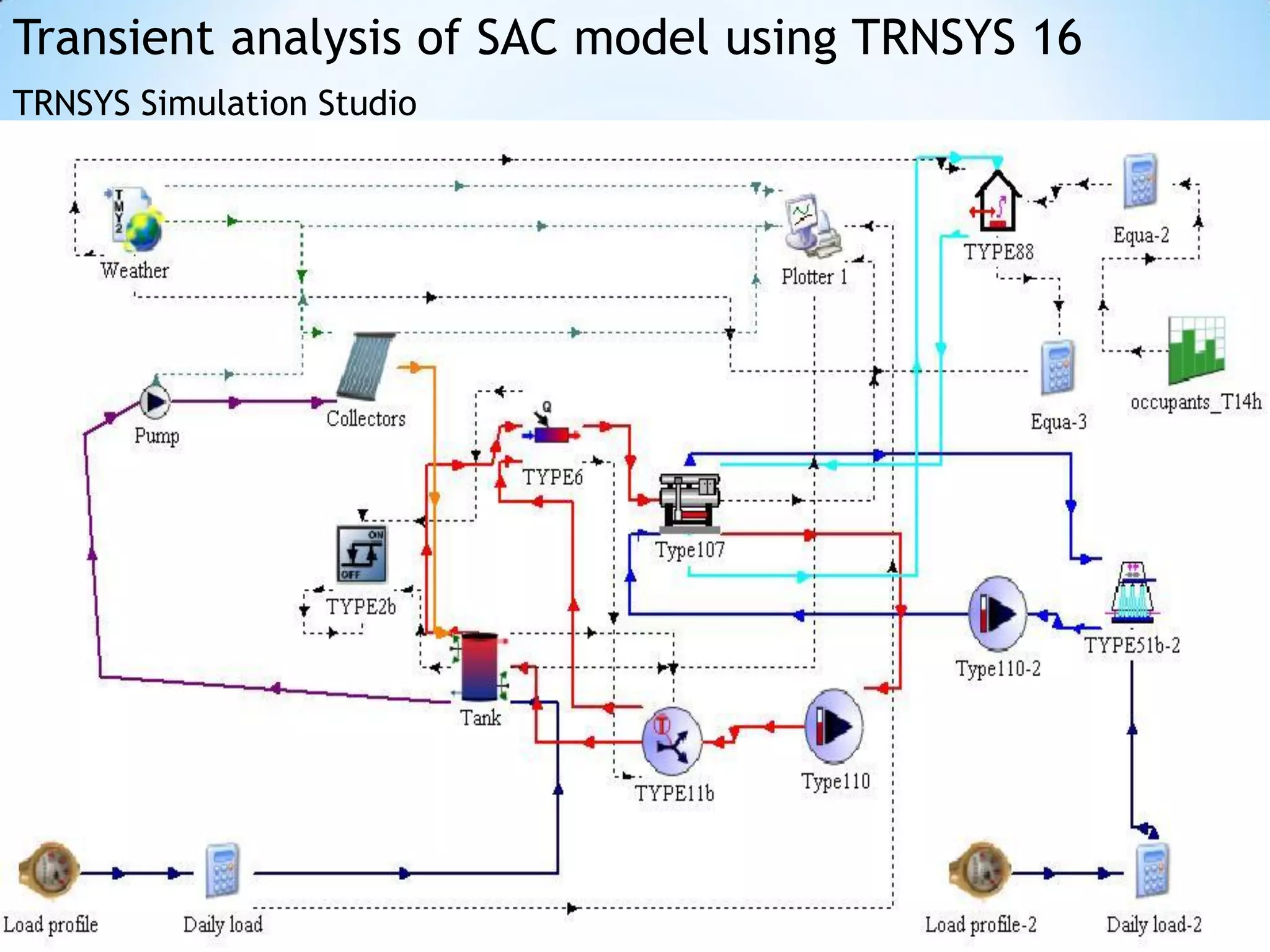
Transient analysis of SAC model using TRNSYS 16
TRNSYS Simulation Studio
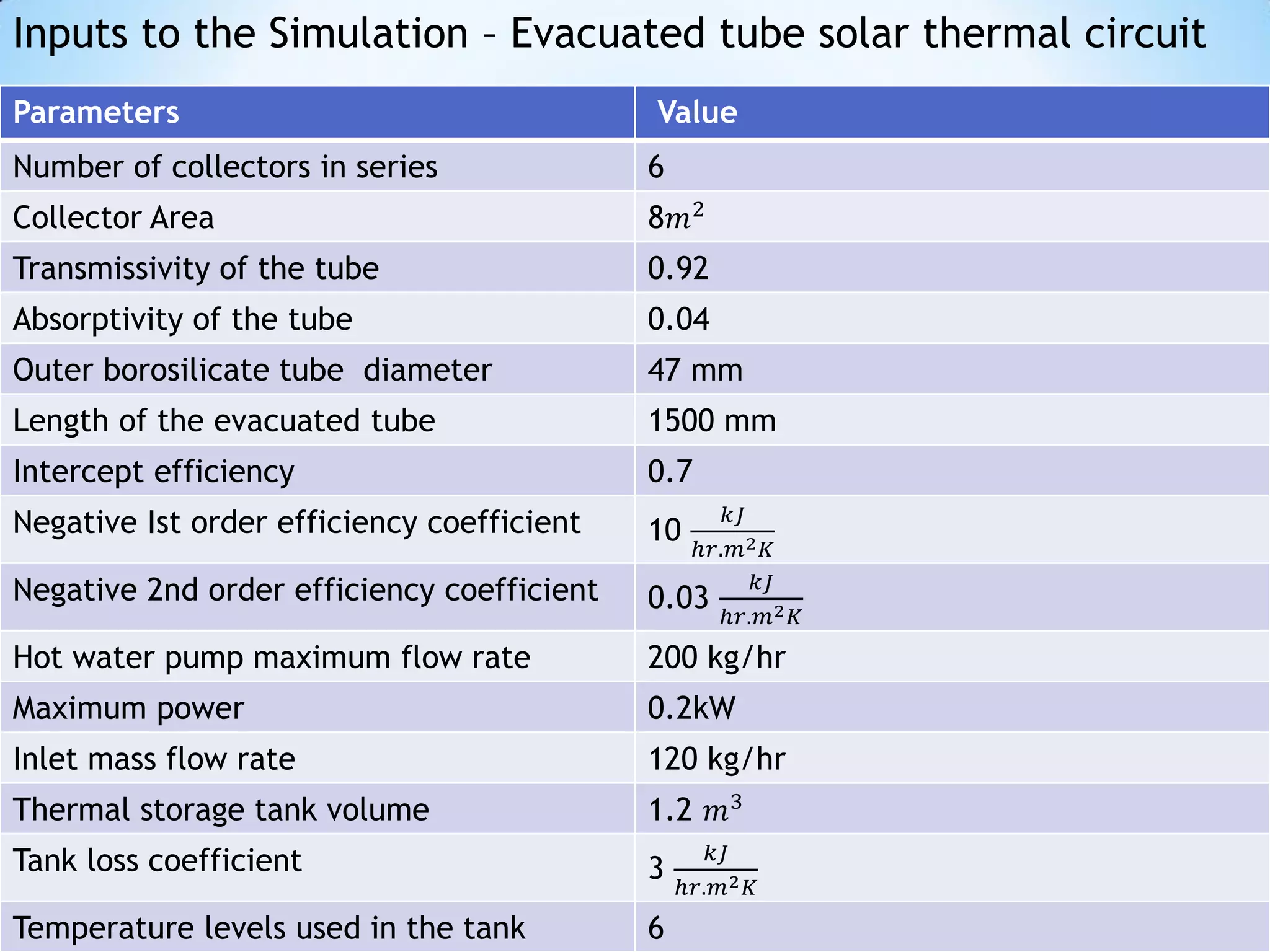
Inputs to the Simulation – Evacuated tube solar thermal circuit
Parameters                                  Value
Number of collectors in series              6
Collector Area                              8𝑚2
Transmissivity of the tube                  0.92
Absorptivity of the tube                    0.04
Outer borosilicate tube diameter            47 mm
Length of the evacuated tube                1500 mm
Intercept efficiency                        0.7
Negative Ist order efficiency coefficient         𝑘𝐽
                                            10 ℎ𝑟.𝑚2 𝐾
Negative 2nd order efficiency coefficient            𝑘𝐽
                                            0.03 ℎ𝑟.𝑚2 𝐾
Hot water pump maximum flow rate            200 kg/hr
Maximum power                               0.2kW
Inlet mass flow rate                        120 kg/hr
Thermal storage tank volume                 1.2 𝑚3
Tank loss coefficient                              𝑘𝐽
                                            3   ℎ𝑟.𝑚2 𝐾
Temperature levels used in the tank         6
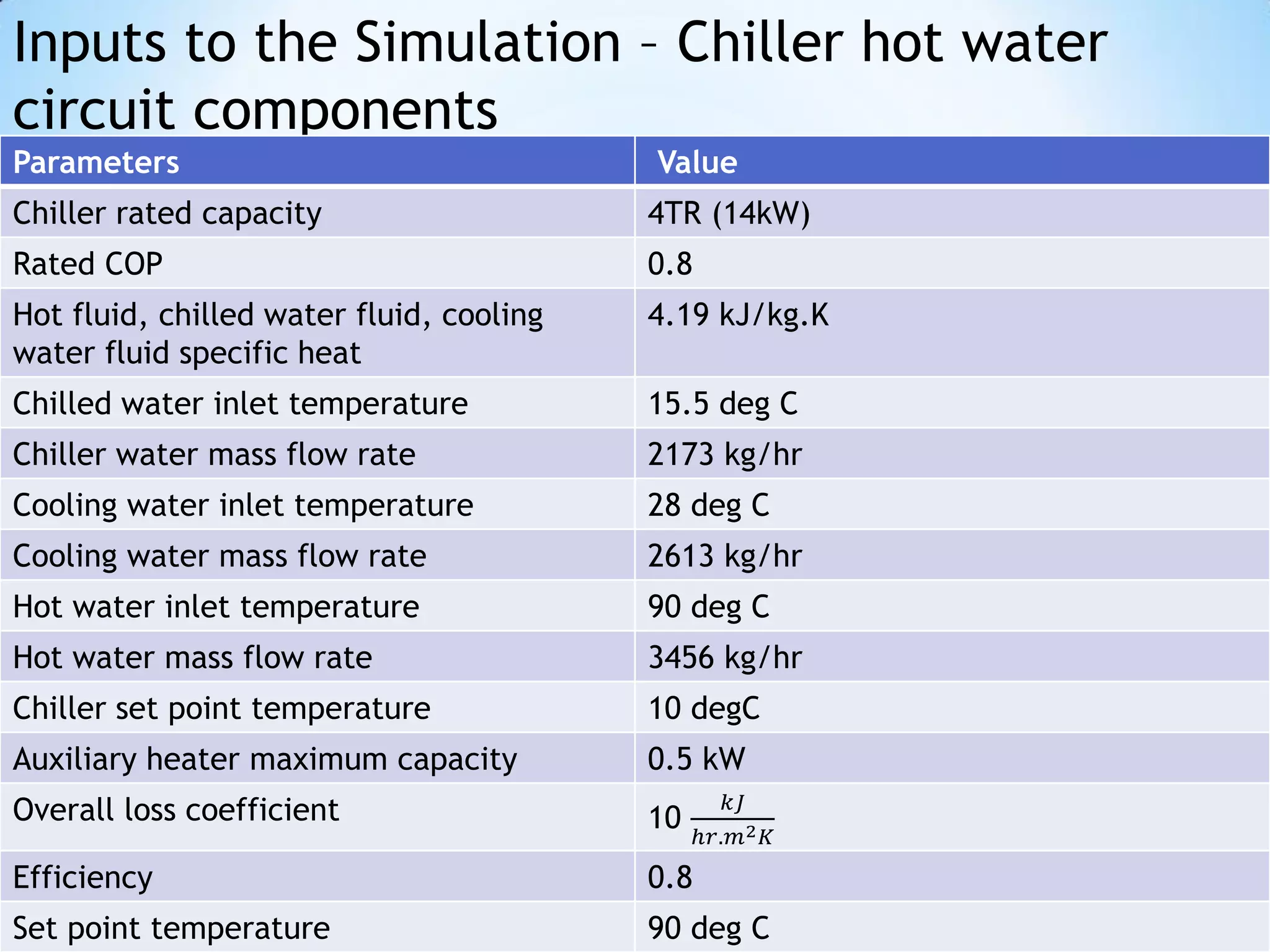
Inputs to the Simulation – Chiller hot water
circuit components
Parameters                                Value
Chiller rated capacity                    4TR (14kW)
Rated COP                                 0.8
Hot fluid, chilled water fluid, cooling   4.19 kJ/kg.K
water fluid specific heat
Chilled water inlet temperature           15.5 deg C
Chiller water mass flow rate              2173 kg/hr
Cooling water inlet temperature           28 deg C
Cooling water mass flow rate              2613 kg/hr
Hot water inlet temperature               90 deg C
Hot water mass flow rate                  3456 kg/hr
Chiller set point temperature             10 degC
Auxiliary heater maximum capacity         0.5 kW
Overall loss coefficient                          𝑘𝐽
                                          10
                                               ℎ𝑟.𝑚2 𝐾
Efficiency                                0.8
Set point temperature                     90 deg C
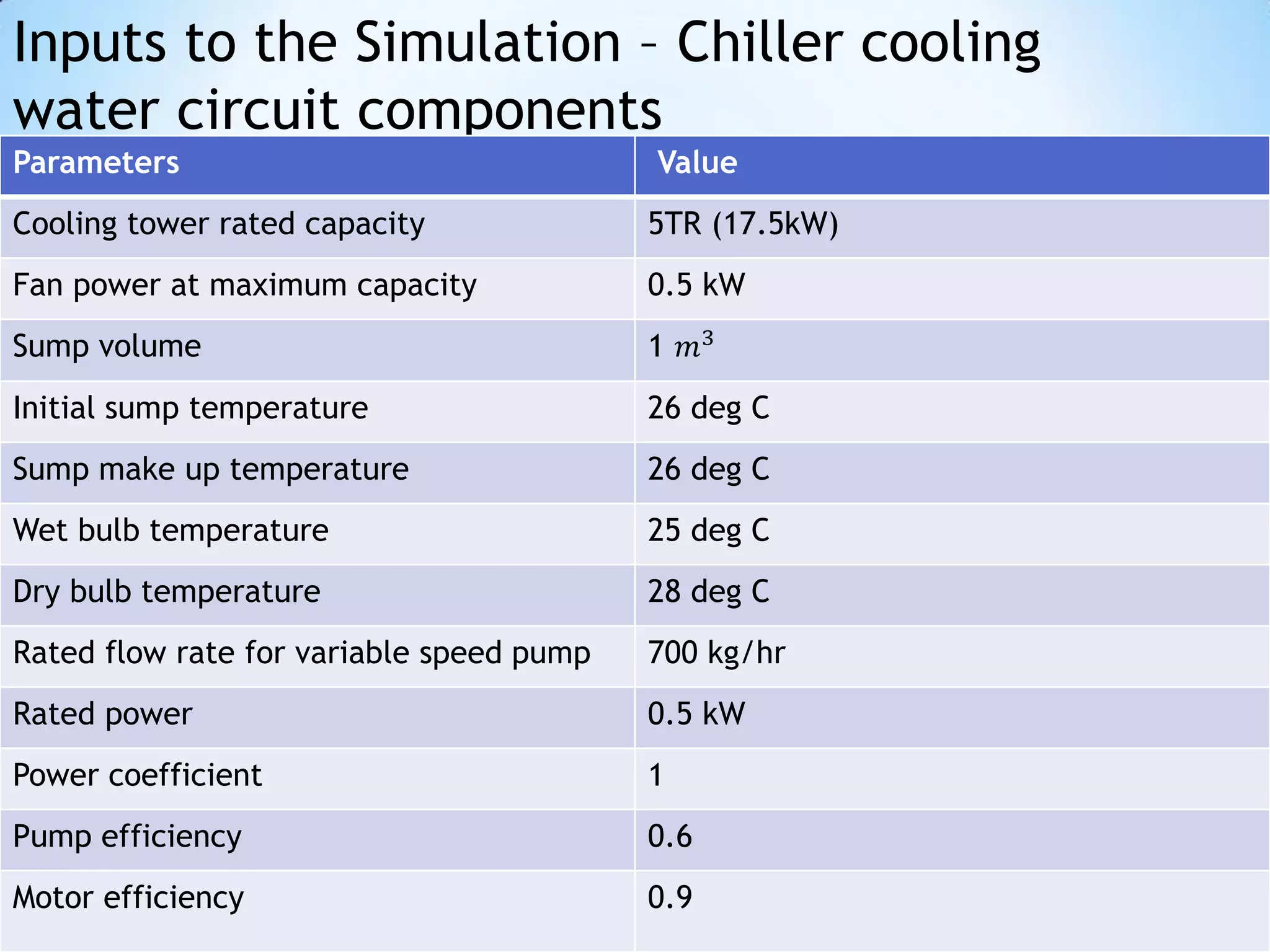
Inputs to the Simulation – Chiller cooling
water circuit components
Parameters                                Value
Cooling tower rated capacity              5TR (17.5kW)
Fan power at maximum capacity             0.5 kW
Sump volume                               1 𝑚3
Initial sump temperature                  26 deg C
Sump make up temperature                  26 deg C
Wet bulb temperature                      25 deg C
Dry bulb temperature                      28 deg C
Rated flow rate for variable speed pump   700 kg/hr
Rated power                               0.5 kW
Power coefficient                         1
Pump efficiency                           0.6
Motor efficiency                          0.9
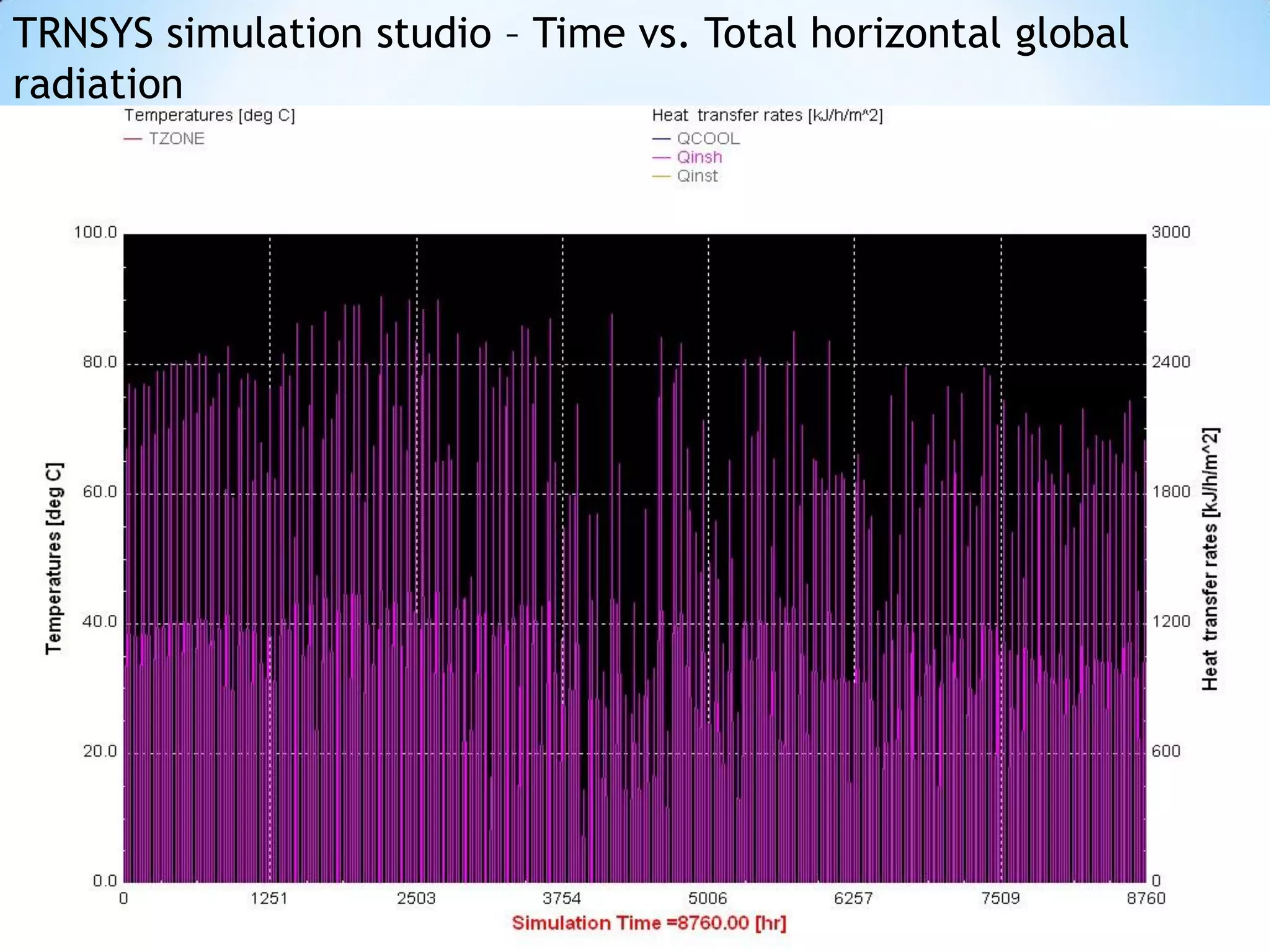
TRNSYS simulation studio – Time vs. Total horizontal global
radiation
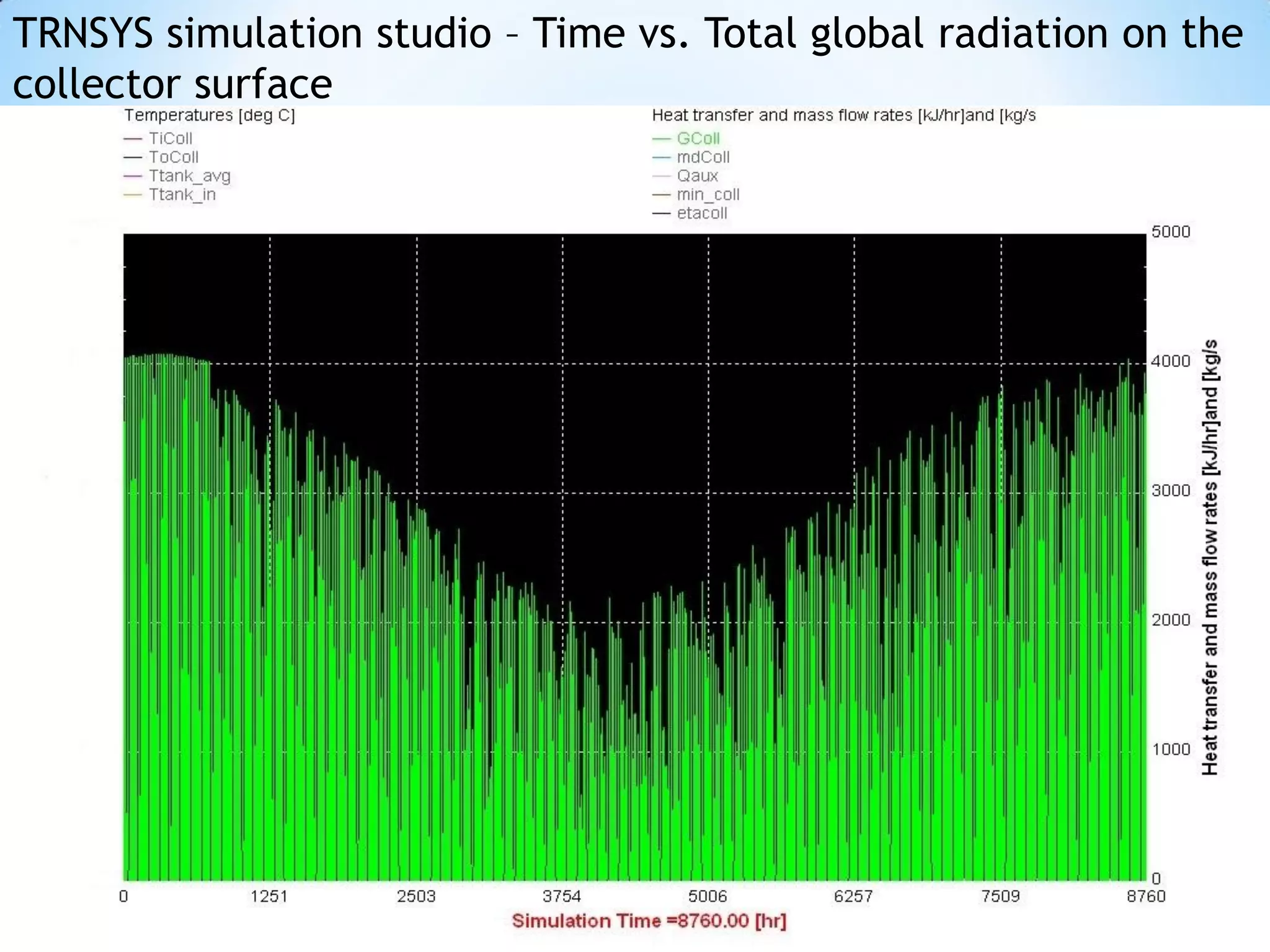
TRNSYS simulation studio – Time vs. Total global radiation on the
collector surface
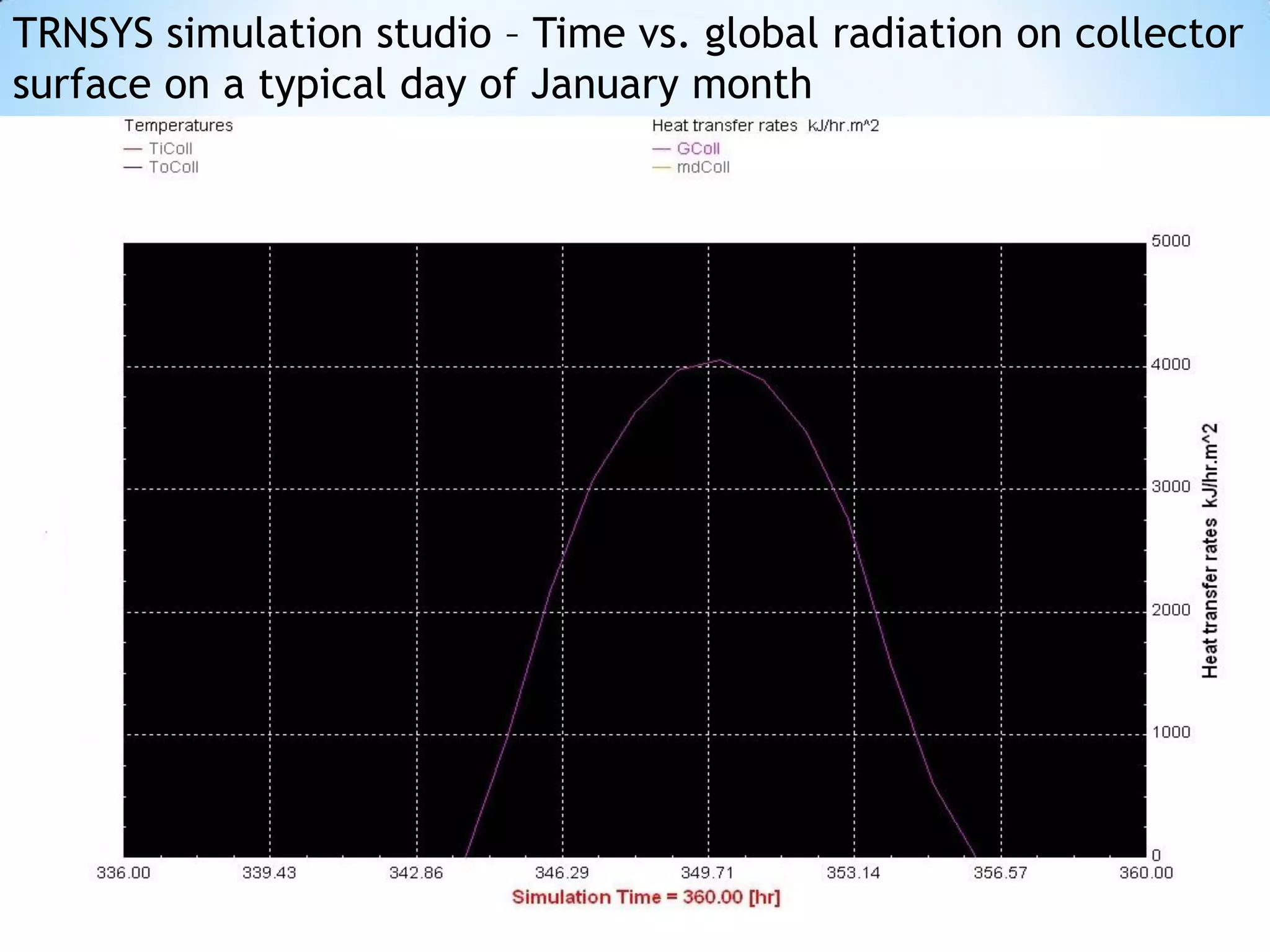
TRNSYS simulation studio – Time vs. global radiation on collector
surface on a typical day of January month
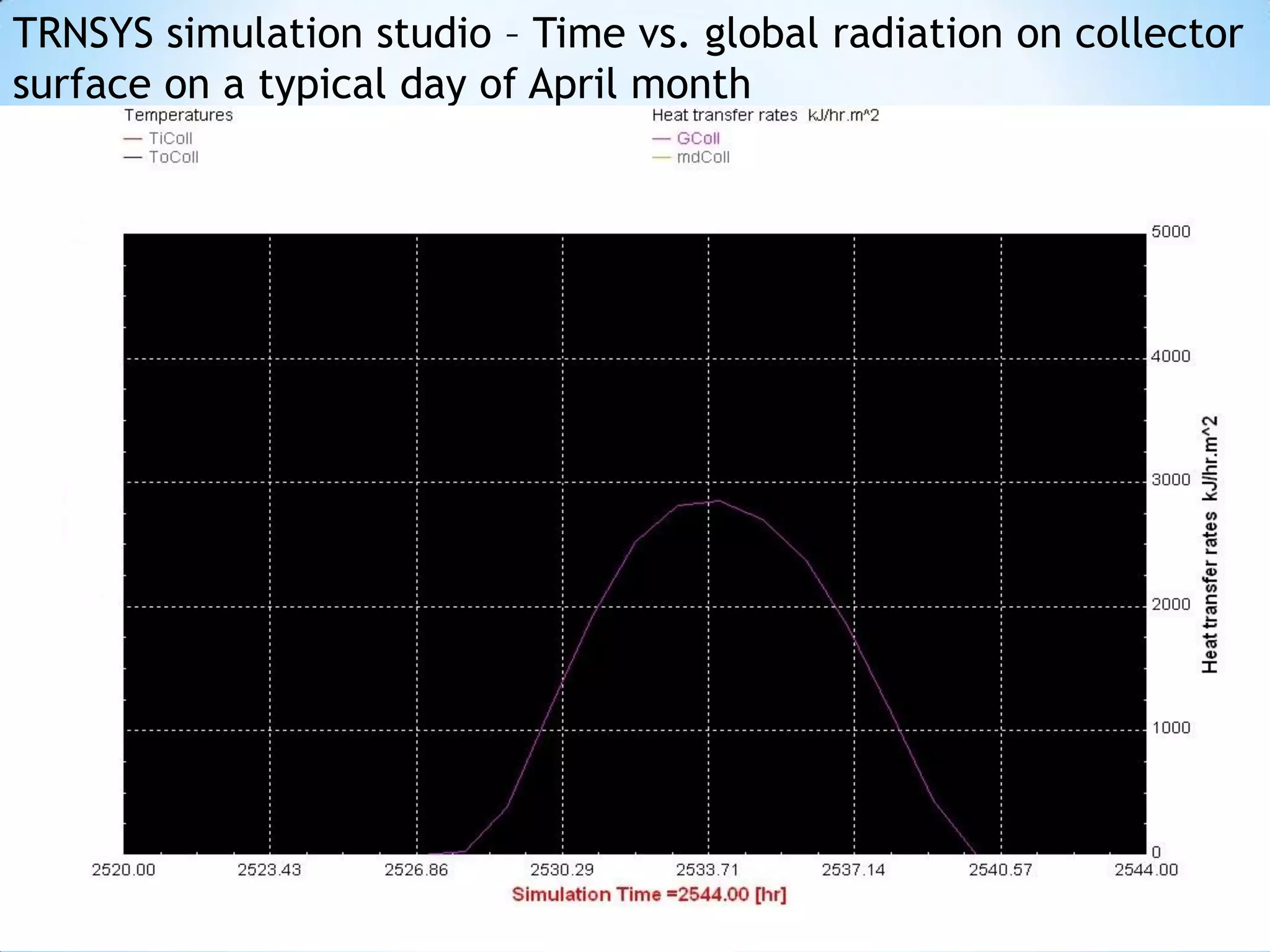
TRNSYS simulation studio – Time vs. global radiation on collector
surface on a typical day of April month
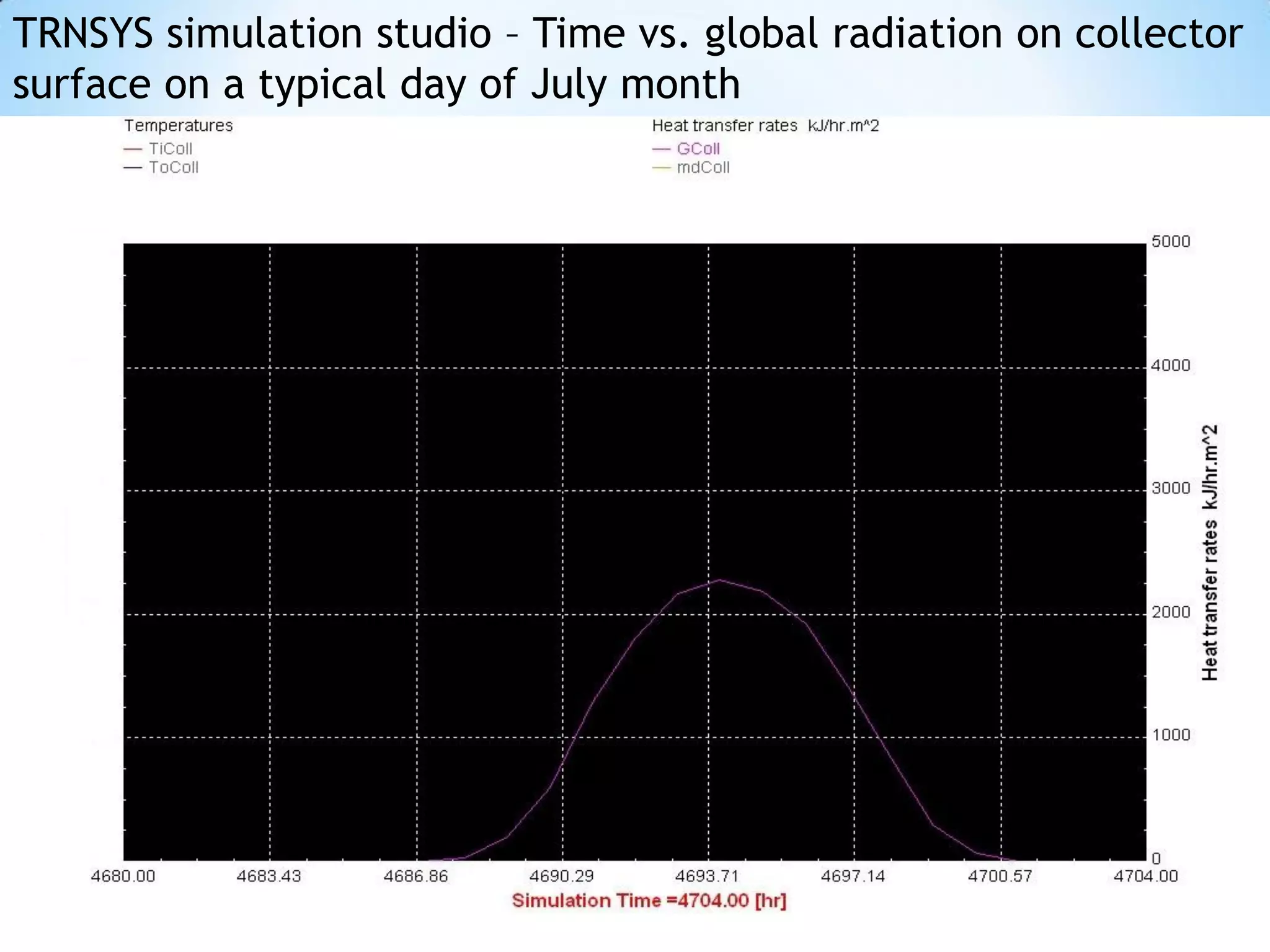
TRNSYS simulation studio – Time vs. global radiation on collector
surface on a typical day of July month
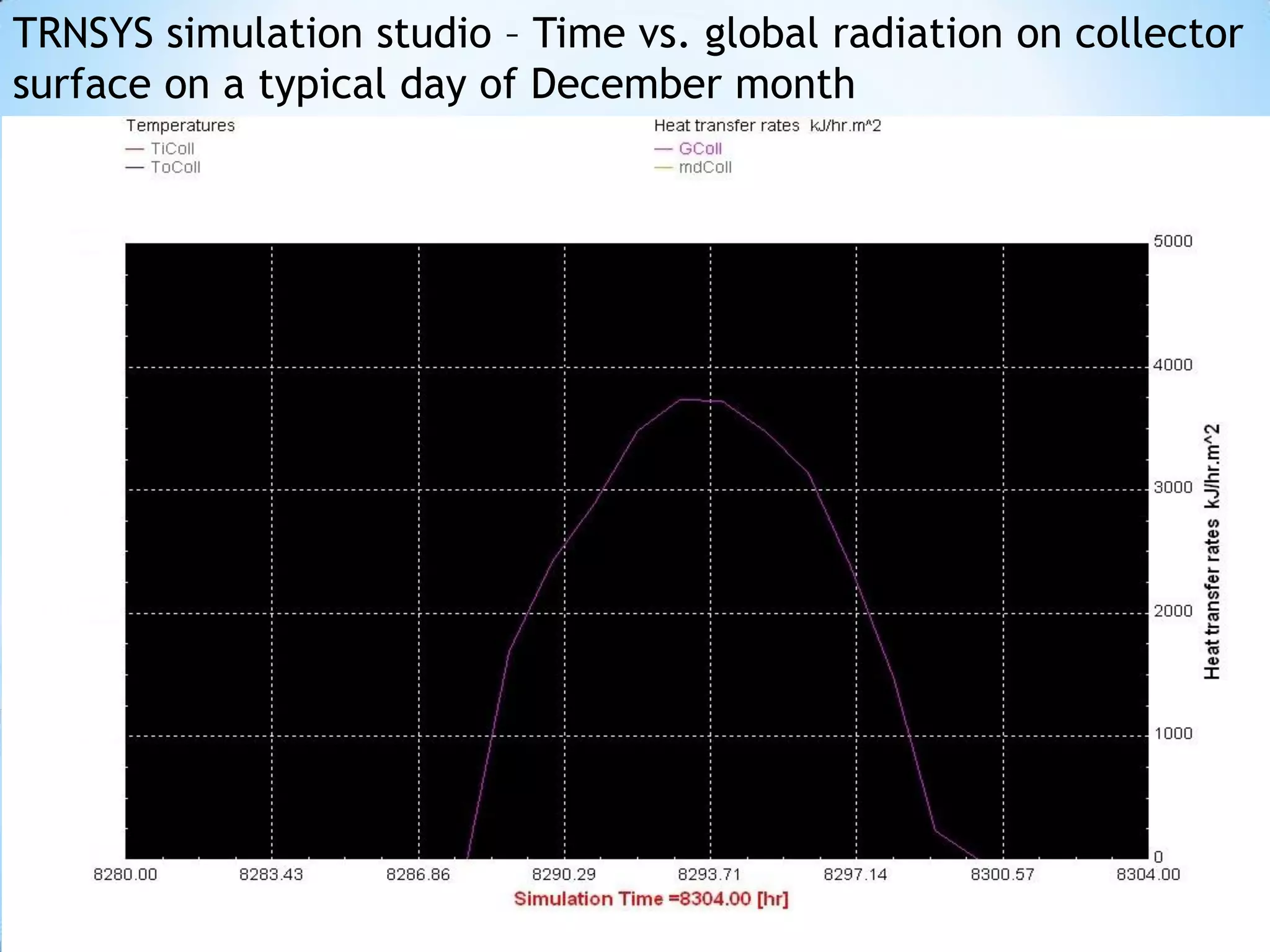
TRNSYS simulation studio – Time vs. global radiation on collector
surface on a typical day of December month
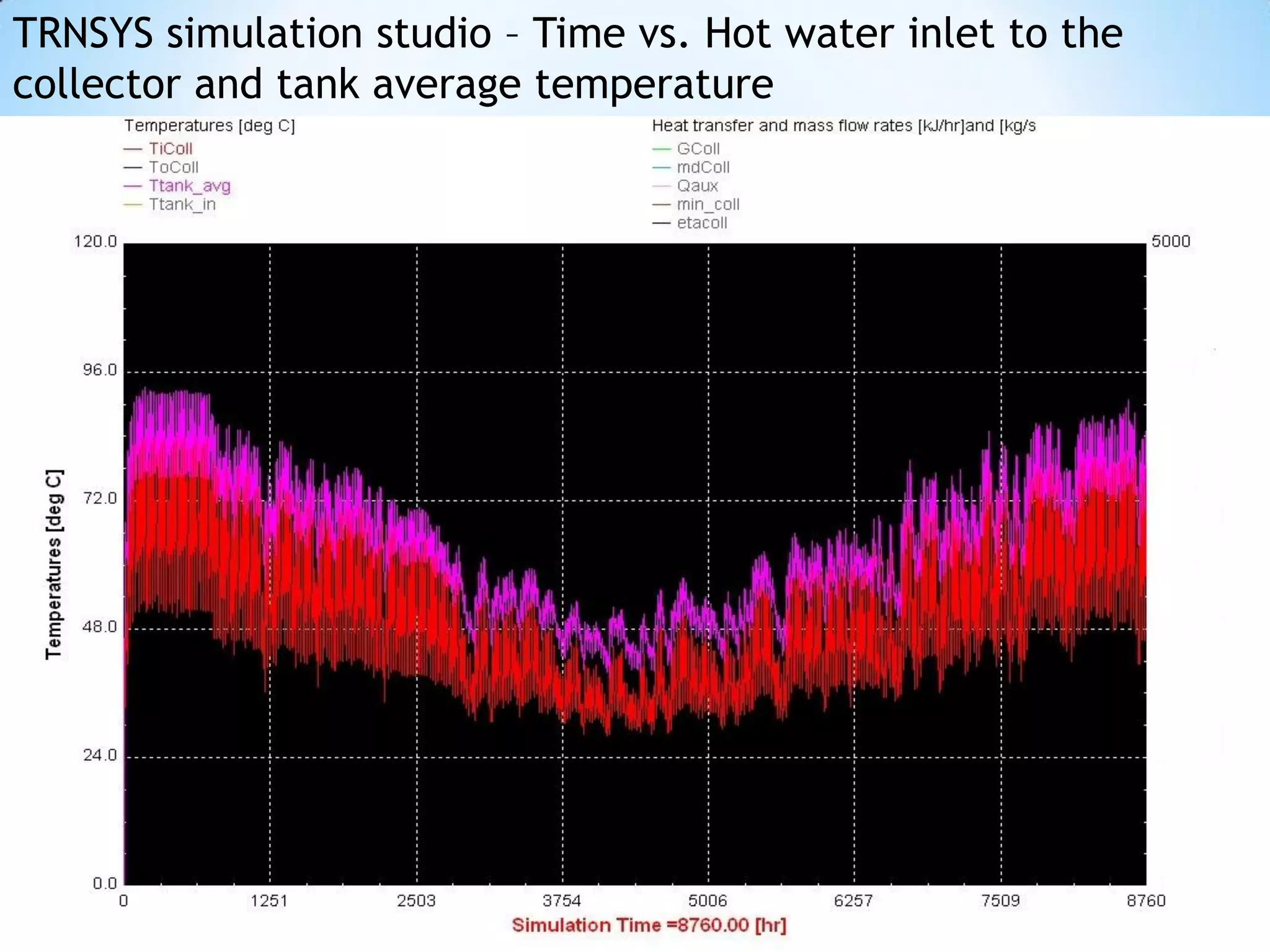
TRNSYS simulation studio – Time vs. Hot water inlet to the
collector and tank average temperature
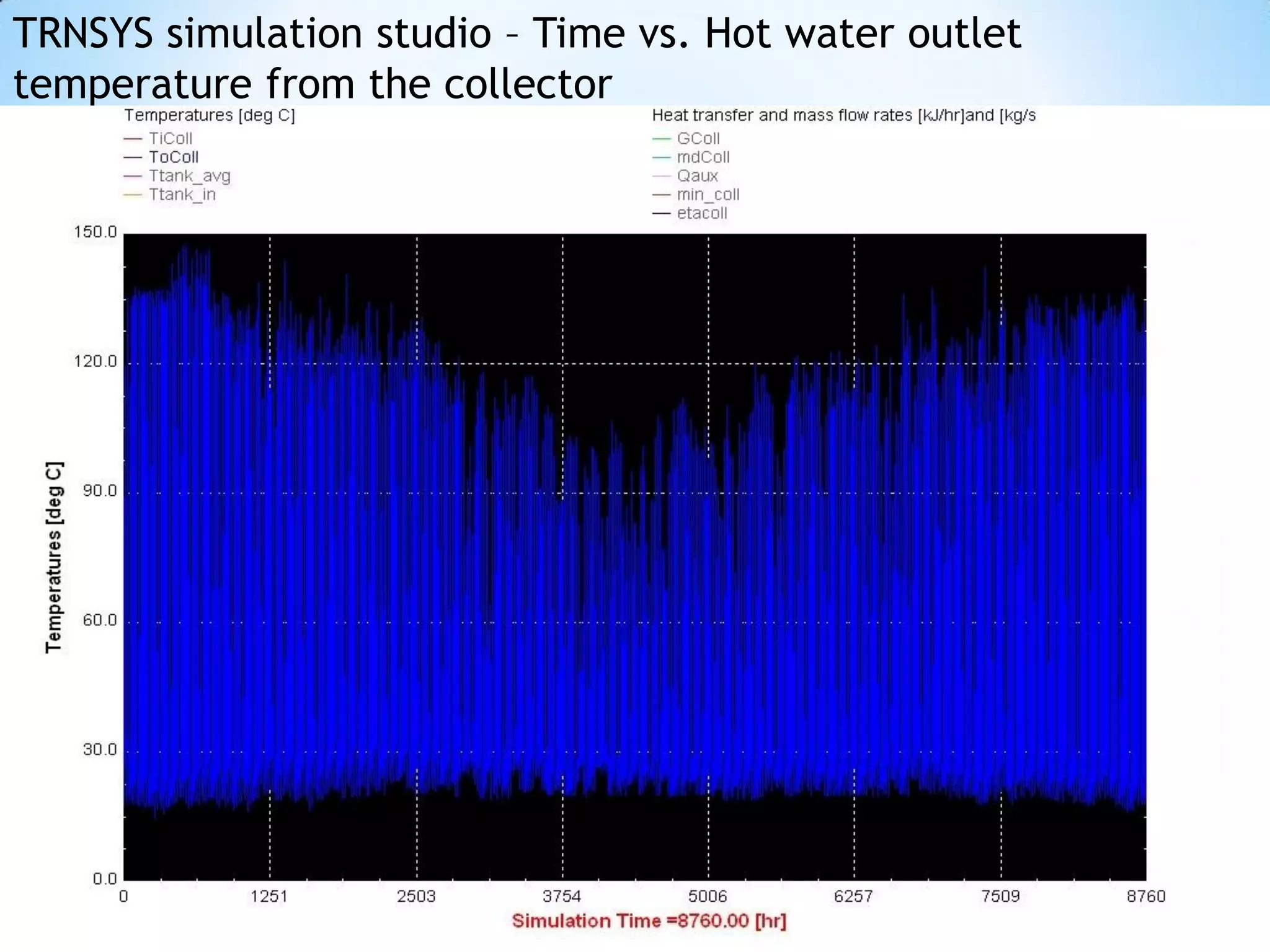
TRNSYS simulation studio – Time vs. Hot water outlet
temperature from the collector
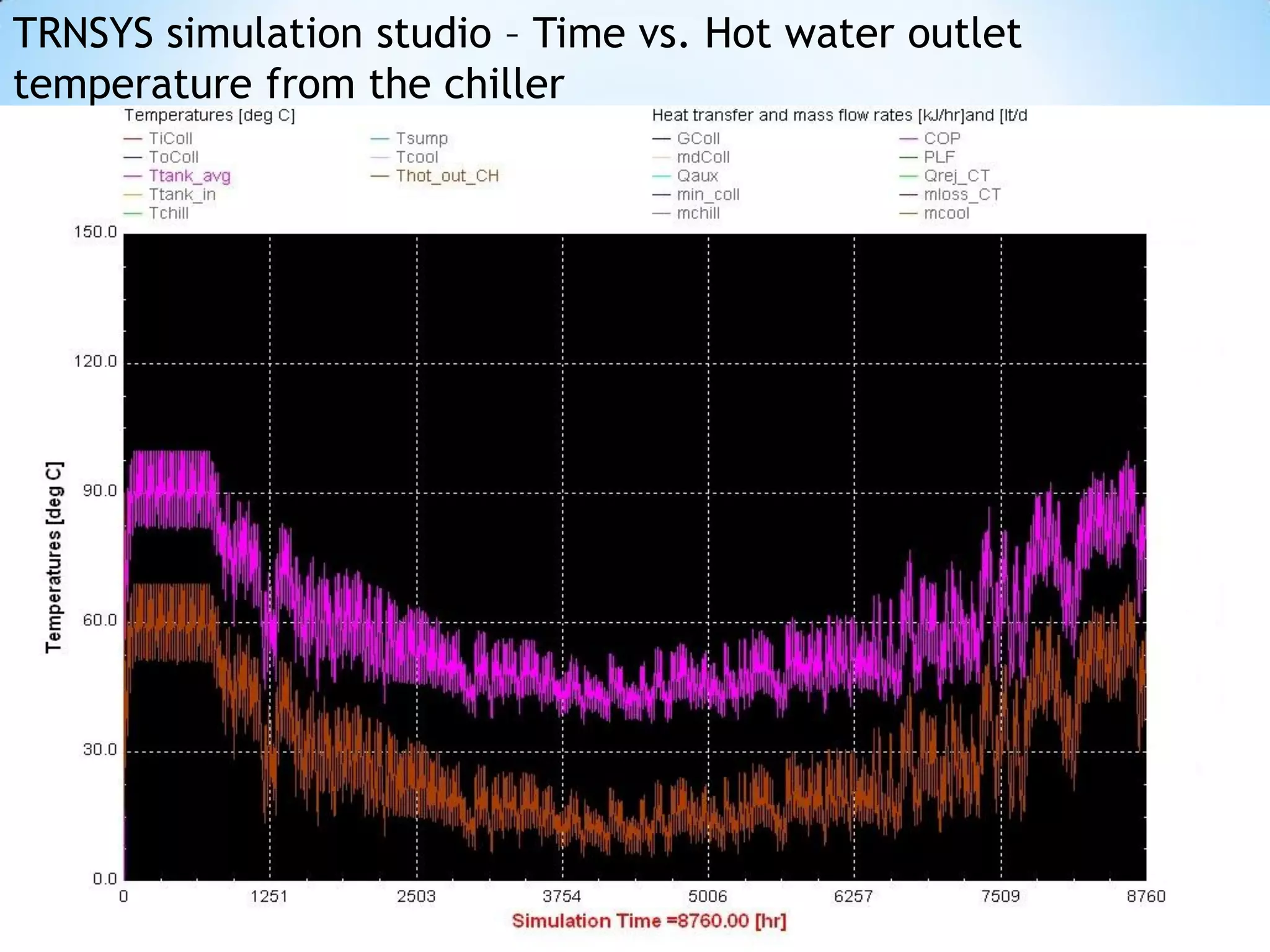
TRNSYS simulation studio – Time vs. Hot water outlet
temperature from the chiller
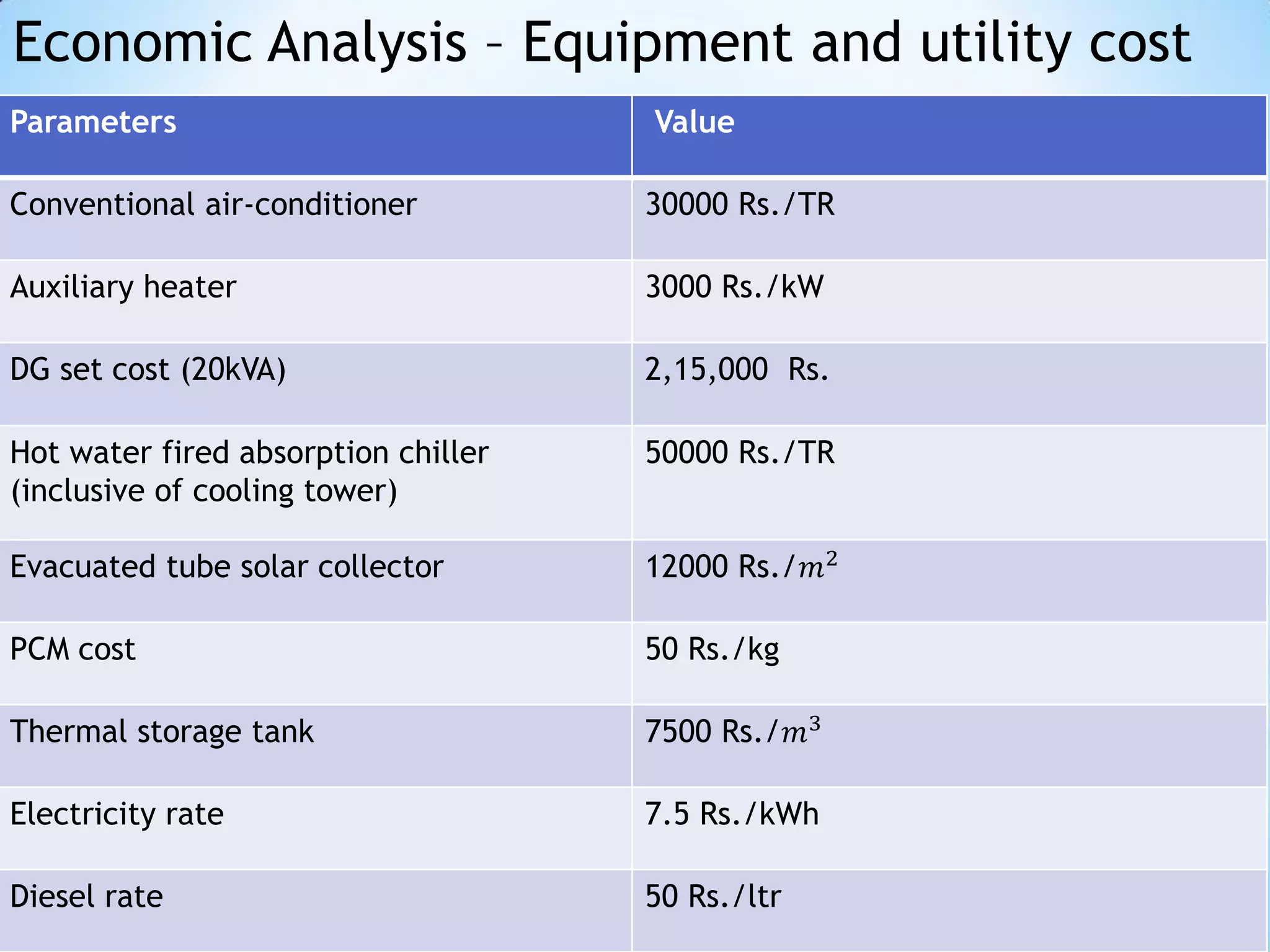
Economic Analysis – Equipment and utility cost
Parameters                           Value

Conventional air-conditioner         30000 Rs./TR

Auxiliary heater                     3000 Rs./kW

DG set cost (20kVA)                  2,15,000 Rs.

Hot water fired absorption chiller   50000 Rs./TR
(inclusive of cooling tower)

Evacuated tube solar collector       12000 Rs./𝑚2

PCM cost                             50 Rs./kg

Thermal storage tank                 7500 Rs./𝑚3

Electricity rate                     7.5 Rs./kWh

Diesel rate                          50 Rs./ltr
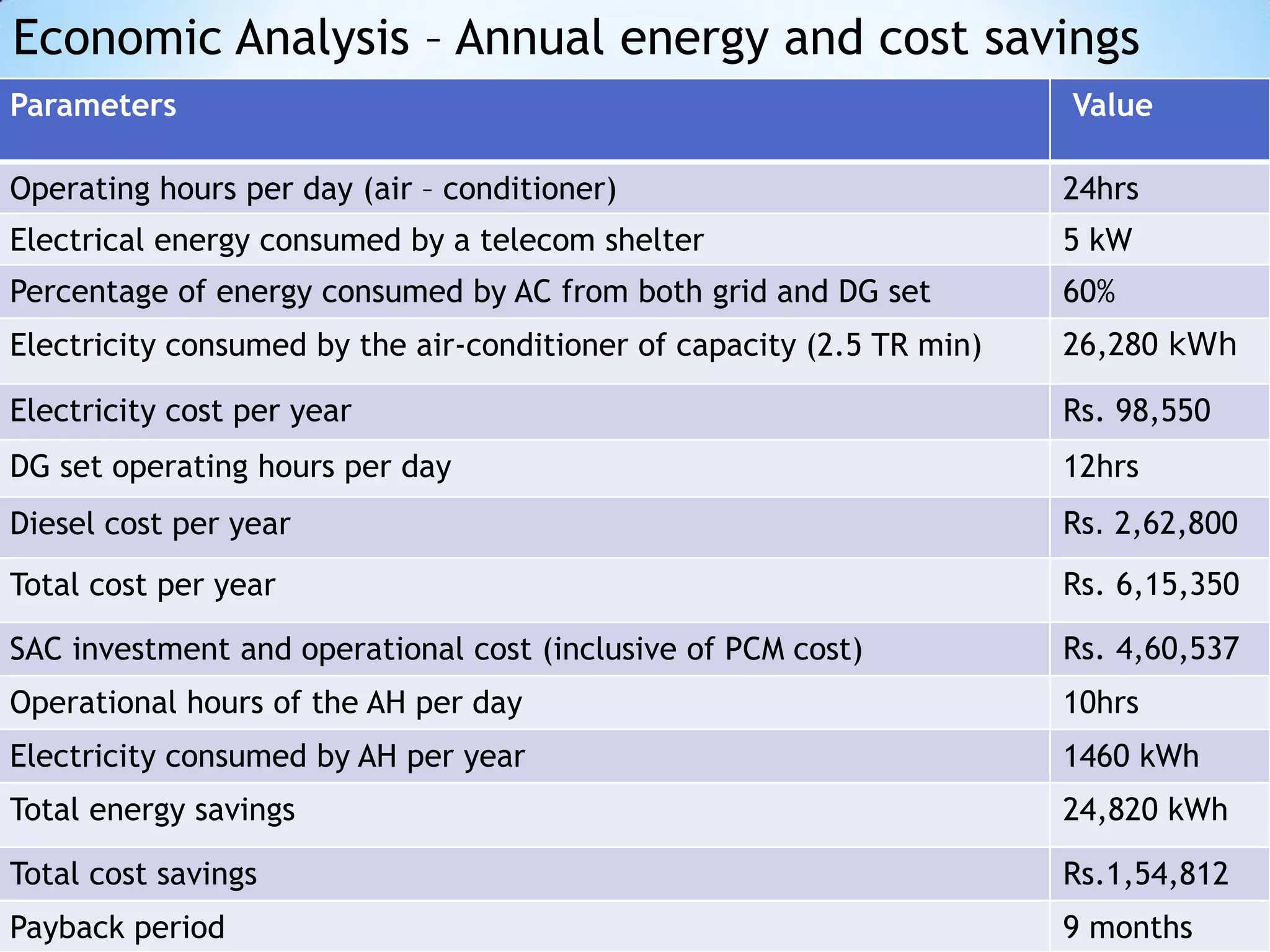
Economic Analysis – Annual energy and cost savings
Parameters                                                             Value

Operating hours per day (air – conditioner)                            24hrs
Electrical energy consumed by a telecom shelter                        5 kW
Percentage of energy consumed by AC from both grid and DG set          60%
Electricity consumed by the air-conditioner of capacity (2.5 TR min)   26,280 kWh

Electricity cost per year                                              Rs. 98,550
DG set operating hours per day                                         12hrs
Diesel cost per year                                                   Rs. 2,62,800
Total cost per year                                                    Rs. 6,15,350

SAC investment and operational cost (inclusive of PCM cost)            Rs. 4,60,537
Operational hours of the AH per day                                    10hrs
Electricity consumed by AH per year                                    1460 kWh
Total energy savings                                                   24,820 kWh

Total cost savings                                                     Rs.1,54,812
Payback period                                                         9 months
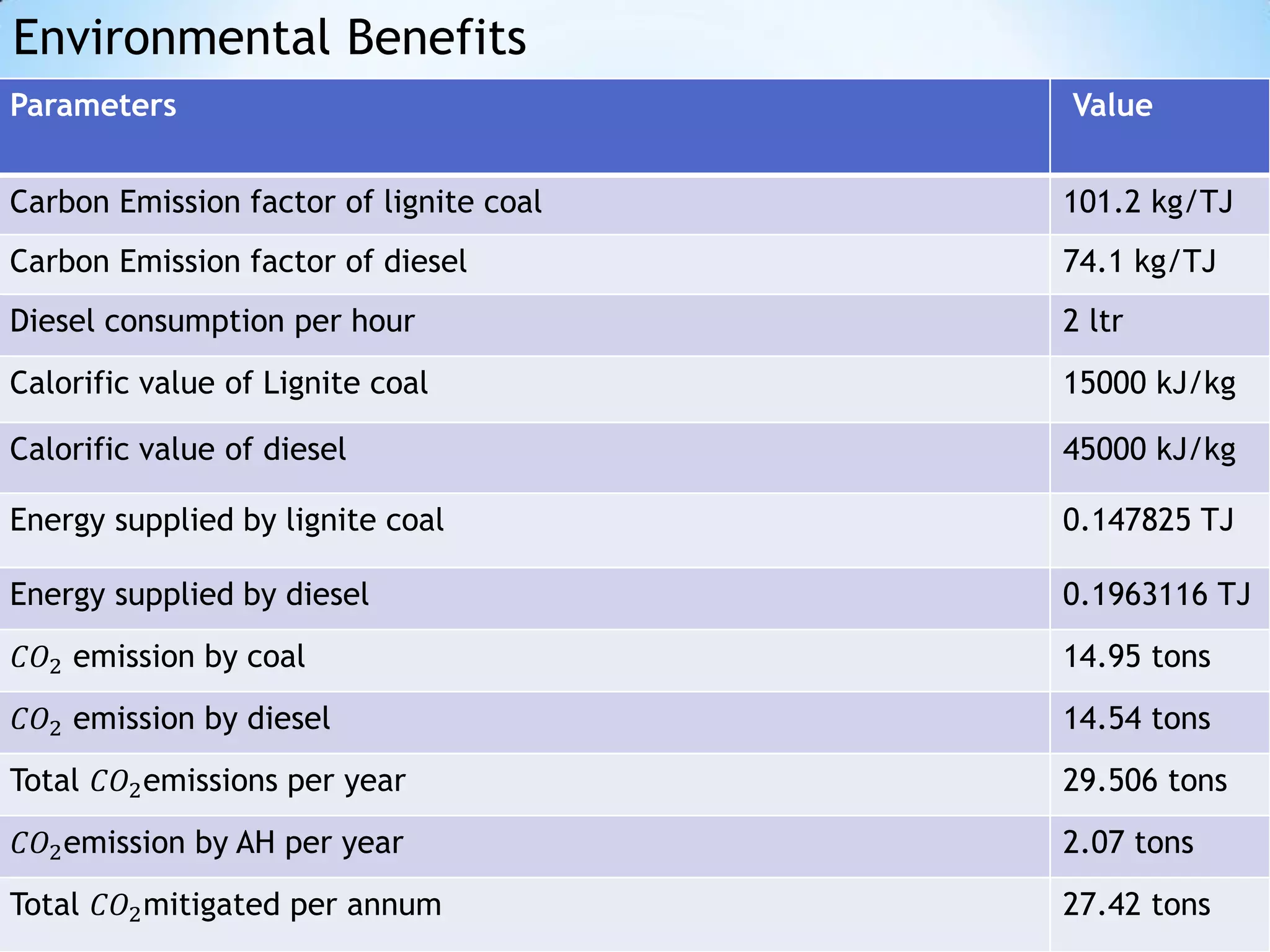
Environmental Benefits
Parameters                               Value


Carbon Emission factor of lignite coal   101.2 kg/TJ
Carbon Emission factor of diesel         74.1 kg/TJ
Diesel consumption per hour              2 ltr
Calorific value of Lignite coal          15000 kJ/kg

Calorific value of diesel                45000 kJ/kg

Energy supplied by lignite coal          0.147825 TJ

Energy supplied by diesel                0.1963116 TJ
𝐶𝑂2 emission by coal                     14.95 tons
𝐶𝑂2 emission by diesel                   14.54 tons
Total 𝐶𝑂2 emissions per year             29.506 tons
𝐶𝑂2 emission by AH per year              2.07 tons
Total 𝐶𝑂2 mitigated per annum            27.42 tons
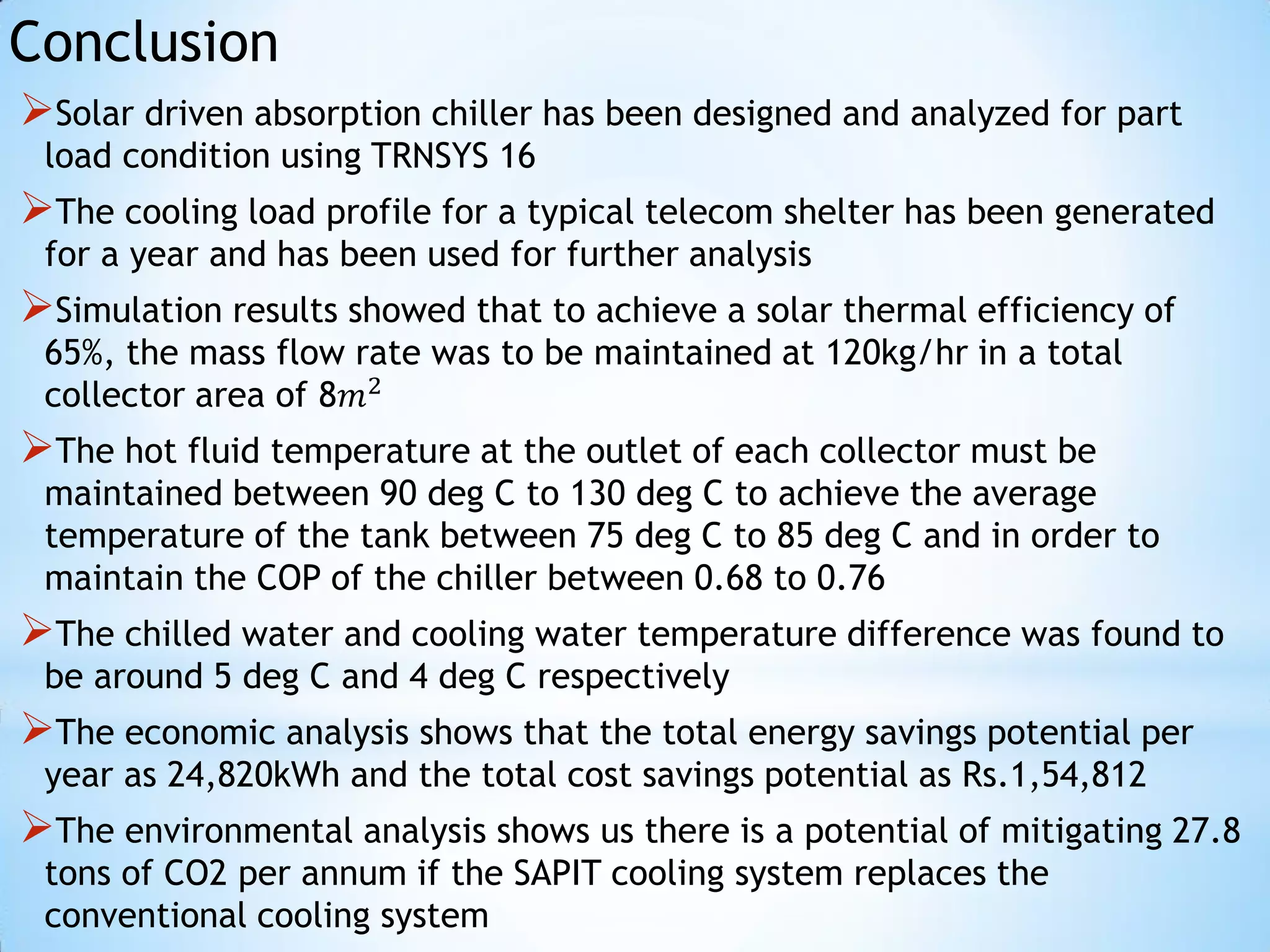
Conclusion
Solar driven absorption chiller has been designed and analyzed for part
 load condition using TRNSYS 16
The cooling load profile for a typical telecom shelter has been generated
 for a year and has been used for further analysis
Simulation results showed that to achieve a solar thermal efficiency of
 65%, the mass flow rate was to be maintained at 120kg/hr in a total
 collector area of 8𝑚2
The hot fluid temperature at the outlet of each collector must be
 maintained between 90 deg C to 130 deg C to achieve the average
 temperature of the tank between 75 deg C to 85 deg C and in order to
 maintain the COP of the chiller between 0.68 to 0.76
The chilled water and cooling water temperature difference was found to
 be around 5 deg C and 4 deg C respectively
The economic analysis shows that the total energy savings potential per
 year as 24,820kWh and the total cost savings potential as Rs.1,54,812
The environmental analysis shows us there is a potential of mitigating 27.8
 tons of CO2 per annum if the SAPIT cooling system replaces the
 conventional cooling system

11 mn01 review 3

  • 1.
    Project Phase –I Review -III Design and Analysis of Solar Absorption Chiller - Phase Change Material Integrated Technology (SAPIT) for cooling telecommunication shelters in India Undertaken by: Anirudh B Mentored by: Dr.R.Velavan 11MN01 Associate Professor School of Energy PG Scholar PSG College of Technology ME Energy Engineering School of Energy PSG College of Technology
  • 2.
    Transient analysis oftelecom shelter using TRNSYS 16 Building simulation wizard
  • 3.
    Theoretical model ofSAC Thermal energy required by the absorption chiller, 𝑄𝑐 𝑄 𝑐ℎ = 𝐶𝑂𝑃 𝑐ℎ Where, 𝐶𝑂𝑃 𝑐ℎ is the coefficient of performance of the absorption chiller which varies with demand is given in a fourth order polynomial for partial load efficiency of absorption chiller, 4 3 2 𝐶𝑂𝑃 𝑐ℎ = 𝑎𝑓𝑐ℎ + 𝑏𝑓𝑐ℎ + 𝑐𝑓𝑐ℎ + 𝑑𝑓𝑐ℎ + 𝑒 Where, a=-2.0821,b=6.2385,c=-7.2852,d=3.8055,e=0.023 Where, 𝑓𝑐ℎ is the ratio of the cooling load and the chiller nominal capacity and given by 𝑄𝑐 𝑓𝑐ℎ = 𝐶𝐻 𝑐𝑎𝑝 Courtesy: N. Fumo, V. Bortone, J. C. Zambrano, “Solar Thermal Driven Cooling System for a Data Center in Albuquerque New Mexico”, Journal of Solar Energy Engineering, ASME(2011)
  • 4.
    Building simulation wizard-Time vs. Cooling load_W
  • 5.
    Building simulation wizard-Time vs. Zone temperature
  • 6.
  • 7.
  • 8.
    Building simulation wizard-Time vs. Required thermal energy
  • 9.
    PCM properties andspecifications Types Properties Value Application Phase change temperature 27 – 29 deg C Operating range 22 – 34 deg C Density 1550 kg/𝑚3 Latent heat 190 kJ/kg Maximum operating 80 deg C temperature HS 29 Quantity per kWh 20 kg Telecom HDPE profile size 840X200X20 mm shelter cooling Maximum amount of heat to 5000 W application be removed Operating hours of PCM 16 hrs Quantity of PCM required 1515 kg No. of panels required 379 panels Courtesy: Pluss polymers Ltd., www.thermalenergystorage.in
  • 10.
    Evacuated tube collector-thermal analysis Solar radiation incident on the tube, 𝐸 𝑖𝑛𝑐𝑖𝑑𝑒𝑛𝑡 = 𝐺𝐴 𝑝𝑜 Where, 𝐺 is the Global horizontal solar radiation on a typical day and 𝐴 𝑝𝑜 is the aperture area of the outer borosilicate tube Solar radiation transmitted through the tube, 𝐸 𝑡𝑟𝑎𝑛𝑠𝑚𝑖𝑡𝑡𝑒𝑑 = 𝐸 𝑖𝑛𝑐𝑖𝑑𝑒𝑛𝑡 𝜏 Where, 𝜏 = 0.92 Useful heat gained by the collector, 𝐸 𝑢 = 𝐸 𝑡𝑟𝑎𝑛𝑠𝑚𝑖𝑡𝑡𝑒𝑑 𝑁 𝑡 Where, 𝑁 𝑡 is the number of tubes in the collector Outlet hot water from the collector is given by, 𝐸 𝑢 = 𝑚ℎ,𝑐𝑜𝑙 𝑐ℎ,𝑐𝑜𝑙 (𝑇ℎ,𝑐𝑜𝑙 − 𝑇 𝑎𝑣𝑔 ) Where, 𝑇 𝑎𝑣𝑔 is the average temperature of the storage tank Courtesy: Siddharth Arora, Shobhit Chitkara, R. Udayakumar, Muhammad Ali, “Thermal analysis of evacuated tube solar collectors”, Journal of Petroleum and Gas Engineering, Vol. 2(4), pg: 74- 82, April 2011
  • 11.
    Transient analysis ofSAC model using TRNSYS 16 TRNSYS Simulation Studio
  • 12.
    Inputs to theSimulation – Evacuated tube solar thermal circuit Parameters Value Number of collectors in series 6 Collector Area 8𝑚2 Transmissivity of the tube 0.92 Absorptivity of the tube 0.04 Outer borosilicate tube diameter 47 mm Length of the evacuated tube 1500 mm Intercept efficiency 0.7 Negative Ist order efficiency coefficient 𝑘𝐽 10 ℎ𝑟.𝑚2 𝐾 Negative 2nd order efficiency coefficient 𝑘𝐽 0.03 ℎ𝑟.𝑚2 𝐾 Hot water pump maximum flow rate 200 kg/hr Maximum power 0.2kW Inlet mass flow rate 120 kg/hr Thermal storage tank volume 1.2 𝑚3 Tank loss coefficient 𝑘𝐽 3 ℎ𝑟.𝑚2 𝐾 Temperature levels used in the tank 6
  • 13.
    Inputs to theSimulation – Chiller hot water circuit components Parameters Value Chiller rated capacity 4TR (14kW) Rated COP 0.8 Hot fluid, chilled water fluid, cooling 4.19 kJ/kg.K water fluid specific heat Chilled water inlet temperature 15.5 deg C Chiller water mass flow rate 2173 kg/hr Cooling water inlet temperature 28 deg C Cooling water mass flow rate 2613 kg/hr Hot water inlet temperature 90 deg C Hot water mass flow rate 3456 kg/hr Chiller set point temperature 10 degC Auxiliary heater maximum capacity 0.5 kW Overall loss coefficient 𝑘𝐽 10 ℎ𝑟.𝑚2 𝐾 Efficiency 0.8 Set point temperature 90 deg C
  • 14.
    Inputs to theSimulation – Chiller cooling water circuit components Parameters Value Cooling tower rated capacity 5TR (17.5kW) Fan power at maximum capacity 0.5 kW Sump volume 1 𝑚3 Initial sump temperature 26 deg C Sump make up temperature 26 deg C Wet bulb temperature 25 deg C Dry bulb temperature 28 deg C Rated flow rate for variable speed pump 700 kg/hr Rated power 0.5 kW Power coefficient 1 Pump efficiency 0.6 Motor efficiency 0.9
  • 15.
    TRNSYS simulation studio– Time vs. Total horizontal global radiation
  • 16.
    TRNSYS simulation studio– Time vs. Total global radiation on the collector surface
  • 17.
    TRNSYS simulation studio– Time vs. global radiation on collector surface on a typical day of January month
  • 18.
    TRNSYS simulation studio– Time vs. global radiation on collector surface on a typical day of April month
  • 19.
    TRNSYS simulation studio– Time vs. global radiation on collector surface on a typical day of July month
  • 20.
    TRNSYS simulation studio– Time vs. global radiation on collector surface on a typical day of December month
  • 21.
    TRNSYS simulation studio– Time vs. Hot water inlet to the collector and tank average temperature
  • 22.
    TRNSYS simulation studio– Time vs. Hot water outlet temperature from the collector
  • 23.
    TRNSYS simulation studio– Time vs. Hot water outlet temperature from the chiller
  • 24.
    Economic Analysis –Equipment and utility cost Parameters Value Conventional air-conditioner 30000 Rs./TR Auxiliary heater 3000 Rs./kW DG set cost (20kVA) 2,15,000 Rs. Hot water fired absorption chiller 50000 Rs./TR (inclusive of cooling tower) Evacuated tube solar collector 12000 Rs./𝑚2 PCM cost 50 Rs./kg Thermal storage tank 7500 Rs./𝑚3 Electricity rate 7.5 Rs./kWh Diesel rate 50 Rs./ltr
  • 25.
    Economic Analysis –Annual energy and cost savings Parameters Value Operating hours per day (air – conditioner) 24hrs Electrical energy consumed by a telecom shelter 5 kW Percentage of energy consumed by AC from both grid and DG set 60% Electricity consumed by the air-conditioner of capacity (2.5 TR min) 26,280 kWh Electricity cost per year Rs. 98,550 DG set operating hours per day 12hrs Diesel cost per year Rs. 2,62,800 Total cost per year Rs. 6,15,350 SAC investment and operational cost (inclusive of PCM cost) Rs. 4,60,537 Operational hours of the AH per day 10hrs Electricity consumed by AH per year 1460 kWh Total energy savings 24,820 kWh Total cost savings Rs.1,54,812 Payback period 9 months
  • 26.
    Environmental Benefits Parameters Value Carbon Emission factor of lignite coal 101.2 kg/TJ Carbon Emission factor of diesel 74.1 kg/TJ Diesel consumption per hour 2 ltr Calorific value of Lignite coal 15000 kJ/kg Calorific value of diesel 45000 kJ/kg Energy supplied by lignite coal 0.147825 TJ Energy supplied by diesel 0.1963116 TJ 𝐶𝑂2 emission by coal 14.95 tons 𝐶𝑂2 emission by diesel 14.54 tons Total 𝐶𝑂2 emissions per year 29.506 tons 𝐶𝑂2 emission by AH per year 2.07 tons Total 𝐶𝑂2 mitigated per annum 27.42 tons
  • 27.
    Conclusion Solar driven absorptionchiller has been designed and analyzed for part load condition using TRNSYS 16 The cooling load profile for a typical telecom shelter has been generated for a year and has been used for further analysis Simulation results showed that to achieve a solar thermal efficiency of 65%, the mass flow rate was to be maintained at 120kg/hr in a total collector area of 8𝑚2 The hot fluid temperature at the outlet of each collector must be maintained between 90 deg C to 130 deg C to achieve the average temperature of the tank between 75 deg C to 85 deg C and in order to maintain the COP of the chiller between 0.68 to 0.76 The chilled water and cooling water temperature difference was found to be around 5 deg C and 4 deg C respectively The economic analysis shows that the total energy savings potential per year as 24,820kWh and the total cost savings potential as Rs.1,54,812 The environmental analysis shows us there is a potential of mitigating 27.8 tons of CO2 per annum if the SAPIT cooling system replaces the conventional cooling system