RABIES
PAPER-203
What is rabies?
• Rabies is a serious illness. By the time the
symptoms of rabies have become apparent, it is
generally too late to save the patient.
• Rabies is a virulent killer that can spread using
any mammal species as a host
• Rabies is a viral infection spread via saliva.
• If someone presents with rabies symptoms, it is
almost always fatal.
• In countries where stray dogs are present in large
numbers, they are the biggest rabies threat.
What is rabies?
• Predominantly, in the US,
rabies is spread by raccoons,
coyotes, bats, skunks and
foxes.
• Bats carrying rabies have been
found in all 48 contiguous
states.
• Dr. Joseph Lennox Pawan first
discovered animal-to-human
transmission of rabies in the
vampire bat in Trinidad in
1932.
• It is now known that any
mammal can harbor and
transmit the virus.
• However, smaller mammals
such as rodents very rarely
become infected or transmit
rabies.
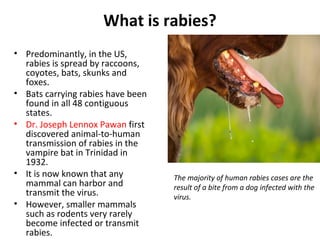
The majority of human rabies cases are the
result of a bite from a dog infected with the
virus.
Symptoms of rabies
• The symptoms of rabies can present themselves just a few days after a
bite, or they might take as long as 12 weeks.
• Some rare cases report a number of years between the bite and the onset
of symptoms.
• The closer the bite is to your brain, the quicker the effects are likely to
appear.
• When the initial symptoms of rabies occur, they can be similar to flu and
last 2-12 days, becoming progressively stronger.
• From the early flu-like symptoms, the condition worsens and symptoms
can include the following:
• Anxiety, Fever, Headache, Nausea, Confusion, Hyperactivity, Excess
salivation, Fear of water (hydrophobia) due to difficulty in swallowing,
Hallucinations, Priapism (permanent erection), Photophobia, Nightmares,
Insomnia, Partial paralysis.
Causes of rabies
• Rabies is a virus and, as mentioned, it  predominantly spreads 
by a bite from an infected animal.
• However, it is also possible to become infected if saliva from 
an infected animal gets into an open wound or through a 
mucous membrane, such as the eyes or mouth.
• Tests and diagnosis of rabies
• At the time of a bite, there is no way to tell for sure whether 
an animal is rabid, or whether it has infected you.
• The doctor will suggest moving straight to treatment; there is 
no benefit in waiting.
Rabies progression
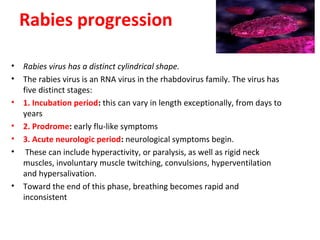
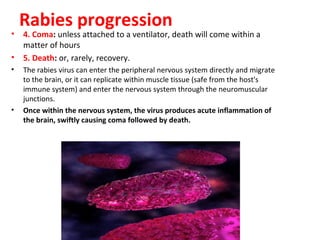
• Rabies virus has a distinct cylindrical shape.
• The rabies virus is an RNA virus in the rhabdovirus family. The virus has 
five distinct stages:
• 1. Incubation period: this can vary in length exceptionally, from days to 
years
• 2. Prodrome: early flu-like symptoms
• 3. Acute neurologic period: neurological symptoms begin.
•  These can include hyperactivity, or paralysis, as well as rigid neck 
muscles, involuntary muscle twitching, convulsions, hyperventilation 
and hypersalivation. 
• Toward the end of this phase, breathing becomes rapid and 
inconsistent
Rabies progression
• 4. Coma: unless attached to a ventilator, death will come within a 
matter of hours
• 5. Death: or, rarely, recovery.
• The rabies virus can enter the peripheral nervous system directly and migrate 
to the brain, or it can replicate within muscle tissue (safe from the host's 
immune system) and enter the nervous system through the neuromuscular 
junctions.
• Once within the nervous system, the virus produces acute inflammation of
the brain, swiftly causing coma followed by death.

Rabies final

  • 1.
  • 2.
    What is rabies? •Rabies is a serious illness. By the time the symptoms of rabies have become apparent, it is generally too late to save the patient. • Rabies is a virulent killer that can spread using any mammal species as a host • Rabies is a viral infection spread via saliva. • If someone presents with rabies symptoms, it is almost always fatal. • In countries where stray dogs are present in large numbers, they are the biggest rabies threat.
  • 3.
    What is rabies? •Predominantly, in the US, rabies is spread by raccoons, coyotes, bats, skunks and foxes. • Bats carrying rabies have been found in all 48 contiguous states. • Dr. Joseph Lennox Pawan first discovered animal-to-human transmission of rabies in the vampire bat in Trinidad in 1932. • It is now known that any mammal can harbor and transmit the virus. • However, smaller mammals such as rodents very rarely become infected or transmit rabies. The majority of human rabies cases are the result of a bite from a dog infected with the virus.
  • 4.
    Symptoms of rabies •The symptoms of rabies can present themselves just a few days after a bite, or they might take as long as 12 weeks. • Some rare cases report a number of years between the bite and the onset of symptoms. • The closer the bite is to your brain, the quicker the effects are likely to appear. • When the initial symptoms of rabies occur, they can be similar to flu and last 2-12 days, becoming progressively stronger. • From the early flu-like symptoms, the condition worsens and symptoms can include the following: • Anxiety, Fever, Headache, Nausea, Confusion, Hyperactivity, Excess salivation, Fear of water (hydrophobia) due to difficulty in swallowing, Hallucinations, Priapism (permanent erection), Photophobia, Nightmares, Insomnia, Partial paralysis.
  • 5.
    Causes of rabies •Rabies is a virus and, as mentioned, it  predominantly spreads  by a bite from an infected animal. • However, it is also possible to become infected if saliva from  an infected animal gets into an open wound or through a  mucous membrane, such as the eyes or mouth. • Tests and diagnosis of rabies • At the time of a bite, there is no way to tell for sure whether  an animal is rabid, or whether it has infected you. • The doctor will suggest moving straight to treatment; there is  no benefit in waiting.
  • 6.
    Rabies progression • Rabiesvirus has a distinct cylindrical shape. • The rabies virus is an RNA virus in the rhabdovirus family. The virus has  five distinct stages: • 1. Incubation period: this can vary in length exceptionally, from days to  years • 2. Prodrome: early flu-like symptoms • 3. Acute neurologic period: neurological symptoms begin. •  These can include hyperactivity, or paralysis, as well as rigid neck  muscles, involuntary muscle twitching, convulsions, hyperventilation  and hypersalivation.  • Toward the end of this phase, breathing becomes rapid and  inconsistent
  • 7.
    Rabies progression • 4.Coma: unless attached to a ventilator, death will come within a  matter of hours • 5. Death: or, rarely, recovery. • The rabies virus can enter the peripheral nervous system directly and migrate  to the brain, or it can replicate within muscle tissue (safe from the host's  immune system) and enter the nervous system through the neuromuscular  junctions. • Once within the nervous system, the virus produces acute inflammation of the brain, swiftly causing coma followed by death.