Rabia Waheed
BS(Zoology)
Dated: 5th May, 2018
SUSTAINABLE
DEVELOPMENT
OF
WILDLIFE
CONTENTS
 Biodiversity
 Types of biodiversity
 Sustainable development
 Inter relation of biodiversity and sustainable development
 Biodiversity is essential for sustainable development
 Wildlife conservation
 Ways of conservation
Sustainable use of Wildlife
 Strategies to follow
 Sustainability goals of organizations
 Bottom line
BIODIVERSITY
WORDHISTORY
Bio- life Diversity- variety
HISTORY
This term biodiversity was first coined by
Lovejoy in 1980.
DEFINITION
The variety and variability of species of
their population the variety of species of their
life forms the diversity of complex
association with species with their interaction
and their ecological process which
influences performance.
As defined in convention on Biodiversity signed
at Rio De Jenerio (Brazil) in 1992;
“Variability among living organism from
all sources including inter-terrestrial, marine
and equatic ecosystem and the ecological
complexes of which the area part, this
include diversity within the species, between
species and of ecosystem”.
The importance of this definition is that it draws
attention to many dimensions of biodiversity. It
explicitly recognizes that every biota can be
characterized by its taxonomic , ecological and
genetic diversity.
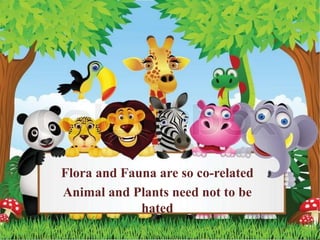
Flora and Fauna are so co-related
Animal and Plants need not to be
hated
TYPES OF BIODIVERSITY
 Species diversity
 Genetic diversity
 Ecosystem diversity
SPECIES DIVERSITY
“Group of individuals which interbreed freely
and produce fertile offspring”.
It refers to the variety of different living things.
The members of same species usually do not breed
with the members of another species. They have
specific characteristics that distinguish them from other
species.
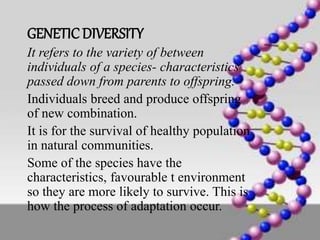
GENETICDIVERSITY
It refers to the variety of between
individuals of a species- characteristics
passed down from parents to offspring.
Individuals breed and produce offspring
of new combination.
It is for the survival of healthy population
in natural communities.
Some of the species have the
characteristics, favourable t environment
so they are more likely to survive. This is
how the process of adaptation occur.
ECOSYSTEMBIODIVERSITY
It refers to the variety of environment produces
by the interplay of the biotic(plants and
animals) and a-biotic(nonliving world; earth
forms, rocks , air and water).
Each ecosystem provides different kind of
habitat. Different species have different role to
play in different ecosystem which help them
maintain their characteristics unique to that
environment.
SUSTAINABLE
DEVELOPMENT
HISTORY
This term was first used by ‘Brunt land
Commission’.
DEFINITION
“The development that meets the
need of present generation without
compromising the ability of future
generations to meet their own needs”.
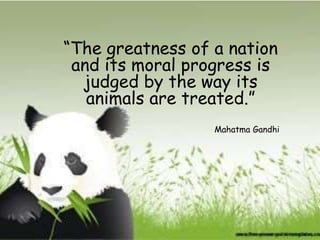
“The greatness of a nation
and its moral progress is
judged by the way its
animals are treated.”
Mahatma Gandhi
INTER-RELATION BETWEEN
BIODIVERSITY AND
SUSTAINABLE
DEVELEOPMENT
Biodiversity is the life
insurance for sustainable
development.
Biodiversity is the foundation upon which
human civilization has been built.
• First, it supports the ecosystem function,
essential for life on earth, such as the provision
of fresh water, soil conservation and climate
stability.
• Second, it provides products such as food,
medicines and materials for industry.
• Finally, it is the heart of many cultural values.
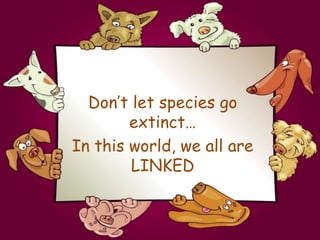
Don’t let species go
extinct…
In this world, we all are
LINKED
BIODIVERSITY IS ESSENTIAL
FOR SUSTAINABLE
DEVELOPMENT
Biodiversity directly supports many
economic activities and jobs in diverse section
such as agriculture, fisheries, forestry,
pharmaceutical, cosmetics, biotechnology etc.
FOOD:
• It depends on biodiversity and the services
provided by ecosystems.
• It is the basis for soil fertility, pollination, pest
control and other aspects for producing world’s
food.
WATER:
• Clean and secure water supplies also depend
on biodiversity.
• Forest protect water supplies, wetlands
regulate flood, healthy soil increase water.
HUMAN HEALTH:
• Biodiversity is essential for the regulation of
immune response.
• It is the basis of traditional medicines,
prescription drugs extracted from animals.
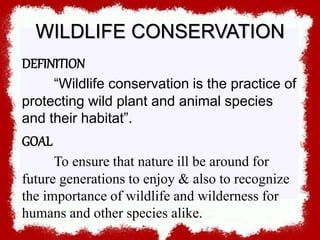
WILDLIFE CONSERVATION
DEFINITION
“Wildlife conservation is the practice of
protecting wild plant and animal species
and their habitat”.
GOAL
To ensure that nature ill be around for
future generations to enjoy & also to recognize
the importance of wildlife and wilderness for
humans and other species alike.
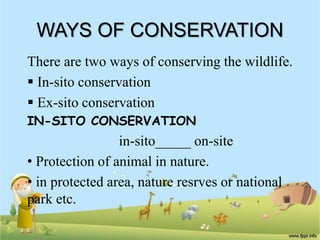
WAYS OF CONSERVATION
There are two ways of conserving the wildlife.
 In-sito conservation
 Ex-sito conservation
IN-SITO CONSERVATION
in-sito_____ on-site
• Protection of animal in nature.
• in protected area, nature resrves or national
park etc.
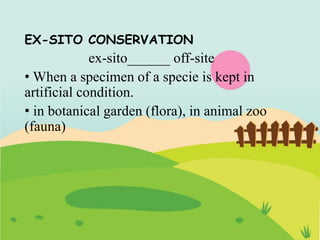
EX-SITO CONSERVATION
ex-sito______ off-site
• When a specimen of a specie is kept in
artificial condition.
• in botanical garden (flora), in animal zoo
(fauna)
SUSTAINABLE USE OF
WILDLIFE
“The use of components of
biodiversity in a way and at a
rate that does not lead to the
long term decline of biological
diversity, thereby maintaining
its potential to meet the needs
and aspirations of future
generations”.
STRATEGIES TO FOLLOW
• Determine the productive capacities of
exploited species and ensure that utilization
does not exceed those capacities.
• Reduce excessive yield to sustainable levels.
• Reduce incidental take as much as possible.
• Maintain the habitat of resource species.
• Regulate international trade in wild plants and
animals
SUSTAINABLITY GOALS OF
ORGANIZATIONS
Many organizations are working on for
sustainable development of wildlife. Some are;
 IUCN
 WWF
 IFAW
AIM OF ORGANIZATIONS
• To maintain essential ecological processes and life
support system
• To preserve genetic material
• To ensure the sustainable utilization of species and
ecosystem
Killing of animal to make a
coat is sin. It wasn’t
meant to be and we have
no right to do it.
BOTTOM LINE
Wildlife is our natural heritage.
It should be conserved with all of its components.
It should be utilized with a sustainable
development because our life is directly
connected with the wildlife.
Thank you!

Wildlife & Sustainable development

  • 1.
  • 2.
  • 3.
    CONTENTS  Biodiversity  Typesof biodiversity  Sustainable development  Inter relation of biodiversity and sustainable development  Biodiversity is essential for sustainable development  Wildlife conservation  Ways of conservation Sustainable use of Wildlife  Strategies to follow  Sustainability goals of organizations  Bottom line
  • 4.
    BIODIVERSITY WORDHISTORY Bio- life Diversity-variety HISTORY This term biodiversity was first coined by Lovejoy in 1980. DEFINITION The variety and variability of species of their population the variety of species of their life forms the diversity of complex association with species with their interaction and their ecological process which influences performance.
  • 5.
    As defined inconvention on Biodiversity signed at Rio De Jenerio (Brazil) in 1992; “Variability among living organism from all sources including inter-terrestrial, marine and equatic ecosystem and the ecological complexes of which the area part, this include diversity within the species, between species and of ecosystem”. The importance of this definition is that it draws attention to many dimensions of biodiversity. It explicitly recognizes that every biota can be characterized by its taxonomic , ecological and genetic diversity.
  • 6.
    Flora and Faunaare so co-related Animal and Plants need not to be hated
  • 7.
    TYPES OF BIODIVERSITY Species diversity  Genetic diversity  Ecosystem diversity SPECIES DIVERSITY “Group of individuals which interbreed freely and produce fertile offspring”. It refers to the variety of different living things. The members of same species usually do not breed with the members of another species. They have specific characteristics that distinguish them from other species.
  • 8.
    GENETICDIVERSITY It refers tothe variety of between individuals of a species- characteristics passed down from parents to offspring. Individuals breed and produce offspring of new combination. It is for the survival of healthy population in natural communities. Some of the species have the characteristics, favourable t environment so they are more likely to survive. This is how the process of adaptation occur.
  • 9.
    ECOSYSTEMBIODIVERSITY It refers tothe variety of environment produces by the interplay of the biotic(plants and animals) and a-biotic(nonliving world; earth forms, rocks , air and water). Each ecosystem provides different kind of habitat. Different species have different role to play in different ecosystem which help them maintain their characteristics unique to that environment.
  • 10.
    SUSTAINABLE DEVELOPMENT HISTORY This term wasfirst used by ‘Brunt land Commission’. DEFINITION “The development that meets the need of present generation without compromising the ability of future generations to meet their own needs”.
  • 11.
    “The greatness ofa nation and its moral progress is judged by the way its animals are treated.” Mahatma Gandhi
  • 12.
    INTER-RELATION BETWEEN BIODIVERSITY AND SUSTAINABLE DEVELEOPMENT Biodiversityis the life insurance for sustainable development. Biodiversity is the foundation upon which human civilization has been built.
  • 13.
    • First, itsupports the ecosystem function, essential for life on earth, such as the provision of fresh water, soil conservation and climate stability. • Second, it provides products such as food, medicines and materials for industry. • Finally, it is the heart of many cultural values.
  • 14.
    Don’t let speciesgo extinct… In this world, we all are LINKED
  • 15.
    BIODIVERSITY IS ESSENTIAL FORSUSTAINABLE DEVELOPMENT Biodiversity directly supports many economic activities and jobs in diverse section such as agriculture, fisheries, forestry, pharmaceutical, cosmetics, biotechnology etc. FOOD: • It depends on biodiversity and the services provided by ecosystems. • It is the basis for soil fertility, pollination, pest control and other aspects for producing world’s food.
  • 16.
    WATER: • Clean andsecure water supplies also depend on biodiversity. • Forest protect water supplies, wetlands regulate flood, healthy soil increase water. HUMAN HEALTH: • Biodiversity is essential for the regulation of immune response. • It is the basis of traditional medicines, prescription drugs extracted from animals.
  • 17.
    WILDLIFE CONSERVATION DEFINITION “Wildlife conservationis the practice of protecting wild plant and animal species and their habitat”. GOAL To ensure that nature ill be around for future generations to enjoy & also to recognize the importance of wildlife and wilderness for humans and other species alike.
  • 19.
    WAYS OF CONSERVATION Thereare two ways of conserving the wildlife.  In-sito conservation  Ex-sito conservation IN-SITO CONSERVATION in-sito_____ on-site • Protection of animal in nature. • in protected area, nature resrves or national park etc.
  • 20.
    EX-SITO CONSERVATION ex-sito______ off-site •When a specimen of a specie is kept in artificial condition. • in botanical garden (flora), in animal zoo (fauna)
  • 21.
    SUSTAINABLE USE OF WILDLIFE “Theuse of components of biodiversity in a way and at a rate that does not lead to the long term decline of biological diversity, thereby maintaining its potential to meet the needs and aspirations of future generations”.
  • 23.
    STRATEGIES TO FOLLOW •Determine the productive capacities of exploited species and ensure that utilization does not exceed those capacities. • Reduce excessive yield to sustainable levels. • Reduce incidental take as much as possible. • Maintain the habitat of resource species. • Regulate international trade in wild plants and animals
  • 25.
    SUSTAINABLITY GOALS OF ORGANIZATIONS Manyorganizations are working on for sustainable development of wildlife. Some are;  IUCN  WWF  IFAW AIM OF ORGANIZATIONS • To maintain essential ecological processes and life support system • To preserve genetic material • To ensure the sustainable utilization of species and ecosystem
  • 26.
    Killing of animalto make a coat is sin. It wasn’t meant to be and we have no right to do it.
  • 27.
    BOTTOM LINE Wildlife isour natural heritage. It should be conserved with all of its components. It should be utilized with a sustainable development because our life is directly connected with the wildlife.
  • 28.