AGENDA
 Introduction
 Kinds of census
 Census methods
 Uses of census
 Report of previous census
 conclusion
 reference
Introduction
what is wildlife census?
“The enumeration or counting of a
particular species in a particular area/habitat
in a particular time as well as dividing them
into age and sex classes etc”.
Kinds of census
 Total count census
 Sample count census
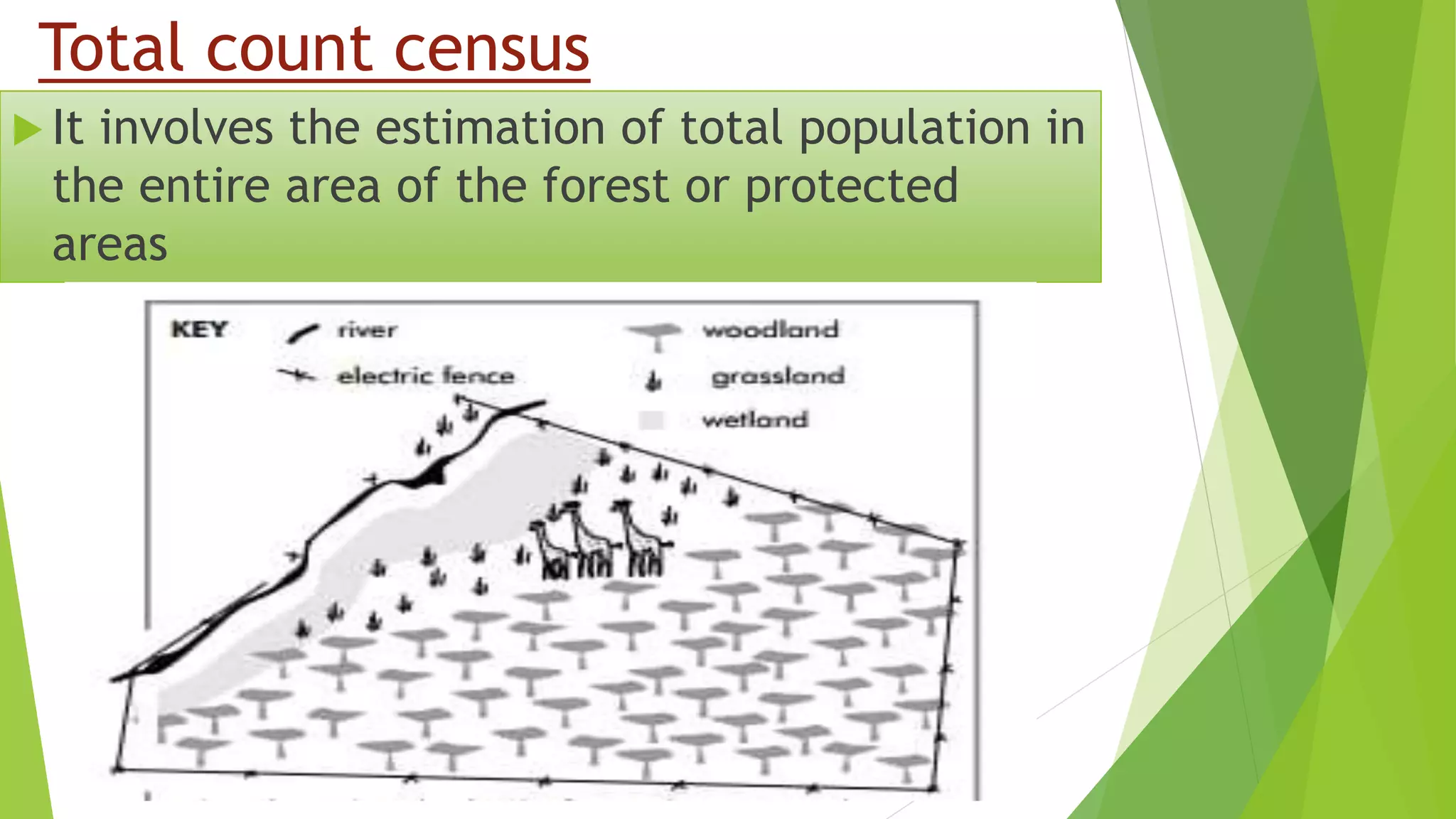
Total count census
 It involves the estimation of total population in
the entire area of the forest or protected
areas
Disadvantages
 It is very difficult process when
practically applying at field
 It covers larger area
 Counting of smaller animal is not
possible
 Time and labour requirement is high
 Interpretation of result is difficult
Sample count census
 It involves the estimation of number of animals
in the entire area within the census units from
the number counted in a smaller area(sample
unit)
Disadvantages
 Chances of personal bias is more
 Counting results may be over or
under estimation in case of wrong
selection of samples
METHODS
1. Road side index survey
2. Dung survey
3. Water hole survey
4. Calls for census
5. Quadrate
6. Distance sampling
8. Pug mark count survey
9. Single team block census
METHODS
10. Beet or line drive count census
11. King census method
12. Sight and resight method
13. Aerial survey
14. Camera spotting method
15. Song tapes
Roadside index survey
This is useful for deer antelope,
goat and sheep. In this surveyor has
to go along the selected path or rows
by motor or walk. The number of
tracks is selected in such way that all
areas are represented properly. The
speed walking should be less than
20km per hour
Dung survey
 In this method, the observer has to recognize
different kinds of dung
 Different dung groups are identified and
seperated
 Sample plots are laid, surveyed and the
results are extraploted
 The main disadvantages is the decay of
dung shortly
Water hole survey
 This is applicable to dry areas where limited water hole is available
 Counting is done from a hided place nearer to the water hole
 First preliminary survey is needed to locate the water hole
 For night time full moon day is preferable
 In this, the observer should have the ability to
recognize a different calls made by different animals
Calls for census
Quadrate method
 Sampling area is divided into small called
quadrate.
 Suitable for sampling plants, slow moving
animals and some aquatic organisms
Distance sampling
It is a widely-used group of closely related
methods for estimating the density and/or abundance
of biological populations. The main methods are
 Line transect
a series of straight lines(track lines) is traversed
by an observer. This may be achieved in various ways,
depending on the study species
 Point transect
in this method points are selected randomly and
count number of organism present at each point from
this number the population size is estimated.
Pug mark count
 This is useful for large carnivores animals such as tiger, lion
etc.
 Here, observer should have the ability to recognize pug
marks of different animal
 In this, a sample block is systematically covered
by a group of people by walking along a line
Beet or line drive count census
Single team block census
In this sample counts are taken by actual sighting
The area of sample block should be 2 km
King census method
It is simple, flexible, unbiased and useful for all
terrain conditions
In this, a detailed transect is laid over the entire area
The length of transect should not be more than 10 km
Camera spotting method
Camera types
 Infra red camera
animal friendly, take continuous shoot and produce black and
white image.
 Digital flash camera
provide colour images, not animal friendly(animals are terrified
by flash)
types
 Active camera type
noted only motion of animal.
 Passive camera type
noted motion as well as stripes.
Song tapes
 This method is suitable for sensitive birds
Digital flash Infra red
Status of tiger In India
By virtue of being the top predator, the tiger functions
as an umbrella species for the conservation of biodiversity,
ecosystem functions, goods, and services in forest system of
Asia.
double sampling approach is used
First component
 Ground surveys of all potential tiger
Second component
 Camera trapping and recapture techniques
 Line transect based distance sampling
conclusion
By census we can able to know the status of an
organism, habitat distribution, reproductive behaviour
and number. Based on the status different conservation
strategies are used
It helps to the conservation of wildlife
THANK YOU

Wild life census kinds and methods copy

  • 2.
    AGENDA  Introduction  Kindsof census  Census methods  Uses of census  Report of previous census  conclusion  reference
  • 3.
    Introduction what is wildlifecensus? “The enumeration or counting of a particular species in a particular area/habitat in a particular time as well as dividing them into age and sex classes etc”.
  • 4.
    Kinds of census Total count census  Sample count census
  • 5.
    Total count census It involves the estimation of total population in the entire area of the forest or protected areas
  • 6.
    Disadvantages  It isvery difficult process when practically applying at field  It covers larger area  Counting of smaller animal is not possible  Time and labour requirement is high  Interpretation of result is difficult
  • 7.
    Sample count census It involves the estimation of number of animals in the entire area within the census units from the number counted in a smaller area(sample unit)
  • 8.
    Disadvantages  Chances ofpersonal bias is more  Counting results may be over or under estimation in case of wrong selection of samples
  • 9.
    METHODS 1. Road sideindex survey 2. Dung survey 3. Water hole survey 4. Calls for census 5. Quadrate 6. Distance sampling 8. Pug mark count survey 9. Single team block census
  • 10.
    METHODS 10. Beet orline drive count census 11. King census method 12. Sight and resight method 13. Aerial survey 14. Camera spotting method 15. Song tapes
  • 11.
    Roadside index survey Thisis useful for deer antelope, goat and sheep. In this surveyor has to go along the selected path or rows by motor or walk. The number of tracks is selected in such way that all areas are represented properly. The speed walking should be less than 20km per hour
  • 12.
    Dung survey  Inthis method, the observer has to recognize different kinds of dung  Different dung groups are identified and seperated
  • 13.
     Sample plotsare laid, surveyed and the results are extraploted  The main disadvantages is the decay of dung shortly
  • 14.
    Water hole survey This is applicable to dry areas where limited water hole is available  Counting is done from a hided place nearer to the water hole  First preliminary survey is needed to locate the water hole  For night time full moon day is preferable
  • 15.
     In this,the observer should have the ability to recognize a different calls made by different animals Calls for census
  • 16.
    Quadrate method  Samplingarea is divided into small called quadrate.  Suitable for sampling plants, slow moving animals and some aquatic organisms
  • 17.
    Distance sampling It isa widely-used group of closely related methods for estimating the density and/or abundance of biological populations. The main methods are  Line transect a series of straight lines(track lines) is traversed by an observer. This may be achieved in various ways, depending on the study species  Point transect in this method points are selected randomly and count number of organism present at each point from this number the population size is estimated.
  • 19.
    Pug mark count This is useful for large carnivores animals such as tiger, lion etc.  Here, observer should have the ability to recognize pug marks of different animal
  • 20.
     In this,a sample block is systematically covered by a group of people by walking along a line Beet or line drive count census Single team block census In this sample counts are taken by actual sighting The area of sample block should be 2 km
  • 21.
    King census method Itis simple, flexible, unbiased and useful for all terrain conditions In this, a detailed transect is laid over the entire area The length of transect should not be more than 10 km
  • 22.
  • 23.
    Camera types  Infrared camera animal friendly, take continuous shoot and produce black and white image.  Digital flash camera provide colour images, not animal friendly(animals are terrified by flash) types  Active camera type noted only motion of animal.  Passive camera type noted motion as well as stripes.
  • 24.
    Song tapes  Thismethod is suitable for sensitive birds Digital flash Infra red
  • 25.
    Status of tigerIn India By virtue of being the top predator, the tiger functions as an umbrella species for the conservation of biodiversity, ecosystem functions, goods, and services in forest system of Asia. double sampling approach is used First component  Ground surveys of all potential tiger Second component  Camera trapping and recapture techniques  Line transect based distance sampling
  • 27.
    conclusion By census wecan able to know the status of an organism, habitat distribution, reproductive behaviour and number. Based on the status different conservation strategies are used It helps to the conservation of wildlife
  • 28.