TECHNIQUES OFANIMAL TRACKING
PREPARED BY QANDEEL ALAM COURSE INSTRUCTOR GGDC NSR
<ANIMAL TRACKING>
In past track wildlife was to simply follow and observe the movement and
habits of an animal or to capture an animal and put a tag on it Today,
scientists have new tools to help them determine how animals move and how
they use their environment.
TYPES
1. Ground tracking
2. Aerial tracking
TRACKING WITH TECHNOLOGY
• Radio tracking technology can help determine exactly where an animal
is at any moment in time and often what that animal is doing! Using
the data collected from tracking devices, scientists can determine the
day-to-day movements of an animal, the size of an animal's home
range, what other animals share an animal's range and the types of
habitats an animal uses. By analyzing all this data, scientists can learn
new ways to help control animal populations, determine what impact
development might have on an animal population, and determine if
there are enough individuals of a particular species in an area to allow
for reproduction.
TYPES OF RADIO TRACKING SYSTEMS
three types
1. VHF Radio Tracking,
2. Satellite Tracking
3. Global Positioning
System (GPS) Tracking.
!
VHF RADIO TRACKING
• a radio transmitter is placed on the animal. Usually, the animal is first
sedated. While the animal is asleep, the scientists gather information
about the health and condition of the animal.
• Once the radio transmitter is placed on the animal, it begins
transmitting a signal to a radio antenna and receiver. In order to locate
an animal using VHF radio tracking, scientists must be close enough to
the animal with the radio antenna so they can pick up the signal from
the radio transmitter on the animal
• Radio transmitters used to be fairly large and were only used on larger
animals, but improvements in technology have allowed scientists to
create much smaller transmitters that can be attached to small
animals. They even make transmitters that can be swallowed by an
animal or placed under an animal's skin!
• Satellite tracking is similar to VHF radio tracking, but instead of a radio
signal being sent to a radio receiver a signal is sent to a satellite. With
satellite tracking, scientists don't have to be near the animal to pick up
its signal. They can track the animal using a computer
2. SATELLITE TRACKING
• GPS tracking is the newest technology being used to track wildlife. In
GPS tracking, a radio receiver, not a transmitter, is placed on the
animal. The radio receiver picks up signals from special satellites. The
receiver has a computer that then calculates the location and
movement of the animal. The data gathered by the receiver is then
sent to another set of satellites. The second set of satellites then sends
the data to the scientists.
GPS TRACKING GLOBAL POSITIONING SYSTEM
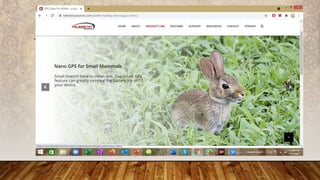
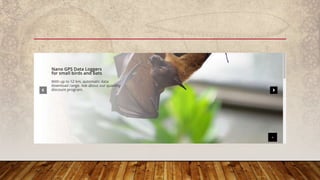
• now GPS receivers that are solar powered and small enough to attach
to a bird
• A GPS tag calculates the location of an animal at specific time intervals using positions estimated
by a network of satellites. These locations can be stored on-board the tag or transmitted to the user
through a communication network (for example, Argos satellites or the GSM network) or through
wireless downloads from a custom base station. These tags can provide high-resolution and accurate
(within meters) location estimations for animals. However, these tags are relatively expensive and
heavy, and so are usually limited to larger animals and require a large research budget if many
animals will be tagged.
• Advanced Research and Global Observation Satellite collects data for
environmental applications: animal tracking, oceanography, meteorology,
climatology
• Global System for Mobile Communications (GSM)
protocols for second-generation (2G) digital cellular networks
ARGOS SATELLITE SYSTEM
• GPS
• Argos Doppler
• Radio telemetry
• Acoustic telemetry
• Geolocation
• Banding or ringing
• Bio-logging
COMMONLY USED METHODS FOR TRACKING ANIMALS
• Argos Doppler tags (known as platform transmitter terminals, or PTTs) are electronic tags that send
periodic signals to Argos transmitters on polar-orbiting satellites. Receiving stations located around
the globe collect the data from the satellites and send it to a processing center. The location
estimates are less accurate (within kilometers) than those made with a GPS, but the tags can be
cheaper and lighter than GPS units and can also be used to remotely transmit GPS locations if the
tag is properly equipped and allow for location measurements from anywhere on the globe.
ARGOS DOPPLER
• Radio transmitters are electronic tags that emit a very high radio frequency signal that can be used
to locate the animal. The researcher must track the signal using a receiver and directional antennae,
which must typically be within a few kilometers or less of the animal to detect the signal. The signal
can be tracked by foot, car or plane, or using one or more stationary receiver arrays. The tags are
relatively lightweight, inexpensive and can have long battery lives. However, it can be labor-
intensive to follow the animals with the receiver. This method can be used on small animals for
populations that stay within a geographically restricted area. Some groups, such as the Motus
Wildlife Tracking System, run networks of receiver stations that can track long-distance movements
of animals too small to hold a PTT or GPS tag.
RADIO TELEMETRY
• Acoustic tags emit sounds that are received by underwater hydrophone receivers. Using mobile
receivers or stationary receiver , researchers can monitor the presence, location and movements of
fish and other animals in marine and freshwater systems. Monitoring long-distance movements
requires communication between the tag owner (who knows the species and details of the animal
the tag is deployed on) and the receiver owner (who knows the time and place at which the tag was
detected). Collaborative groups and monitoring systems support regional (Great Lakes Acoustic
Telemetry Observation System) and global (Ocean Tracking Network) animal tracking using
acoustic telemetry.
ACOUSTIC TELEMETRY
• The tagged animal must be recaptured, and the tag removed to access the data. The light level
information is used to estimate sunrise and sunset times, which are used to estimate the movement
of the animal. These tags can be lightweight and are relatively inexpensive and provide the only
available method for tracking movements of some smaller migrating animals as well as many
marine species that spend most of their time below the ocean surface where they cannot be tracked
by satellites or radio receivers. However, the location estimates can have very large errors, which
vary depending on the time of year and location of the animal
GEOLOCATION
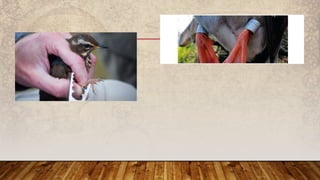
• A band or ring is a physical tag with a unique code or number is attached to the animal. To record
movement, the individual must be seen or caught again, . These tags contain no electronic
components and are most used on birds. They are lightweight, very inexpensive and can be
attached by trained volunteers, meaning that large numbers of animals can be tagged. Because most
of these animals are not caught again, however, only a small percentage of these tags result in
movement data, and most of the movement data include only two locations per animal. Bird
banding programs have been in operation since the early 1900s, and so large long-term datasets are
available for this type of tracking.
BANDING OR RINGING
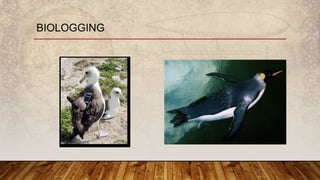
• Bio-logging, or biotelemetry, refers broadly to the collection of data using on-animal sensors. These
sensors can collect a range of information about animals' location and movements as well as
behavior (for example using accelerometers or cameras), physiology (for example by measuring
heart rate or internal temperature) and surrounding environment (for example by monitoring
salinity).
BIO-LOGGING
BIOLOGGING
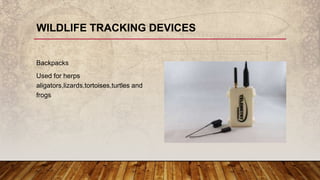
Backpacks
Used for herps
aligators,lizards,tortoises,turtles and
frogs
WILDLIFE TRACKING DEVICES
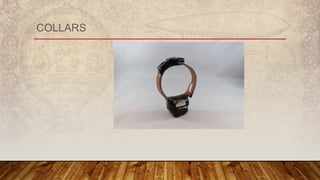
COLLARS
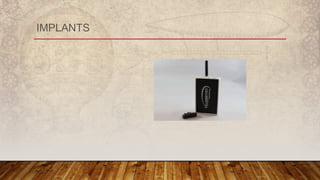
IMPLANTS
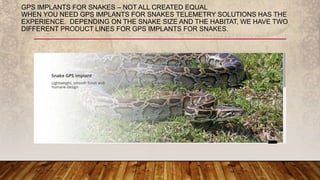
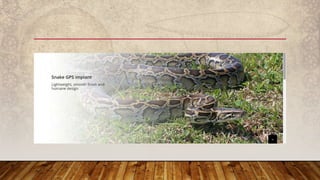
GPS IMPLANTS FOR SNAKES – NOT ALL CREATED EQUAL
WHEN YOU NEED GPS IMPLANTS FOR SNAKES TELEMETRY SOLUTIONS HAS THE
EXPERIENCE. DEPENDING ON THE SNAKE SIZE AND THE HABITAT, WE HAVE TWO
DIFFERENT PRODUCT LINES FOR GPS IMPLANTS FOR SNAKES.
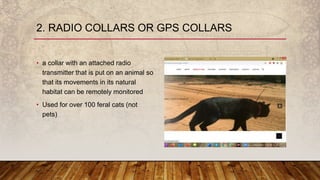
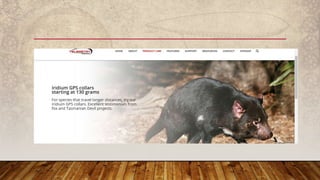
• a collar with an attached radio
transmitter that is put on an animal so
that its movements in its natural
habitat can be remotely monitored
• Used for over 100 feral cats (not
pets)
2. RADIO COLLARS OR GPS COLLARS
• GPS Tracking
• Radio tracking
• Drone (radio signals)
• Aerial Automated Animal Tracking via Artificial Intelligence
• drone technology for monitoring wildlife
• Wildlife drones
• Seaturtles hatching tags
• Motus Wildlife Tracking System, run networks of receiver stations that can track long-distance
2.AERIAL TRACKING
• Aerial robots, artificial intelligence and statistics revolutionize wildlife tracking and research
• Birds tracking now done by using tiny tracking devices and network of 100s of receiving stations it
can safely track bird's movement over vast distances
• Attaching a Marshall GPS to your parrot
• Some birds GPS attached on back like eagle and in some birds its attached-on tail like parrots or
GPS is tied with its limbs
• Monarch Butterflies Get Tiny Radio Trackers

Techniques of animal tracking

  • 1.
    TECHNIQUES OFANIMAL TRACKING PREPAREDBY QANDEEL ALAM COURSE INSTRUCTOR GGDC NSR
  • 2.
    <ANIMAL TRACKING> In pasttrack wildlife was to simply follow and observe the movement and habits of an animal or to capture an animal and put a tag on it Today, scientists have new tools to help them determine how animals move and how they use their environment.
  • 3.
  • 4.
    TRACKING WITH TECHNOLOGY •Radio tracking technology can help determine exactly where an animal is at any moment in time and often what that animal is doing! Using the data collected from tracking devices, scientists can determine the day-to-day movements of an animal, the size of an animal's home range, what other animals share an animal's range and the types of habitats an animal uses. By analyzing all this data, scientists can learn new ways to help control animal populations, determine what impact development might have on an animal population, and determine if there are enough individuals of a particular species in an area to allow for reproduction.
  • 5.
    TYPES OF RADIOTRACKING SYSTEMS three types 1. VHF Radio Tracking, 2. Satellite Tracking 3. Global Positioning System (GPS) Tracking. !
  • 6.
    VHF RADIO TRACKING •a radio transmitter is placed on the animal. Usually, the animal is first sedated. While the animal is asleep, the scientists gather information about the health and condition of the animal.
  • 7.
    • Once theradio transmitter is placed on the animal, it begins transmitting a signal to a radio antenna and receiver. In order to locate an animal using VHF radio tracking, scientists must be close enough to the animal with the radio antenna so they can pick up the signal from the radio transmitter on the animal
  • 8.
    • Radio transmittersused to be fairly large and were only used on larger animals, but improvements in technology have allowed scientists to create much smaller transmitters that can be attached to small animals. They even make transmitters that can be swallowed by an animal or placed under an animal's skin!
  • 9.
    • Satellite trackingis similar to VHF radio tracking, but instead of a radio signal being sent to a radio receiver a signal is sent to a satellite. With satellite tracking, scientists don't have to be near the animal to pick up its signal. They can track the animal using a computer 2. SATELLITE TRACKING
  • 10.
    • GPS trackingis the newest technology being used to track wildlife. In GPS tracking, a radio receiver, not a transmitter, is placed on the animal. The radio receiver picks up signals from special satellites. The receiver has a computer that then calculates the location and movement of the animal. The data gathered by the receiver is then sent to another set of satellites. The second set of satellites then sends the data to the scientists. GPS TRACKING GLOBAL POSITIONING SYSTEM
  • 11.
    • now GPSreceivers that are solar powered and small enough to attach to a bird • A GPS tag calculates the location of an animal at specific time intervals using positions estimated by a network of satellites. These locations can be stored on-board the tag or transmitted to the user through a communication network (for example, Argos satellites or the GSM network) or through wireless downloads from a custom base station. These tags can provide high-resolution and accurate (within meters) location estimations for animals. However, these tags are relatively expensive and heavy, and so are usually limited to larger animals and require a large research budget if many animals will be tagged.
  • 12.
    • Advanced Researchand Global Observation Satellite collects data for environmental applications: animal tracking, oceanography, meteorology, climatology • Global System for Mobile Communications (GSM) protocols for second-generation (2G) digital cellular networks ARGOS SATELLITE SYSTEM
  • 13.
    • GPS • ArgosDoppler • Radio telemetry • Acoustic telemetry • Geolocation • Banding or ringing • Bio-logging COMMONLY USED METHODS FOR TRACKING ANIMALS
  • 14.
    • Argos Dopplertags (known as platform transmitter terminals, or PTTs) are electronic tags that send periodic signals to Argos transmitters on polar-orbiting satellites. Receiving stations located around the globe collect the data from the satellites and send it to a processing center. The location estimates are less accurate (within kilometers) than those made with a GPS, but the tags can be cheaper and lighter than GPS units and can also be used to remotely transmit GPS locations if the tag is properly equipped and allow for location measurements from anywhere on the globe. ARGOS DOPPLER
  • 15.
    • Radio transmittersare electronic tags that emit a very high radio frequency signal that can be used to locate the animal. The researcher must track the signal using a receiver and directional antennae, which must typically be within a few kilometers or less of the animal to detect the signal. The signal can be tracked by foot, car or plane, or using one or more stationary receiver arrays. The tags are relatively lightweight, inexpensive and can have long battery lives. However, it can be labor- intensive to follow the animals with the receiver. This method can be used on small animals for populations that stay within a geographically restricted area. Some groups, such as the Motus Wildlife Tracking System, run networks of receiver stations that can track long-distance movements of animals too small to hold a PTT or GPS tag. RADIO TELEMETRY
  • 16.
    • Acoustic tagsemit sounds that are received by underwater hydrophone receivers. Using mobile receivers or stationary receiver , researchers can monitor the presence, location and movements of fish and other animals in marine and freshwater systems. Monitoring long-distance movements requires communication between the tag owner (who knows the species and details of the animal the tag is deployed on) and the receiver owner (who knows the time and place at which the tag was detected). Collaborative groups and monitoring systems support regional (Great Lakes Acoustic Telemetry Observation System) and global (Ocean Tracking Network) animal tracking using acoustic telemetry. ACOUSTIC TELEMETRY
  • 17.
    • The taggedanimal must be recaptured, and the tag removed to access the data. The light level information is used to estimate sunrise and sunset times, which are used to estimate the movement of the animal. These tags can be lightweight and are relatively inexpensive and provide the only available method for tracking movements of some smaller migrating animals as well as many marine species that spend most of their time below the ocean surface where they cannot be tracked by satellites or radio receivers. However, the location estimates can have very large errors, which vary depending on the time of year and location of the animal GEOLOCATION
  • 19.
    • A bandor ring is a physical tag with a unique code or number is attached to the animal. To record movement, the individual must be seen or caught again, . These tags contain no electronic components and are most used on birds. They are lightweight, very inexpensive and can be attached by trained volunteers, meaning that large numbers of animals can be tagged. Because most of these animals are not caught again, however, only a small percentage of these tags result in movement data, and most of the movement data include only two locations per animal. Bird banding programs have been in operation since the early 1900s, and so large long-term datasets are available for this type of tracking. BANDING OR RINGING
  • 20.
    • Bio-logging, orbiotelemetry, refers broadly to the collection of data using on-animal sensors. These sensors can collect a range of information about animals' location and movements as well as behavior (for example using accelerometers or cameras), physiology (for example by measuring heart rate or internal temperature) and surrounding environment (for example by monitoring salinity). BIO-LOGGING
  • 21.
  • 22.
  • 23.
  • 24.
  • 25.
    GPS IMPLANTS FORSNAKES – NOT ALL CREATED EQUAL WHEN YOU NEED GPS IMPLANTS FOR SNAKES TELEMETRY SOLUTIONS HAS THE EXPERIENCE. DEPENDING ON THE SNAKE SIZE AND THE HABITAT, WE HAVE TWO DIFFERENT PRODUCT LINES FOR GPS IMPLANTS FOR SNAKES.
  • 26.
    • a collarwith an attached radio transmitter that is put on an animal so that its movements in its natural habitat can be remotely monitored • Used for over 100 feral cats (not pets) 2. RADIO COLLARS OR GPS COLLARS
  • 32.
    • GPS Tracking •Radio tracking • Drone (radio signals) • Aerial Automated Animal Tracking via Artificial Intelligence • drone technology for monitoring wildlife • Wildlife drones • Seaturtles hatching tags • Motus Wildlife Tracking System, run networks of receiver stations that can track long-distance 2.AERIAL TRACKING
  • 33.
    • Aerial robots,artificial intelligence and statistics revolutionize wildlife tracking and research • Birds tracking now done by using tiny tracking devices and network of 100s of receiving stations it can safely track bird's movement over vast distances • Attaching a Marshall GPS to your parrot • Some birds GPS attached on back like eagle and in some birds its attached-on tail like parrots or GPS is tied with its limbs • Monarch Butterflies Get Tiny Radio Trackers