The role of the census in
public policy-making:
information practices of policy
makers
Lynn Killick, Prof Alistair Duff, Prof Hazel
Hall & Prof Mark Deakin
@sherpalynn @ingsocproject
The role of the census in
public policy-making:
information practices of policy
makers
@sherpalynn
So why the census?
• The ‘foundation’ for government
statistics
• The ‘anchor’ to compare other data
sources against
And who are the policy makers?
• Regulators
• Politicians
• Council Officials
• Civil Servants
• Non-executives
• Third sector workers
approach
Content Analysis
• Longitudinal analysis of
policy documents
• First phase complete,
documents published by
Scottish Government for
2014
• Next phase will apply
coding schedule to 2015
documents
• Using NVivo
Semi-structured interviews
• Interviews not yet complete
• 19 concluded to date
covering all target areas
• Emerging results at this
stage
Which documents?
• Equality Impact Assessments (EQIA’s)
– Documents that public bodies must publish
– Relate to any policy decision
– Should detail all evidence consulted
– Should detail any detrimental impact or
positive impact
• Scottish Government EQIA’s reviewed
approach
Caveats
• The census not always
an appropriate evidence
source
• Unlikely to be the only
source of evidence
• First 2011 Census results
released in December
2013
Results
• Few documents made
reference to the census
• One document referred to a
specific statistic emerging
from the census
• No evidence derived from
small area data was referred
to or mentioned directly
approach
• References to the census
appeared to be a caught
in a general statement
• No confidence that
census data beyond the
national headlines is
accessed
• Not all policy decisions need
census data
• Not all relevant reports
would be available
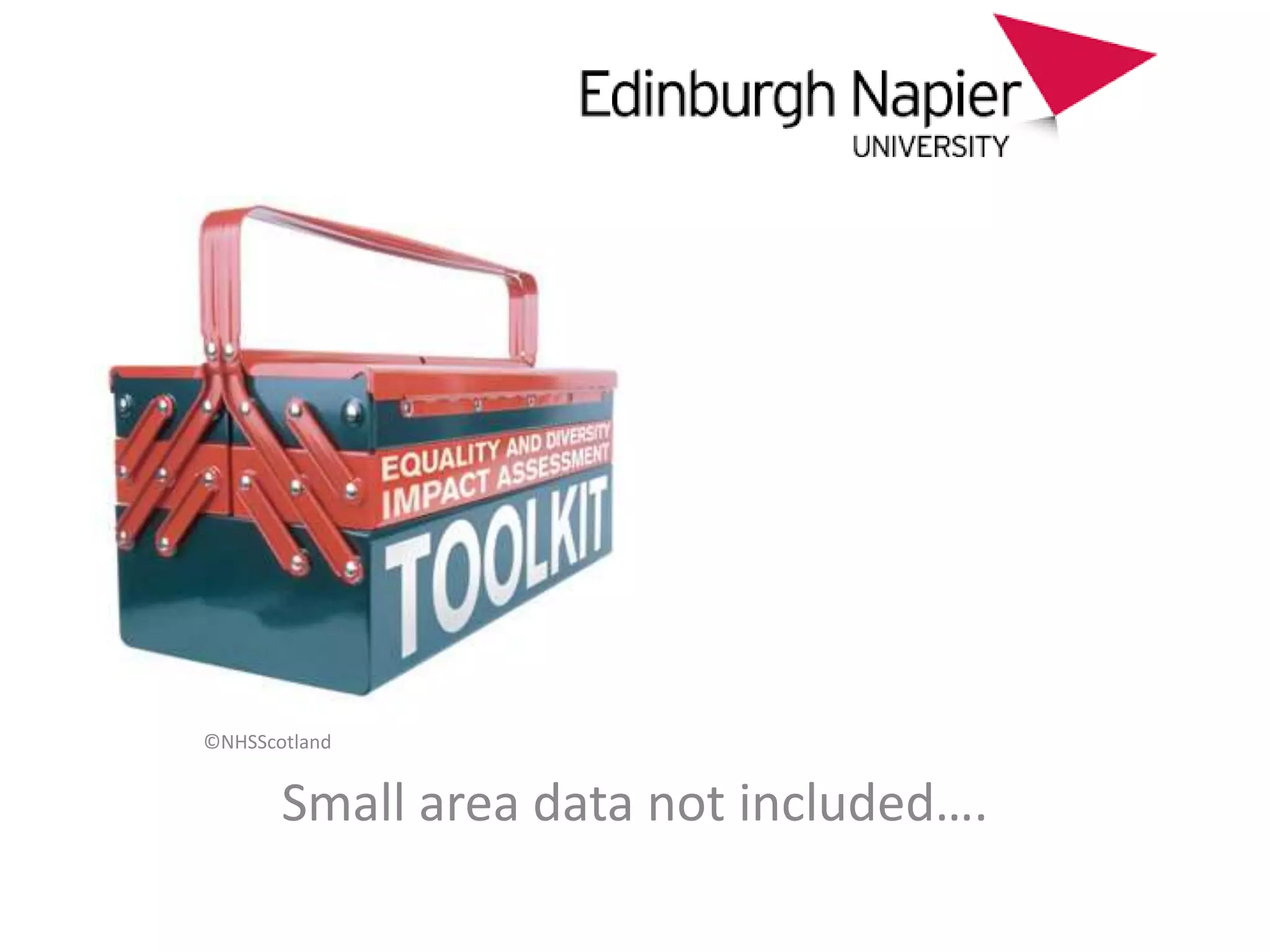
©NHSScotland
Small area data not included….
approach
Interviews
• Recorded using iPad x 2
• Transcribed using Nvivo
• Average length of
interview 45 minutes
• Confidentiality key – If
Edinburgh is a village,
Scotland is a very small
town
• First interview February
• Last interview?
Without it we couldn’t
demonstrate we were
doing our job… it is our
only measure of
progress
I’ve never been asked
for more detailed
information
Those assessments?,
they are a bit of pain
to be honest
approach
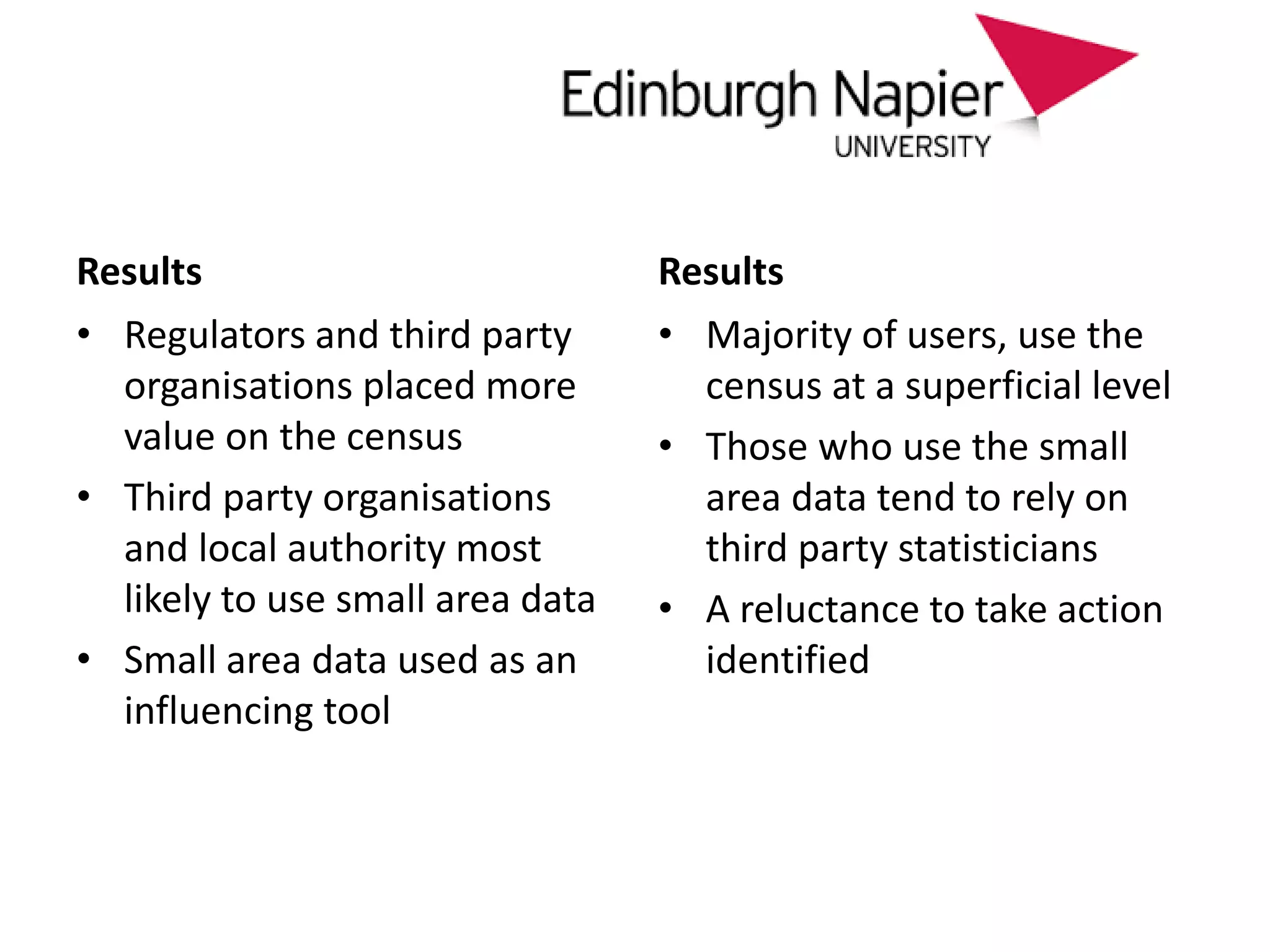
Results Results
• Majority of users, use the
census at a superficial level
• Those who use the small
area data tend to rely on
third party statisticians
• A reluctance to take action
identified
• Regulators and third party
organisations placed more
value on the census
• Third party organisations
and local authority most
likely to use small area data
• Small area data used as an
influencing tool
Key findings
The data is difficult to navigate – easy
to look at top level information
The place of census data as a
benchmark/foundation is accepted
Concerns that other initiatives
(PREVENT) will affect the census and
in turn the use of census data
Policy makers lack the ????? to apply
census data to their work
References
Baffour, B., King, T., & Valente, P. (2013). The modern census: evolution, examples and evaluation.
International Statistical Review, 81(3), 407–425. doi:10.1111/insr.12036
Boyle, P., & Dorling, D. (2004). Guest editorial: the 2001 UK census: remarkable resource or bygone
legacy of the “pencil and paper era”? Area, 36, 101–110. doi:10.1111/j.0004-0894.2004.00207.x
The Cabinet Office, HM Government (2012). The Civil Service Reform Plan Retrieved from
https://www.gov.uk/government/uploads/system/uploads/attachment_data/file/305148/Civil-
Service-Reform-Plan-final.pdf
Chertov, O., & Aleksandrova, M. (2013). Using association rules for searching levers of influence in
census data. Procedia - Social and Behavioral Sciences, 73, 475–478.
doi:10.1016/j.sbspro.2013.02.079
Coleman, D. (2013). The twilight of the census. Population and development Review, 8, 334–351.
Retrieved from http://onlinelibrary.wiley.com/doi/10.1111/j.1728-4457.2013.00568.x/abstract
Cullen, R. (2009). Culture, identity and information privacy in the age of digital government. Online
Information Review, 33(3), 405–421. doi:10.1108/14684520910969871
Dugmore, K., Furness, P., Leventhal, B., & Moy, C. (2011). Beyond the 2011 census in the United
Kingdom: with an international perspective. International Journal of Market Research.
doi:10.2501/IJMR-53-5-619-650
References
Feather, J. (2013). The information society: a study of continuity and change (6th ed.). London: Facet
Publishing.
Foreman, J., & Thomson L. (2009) Government information literacy in the "century of information".
Journal of Information Literacy, 3(2), 64-72
Heeney, C. (2012). Breaching the contract? Privacy and the UK Census. The Information Society.
doi:10.1080/01972243.2012.709479
Kauhanen-Simanainen, A. (2007). Corporate literacy: discovering the senses of the organisation.
Oxford
National Audit Office (2013). Building capability in the Senior Civil Service to meet today's challenges,
Report by the Controller and Auditor General. London. The Stationery Office (HC 129) Retrieved
from http://www.nao.org.uk/wp-content/uploads/2013/06/10167-001-Full-Report.pdf
Simpson, S., & Dorling, D. (1994). Those missing millions: implications for social statistics of non-
response to the 1991 Census. Journal of Social Policy. Retrieved from
http://journals.cambridge.org/production/action/cjoGetFulltext?fulltextid=3322620
Talbot, C., & Talbot, C. (2014). Sir Humphrey and the professors: What does Whitehall want from
academics?.
White, I. (2009). The 2011 census taking shape: methodological and technological developments.
Population Trends, (136), 64–72. Retrieved from http://www.ncbi.nlm.nih.gov/pubmed/19606600
@sherpalynn
www.informingthegoodsociety.com
@ingsocproject

Census policy information_practices

  • 1.
    The role ofthe census in public policy-making: information practices of policy makers Lynn Killick, Prof Alistair Duff, Prof Hazel Hall & Prof Mark Deakin @sherpalynn @ingsocproject
  • 3.
    The role ofthe census in public policy-making: information practices of policy makers @sherpalynn
  • 4.
    So why thecensus? • The ‘foundation’ for government statistics • The ‘anchor’ to compare other data sources against
  • 5.
    And who arethe policy makers? • Regulators • Politicians • Council Officials • Civil Servants • Non-executives • Third sector workers
  • 6.
    approach Content Analysis • Longitudinalanalysis of policy documents • First phase complete, documents published by Scottish Government for 2014 • Next phase will apply coding schedule to 2015 documents • Using NVivo Semi-structured interviews • Interviews not yet complete • 19 concluded to date covering all target areas • Emerging results at this stage
  • 7.
    Which documents? • EqualityImpact Assessments (EQIA’s) – Documents that public bodies must publish – Relate to any policy decision – Should detail all evidence consulted – Should detail any detrimental impact or positive impact • Scottish Government EQIA’s reviewed
  • 8.
    approach Caveats • The censusnot always an appropriate evidence source • Unlikely to be the only source of evidence • First 2011 Census results released in December 2013 Results • Few documents made reference to the census • One document referred to a specific statistic emerging from the census • No evidence derived from small area data was referred to or mentioned directly
  • 9.
    approach • References tothe census appeared to be a caught in a general statement • No confidence that census data beyond the national headlines is accessed • Not all policy decisions need census data • Not all relevant reports would be available
  • 10.
  • 11.
    approach Interviews • Recorded usingiPad x 2 • Transcribed using Nvivo • Average length of interview 45 minutes • Confidentiality key – If Edinburgh is a village, Scotland is a very small town • First interview February • Last interview?
  • 12.
    Without it wecouldn’t demonstrate we were doing our job… it is our only measure of progress
  • 15.
    I’ve never beenasked for more detailed information
  • 16.
    Those assessments?, they area bit of pain to be honest
  • 18.
    approach Results Results • Majorityof users, use the census at a superficial level • Those who use the small area data tend to rely on third party statisticians • A reluctance to take action identified • Regulators and third party organisations placed more value on the census • Third party organisations and local authority most likely to use small area data • Small area data used as an influencing tool
  • 19.
    Key findings The datais difficult to navigate – easy to look at top level information The place of census data as a benchmark/foundation is accepted Concerns that other initiatives (PREVENT) will affect the census and in turn the use of census data
  • 20.
    Policy makers lackthe ????? to apply census data to their work
  • 21.
    References Baffour, B., King,T., & Valente, P. (2013). The modern census: evolution, examples and evaluation. International Statistical Review, 81(3), 407–425. doi:10.1111/insr.12036 Boyle, P., & Dorling, D. (2004). Guest editorial: the 2001 UK census: remarkable resource or bygone legacy of the “pencil and paper era”? Area, 36, 101–110. doi:10.1111/j.0004-0894.2004.00207.x The Cabinet Office, HM Government (2012). The Civil Service Reform Plan Retrieved from https://www.gov.uk/government/uploads/system/uploads/attachment_data/file/305148/Civil- Service-Reform-Plan-final.pdf Chertov, O., & Aleksandrova, M. (2013). Using association rules for searching levers of influence in census data. Procedia - Social and Behavioral Sciences, 73, 475–478. doi:10.1016/j.sbspro.2013.02.079 Coleman, D. (2013). The twilight of the census. Population and development Review, 8, 334–351. Retrieved from http://onlinelibrary.wiley.com/doi/10.1111/j.1728-4457.2013.00568.x/abstract Cullen, R. (2009). Culture, identity and information privacy in the age of digital government. Online Information Review, 33(3), 405–421. doi:10.1108/14684520910969871 Dugmore, K., Furness, P., Leventhal, B., & Moy, C. (2011). Beyond the 2011 census in the United Kingdom: with an international perspective. International Journal of Market Research. doi:10.2501/IJMR-53-5-619-650
  • 22.
    References Feather, J. (2013).The information society: a study of continuity and change (6th ed.). London: Facet Publishing. Foreman, J., & Thomson L. (2009) Government information literacy in the "century of information". Journal of Information Literacy, 3(2), 64-72 Heeney, C. (2012). Breaching the contract? Privacy and the UK Census. The Information Society. doi:10.1080/01972243.2012.709479 Kauhanen-Simanainen, A. (2007). Corporate literacy: discovering the senses of the organisation. Oxford National Audit Office (2013). Building capability in the Senior Civil Service to meet today's challenges, Report by the Controller and Auditor General. London. The Stationery Office (HC 129) Retrieved from http://www.nao.org.uk/wp-content/uploads/2013/06/10167-001-Full-Report.pdf Simpson, S., & Dorling, D. (1994). Those missing millions: implications for social statistics of non- response to the 1991 Census. Journal of Social Policy. Retrieved from http://journals.cambridge.org/production/action/cjoGetFulltext?fulltextid=3322620 Talbot, C., & Talbot, C. (2014). Sir Humphrey and the professors: What does Whitehall want from academics?. White, I. (2009). The 2011 census taking shape: methodological and technological developments. Population Trends, (136), 64–72. Retrieved from http://www.ncbi.nlm.nih.gov/pubmed/19606600
  • 24.