Extracorporeal membrane
oxygenation
in Adults
GUILLERMO MARTINEZ MD
ALAIN VUYLSTEKE MD FRCA FFICM
CONTINUING EDUCATION IN ANAESTHESIA,
CRITICAL CARE & PAIN| VOLUME 12 NUMBER 2 2012
ECMO
 Extracorporeal membrane oxygenation (ECMO) uses technology derived from
cardiopulmonary bypass (CPB) that allows gas exchange outside the body.

 The benefits of ECMO in adult patients with cardiac failure or refractory acute respiratory
distress syndrome (ARDS) are still debated, as ECMO was initially associated with poor
survival rates.
 However, recent technological advances in the ECMO circuit have led to a reduction in the
rate of technical issues and complications.
ECMO has emerged from its widespread use as a rescue therapy for patients with ARDS
and refractory hypoxaemia associated with H1N1/2009 infection (‘swine flu’).
Types:
An ECMO circuit can be set up in three ways:
I. Veno-Arterial ECMO (VA-ECMO):
II. Veno-Venous (VV-ECMO):
III. Arterio-Venous ECMO (AV-ECMO):
Description:
 The circuit for VA or VV is almost identical. Blood movement is facilitated by external pump
through the membrane allowing gas exchange
 The gas exchanger (oxygenator) allows more efficient CO2 removal than O2 addition
because of the solubility and better diffusion properties of CO2 relative to O2.
 The most recent models (hollow fibre non-micropore membrane) present less resistance to
blood flow and are less traumatic to blood components than previous designs.¥
 Centrifugal pumps are better reliable and easy to care for.
Cannulae
 Indwelling cannulae
 Venous
 Arterial
 Placed under
 Direct vision
 Percutaneous should be done ideally under ultrasound or fluoroscospy
Veno-Arterial ECMO:
 VA-ECMO bypasses pt heart and lung
 The drainage cannula is commonly placed in the inferior vena cava or rt atrium
 Done by sternotomy or percutaneously by inserting the cannula via the internal jugular or the
femoral vein.
 The bloods returns by cannula inserted in either
 Ascending aorta(central ECMO) or (preferred esp immediately after CPB as cannula same)
 Femoral Artery(peripheral ECMO)
 VA-ECMO reduces cardiac work and oxygen consumption
 VA-ECMO provides adequate organ perfusion
Veno-venous ECMO
 When cardiac function preserved to improve O2
 Insertion of at least two cannulae in large veins
 Decreases incidence of
 Recirculation
 Bleeding issues
 Allows greater mobilization
AV pumpless Device:
 Characterized by membrane gas exchange device integrated into a pumpless AV circuit
 Cannulation of femoral artery and vein
 Predominantly CO2 removal more than oxygenation
 AV ECMO requires cardiac index at least 2.5 Lmin before insertion
Clinical indications for institution of
ECMO support:
VA-ECMO VV-ECMO
Weaning from cardiopulmonary bypass after cardiac
surgery
Any potentially reversible acute
respiratory failure
Bridge to cardiac transplantation ARDS. Associated with pneumonia (viral or bacterial)
Acute myocarditis Failed lung transplant graft
Intractable arrhythmia Trauma (pulmonary contusion)
Post-cardiac arrest (as part of Advance Life Support) Pulmonary embolism (if acceptable cardiac function)
Local anaesthetic toxicity
Pulmonary hypertension (after pulmonary
endarterectomy
Parameters:
 VA-ECMO considered
 SAP lower than 85mmHg
 Cardiac Index less than 1.2L/min despite adequate preload
 More than ≥two inotropes in use
 Intra-aortic balloon counterpulsation
 Systemic signs of low cardiac output
 AV-ECMO useful in Severe hypercapnia, respiratory acidosis and moderate
hypoxemia with advantage of easier transportation no pump requirement
Indications:
 Aim of VV-ECMO
 Provide oxygenation and rest the lungs
 Decrease insult by mechanical ventilation
 Advantage of VV
 Lowers thromboembolic complications
 Lung perfusion allows endocrine function in comparison with VA-ECMO
 Best survival rates are observed in pt with
 Non-necrotizing viral pneumonia associated with respiratory failure
Cesar Trial compared survival at 6months in absence of severe disability in pt who developed
ARDS and has been randomized to be treated in their original or ECMO centre. The trial showed that
pt treated in ECMO centre had better outcome and approach is cost-effective
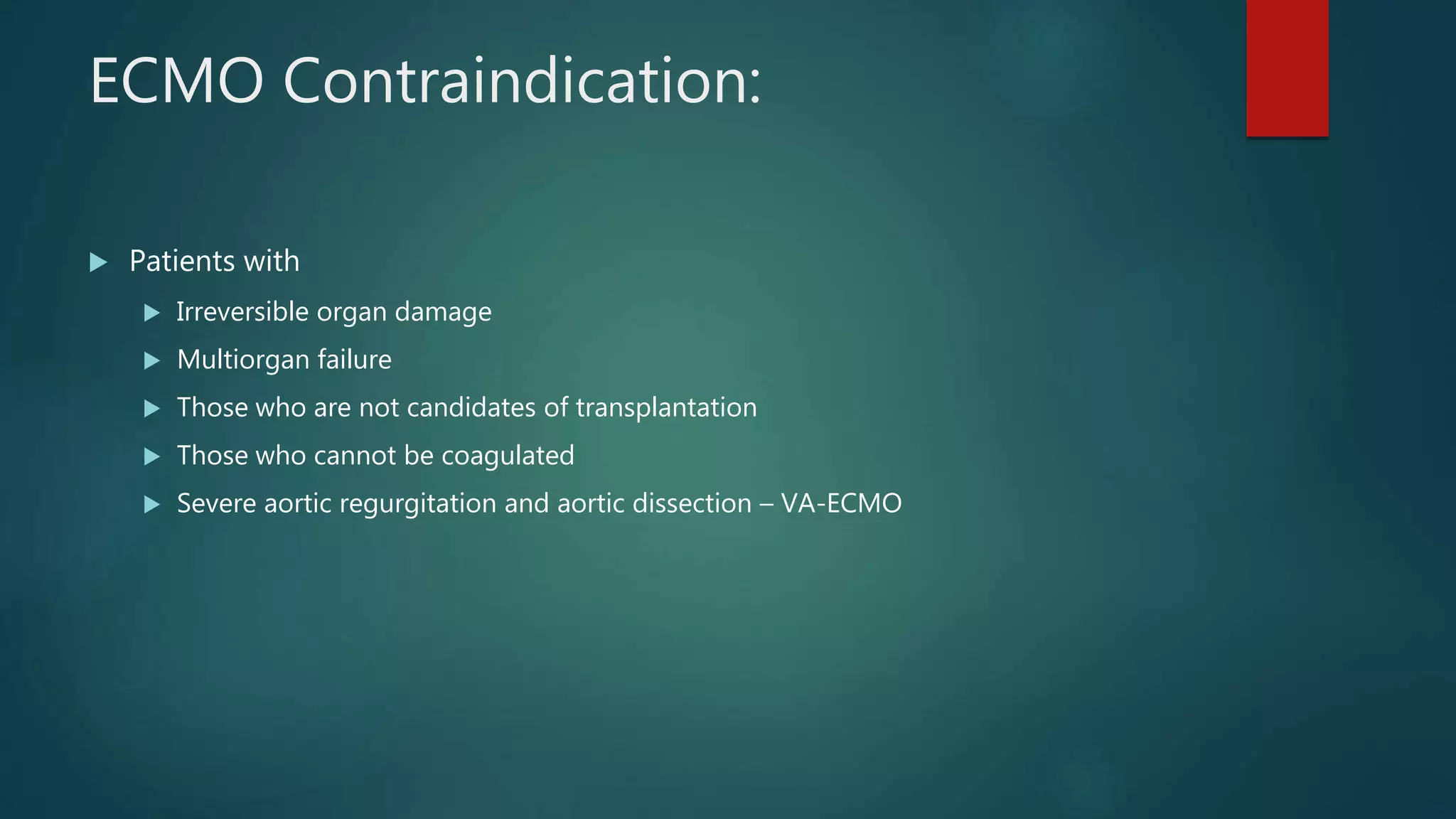
ECMO Contraindication:
 Patients with
 Irreversible organ damage
 Multiorgan failure
 Those who are not candidates of transplantation
 Those who cannot be coagulated
 Severe aortic regurgitation and aortic dissection – VA-ECMO
Complications:
 Haemorrhage due to continuous anti-coagulation
 Infection due indwelling catheters or Primary pathology
 Thromboembolism pathogenesis is multifactorial
 blood activation after contact with foreign surfaces
 blood stasis in the cardiac chambers and the systemic veins
 DIC
 Thrombus in the circuit effect pump func. And in VA-ECMO can lead leg ischaemia
 Cannula displacement or malposition and circuit failure = catastrophic affect
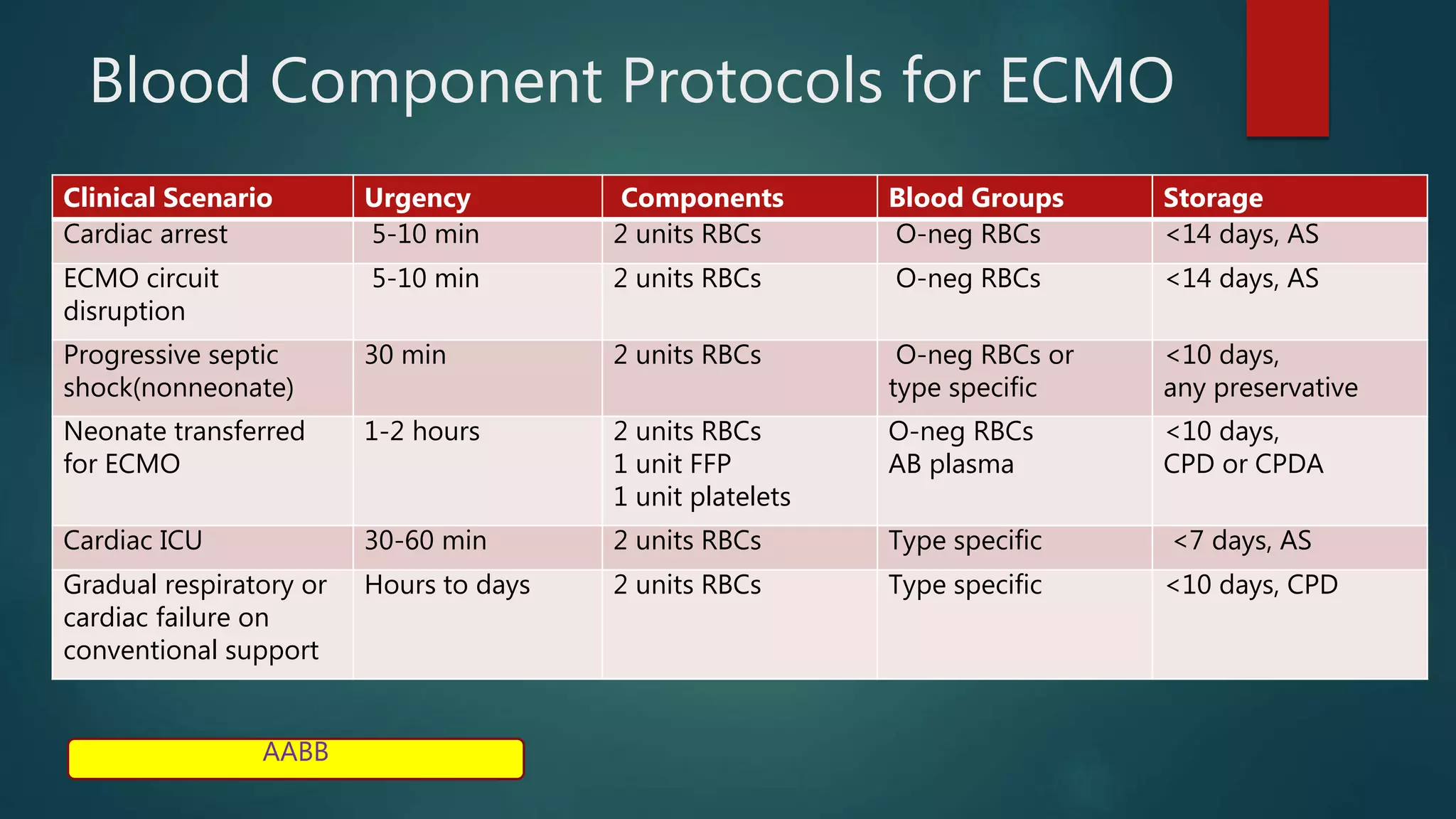
Blood Component Protocols for ECMO
Clinical Scenario Urgency Components Blood Groups Storage
Cardiac arrest 5-10 min 2 units RBCs O-neg RBCs <14 days, AS
ECMO circuit
disruption
5-10 min 2 units RBCs O-neg RBCs <14 days, AS
Progressive septic
shock(nonneonate)
30 min 2 units RBCs O-neg RBCs or
type specific
<10 days,
any preservative
Neonate transferred
for ECMO
1-2 hours 2 units RBCs
1 unit FFP
1 unit platelets
O-neg RBCs
AB plasma
<10 days,
CPD or CPDA
Cardiac ICU 30-60 min 2 units RBCs Type specific <7 days, AS
Gradual respiratory or
cardiac failure on
conventional support
Hours to days 2 units RBCs Type specific <10 days, CPD
AABB
Platelet Transfusion thresholds for
ECMO in paediatric patients:
 Platelet Transfusion in neonate Patient undergoing ECMO with:
 A platelet count of <100,000/μL(AABB), or 50,000-100,000/μL(ROSSI)
 Higher platelet counts if bleeding
Paediatric Plasma Transfusion in ECMO
Patients:
 ECMO is increasingly being utilized to treat a number of paediatric conditions nonresponsive to
traditional ventilatory support
 As institutions use Albumin, RBC and other additives to prime the circuit, coagulopathy is
complicated
 Plasma transfusion in children in ECMO, protocol includes
 Factor Xa monitoring
 Thromboelastography
 Anti-Thrombin monitoring
 Plasma to be transfused
 ABO compatible but Rh matching not required
 No irradiation required
 10-15ml/kg plasma raises INR by 30% approx.
Rossi
Transfusion Guidelines for Adult in
ECMO
ELSO(Extracorporeal Life Support Organisation) has no specific guidelines for transfusion in Adults,
 Although ELSO recommends 12-14g/dl. Restrictive transfusion is better outcome with
Transfusion threshold at ≤ 7g/dl(Voelker et al) whereas TRICS III showed threshold 7.5-8g/dl
reasonably good regarding composite outcome of mortality, Myocardial ischaemia etc.
 Decrease Anticoagulant(Heparin) or transfuse FFP till Activated Clotting Time or PTT is 1.4 to 1.5
times normal (target aPTT 40-60 secs)
 Since procedure itself results in Thrombocytopenia so it is wise to maintain the platelet count
above 100,000/μL by platelet transfusion. ELSO recommends plt above 75,000/μL
 Giving Antifibrinolytics
ELSO Guidelines for Adult Respiratory Failure, August 2017
Thank You
HAVE A NICE DAY!

Extracorporeal membrane oxygenation

  • 1.
    Extracorporeal membrane oxygenation in Adults GUILLERMOMARTINEZ MD ALAIN VUYLSTEKE MD FRCA FFICM CONTINUING EDUCATION IN ANAESTHESIA, CRITICAL CARE & PAIN| VOLUME 12 NUMBER 2 2012
  • 2.
    ECMO  Extracorporeal membraneoxygenation (ECMO) uses technology derived from cardiopulmonary bypass (CPB) that allows gas exchange outside the body.   The benefits of ECMO in adult patients with cardiac failure or refractory acute respiratory distress syndrome (ARDS) are still debated, as ECMO was initially associated with poor survival rates.  However, recent technological advances in the ECMO circuit have led to a reduction in the rate of technical issues and complications. ECMO has emerged from its widespread use as a rescue therapy for patients with ARDS and refractory hypoxaemia associated with H1N1/2009 infection (‘swine flu’).
  • 3.
    Types: An ECMO circuitcan be set up in three ways: I. Veno-Arterial ECMO (VA-ECMO): II. Veno-Venous (VV-ECMO): III. Arterio-Venous ECMO (AV-ECMO):
  • 4.
    Description:  The circuitfor VA or VV is almost identical. Blood movement is facilitated by external pump through the membrane allowing gas exchange  The gas exchanger (oxygenator) allows more efficient CO2 removal than O2 addition because of the solubility and better diffusion properties of CO2 relative to O2.  The most recent models (hollow fibre non-micropore membrane) present less resistance to blood flow and are less traumatic to blood components than previous designs.¥  Centrifugal pumps are better reliable and easy to care for.
  • 5.
    Cannulae  Indwelling cannulae Venous  Arterial  Placed under  Direct vision  Percutaneous should be done ideally under ultrasound or fluoroscospy
  • 6.
    Veno-Arterial ECMO:  VA-ECMObypasses pt heart and lung  The drainage cannula is commonly placed in the inferior vena cava or rt atrium  Done by sternotomy or percutaneously by inserting the cannula via the internal jugular or the femoral vein.  The bloods returns by cannula inserted in either  Ascending aorta(central ECMO) or (preferred esp immediately after CPB as cannula same)  Femoral Artery(peripheral ECMO)  VA-ECMO reduces cardiac work and oxygen consumption  VA-ECMO provides adequate organ perfusion
  • 8.
    Veno-venous ECMO  Whencardiac function preserved to improve O2  Insertion of at least two cannulae in large veins  Decreases incidence of  Recirculation  Bleeding issues  Allows greater mobilization
  • 9.
    AV pumpless Device: Characterized by membrane gas exchange device integrated into a pumpless AV circuit  Cannulation of femoral artery and vein  Predominantly CO2 removal more than oxygenation  AV ECMO requires cardiac index at least 2.5 Lmin before insertion
  • 10.
    Clinical indications forinstitution of ECMO support: VA-ECMO VV-ECMO Weaning from cardiopulmonary bypass after cardiac surgery Any potentially reversible acute respiratory failure Bridge to cardiac transplantation ARDS. Associated with pneumonia (viral or bacterial) Acute myocarditis Failed lung transplant graft Intractable arrhythmia Trauma (pulmonary contusion) Post-cardiac arrest (as part of Advance Life Support) Pulmonary embolism (if acceptable cardiac function) Local anaesthetic toxicity Pulmonary hypertension (after pulmonary endarterectomy
  • 11.
    Parameters:  VA-ECMO considered SAP lower than 85mmHg  Cardiac Index less than 1.2L/min despite adequate preload  More than ≥two inotropes in use  Intra-aortic balloon counterpulsation  Systemic signs of low cardiac output  AV-ECMO useful in Severe hypercapnia, respiratory acidosis and moderate hypoxemia with advantage of easier transportation no pump requirement
  • 12.
    Indications:  Aim ofVV-ECMO  Provide oxygenation and rest the lungs  Decrease insult by mechanical ventilation  Advantage of VV  Lowers thromboembolic complications  Lung perfusion allows endocrine function in comparison with VA-ECMO  Best survival rates are observed in pt with  Non-necrotizing viral pneumonia associated with respiratory failure Cesar Trial compared survival at 6months in absence of severe disability in pt who developed ARDS and has been randomized to be treated in their original or ECMO centre. The trial showed that pt treated in ECMO centre had better outcome and approach is cost-effective
  • 13.
    ECMO Contraindication:  Patientswith  Irreversible organ damage  Multiorgan failure  Those who are not candidates of transplantation  Those who cannot be coagulated  Severe aortic regurgitation and aortic dissection – VA-ECMO
  • 14.
    Complications:  Haemorrhage dueto continuous anti-coagulation  Infection due indwelling catheters or Primary pathology  Thromboembolism pathogenesis is multifactorial  blood activation after contact with foreign surfaces  blood stasis in the cardiac chambers and the systemic veins  DIC  Thrombus in the circuit effect pump func. And in VA-ECMO can lead leg ischaemia  Cannula displacement or malposition and circuit failure = catastrophic affect
  • 15.
    Blood Component Protocolsfor ECMO Clinical Scenario Urgency Components Blood Groups Storage Cardiac arrest 5-10 min 2 units RBCs O-neg RBCs <14 days, AS ECMO circuit disruption 5-10 min 2 units RBCs O-neg RBCs <14 days, AS Progressive septic shock(nonneonate) 30 min 2 units RBCs O-neg RBCs or type specific <10 days, any preservative Neonate transferred for ECMO 1-2 hours 2 units RBCs 1 unit FFP 1 unit platelets O-neg RBCs AB plasma <10 days, CPD or CPDA Cardiac ICU 30-60 min 2 units RBCs Type specific <7 days, AS Gradual respiratory or cardiac failure on conventional support Hours to days 2 units RBCs Type specific <10 days, CPD AABB
  • 16.
    Platelet Transfusion thresholdsfor ECMO in paediatric patients:  Platelet Transfusion in neonate Patient undergoing ECMO with:  A platelet count of <100,000/μL(AABB), or 50,000-100,000/μL(ROSSI)  Higher platelet counts if bleeding
  • 17.
    Paediatric Plasma Transfusionin ECMO Patients:  ECMO is increasingly being utilized to treat a number of paediatric conditions nonresponsive to traditional ventilatory support  As institutions use Albumin, RBC and other additives to prime the circuit, coagulopathy is complicated  Plasma transfusion in children in ECMO, protocol includes  Factor Xa monitoring  Thromboelastography  Anti-Thrombin monitoring  Plasma to be transfused  ABO compatible but Rh matching not required  No irradiation required  10-15ml/kg plasma raises INR by 30% approx. Rossi
  • 18.
    Transfusion Guidelines forAdult in ECMO ELSO(Extracorporeal Life Support Organisation) has no specific guidelines for transfusion in Adults,  Although ELSO recommends 12-14g/dl. Restrictive transfusion is better outcome with Transfusion threshold at ≤ 7g/dl(Voelker et al) whereas TRICS III showed threshold 7.5-8g/dl reasonably good regarding composite outcome of mortality, Myocardial ischaemia etc.  Decrease Anticoagulant(Heparin) or transfuse FFP till Activated Clotting Time or PTT is 1.4 to 1.5 times normal (target aPTT 40-60 secs)  Since procedure itself results in Thrombocytopenia so it is wise to maintain the platelet count above 100,000/μL by platelet transfusion. ELSO recommends plt above 75,000/μL  Giving Antifibrinolytics ELSO Guidelines for Adult Respiratory Failure, August 2017
  • 19.

Editor's Notes

  • #4 VA allows gas exchange and Hemodynamics support VV facilitates gas exch but does not provide hemodyn support AV facilitates gas exchange by using the patients own art blood pr to pump
  • #5 ¥They are less thrombogenic = less anticoagulant required
  • #7 Final content of Oxygen depends on combination of ECMO and Pt blood flow
  • #9 Recently dual chamber cannulae allows better drainage from inf and sup venacava and return blood to RA
  • #11 VA-ECMO is indicated in pt with refractory cardiogenic shock tp bridge between ventricular assist device or cardiac transplantation VA ECMO as Salvage tech during cardiac arrest data suggest to use 10min after Adequate unsuccessful ALS
  • #12 AV ECMO cardiac function must be preserved
  • #13 Alternative to conventional therapy for adults with ARDS graft dysfunction after lung transplant
  • #15 More than 50% suffer haem. Intracranial Improvement in heparin binding tech allows interr
  • #18 In addition to traditional coagulation testing