Professor Anne-Maree Kelly
Western Health
@kellyam_jec
 This presentation may be reproduced in part or
whole for education purposes on the condition that
each reproduced slide contains the following:
‘Reproduced with permission of Professor Anne-
Maree Kelly, Joseph Epstein Centre for Emergency
Medicine Research @Western Health, Melbourne,
Australia’
 Support for this meeting and advisory boards from Astra Zeneca
 Travel support to speak at a conference (on blood gases) by Radiometer
 Advisory board membership MSD
 No relationships with manufacturers of hypothermia equipment
 Co-author of NHF guidelines for the management of ACS and addenda & of
some of the research mentioned in this talk
 Editorial boards of:
◦ Annals of Emergency Medicine
◦ Emergency Medicine Australasia
◦ Hong Kong Journal of Emergency Medicine
 My Colleagues Dr Stephen Bernard, Dr Karen Smith and
colleagues for the ongoing, world leading body of work in this
space
 To review the pathophysiology of post-cardiac arrest
syndrome
 To summarize the evidence for a variety of interventions to
improve outcome after out of hospital cardiac arrest
 To propose the concept of a bundle of care approach to
management of these patients
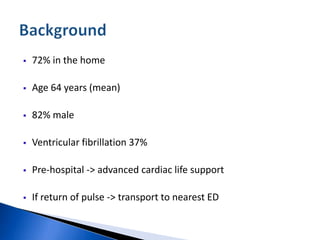
 72% in the home
 Age 64 years (mean)
 82% male
 Ventricular fibrillation 37%
 Pre-hospital -> advanced cardiac life support
 If return of pulse -> transport to nearest ED
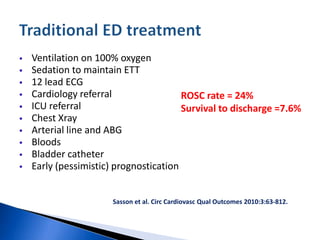
 Ventilation on 100% oxygen
 Sedation to maintain ETT
 12 lead ECG
 Cardiology referral
 ICU referral
 Chest Xray
 Arterial line and ABG
 Bloods
 Bladder catheter
 Early (pessimistic) prognostication
ROSC rate = 24%
Survival to discharge =7.6%
Sasson et al. Circ Cardiovasc Qual Outcomes 2010:3:63-812.
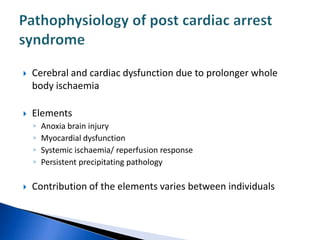
 Cerebral and cardiac dysfunction due to prolonger whole
body ischaemia
 Elements
◦ Anoxia brain injury
◦ Myocardial dysfunction
◦ Systemic ischaemia/ reperfusion response
◦ Persistent precipitating pathology
 Contribution of the elements varies between individuals
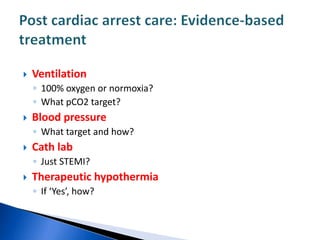
 Ventilation
◦ 100% oxygen or normoxia?
◦ What pCO2 target?
 Blood pressure
◦ What target and how?
 Cath lab
◦ Just STEMI?
 Therapeutic hypothermia
◦ If ‘Yes’, how?
 High oxygen concentration may increase free radical
production
 Some observational data (from ICU) that higher oxygenation
is harmful
 Each 100mmHg increase in pO2 (on ICU admission) associated
with 24% increase in mortality
 Currently the subject of RCT proposals
Kilgannon et al. JAMA 2010;123:2717-2722
 Avoidance of both hyperoxia and hypoxia
 SpO2 target 94-96%
 Avoid hypocarbia as it:
◦ Causes cerebral vasoconstriction
◦ Hyperventilation decreases cardiac output
 Increased blood pressure may improve cerebral perfusion,
BUT
 Inotropes/ pressors may cause additional cardiac injury
 Observational data only suggesting ~30% improvement in
outcome with achievement of haemodynamic stability
 Studies used different targets
 MAP 80-100mmHg vs 65-70mmHg
 Optimal MAP target remains unclear
Gaieski et al. Resuscitation; 2009;80:418-24.
Sunde et al. Resuscitation 2007; 73:29-39.
 Aim for mean arterial pressure of 65-100mmHg
 Taken into consideration ‘usual’ BP and severity of
myocardial dysfunction
 Judicious fluid loading
 Inotropic drug therapy
 Mechanical support devices e.g.
◦ IABP
◦ ECMO
 Anoxic brain injury responsible for ~2/3rds of deaths
post cardiac arrest
 Therapeutic hypothermia is a major recent advance in
neuroprotection
 How it works?
◦ Multifactorial?
◦ Decreases cerebral oxygen demand
◦ ? Direct cellular effects
◦ Reduction in reactive oxygen species generation
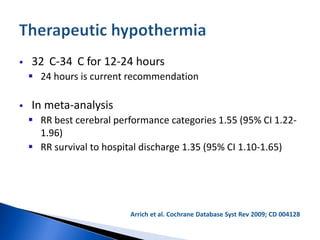
 32 C-34 C for 12-24 hours
 24 hours is current recommendation
 In meta-analysis
 RR best cerebral performance categories 1.55 (95% CI 1.22-
1.96)
 RR survival to hospital discharge 1.35 (95% CI 1.10-1.65)
Arrich et al. Cochrane Database Syst Rev 2009; CD 004128
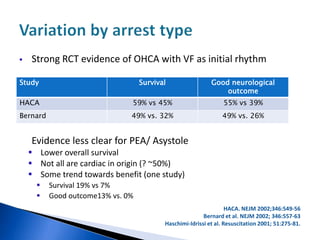
 Strong RCT evidence of OHCA with VF as initial rhythm


Evidence less clear for PEA/ Asystole
 Lower overall survival
 Not all are cardiac in origin (? ~50%)
 Some trend towards benefit (one study)
 Survival 19% vs 7%
 Good outcome13% vs. 0%
Study Survival Good neurological
outcome
HACA 59% vs 45% 55% vs 39%
Bernard 49% vs. 32% 49% vs. 26%
HACA. NEJM 2002;346:549-56
Bernard et al. NEJM 2002; 346:557-63
Haschimi-Idrissi et al. Resuscitation 2001; 51:275-81.
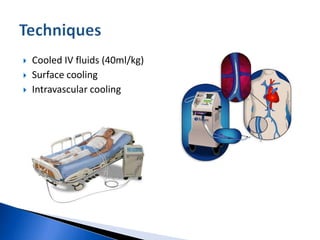
 Cooled IV fluids (40ml/kg)
 Surface cooling
 Intravascular cooling
 Persuasive animal data that the earlier the better
 Two RCT have demonstrated that pre-hospital cooling
using IV fluids is safe, feasible and effective
 No clinical outcome benefit shown compared to in-
hospital cooling (yet)
◦ Main (probable explanation): small difference in times
 STEMI unconscious post cardiac arrest were excluded from
PCI vs. thrombolysis trials
 Initial ECG shows STEMI in 30-60% of patients with ROCS after
OHCA
 Good evidence that early angiography with view to PCI
improves outcome for patients with STEMI (RCT and
observational)
 Recent study showed significant coronary lesions
present in up to 66% of patients with OHCA without
ST elevation.
 Registry data has reported primary PCI as an
independent predictor of survival regardless of initial
ECG (odds ratio, 2.06; 95% CI, 1.16 to 3.66).
Reynolds et al. J Intensive Care Med 2009; 24: 179-86.
Dumas et al. Circ Cardiovasc Interv 2010; 3:200-7.
 2902 post arrest patients in Victoria
 Transported to one of 70 hospitals
 1816 (63%) of patients were treated at hospitals with 24 hour
cardiac interventional services
 After adjusting for differences in baseline characteristics,
treatment at hospitals with 24 hour cardiac interventional
services was significantly associated with survival (odds ratio
1.40; 95% CI 1.12-1.74, p=0.003)
Stub D et al. Heart. 201197:1489-94.
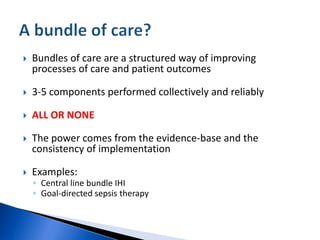
 Bundles of care are a structured way of improving
processes of care and patient outcomes
 3-5 components performed collectively and reliably
 ALL OR NONE
 The power comes from the evidence-base and the
consistency of implementation
 Examples:
◦ Central line bundle IHI
◦ Goal-directed sepsis therapy
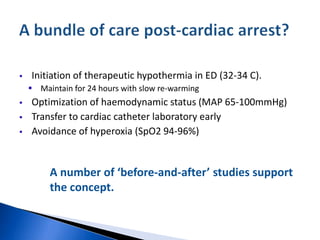
 Initiation of therapeutic hypothermia in ED (32-34 C).
 Maintain for 24 hours with slow re-warming
 Optimization of haemodynamic status (MAP 65-100mmHg)
 Transfer to cardiac catheter laboratory early
 Avoidance of hyperoxia (SpO2 94-96%)
A number of ‘before-and-after’ studies support
the concept.
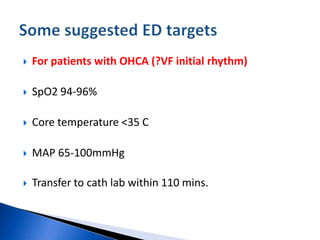
 For patients with OHCA (?VF initial rhythm)
 SpO2 94-96%
 Core temperature <35 C
 MAP 65-100mmHg
 Transfer to cath lab within 110 mins.
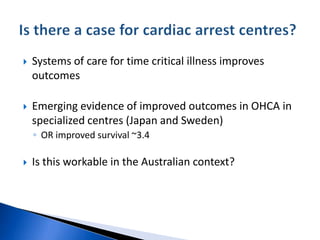
 Systems of care for time critical illness improves
outcomes
 Emerging evidence of improved outcomes in OHCA in
specialized centres (Japan and Sweden)
◦ OR improved survival ~3.4
 Is this workable in the Australian context?
Post cardiac arrest care in ED

Post cardiac arrest care in ED

  • 1.
  • 2.
     This presentationmay be reproduced in part or whole for education purposes on the condition that each reproduced slide contains the following: ‘Reproduced with permission of Professor Anne- Maree Kelly, Joseph Epstein Centre for Emergency Medicine Research @Western Health, Melbourne, Australia’
  • 3.
     Support forthis meeting and advisory boards from Astra Zeneca  Travel support to speak at a conference (on blood gases) by Radiometer  Advisory board membership MSD  No relationships with manufacturers of hypothermia equipment  Co-author of NHF guidelines for the management of ACS and addenda & of some of the research mentioned in this talk  Editorial boards of: ◦ Annals of Emergency Medicine ◦ Emergency Medicine Australasia ◦ Hong Kong Journal of Emergency Medicine
  • 4.
     My ColleaguesDr Stephen Bernard, Dr Karen Smith and colleagues for the ongoing, world leading body of work in this space
  • 5.
     To reviewthe pathophysiology of post-cardiac arrest syndrome  To summarize the evidence for a variety of interventions to improve outcome after out of hospital cardiac arrest  To propose the concept of a bundle of care approach to management of these patients
  • 6.
     72% inthe home  Age 64 years (mean)  82% male  Ventricular fibrillation 37%  Pre-hospital -> advanced cardiac life support  If return of pulse -> transport to nearest ED
  • 7.
     Ventilation on100% oxygen  Sedation to maintain ETT  12 lead ECG  Cardiology referral  ICU referral  Chest Xray  Arterial line and ABG  Bloods  Bladder catheter  Early (pessimistic) prognostication ROSC rate = 24% Survival to discharge =7.6% Sasson et al. Circ Cardiovasc Qual Outcomes 2010:3:63-812.
  • 8.
     Cerebral andcardiac dysfunction due to prolonger whole body ischaemia  Elements ◦ Anoxia brain injury ◦ Myocardial dysfunction ◦ Systemic ischaemia/ reperfusion response ◦ Persistent precipitating pathology  Contribution of the elements varies between individuals
  • 9.
     Ventilation ◦ 100%oxygen or normoxia? ◦ What pCO2 target?  Blood pressure ◦ What target and how?  Cath lab ◦ Just STEMI?  Therapeutic hypothermia ◦ If ‘Yes’, how?
  • 10.
     High oxygenconcentration may increase free radical production  Some observational data (from ICU) that higher oxygenation is harmful  Each 100mmHg increase in pO2 (on ICU admission) associated with 24% increase in mortality  Currently the subject of RCT proposals Kilgannon et al. JAMA 2010;123:2717-2722
  • 11.
     Avoidance ofboth hyperoxia and hypoxia  SpO2 target 94-96%  Avoid hypocarbia as it: ◦ Causes cerebral vasoconstriction ◦ Hyperventilation decreases cardiac output
  • 12.
     Increased bloodpressure may improve cerebral perfusion, BUT  Inotropes/ pressors may cause additional cardiac injury  Observational data only suggesting ~30% improvement in outcome with achievement of haemodynamic stability  Studies used different targets  MAP 80-100mmHg vs 65-70mmHg  Optimal MAP target remains unclear Gaieski et al. Resuscitation; 2009;80:418-24. Sunde et al. Resuscitation 2007; 73:29-39.
  • 13.
     Aim formean arterial pressure of 65-100mmHg  Taken into consideration ‘usual’ BP and severity of myocardial dysfunction
  • 14.
     Judicious fluidloading  Inotropic drug therapy  Mechanical support devices e.g. ◦ IABP ◦ ECMO
  • 15.
     Anoxic braininjury responsible for ~2/3rds of deaths post cardiac arrest  Therapeutic hypothermia is a major recent advance in neuroprotection  How it works? ◦ Multifactorial? ◦ Decreases cerebral oxygen demand ◦ ? Direct cellular effects ◦ Reduction in reactive oxygen species generation
  • 16.
     32 C-34C for 12-24 hours  24 hours is current recommendation  In meta-analysis  RR best cerebral performance categories 1.55 (95% CI 1.22- 1.96)  RR survival to hospital discharge 1.35 (95% CI 1.10-1.65) Arrich et al. Cochrane Database Syst Rev 2009; CD 004128
  • 17.
     Strong RCTevidence of OHCA with VF as initial rhythm   Evidence less clear for PEA/ Asystole  Lower overall survival  Not all are cardiac in origin (? ~50%)  Some trend towards benefit (one study)  Survival 19% vs 7%  Good outcome13% vs. 0% Study Survival Good neurological outcome HACA 59% vs 45% 55% vs 39% Bernard 49% vs. 32% 49% vs. 26% HACA. NEJM 2002;346:549-56 Bernard et al. NEJM 2002; 346:557-63 Haschimi-Idrissi et al. Resuscitation 2001; 51:275-81.
  • 18.
     Cooled IVfluids (40ml/kg)  Surface cooling  Intravascular cooling
  • 19.
     Persuasive animaldata that the earlier the better  Two RCT have demonstrated that pre-hospital cooling using IV fluids is safe, feasible and effective  No clinical outcome benefit shown compared to in- hospital cooling (yet) ◦ Main (probable explanation): small difference in times
  • 20.
     STEMI unconsciouspost cardiac arrest were excluded from PCI vs. thrombolysis trials  Initial ECG shows STEMI in 30-60% of patients with ROCS after OHCA  Good evidence that early angiography with view to PCI improves outcome for patients with STEMI (RCT and observational)
  • 21.
     Recent studyshowed significant coronary lesions present in up to 66% of patients with OHCA without ST elevation.  Registry data has reported primary PCI as an independent predictor of survival regardless of initial ECG (odds ratio, 2.06; 95% CI, 1.16 to 3.66). Reynolds et al. J Intensive Care Med 2009; 24: 179-86. Dumas et al. Circ Cardiovasc Interv 2010; 3:200-7.
  • 22.
     2902 postarrest patients in Victoria  Transported to one of 70 hospitals  1816 (63%) of patients were treated at hospitals with 24 hour cardiac interventional services  After adjusting for differences in baseline characteristics, treatment at hospitals with 24 hour cardiac interventional services was significantly associated with survival (odds ratio 1.40; 95% CI 1.12-1.74, p=0.003) Stub D et al. Heart. 201197:1489-94.
  • 23.
     Bundles ofcare are a structured way of improving processes of care and patient outcomes  3-5 components performed collectively and reliably  ALL OR NONE  The power comes from the evidence-base and the consistency of implementation  Examples: ◦ Central line bundle IHI ◦ Goal-directed sepsis therapy
  • 24.
     Initiation oftherapeutic hypothermia in ED (32-34 C).  Maintain for 24 hours with slow re-warming  Optimization of haemodynamic status (MAP 65-100mmHg)  Transfer to cardiac catheter laboratory early  Avoidance of hyperoxia (SpO2 94-96%) A number of ‘before-and-after’ studies support the concept.
  • 25.
     For patientswith OHCA (?VF initial rhythm)  SpO2 94-96%  Core temperature <35 C  MAP 65-100mmHg  Transfer to cath lab within 110 mins.
  • 26.
     Systems ofcare for time critical illness improves outcomes  Emerging evidence of improved outcomes in OHCA in specialized centres (Japan and Sweden) ◦ OR improved survival ~3.4  Is this workable in the Australian context?