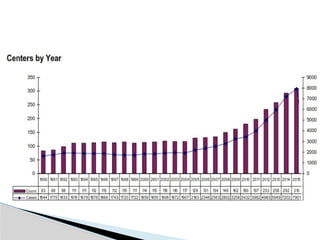
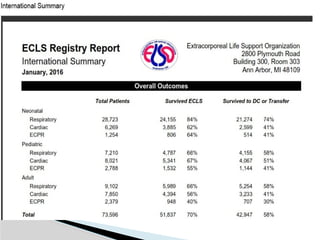
ECMO
JINIL RAJ
Lisie heart institute
 Extracorporeal technique
 Temporary life support
 Potentially reversible cardiac and respiratory
insufficiency
 Failing to respond to conventional medical
therapy.
Extracorporeal membrane oxygenation (ECMO)
 Adaptation of conventional cardiopulmonary bypass
techniques used in OR for prolonged support in ICU.
 Does not treat the underlying disease process.
 Aids in recovery by unloading the cardiopulmonary
system.
 Can serve as a bridge to organ transplant.
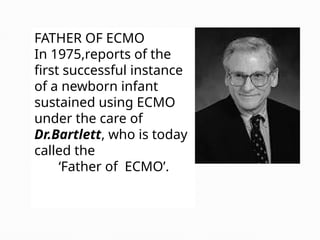
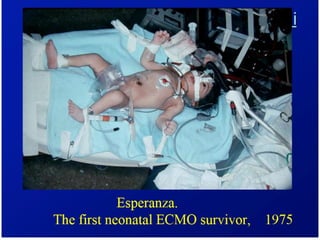
FATHER OF ECMO
In 1975,reports of the
first successful instance
of a newborn infant
sustained using ECMO
under the care of
Dr.Bartlett, who is today
called the
‘Father of ECMO’.
 VENO-ARTERIAL ECMO
 VENO-VENOUS ECMO
Types of ecmo....
 For cardiac support
 Cannulation from a venous side to an arterial
side.
 Central – right atrium to ascending aorta.
 Periferal – femoral /internal jugular vein to
femoral /carotid artery.
 Cannulation sites differs according to the
anatomy and pathology.
VENO ARTERIAL ECMO
 Post cardiotomy cardiac failure.
 Cardiomyopathies
 Viral myocarditis.
 Bridge to transplant.
Common indications.
In the ICU: the severity defined by pressor and
inotropic requirement, metabolic acidosis,
decreased urine output for 6 hours.
pH<7.25 with raised lactates .
 Early postoperative cardiac failure in the operating
room (unable to come off bypass)
 Cardiac arrest from any cause
 Septic shock without evidence of coagulopathy or
multiorgan damage.
 Elective support through high risk catheter
procedures
when to start Ecmo.....
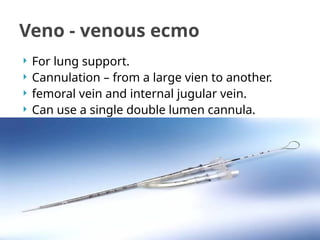
 For lung support.
 Cannulation – from a large vien to another.
 femoral vein and internal jugular vein.
 Can use a single double lumen cannula.
Veno - venous ecmo
 Can be used for anything causing ARDS.
 -mechonium aspiration.
 -congenital diaphragmatic hernia
 -persisant pulmonary hypertension.
 -Status asmaticus.
 - snake bite.
 -organic phosphorus poisoning.
 Sepsis.
Common indications
 Severe resp. failure
O.I (Oxygenation Index) – M.A.P X FiO2/
PaO2
O.I > 40 on conventional vent. for 6hrs
Uncorrectable hypercarbia with pH <7
MAP more than 30 is the sign of barotrauma
When do we initiate an ECMO in
Resp.Failure........
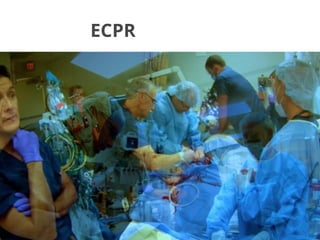
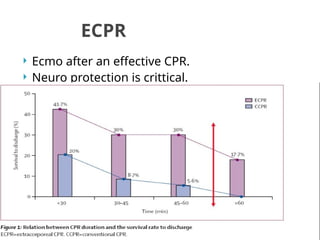
ECPR
 Ecmo after an effective CPR.
 Neuro protection is crittical.
ECPR
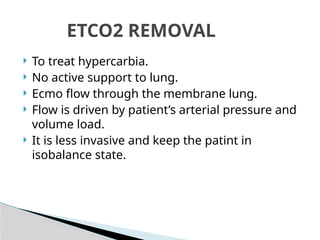
 To treat hypercarbia.
 No active support to lung.
 Ecmo flow through the membrane lung.
 Flow is driven by patient’s arterial pressure and
volume load.
 It is less invasive and keep the patint in
isobalance state.
ETCO2 REMOVAL
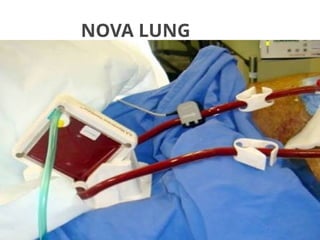
NOVA LUNG
“The key to the success of
ECMO may be the time of
initiation”
Improper selection can result in a
‘ bridge to nowhere’ situation
Proper selection is mandatory.
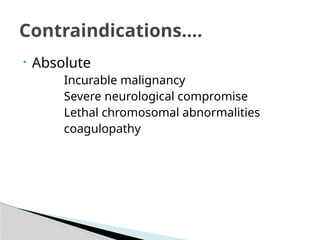
• Absolute
Incurable malignancy
Severe neurological compromise
Lethal chromosomal abnormalities
coagulopathy
Contraindications....
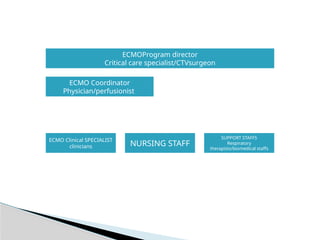
ECMOProgram director
Critical care specialist/CTVsurgeon
ECMO Coordinator
Physician/perfusionist
ECMO Clinical SPECIALIST
clinicians NURSING STAFF
SUPPORT STAFFS
Respiratory
therapists/biomedical staffs
LET’S PARTY
NOW
…
.

ECMO. Introduction to VA, VV ECMO, ECPR.

  • 1.
  • 2.
     Extracorporeal technique Temporary life support  Potentially reversible cardiac and respiratory insufficiency  Failing to respond to conventional medical therapy. Extracorporeal membrane oxygenation (ECMO)
  • 3.
     Adaptation ofconventional cardiopulmonary bypass techniques used in OR for prolonged support in ICU.  Does not treat the underlying disease process.  Aids in recovery by unloading the cardiopulmonary system.  Can serve as a bridge to organ transplant.
  • 5.
    FATHER OF ECMO In1975,reports of the first successful instance of a newborn infant sustained using ECMO under the care of Dr.Bartlett, who is today called the ‘Father of ECMO’.
  • 7.
     VENO-ARTERIAL ECMO VENO-VENOUS ECMO Types of ecmo....
  • 8.
     For cardiacsupport  Cannulation from a venous side to an arterial side.  Central – right atrium to ascending aorta.  Periferal – femoral /internal jugular vein to femoral /carotid artery.  Cannulation sites differs according to the anatomy and pathology. VENO ARTERIAL ECMO
  • 9.
     Post cardiotomycardiac failure.  Cardiomyopathies  Viral myocarditis.  Bridge to transplant. Common indications.
  • 10.
    In the ICU:the severity defined by pressor and inotropic requirement, metabolic acidosis, decreased urine output for 6 hours. pH<7.25 with raised lactates .  Early postoperative cardiac failure in the operating room (unable to come off bypass)  Cardiac arrest from any cause  Septic shock without evidence of coagulopathy or multiorgan damage.  Elective support through high risk catheter procedures when to start Ecmo.....
  • 11.
     For lungsupport.  Cannulation – from a large vien to another.  femoral vein and internal jugular vein.  Can use a single double lumen cannula. Veno - venous ecmo
  • 12.
     Can beused for anything causing ARDS.  -mechonium aspiration.  -congenital diaphragmatic hernia  -persisant pulmonary hypertension.  -Status asmaticus.  - snake bite.  -organic phosphorus poisoning.  Sepsis. Common indications
  • 13.
     Severe resp.failure O.I (Oxygenation Index) – M.A.P X FiO2/ PaO2 O.I > 40 on conventional vent. for 6hrs Uncorrectable hypercarbia with pH <7 MAP more than 30 is the sign of barotrauma When do we initiate an ECMO in Resp.Failure........
  • 14.
  • 15.
     Ecmo afteran effective CPR.  Neuro protection is crittical. ECPR
  • 16.
     To treathypercarbia.  No active support to lung.  Ecmo flow through the membrane lung.  Flow is driven by patient’s arterial pressure and volume load.  It is less invasive and keep the patint in isobalance state. ETCO2 REMOVAL
  • 17.
  • 18.
    “The key tothe success of ECMO may be the time of initiation”
  • 19.
    Improper selection canresult in a ‘ bridge to nowhere’ situation Proper selection is mandatory.
  • 20.
    • Absolute Incurable malignancy Severeneurological compromise Lethal chromosomal abnormalities coagulopathy Contraindications....
  • 21.
    ECMOProgram director Critical carespecialist/CTVsurgeon ECMO Coordinator Physician/perfusionist ECMO Clinical SPECIALIST clinicians NURSING STAFF SUPPORT STAFFS Respiratory therapists/biomedical staffs
  • 25.

Editor's Notes

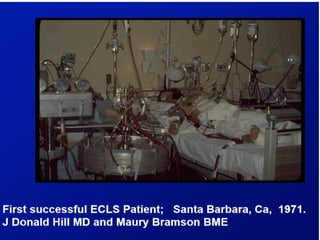
  • #5 The first attempts at ecmo were successful in 1971 when an adult patient was put on ecmo and revived.