My Horse University and eXtension’s HorseQuest  welcome you to this live Webcast. Why Won’t my Mare Get Pregnant? Kathy Anderson University of Nebraska-Lincoln
Meet our presenter: Kathy Anderson University of Nebraska-Lincoln
Factors Affecting Getting Mares “Settled” Is she normal? Cycling Health Reproductive anatomy Fertility Uterine environment Is he normal? Fertility
Is She Cycling?
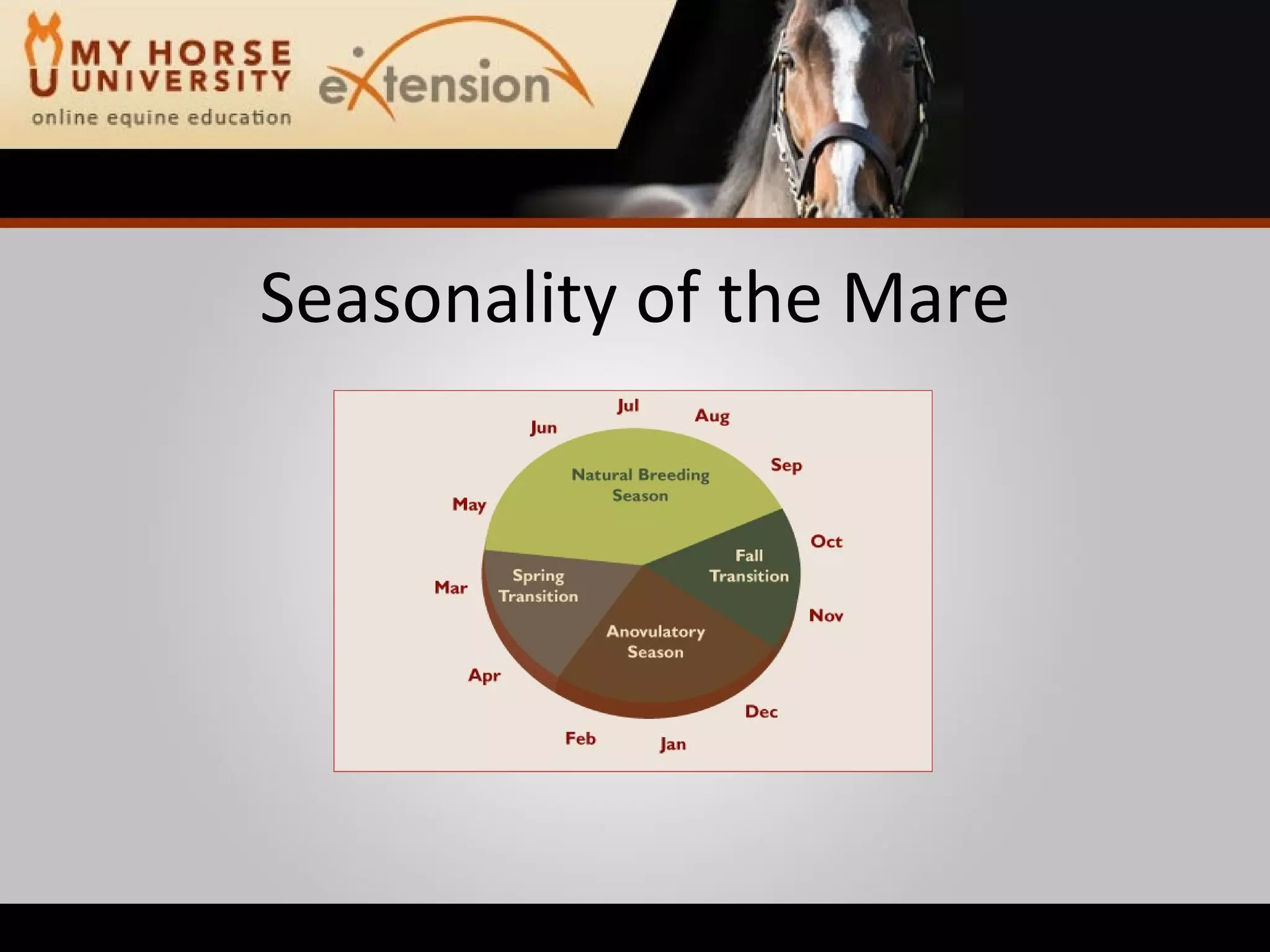
Seasonality of the Mare
Normal Estrus/Heat Cycle 21 day cycle Estrus/heat period 3- 4 days Individual variation Seasons
Estrus Detection Signs Urinate Squatting Tail raising Winking of vulva Swelling, relaxation of vulva area Much variation between mares
Estrus Detection Tease scores 0 = out of heat 1 = passive 2 = slightly interested May be coming in or going out 3 = urinates, winking, greater interest 4 = intense behavioral signs
Estrus Detection Video
Foal Heat Mares Occurs 7 – 9 days after foaling Fertile estrus period May last 3 – 5 days May not show estrus, but will ovulate
Foal Heat Mares Slightly lower conception rates Be selective and screen mares Difficult parturition? Retained placenta? Condition of mare? Time of year?
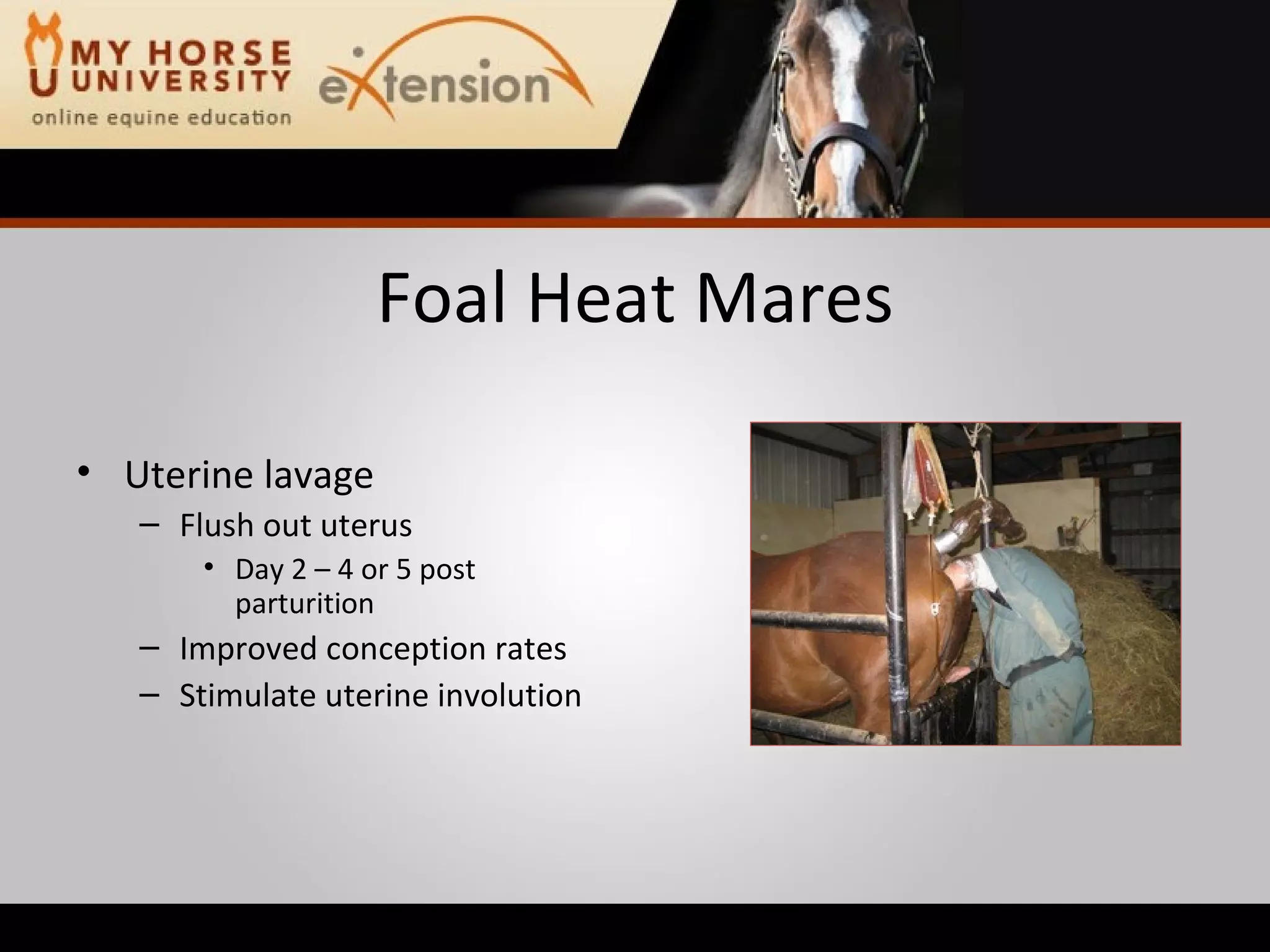
Foal Heat Mares Uterine lavage Flush out uterus Day 2 – 4 or 5 post parturition Improved conception rates Stimulate uterine involution
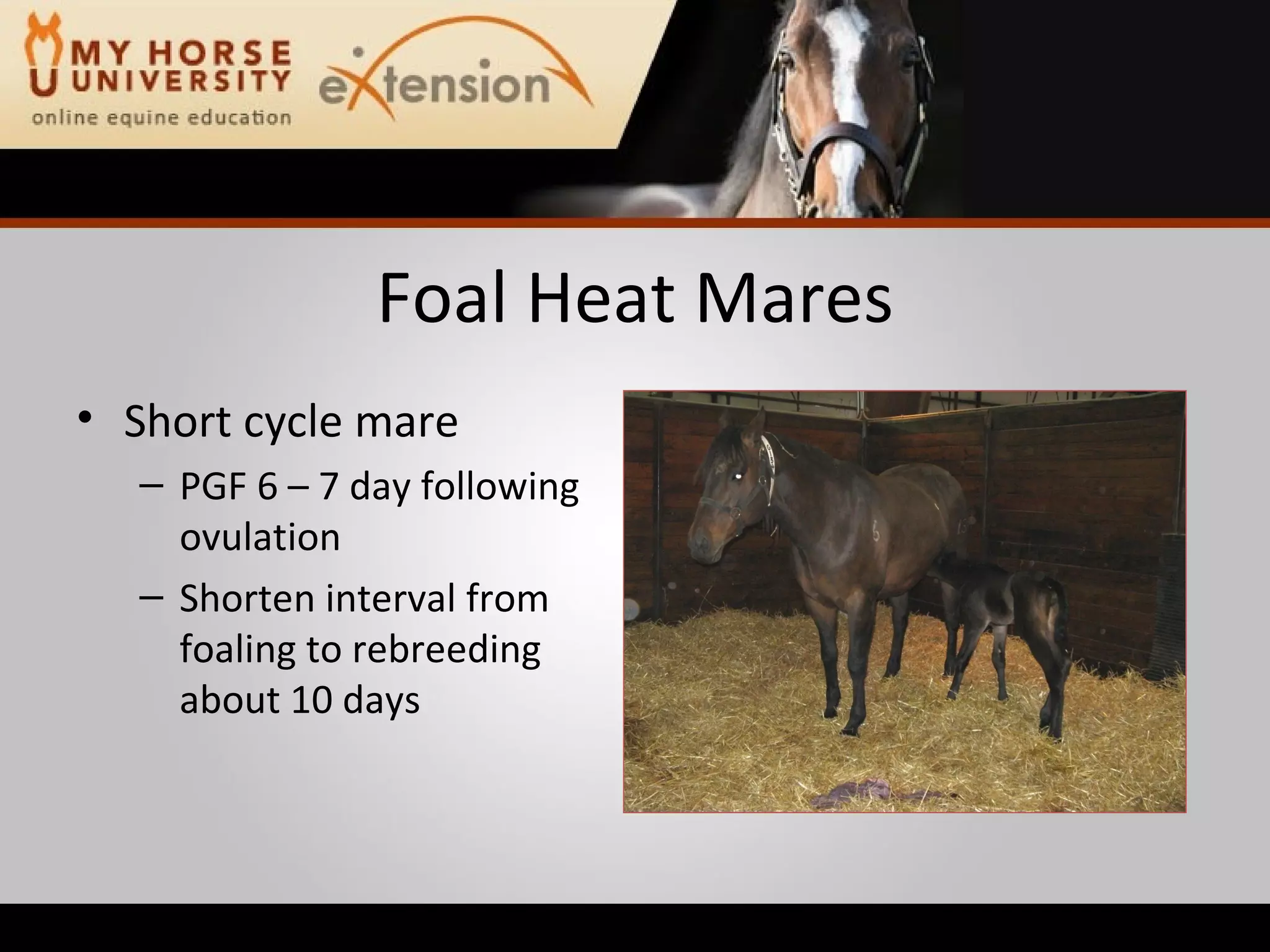
Foal Heat Mares Short cycle mare PGF 6 – 7 day following ovulation Shorten interval from foaling to rebreeding about 10 days
Lactational Anestrus Postpartum mare which do not show estrus May or may not ovulate Body condition score? Foaled early in year? Restrictive nursing Separate foals and only allow nursing 4 – 6 times per day Regumate treatment
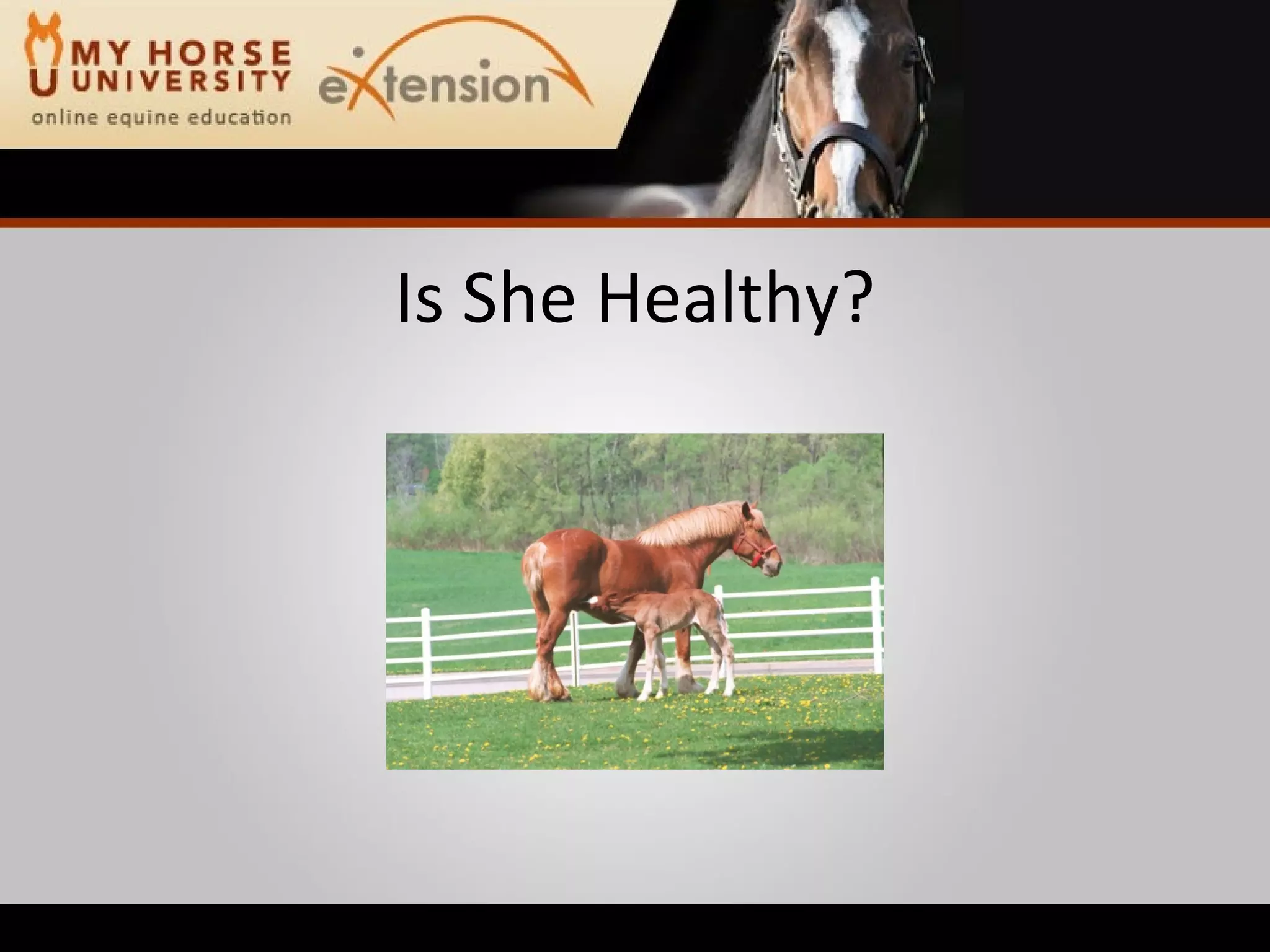
Is She Healthy?
Body Condition and Reproductive Performance 5 or below Reduced reproductive performance Increased embryonic loss
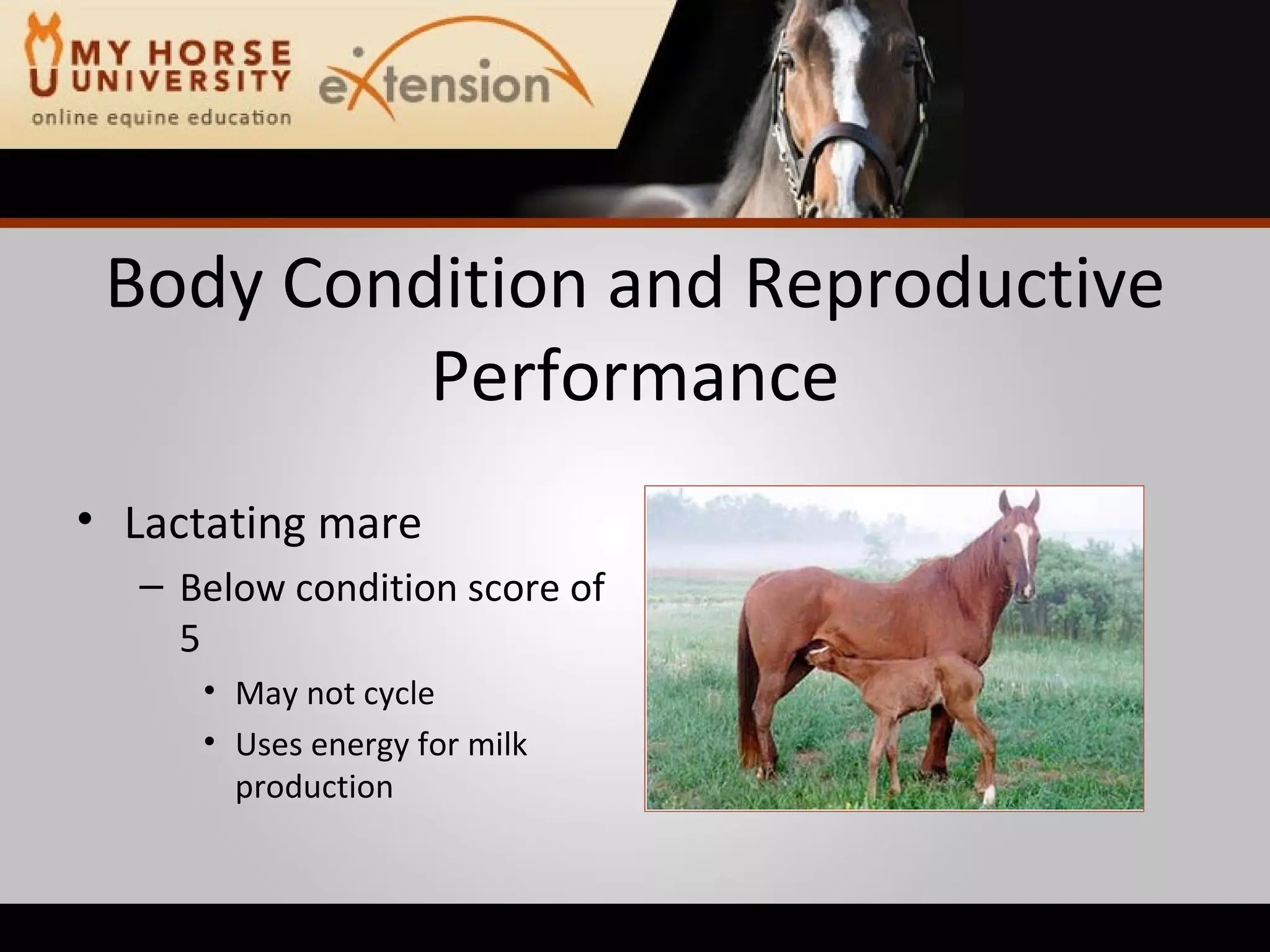
Body Condition and Reproductive Performance 5 or above Improved reproductive performance Cycle earlier in the year Fewer cycles per conception Higher pregnancy rate Improved pregnancy maintenance rate
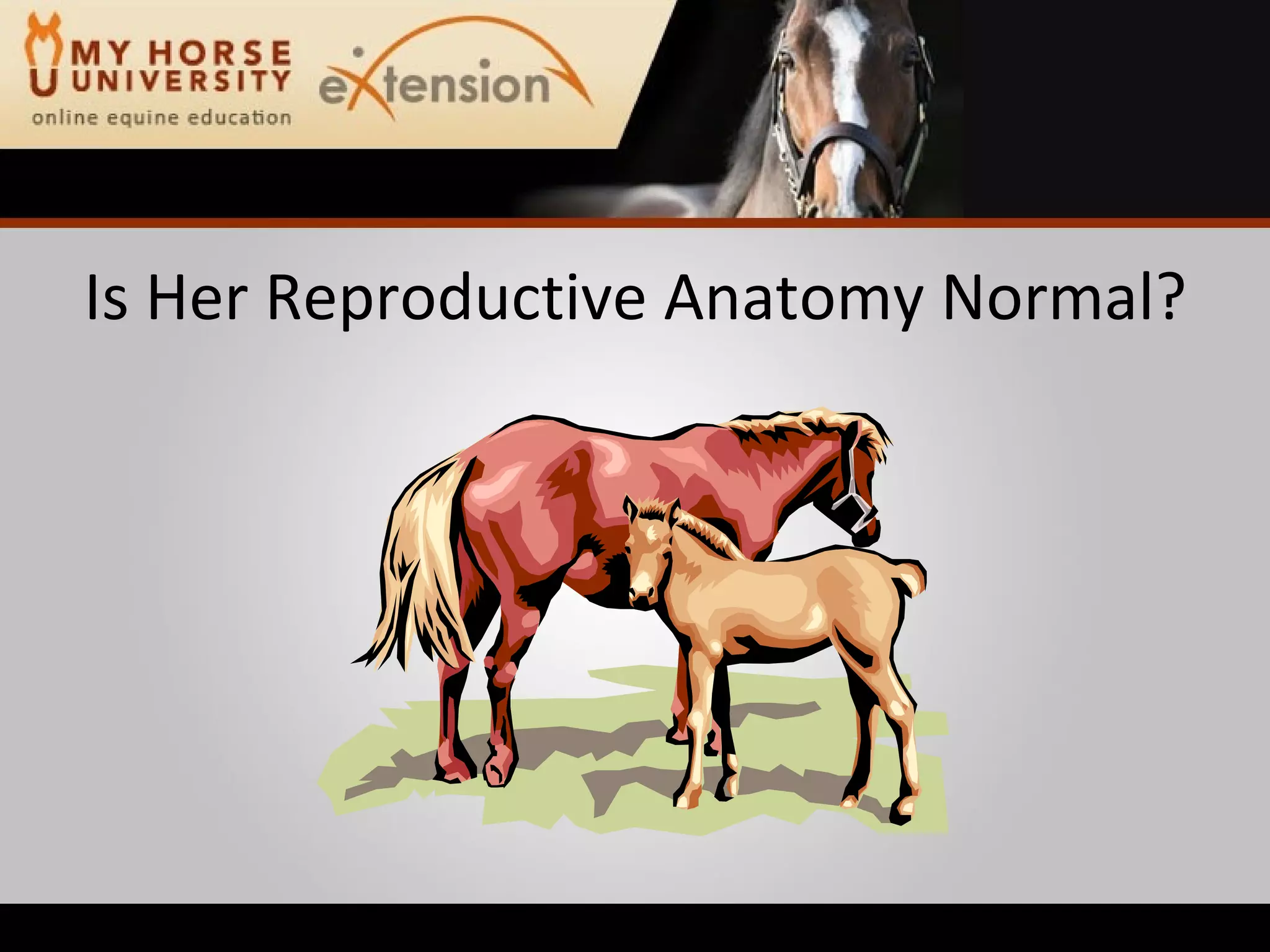
Body Condition and Reproductive Performance Lactating mare Below condition score of 5 May not cycle Uses energy for milk production
Stress, Soundness
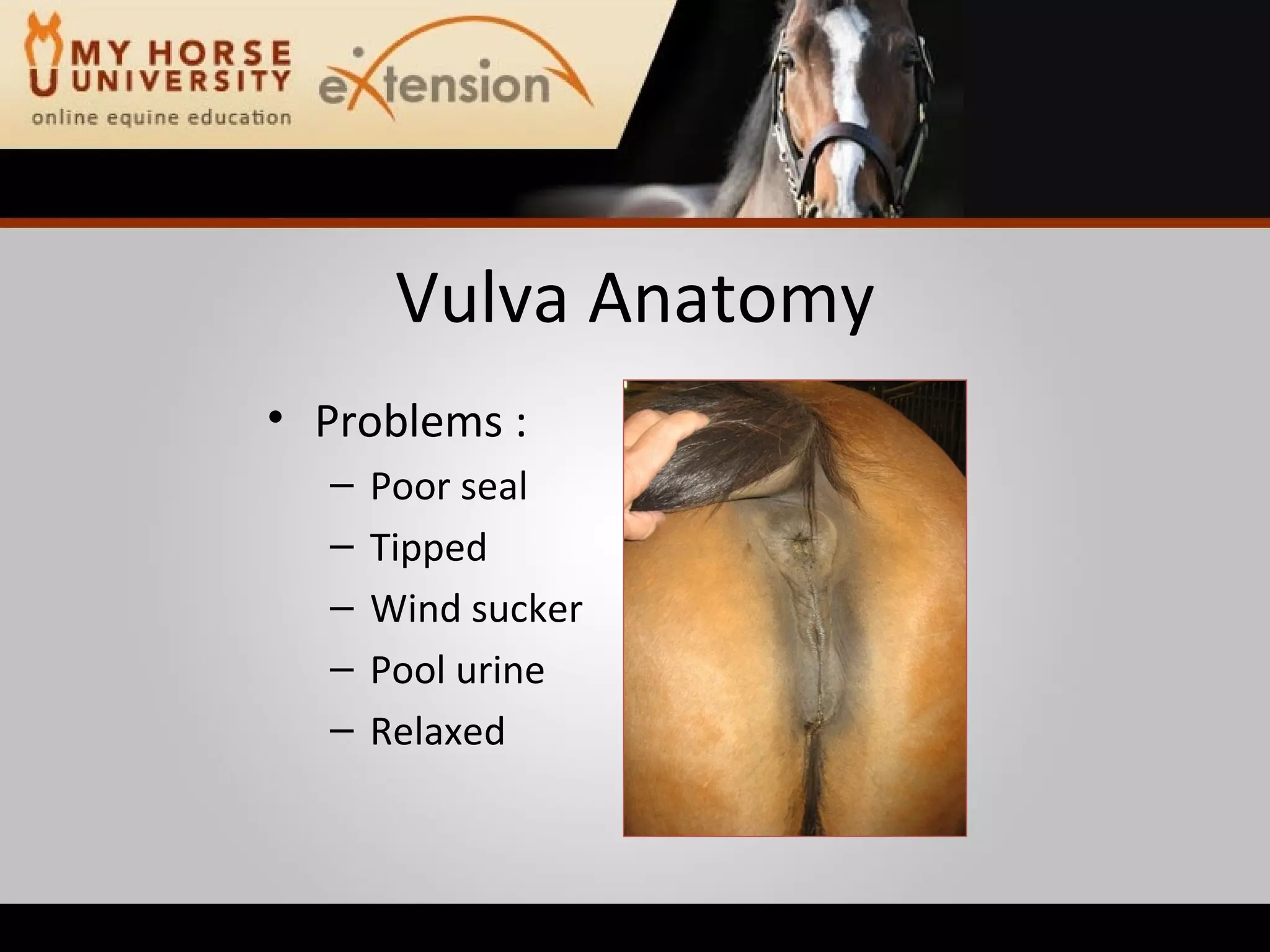
Is Her Reproductive Anatomy Normal?
Vulva Anatomy Problems : Poor seal Tipped Wind sucker Pool urine Relaxed
Vulva External structure Cyclic changes Estrus In “heat” Loose, relaxed, winking when in heat Diestrus “ Out of heat” Tight, closed Estrus
Vulva Anatomy Caslick’s Sutures lips closed Used in mares with poor conformation Used sometimes in other situations
Is She Fertile?
Early Embryonic Loss Prior to Day 40 Causes Maternal factors Endocrine Low progesterone Oviductal environment Poor transport Uterine environment Endometritis Fluid w/n uterus Periglandular fibrosis Uterine cysts Age Lactation Poor body condition Delayed uterine involution External factors Stress Inadequate nutrition Embryonic factors Small size Defects Chromosomal abnormalities Reduced viability
Influence of Mare’s Age on Reproductive Efficiency TABLE 1. 3-8 Years 9-13 Years 14-18 Years >18 Years TOTAL No. Mares 386 214 118 50 768 No. Estrus Cycles 592 328 190 95 1205 Day 15 Preg./Cycle 64.7 65.5 60.0 44.2 62.6 Day 40 Preg/Cycle 60.8 58.5 50.5 34.7 56.5 % Preg. Lost Days 15-40 6.0 10.7 15.8 21.4 9.7 % Preg. Lost Day 40-Foaling 8.4 8.3 16.0 15.2 9.8 % Mares Produced Live Foal 84.7 82.2 66.9 56.0 79.4
Clean Reproductive Practices
Uterine Environment  Examinations & Tests Rectal palpation Ultrasound examination Uterine culture Endometrial biopsy
Uterine Environment Low grade endometritis Low grade infection Flush Antibiotic infusion Scaring
Uterine Environment Cysts More common as mares age May or may not cause fertility problems Post-breeding inflammatory response Lavage between breedings Common with: Frozen semen Using extender
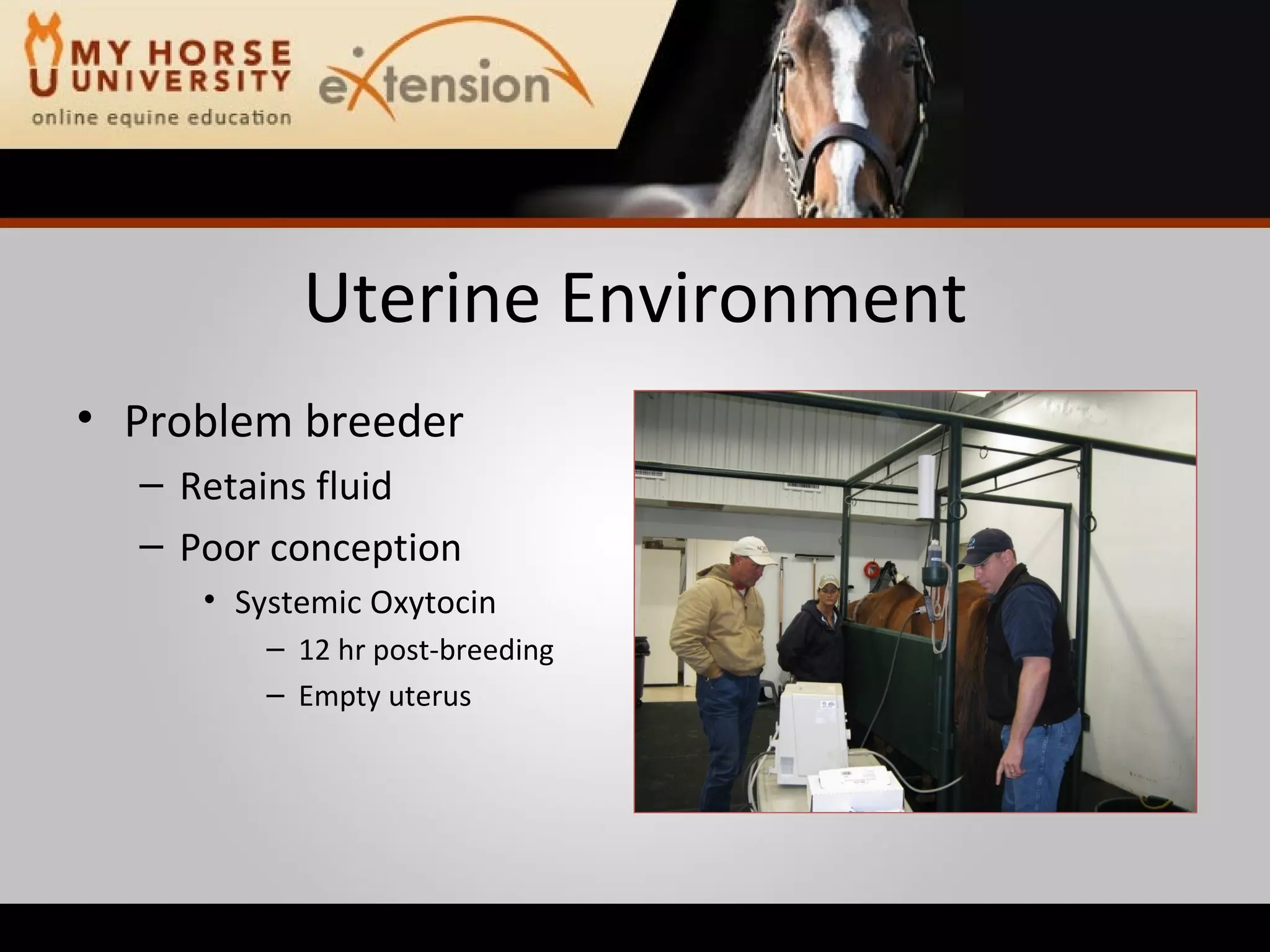
Uterine Environment Problem breeder Retains fluid Poor conception Systemic Oxytocin 12 hr post-breeding Empty uterus
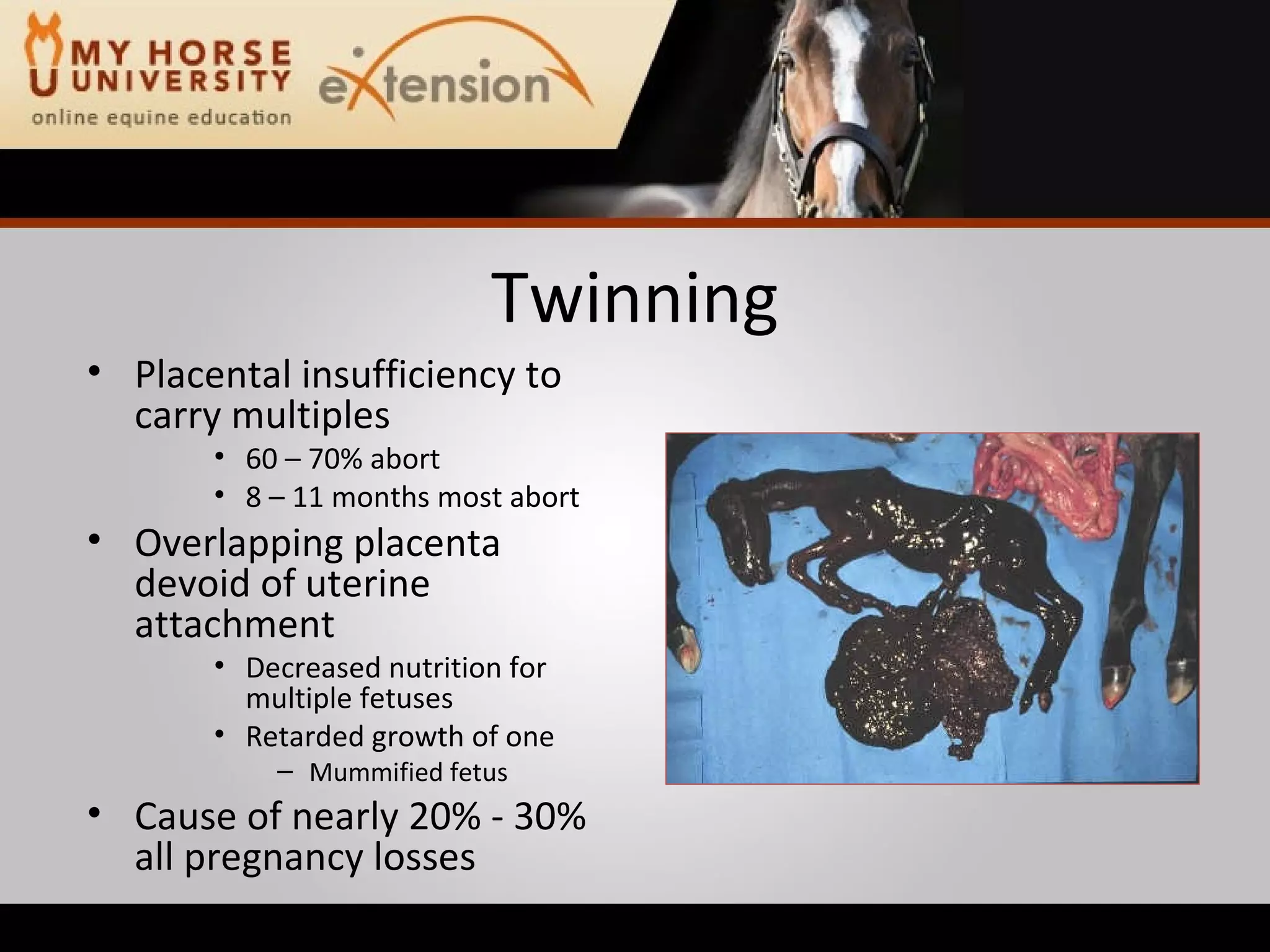
Twinning Placental insufficiency to carry multiples 60 – 70% abort 8 – 11 months most abort Overlapping placenta devoid of uterine attachment Decreased nutrition for multiple fetuses Retarded growth of one Mummified fetus Cause of nearly 20% - 30% all pregnancy losses
Twinning in Mares All twin pregnancies 60% Live single Foal 9% Carry both twins to term 31% Abort both 64.5% 2 stillborn 21% 1 live, 1 stillborn 14.5% 2 live twins
Is He Fertile?
Factors Determining Sperm Output Testicular size # of spermatozoa produced depends largely on amount of FUNCTIONAL testicular tissue Testes size is heritable Scrotal circumference should be greater than 80 mm
Frequency of Ejaculation Increasing the frequency of ejaculation from 1 to 2 times/day does NOT result in increased sperm output Ejaculation frequency has little to no effect on fertility of individual spermatozoa No scientific evidence to support the common belief that if ejaculation occurs too frequently the stallion will ejaculate immature spermatozoa
Seasonality and the Stallion Use of artificial lights on stallions “ Shift” of breeding season from summer to fall No increase in total sperm produced/season Will have increased sperm production in winter months Decreased sperm production in summer months
Factors Determining Sperm Output Age Sperm reserves of sexually rested stallions increased with advancing age (due to a much larger storage capacity for spermatozoa) Testicular size increases with age>> increased DSP
Factors Determining Sperm Output 2 collections, 1 hour apart Second collection will be ½ of the first
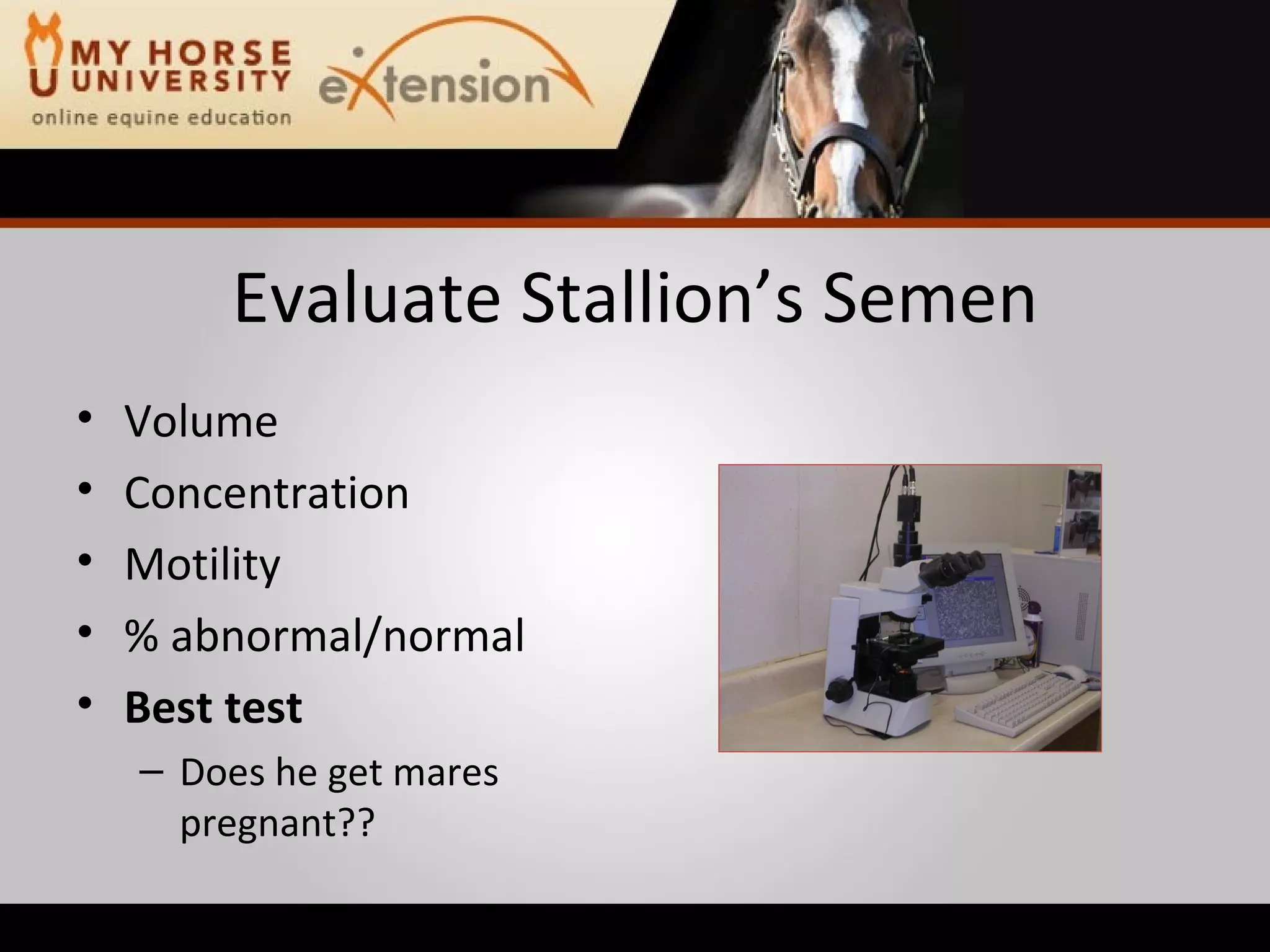
Evaluate Stallion’s Semen Volume Concentration Motility % abnormal/normal Best test Does he get mares pregnant??
The Bottom Line Make sure she is cycling Make sure she is in correct body condition Reduce stress Have her reproductive status evaluated Use the most fertile stallion Good luck!!
Give us your feedback! You will receive a survey by email in 1-2 days. Please take a few minutes to give us your feedback on this webcast. It will help us to better serve you!
Upcoming Webcasts Nutritional Supplements for Horses December 15, 2009 | 7:00 pm EST
Thank you for attending this live web presentation! For more information about  My Horse University please visit us at: www.myhorseuniversity.com info@myhorseuniversity.com | www.myhorseuniversity.com | 517-353-3123

Why Wont My Mare Get Pregnant (Anderson)

  • 1.
    My Horse Universityand eXtension’s HorseQuest welcome you to this live Webcast. Why Won’t my Mare Get Pregnant? Kathy Anderson University of Nebraska-Lincoln
  • 2.
    Meet our presenter:Kathy Anderson University of Nebraska-Lincoln
  • 3.
    Factors Affecting GettingMares “Settled” Is she normal? Cycling Health Reproductive anatomy Fertility Uterine environment Is he normal? Fertility
  • 4.
  • 5.
  • 6.
    Normal Estrus/Heat Cycle21 day cycle Estrus/heat period 3- 4 days Individual variation Seasons
  • 7.
    Estrus Detection SignsUrinate Squatting Tail raising Winking of vulva Swelling, relaxation of vulva area Much variation between mares
  • 8.
    Estrus Detection Teasescores 0 = out of heat 1 = passive 2 = slightly interested May be coming in or going out 3 = urinates, winking, greater interest 4 = intense behavioral signs
  • 9.
  • 10.
    Foal Heat MaresOccurs 7 – 9 days after foaling Fertile estrus period May last 3 – 5 days May not show estrus, but will ovulate
  • 11.
    Foal Heat MaresSlightly lower conception rates Be selective and screen mares Difficult parturition? Retained placenta? Condition of mare? Time of year?
  • 12.
    Foal Heat MaresUterine lavage Flush out uterus Day 2 – 4 or 5 post parturition Improved conception rates Stimulate uterine involution
  • 13.
    Foal Heat MaresShort cycle mare PGF 6 – 7 day following ovulation Shorten interval from foaling to rebreeding about 10 days
  • 14.
    Lactational Anestrus Postpartummare which do not show estrus May or may not ovulate Body condition score? Foaled early in year? Restrictive nursing Separate foals and only allow nursing 4 – 6 times per day Regumate treatment
  • 15.
  • 16.
    Body Condition andReproductive Performance 5 or below Reduced reproductive performance Increased embryonic loss
  • 17.
    Body Condition andReproductive Performance 5 or above Improved reproductive performance Cycle earlier in the year Fewer cycles per conception Higher pregnancy rate Improved pregnancy maintenance rate
  • 18.
    Body Condition andReproductive Performance Lactating mare Below condition score of 5 May not cycle Uses energy for milk production
  • 19.
  • 20.
    Is Her ReproductiveAnatomy Normal?
  • 21.
    Vulva Anatomy Problems: Poor seal Tipped Wind sucker Pool urine Relaxed
  • 22.
    Vulva External structureCyclic changes Estrus In “heat” Loose, relaxed, winking when in heat Diestrus “ Out of heat” Tight, closed Estrus
  • 23.
    Vulva Anatomy Caslick’sSutures lips closed Used in mares with poor conformation Used sometimes in other situations
  • 24.
  • 25.
    Early Embryonic LossPrior to Day 40 Causes Maternal factors Endocrine Low progesterone Oviductal environment Poor transport Uterine environment Endometritis Fluid w/n uterus Periglandular fibrosis Uterine cysts Age Lactation Poor body condition Delayed uterine involution External factors Stress Inadequate nutrition Embryonic factors Small size Defects Chromosomal abnormalities Reduced viability
  • 26.
    Influence of Mare’sAge on Reproductive Efficiency TABLE 1. 3-8 Years 9-13 Years 14-18 Years >18 Years TOTAL No. Mares 386 214 118 50 768 No. Estrus Cycles 592 328 190 95 1205 Day 15 Preg./Cycle 64.7 65.5 60.0 44.2 62.6 Day 40 Preg/Cycle 60.8 58.5 50.5 34.7 56.5 % Preg. Lost Days 15-40 6.0 10.7 15.8 21.4 9.7 % Preg. Lost Day 40-Foaling 8.4 8.3 16.0 15.2 9.8 % Mares Produced Live Foal 84.7 82.2 66.9 56.0 79.4
  • 27.
  • 28.
    Uterine Environment Examinations & Tests Rectal palpation Ultrasound examination Uterine culture Endometrial biopsy
  • 29.
    Uterine Environment Lowgrade endometritis Low grade infection Flush Antibiotic infusion Scaring
  • 30.
    Uterine Environment CystsMore common as mares age May or may not cause fertility problems Post-breeding inflammatory response Lavage between breedings Common with: Frozen semen Using extender
  • 31.
    Uterine Environment Problembreeder Retains fluid Poor conception Systemic Oxytocin 12 hr post-breeding Empty uterus
  • 32.
    Twinning Placental insufficiencyto carry multiples 60 – 70% abort 8 – 11 months most abort Overlapping placenta devoid of uterine attachment Decreased nutrition for multiple fetuses Retarded growth of one Mummified fetus Cause of nearly 20% - 30% all pregnancy losses
  • 33.
    Twinning in MaresAll twin pregnancies 60% Live single Foal 9% Carry both twins to term 31% Abort both 64.5% 2 stillborn 21% 1 live, 1 stillborn 14.5% 2 live twins
  • 34.
  • 35.
    Factors Determining SpermOutput Testicular size # of spermatozoa produced depends largely on amount of FUNCTIONAL testicular tissue Testes size is heritable Scrotal circumference should be greater than 80 mm
  • 36.
    Frequency of EjaculationIncreasing the frequency of ejaculation from 1 to 2 times/day does NOT result in increased sperm output Ejaculation frequency has little to no effect on fertility of individual spermatozoa No scientific evidence to support the common belief that if ejaculation occurs too frequently the stallion will ejaculate immature spermatozoa
  • 37.
    Seasonality and theStallion Use of artificial lights on stallions “ Shift” of breeding season from summer to fall No increase in total sperm produced/season Will have increased sperm production in winter months Decreased sperm production in summer months
  • 38.
    Factors Determining SpermOutput Age Sperm reserves of sexually rested stallions increased with advancing age (due to a much larger storage capacity for spermatozoa) Testicular size increases with age>> increased DSP
  • 39.
    Factors Determining SpermOutput 2 collections, 1 hour apart Second collection will be ½ of the first
  • 40.
    Evaluate Stallion’s SemenVolume Concentration Motility % abnormal/normal Best test Does he get mares pregnant??
  • 41.
    The Bottom LineMake sure she is cycling Make sure she is in correct body condition Reduce stress Have her reproductive status evaluated Use the most fertile stallion Good luck!!
  • 42.
    Give us yourfeedback! You will receive a survey by email in 1-2 days. Please take a few minutes to give us your feedback on this webcast. It will help us to better serve you!
  • 43.
    Upcoming Webcasts NutritionalSupplements for Horses December 15, 2009 | 7:00 pm EST
  • 44.
    Thank you forattending this live web presentation! For more information about My Horse University please visit us at: www.myhorseuniversity.com info@myhorseuniversity.com | www.myhorseuniversity.com | 517-353-3123

Editor's Notes

  • #8 These are the various signs most mares will show during estrus or while in heat. Mares are very consistent in what they do from cycle to cycle. Some mares will always tease up to a 4, whereas others be most they will show is a 2. A good manager becomes familiar with their mares, and knows what each one will do.
  • #13 Foal heat mares may have slightly lower conception rates, so it is a good idea to be selective and screen mares. Mares should be screened for difficult parturition, retained placenta, and condition. A uterine lavage can be used to flush out the uterus 2-5 days post parturition to stimulate uterine involution and improve conception rates. To short cycle a mare, give PGF 6-7 days following ovulation, which will shorten the interval from foaling to rebreeding about 10 days.
  • #15 During lactation, lactational anestrus may occur in some mares. A postpartum mare that does not show estrus may or may not ovulate. Her body condition score and if she foaled earlier in the year should be considered. Restrictive nursing can also be implemented by separating the mare and foal and only allowing nursing 4-6 times per day. Another treatment for lactational anestrus is regumate treatment.
  • #17 Mares at a CS of 5 or below took longer to cycle than other mares. This was generally until they were up to a CS of around 5. Furthermore they took more cycles to be bred, and if remained thin, had an increase in early embryonic loss
  • #18 CS 5+ cycled earlier in the year, took fewer cycles to settle, had an overall higher PG rate and improve PG maintenance