WELCOME
Clinical Conference-I (VCC 421)
PRESENTATION ON THE CASES OF
ABORTION REPORTED AT VETERINARY
TEACHING HOSPITAL OF IAAS
Presenter:
Yuvraj Panth
Veterinary Teaching Hospital,IAAS
Established in 2000 A.D.
Has been providing clinical services to farm
animals and local farmers
Theriogenology related cases are presented at
the VTH frequently
Repeat breeding and anestrous conditions are
the major cases
Case study of abortion was done via through
study from the data available between
2068/04/17 to 2072/08/15 at the Hospital
record
 Out of all case studies only one case of
abortion was found to be presented at VTH
Total No. of Theriogenology related
cases at VTH
Repeat Breeding =9,
 Anestrous = 14
PD = 56 (25 + and 31 -)
ROP = 1
Cervicitis = 3
Abortion = 1
Case Details
Name of Owner: Indira Rimal
Address: Shivanagar-6, Chitwan
Case date: 2071/04/19
Species of Animal: Cattle
Breed: Jx
Sex: Female
Age: 1st Lactation
History:
 Aborted 2 days ago
Parturated on Bhadra,2070
 History of Repeat Breeding at 22 days
interval
Last time conceived on Jestha, 2071
Rx:
 OTC-LA (Limoxin)
Sig. 30 ml I/M once
 Lugol’s Solution (30 ml) + Gentamycin (25 ml)
Sig. I/U for 3 days
 Inj. Multivitamin
Sig. 10 ml I/M daily * 3 days
 Inj. E Care-Se
Sig. 10 ml I/M * alternate day* 3 injections
 Chleated Agrimin Forte- 1 kg
Sig. 40 gm OD Orally
Veterinarian: Dr. S.K. Shah
Case Description
Abortion
• Abortion is the termination of pregnancy after
organogenesis is complete but before the
expelled fetus can survive
• In cows usually defined as pregnancy loss
between 42 and 260 days of gestation
• Associated with induced, infectious and non-
infectious causes
• Most herds have an abortion rate of < 2% per
year, so a single abortion is no cause for alarm
• A rate > 5% per year indicates a significant
problem
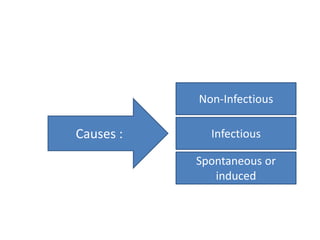
Non-Infectious
Spontaneous or
induced
InfectiousCauses :
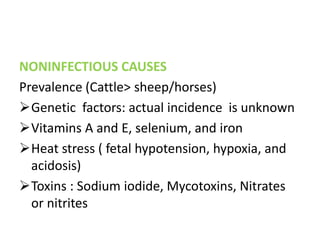
NONINFECTIOUS CAUSES
Prevalence (Cattle> sheep/horses)
Genetic factors: actual incidence is unknown
Vitamins A and E, selenium, and iron
Heat stress ( fetal hypotension, hypoxia, and
acidosis)
Toxins : Sodium iodide, Mycotoxins, Nitrates
or nitrites
INFECTIOUS CAUSES
Leptospirosis
Brucellosis
Campylobacteriosis
Listeriosis
Chlamydiosis
Trichomoniasis
Neosporosis
BVD
IBR
Mycotic abortion
(Aspergillus,Mucor,Rhizopus,etc.
INDUCED ABORTION
High doses of estrogens, PGF2α, glucocorticoids
(particularly in young females bred at an early
age and in meat producing animals)
Twin pregnancy is the most common cause of
abortion in mares (over two-thirds of twin
pregnancies)
Placental insufficiency -> death of one fetus ->
abortion of both fetuses
Fetal membranes hanging from the vulva are
often the first sign of abortion
Aborted fetus
Line of Treatment:
 Antibiotics (Eg. Oxytetracyclines) against
Bacteria, Protozoa can be injected parenterally
Intra-uterine application of antiseptics like
Lugol’s iodine along with antibiotics
 Vitamins and Mineral supplements can be
orally supplied
References
• Case record at VTH
• Hafez , E.S.E. 2000. Reproduction in Farm
Animals. Lea and Febiger Philadelphia (7th
Edition).
• Robert, S.J. 1971. Veterinary Obstetrics and
genital diseases. CBS Publishers and
Distributors, New Delhi (2nd Edition).
Acknowledgement:
o Dr. S.K.Shah
o Santosh Devkota
o Shilu Sharma
o Ganesh Adhikari
Thank You

Abortion cases