Increasing Your Chances for a Successful Outcome
Dr Greg Rodda BVMS BSc Meadows
Veterinary Centre
Introduction
 In 1957 the first foal was born as a result of frozen semen
 For Artificial Insemination (AI) the likelihood of success
with a fertile mare & good quality semen in Australia are
 Chilled semen – pregnancy rates of 70-80% per cycle
 Frozen semen- pregnancy rates of 45-50% per cycle
Dr Greg Rodda BVMS BSc Meadows
Veterinary Centre
Three Most Important Components
of working together to achieve a
successful outcome are:
•Knowledge
•Communication
•Timing
Dr Greg Rodda BVMS BSc Meadows
Veterinary Centre
Guide to Selecting a Mare for
Insemination
Good Choice of Mare:
 Good reproductive history
 Good vulval conformation
 Good health status including worming & dental
 Normal findings on pre breeding reproductive exam
via ultrasound & uterine swab for non maiden mares
 Less than 18 years especially maidens!
Dr Greg Rodda BVMS BSc Meadows
Veterinary Centre
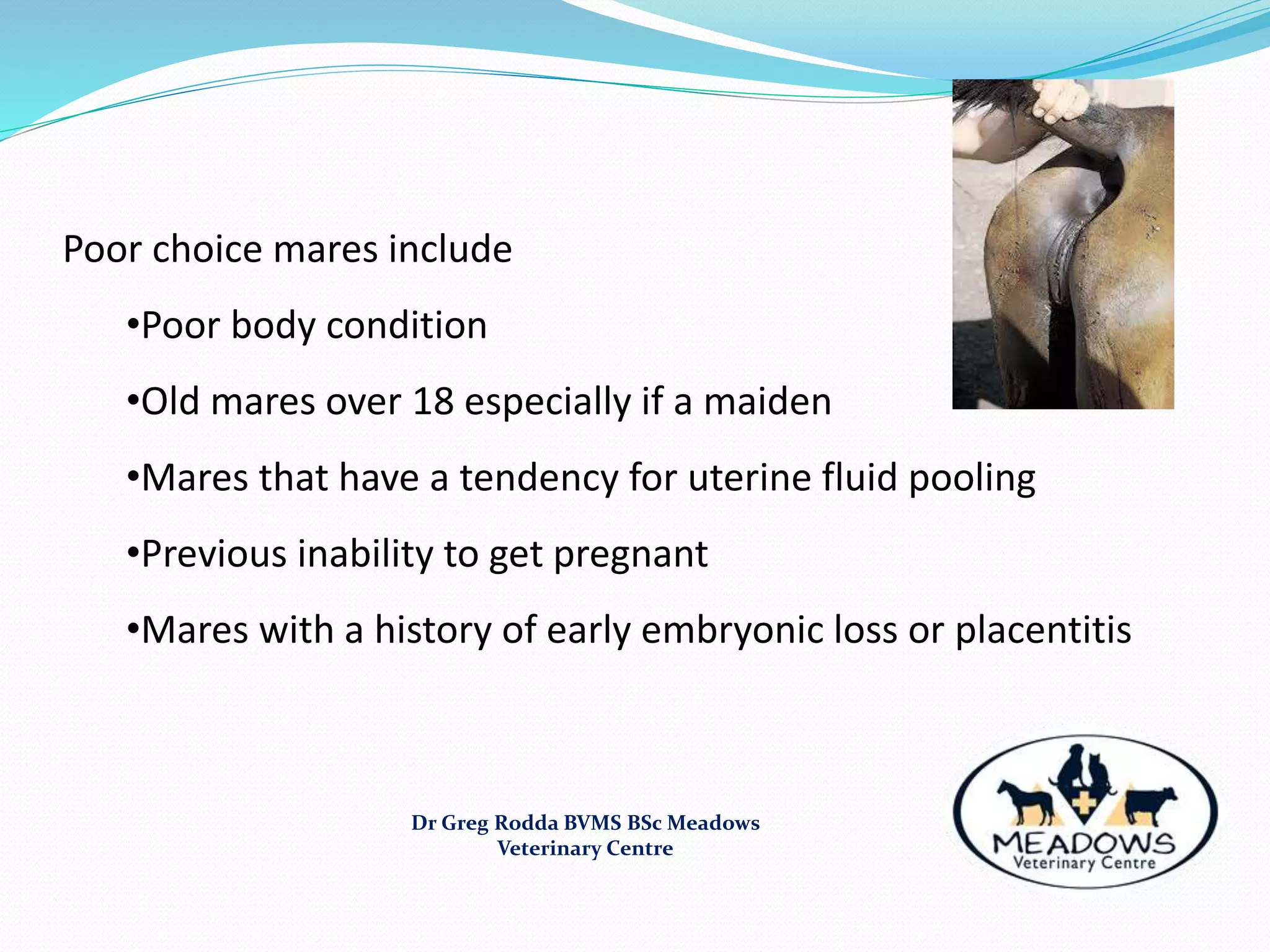
Poor choice mares include
•Poor body condition
•Old mares over 18 especially if a maiden
•Mares that have a tendency for uterine fluid pooling
•Previous inability to get pregnant
•Mares with a history of early embryonic loss or placentitis
Dr Greg Rodda BVMS BSc Meadows
Veterinary Centre
Mare’s Reproductive Cycle
 During ovulatory season (usually mid spring to early
autumn) repeated oestrus cycles of 21-22days
 3-7 days of oestrus (heat)
 15-17days of dioestrus where she
has a CL producing progesterone
 Follicle growth of approx 5mm per day
Dr Greg Rodda BVMS BSc Meadows
Veterinary Centre
 Once dominant follicle gets between 35mm to 38mm an
ovulatory drug is given
 Mare if she responds should ovulate 36-48 hours later
 Latest drug used causing ovulation at approx 39-41 hours
 These drugs are used to enable the best timing for
insemination
Dr Greg Rodda BVMS BSc Meadows
Veterinary Centre
 Winter – anoestrus small follicles not growing
 Transitional mares in Spring
 14 days on heat
 Follicles can regress
Dr Greg Rodda BVMS BSc Meadows
Veterinary Centre
Choosing a Stallion
Increase your chances by choosing carefully!
•Always ask about the fertility of the stallion eg
progressive motility
•Fertility of the selected stallion ie what is the number of
cycles per pregnancy – DO NOT rely on impressive under
the microscope reports of how good the semen looks!
The only real test is whether the semen achieves a
pregnancy!
Dr Greg Rodda BVMS BSc Meadows
Veterinary Centre
Bon Couer
• If the stallion is becoming older do not rely on past
fertility results – be aware that as a stallion ages fertility
may decrease!
• With frozen semen ask about post thaw motility but be
aware that pregnancies can still be achieved with low
post thaw motility & also that excellent post thaw
motility may not produce a pregnancy!
Dr Greg Rodda BVMS BSc Meadows
Veterinary Centre
Chilled Semen Collection & Transport
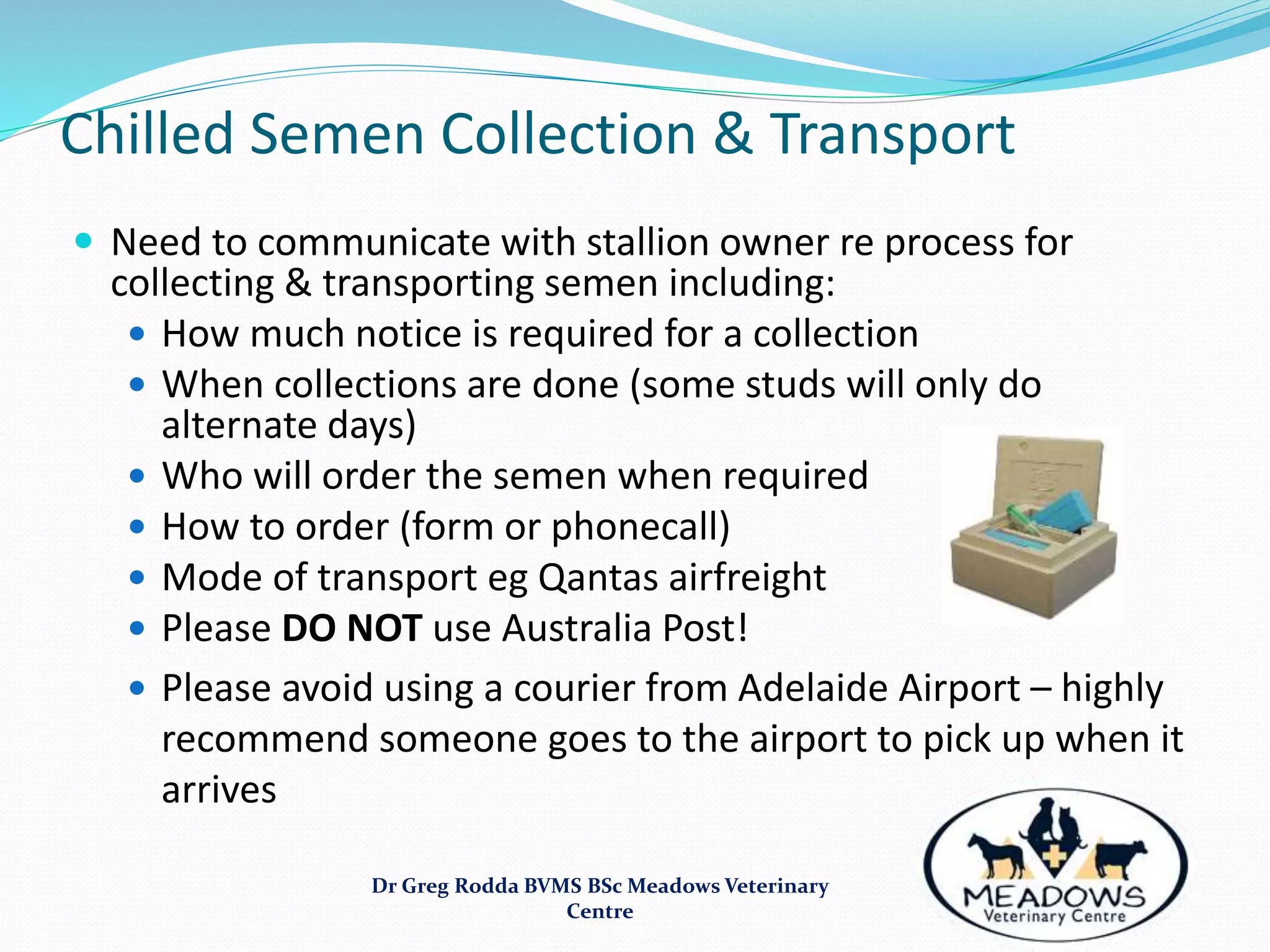
 Need to communicate with stallion owner re process for
collecting & transporting semen including:
 How much notice is required for a collection
 When collections are done (some studs will only do
alternate days)
 Who will order the semen when required
 How to order (form or phonecall)
 Mode of transport eg Qantas airfreight
 Please DO NOT use Australia Post!
 Please avoid using a courier from Adelaide Airport – highly
recommend someone goes to the airport to pick up when it
arrives
Dr Greg Rodda BVMS BSc Meadows Veterinary
Centre
Frozen Semen Transport & Storage
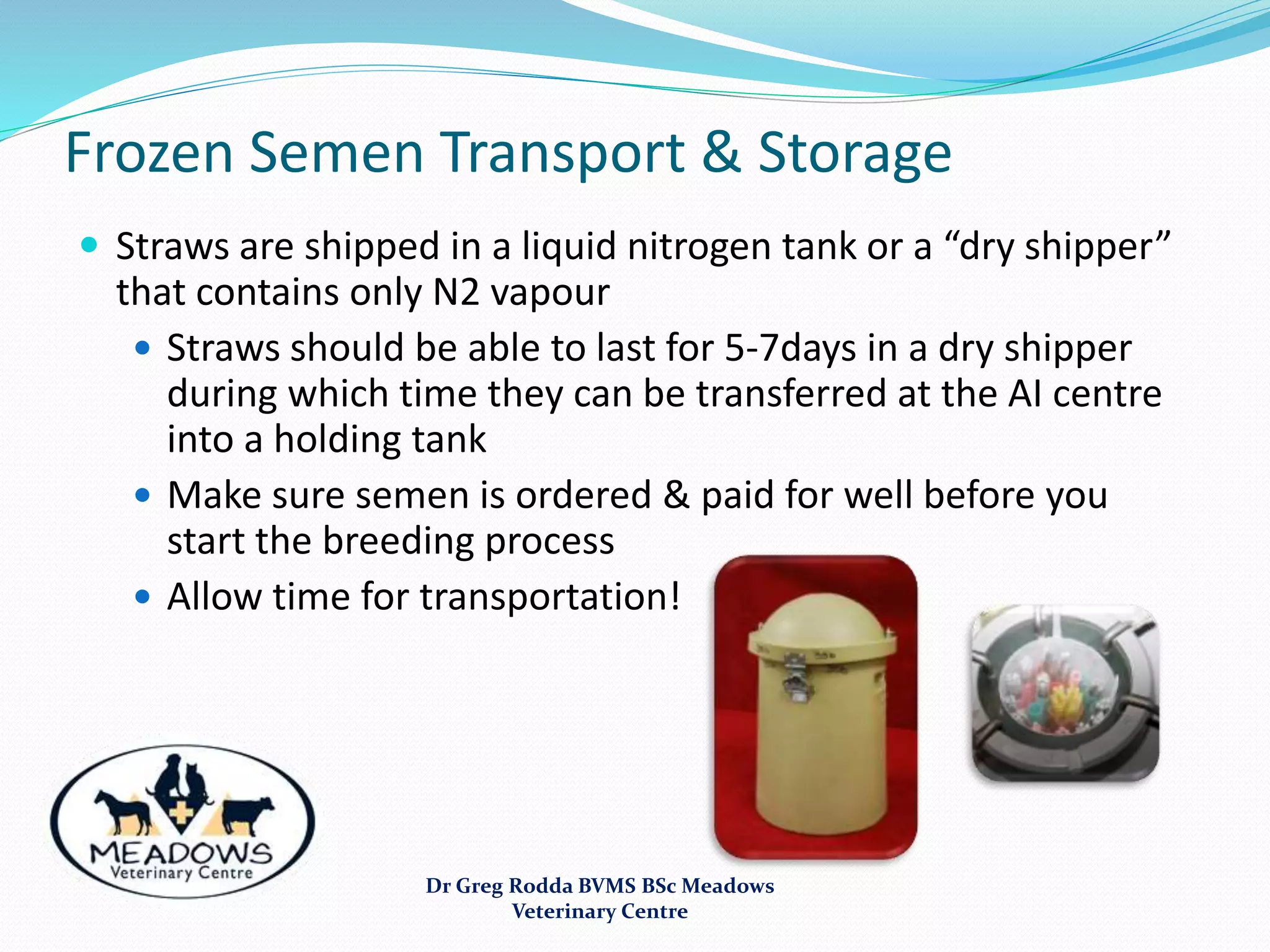
 Straws are shipped in a liquid nitrogen tank or a “dry shipper”
that contains only N2 vapour
 Straws should be able to last for 5-7days in a dry shipper
during which time they can be transferred at the AI centre
into a holding tank
 Make sure semen is ordered & paid for well before you
start the breeding process
 Allow time for transportation!
Dr Greg Rodda BVMS BSc Meadows
Veterinary Centre
Timing of Insemination
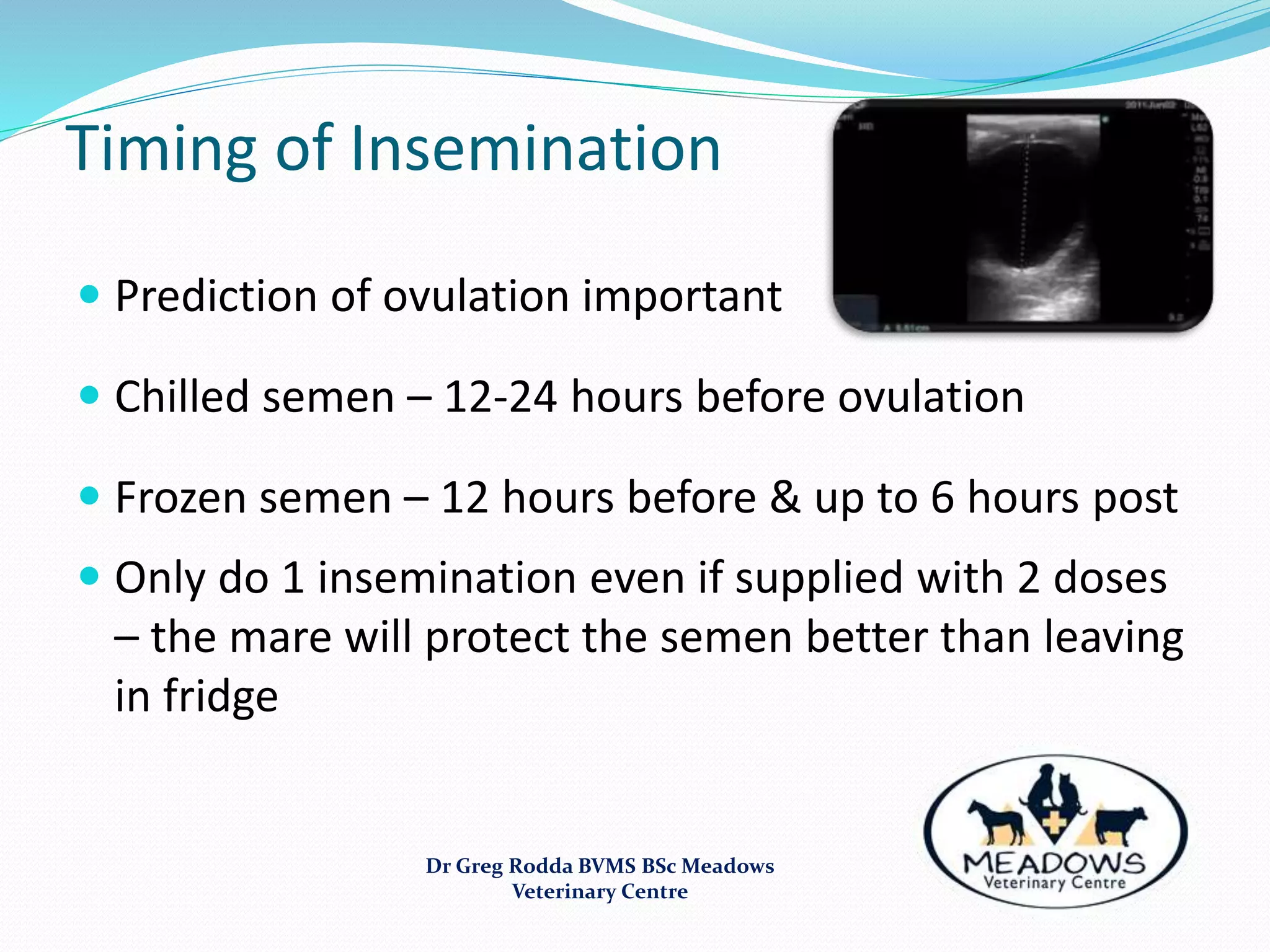
 Prediction of ovulation important
 Chilled semen – 12-24 hours before ovulation
 Frozen semen – 12 hours before & up to 6 hours post
 Only do 1 insemination even if supplied with 2 doses
– the mare will protect the semen better than leaving
in fridge
Dr Greg Rodda BVMS BSc Meadows
Veterinary Centre
 Need 1 billion sperm per insemination
 Every insemination may induce a inflammatory response
 All instruments in contact with semen are warmed
 Motility of semen is assessed under a microscope on a
warm (37 degrees) slide
 Hope to see 70-80% progressively motile sperm
Dr Greg Rodda BVMS BSc Meadows
Veterinary Centre
After the Insemination
 A) Chilled Insemination
 Scan to make sure no fluid is present & ovulation has occurred
 Oxytocin use
 B) Frozen Insemination
 Scan – for fluid
 Treatments including flushing, use of Oxytocin & other medications are
often used as needed
 If fluid pooling is an issue treatments can be given for up to 3 days
 Mares can then go home
 First pregnancy scan day 15 – 16 days post insemination
 Then day 27
 Finally day 45
Dr Greg Rodda BVMS BSc Meadows
Veterinary Centre
Embryo Transfer
 Involves the flushing of an embryo from a mare (donor)
that has been inseminated & then placing the embryo
into another mare (the recipient) to carry, give birth &
raise.
 Easy! – not quite!
 Recipient mare selection & timing is crucial!
Dr Greg Rodda BVMS BSc Meadows
Veterinary Centre
Recipient Selection
 Mares need to be:
 In good health
 Easy to handle
 500kgs
 4-10 years (younger the better)
 Sound breeding condition with a good breeding history
 Disease free
 Normal on repro exam & uterine biopsy
 We recommend a minimum of 3 mares if client is using own
mares but more is better
 Can flush embryos & transport to large recip herds in
Victoria
Dr Greg Rodda BVMS BSc Meadows
Veterinary Centre
Synchronisation
 It is essential by using drugs to get all the mares ovulating at
around the same time as the donor or 1 day before or up to 3
days after
 Donor mare is inseminated with the usual protocol &
treatments
 For ET work please make sure all mares including the donor
are able to be easily injected as many injections are involved!
 (BEVA – great videos on clicker training to overcome head &
needle shy horses!)
Dr Greg Rodda BVMS BSc Meadows
Veterinary Centre
Meadows Vet Centre
Equine Facilities
Dr Greg Rodda BVMS BSc Meadows
Veterinary Centre

Equine Artificial Reproduction: Increasing your changes for a successful outcome #horsebreeding

  • 1.
    Increasing Your Chancesfor a Successful Outcome Dr Greg Rodda BVMS BSc Meadows Veterinary Centre
  • 2.
    Introduction  In 1957the first foal was born as a result of frozen semen  For Artificial Insemination (AI) the likelihood of success with a fertile mare & good quality semen in Australia are  Chilled semen – pregnancy rates of 70-80% per cycle  Frozen semen- pregnancy rates of 45-50% per cycle Dr Greg Rodda BVMS BSc Meadows Veterinary Centre
  • 3.
    Three Most ImportantComponents of working together to achieve a successful outcome are: •Knowledge •Communication •Timing Dr Greg Rodda BVMS BSc Meadows Veterinary Centre
  • 4.
    Guide to Selectinga Mare for Insemination Good Choice of Mare:  Good reproductive history  Good vulval conformation  Good health status including worming & dental  Normal findings on pre breeding reproductive exam via ultrasound & uterine swab for non maiden mares  Less than 18 years especially maidens! Dr Greg Rodda BVMS BSc Meadows Veterinary Centre
  • 5.
    Poor choice maresinclude •Poor body condition •Old mares over 18 especially if a maiden •Mares that have a tendency for uterine fluid pooling •Previous inability to get pregnant •Mares with a history of early embryonic loss or placentitis Dr Greg Rodda BVMS BSc Meadows Veterinary Centre
  • 6.
    Mare’s Reproductive Cycle During ovulatory season (usually mid spring to early autumn) repeated oestrus cycles of 21-22days  3-7 days of oestrus (heat)  15-17days of dioestrus where she has a CL producing progesterone  Follicle growth of approx 5mm per day Dr Greg Rodda BVMS BSc Meadows Veterinary Centre
  • 7.
     Once dominantfollicle gets between 35mm to 38mm an ovulatory drug is given  Mare if she responds should ovulate 36-48 hours later  Latest drug used causing ovulation at approx 39-41 hours  These drugs are used to enable the best timing for insemination Dr Greg Rodda BVMS BSc Meadows Veterinary Centre
  • 8.
     Winter –anoestrus small follicles not growing  Transitional mares in Spring  14 days on heat  Follicles can regress Dr Greg Rodda BVMS BSc Meadows Veterinary Centre
  • 9.
    Choosing a Stallion Increaseyour chances by choosing carefully! •Always ask about the fertility of the stallion eg progressive motility •Fertility of the selected stallion ie what is the number of cycles per pregnancy – DO NOT rely on impressive under the microscope reports of how good the semen looks! The only real test is whether the semen achieves a pregnancy! Dr Greg Rodda BVMS BSc Meadows Veterinary Centre Bon Couer
  • 10.
    • If thestallion is becoming older do not rely on past fertility results – be aware that as a stallion ages fertility may decrease! • With frozen semen ask about post thaw motility but be aware that pregnancies can still be achieved with low post thaw motility & also that excellent post thaw motility may not produce a pregnancy! Dr Greg Rodda BVMS BSc Meadows Veterinary Centre
  • 11.
    Chilled Semen Collection& Transport  Need to communicate with stallion owner re process for collecting & transporting semen including:  How much notice is required for a collection  When collections are done (some studs will only do alternate days)  Who will order the semen when required  How to order (form or phonecall)  Mode of transport eg Qantas airfreight  Please DO NOT use Australia Post!  Please avoid using a courier from Adelaide Airport – highly recommend someone goes to the airport to pick up when it arrives Dr Greg Rodda BVMS BSc Meadows Veterinary Centre
  • 12.
    Frozen Semen Transport& Storage  Straws are shipped in a liquid nitrogen tank or a “dry shipper” that contains only N2 vapour  Straws should be able to last for 5-7days in a dry shipper during which time they can be transferred at the AI centre into a holding tank  Make sure semen is ordered & paid for well before you start the breeding process  Allow time for transportation! Dr Greg Rodda BVMS BSc Meadows Veterinary Centre
  • 13.
    Timing of Insemination Prediction of ovulation important  Chilled semen – 12-24 hours before ovulation  Frozen semen – 12 hours before & up to 6 hours post  Only do 1 insemination even if supplied with 2 doses – the mare will protect the semen better than leaving in fridge Dr Greg Rodda BVMS BSc Meadows Veterinary Centre
  • 14.
     Need 1billion sperm per insemination  Every insemination may induce a inflammatory response  All instruments in contact with semen are warmed  Motility of semen is assessed under a microscope on a warm (37 degrees) slide  Hope to see 70-80% progressively motile sperm Dr Greg Rodda BVMS BSc Meadows Veterinary Centre
  • 15.
    After the Insemination A) Chilled Insemination  Scan to make sure no fluid is present & ovulation has occurred  Oxytocin use  B) Frozen Insemination  Scan – for fluid  Treatments including flushing, use of Oxytocin & other medications are often used as needed  If fluid pooling is an issue treatments can be given for up to 3 days  Mares can then go home  First pregnancy scan day 15 – 16 days post insemination  Then day 27  Finally day 45 Dr Greg Rodda BVMS BSc Meadows Veterinary Centre
  • 16.
    Embryo Transfer  Involvesthe flushing of an embryo from a mare (donor) that has been inseminated & then placing the embryo into another mare (the recipient) to carry, give birth & raise.  Easy! – not quite!  Recipient mare selection & timing is crucial! Dr Greg Rodda BVMS BSc Meadows Veterinary Centre
  • 17.
    Recipient Selection  Maresneed to be:  In good health  Easy to handle  500kgs  4-10 years (younger the better)  Sound breeding condition with a good breeding history  Disease free  Normal on repro exam & uterine biopsy  We recommend a minimum of 3 mares if client is using own mares but more is better  Can flush embryos & transport to large recip herds in Victoria Dr Greg Rodda BVMS BSc Meadows Veterinary Centre
  • 18.
    Synchronisation  It isessential by using drugs to get all the mares ovulating at around the same time as the donor or 1 day before or up to 3 days after  Donor mare is inseminated with the usual protocol & treatments  For ET work please make sure all mares including the donor are able to be easily injected as many injections are involved!  (BEVA – great videos on clicker training to overcome head & needle shy horses!) Dr Greg Rodda BVMS BSc Meadows Veterinary Centre
  • 19.
    Meadows Vet Centre EquineFacilities Dr Greg Rodda BVMS BSc Meadows Veterinary Centre