
Oestrus synchronization and AI as tools for rapid dissemination of
improved sheep genotypes
EIAR/ATA/ICARDA Workshop on small ruminant breeding programs in Ethiopia
Debre Birhan, 17-18 December, 2015
Zeleke Mekuriaw
LIVES project, ILRI
Outline
 Introduction
 Merits of oestrus synchronization
 Common oestrus synchronization agents
 AI in shoats
 Experiences in oestrus synchronization & AI in shoats
 Lessons drawn and conclusion
2
Introduction
• Naturally, mating & lambing in a flock occurs in scattered manner
• Reduces production, productivity & profitability
• Artificial manipulation of reproduction is very important
• Oestrus synchronization & Artificial insemination major management &
breeding tools
3
Merits of oestrus synchronization
• Reduces time & labour for heat detection
• Facilitates application of fixed time AI
• Enables programed mating
• Enables programed lambing (targeting feed availability, market, health)
• Improves life time productivity of the ewes by inducing ovarian activity in
anoestrus ewes & pre-pubertal ewe lambs
4
Merits …
• Age uniformity in lambs (fore selling, feeding & healthcare)
• Physiological similarity of ewes (for feeding management)
• Enables efficient use of few genetically superior rams
5
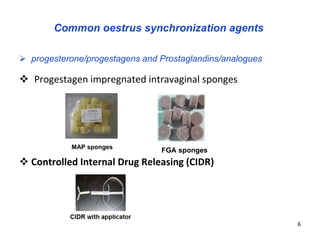
Common oestrus synchronization agents
 progesterone/progestagens and Prostaglandins/analogues
 Progestagen impregnated intravaginal sponges
 Controlled Internal Drug Releasing (CIDR)
MAP sponges
FGA sponges
6
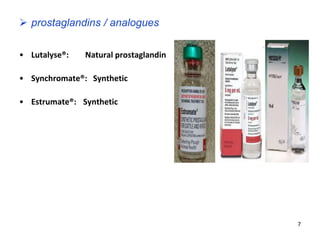
 prostaglandins / analogues
• Lutalyse®: Natural prostaglandin
• Synchromate®: Synthetic
• Estrumate®: Synthetic
7
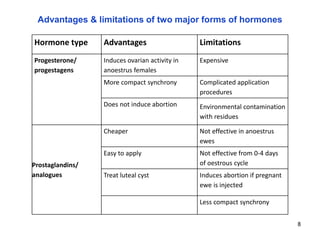
Advantages & limitations of two major forms of hormones
8
Hormone type Advantages Limitations
Progesterone/
progestagens
Induces ovarian activity in
anoestrus females
Expensive
More compact synchrony Complicated application
procedures
Does not induce abortion Environmental contamination
with residues
Prostaglandins/
analogues
Cheaper Not effective in anoestrus
ewes
Easy to apply Not effective from 0-4 days
of oestrous cycle
Treat luteal cyst Induces abortion if pregnant
ewe is injected
Less compact synchrony
Artificial insemination in sheep
 AI : Key breeding tool for efficient use of superior rams
 Two forms of semen are used:
 Frozen semen
 Effective when trans-cervical or uterine insemination
used (laparoscopy technique)
 Low fertility when cervical insemination is used
 Difficulty in penetrating cervical canal in sheep
 Fresh diluted semen:
 Effective for cervical insemination
 Can be used for about 10 hrs at +150c
 Fixed time insemination at 48 and 60hrs if double or at
55±1hr post sponge removal if once.
 Insemination at observed heat (15-17hrs after onset of
heat)
Experience in oestrus synchronization & AI of shoats
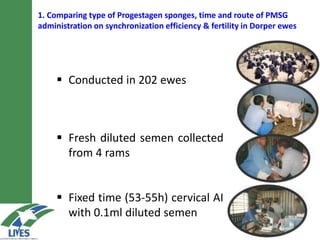
 Conducted in 202 ewes
 Fresh diluted semen collected
from 4 rams
 Fixed time (53-55h) cervical AI
with 0.1ml diluted semen
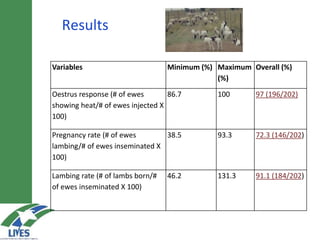
1. Comparing type of Progestagen sponges, time and route of PMSG
administration on synchronization efficiency & fertility in Dorper ewes
Variables Minimum (%) Maximum
(%)
Overall (%)
Oestrus response (# of ewes
showing heat/# of ewes injected X
100)
86.7 100 97 (196/202)
Pregnancy rate (# of ewes
lambing/# of ewes inseminated X
100)
38.5 93.3 72.3 (146/202)
Lambing rate (# of lambs born/#
of ewes inseminated X 100)
46.2 131.3 91.1 (184/202)
Results
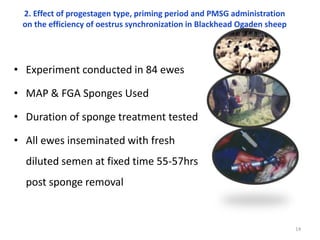
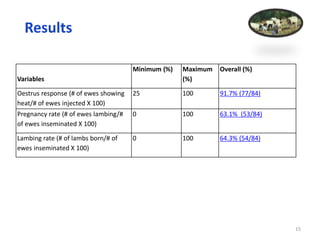
2. Effect of progestagen type, priming period and PMSG administration
on the efficiency of oestrus synchronization in Blackhead Ogaden sheep
• Experiment conducted in 84 ewes
• MAP & FGA Sponges Used
• Duration of sponge treatment tested
• All ewes inseminated with fresh
diluted semen at fixed time 55-57hrs
post sponge removal
14
Variables
Minimum (%) Maximum
(%)
Overall (%)
Oestrus response (# of ewes showing
heat/# of ewes injected X 100)
25 100 91.7% (77/84)
Pregnancy rate (# of ewes lambing/#
of ewes inseminated X 100)
0 100 63.1% (53/84)
Lambing rate (# of lambs born/# of
ewes inseminated X 100)
0 100 64.3% (54/84)
Results
15
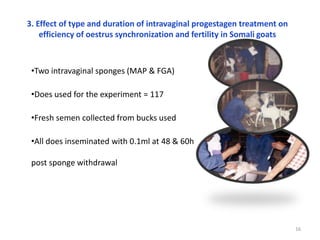
3. Effect of type and duration of intravaginal progestagen treatment on
efficiency of oestrus synchronization and fertility in Somali goats
•Two intravaginal sponges (MAP & FGA)
•Does used for the experiment = 117
•Fresh semen collected from bucks used
•All does inseminated with 0.1ml at 48 & 60h
post sponge withdrawal
16
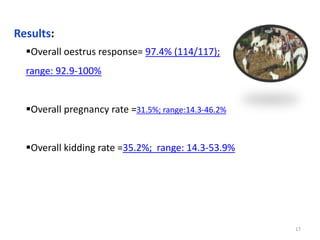
Results:
Overall oestrus response= 97.4% (114/117);
range: 92.9-100%
Overall pregnancy rate =31.5%; range:14.3-46.2%
Overall kidding rate =35.2%; range: 14.3-53.9%
17
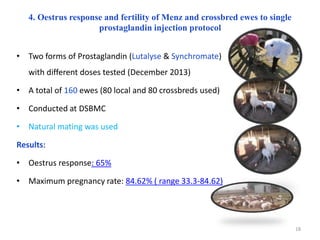
4. Oestrus response and fertility of Menz and crossbred ewes to single
prostaglandin injection protocol
• Two forms of Prostaglandin (Lutalyse & Synchromate)
with different doses tested (December 2013)
• A total of 160 ewes (80 local and 80 crossbreds used)
• Conducted at DSBMC
• Natural mating was used
Results:
• Oestrus response: 65%
• Maximum pregnancy rate: 84.62% ( range 33.3-84.62)
18
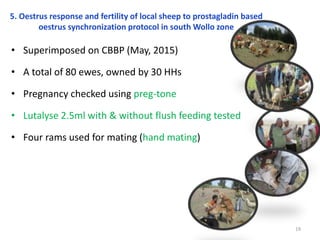
5. Oestrus response and fertility of local sheep to prostagladin based
oestrus synchronization protocol in south Wollo zone
• Superimposed on CBBP (May, 2015)
• A total of 80 ewes, owned by 30 HHs
• Pregnancy checked using preg-tone
• Lutalyse 2.5ml with & without flush feeding tested
• Four rams used for mating (hand mating)
19
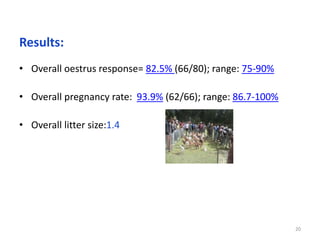
Results:
• Overall oestrus response= 82.5% (66/80); range: 75-90%
• Overall pregnancy rate: 93.9% (62/66); range: 86.7-100%
• Overall litter size:1.4
20
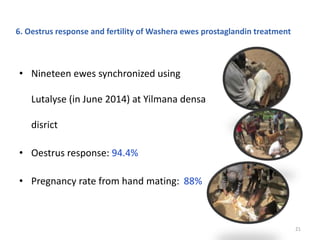
6. Oestrus response and fertility of Washera ewes prostaglandin treatment
• Nineteen ewes synchronized using
Lutalyse (in June 2014) at Yilmana densa
disrict
• Oestrus response: 94.4%
• Pregnancy rate from hand mating: 88%
21
7. Oestrus response and fertility of Washera sheep to
Prostaglandin treatment
• Total of 66 ewes synchronized at Mecha district using
Lutalyse
• Conception rate: 67% (44/66)
• Not yet lambed
• Challenge shortage of rams
22
8. Tigrai region
• Number of ewes synchronized: 125
• hormone used: Synchromate
• Oestrus response: 44% (55/125)
• Pregnancy rate: 50.1% (28/55)
• Lambing not yet completed
23
9. Debre Berhan Sheep Research Center
24
• Number of ewes synchronized: 86
• Progestagen and prostaglandin used in conjunction with GnRH
• Lambing rate: 82.6% (71/86) (range: 70.4-89.7
Lessons drawn and conclusion
• Local ewes & does are responsive to prostaglandin or progestagen
treatments
• Use of prostaglandin is preferable to Progestagen (cheaper, easy to
apply, more available)
• Accurate early pregnancy detection technologies are mandatory
• Availing proven breeding rams/bucks for the community is important
(Appropriate ram/buck service delivery modalities need to be
developed)
• Hand mating is preferable to random mating since it enables economic
use of few superior sires
• Flush feeding improved oestrus response, pregnancy rate and litter size
 Insemination using fresh diluted semen has a
potential role in speeding up genetic gains provided
that:
• Facilities for semen collection & insemination fulfilled
• Capacity of technicians built
o Facilities being constructed for cattle can be used with
few additions
 Use of frozen semen may be an alternative strategy only for
introducing new genotypes from abroad since it is cheaper than
introducing live rams
Lessons drawn…
The presentation has a Creative Commons licence. You are free to re-use or distribute this work, provided credit is given to ILRI.
www.lives-ethiopia.org

Oestrus synchronization and AI as tools for rapid dissemination of improved sheep genotypes

  • 1.
    Oestrus synchronization andAI as tools for rapid dissemination of improved sheep genotypes EIAR/ATA/ICARDA Workshop on small ruminant breeding programs in Ethiopia Debre Birhan, 17-18 December, 2015 Zeleke Mekuriaw LIVES project, ILRI
  • 2.
    Outline  Introduction  Meritsof oestrus synchronization  Common oestrus synchronization agents  AI in shoats  Experiences in oestrus synchronization & AI in shoats  Lessons drawn and conclusion 2
  • 3.
    Introduction • Naturally, mating& lambing in a flock occurs in scattered manner • Reduces production, productivity & profitability • Artificial manipulation of reproduction is very important • Oestrus synchronization & Artificial insemination major management & breeding tools 3
  • 4.
    Merits of oestrussynchronization • Reduces time & labour for heat detection • Facilitates application of fixed time AI • Enables programed mating • Enables programed lambing (targeting feed availability, market, health) • Improves life time productivity of the ewes by inducing ovarian activity in anoestrus ewes & pre-pubertal ewe lambs 4
  • 5.
    Merits … • Ageuniformity in lambs (fore selling, feeding & healthcare) • Physiological similarity of ewes (for feeding management) • Enables efficient use of few genetically superior rams 5
  • 6.
    Common oestrus synchronizationagents  progesterone/progestagens and Prostaglandins/analogues  Progestagen impregnated intravaginal sponges  Controlled Internal Drug Releasing (CIDR) MAP sponges FGA sponges 6
  • 7.
     prostaglandins /analogues • Lutalyse®: Natural prostaglandin • Synchromate®: Synthetic • Estrumate®: Synthetic 7
  • 8.
    Advantages & limitationsof two major forms of hormones 8 Hormone type Advantages Limitations Progesterone/ progestagens Induces ovarian activity in anoestrus females Expensive More compact synchrony Complicated application procedures Does not induce abortion Environmental contamination with residues Prostaglandins/ analogues Cheaper Not effective in anoestrus ewes Easy to apply Not effective from 0-4 days of oestrous cycle Treat luteal cyst Induces abortion if pregnant ewe is injected Less compact synchrony
  • 9.
    Artificial insemination insheep  AI : Key breeding tool for efficient use of superior rams  Two forms of semen are used:  Frozen semen  Effective when trans-cervical or uterine insemination used (laparoscopy technique)  Low fertility when cervical insemination is used  Difficulty in penetrating cervical canal in sheep
  • 10.
     Fresh dilutedsemen:  Effective for cervical insemination  Can be used for about 10 hrs at +150c  Fixed time insemination at 48 and 60hrs if double or at 55±1hr post sponge removal if once.  Insemination at observed heat (15-17hrs after onset of heat)
  • 11.
    Experience in oestrussynchronization & AI of shoats
  • 12.
     Conducted in202 ewes  Fresh diluted semen collected from 4 rams  Fixed time (53-55h) cervical AI with 0.1ml diluted semen 1. Comparing type of Progestagen sponges, time and route of PMSG administration on synchronization efficiency & fertility in Dorper ewes
  • 13.
    Variables Minimum (%)Maximum (%) Overall (%) Oestrus response (# of ewes showing heat/# of ewes injected X 100) 86.7 100 97 (196/202) Pregnancy rate (# of ewes lambing/# of ewes inseminated X 100) 38.5 93.3 72.3 (146/202) Lambing rate (# of lambs born/# of ewes inseminated X 100) 46.2 131.3 91.1 (184/202) Results
  • 14.
    2. Effect ofprogestagen type, priming period and PMSG administration on the efficiency of oestrus synchronization in Blackhead Ogaden sheep • Experiment conducted in 84 ewes • MAP & FGA Sponges Used • Duration of sponge treatment tested • All ewes inseminated with fresh diluted semen at fixed time 55-57hrs post sponge removal 14
  • 15.
    Variables Minimum (%) Maximum (%) Overall(%) Oestrus response (# of ewes showing heat/# of ewes injected X 100) 25 100 91.7% (77/84) Pregnancy rate (# of ewes lambing/# of ewes inseminated X 100) 0 100 63.1% (53/84) Lambing rate (# of lambs born/# of ewes inseminated X 100) 0 100 64.3% (54/84) Results 15
  • 16.
    3. Effect oftype and duration of intravaginal progestagen treatment on efficiency of oestrus synchronization and fertility in Somali goats •Two intravaginal sponges (MAP & FGA) •Does used for the experiment = 117 •Fresh semen collected from bucks used •All does inseminated with 0.1ml at 48 & 60h post sponge withdrawal 16
  • 17.
    Results: Overall oestrus response=97.4% (114/117); range: 92.9-100% Overall pregnancy rate =31.5%; range:14.3-46.2% Overall kidding rate =35.2%; range: 14.3-53.9% 17
  • 18.
    4. Oestrus responseand fertility of Menz and crossbred ewes to single prostaglandin injection protocol • Two forms of Prostaglandin (Lutalyse & Synchromate) with different doses tested (December 2013) • A total of 160 ewes (80 local and 80 crossbreds used) • Conducted at DSBMC • Natural mating was used Results: • Oestrus response: 65% • Maximum pregnancy rate: 84.62% ( range 33.3-84.62) 18
  • 19.
    5. Oestrus responseand fertility of local sheep to prostagladin based oestrus synchronization protocol in south Wollo zone • Superimposed on CBBP (May, 2015) • A total of 80 ewes, owned by 30 HHs • Pregnancy checked using preg-tone • Lutalyse 2.5ml with & without flush feeding tested • Four rams used for mating (hand mating) 19
  • 20.
    Results: • Overall oestrusresponse= 82.5% (66/80); range: 75-90% • Overall pregnancy rate: 93.9% (62/66); range: 86.7-100% • Overall litter size:1.4 20
  • 21.
    6. Oestrus responseand fertility of Washera ewes prostaglandin treatment • Nineteen ewes synchronized using Lutalyse (in June 2014) at Yilmana densa disrict • Oestrus response: 94.4% • Pregnancy rate from hand mating: 88% 21
  • 22.
    7. Oestrus responseand fertility of Washera sheep to Prostaglandin treatment • Total of 66 ewes synchronized at Mecha district using Lutalyse • Conception rate: 67% (44/66) • Not yet lambed • Challenge shortage of rams 22
  • 23.
    8. Tigrai region •Number of ewes synchronized: 125 • hormone used: Synchromate • Oestrus response: 44% (55/125) • Pregnancy rate: 50.1% (28/55) • Lambing not yet completed 23
  • 24.
    9. Debre BerhanSheep Research Center 24 • Number of ewes synchronized: 86 • Progestagen and prostaglandin used in conjunction with GnRH • Lambing rate: 82.6% (71/86) (range: 70.4-89.7
  • 25.
    Lessons drawn andconclusion • Local ewes & does are responsive to prostaglandin or progestagen treatments • Use of prostaglandin is preferable to Progestagen (cheaper, easy to apply, more available) • Accurate early pregnancy detection technologies are mandatory • Availing proven breeding rams/bucks for the community is important (Appropriate ram/buck service delivery modalities need to be developed) • Hand mating is preferable to random mating since it enables economic use of few superior sires • Flush feeding improved oestrus response, pregnancy rate and litter size
  • 26.
     Insemination usingfresh diluted semen has a potential role in speeding up genetic gains provided that: • Facilities for semen collection & insemination fulfilled • Capacity of technicians built o Facilities being constructed for cattle can be used with few additions  Use of frozen semen may be an alternative strategy only for introducing new genotypes from abroad since it is cheaper than introducing live rams Lessons drawn…
  • 28.
    The presentation hasa Creative Commons licence. You are free to re-use or distribute this work, provided credit is given to ILRI. www.lives-ethiopia.org