Identify
each
point of
issue
(stream)
- with
ISSN
Who is looking after your e-journals?
Telling Tales About The Keepers Registry
& Your Digital Shelves
Peter Burnhill (& Françoise Pelle)
EDINA, University of Edinburgh, UK
(ISSN International Centre / Centre International de l'ISSN, Paris, France)
http://creativecommons.org/licenses/by/3.0/
Adapted from presentation given to IFLA2013
+ some things I have learnt at iPrs2013
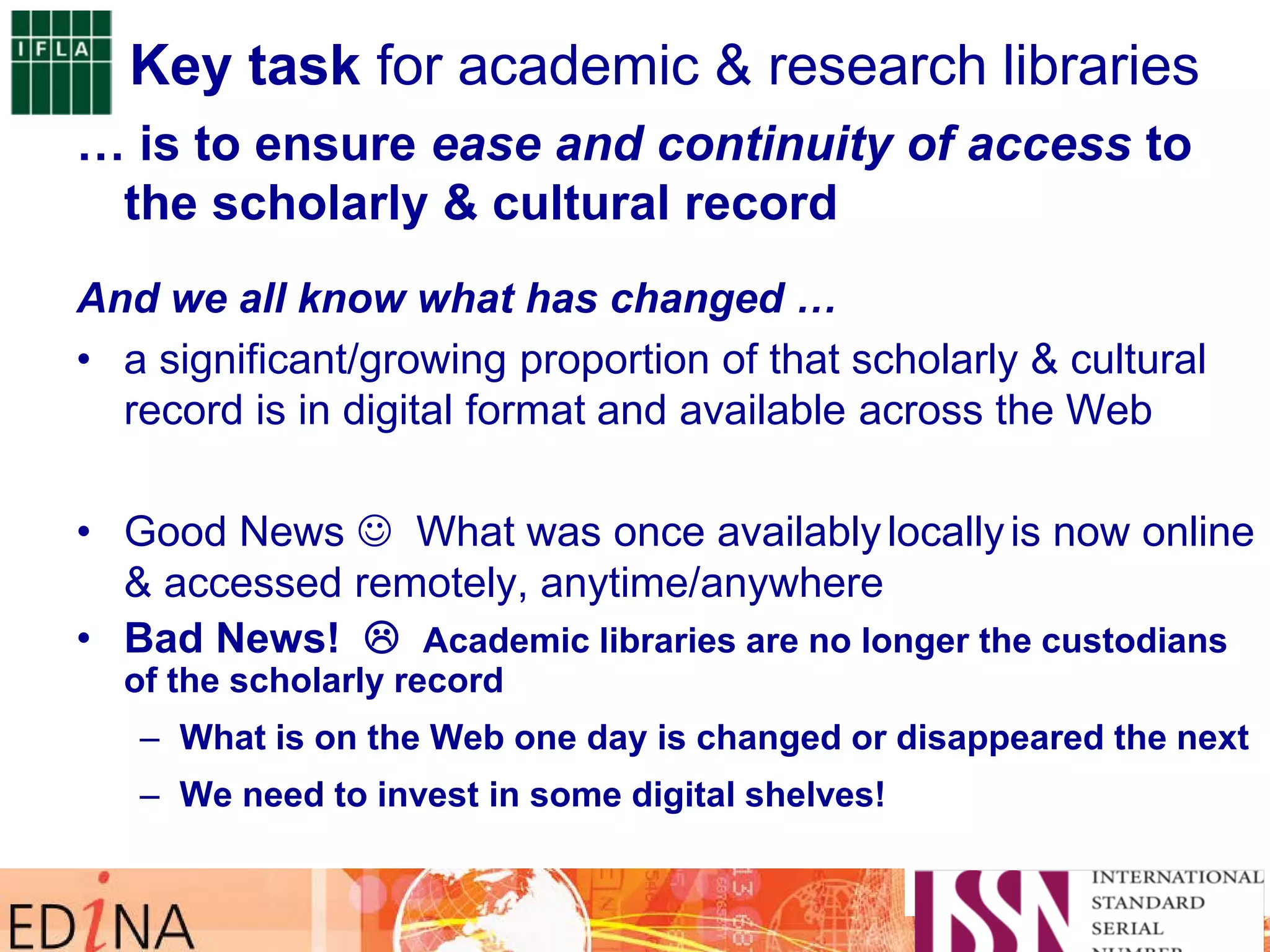
… is to ensure ease and continuity of access to
the scholarly & cultural record
And we all know what has changed …
• a significant/growing proportion of that scholarly & cultural
record is in digital format and available across the Web
• Good News  What was once availablylocallyis now online
& accessed remotely, anytime/anywhere
• Bad News!  Academic libraries are no longer the custodians
of the scholarly record
– What is on the Web one day is changed or disappeared the next
– We need to invest in some digital shelves!
Key task for academic & research libraries
Focus on international challenge of e-journals
Researchers (and therefore libraries) in any one country
are dependent upon content written and published in other countries
US.LoC 20%
UK.BL 10%
‘hidden’ e-journals:
low % ISSN
Netherlands
& Germany:
c. 4.5% each
Brazil 4%
%age of the 100,000 ISSN issued for e-serials
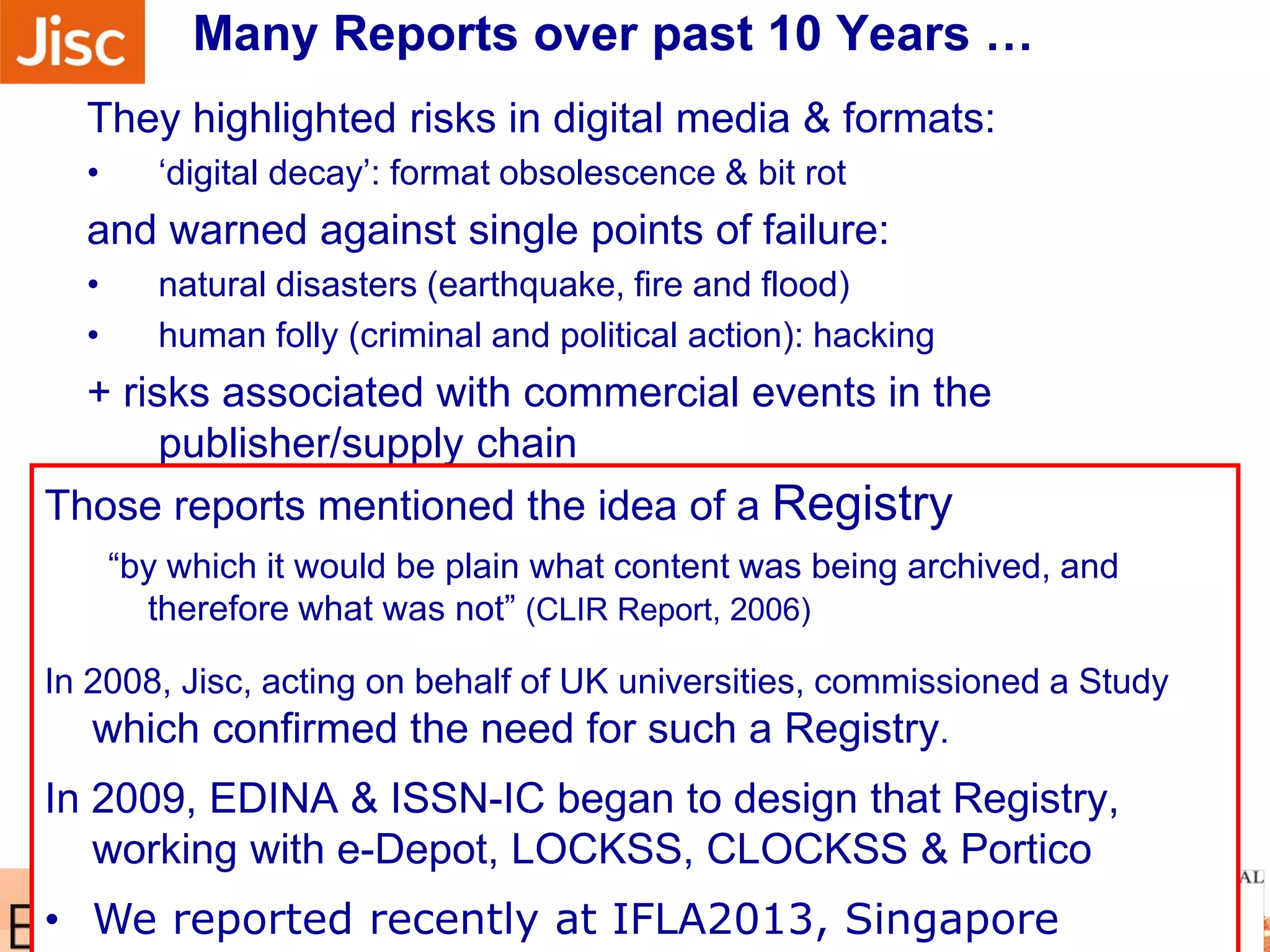
Many Reports over past 10 Years …
They highlighted risks in digital media & formats:
• ‘digital decay’: format obsolescence & bit rot
and warned against single points of failure:
• natural disasters (earthquake, fire and flood)
• human folly (criminal and political action): hacking
+ risks associated with commercial events in the
publisher/supply chain
• eDepot at Koninklijke Bibliotheek
• international significance (Elsevier & Kluwer) as well as national
role for The Netherlands)
• the LOCKSS project at Stanford University
• from which came CLOCKSS
• the Electronic-Archiving Initiative at JSTOR
• from which came Portico
… as early archiving initiatives emergedThose reports mentioned the idea of a Registry
“by which it would be plain what content was being archived, and
therefore what was not” (CLIR Report, 2006)
In 2008, Jisc, acting on behalf of UK universities, commissioned a Study
which confirmed the need for such a Registry.
In 2009, EDINA & ISSN-IC began to design that Registry,
working with e-Depot, LOCKSS, CLOCKSS & Portico
• We reported recently at IFLA2013, Singapore
ISSN
Register
E-J Preservation Registry Service
E-Journal
Preservation
Registry
SERVICES: user
requirements
(a)
(b)
Data
dependency
ISSN-L as
kernel field
METADATA
on extant e-journals
METADATA
on preservation action
ISSN Register at the heart of the Data Model
(Taken from Figure 1 in reference paper in Serials, March 2009)
Digital Preservation
Agencies
e.g. CLOCKSS, Portico; BL, KB;
UK LOCKSS Alliance etc.
http://thekeepers.org
Enter title
or ISSN
to search across metadata
reported by leading
archiving organisations
- Now include digitised journals
… to discover who is looking after what
7
… but coverage
of volumes is
partial & patchy
This e-journal is being archived
by 5 archiving agencies …
Example search: ‘Origins of Life’
… and discover details of its ‘archival status’
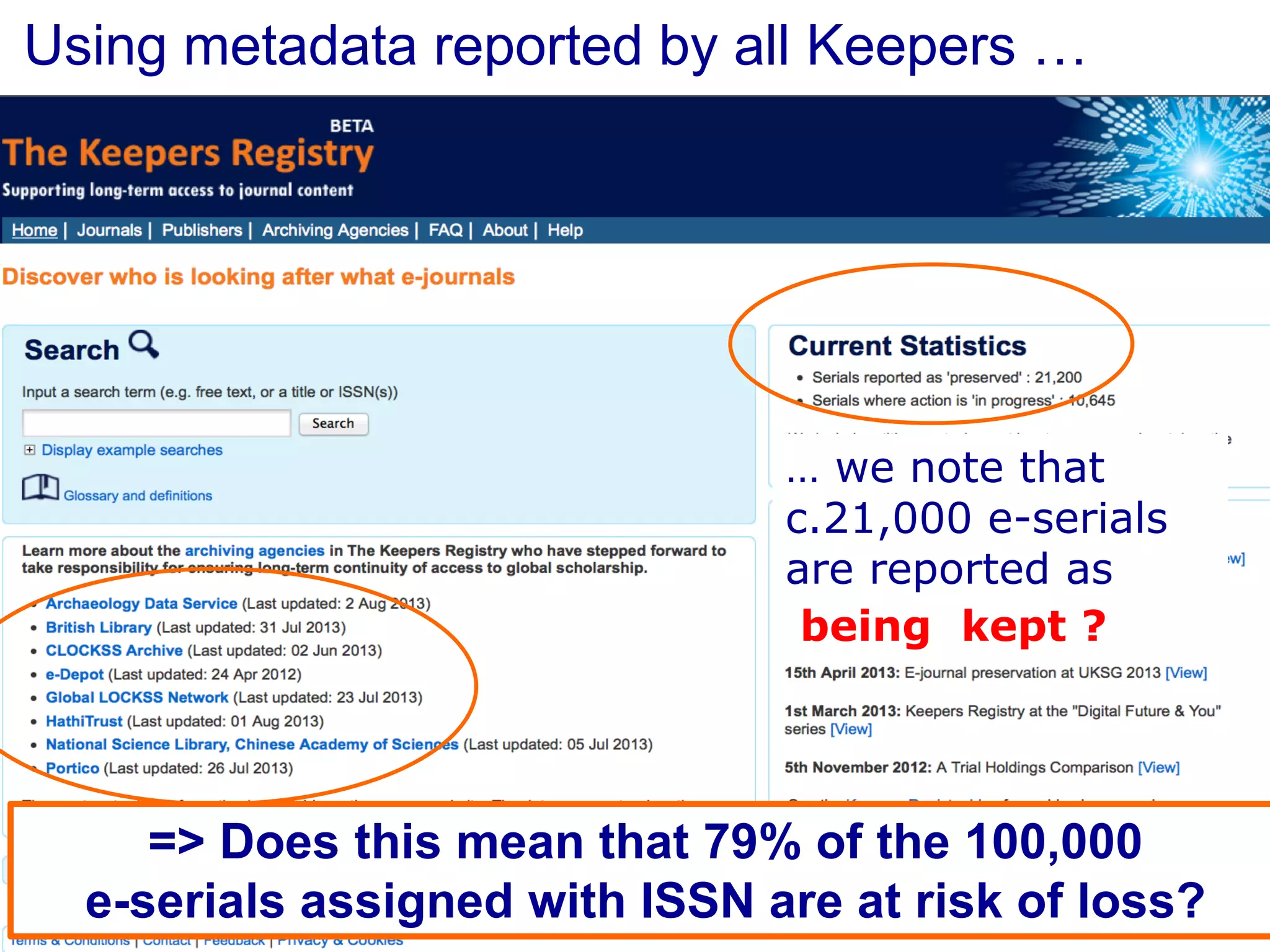
Using metadata reported by all Keepers …
… we note that
c.21,000 e-serials
are reported as
being ‘preserved’
=> Does this mean that 79% of the 100,000
e-serials assigned with ISSN are at risk of loss?
being kept ?
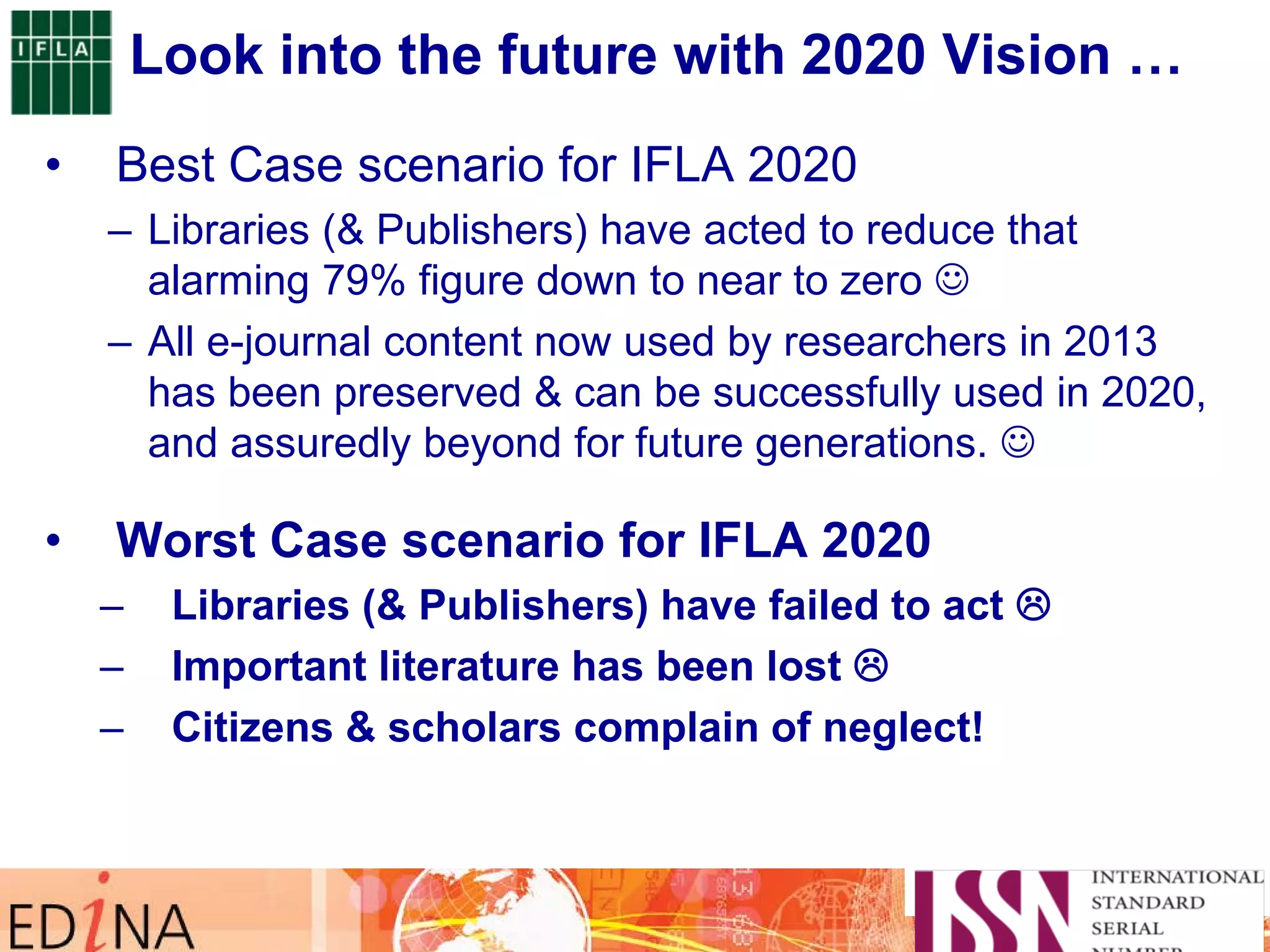
Look into the future with 2020 Vision …
• Best Case scenario for IFLA 2020
– Libraries (& Publishers) have acted to reduce that
alarming 79% figure down to near to zero 
– All e-journal content now used by researchers in 2013
has been preserved & can be successfully used in 2020,
and assuredly beyond for future generations. 
• Worst Case scenario for IFLA 2020
– Libraries (& Publishers) have failed to act 
– Important literature has been lost 
– Citizens & scholars complain of neglect!
Reminder about the real heroes in the story,
3 types of Keeper:
① web-scale not-for-profit archiving agencies
e.g. CLOCKSS Archive* & Portico* [*project start]
② national libraries (sometimes with legal deposit in mind)
e.g. e-Depot* (Netherlands); British Library*
& National Science Library of China
③ research libraries: consortia & specialist centres
e.g. Global LOCKSS Network*, HathiTrust,
Scholars Portal, Archaeology Data Service
*news* US Library of Congress in process of joining
Many archiving organisations is a Good Thing 
“Digital information is best preserved by replicating it at
multiple archives run by autonomous organizations”
B. Cooper and H. Garcia-Molina (2002)
The Keepers Registry acts as the global lens onto
their activity: so we can all know who is looking after
what, and what is still at risk …
Kaisu!
What does the Registry tell about progress?
• c.100,000 ISSN for online resources
– but expect / hope to identify many more
• Is there such thing as a ‘priority list’ of titles?
– c.30,000 refereed scholarly journals
• Do we look at on what individual libraries list?
– In 2012 we checked ‘archival status’ for 3 large university libraries
• Two key indicators: %age (& number) of titles that are ‘at risk of loss’
%age (& number) of titles that are ‘preserved by 3 or more Keepers’.
c.75%
‘at risk’
c.11%
kept by
3 or more
*news* In new release of the online Registry, each and every
library can ‘upload & compare’ to discover what of their
collection is ‘being kept’, or is ‘at risk of loss’.
What else can the Registry tell about progress?
• c.100,000 ISSN for online resources
– but expect / hope to identify many more
• Is there such thing as a ‘priority list’ of titles?
– c.30,000 refereed scholarly journals
• Do we look at on what individual libraries list?
– In 2012 we checked ‘archival status’ for 3 large university libraries
• Two key indicators: %age (& number) of titles that are ‘at risk of loss’
%age (& number) of titles that are ‘preserved by 3 or more Keepers’.
c.75%
‘at risk’
c.11%
held by
3 or more
Look at the problem from users’ point of view …
… with online usage (OpenURL requests) as guide to priority
*Latest but Provisional (so do not cite)*
Analysis of > 10.4m full text OpenURL requests by researchers and
student from 111 (of 160+) UK institutions in 2012 (using the UK OpenURL
Router logs and the ISSN-L to de-duplicate ISSN entries) shows:
53,311 online titles were consulted in 2012, of which:
only 14.7% (7,862) are ‘being kept’ by 3 or more Keepers
one third (32% : 16,985) by at least one; two thirds (68% : 36,326) held by none.
> 36,000 titles ‘at risk’ of loss 
• Check robustness with UK logs for 2011 & 2013 [and monitor annually]
• Assess generalisability with OpenURL logs for other countries
=> Support action: disclose the journals & the publishers!
Sidebar note on monitoring their progress …Your Priorities for The Keepers Registry?
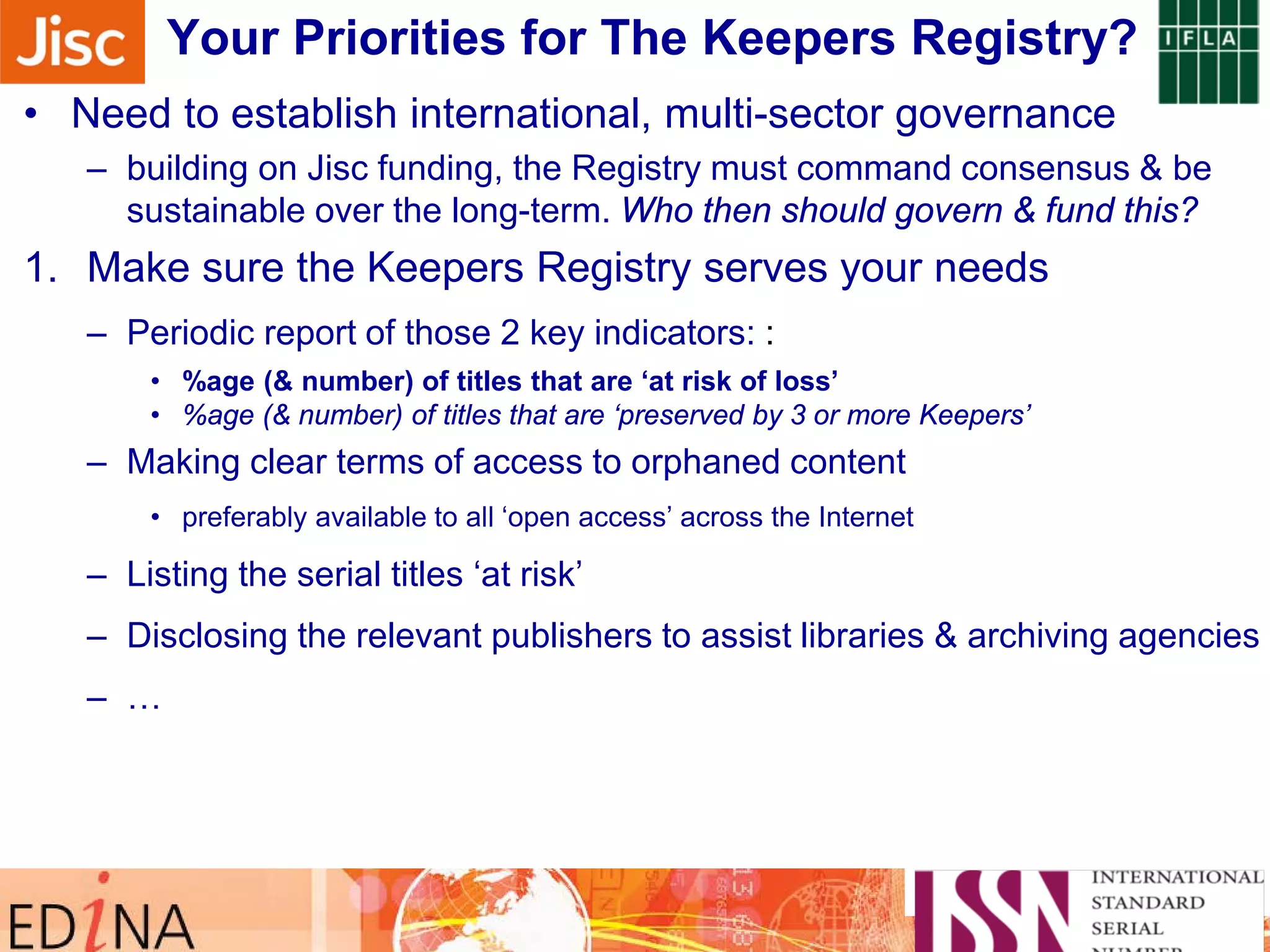
• Need to establish international, multi-sector governance
– building on Jisc funding, the Registry must command consensus & be
sustainable over the long-term. Who then should govern & fund this?
1. Make sure the Keepers Registry serves your needs
– Periodic report of those 2 key indicators: :
• %age (& number) of titles that are ‘at risk of loss’
• %age (& number) of titles that are ‘preserved by 3 or more Keepers’
– Making clear terms of access to orphaned content
• preferably available to all ‘open access’ across the Internet
– Listing the serial titles ‘at risk’
– Disclosing the relevant publishers to assist libraries & archiving agencies
– …
Sidebar note on monitoring their progress …Your Priorities for The Keepers Registry?
• Need to establish international, multi-sector governance
– building on Jisc funding, the Registry must command consensus & be
sustainable over the long-term. Who then should govern & fund this?
1. Make sure the Keepers Registry serves your needs
2. Close focus on volumes & issues: completeness takes hard work!
3. Assist the ISSN Network assign more ISSN [& start to use URN?]
– If it is worth preserving, it should have an identifier: ‘hidden e-journals’
4. Encourage more organisations to be Keepers in the Registry
– including every national library that acts as an archive
 The Registry is not an audit / certification authority but need for
eligibility checks for integrity of ‘archival intent’
5. Assist collaboration between Keepers in ‘a safe places
network’: many are meeting at iPres 2013 in Lisbon in September
– Yes lah!
• More and more scholarly statement is issued on the Web
• Often with no obvious ‘country of publication’
– New ‘scholarly objects’; rich in data or with dependent links to data
– Increasing use of HTTP URL/URI to cite resources & work of others
– Content at URI can and does change, or even cease to be
• R&D at Mellon-funded Hiberlink project at U. of Edinburgh / LANL
• and more and more is Open Access
– issued in OA journals or via repositories such as Arkiv
• and then there is the Internet Archive, and figshare, and ..
– Is someone else running the global library of the future?
 But still necessary to preserve e-journal content!
 Still sufficient in the mainstream, although should also engage with the ‘new now’
Surely, Scholarly Record is more than e-journals?
Securing the future with 2020 Vision…
Actions needed to achieve good news at IFLA 2020
– to reduce that alarming 75% ‘at risk’ figure down towards zero
• Individual actions by each research library
– give material support to one or more archiving agency
– consider an ‘archive clause’ in licences
• requiring publishers to deposit content with an archiving organisation
• As a coalition of research libraries & memory organisations
– to develop that model ‘archive clause’ requiring deposit with an archive
– to engage with publisher associations, internationally and nationally
• Many e-journals are from small publishers: ‘long tail problem’
• Role for consortia and/or subscription agents?
– to act globally, not leaving matters to each country
• Using legal deposit in national library as a back-up
• Use the Keepers Registry to monitor progress
Identify
each
content
stream
with an
ISSN
Or with
URN?
Thank you for listening
http://thekeepers.org
New release in September
* Legal Deposit: a sidebar note
Should we wait upon that and action by National Libraries?
• 44% national libraries had legislation in 2011 for e-books or e-
journals; expected to rise to 58% by June 2012.
• But only 27% [expected to rise to 37% by June 2012] actually
ingesting via legal deposit
 Others have collected by voluntary deposit (esp.Netherlands)
 Key point is not to object to the call for ‘legal deposit’,
but it is taking too much time, and is not sufficient
 Even if the slowness is usually down to the actions of government and
publishers, not the national libraries.
 Only KB e-Depot, BL, NSLC (+ LoC) in The Keepers Registry
 Need to encourage others to join so we will all know about their activity
from presentation, CENL 2011 Survey by Lynne Brindley
to CDNL Annual Meeting Puerto Rico, 15/8/11
*Reminder* Researchers (and therefore libraries) in any one country
are dependent upon content written and published in other countries

Who is looking after your e-journals

  • 1.
    Identify each point of issue (stream) - with ISSN Whois looking after your e-journals? Telling Tales About The Keepers Registry & Your Digital Shelves Peter Burnhill (& Françoise Pelle) EDINA, University of Edinburgh, UK (ISSN International Centre / Centre International de l'ISSN, Paris, France) http://creativecommons.org/licenses/by/3.0/ Adapted from presentation given to IFLA2013 + some things I have learnt at iPrs2013
  • 2.
    … is toensure ease and continuity of access to the scholarly & cultural record And we all know what has changed … • a significant/growing proportion of that scholarly & cultural record is in digital format and available across the Web • Good News  What was once availablylocallyis now online & accessed remotely, anytime/anywhere • Bad News!  Academic libraries are no longer the custodians of the scholarly record – What is on the Web one day is changed or disappeared the next – We need to invest in some digital shelves! Key task for academic & research libraries
  • 3.
    Focus on internationalchallenge of e-journals Researchers (and therefore libraries) in any one country are dependent upon content written and published in other countries US.LoC 20% UK.BL 10% ‘hidden’ e-journals: low % ISSN Netherlands & Germany: c. 4.5% each Brazil 4% %age of the 100,000 ISSN issued for e-serials
  • 4.
    Many Reports overpast 10 Years … They highlighted risks in digital media & formats: • ‘digital decay’: format obsolescence & bit rot and warned against single points of failure: • natural disasters (earthquake, fire and flood) • human folly (criminal and political action): hacking + risks associated with commercial events in the publisher/supply chain • eDepot at Koninklijke Bibliotheek • international significance (Elsevier & Kluwer) as well as national role for The Netherlands) • the LOCKSS project at Stanford University • from which came CLOCKSS • the Electronic-Archiving Initiative at JSTOR • from which came Portico … as early archiving initiatives emergedThose reports mentioned the idea of a Registry “by which it would be plain what content was being archived, and therefore what was not” (CLIR Report, 2006) In 2008, Jisc, acting on behalf of UK universities, commissioned a Study which confirmed the need for such a Registry. In 2009, EDINA & ISSN-IC began to design that Registry, working with e-Depot, LOCKSS, CLOCKSS & Portico • We reported recently at IFLA2013, Singapore
  • 5.
    ISSN Register E-J Preservation RegistryService E-Journal Preservation Registry SERVICES: user requirements (a) (b) Data dependency ISSN-L as kernel field METADATA on extant e-journals METADATA on preservation action ISSN Register at the heart of the Data Model (Taken from Figure 1 in reference paper in Serials, March 2009) Digital Preservation Agencies e.g. CLOCKSS, Portico; BL, KB; UK LOCKSS Alliance etc.
  • 6.
    http://thekeepers.org Enter title or ISSN tosearch across metadata reported by leading archiving organisations - Now include digitised journals … to discover who is looking after what
  • 7.
    7 … but coverage ofvolumes is partial & patchy This e-journal is being archived by 5 archiving agencies … Example search: ‘Origins of Life’ … and discover details of its ‘archival status’
  • 8.
    Using metadata reportedby all Keepers … … we note that c.21,000 e-serials are reported as being ‘preserved’ => Does this mean that 79% of the 100,000 e-serials assigned with ISSN are at risk of loss? being kept ?
  • 9.
    Look into thefuture with 2020 Vision … • Best Case scenario for IFLA 2020 – Libraries (& Publishers) have acted to reduce that alarming 79% figure down to near to zero  – All e-journal content now used by researchers in 2013 has been preserved & can be successfully used in 2020, and assuredly beyond for future generations.  • Worst Case scenario for IFLA 2020 – Libraries (& Publishers) have failed to act  – Important literature has been lost  – Citizens & scholars complain of neglect!
  • 10.
    Reminder about thereal heroes in the story, 3 types of Keeper: ① web-scale not-for-profit archiving agencies e.g. CLOCKSS Archive* & Portico* [*project start] ② national libraries (sometimes with legal deposit in mind) e.g. e-Depot* (Netherlands); British Library* & National Science Library of China ③ research libraries: consortia & specialist centres e.g. Global LOCKSS Network*, HathiTrust, Scholars Portal, Archaeology Data Service *news* US Library of Congress in process of joining
  • 11.
    Many archiving organisationsis a Good Thing  “Digital information is best preserved by replicating it at multiple archives run by autonomous organizations” B. Cooper and H. Garcia-Molina (2002) The Keepers Registry acts as the global lens onto their activity: so we can all know who is looking after what, and what is still at risk … Kaisu!
  • 12.
    What does theRegistry tell about progress? • c.100,000 ISSN for online resources – but expect / hope to identify many more • Is there such thing as a ‘priority list’ of titles? – c.30,000 refereed scholarly journals • Do we look at on what individual libraries list? – In 2012 we checked ‘archival status’ for 3 large university libraries • Two key indicators: %age (& number) of titles that are ‘at risk of loss’ %age (& number) of titles that are ‘preserved by 3 or more Keepers’. c.75% ‘at risk’ c.11% kept by 3 or more *news* In new release of the online Registry, each and every library can ‘upload & compare’ to discover what of their collection is ‘being kept’, or is ‘at risk of loss’.
  • 13.
    What else canthe Registry tell about progress? • c.100,000 ISSN for online resources – but expect / hope to identify many more • Is there such thing as a ‘priority list’ of titles? – c.30,000 refereed scholarly journals • Do we look at on what individual libraries list? – In 2012 we checked ‘archival status’ for 3 large university libraries • Two key indicators: %age (& number) of titles that are ‘at risk of loss’ %age (& number) of titles that are ‘preserved by 3 or more Keepers’. c.75% ‘at risk’ c.11% held by 3 or more Look at the problem from users’ point of view … … with online usage (OpenURL requests) as guide to priority *Latest but Provisional (so do not cite)* Analysis of > 10.4m full text OpenURL requests by researchers and student from 111 (of 160+) UK institutions in 2012 (using the UK OpenURL Router logs and the ISSN-L to de-duplicate ISSN entries) shows: 53,311 online titles were consulted in 2012, of which: only 14.7% (7,862) are ‘being kept’ by 3 or more Keepers one third (32% : 16,985) by at least one; two thirds (68% : 36,326) held by none. > 36,000 titles ‘at risk’ of loss  • Check robustness with UK logs for 2011 & 2013 [and monitor annually] • Assess generalisability with OpenURL logs for other countries => Support action: disclose the journals & the publishers!
  • 14.
    Sidebar note onmonitoring their progress …Your Priorities for The Keepers Registry? • Need to establish international, multi-sector governance – building on Jisc funding, the Registry must command consensus & be sustainable over the long-term. Who then should govern & fund this? 1. Make sure the Keepers Registry serves your needs – Periodic report of those 2 key indicators: : • %age (& number) of titles that are ‘at risk of loss’ • %age (& number) of titles that are ‘preserved by 3 or more Keepers’ – Making clear terms of access to orphaned content • preferably available to all ‘open access’ across the Internet – Listing the serial titles ‘at risk’ – Disclosing the relevant publishers to assist libraries & archiving agencies – …
  • 15.
    Sidebar note onmonitoring their progress …Your Priorities for The Keepers Registry? • Need to establish international, multi-sector governance – building on Jisc funding, the Registry must command consensus & be sustainable over the long-term. Who then should govern & fund this? 1. Make sure the Keepers Registry serves your needs 2. Close focus on volumes & issues: completeness takes hard work! 3. Assist the ISSN Network assign more ISSN [& start to use URN?] – If it is worth preserving, it should have an identifier: ‘hidden e-journals’ 4. Encourage more organisations to be Keepers in the Registry – including every national library that acts as an archive  The Registry is not an audit / certification authority but need for eligibility checks for integrity of ‘archival intent’ 5. Assist collaboration between Keepers in ‘a safe places network’: many are meeting at iPres 2013 in Lisbon in September
  • 16.
    – Yes lah! •More and more scholarly statement is issued on the Web • Often with no obvious ‘country of publication’ – New ‘scholarly objects’; rich in data or with dependent links to data – Increasing use of HTTP URL/URI to cite resources & work of others – Content at URI can and does change, or even cease to be • R&D at Mellon-funded Hiberlink project at U. of Edinburgh / LANL • and more and more is Open Access – issued in OA journals or via repositories such as Arkiv • and then there is the Internet Archive, and figshare, and .. – Is someone else running the global library of the future?  But still necessary to preserve e-journal content!  Still sufficient in the mainstream, although should also engage with the ‘new now’ Surely, Scholarly Record is more than e-journals?
  • 17.
    Securing the futurewith 2020 Vision… Actions needed to achieve good news at IFLA 2020 – to reduce that alarming 75% ‘at risk’ figure down towards zero • Individual actions by each research library – give material support to one or more archiving agency – consider an ‘archive clause’ in licences • requiring publishers to deposit content with an archiving organisation • As a coalition of research libraries & memory organisations – to develop that model ‘archive clause’ requiring deposit with an archive – to engage with publisher associations, internationally and nationally • Many e-journals are from small publishers: ‘long tail problem’ • Role for consortia and/or subscription agents? – to act globally, not leaving matters to each country • Using legal deposit in national library as a back-up • Use the Keepers Registry to monitor progress
  • 18.
    Identify each content stream with an ISSN Or with URN? Thankyou for listening http://thekeepers.org New release in September
  • 19.
    * Legal Deposit:a sidebar note Should we wait upon that and action by National Libraries? • 44% national libraries had legislation in 2011 for e-books or e- journals; expected to rise to 58% by June 2012. • But only 27% [expected to rise to 37% by June 2012] actually ingesting via legal deposit  Others have collected by voluntary deposit (esp.Netherlands)  Key point is not to object to the call for ‘legal deposit’, but it is taking too much time, and is not sufficient  Even if the slowness is usually down to the actions of government and publishers, not the national libraries.  Only KB e-Depot, BL, NSLC (+ LoC) in The Keepers Registry  Need to encourage others to join so we will all know about their activity from presentation, CENL 2011 Survey by Lynne Brindley to CDNL Annual Meeting Puerto Rico, 15/8/11 *Reminder* Researchers (and therefore libraries) in any one country are dependent upon content written and published in other countries