Tales from The Keepers Registry
Helping to ensure ease & continuity of access to digital resources


                           Peter Burnhill
                EDINA (JISC & University of Edinburgh)

       Digital Future and You: Library of Congress, Washington DC
                          10 December, 2012
Three Stories To Tell & Pictures To Paint
      (based on an invited paper being accepted for Serials Review)


1.    The Keepers Registry (to monitor progress)

2.    A Large Volume of Serial Issues

3.    The Scholarly Web (the now & the future then)


+ some asides on the way: eg, ‘seriality’
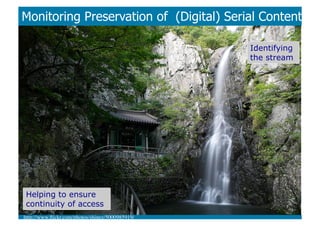
Monitoring Preservation of (Digital) Serial Content

                                                    Identifying
                                                    the stream


 Helping to ensure
 continuity of access
http://www.flickr.com/photos/shinez/5000985919/
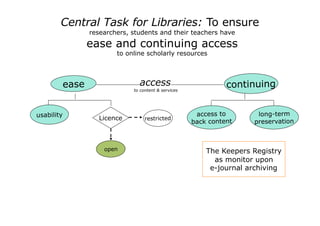
Central Task for Libraries: To ensure
                   researchers, students and their teachers have
                   ease and continuing access
                           to online scholarly resources


            ease                  access                          continuing
                                to content & services


usability                                                access to       long-term
                      Licence        restricted
                                                        back content    preservation


                       open                                 The Keepers Registry
                                                              as monitor upon
                                                             e-journal archiving
The Basics of Our Shared Concern
[The Good News] 
What was once availably locally <on shelf, in drawer/datacentre>
 is now online & accessed remotely, anytime/anywhere
     –  Studies show that scholarly literature is now nearly all online
     –  Libraries moving to an e-only environment for journals

[The Bad News] 
The role of libraries as trusted keepers of information and
  culture has been disrupted
    Libraries no longer take physical custody of digital
     –  Publishers license content online remotely

    Risk of loss for future scholars, citizens & our children
Our Shared Understanding
    World heritage & scientific understanding is global

    Scholarship & science has global literature
         Researchers in any one country are dependent upon
          content written and published in other countries
    International/National Reports & Activity: 10 Years On
      Draft Charter on the Preservation of the Digital Heritage, 2003
     Increasingly born digital,
     or re-born digitized
         Archiving E-Journals (JISC: Maggie Jones, 2003)
     Need to ensure continuity
       Archiving Electronic Journals   of
                                        (L. Cantara (Ed) DLF/CLR, 2003)
     access
      E-Journal Archiving Metes and Bounds: A Survey of the
          Landscape (Anne Kenney et al, 2006)
         …
The real heroes in the story are …
The Keepers, organisations that act as
 our digital shelves:
  ①  web-scale   not-for-profit   organizations
     *  e.g. CLOCKSS Archive & Portico
  ②  national libraries
     * e.g. British Library, e-Depot (Netherlands)
       & National Science Library of China
  ③  library consortia
     * e.g. HathiTrust & Global LOCKSS Network


                                      http://www.flickr.com/photos/damork/450592706/
Sidebar note on National Libraries
Should we wait upon Legal Deposit?
     –  94% of libraries have some form of legal deposit for print.

•    Only 44% national libraries had legislation in 2011 for
     e-books or e-journals; expected to rise to 58% by June 2012.
•    Only 27% [expected to rise to 37% by June 2012] actually
     ingesting via legal deposit
     Total national libraries collecting =
        those 14 via legal deposit + 9 by other means
       (Netherlands, UK/BL & Switzerland have voluntary deposit)


    2 (KB e-Depot & BL) participate in the Keepers Registry
     –  Only when the other 21 join will all know about their activity

                 from presentation, CENL 2011 Survey by Lynne Brindley
                  to CDNL Annual Meeting Puerto Rico, 15/8/11
Many archiving initiatives is a Good Thing 


“Digital information is best preserved by replicating it at
  multiple archives run by autonomous organizations”
                           B. Cooper and H. Garcia-Molina (2002)
A Registry to discover ‘who is looking after what’
•    Idea mooted in UK Report (JISC: Maggie Jones, 2003/4);
     Call in USA/Canada for “clarity of public statement by each
     agency or through a registry” (CLIR Report, 2006)

•    UK scoping study recommended an e-journals preservation
     registry be built (JISC: Rightscom/U. of Loughborough 2007)

•    JISC funded EDINA & ISSN-IC as partners to Pilot an
     E-Journal Preservation Registry Services (PEPRS)
     –  Phase 1: August 2008 – July 2010
             ‘investigate, prototype and build’ [evaluation in Feb. 2010]
     –  Phase 2: August 2010 – July 2012
             ‘preparing for service & governance’
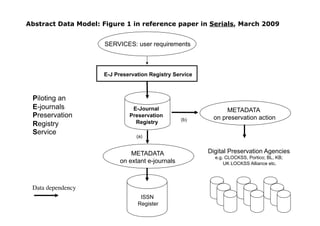
Abstract Data Model: Figure 1 in reference paper in Serials, March 2009


                      SERVICES: user requirements


                      E-J Preservation Registry Service


 Piloting an
 E-journals                     E-Journal                       METADATA 
 Preservation                  Preservation                on preservation action
                                                  (b)
 Registry                        Registry
 Service
                                  (a)


                               METADATA                   Digital Preservation Agencies
                                                            e.g. CLOCKSS, Portico; BL, KB;
                           on extant e-journals                 UK LOCKSS Alliance etc.


 Data dependency	

                                   ISSN
                                  Register
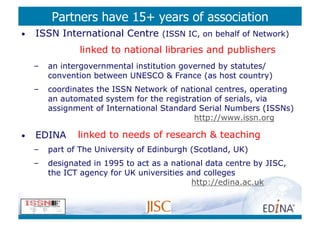
Partners have 15+ years of association
•    ISSN International Centre (ISSN IC, on behalf of Network)
                  linked to national libraries and publishers
     –    an intergovernmental institution governed by statutes/
          convention between UNESCO  France (as host country)
     –    coordinates the ISSN Network of national centres, operating
          an automated system for the registration of serials, via
          assignment of International Standard Serial Numbers (ISSNs)
                                              http://www.issn.org

•    EDINA       linked to needs of research  teaching
     –    part of The University of Edinburgh (Scotland, UK)
     –    designated in 1995 to act as a national data centre by JISC,
          the ICT agency for UK universities and colleges
                                              http://edina.ac.uk
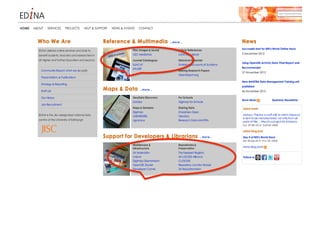
EDINA
EDINA’s Mission: We develop and deliver online services
   digital infrastructure for UK research and education.
Our Vision: To be integral to the quality  productivity of
  research  education, in the UK  beyond
       part of The University of Edinburgh  the Jisc Family
14
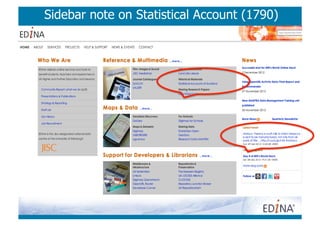
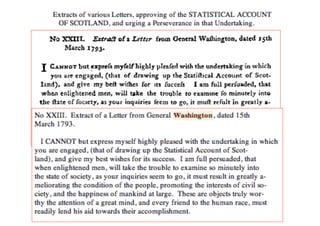
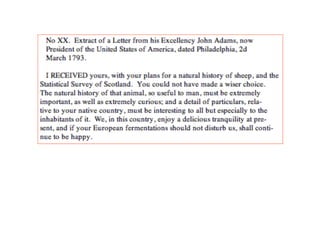
Sidebar note on Statistical Account (1790)
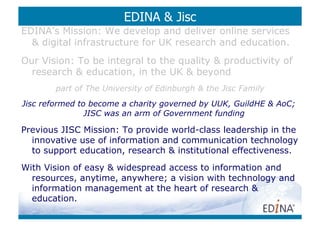
EDINA  Jisc
EDINA’s Mission: We develop and deliver online services
   digital infrastructure for UK research and education.
Our Vision: To be integral to the quality  productivity of
  research  education, in the UK  beyond
        part of The University of Edinburgh  the Jisc Family
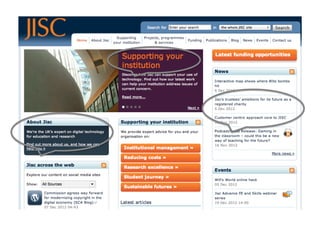
Jisc reformed to become a charity governed by UUK, GuildHE  AoC;
                JISC was an arm of Government funding

Previous JISC Mission: To provide world-class leadership in the
  innovative use of information and communication technology
  to support education, research  institutional effectiveness.
With Vision of easy  widespread access to information and
  resources, anytime, anywhere; a vision with technology and
  information management at the heart of research 
  education.
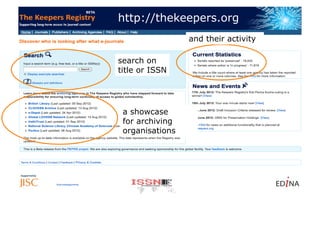
The Keepers Registry
•    Initial scope was upon what is published in digital form
     –  in serials and periodicals (journals, magazines, newspapers etc)
•    Content of significance for each  every country:
     –  publishers  archiving agencies are international

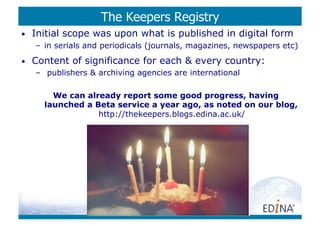
         We can already report some good progress, having
       launched a Beta service a year ago, as noted on our blog,
                   http://thekeepers.blogs.edina.ac.uk/
http://thekeepers.org
                 and their activity

search on
title or ISSN


 a showcase
 for archiving
 organisations
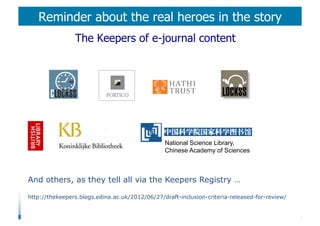
Reminder about the real heroes in the story
                The Keepers of e-journal content


                                                National Science Library,
                                                Chinese Academy of Sciences


And others, as they tell all via the Keepers Registry …

http://thekeepers.blogs.edina.ac.uk/2012/06/27/draft-inclusion-criteria-released-for-review/


                                                    http://www.flickr.com/photos/damork/450592706/
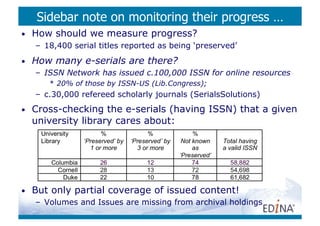
Sidebar note on monitoring their progress …
•    How should we measure progress?
     –  18,400 serial titles reported as being ‘preserved’
•    How many e-serials are there?
     –  ISSN Network has issued c.100,000 ISSN for online resources
        *  20% of those by ISSN-US (Lib.Congress);
     –  c.30,000 refereed scholarly journals (SerialsSolutions)
•    Cross-checking the e-serials (having ISSN) that a given
     university library cares about:


•    But only partial coverage of issued content!
     –  Volumes and Issues are missing from archival holdings
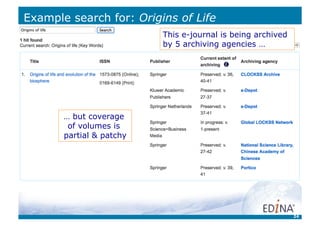
Example search for: Origins of Life
                          This e-journal is being archived
                          by 5 archiving agencies …


       … but coverage
        of volumes is
       partial  patchy


                                                             24
2. A Large Volume of Serial Issues
1. Identification
-    focus when building the Registry was online content that had an
     ISSN, as project convenience
     -  Incorrect, erroneous or missing
-    We knew that different ISSN for digital and for print
     -  But value of ISSN-L as kernel field to link across ISSN records
-    Used HathiTrust to extending scope to include digitized journals
     -  Rules for assigning ISSN to digitised content from print journals
     -  same ISSN applies to all digital versions of an online resource
-    Noted ISSN assignment rules for integrating resources (websites
     and online databases that change over time)
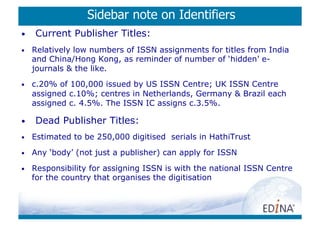
Sidebar note on Identifiers
•    Current Publisher Titles:
•    Relatively low numbers of ISSN assignments for titles from India
     and China/Hong Kong, as reminder of number of ‘hidden’ e-
     journals  the like.
•    c.20% of 100,000 issued by US ISSN Centre; UK ISSN Centre
     assigned c.10%; centres in Netherlands, Germany  Brazil each
     assigned c. 4.5%. The ISSN IC assigns c.3.5%.

•    Dead Publisher Titles:
•    Estimated to be 250,000 digitised serials in HathiTrust
•    Any ‘body’ (not just a publisher) can apply for ISSN

•    Responsibility for assigning ISSN is with the national ISSN Centre
     for the country that organises the digitisation
A Large Volume of Serial Issues                     (cont.)
1.    Identification


2.    Recording the extent preserved
      –     Issues about issues: a Universal holdings statement
           *      Stewardship: print archiving as much as digital archiving
           *      ‘Middle child syndrome’ ALA Annual Holdings Update Forum, 2011
      –     Interoperability standard for Issues and Volumes
           *      ONIX for Preservation Holdings (ONIX-PH); KBART

3.    Variability in publisher information
      –     Transfer of title between publisher
           *      TRANSFER Code of Practice, http://www.uksg.org/transfer/
      –     publisher naming
           *      Not critical at ingest into Keepers Registry, but poor browsing
      –     Identifiers for Publishers (ISNI, builds on VIAF)
           *      International Standard Name Identifier (ISO 27729),
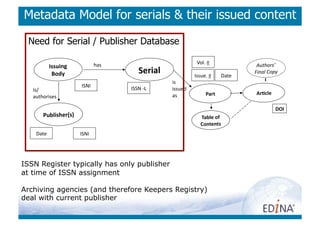
Metadata Model for serials  their issued content

  Need for Serial / Publisher Database

                                             has	
                                           Vol.	
  #	
  
               Issuing	
  	
                                                                                                  Authors’	
  	
  
                Body	
                                        Serial	
                      Issue.	
  #	
         Date	
  
                                                                                                                             Final	
  Copy	
  
                                                                           is	
  	
  
                                  ISNI	
               ISSN	
  -­‐L	
  
   Is/                                                                     issued	
  	
  
                                                                           as	
                      Part	
                   Ar7cle	
  
   authorises	
  

                                                                                                                                           DOI	
  
        Publisher(s)	
                                                                           Table	
  of	
  	
  
                                                                                                 Contents	
  
    Date	
                       ISNI	


ISSN Register typically has only publisher
at time of ISSN assignment

Archiving agencies (and therefore Keepers Registry)
deal with current publisher
Issuing	
  	
       has	
                                                                                           Authors’	
  	
  
                                                               Serial	
                                                         Final	
  Copy	
  
              Body	
                                                                            Vol.	
  #	
          Date	
  
                                                                                                                                                    DOI	
  
                                                                               is	
  	
  
                                                ISSN	
  	
                     issued	
  	
  
             Is/authorises	
                                                   as	
                    Issue	
                     Ar7cle	
  
Org/ID	
  

       Publisher(s)	
                                                                              Table	
  of	
  	
  
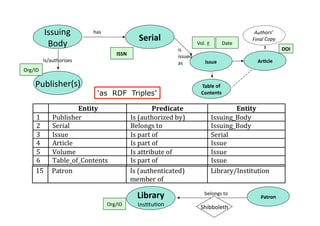
                                    ‘as RDF Triples’                                               Contents	


             Basic bibliographic elements 	


                                                               Library	
                               belongs	
  to	
  
                                                                                                                                     Patron	
  
                                           Org/ID	
            Ins?tu?on	
                         Shibboleth	
  
3. The Scholarly Web (the now  the future then)
a)    Preserving the digital
      –  OAIS (ISO 14721:2003) (ISO 14721:2012)

b)    Digital Fixity  Copy of Record
      –  “the property of being unchanged between two points in time”,
         (Caplan, 2006)
      –  Abrams  Rosenblum (2003): use of XML as archiving format
      –  Rosenthal (2010): format obsolescence as rare problem that
         happens infrequently to a minority of unpopular formats
      –  “the sine qua non is that the original bits be preserved”.
3. The Scholarly Web (the now  the future then)
a)    Preserving the digital
b)    Digital Fixity  Copy of Record

c)    Citation in Serials of Serial Content
      –  Citation of sources is a fundamental part of scholarly discourse.
      –  expectation that the sources with which scholarly statements
         are made can and should be checked by others, with the
         potential for their re‐use for the purposes of reproducibility of
         results.
      –  traditionally, sources relate only to statements made by other
         scholars and to some extent the evidence from which these
         statements are drawn.

•     Presumption that the cited (printed) material –
      typically an article – sat on a shelf that could, with
      tedium and delay, be obtained on Inter-Library Loan
3. The Scholarly Web (the now  the future then)
a)    Preserving the digital
b)    Digital Fixity  Copy of Record
c)    Citation in Serials of Serial Content

d)    New Models of Scholarly Communication
      –  Then we all began to apply electricity  get digital …
3. The Scholarly Web (the now  the future then)
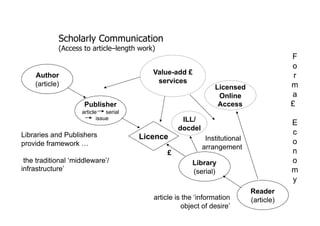
            Scholarly Communication
            (Access to article–length work)
                                                                                         F
                                                                                         o
    Author                                 Value-add £                                    r
    (article)                               services
                                                                Licensed                 m
                                                                 Online                  a
                     Publisher                                   Access                  £
                    article    serial
                           issue                    ILL/                                 E
                                                   docdel
Libraries and Publishers                                                                 c
                                        Licence              Institutional
provide framework …                                                                      o
                                                            arrangement
                                               £                                         n
 the traditional ‘middleware’/                          Library                          o
infrastructure’                                         (serial)                         m
                                                                                         y
                                                                             Reader
                                           article is the ‘information       (article)
                                                     object of desire’
Mixed Modes in Scholarly Communication
                                                                                          F
                                                                                          o
     Author                                                                                r
     (article)                                                                            m
                                                                 Licensed
                                                                                          a
               peer                                               Online
              review
                                       repositories               Access
                                                                                          £
                       Publisher
             learned article serial
              society       issue                    ILL/                                 E
                                                    docdel                                c
  peer                                 Licence                                            o
                                                              Institutional
exchange                                                                                  n
                       ‘Open Access’                         arrangement
                                               ££                                         o
  E-prints                                                                                m
                                                       Library
                                repositories           (serial)                           y
           free2web access
                                                                              Reader
                                                                              (article)
 Informal: ‘invisible college’ and the ‘gift economy’
3. The Scholarly Web (the now  the future then)
a)    Preserving the digital
b)    Digital Fixity  Copy of Record
c)    Citation in Serials of Serial Content
d)    New Modes of Scholarly Communication

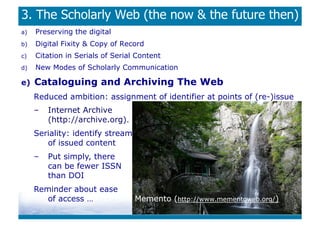
e)    Cataloguing and Archiving The Web
      Reduced ambition: assignment of identifier at points of (re-)issue
      –    Internet Archive
           (http://archive.org).
      Seriality: identify stream
         of issued content
      –    Put simply, there
           can be fewer ISSN
           than DOI
      Reminder about ease
         of access …               Memento (http://www.mementoweb.org/)
3. The Scholarly Web (the now  the future then)
a)    Preserving the digital
b)    Digital Fixity  Copy of Record
c)    Citation in Serials of Serial Content
d)    New Modes of Scholarly Communication
e)    Cataloguing and Archiving The Web


f)    New Scholarly Objects, with Links
Beyond enhanced publication  supplementary data (behind the graph)
•  Research Objects: rich aggregations of linked content with
   suitability for re-use by machine. Archived Objects  Publication
   Objects which “are intended as a record of activity, and should
   thus be immutable” and citable.” (Bechhofer, et al, 2010)
•  Compound units: “aggregations of distinct information units []
   “represented (by OAI-ORE) [to] enable it to be accessed and
   processed by machines  agents” (Van de Sompel  Lagoze, 2007)
“two traditions, or mentalities, even cultures, co-exist” (Buckland, 1998):
      (i) Approaches based on a concern with documents, with signifying
      records: archives, bibliography, documentation, librarianship, records
      management, and the like; and
      (ii) approaches based on finding uses for formal techniques, whether
      mechanical … or mathematical (as in algorithmic procedures).
3. The Scholarly Web (the now  the future then)
a)     Preserving the digital
b)     Digital Fixity  Copy of Record
c)     Citation in Serials of Serial Content
d)     New Modes of Scholarly Communication
e)     Cataloguing and Archiving The Web
f)     New Scholarly Objects, with Links


g)     Web Citation
       –  Range of scholarly assets published  referenced is increased
       –  Dynamic. What was at the end of a given HTTP URL/URI at the
          moment of citation can and does change, or even cease to be,
          when scholars wish to look up the citation.
       This is referred to as ‘citation rot’.
  •      study by Sanderson, Phillips  Van de Sompel (2011)
        found that 28% of the resources referenced by articles in an
        institutional repository had been lost and that 45% (66,096) of
        the URLs [in arXiv] that were found to still exist had not been
        archived.
       –  Expect announcement of Mellon funding of Time Travel for the
           Scholarly Web (TT4SW) as joint UoE/LANL project 
3. The Scholarly Web (the now  the future then)
a)    Preserving the digital
b)    Digital Fixity  Copy of Record
c)    Citation in Serials of Serial Content
d)    New Modes of Scholarly Communication
e)    Cataloguing and Archiving The Web
f)    New Scholarly Objects, with Links

g)    Web Citation


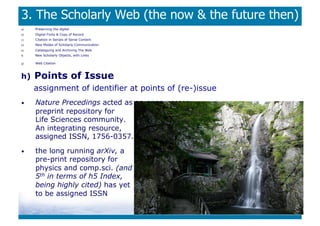
h)    Points of Issue
      assignment of identifier at points of (re-)issue
•     Nature Precedings acted as an open access
      preprint repository for
      Life Sciences community.
      An integrating resource,
      assigned ISSN, 1756-0357.

•     the long running arXiv, a
      pre-print repository for
      physics and comp.sci. (and
      5th in terms of h5 Index,
      being highly cited) has yet
      to be assigned ISSN
Strategies - Action Plans - Delivery

•    Principles into practice [even for unique/special objects]
     ①  Assign an identifier at ‘point of issue’ [ISSN for the stream]
     ②  Archive routinely (preferably have others/peers do that for you too)
     ③  Tell someone what you are doing (and how) [e.g. Keepers Registry]
     ④  Publish terms of access (now and when triggered as orphaned) [OA]


•    Make Copies, Establish Safe Places  Monitor Progress
     –    What is different about the digital includes the ease with which digital
          content can be copied, cheaply and exactly.
     –    Strategy for a safe places network in which the responsibility for
          custody of the new digital content is shared.
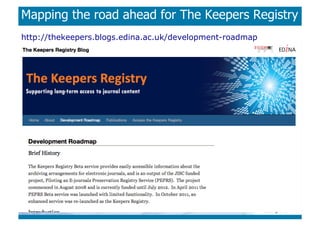
Mapping the road ahead for The Keepers Registry
http://thekeepers.blogs.edina.ac.uk/development-roadmap
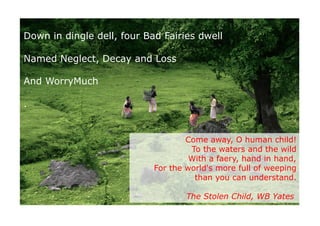
Down in dingle dell, four Bad Fairies dwell

Named Neglect, Decay and Loss

And WorryMuch

.


                                    Come away, O human child!
                                     To the waters and the wild
                                     With a faery, hand in hand,
                            For the world's more full of weeping
                                      than you can understand.

                                    The Stolen Child, WB Yates

                                  http://www.flickr.com/photos/agnihot/4791066830/
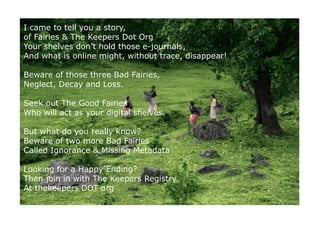
I came to tell you a story,
of Fairies  The Keepers Dot Org
Your shelves don’t hold those e-journals,
And what is online might, without trace, disappear!

Beware of those three Bad Fairies,
Neglect, Decay and Loss.

Seek out The Good Fairies
Who will act as your digital shelves.

But what do you really know?
Beware of two more Bad Fairies
Called Ignorance  Missing Metadata

Looking for a Happy Ending?
Then join in with The Keepers Registry
At thekeepers DOT org


.                                        http://www.flickr.com/photos/agnihot/4791066830/
Use Seriality for Preservation Monitoring

              Thank you for listening


                                 p.burnhill@ed.ac.uk

                             http://thekeepers.org

   http://thekeepers.blogs.edina.ac.uk/

http://www.flickr.com/photos/shinez/5000985919/

Tales from the Keepers Registry

  • 1.
    Tales from TheKeepers Registry Helping to ensure ease & continuity of access to digital resources Peter Burnhill EDINA (JISC & University of Edinburgh) Digital Future and You: Library of Congress, Washington DC 10 December, 2012
  • 2.
    Three Stories ToTell & Pictures To Paint (based on an invited paper being accepted for Serials Review) 1.  The Keepers Registry (to monitor progress) 2.  A Large Volume of Serial Issues 3.  The Scholarly Web (the now & the future then) + some asides on the way: eg, ‘seriality’
  • 3.
    Monitoring Preservation of(Digital) Serial Content Identifying the stream Helping to ensure continuity of access http://www.flickr.com/photos/shinez/5000985919/
  • 4.
    Central Task forLibraries: To ensure researchers, students and their teachers have ease and continuing access to online scholarly resources ease access continuing to content & services usability access to long-term Licence restricted back content preservation open The Keepers Registry as monitor upon e-journal archiving
  • 5.
    The Basics ofOur Shared Concern [The Good News]  What was once availably locally <on shelf, in drawer/datacentre> is now online & accessed remotely, anytime/anywhere –  Studies show that scholarly literature is now nearly all online –  Libraries moving to an e-only environment for journals [The Bad News]  The role of libraries as trusted keepers of information and culture has been disrupted   Libraries no longer take physical custody of digital –  Publishers license content online remotely   Risk of loss for future scholars, citizens & our children
  • 6.
    Our Shared Understanding   World heritage & scientific understanding is global   Scholarship & science has global literature   Researchers in any one country are dependent upon content written and published in other countries   International/National Reports & Activity: 10 Years On  Draft Charter on the Preservation of the Digital Heritage, 2003 Increasingly born digital, or re-born digitized   Archiving E-Journals (JISC: Maggie Jones, 2003) Need to ensure continuity   Archiving Electronic Journals of (L. Cantara (Ed) DLF/CLR, 2003) access  E-Journal Archiving Metes and Bounds: A Survey of the Landscape (Anne Kenney et al, 2006)   …
  • 7.
    The real heroesin the story are … The Keepers, organisations that act as our digital shelves: ①  web-scale not-for-profit organizations *  e.g. CLOCKSS Archive & Portico ②  national libraries * e.g. British Library, e-Depot (Netherlands) & National Science Library of China ③  library consortia * e.g. HathiTrust & Global LOCKSS Network http://www.flickr.com/photos/damork/450592706/
  • 8.
    Sidebar note onNational Libraries Should we wait upon Legal Deposit? –  94% of libraries have some form of legal deposit for print. •  Only 44% national libraries had legislation in 2011 for e-books or e-journals; expected to rise to 58% by June 2012. •  Only 27% [expected to rise to 37% by June 2012] actually ingesting via legal deposit   Total national libraries collecting = those 14 via legal deposit + 9 by other means (Netherlands, UK/BL & Switzerland have voluntary deposit)   2 (KB e-Depot & BL) participate in the Keepers Registry –  Only when the other 21 join will all know about their activity from presentation, CENL 2011 Survey by Lynne Brindley to CDNL Annual Meeting Puerto Rico, 15/8/11
  • 9.
    Many archiving initiativesis a Good Thing  “Digital information is best preserved by replicating it at multiple archives run by autonomous organizations” B. Cooper and H. Garcia-Molina (2002)
  • 10.
    A Registry todiscover ‘who is looking after what’ •  Idea mooted in UK Report (JISC: Maggie Jones, 2003/4); Call in USA/Canada for “clarity of public statement by each agency or through a registry” (CLIR Report, 2006) •  UK scoping study recommended an e-journals preservation registry be built (JISC: Rightscom/U. of Loughborough 2007) •  JISC funded EDINA & ISSN-IC as partners to Pilot an E-Journal Preservation Registry Services (PEPRS) –  Phase 1: August 2008 – July 2010 ‘investigate, prototype and build’ [evaluation in Feb. 2010] –  Phase 2: August 2010 – July 2012 ‘preparing for service & governance’
  • 11.
    Abstract Data Model:Figure 1 in reference paper in Serials, March 2009 SERVICES: user requirements E-J Preservation Registry Service Piloting an E-journals E-Journal METADATA Preservation Preservation on preservation action (b) Registry Registry Service (a) METADATA Digital Preservation Agencies e.g. CLOCKSS, Portico; BL, KB; on extant e-journals UK LOCKSS Alliance etc. Data dependency ISSN Register
  • 12.
    Partners have 15+years of association •  ISSN International Centre (ISSN IC, on behalf of Network) linked to national libraries and publishers –  an intergovernmental institution governed by statutes/ convention between UNESCO France (as host country) –  coordinates the ISSN Network of national centres, operating an automated system for the registration of serials, via assignment of International Standard Serial Numbers (ISSNs) http://www.issn.org •  EDINA linked to needs of research teaching –  part of The University of Edinburgh (Scotland, UK) –  designated in 1995 to act as a national data centre by JISC, the ICT agency for UK universities and colleges http://edina.ac.uk
  • 13.
    EDINA EDINA’s Mission: Wedevelop and deliver online services digital infrastructure for UK research and education. Our Vision: To be integral to the quality productivity of research education, in the UK beyond part of The University of Edinburgh the Jisc Family
  • 14.
  • 15.
    Sidebar note onStatistical Account (1790)
  • 18.
    EDINA Jisc EDINA’sMission: We develop and deliver online services digital infrastructure for UK research and education. Our Vision: To be integral to the quality productivity of research education, in the UK beyond part of The University of Edinburgh the Jisc Family Jisc reformed to become a charity governed by UUK, GuildHE AoC; JISC was an arm of Government funding Previous JISC Mission: To provide world-class leadership in the innovative use of information and communication technology to support education, research institutional effectiveness. With Vision of easy widespread access to information and resources, anytime, anywhere; a vision with technology and information management at the heart of research education.
  • 20.
    The Keepers Registry •  Initial scope was upon what is published in digital form –  in serials and periodicals (journals, magazines, newspapers etc) •  Content of significance for each every country: –  publishers archiving agencies are international We can already report some good progress, having launched a Beta service a year ago, as noted on our blog, http://thekeepers.blogs.edina.ac.uk/
  • 21.
    http://thekeepers.org and their activity search on title or ISSN a showcase for archiving organisations
  • 22.
    Reminder about thereal heroes in the story The Keepers of e-journal content National Science Library, Chinese Academy of Sciences And others, as they tell all via the Keepers Registry … http://thekeepers.blogs.edina.ac.uk/2012/06/27/draft-inclusion-criteria-released-for-review/ http://www.flickr.com/photos/damork/450592706/
  • 23.
    Sidebar note onmonitoring their progress … •  How should we measure progress? –  18,400 serial titles reported as being ‘preserved’ •  How many e-serials are there? –  ISSN Network has issued c.100,000 ISSN for online resources *  20% of those by ISSN-US (Lib.Congress); –  c.30,000 refereed scholarly journals (SerialsSolutions) •  Cross-checking the e-serials (having ISSN) that a given university library cares about: •  But only partial coverage of issued content! –  Volumes and Issues are missing from archival holdings
  • 24.
    Example search for:Origins of Life This e-journal is being archived by 5 archiving agencies … … but coverage of volumes is partial patchy 24
  • 25.
    2. A LargeVolume of Serial Issues 1. Identification -  focus when building the Registry was online content that had an ISSN, as project convenience -  Incorrect, erroneous or missing -  We knew that different ISSN for digital and for print -  But value of ISSN-L as kernel field to link across ISSN records -  Used HathiTrust to extending scope to include digitized journals -  Rules for assigning ISSN to digitised content from print journals -  same ISSN applies to all digital versions of an online resource -  Noted ISSN assignment rules for integrating resources (websites and online databases that change over time)
  • 26.
    Sidebar note onIdentifiers •  Current Publisher Titles: •  Relatively low numbers of ISSN assignments for titles from India and China/Hong Kong, as reminder of number of ‘hidden’ e- journals the like. •  c.20% of 100,000 issued by US ISSN Centre; UK ISSN Centre assigned c.10%; centres in Netherlands, Germany Brazil each assigned c. 4.5%. The ISSN IC assigns c.3.5%. •  Dead Publisher Titles: •  Estimated to be 250,000 digitised serials in HathiTrust •  Any ‘body’ (not just a publisher) can apply for ISSN •  Responsibility for assigning ISSN is with the national ISSN Centre for the country that organises the digitisation
  • 27.
    A Large Volumeof Serial Issues (cont.) 1.  Identification 2.  Recording the extent preserved –  Issues about issues: a Universal holdings statement *  Stewardship: print archiving as much as digital archiving *  ‘Middle child syndrome’ ALA Annual Holdings Update Forum, 2011 –  Interoperability standard for Issues and Volumes *  ONIX for Preservation Holdings (ONIX-PH); KBART 3.  Variability in publisher information –  Transfer of title between publisher *  TRANSFER Code of Practice, http://www.uksg.org/transfer/ –  publisher naming *  Not critical at ingest into Keepers Registry, but poor browsing –  Identifiers for Publishers (ISNI, builds on VIAF) *  International Standard Name Identifier (ISO 27729),
  • 28.
    Metadata Model forserials their issued content Need for Serial / Publisher Database has   Vol.  #   Issuing     Authors’     Body   Serial   Issue.  #   Date   Final  Copy   is     ISNI   ISSN  -­‐L   Is/ issued     as   Part   Ar7cle   authorises   DOI   Publisher(s)   Table  of     Contents   Date   ISNI   ISSN Register typically has only publisher at time of ISSN assignment Archiving agencies (and therefore Keepers Registry) deal with current publisher
  • 29.
    Issuing     has   Authors’     Serial   Final  Copy   Body   Vol.  #   Date   DOI   is     ISSN     issued     Is/authorises   as   Issue   Ar7cle   Org/ID   Publisher(s)   Table  of     ‘as RDF Triples’ Contents   Basic bibliographic elements Library   belongs  to   Patron   Org/ID   Ins?tu?on   Shibboleth  
  • 30.
    3. The ScholarlyWeb (the now the future then) a)  Preserving the digital –  OAIS (ISO 14721:2003) (ISO 14721:2012) b)  Digital Fixity Copy of Record –  “the property of being unchanged between two points in time”, (Caplan, 2006) –  Abrams Rosenblum (2003): use of XML as archiving format –  Rosenthal (2010): format obsolescence as rare problem that happens infrequently to a minority of unpopular formats –  “the sine qua non is that the original bits be preserved”.
  • 31.
    3. The ScholarlyWeb (the now the future then) a)  Preserving the digital b)  Digital Fixity Copy of Record c)  Citation in Serials of Serial Content –  Citation of sources is a fundamental part of scholarly discourse. –  expectation that the sources with which scholarly statements are made can and should be checked by others, with the potential for their re‐use for the purposes of reproducibility of results. –  traditionally, sources relate only to statements made by other scholars and to some extent the evidence from which these statements are drawn. •  Presumption that the cited (printed) material – typically an article – sat on a shelf that could, with tedium and delay, be obtained on Inter-Library Loan
  • 32.
    3. The ScholarlyWeb (the now the future then) a)  Preserving the digital b)  Digital Fixity Copy of Record c)  Citation in Serials of Serial Content d)  New Models of Scholarly Communication –  Then we all began to apply electricity get digital …
  • 33.
    3. The ScholarlyWeb (the now the future then) Scholarly Communication (Access to article–length work) F o Author Value-add £ r (article) services Licensed m Online a Publisher Access £ article serial issue ILL/ E docdel Libraries and Publishers c Licence Institutional provide framework … o arrangement £ n the traditional ‘middleware’/ Library o infrastructure’ (serial) m y Reader article is the ‘information (article) object of desire’
  • 34.
    Mixed Modes inScholarly Communication F o Author r (article) m Licensed a peer Online review repositories Access £ Publisher learned article serial society issue ILL/ E docdel c peer Licence o Institutional exchange n ‘Open Access’ arrangement ££ o E-prints m Library repositories (serial) y free2web access Reader (article) Informal: ‘invisible college’ and the ‘gift economy’
  • 35.
    3. The ScholarlyWeb (the now the future then) a)  Preserving the digital b)  Digital Fixity Copy of Record c)  Citation in Serials of Serial Content d)  New Modes of Scholarly Communication e)  Cataloguing and Archiving The Web Reduced ambition: assignment of identifier at points of (re-)issue –  Internet Archive (http://archive.org). Seriality: identify stream of issued content –  Put simply, there can be fewer ISSN than DOI Reminder about ease of access … Memento (http://www.mementoweb.org/)
  • 36.
    3. The ScholarlyWeb (the now the future then) a)  Preserving the digital b)  Digital Fixity Copy of Record c)  Citation in Serials of Serial Content d)  New Modes of Scholarly Communication e)  Cataloguing and Archiving The Web f)  New Scholarly Objects, with Links Beyond enhanced publication supplementary data (behind the graph) •  Research Objects: rich aggregations of linked content with suitability for re-use by machine. Archived Objects Publication Objects which “are intended as a record of activity, and should thus be immutable” and citable.” (Bechhofer, et al, 2010) •  Compound units: “aggregations of distinct information units [] “represented (by OAI-ORE) [to] enable it to be accessed and processed by machines agents” (Van de Sompel Lagoze, 2007) “two traditions, or mentalities, even cultures, co-exist” (Buckland, 1998): (i) Approaches based on a concern with documents, with signifying records: archives, bibliography, documentation, librarianship, records management, and the like; and (ii) approaches based on finding uses for formal techniques, whether mechanical … or mathematical (as in algorithmic procedures).
  • 37.
    3. The ScholarlyWeb (the now the future then) a)  Preserving the digital b)  Digital Fixity Copy of Record c)  Citation in Serials of Serial Content d)  New Modes of Scholarly Communication e)  Cataloguing and Archiving The Web f)  New Scholarly Objects, with Links g)  Web Citation –  Range of scholarly assets published referenced is increased –  Dynamic. What was at the end of a given HTTP URL/URI at the moment of citation can and does change, or even cease to be, when scholars wish to look up the citation. This is referred to as ‘citation rot’. •  study by Sanderson, Phillips Van de Sompel (2011) found that 28% of the resources referenced by articles in an institutional repository had been lost and that 45% (66,096) of the URLs [in arXiv] that were found to still exist had not been archived. –  Expect announcement of Mellon funding of Time Travel for the Scholarly Web (TT4SW) as joint UoE/LANL project 
  • 38.
    3. The ScholarlyWeb (the now the future then) a)  Preserving the digital b)  Digital Fixity Copy of Record c)  Citation in Serials of Serial Content d)  New Modes of Scholarly Communication e)  Cataloguing and Archiving The Web f)  New Scholarly Objects, with Links g)  Web Citation h)  Points of Issue assignment of identifier at points of (re-)issue •  Nature Precedings acted as an open access preprint repository for Life Sciences community. An integrating resource, assigned ISSN, 1756-0357. •  the long running arXiv, a pre-print repository for physics and comp.sci. (and 5th in terms of h5 Index, being highly cited) has yet to be assigned ISSN
  • 39.
    Strategies - ActionPlans - Delivery •  Principles into practice [even for unique/special objects] ①  Assign an identifier at ‘point of issue’ [ISSN for the stream] ②  Archive routinely (preferably have others/peers do that for you too) ③  Tell someone what you are doing (and how) [e.g. Keepers Registry] ④  Publish terms of access (now and when triggered as orphaned) [OA] •  Make Copies, Establish Safe Places Monitor Progress –  What is different about the digital includes the ease with which digital content can be copied, cheaply and exactly. –  Strategy for a safe places network in which the responsibility for custody of the new digital content is shared.
  • 40.
    Mapping the roadahead for The Keepers Registry http://thekeepers.blogs.edina.ac.uk/development-roadmap
  • 41.
    Down in dingledell, four Bad Fairies dwell Named Neglect, Decay and Loss And WorryMuch . Come away, O human child! To the waters and the wild With a faery, hand in hand, For the world's more full of weeping than you can understand. The Stolen Child, WB Yates http://www.flickr.com/photos/agnihot/4791066830/
  • 42.
    I came totell you a story, of Fairies The Keepers Dot Org Your shelves don’t hold those e-journals, And what is online might, without trace, disappear! Beware of those three Bad Fairies, Neglect, Decay and Loss. Seek out The Good Fairies Who will act as your digital shelves. But what do you really know? Beware of two more Bad Fairies Called Ignorance Missing Metadata Looking for a Happy Ending? Then join in with The Keepers Registry At thekeepers DOT org . http://www.flickr.com/photos/agnihot/4791066830/
  • 43.
    Use Seriality forPreservation Monitoring Thank you for listening p.burnhill@ed.ac.uk http://thekeepers.org http://thekeepers.blogs.edina.ac.uk/ http://www.flickr.com/photos/shinez/5000985919/