Finding out about the preservation of e-journals: the PEPRS Project P iloting an  E -journals  P reservation  R egistry  S ervice Fred Guy, Project Manager, EDINA, University of Edinburgh [email_address] Internet Librarian International Conference 2010 15 th  October 2010
So What’s the Problem with E-journals? 96.1% of Science journals are online 86.5% of Arts and Humanities are online 2006-2007 – 102,000,000 downloads  Up 21% from previous year 17% usage is at the weekend Source .  E-journals: their use, value and impact.    Research Information Network. UK April 2009.
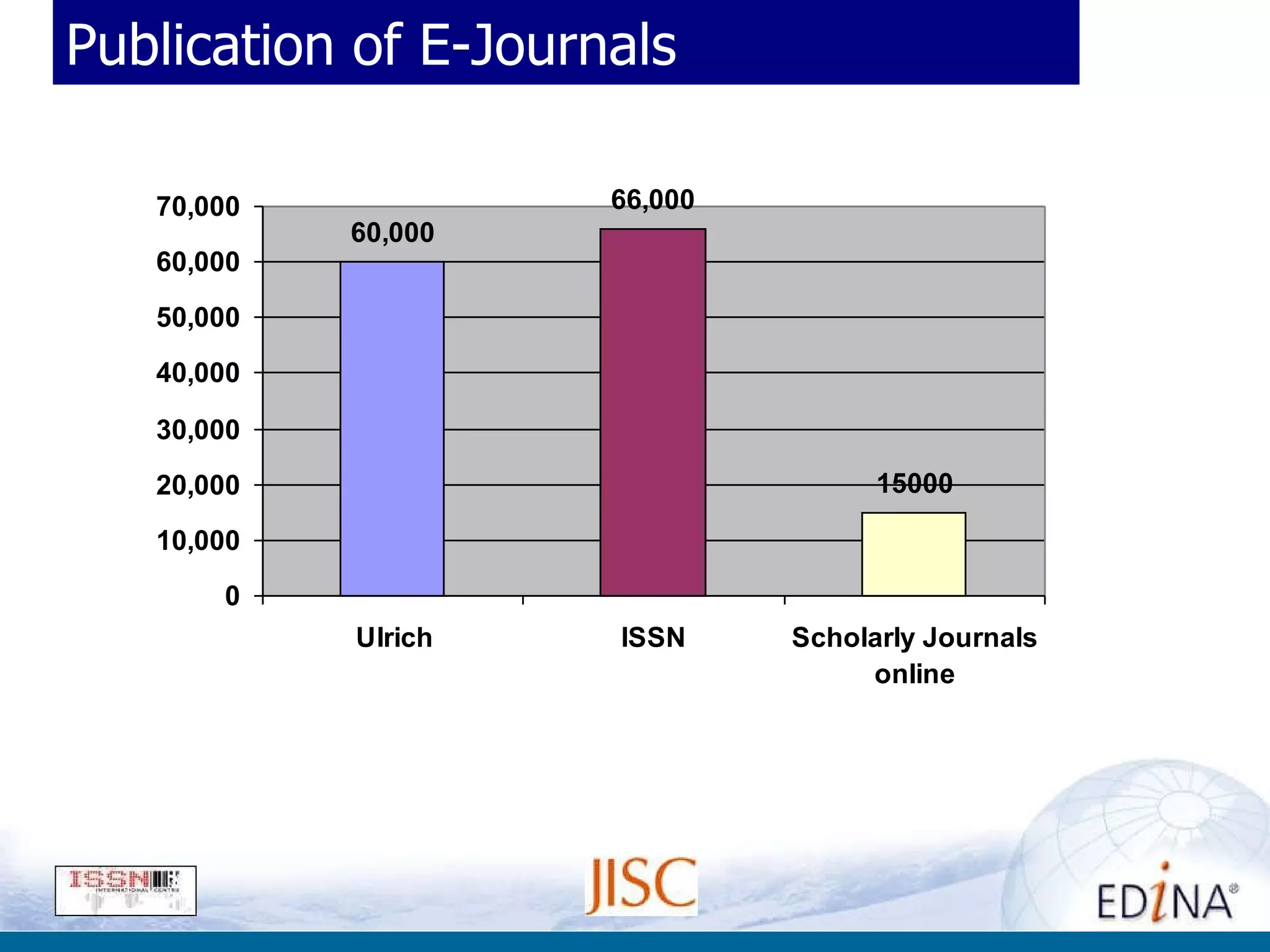
Publication of E-Journals
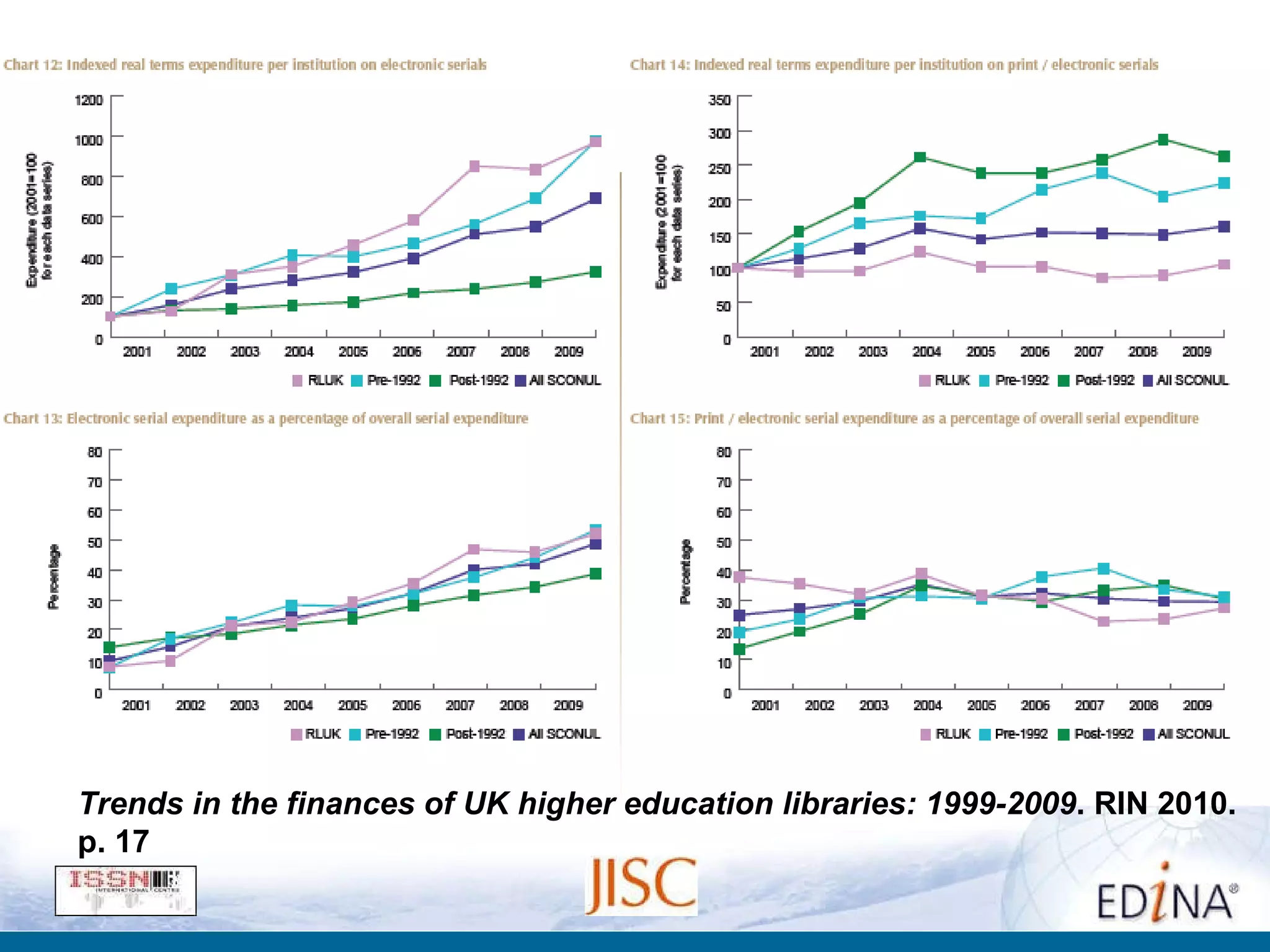
Trends in the finances of UK higher education libraries: 1999-2009 . RIN 2010. p. 17
Why Worry About Digital Preservation? Worries that all that is now digital may not always be available, for a variety of reasons. Publishers ceases publication with no transfer Publisher goes out of business with no transfer Publisher taken over
Legal Deposit Works well with print via legislation and national libraries.  Countries with legislation enacted (or ‘in train’) for e-materials include:  Canada, Denmark, Finland, France, Germany, Iceland, New Zealand, Norway, South Africa, Sweden, UK But , not all countries (notably USA) and in UK the legislation supports  voluntary  deposit, with restrictions of mode of access
Why a Preservation Registry? Many schemes emerging to meet challenge But who is doing what?  How can libraries & policy-makers assess which e-journals are being archived, by what methods, and under what terms of access? JISC commissioned a scoping study for an  e-journals preservation registry the idea had been mentioned in the literature
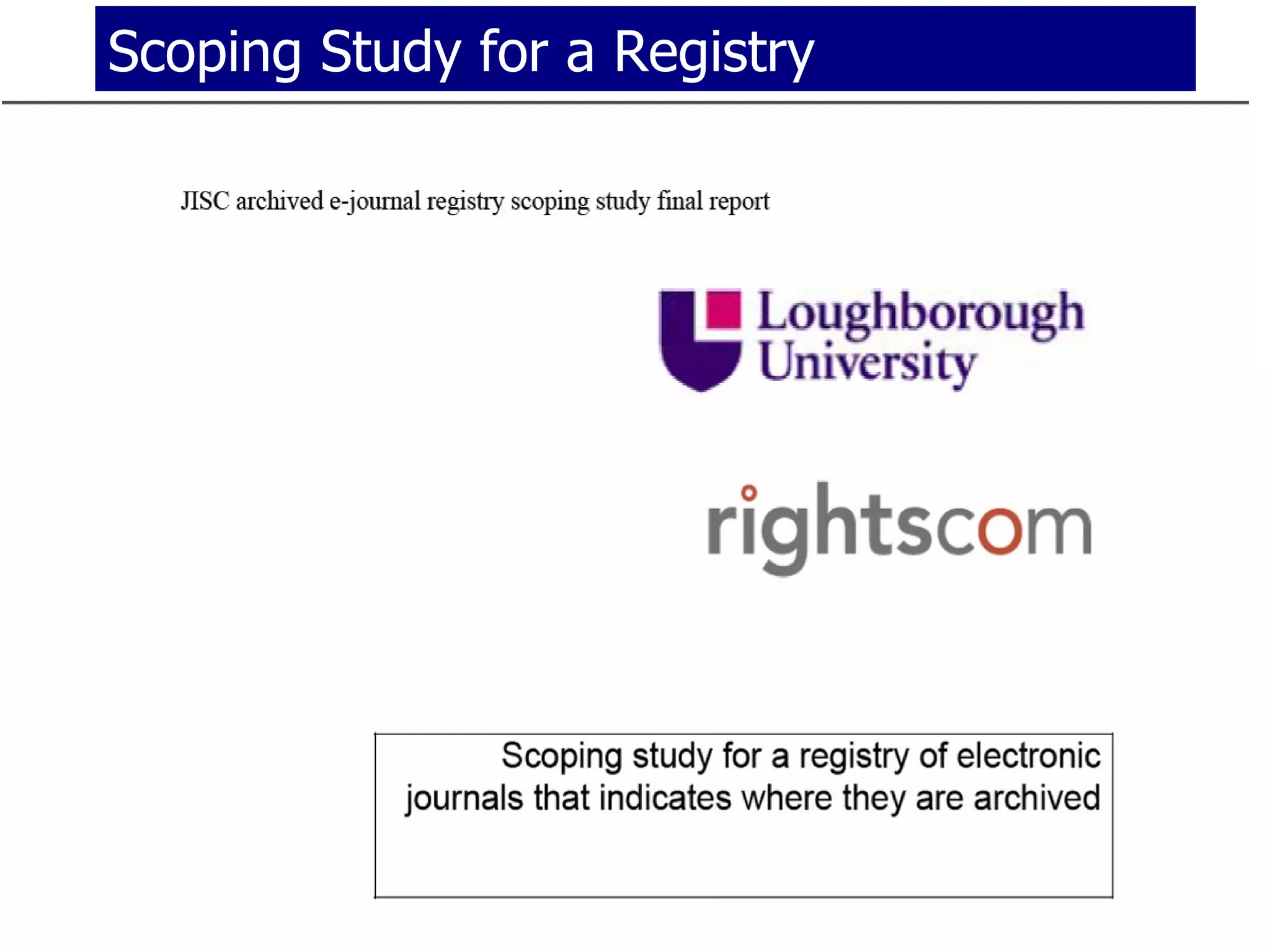
Scoping Study for a Registry
Scoping Study Report Precedes PEPRS Rightscom / Loughborough University, 2007 Confirmed expressed need among libraries and policy makers Warned of potential burden on digital preservation agencies  Recommended:  an e-journals preservation registry should be built UK Union Catalogue of Serials (SUNCAT)  or SHERPA (Open Access) get involved   SUNCAT is hosted and managed at EDINA
PROJECT DETAILS Phase 1 funded by JISC (Preservation Programme) from August 2008 – July 2010 EDINA, University of Edinburgh, grant recipient Project partner – ISSN International Centre, Paris Evaluation carried out by Charles Beagrie Limited for the JISC in February 2010
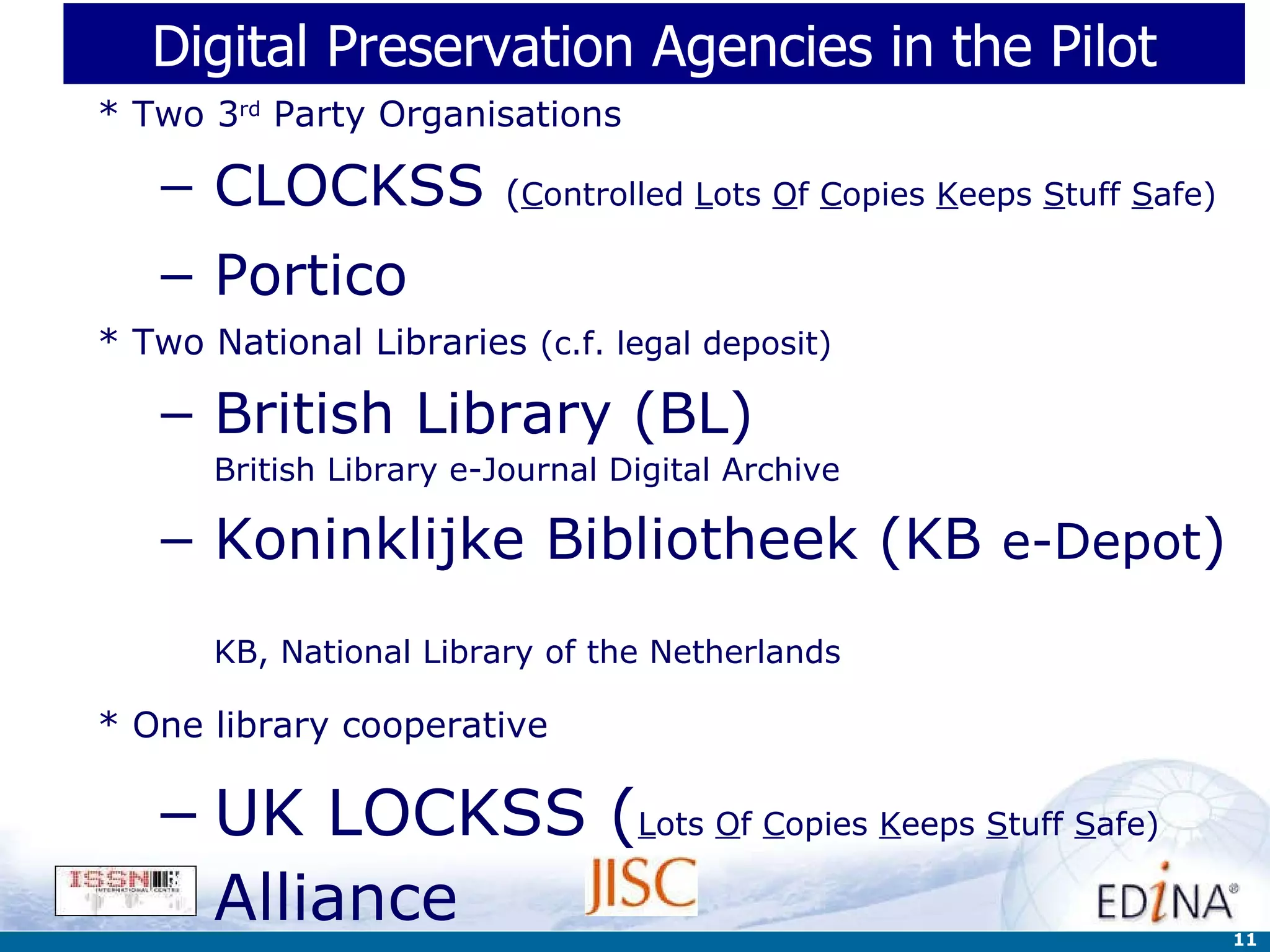
Digital Preservation Agencies in the Pilot * Two 3 rd  Party Organisations CLOCKSS  ( C ontrolled  L ots  O f  C opies  K eeps  S tuff  S afe) Portico * Two National Libraries  (c.f. legal deposit) British Library (BL) British Library e-Journal Digital Archive Koninklijke Bibliotheek (KB  e-Depot )   KB, National Library of the Netherlands * One library cooperative   UK LOCKSS ( L ots  O f  C opies  K eeps  S tuff  S afe)  Alliance
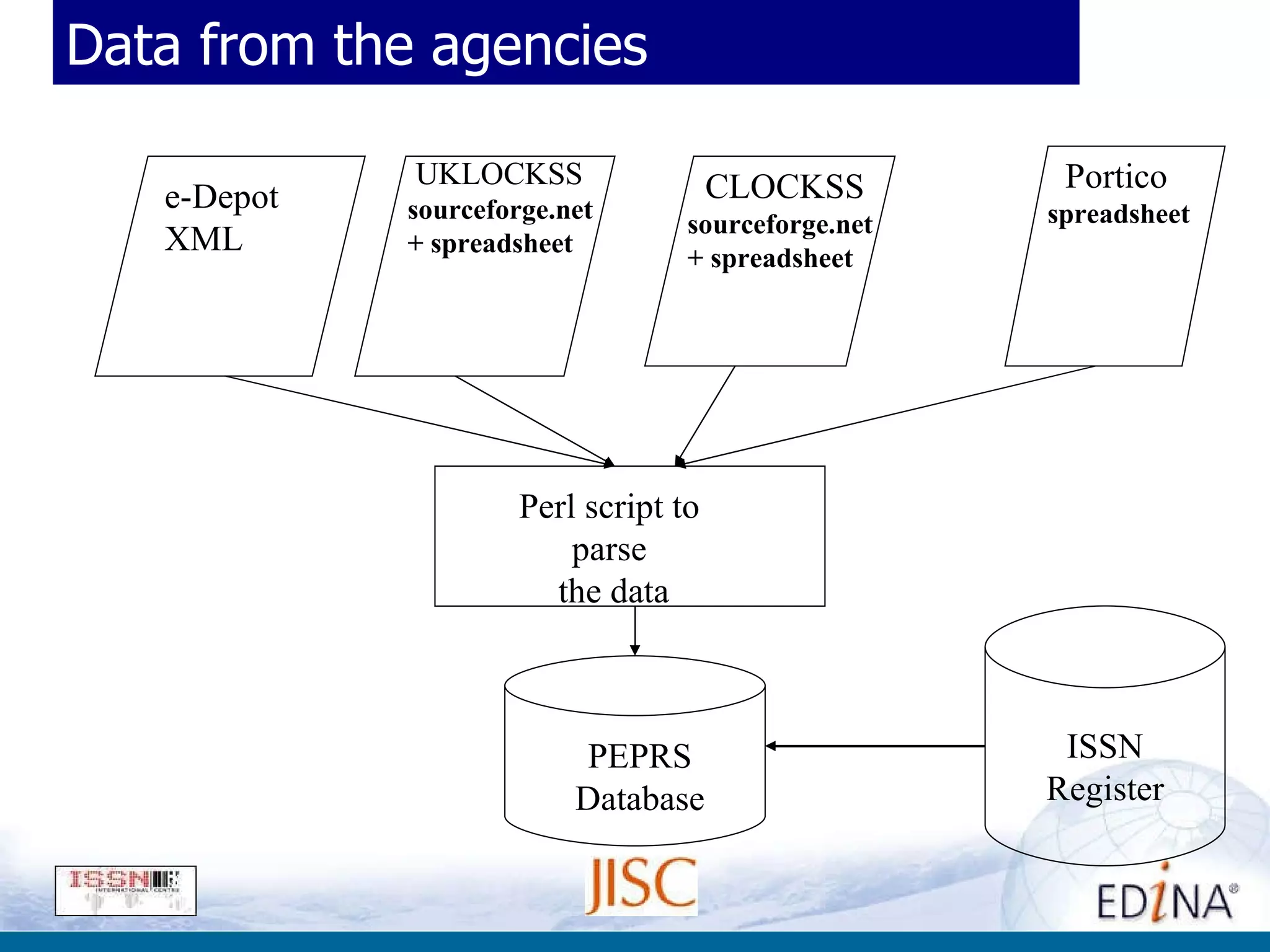
Data from the agencies e-Depot XML e-Depot XML UKLOCKSS sourceforge.net + spreadsheet CLOCKSS sourceforge.net + spreadsheet Portico spreadsheet Perl script to parse the data ISSN Register PEPRS Database
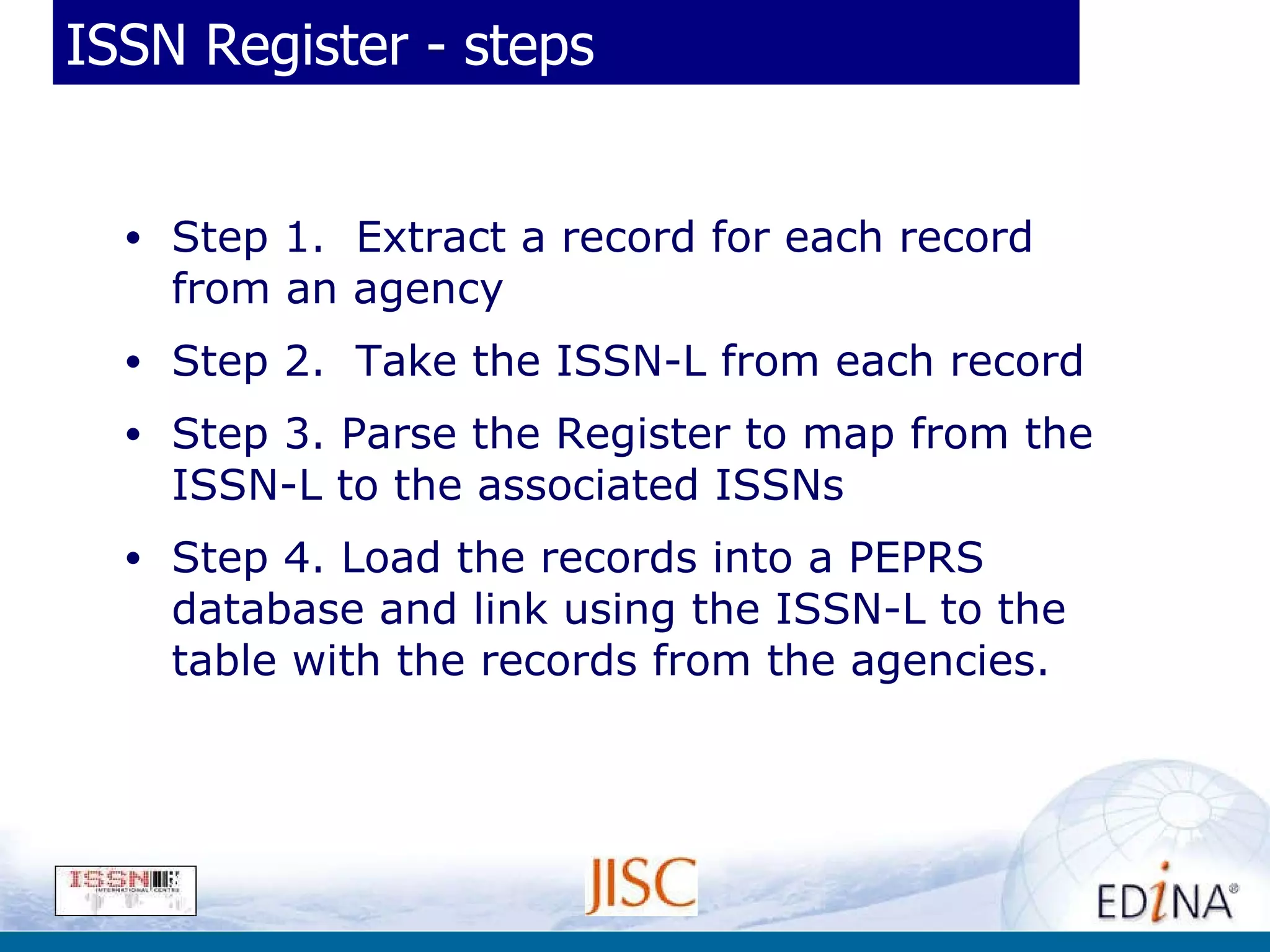
ISSN Register - steps Step 1.  Extract a record for each record from an agency Step 2.  Take the ISSN-L from each record Step 3. Parse the Register to map from the ISSN-L to the associated ISSNs Step 4. Load the records into a PEPRS database and link using the ISSN-L to the table with the records from the agencies.
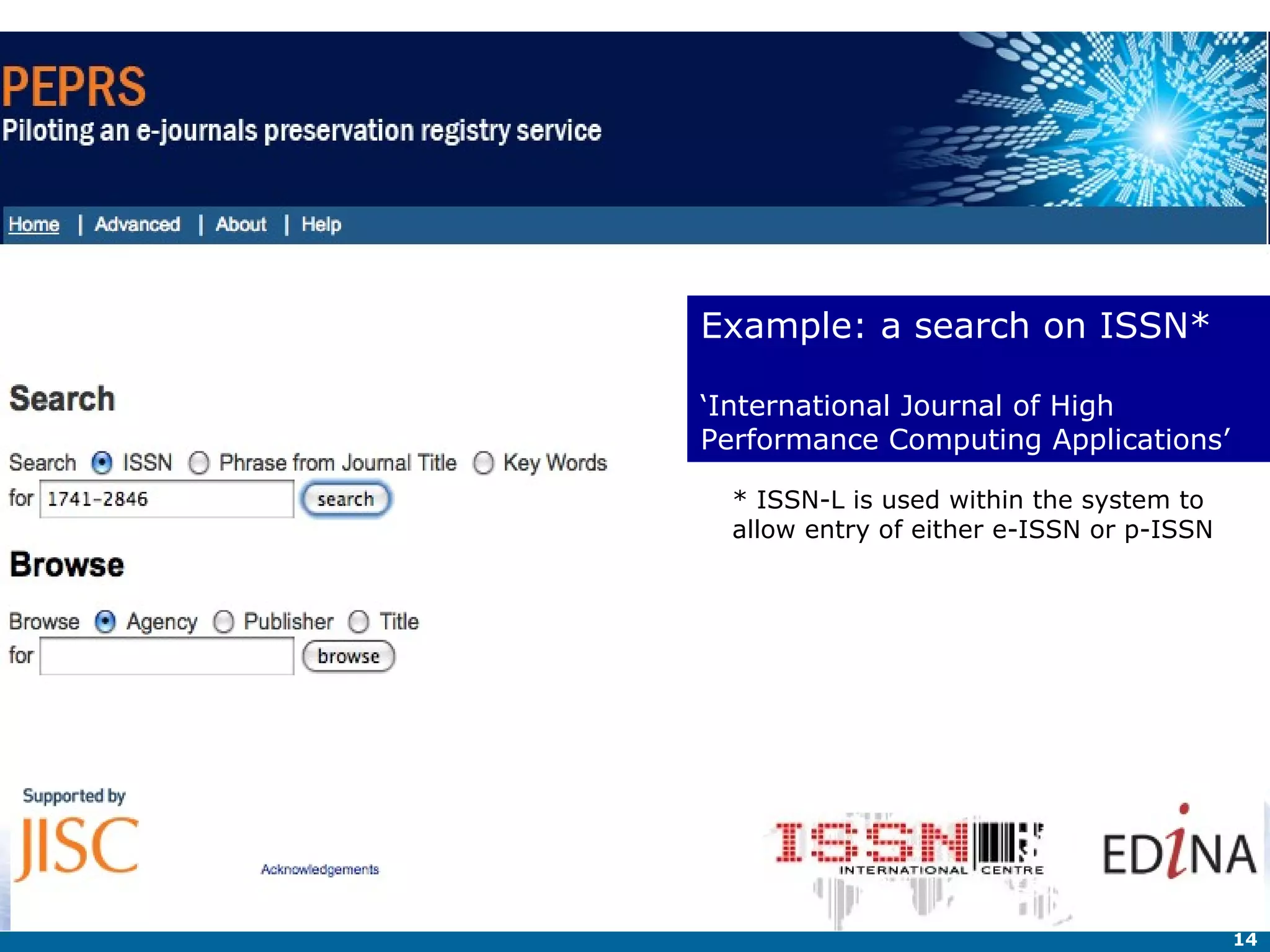
Example: a search on ISSN* ‘ International Journal of High Performance Computing Applications’ * ISSN-L is used within the system to allow entry of either e-ISSN or p-ISSN
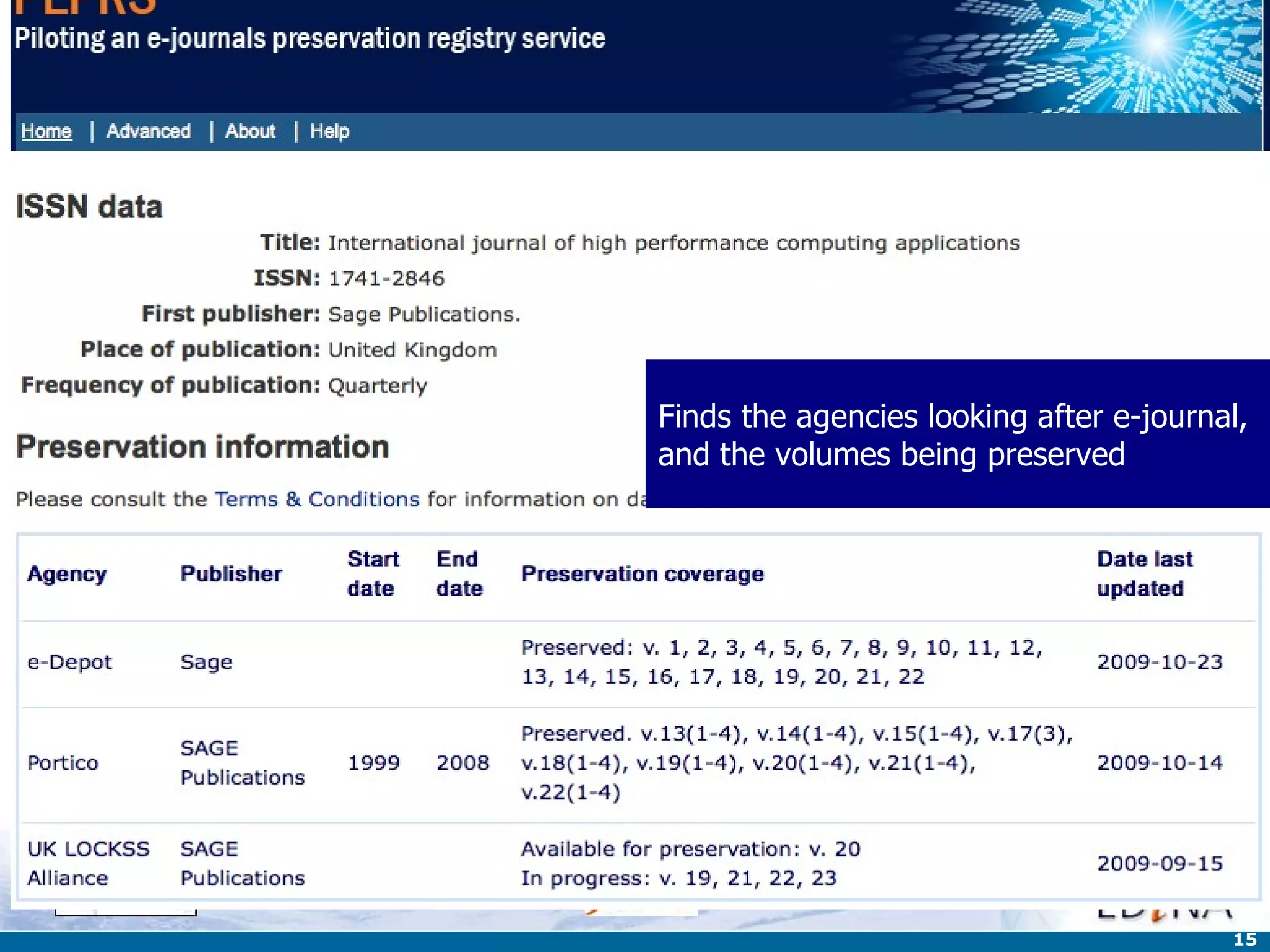
Finds the agencies looking after e-journal, and the volumes being preserved
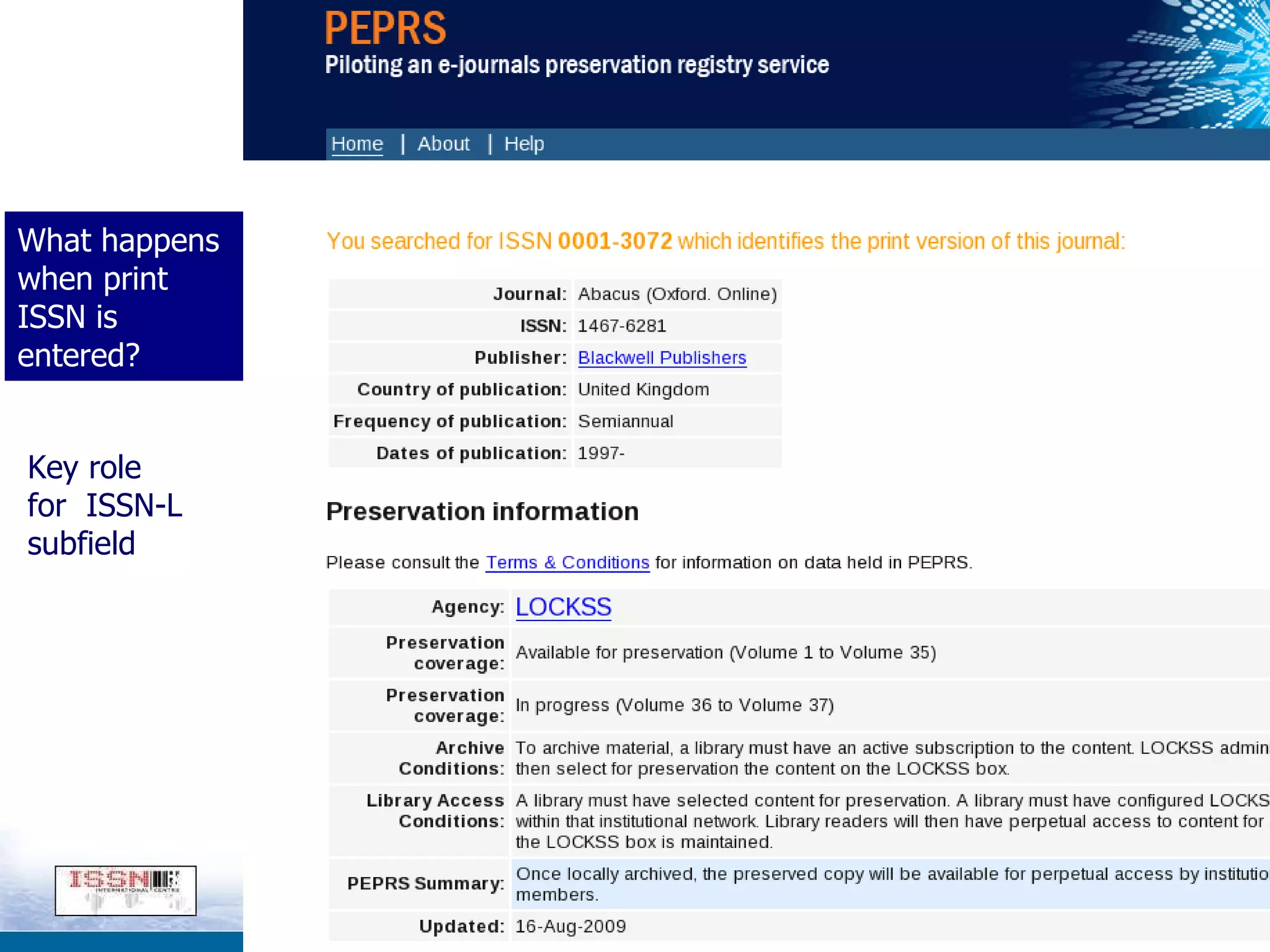
What happens  when print ISSN is entered? Key role  for  ISSN-L subfield
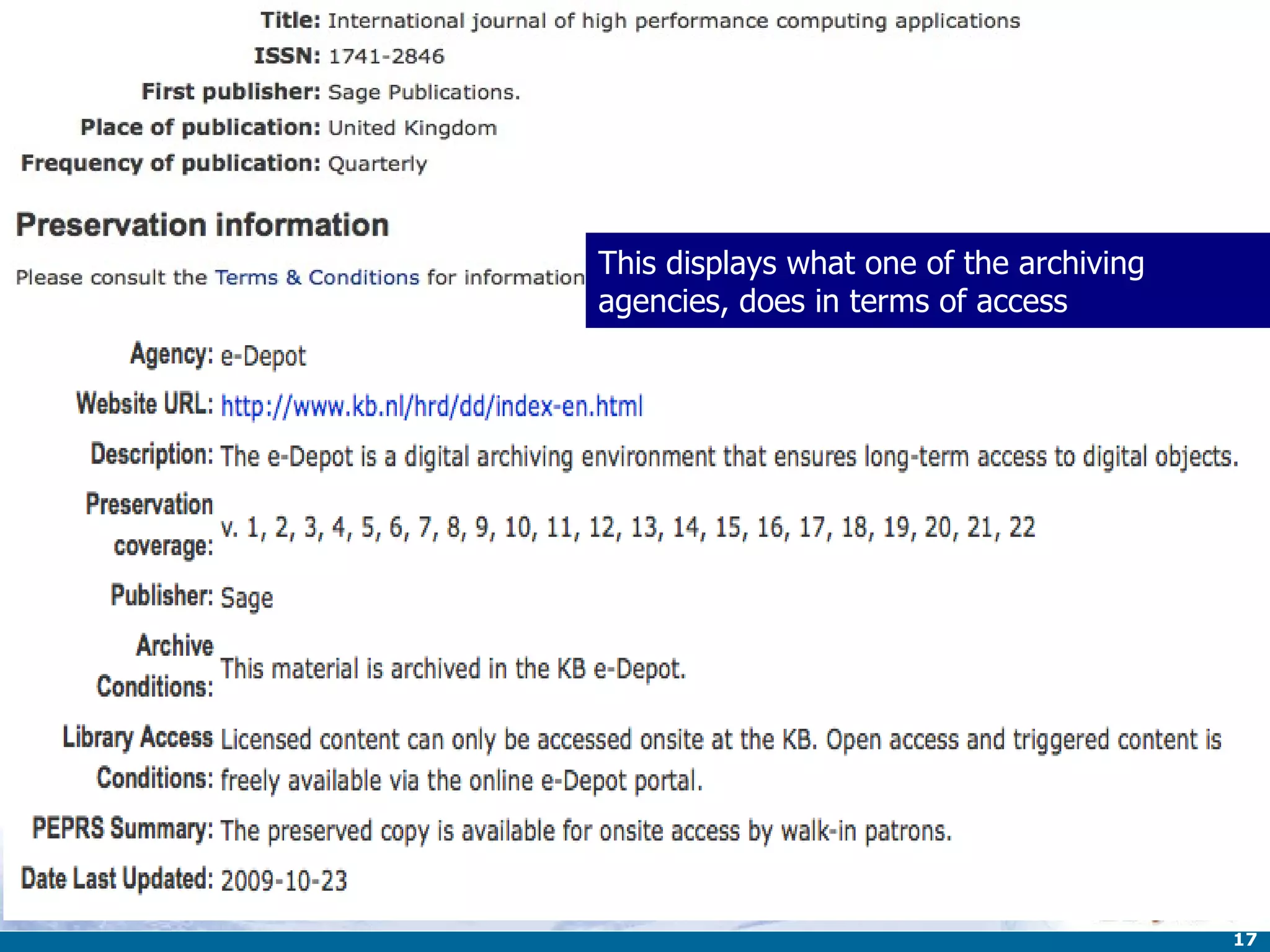
This displays what one of the archiving agencies, does in terms of access
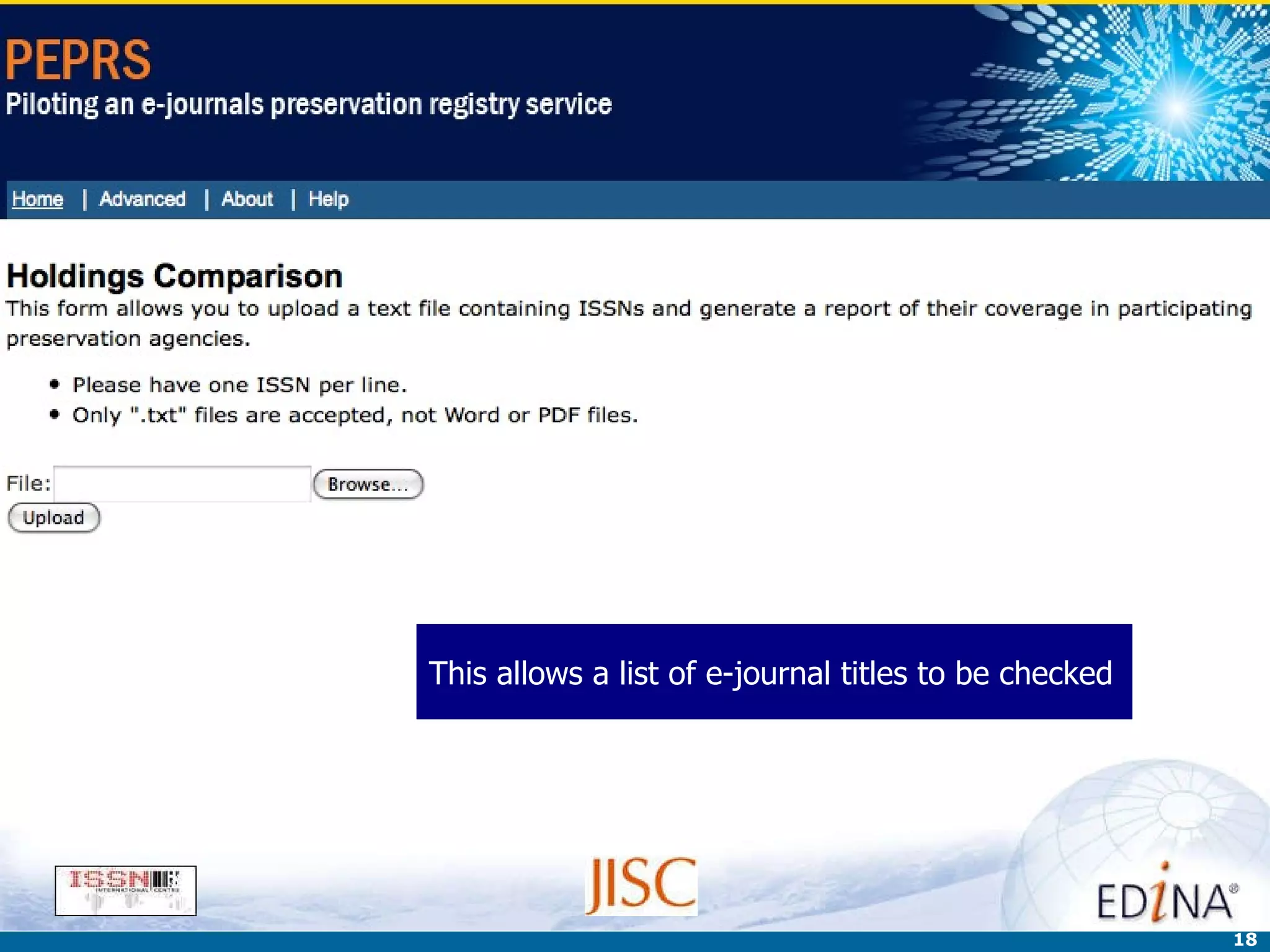
This allows a list of e-journal titles to be checked
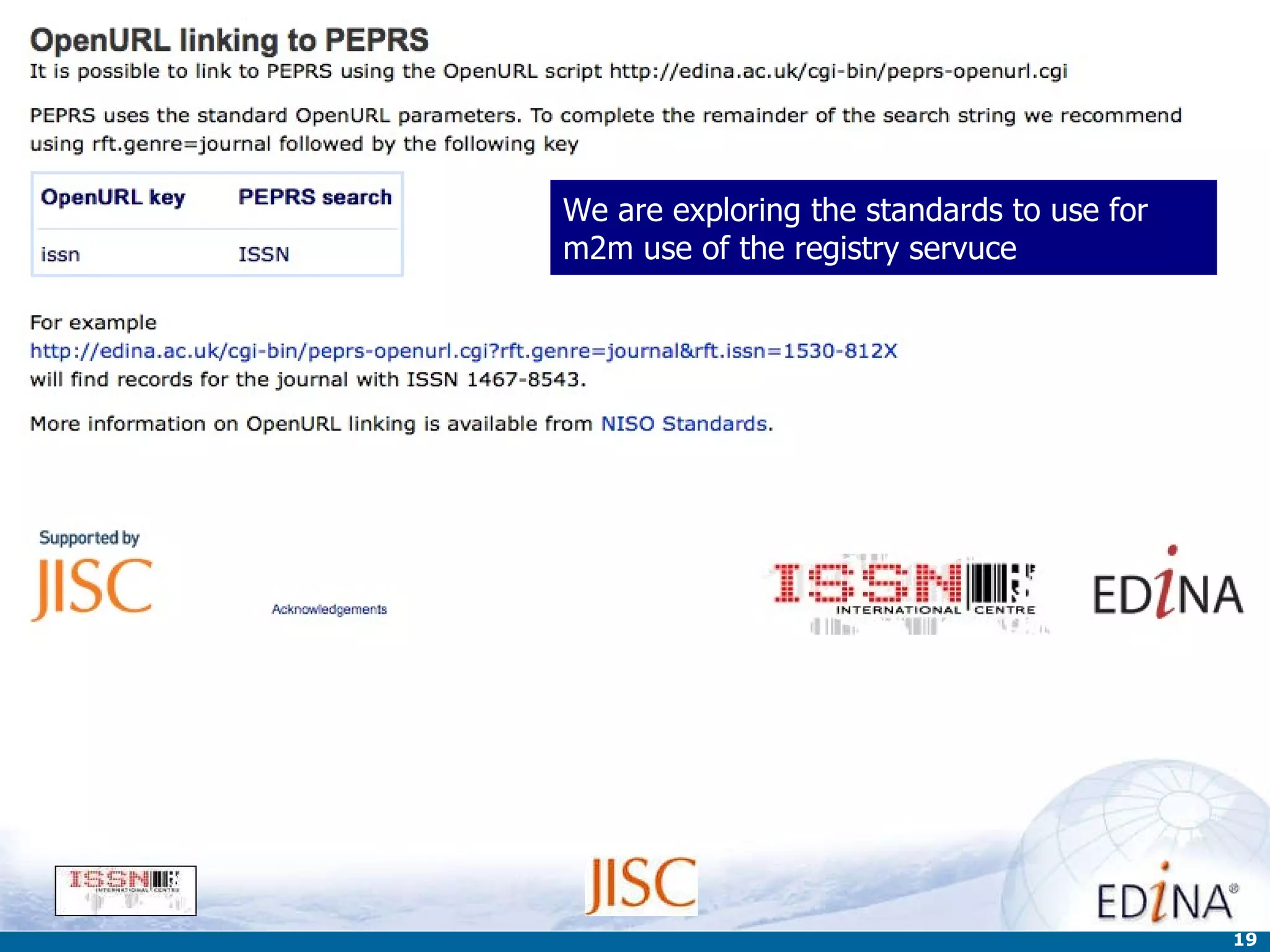
We are exploring the standards to use for m2m use of the registry servuce
PEPRS demonstrator Demonstrator
Issues identified in Phase 1 ISSNs used by agencies Holdings information supplied by the agencies Vocabulary used by the agencies
ISSN issues ISSNs missing in some agency records and some not in ISSN Register  Some duplicate records Some p-ISSNs used as e-ISSNs Some p-ISSNs linked via a common ISSN-L to a number of e-ISSNs but which one is correct? Some were incorrect
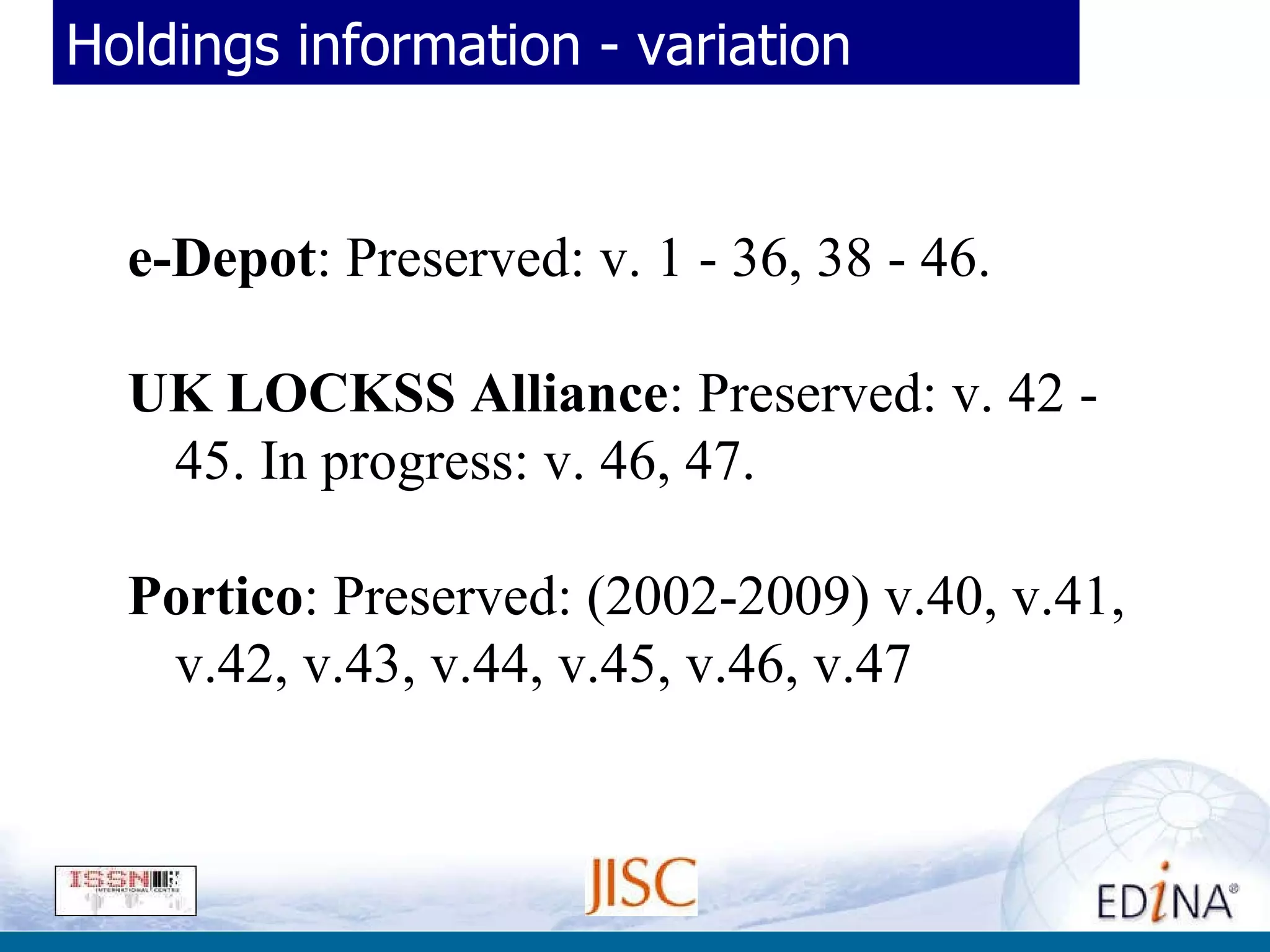
Holdings information - variation e-Depot : Preserved: v. 1 - 36, 38 - 46.  UK LOCKSS Alliance : Preserved: v. 42 - 45. In progress: v. 46, 47.  Portico : Preserved: (2002-2009) v.40, v.41, v.42, v.43, v.44, v.45, v.46, v.47 .
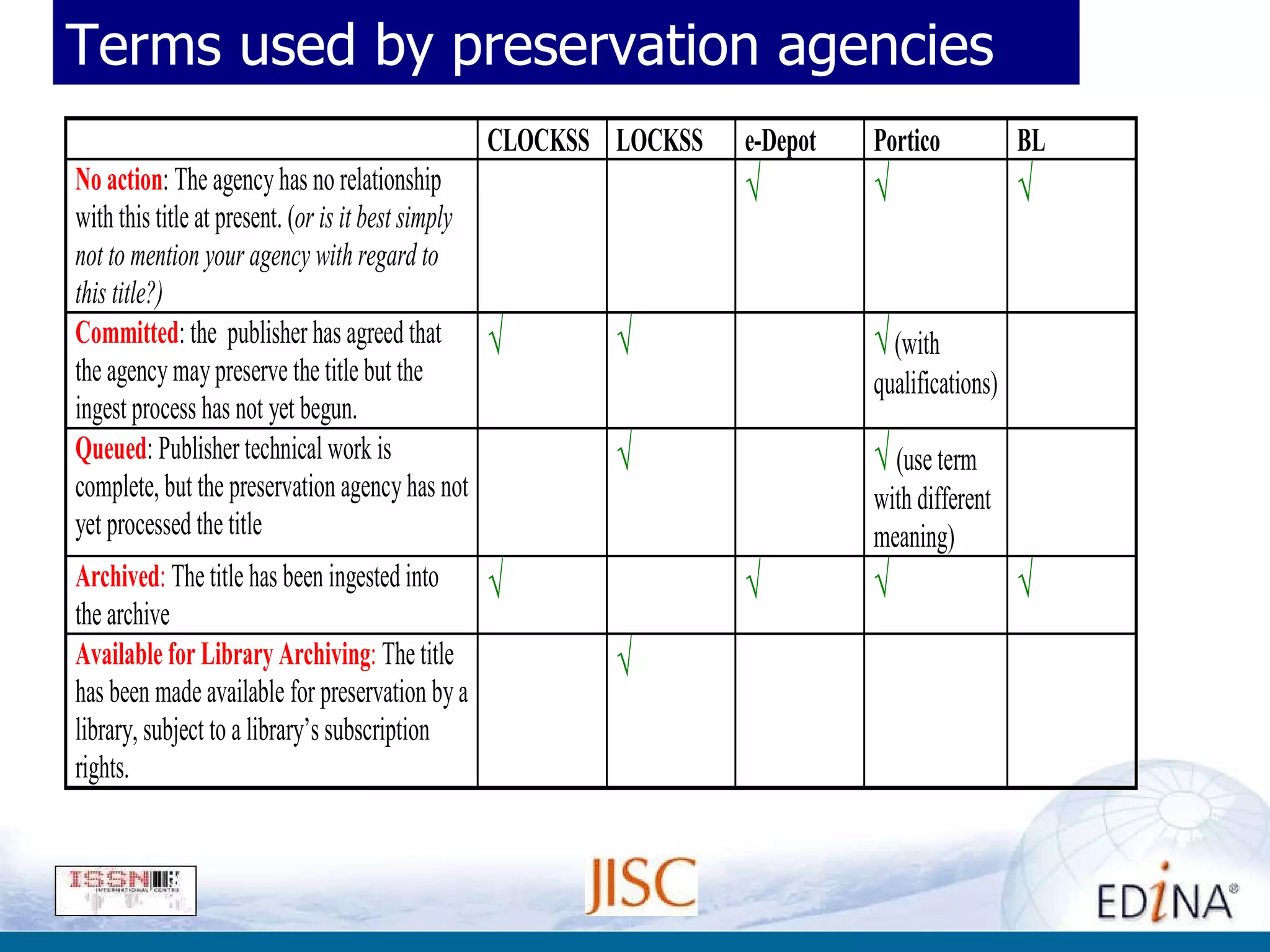
Terms used by preservation agencies
Key recommendations from evaluation carried out in February 2010 Should be funding for 2 further years with an initial 6 month phase and then if reviewed successfully for another 18 months Need to resolve with the agencies currency and updating of agency statements, archiving status and fields and terms to use in display. Continue with the development platform until the end of 2010 Establish a governance structure
PEPRS Phase 2 Funding provided from August 2010 – July 2012 Beta service – late 2010 Full service – late 2011? Involve international users in testing
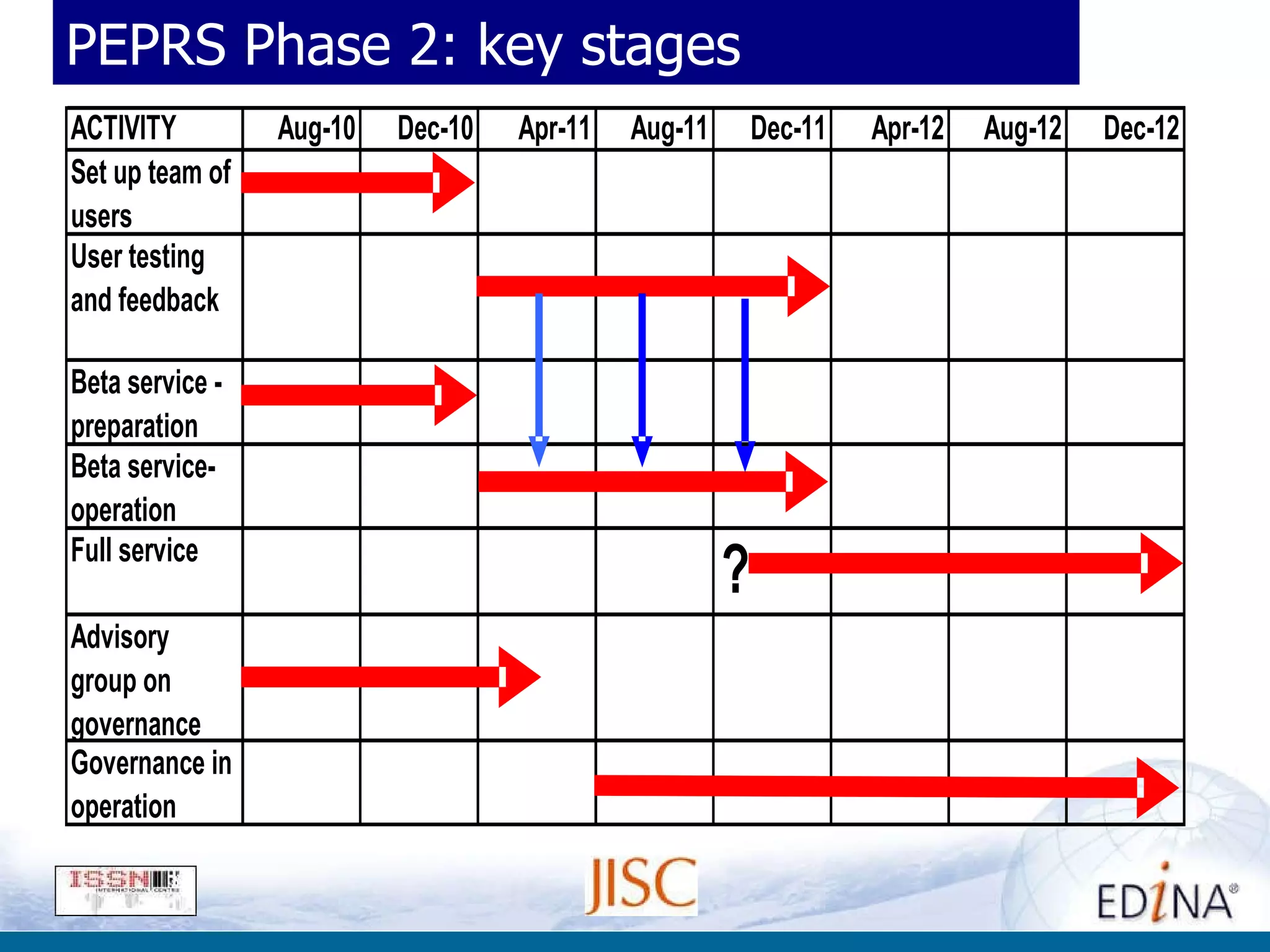
PEPRS Phase 2: key stages
Involvement with international initiatives Print Archives Program  of the Center for Research Libraries – “ CRL is working with consortial partners to plan a prototype print archives framework to link existing print archiving efforts. has developed a searchable Print Archives Registry of information about print-archiving initiatives, including: Projects  Serial Holdings . HATHITrust –  “…. is committed to preserving the intellectual content and in many cases the exact appearance and layout of materials digitized for deposit. HathiTrust stores and preserves metadata detailing the sequence of files for the digital object” .
PEPRS: Further information and Contact details http://edina.ac.uk/projects/peprs/index.html Fred Guy, EDINA, University of Edinburgh [email_address]

Finalrevc

  • 1.
    Finding out aboutthe preservation of e-journals: the PEPRS Project P iloting an E -journals P reservation R egistry S ervice Fred Guy, Project Manager, EDINA, University of Edinburgh [email_address] Internet Librarian International Conference 2010 15 th October 2010
  • 2.
    So What’s theProblem with E-journals? 96.1% of Science journals are online 86.5% of Arts and Humanities are online 2006-2007 – 102,000,000 downloads Up 21% from previous year 17% usage is at the weekend Source . E-journals: their use, value and impact. Research Information Network. UK April 2009.
  • 3.
  • 4.
    Trends in thefinances of UK higher education libraries: 1999-2009 . RIN 2010. p. 17
  • 5.
    Why Worry AboutDigital Preservation? Worries that all that is now digital may not always be available, for a variety of reasons. Publishers ceases publication with no transfer Publisher goes out of business with no transfer Publisher taken over
  • 6.
    Legal Deposit Workswell with print via legislation and national libraries. Countries with legislation enacted (or ‘in train’) for e-materials include: Canada, Denmark, Finland, France, Germany, Iceland, New Zealand, Norway, South Africa, Sweden, UK But , not all countries (notably USA) and in UK the legislation supports voluntary deposit, with restrictions of mode of access
  • 7.
    Why a PreservationRegistry? Many schemes emerging to meet challenge But who is doing what? How can libraries & policy-makers assess which e-journals are being archived, by what methods, and under what terms of access? JISC commissioned a scoping study for an e-journals preservation registry the idea had been mentioned in the literature
  • 8.
  • 9.
    Scoping Study ReportPrecedes PEPRS Rightscom / Loughborough University, 2007 Confirmed expressed need among libraries and policy makers Warned of potential burden on digital preservation agencies Recommended: an e-journals preservation registry should be built UK Union Catalogue of Serials (SUNCAT) or SHERPA (Open Access) get involved SUNCAT is hosted and managed at EDINA
  • 10.
    PROJECT DETAILS Phase1 funded by JISC (Preservation Programme) from August 2008 – July 2010 EDINA, University of Edinburgh, grant recipient Project partner – ISSN International Centre, Paris Evaluation carried out by Charles Beagrie Limited for the JISC in February 2010
  • 11.
    Digital Preservation Agenciesin the Pilot * Two 3 rd Party Organisations CLOCKSS ( C ontrolled L ots O f C opies K eeps S tuff S afe) Portico * Two National Libraries (c.f. legal deposit) British Library (BL) British Library e-Journal Digital Archive Koninklijke Bibliotheek (KB e-Depot ) KB, National Library of the Netherlands * One library cooperative UK LOCKSS ( L ots O f C opies K eeps S tuff S afe) Alliance
  • 12.
    Data from theagencies e-Depot XML e-Depot XML UKLOCKSS sourceforge.net + spreadsheet CLOCKSS sourceforge.net + spreadsheet Portico spreadsheet Perl script to parse the data ISSN Register PEPRS Database
  • 13.
    ISSN Register -steps Step 1. Extract a record for each record from an agency Step 2. Take the ISSN-L from each record Step 3. Parse the Register to map from the ISSN-L to the associated ISSNs Step 4. Load the records into a PEPRS database and link using the ISSN-L to the table with the records from the agencies.
  • 14.
    Example: a searchon ISSN* ‘ International Journal of High Performance Computing Applications’ * ISSN-L is used within the system to allow entry of either e-ISSN or p-ISSN
  • 15.
    Finds the agencieslooking after e-journal, and the volumes being preserved
  • 16.
    What happens when print ISSN is entered? Key role for ISSN-L subfield
  • 17.
    This displays whatone of the archiving agencies, does in terms of access
  • 18.
    This allows alist of e-journal titles to be checked
  • 19.
    We are exploringthe standards to use for m2m use of the registry servuce
  • 20.
  • 21.
    Issues identified inPhase 1 ISSNs used by agencies Holdings information supplied by the agencies Vocabulary used by the agencies
  • 22.
    ISSN issues ISSNsmissing in some agency records and some not in ISSN Register Some duplicate records Some p-ISSNs used as e-ISSNs Some p-ISSNs linked via a common ISSN-L to a number of e-ISSNs but which one is correct? Some were incorrect
  • 23.
    Holdings information -variation e-Depot : Preserved: v. 1 - 36, 38 - 46. UK LOCKSS Alliance : Preserved: v. 42 - 45. In progress: v. 46, 47. Portico : Preserved: (2002-2009) v.40, v.41, v.42, v.43, v.44, v.45, v.46, v.47 .
  • 24.
    Terms used bypreservation agencies
  • 25.
    Key recommendations fromevaluation carried out in February 2010 Should be funding for 2 further years with an initial 6 month phase and then if reviewed successfully for another 18 months Need to resolve with the agencies currency and updating of agency statements, archiving status and fields and terms to use in display. Continue with the development platform until the end of 2010 Establish a governance structure
  • 26.
    PEPRS Phase 2Funding provided from August 2010 – July 2012 Beta service – late 2010 Full service – late 2011? Involve international users in testing
  • 27.
    PEPRS Phase 2:key stages
  • 28.
    Involvement with internationalinitiatives Print Archives Program of the Center for Research Libraries – “ CRL is working with consortial partners to plan a prototype print archives framework to link existing print archiving efforts. has developed a searchable Print Archives Registry of information about print-archiving initiatives, including: Projects Serial Holdings . HATHITrust – “…. is committed to preserving the intellectual content and in many cases the exact appearance and layout of materials digitized for deposit. HathiTrust stores and preserves metadata detailing the sequence of files for the digital object” .
  • 29.
    PEPRS: Further informationand Contact details http://edina.ac.uk/projects/peprs/index.html Fred Guy, EDINA, University of Edinburgh [email_address]

Editor's Notes

  • #6 Many preservation schemes emerging, including: Collaborative and Third Party Schemes: CLOCKSS & Portico National Libraries & Legal Deposit Libraries and groups of libraries: LOCKSS Alliance
  • #8 Many preservation schemes emerging, including: Collaborative and Third Party Schemes: CLOCKSS & Portico National Libraries & Legal Deposit Libraries and groups of libraries: LOCKSS Alliance
  • #10 Many preservation schemes emerging, including: Collaborative and Third Party Schemes: CLOCKSS & Portico National Libraries & Legal Deposit Libraries and groups of libraries: LOCKSS Alliance