USER-FOCUSED DIGITAL LIBRARY: A PRACTICAL GUIDE -- useful tools, tips, and practicesQin ZhuSophia GuevaraStephen Pomes
DisclaimerToday, I will be discussing the MMS Library.  Although I am an employee of this government agency, I am not speaking as a official representative of this agency, nor will I be discussing broad policy matters or the Deepwater Horizon oil spill.--  Stephen Pomes
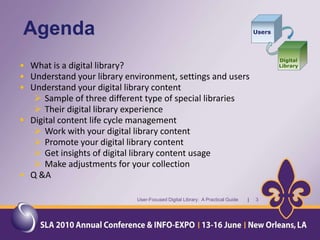
AgendaUsersDigital LibraryWhat is a digital library?
Understand your library environment, settings and users
Understand your digital library content
Sample of three different type of special libraries
Their digital library experience
Digital content life cycle management
Work with your digital library content
Promote your digital library content
Get insights of digital library content usage
Make adjustments for your collection
Q &AUser-Focused Digital Library:  A Practical Guide       |3
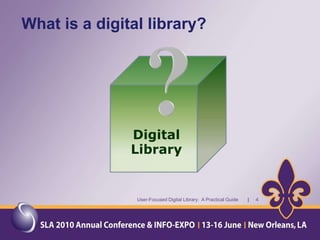
What is a digital library??Digital LibraryUser-Focused Digital Library:  A Practical Guide       |     4
Let’s do a quick survey --- What is a digital library?  Digital library is more or less about digitizing and digital preservation.
 A digital library is a system, a database for digitized items, such as digitized books, more or less about a system, an infrastructure.
 A digital library is a set of resources, especially electronic resources, more or less about digital content.User-Focused Digital Library:  A Practical Guide       |     5
What is a Digital Library?Digital libraries have been discussed for over twenty years, and different authors have provided various definitions.
It's beyond the scope of this presentation to discuss them all, but I will mention several.User-Focused Digital Library:  A Practical Guide       |6
What is a Digital Library?“Digital libraries are the logical extensions and augmentations of physical libraries in the electronic information society. Extensions amplify existing resources and services and augmentations enable new kinds of human problem solving and expression. As such, digital libraries offer new levels of access to broader audiences of users and new opportunities for the library and information science field to advance both theory and practice.” (Marchionini) http://www.ils.unc.edu/~march/digital_library_R_and_D.htmlUser-Focused Digital Library:  A Practical Guide       |    7
What is a Digital Library“A digital library is a distributed technology environment which dramatically reduces barriers to the creation, dissemination, manipulation, storage, integration, and reuse of information by individuals and groups.” (Fox, p. 65) http://eprints.cs.vt.edu/archive/00000377/01/TR-93-35.pdf
“This paper uses the term 'digital library' as a generic name for dynamic, federated structures that provide intellectual and physical access to the growing world-wide networks of information encoded in multimedia digital formats and examines research toward the broad goal of personalized harvesting in the information wilderness organized around agency-based architecture. Beginning from the perspective of the desktop, the researchers will explore the creation and evaluation of an architecture consisting of user interface agents, query processing agents, mediators, ontologies, and collection interface agents.”  (Birmingham, et al) http://www.csdl.tamu.edu/DL94/paper/umdl.htmlUser-Focused Digital Library:  A Practical Guide       |  8
What is a Digital Library?“A digital library is a library in which collections are stored in digital formats (as opposed to print, microform or other media) and accessible by computers. The digital content may be stored locally, or accessed remotely via computer networks. A digital library is a type of information retrieval system.” http://en_wikipedia.org/wiki/Digital_Library
I would define a digital library broadly as: “A library that uses a variety of electronic technologies to store, retrieve, and transmit information in various formats.”User-Focused Digital Library:  A Practical Guide       |   9
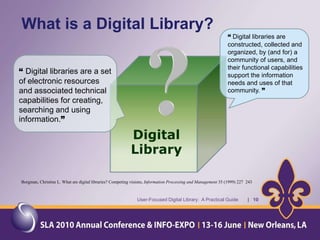
What is a Digital Library??“ Digital libraries are constructed, collected and organized, by (and for) a community of users, and their functional capabilities support the information needs and uses of that community. ”“ Digital libraries are a set of electronic resources and associated technical capabilities for creating, searching and using information.”Digital LibraryBorgman, Christine L. What are digital libraries? Competing visions, Information Processing and Management 35 (1999) 227±243 User-Focused Digital Library:  A Practical Guide       |   10
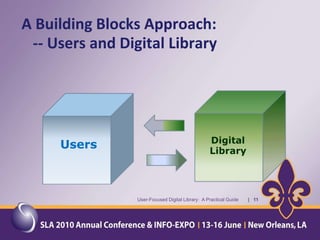
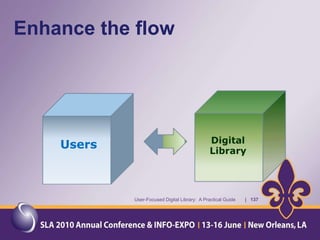
A Building Blocks Approach:    -- Users and Digital Library Digital LibraryUsersUser-Focused Digital Library:  A Practical Guide       |   11
Let’s do a quick survey --- What type of library are you from? From a corporate library?
 From a government library?
 From a non-profit organization library?
 From a research library?
 From a legal / law library?
 Other types?User-Focused Digital Library:  A Practical Guide       |   12
Understanding the differencesCollection development practices and funding are usually much different from that of a Corporate/academic/government library.  Must be creative in finding cost-effective information resources.Librarian/library may find their services supplemented by outside research consultants – services sought by the client. User-Focused Digital Library:  A Practical Guide       |   13
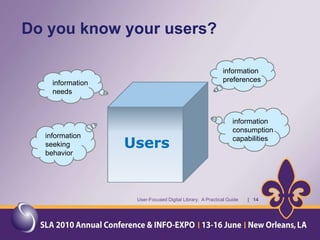
Do you know your users?information preferencesinformation needsinformation consumption capabilitiesinformation seeking behaviorUsersUser-Focused Digital Library:  A Practical Guide       |   14
User - Understand your library environment and settings UsersWho is the user?
What are the goals or your organization/clientele?  What are their preferences and capabilities?
How can you align your services with these goals in mind?User-Focused Digital Library:  A Practical Guide       |   15
User - Understand your library environment and settings UsersIdentify users’ information needs
Identify users’ information trends
Survey your user communityUser-Focused Digital Library:  A Practical Guide       |   16
Taking the pulse of the organization: SurveysWhy do surveys?  What is their value?Provides a way to learn more about your clients needs and expectationsWhy make surveys anonymousProvide the opportunity for participants to be fully expressive and offer constructive criticism.  Surveys help you catch little problems before they grow into bigger ones.The marketing aspectEmail creationRemind them that you want to provide not just good but excellent service and that their participation in the survey will help you do just that.Establishing valueOrganizational – A tool to learn about the organization’s current needsParticipant – A tool to give your clients a voiceUser-Focused Digital Library:  A Practical Guide       |   17
Survey implementationHow to implementSurvey software – Surveymonkey (free version)Select a small sample of people you have served in the last month – expect no more than 50% to respond.How to improve the response rate: Implement a giveaway for participantsExample questions to ask:How would you rate the quality of service you received?How satisfied are you with the turnaround time for your request?In addition to the information services you have already received, what other services would you like to see added? How would these services help you successfully achieve your work goals?User-Focused Digital Library:  A Practical Guide       |   18
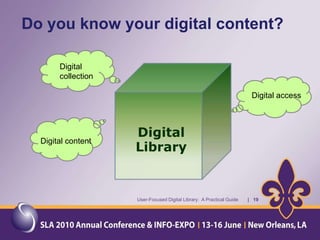
Do you know your digital content?Digital collectionDigital accessDigital LibraryDigital contentUser-Focused Digital Library:  A Practical Guide       |   19
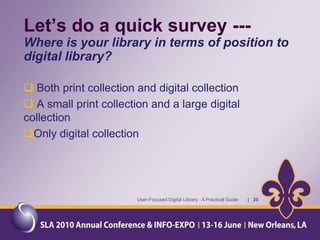
Let’s do a quick survey --- Where is your library in terms of position to  digital library?  Both print collection and digital collection
 A small print collection and a large digital collection
Only digital collectionUser-Focused Digital Library:  A Practical Guide       |   20
The MMS LibraryStephen Pomes, MMS LibraryUser-Focused Digital Library:  A Practical Guide       |   21
DisclaimerToday, I will be discussing the MMS Library.  Although I am an employee of this government agency, I am not speaking as a official representative of this agency, nor will I be discussing broad policy matters or the Deepwater Horizon oil spill.--  Stephen PomesUser-Focused Digital Library:  A Practical Guide       |   22
Outline of PresentationInstitutional Setting – the MMS and its Library
Two Sets of Customers and how the MMS Library Serves These Customers.
Why is the MMS Library an Accidental Digital Library?User-Focused Digital Library:  A Practical Guide       |   23
What is the Minerals Management Service?The Minerals Management Service, a bureau within the United States Department of the Interior, is the Federal agency that manages the nation's natural gas, oil and other mineral resources on the outer continental shelf  (OCS). The agency also collects, accounts for and disburses an average of $13.7 billion per year in revenues from Federal offshore mineral leases and from onshore mineral leases on Federal and American Indian lands. The program is national in scope and is headquartered in Washington, D.C.
The Minerals Management Service was created on January 19, 1982. In 1982, Congress passed the Federal Oil & Gas Royalty Management Act, which mandates protection of the environment and conservation of federal lands in the course of building oil and gas facilities.  User-Focused Digital Library:  A Practical Guide       |   24
What is the Minerals Management Service?The Minerals Management Service was formed out of parts of the Bureau of Land Management (BLM) and the United States Geological Survey (USGS). Both Agencies are part of the United States Department of the Interior.User-Focused Digital Library:  A Practical Guide       |   25
Reorganization of the MMSIn response to the Deepwater Horizon oil spill, on May 19, 2010 Interior Secretary Salazar announced that MMS will be broken up into three separate divisions, which will separately oversee energy leasing, revenue collection, and safety enforcement.
Bureau of Ocean Energy Management – Will be responsible for leasing areas of the Outer Continental Shelf for conventional and renewable energy resources.
Bureau of Safety and Environmental Enforcement – Will be responsible for ensuring comprehensive oversight, safety, and environmental protection in all offshore energy activities.
Office of Natural Resources Revenue – Will be responsible for royalty and revenue management, including collection and distribution of revenue, auditing and compliance, and asset management. User-Focused Digital Library:  A Practical Guide       |   26
The MMS LibraryThe MMS Library is a small technical library office located in the New Orleans metropolitan area, specifically in suburban Jefferson Parish.
Its holdings came from the merger of the older library collections from the respective BLM and USGS offices in the New Orleans area.User-Focused Digital Library:  A Practical Guide       |   27
Materials in the MMS LibraryGiven the nature of the Agency's mission, the MMS Library's print holdings are related to this mission.
Until recently, the MMS Library had approximately 16,000 titles.  The print titles included – but were not limited to – books, scholarly journals, conference proceedings, technical reports, and government documents.User-Focused Digital Library:  A Practical Guide       |   28
Materials in the MMS LibraryIn addition to print materials, the Library had government reports, conference proceedings, and periodicals on CD-ROM.
Microfiche materials on various topics.
Audiovisual materials included:
16 mm documentary films on the offshore oil and gas industry;
Carousel slide tray presentations on the offshore oil and gas industry;
DVDs VHS tapes on various topics.User-Focused Digital Library:  A Practical Guide       |   29
Supplementing the Library CollectionInterlibrary loans via OCLC
Online services – direct access to:
Electronic journals
Online bibliographic databases
Full-text databases
Abstracting and Indexing servicesUser-Focused Digital Library:  A Practical Guide       |   30
Two Groups of CustomersInternal CustomersMMS personnelExternal CustomersOther MMS personnel at other offices
Other government agencies
Other libraries
Members of the publicUser-Focused Digital Library:  A Practical Guide       |   31
Collection Development for Two Sets of CustomersCollection development is: “the process of identifying the strengths and weaknesses of a library’s materials collections in terms of patron needs and community resources, and attempting to correct existing weaknesses, if any.” (Evans, p. 15)Two sets of customers for the MMS Library – two very different ideas about collection development.User-Focused Digital Library:  A Practical Guide       |   32
Who are MMS Library Internal Customers?The MMS is responsible for offshore oil and gas leasing, exploration, and drilling, and the environmental impacts of these offshore oil and gas activities, so the staff at MMS include a variety of professionals, including anthropologists, attorneys, computer hardware and software personnel, economists, exploration geophysicists, marine archaeologists, marine biologists, meteorologists, micropaleontologists, oceanographers, petroleum geologists, petroleum engineers, and professionals in other fields.User-Focused Digital Library:  A Practical Guide       |   33
Collection Development for Internal CustomersFor internal customers, print and subscription based electronic materials selections based on:Relevance
Customer demand
Availability of fundsUser-Focused Digital Library:  A Practical Guide       |   34
How Does the MMS Library Serve its Internal Customers?Circulating print materials, DVDs, CD-ROMs, and microficheInterlibrary loans via OCLCAccess to free and subscribed electronic contentUser-Focused Digital Library:  A Practical Guide       |   35
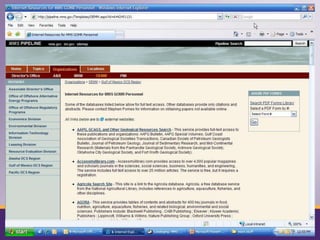
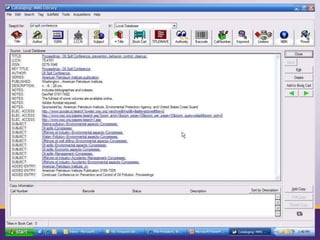
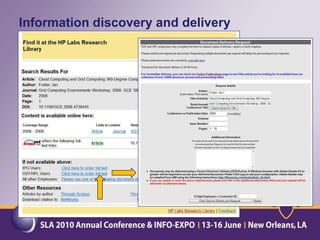
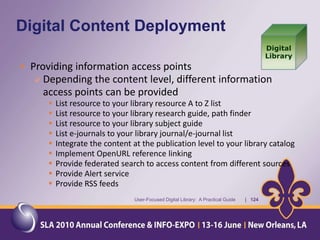
How Are Electronic Materials Made Available to MMS Personnel?In addition to hard copy materials in the Library, the Library makes electronic materials available to MMS employees.Links available via Library online catalog entries (Follett Software) – 856 MARC field.Menu page on Intranet with links to electronic content.Intranet menu page is maintained by Multimedia and Internet Production Section – with input by the librarian.User-Focused Digital Library:  A Practical Guide       |   36
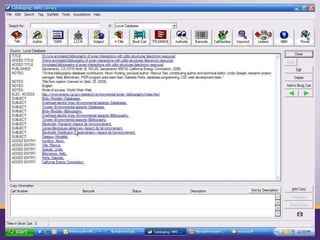
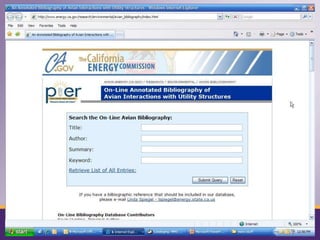
Typical Electronic Resources that MMS Personnel UseOn-Line Annotated Bibliography of Avian Interactions with Utility Structures - http://www.energy.ca.gov/research/environmental/avian_bibliography/index.htmlThe on-line bibliography is comprised of published literature, popular articles, newspaper stories, and industry technical papers that address avian electrocution and collision and closely related topics. Most entries attempt to describe and quantify the impacts of avian collision with transmission line wires and structures and avian electrocution as a result of contact with distribution lines and associated structures. Users: Any MMS personnel involved with writing environmental impact statements.User-Focused Digital Library:  A Practical Guide       |   39
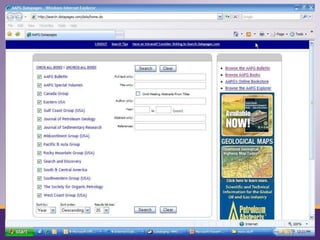
Typical Electronic Resources that MMS Personnel UseAAPG Datapages - http://search.datapages.com/This service provides full-text access to these publications and organizations: AAPG Bulletin, AAPG Special Volumes, Gulf Coast Association of Geological Societies Transactions, Canadian Society of Petroleum Geologists Bulletin, Journal of Petroleum Geology, Journal of Sedimentary Research, and Mid-Continental Research (Materials from the Panhandle Geological Society, Ardmore Geological Society, Oklahoma City Geological Society, and Fort Worth Geological Society).Users: Oceanographers, Petroleum Engineers, Petroleum Geologists, and Petroleum GeophysicistsUser-Focused Digital Library:  A Practical Guide       |   42
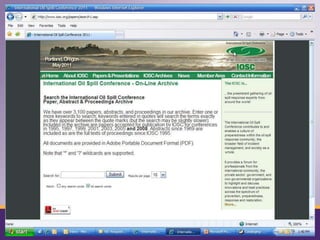
Typical Electronic Resources that MMS Personnel UseInternational Oil Spill Conference - http://www.iosc.org/papers/search1.aspThe International Oil Spill Conference contributes to and enables a culture of preparedness within the oil spill response community, the broader field of incident management, and society as a whole. It provides a forum for professionals from the international community, the private sector, government, and non-governmental organizations to highlight and discuss innovations and best practices across the spectrum of prevention, preparedness, response and restoration.Users: All MMS personnel.User-Focused Digital Library:  A Practical Guide       |   44
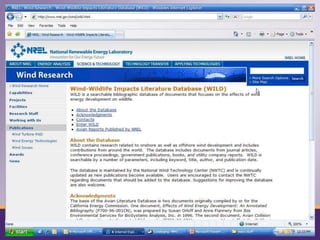
Typical Electronic Resources that MMS Personnel UseWind Wildlife Literature Database – http://www.nrel.gov/wind/wild.html A bibliographic database of documents of effects of wind energy development (including towers, power lines, and other wires) on birds. The database includes documents from journals, periodicals, conference proceedings, government publications, utility company reports, books, and magazines. The database currently contains the abstracts of documents published through 1995. National Renewable Energy Laboratory intends to update this database on a regular basis, adding document citations and abstracts as more documents are published. The database is maintained by the National Wind Technology Center. Users: Staff members involved with writing environmental impact statements.User-Focused Digital Library:  A Practical Guide       |   46
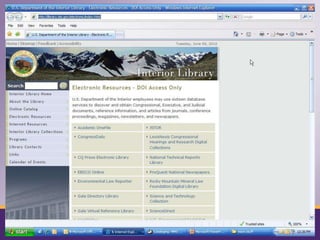
Typical Electronic Resources that MMS Personnel UseDepartment of the Interior Library Federated Search - http://library.doi.gov/electronic/index.htmlThis search engine allows the end user to search fifteen major databases simultaneously. The databases include Academic OneFile, CongressDaily, EBSCO Online, Environmental Law Reporter, Gale Directory Library, Gale Virtual Reference Library, HeinOnline, JSTOR, LexisNexis Congressional Hearings and Research Digital Collections, National Technical Reports Library, ProQuest National Newspapers, Rocky Mountain Mineral Law Foundation Digital Library, Science and Technology Collection, and U.S. Congressional Serial Set.Users: All MMS personnel.User-Focused Digital Library:  A Practical Guide       |   48
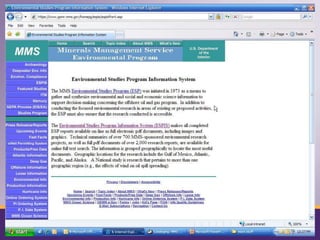
Typical Electronic Resources that MMS Personnel UseEnvironmental Studies Program Information System (ESPIS) - https://www.gomr.mms.gov/homepg/espis/espisfront.aspESPIS makes all completed ESP reports available on-line as full electronic pdf documents, including images and graphics.  Technical summaries of over 700 MMS-sponsored environmental research projects, as well as full pdf documents of over 2,000 research reports, are available for online full text search. The information is grouped geographically to locate the most useful documents.  Geographic locations for the research include the Gulf of Mexico, Atlantic, Pacific, and Alaska.   A National study is research that pertains to more than one geographic region (e.g., the effects of wind on oil spill spreading). Users: All MMS personnel – but especially staff members working on environmental impact statements.User-Focused Digital Library:  A Practical Guide       |   50
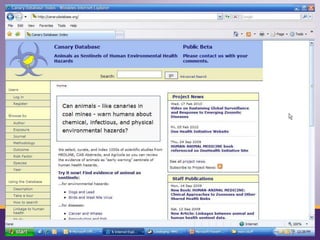
Typical Electronic Resources that MMS Personnel UseCanary Database -  http://canarydatabase.orgThis database is a compilation of curated peer-reviewed research articles related to the use of animals as sentinels of human health hazards. This database contains information added by trained curators in addition to bibliographic records from MEDLINE and other well-known databases. The database includes studies of wildlife, companion, and livestock animals, where either the exposure or the health effect could be considered potentially relevant to human health.Users: Marine biologists, oceanographers, and other personnel involved with writing environmental impact statements.User-Focused Digital Library:  A Practical Guide       |   52
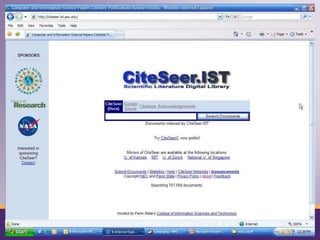
Typical Electronic Resources that MMS Personnel UseCiteSeer - http://citeseer.ist.psu.edu/This service provides full text to computer science and information technology (IT) reports and research.Users: Any MMS personnel involved with IT projects.User-Focused Digital Library:  A Practical Guide       |   54
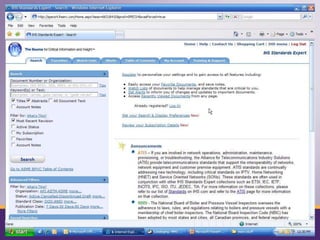
Typical Electronic Resources that MMS Personnel UseIHS Standards Expert – http://www.ihs.comThis resource, from Information Handling Services, provides access to all standards and recommended practices that MMS currently references in its regulations.  These documents originate from the American Petroleum Institute and other organizations. Users: All MMS personnel, but especially petroleum engineers and individuals involved with writing environmental impact statements.User-Focused Digital Library:  A Practical Guide       |   56
Typical Electronic Resources that MMS Personnel UseEBSCO Online - http://search.ebscohost.com/EBSCO Online provides full text access, according to their website, to "thousands of e-journals containing millions of articles from hundreds of different publishers, all at one web site." Access is provided through the Dept. of the Interior Library and requires no login or password.Users: All MMS personnelUser-Focused Digital Library:  A Practical Guide       |   58
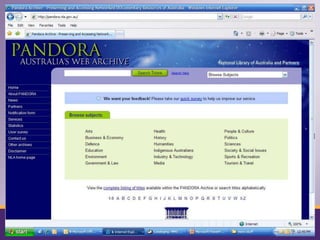
Typical Electronic Resources that MMS Personnel Use Pandora - http://pandora.nla.gov.au/Australia's Web Archive, is a growing collection of Australian online publications, established initially by the National Library of Australia in 1996, and now built in collaboration with nine other Australian libraries and cultural collecting organizations. The materials include magazines, scholarly journals, and other web-based materials. The archive includes publications in the pure and applied sciences, medicine, engineering fields, social sciences, the arts, and the humanities. There are no restrictions on accessing the materials contained in this archive.User-Focused Digital Library:  A Practical Guide       |   59
External CustomersOther Federal Government LibrariesOther Federal AgenciesCitizensAcademic LibrariesPublic LibrariesSchool LibrariesLibraries in the private sectorUser-Focused Digital Library:  A Practical Guide       |   61
How Does the MMS Library Serve External Customers?Interlibrary loansPrint materials mailed.
Journal articles photocopied and fax.
PDFs of journal articles and other materials sent as e-mail attachments.
E-mails sent to borrowing libraries with links to open access journal articles
Because of budget factors, MMS Library does not participate in Ariel.ReferralsReferrals to resources within MMS (e.g., ESPIS) or to materials in other government agency repositoriesUser-Focused Digital Library:  A Practical Guide       |   62
Collection Development for External CustomersThe MMS Library serves external customers primarily through interlibrary loans.Most of the requested materials are journal articles from open access journalsUsing Worldcat.org, Directory of Open Access Journals – http://www.doaj.org, Elektronische Zeitschriftenbibliothek EZB http://ezb.uni-regensburg.de/index.phtml?bibid=AAAAA&colors=7&lang=en , and other bibliographic utilities, I add open access journals that are not widely held by other librariesOpen access journals are peer-reviewed journals that rely on grant money and/or author subsidies for their operating costs.  Although they are free to libraries, they are not “free” in every sense.  Despite their free status, they do have good impact factors (e.g., BioMed Central Journals).Materials are frequently requested, and, for each request filled, the MMS receives lending credit from OCLC.User-Focused Digital Library:  A Practical Guide       |   63
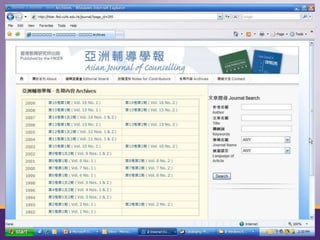
Some Materials Provided to External Customers via Interlibrary LoanThese materials are frequently requested via OCLC Resource SharingAsian Journal of Counselling - http://hkier.fed.cuhk.edu.hk/journal/?page_id=289The Asian Journal of Counselling, co-published by the HKIER and the Hong Kong Professional Counselling Association twice a year, is the only bilingual journal related to the science and practice of counseling published in Hong Kong. The journal contains articles on theories, research and case studies of counseling and covers areas ranging from intervention to individual and group counseling, career counseling, cross-cultural and multicultural counseling, counseling training and supervision, and issues of ethics and values related to counseling. Its aim is to promote the integration of Western counseling theories and practice into Asian and Chinese cultures.User-Focused Digital Library:  A Practical Guide       |   64
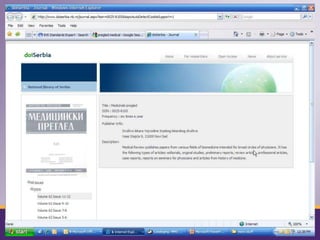
Some Materials Provided to External Customers via Interlibrary LoanMedicinski pregled (Medical Review) - http://www.doiserbia.nb.rs/journal.aspx?issn=0025-8105 Medical Review publishes papers from various fields of biomedicine intended for broad circles of physicians. It has the following types of articles: editorials, original studies, preliminary reports, review articles, professional articles, case reports, reports on seminars for physicians and articles from history of medicine.User-Focused Digital Library:  A Practical Guide       |   66
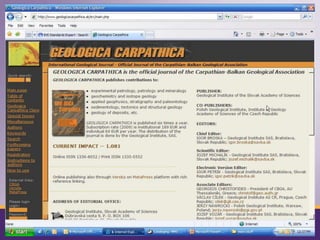
Some Materials Provided to External Customers via Interlibrary LoanGeologica Carpathica, the official journal of the Carpathian-Balkan Geological Association - http://www.geologicacarpathica.sk/src/main.phpThis journal covers these topics such as experimental petrology, petrology and mineralogy; geochemistry and isotope geology; applied geophysics, stratigraphy and paleontology; sedimentology, tectonics and structural geology; and the geology of deposits.User-Focused Digital Library:  A Practical Guide       |   68
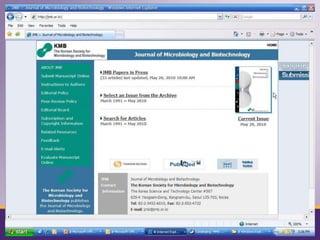
Some Materials Provided to External Customers via Interlibrary LoanJournal of Microbiology and Biotechnology - http://www.jmb.or.kr/The Journal of Microbiology and Biotechnology (JMB) is monthly journal devoted to the advancement and dissemination of scientific knowledge concerning microbiology, biotechnology, biomedicine and related academic disciplines. It covers scientific and technological aspects of microbiology, including physiology and metabolism; environmental, food, and medical microbiology; molecular microbiology; enzymology and enzyme engineering; fermentation technology; plant and animal cell cultures; bioprocess engineering; and biomedical sciences. The JMB is published and distributed by the Korean Society for Microbiology and Biotechnology (KMB).User-Focused Digital Library:  A Practical Guide       |   70
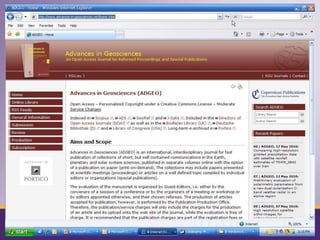
Some Materials Provided to External Customers via Interlibrary LoanAdvances in Geosciences – http://www.advances-in-geosciences.net/home.htmlAdvances in Geosciences (ADGEO) is an international, interdisciplinary journal for fast publication of collections of short, but self-contained communications in the Earth, planetary and solar system sciences.User-Focused Digital Library:  A Practical Guide       |   72
Why is the MMS Library an Accidental Digital Library?For approximately ten years, I have been adding links to online content to online library catalog records (856 MARC field)
Gradually adding online subscriptions and aggregated full-text databases to library holdings
Gradually adding open access publications to library holdingsUser-Focused Digital Library:  A Practical Guide       |   74
Why is the MMS Library an Accidental Digital Library?May 1995 flood resulted in widespread flooding in New Orleans area, including the Elmwood area where the MMS office is.  Library received very minor floodingHurricanes Katrina and Rita damaged top three floors of the MMS office building, but library received no damage.General Services Administration (GSA) authorized building wide repairs and renovations – starting a series of section movesGSA would not authorize enough funds to reinforce the floors on the second floor – the new Library location.User-Focused Digital Library:  A Practical Guide       |   75
Why is the MMS Library an Accidental Digital Library?Mandate to reduce the Library’s collection from 16,000+ titles to 2,000Long term checkouts of print materials to staff members and sectionsTransfers and donations of print materials to other Federal Agencies, Federal Government Libraries, and to other librariesGSA sale of print materialsOther materials transferred to dumpsterUser-Focused Digital Library:  A Practical Guide       |   76
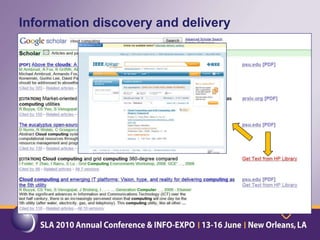
Why is the MMS Library an Accidental Digital Library? With a much smaller collection, how is the Library delivering library and information services?More interlibrary loansMore dependence upon aggregated full-text databasesI send requests to library related electronic mailing lists for requests with short-term deadlinesWhenever possible, I use open access journals and institutional repositories to locate materials to fill information requestsGoogle Scholar is useful for locating open access versions of articlesUser-Focused Digital Library:  A Practical Guide       |   77
Licensing and Authentication IssuesLicensing and purchasingGSA and/or the Department of the Interior negotiate pricing and licensing for subscription based online services.
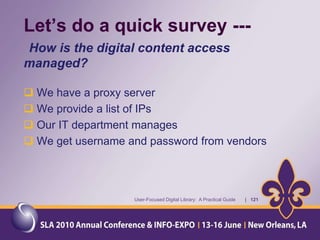
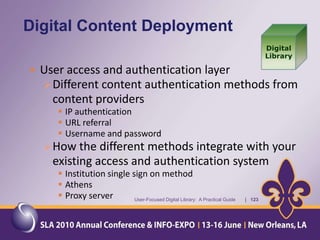
With these policies and procedures in place, there is little need for separate negotiations.AuthenticationSome vendors prefer IP address recognition, whereas other vendors prefer an overall user ID and password for accesing their products.User-Focused Digital Library:  A Practical Guide       |   78
MMS Library in a Post-MMS EnvironmentWith the reorganization into three separate agencies, it is unclear where the MMS Library will be in the organization schemeWith a change of Agency, there will be a change in mission and a change in focus for the LibraryUser-Focused Digital Library:  A Practical Guide       |   79
Digital Library under Research OrganizationQin Zhu, HP LabsUser-Focused Digital Library:  A Practical Guide       |   80
HP Labs“HP Labs is the exploratory and advanced research group for Hewlett-Packard, tackling complex challenges facing our customers and society over the next decades, while pushing the frontier of fundamental science”User-Focused Digital Library:  A Practical Guide       |   81
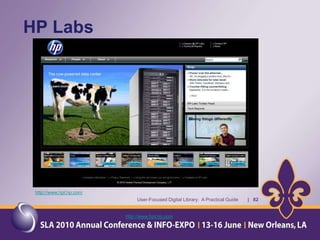
HP Labshttp://www.hpl.hp.comUser-Focused Digital Library:  A Practical Guide       |   82http://www.hpl.hp.com
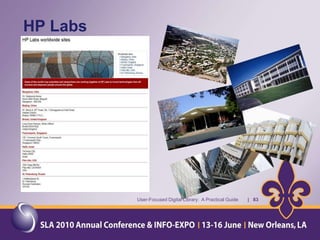
HP LabsUser-Focused Digital Library:  A Practical Guide       |   83
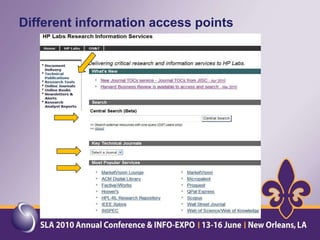
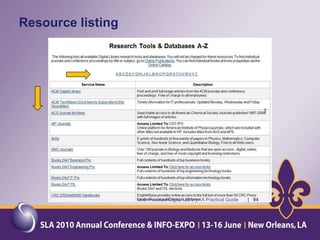
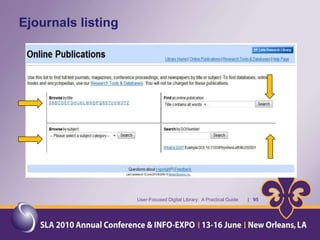
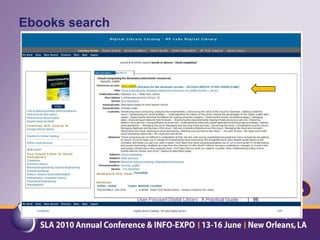
Research Information ServicesResearch Information Services
Digital Library Services
Records Management

User Focused Digital Library: A Practical Guide

  • 1.
    USER-FOCUSED DIGITAL LIBRARY:A PRACTICAL GUIDE -- useful tools, tips, and practicesQin ZhuSophia GuevaraStephen Pomes
  • 2.
    DisclaimerToday, I willbe discussing the MMS Library. Although I am an employee of this government agency, I am not speaking as a official representative of this agency, nor will I be discussing broad policy matters or the Deepwater Horizon oil spill.-- Stephen Pomes
  • 3.
  • 4.
    Understand your libraryenvironment, settings and users
  • 5.
  • 6.
    Sample of threedifferent type of special libraries
  • 7.
  • 8.
    Digital content lifecycle management
  • 9.
    Work with yourdigital library content
  • 10.
    Promote your digitallibrary content
  • 11.
    Get insights ofdigital library content usage
  • 12.
    Make adjustments foryour collection
  • 13.
    Q &AUser-Focused DigitalLibrary: A Practical Guide |3
  • 14.
    What is adigital library??Digital LibraryUser-Focused Digital Library: A Practical Guide | 4
  • 15.
    Let’s do aquick survey --- What is a digital library? Digital library is more or less about digitizing and digital preservation.
  • 16.
    A digitallibrary is a system, a database for digitized items, such as digitized books, more or less about a system, an infrastructure.
  • 17.
    A digitallibrary is a set of resources, especially electronic resources, more or less about digital content.User-Focused Digital Library: A Practical Guide | 5
  • 18.
    What is aDigital Library?Digital libraries have been discussed for over twenty years, and different authors have provided various definitions.
  • 19.
    It's beyond thescope of this presentation to discuss them all, but I will mention several.User-Focused Digital Library: A Practical Guide |6
  • 20.
    What is aDigital Library?“Digital libraries are the logical extensions and augmentations of physical libraries in the electronic information society. Extensions amplify existing resources and services and augmentations enable new kinds of human problem solving and expression. As such, digital libraries offer new levels of access to broader audiences of users and new opportunities for the library and information science field to advance both theory and practice.” (Marchionini) http://www.ils.unc.edu/~march/digital_library_R_and_D.htmlUser-Focused Digital Library: A Practical Guide | 7
  • 21.
    What is aDigital Library“A digital library is a distributed technology environment which dramatically reduces barriers to the creation, dissemination, manipulation, storage, integration, and reuse of information by individuals and groups.” (Fox, p. 65) http://eprints.cs.vt.edu/archive/00000377/01/TR-93-35.pdf
  • 22.
    “This paper usesthe term 'digital library' as a generic name for dynamic, federated structures that provide intellectual and physical access to the growing world-wide networks of information encoded in multimedia digital formats and examines research toward the broad goal of personalized harvesting in the information wilderness organized around agency-based architecture. Beginning from the perspective of the desktop, the researchers will explore the creation and evaluation of an architecture consisting of user interface agents, query processing agents, mediators, ontologies, and collection interface agents.” (Birmingham, et al) http://www.csdl.tamu.edu/DL94/paper/umdl.htmlUser-Focused Digital Library: A Practical Guide | 8
  • 23.
    What is aDigital Library?“A digital library is a library in which collections are stored in digital formats (as opposed to print, microform or other media) and accessible by computers. The digital content may be stored locally, or accessed remotely via computer networks. A digital library is a type of information retrieval system.” http://en_wikipedia.org/wiki/Digital_Library
  • 24.
    I would definea digital library broadly as: “A library that uses a variety of electronic technologies to store, retrieve, and transmit information in various formats.”User-Focused Digital Library: A Practical Guide | 9
  • 25.
    What is aDigital Library??“ Digital libraries are constructed, collected and organized, by (and for) a community of users, and their functional capabilities support the information needs and uses of that community. ”“ Digital libraries are a set of electronic resources and associated technical capabilities for creating, searching and using information.”Digital LibraryBorgman, Christine L. What are digital libraries? Competing visions, Information Processing and Management 35 (1999) 227±243 User-Focused Digital Library: A Practical Guide | 10
  • 26.
    A Building BlocksApproach: -- Users and Digital Library Digital LibraryUsersUser-Focused Digital Library: A Practical Guide | 11
  • 27.
    Let’s do aquick survey --- What type of library are you from? From a corporate library?
  • 28.
    From agovernment library?
  • 29.
    From anon-profit organization library?
  • 30.
    From aresearch library?
  • 31.
    From alegal / law library?
  • 32.
    Other types?User-FocusedDigital Library: A Practical Guide | 12
  • 33.
    Understanding the differencesCollectiondevelopment practices and funding are usually much different from that of a Corporate/academic/government library. Must be creative in finding cost-effective information resources.Librarian/library may find their services supplemented by outside research consultants – services sought by the client. User-Focused Digital Library: A Practical Guide | 13
  • 34.
    Do you knowyour users?information preferencesinformation needsinformation consumption capabilitiesinformation seeking behaviorUsersUser-Focused Digital Library: A Practical Guide | 14
  • 35.
    User - Understandyour library environment and settings UsersWho is the user?
  • 36.
    What are thegoals or your organization/clientele? What are their preferences and capabilities?
  • 37.
    How can youalign your services with these goals in mind?User-Focused Digital Library: A Practical Guide | 15
  • 38.
    User - Understandyour library environment and settings UsersIdentify users’ information needs
  • 39.
  • 40.
    Survey your usercommunityUser-Focused Digital Library: A Practical Guide | 16
  • 41.
    Taking the pulseof the organization: SurveysWhy do surveys? What is their value?Provides a way to learn more about your clients needs and expectationsWhy make surveys anonymousProvide the opportunity for participants to be fully expressive and offer constructive criticism. Surveys help you catch little problems before they grow into bigger ones.The marketing aspectEmail creationRemind them that you want to provide not just good but excellent service and that their participation in the survey will help you do just that.Establishing valueOrganizational – A tool to learn about the organization’s current needsParticipant – A tool to give your clients a voiceUser-Focused Digital Library: A Practical Guide | 17
  • 42.
    Survey implementationHow toimplementSurvey software – Surveymonkey (free version)Select a small sample of people you have served in the last month – expect no more than 50% to respond.How to improve the response rate: Implement a giveaway for participantsExample questions to ask:How would you rate the quality of service you received?How satisfied are you with the turnaround time for your request?In addition to the information services you have already received, what other services would you like to see added? How would these services help you successfully achieve your work goals?User-Focused Digital Library: A Practical Guide | 18
  • 43.
    Do you knowyour digital content?Digital collectionDigital accessDigital LibraryDigital contentUser-Focused Digital Library: A Practical Guide | 19
  • 44.
    Let’s do aquick survey --- Where is your library in terms of position to digital library? Both print collection and digital collection
  • 45.
    A smallprint collection and a large digital collection
  • 46.
    Only digital collectionUser-FocusedDigital Library: A Practical Guide | 20
  • 47.
    The MMS LibraryStephenPomes, MMS LibraryUser-Focused Digital Library: A Practical Guide | 21
  • 48.
    DisclaimerToday, I willbe discussing the MMS Library. Although I am an employee of this government agency, I am not speaking as a official representative of this agency, nor will I be discussing broad policy matters or the Deepwater Horizon oil spill.-- Stephen PomesUser-Focused Digital Library: A Practical Guide | 22
  • 49.
    Outline of PresentationInstitutionalSetting – the MMS and its Library
  • 50.
    Two Sets ofCustomers and how the MMS Library Serves These Customers.
  • 51.
    Why is theMMS Library an Accidental Digital Library?User-Focused Digital Library: A Practical Guide | 23
  • 52.
    What is theMinerals Management Service?The Minerals Management Service, a bureau within the United States Department of the Interior, is the Federal agency that manages the nation's natural gas, oil and other mineral resources on the outer continental shelf (OCS). The agency also collects, accounts for and disburses an average of $13.7 billion per year in revenues from Federal offshore mineral leases and from onshore mineral leases on Federal and American Indian lands. The program is national in scope and is headquartered in Washington, D.C.
  • 53.
    The Minerals ManagementService was created on January 19, 1982. In 1982, Congress passed the Federal Oil & Gas Royalty Management Act, which mandates protection of the environment and conservation of federal lands in the course of building oil and gas facilities. User-Focused Digital Library: A Practical Guide | 24
  • 54.
    What is theMinerals Management Service?The Minerals Management Service was formed out of parts of the Bureau of Land Management (BLM) and the United States Geological Survey (USGS). Both Agencies are part of the United States Department of the Interior.User-Focused Digital Library: A Practical Guide | 25
  • 55.
    Reorganization of theMMSIn response to the Deepwater Horizon oil spill, on May 19, 2010 Interior Secretary Salazar announced that MMS will be broken up into three separate divisions, which will separately oversee energy leasing, revenue collection, and safety enforcement.
  • 56.
    Bureau of OceanEnergy Management – Will be responsible for leasing areas of the Outer Continental Shelf for conventional and renewable energy resources.
  • 57.
    Bureau of Safetyand Environmental Enforcement – Will be responsible for ensuring comprehensive oversight, safety, and environmental protection in all offshore energy activities.
  • 58.
    Office of NaturalResources Revenue – Will be responsible for royalty and revenue management, including collection and distribution of revenue, auditing and compliance, and asset management. User-Focused Digital Library: A Practical Guide | 26
  • 59.
    The MMS LibraryTheMMS Library is a small technical library office located in the New Orleans metropolitan area, specifically in suburban Jefferson Parish.
  • 60.
    Its holdings camefrom the merger of the older library collections from the respective BLM and USGS offices in the New Orleans area.User-Focused Digital Library: A Practical Guide | 27
  • 61.
    Materials in theMMS LibraryGiven the nature of the Agency's mission, the MMS Library's print holdings are related to this mission.
  • 62.
    Until recently, theMMS Library had approximately 16,000 titles. The print titles included – but were not limited to – books, scholarly journals, conference proceedings, technical reports, and government documents.User-Focused Digital Library: A Practical Guide | 28
  • 63.
    Materials in theMMS LibraryIn addition to print materials, the Library had government reports, conference proceedings, and periodicals on CD-ROM.
  • 64.
  • 65.
  • 66.
    16 mm documentaryfilms on the offshore oil and gas industry;
  • 67.
    Carousel slide traypresentations on the offshore oil and gas industry;
  • 68.
    DVDs VHS tapeson various topics.User-Focused Digital Library: A Practical Guide | 29
  • 69.
    Supplementing the LibraryCollectionInterlibrary loans via OCLC
  • 70.
    Online services –direct access to:
  • 71.
  • 72.
  • 73.
  • 74.
    Abstracting and IndexingservicesUser-Focused Digital Library: A Practical Guide | 30
  • 75.
    Two Groups ofCustomersInternal CustomersMMS personnelExternal CustomersOther MMS personnel at other offices
  • 76.
  • 77.
  • 78.
    Members of thepublicUser-Focused Digital Library: A Practical Guide | 31
  • 79.
    Collection Development forTwo Sets of CustomersCollection development is: “the process of identifying the strengths and weaknesses of a library’s materials collections in terms of patron needs and community resources, and attempting to correct existing weaknesses, if any.” (Evans, p. 15)Two sets of customers for the MMS Library – two very different ideas about collection development.User-Focused Digital Library: A Practical Guide | 32
  • 80.
    Who are MMSLibrary Internal Customers?The MMS is responsible for offshore oil and gas leasing, exploration, and drilling, and the environmental impacts of these offshore oil and gas activities, so the staff at MMS include a variety of professionals, including anthropologists, attorneys, computer hardware and software personnel, economists, exploration geophysicists, marine archaeologists, marine biologists, meteorologists, micropaleontologists, oceanographers, petroleum geologists, petroleum engineers, and professionals in other fields.User-Focused Digital Library: A Practical Guide | 33
  • 81.
    Collection Development forInternal CustomersFor internal customers, print and subscription based electronic materials selections based on:Relevance
  • 82.
  • 83.
    Availability of fundsUser-FocusedDigital Library: A Practical Guide | 34
  • 84.
    How Does theMMS Library Serve its Internal Customers?Circulating print materials, DVDs, CD-ROMs, and microficheInterlibrary loans via OCLCAccess to free and subscribed electronic contentUser-Focused Digital Library: A Practical Guide | 35
  • 85.
    How Are ElectronicMaterials Made Available to MMS Personnel?In addition to hard copy materials in the Library, the Library makes electronic materials available to MMS employees.Links available via Library online catalog entries (Follett Software) – 856 MARC field.Menu page on Intranet with links to electronic content.Intranet menu page is maintained by Multimedia and Internet Production Section – with input by the librarian.User-Focused Digital Library: A Practical Guide | 36
  • 88.
    Typical Electronic Resourcesthat MMS Personnel UseOn-Line Annotated Bibliography of Avian Interactions with Utility Structures - http://www.energy.ca.gov/research/environmental/avian_bibliography/index.htmlThe on-line bibliography is comprised of published literature, popular articles, newspaper stories, and industry technical papers that address avian electrocution and collision and closely related topics. Most entries attempt to describe and quantify the impacts of avian collision with transmission line wires and structures and avian electrocution as a result of contact with distribution lines and associated structures. Users: Any MMS personnel involved with writing environmental impact statements.User-Focused Digital Library: A Practical Guide | 39
  • 91.
    Typical Electronic Resourcesthat MMS Personnel UseAAPG Datapages - http://search.datapages.com/This service provides full-text access to these publications and organizations: AAPG Bulletin, AAPG Special Volumes, Gulf Coast Association of Geological Societies Transactions, Canadian Society of Petroleum Geologists Bulletin, Journal of Petroleum Geology, Journal of Sedimentary Research, and Mid-Continental Research (Materials from the Panhandle Geological Society, Ardmore Geological Society, Oklahoma City Geological Society, and Fort Worth Geological Society).Users: Oceanographers, Petroleum Engineers, Petroleum Geologists, and Petroleum GeophysicistsUser-Focused Digital Library: A Practical Guide | 42
  • 93.
    Typical Electronic Resourcesthat MMS Personnel UseInternational Oil Spill Conference - http://www.iosc.org/papers/search1.aspThe International Oil Spill Conference contributes to and enables a culture of preparedness within the oil spill response community, the broader field of incident management, and society as a whole. It provides a forum for professionals from the international community, the private sector, government, and non-governmental organizations to highlight and discuss innovations and best practices across the spectrum of prevention, preparedness, response and restoration.Users: All MMS personnel.User-Focused Digital Library: A Practical Guide | 44
  • 95.
    Typical Electronic Resourcesthat MMS Personnel UseWind Wildlife Literature Database – http://www.nrel.gov/wind/wild.html A bibliographic database of documents of effects of wind energy development (including towers, power lines, and other wires) on birds. The database includes documents from journals, periodicals, conference proceedings, government publications, utility company reports, books, and magazines. The database currently contains the abstracts of documents published through 1995. National Renewable Energy Laboratory intends to update this database on a regular basis, adding document citations and abstracts as more documents are published. The database is maintained by the National Wind Technology Center. Users: Staff members involved with writing environmental impact statements.User-Focused Digital Library: A Practical Guide | 46
  • 97.
    Typical Electronic Resourcesthat MMS Personnel UseDepartment of the Interior Library Federated Search - http://library.doi.gov/electronic/index.htmlThis search engine allows the end user to search fifteen major databases simultaneously. The databases include Academic OneFile, CongressDaily, EBSCO Online, Environmental Law Reporter, Gale Directory Library, Gale Virtual Reference Library, HeinOnline, JSTOR, LexisNexis Congressional Hearings and Research Digital Collections, National Technical Reports Library, ProQuest National Newspapers, Rocky Mountain Mineral Law Foundation Digital Library, Science and Technology Collection, and U.S. Congressional Serial Set.Users: All MMS personnel.User-Focused Digital Library: A Practical Guide | 48
  • 99.
    Typical Electronic Resourcesthat MMS Personnel UseEnvironmental Studies Program Information System (ESPIS) - https://www.gomr.mms.gov/homepg/espis/espisfront.aspESPIS makes all completed ESP reports available on-line as full electronic pdf documents, including images and graphics.  Technical summaries of over 700 MMS-sponsored environmental research projects, as well as full pdf documents of over 2,000 research reports, are available for online full text search. The information is grouped geographically to locate the most useful documents.  Geographic locations for the research include the Gulf of Mexico, Atlantic, Pacific, and Alaska.   A National study is research that pertains to more than one geographic region (e.g., the effects of wind on oil spill spreading). Users: All MMS personnel – but especially staff members working on environmental impact statements.User-Focused Digital Library: A Practical Guide | 50
  • 101.
    Typical Electronic Resourcesthat MMS Personnel UseCanary Database - http://canarydatabase.orgThis database is a compilation of curated peer-reviewed research articles related to the use of animals as sentinels of human health hazards. This database contains information added by trained curators in addition to bibliographic records from MEDLINE and other well-known databases. The database includes studies of wildlife, companion, and livestock animals, where either the exposure or the health effect could be considered potentially relevant to human health.Users: Marine biologists, oceanographers, and other personnel involved with writing environmental impact statements.User-Focused Digital Library: A Practical Guide | 52
  • 103.
    Typical Electronic Resourcesthat MMS Personnel UseCiteSeer - http://citeseer.ist.psu.edu/This service provides full text to computer science and information technology (IT) reports and research.Users: Any MMS personnel involved with IT projects.User-Focused Digital Library: A Practical Guide | 54
  • 105.
    Typical Electronic Resourcesthat MMS Personnel UseIHS Standards Expert – http://www.ihs.comThis resource, from Information Handling Services, provides access to all standards and recommended practices that MMS currently references in its regulations.  These documents originate from the American Petroleum Institute and other organizations. Users: All MMS personnel, but especially petroleum engineers and individuals involved with writing environmental impact statements.User-Focused Digital Library: A Practical Guide | 56
  • 107.
    Typical Electronic Resourcesthat MMS Personnel UseEBSCO Online - http://search.ebscohost.com/EBSCO Online provides full text access, according to their website, to "thousands of e-journals containing millions of articles from hundreds of different publishers, all at one web site." Access is provided through the Dept. of the Interior Library and requires no login or password.Users: All MMS personnelUser-Focused Digital Library: A Practical Guide | 58
  • 108.
    Typical Electronic Resourcesthat MMS Personnel Use Pandora - http://pandora.nla.gov.au/Australia's Web Archive, is a growing collection of Australian online publications, established initially by the National Library of Australia in 1996, and now built in collaboration with nine other Australian libraries and cultural collecting organizations. The materials include magazines, scholarly journals, and other web-based materials. The archive includes publications in the pure and applied sciences, medicine, engineering fields, social sciences, the arts, and the humanities. There are no restrictions on accessing the materials contained in this archive.User-Focused Digital Library: A Practical Guide | 59
  • 110.
    External CustomersOther FederalGovernment LibrariesOther Federal AgenciesCitizensAcademic LibrariesPublic LibrariesSchool LibrariesLibraries in the private sectorUser-Focused Digital Library: A Practical Guide | 61
  • 111.
    How Does theMMS Library Serve External Customers?Interlibrary loansPrint materials mailed.
  • 112.
  • 113.
    PDFs of journalarticles and other materials sent as e-mail attachments.
  • 114.
    E-mails sent toborrowing libraries with links to open access journal articles
  • 115.
    Because of budgetfactors, MMS Library does not participate in Ariel.ReferralsReferrals to resources within MMS (e.g., ESPIS) or to materials in other government agency repositoriesUser-Focused Digital Library: A Practical Guide | 62
  • 116.
    Collection Development forExternal CustomersThe MMS Library serves external customers primarily through interlibrary loans.Most of the requested materials are journal articles from open access journalsUsing Worldcat.org, Directory of Open Access Journals – http://www.doaj.org, Elektronische Zeitschriftenbibliothek EZB http://ezb.uni-regensburg.de/index.phtml?bibid=AAAAA&colors=7&lang=en , and other bibliographic utilities, I add open access journals that are not widely held by other librariesOpen access journals are peer-reviewed journals that rely on grant money and/or author subsidies for their operating costs. Although they are free to libraries, they are not “free” in every sense. Despite their free status, they do have good impact factors (e.g., BioMed Central Journals).Materials are frequently requested, and, for each request filled, the MMS receives lending credit from OCLC.User-Focused Digital Library: A Practical Guide | 63
  • 117.
    Some Materials Providedto External Customers via Interlibrary LoanThese materials are frequently requested via OCLC Resource SharingAsian Journal of Counselling - http://hkier.fed.cuhk.edu.hk/journal/?page_id=289The Asian Journal of Counselling, co-published by the HKIER and the Hong Kong Professional Counselling Association twice a year, is the only bilingual journal related to the science and practice of counseling published in Hong Kong. The journal contains articles on theories, research and case studies of counseling and covers areas ranging from intervention to individual and group counseling, career counseling, cross-cultural and multicultural counseling, counseling training and supervision, and issues of ethics and values related to counseling. Its aim is to promote the integration of Western counseling theories and practice into Asian and Chinese cultures.User-Focused Digital Library: A Practical Guide | 64
  • 119.
    Some Materials Providedto External Customers via Interlibrary LoanMedicinski pregled (Medical Review) - http://www.doiserbia.nb.rs/journal.aspx?issn=0025-8105 Medical Review publishes papers from various fields of biomedicine intended for broad circles of physicians. It has the following types of articles: editorials, original studies, preliminary reports, review articles, professional articles, case reports, reports on seminars for physicians and articles from history of medicine.User-Focused Digital Library: A Practical Guide | 66
  • 121.
    Some Materials Providedto External Customers via Interlibrary LoanGeologica Carpathica, the official journal of the Carpathian-Balkan Geological Association - http://www.geologicacarpathica.sk/src/main.phpThis journal covers these topics such as experimental petrology, petrology and mineralogy; geochemistry and isotope geology; applied geophysics, stratigraphy and paleontology; sedimentology, tectonics and structural geology; and the geology of deposits.User-Focused Digital Library: A Practical Guide | 68
  • 123.
    Some Materials Providedto External Customers via Interlibrary LoanJournal of Microbiology and Biotechnology - http://www.jmb.or.kr/The Journal of Microbiology and Biotechnology (JMB) is monthly journal devoted to the advancement and dissemination of scientific knowledge concerning microbiology, biotechnology, biomedicine and related academic disciplines. It covers scientific and technological aspects of microbiology, including physiology and metabolism; environmental, food, and medical microbiology; molecular microbiology; enzymology and enzyme engineering; fermentation technology; plant and animal cell cultures; bioprocess engineering; and biomedical sciences. The JMB is published and distributed by the Korean Society for Microbiology and Biotechnology (KMB).User-Focused Digital Library: A Practical Guide | 70
  • 125.
    Some Materials Providedto External Customers via Interlibrary LoanAdvances in Geosciences – http://www.advances-in-geosciences.net/home.htmlAdvances in Geosciences (ADGEO) is an international, interdisciplinary journal for fast publication of collections of short, but self-contained communications in the Earth, planetary and solar system sciences.User-Focused Digital Library: A Practical Guide | 72
  • 127.
    Why is theMMS Library an Accidental Digital Library?For approximately ten years, I have been adding links to online content to online library catalog records (856 MARC field)
  • 128.
    Gradually adding onlinesubscriptions and aggregated full-text databases to library holdings
  • 129.
    Gradually adding openaccess publications to library holdingsUser-Focused Digital Library: A Practical Guide | 74
  • 130.
    Why is theMMS Library an Accidental Digital Library?May 1995 flood resulted in widespread flooding in New Orleans area, including the Elmwood area where the MMS office is. Library received very minor floodingHurricanes Katrina and Rita damaged top three floors of the MMS office building, but library received no damage.General Services Administration (GSA) authorized building wide repairs and renovations – starting a series of section movesGSA would not authorize enough funds to reinforce the floors on the second floor – the new Library location.User-Focused Digital Library: A Practical Guide | 75
  • 131.
    Why is theMMS Library an Accidental Digital Library?Mandate to reduce the Library’s collection from 16,000+ titles to 2,000Long term checkouts of print materials to staff members and sectionsTransfers and donations of print materials to other Federal Agencies, Federal Government Libraries, and to other librariesGSA sale of print materialsOther materials transferred to dumpsterUser-Focused Digital Library: A Practical Guide | 76
  • 132.
    Why is theMMS Library an Accidental Digital Library? With a much smaller collection, how is the Library delivering library and information services?More interlibrary loansMore dependence upon aggregated full-text databasesI send requests to library related electronic mailing lists for requests with short-term deadlinesWhenever possible, I use open access journals and institutional repositories to locate materials to fill information requestsGoogle Scholar is useful for locating open access versions of articlesUser-Focused Digital Library: A Practical Guide | 77
  • 133.
    Licensing and AuthenticationIssuesLicensing and purchasingGSA and/or the Department of the Interior negotiate pricing and licensing for subscription based online services.
  • 134.
    With these policiesand procedures in place, there is little need for separate negotiations.AuthenticationSome vendors prefer IP address recognition, whereas other vendors prefer an overall user ID and password for accesing their products.User-Focused Digital Library: A Practical Guide | 78
  • 135.
    MMS Library ina Post-MMS EnvironmentWith the reorganization into three separate agencies, it is unclear where the MMS Library will be in the organization schemeWith a change of Agency, there will be a change in mission and a change in focus for the LibraryUser-Focused Digital Library: A Practical Guide | 79
  • 136.
    Digital Library underResearch OrganizationQin Zhu, HP LabsUser-Focused Digital Library: A Practical Guide | 80
  • 137.
    HP Labs“HP Labsis the exploratory and advanced research group for Hewlett-Packard, tackling complex challenges facing our customers and society over the next decades, while pushing the frontier of fundamental science”User-Focused Digital Library: A Practical Guide | 81
  • 138.
    HP Labshttp://www.hpl.hp.comUser-Focused DigitalLibrary: A Practical Guide | 82http://www.hpl.hp.com
  • 139.
    HP LabsUser-Focused DigitalLibrary: A Practical Guide | 83
  • 140.
  • 141.
  • 142.