Introduction
 There are various ways of representing the earth like :-
 Maps
 Globes
 Sketches
 Plans
 Diagrams
 They have their own advantages and disadvantages which
we will discuss in this chapter.
MAPS
 A Map is a drawing of the whole earth or a part of it on
a flat surface. It is a symbolic representation drawn on
paper that provides information about the earth
surface in a simple manner.
Types of Maps
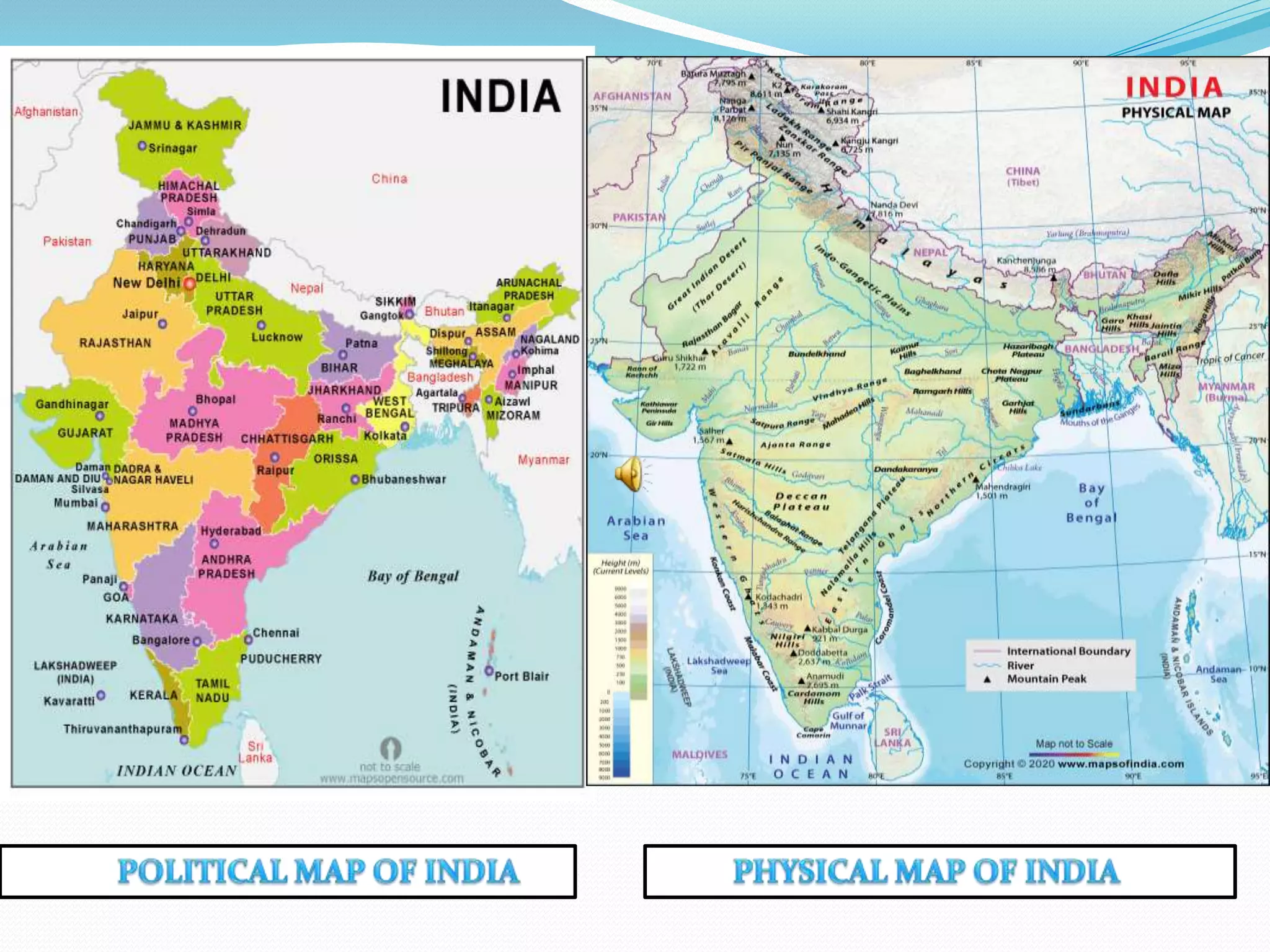
Political Maps
Physical Maps
Thematic Maps
Definitions
 Political Maps:- show the boundaries of countries , states etc. and
also the location of capital cities and towns.
 Physical Maps:- show mountains, valleys, plains, rivers and other
surface features which can be represented by different colors.
 Thematic Maps:- show features such as climate , agriculture,
minerals etc.
 In addition to these maps, there are Topographic Maps which give
detail information about local landforms, streams, rivers, canals, roads,
buildings, railway tracks and other features of smaller areas.
TYPES OF MAPS BASED ON SCALE
 SMALL SCALE MAPS :- These maps show a large land area in a
small space.
 LARGE SCALE MAPS:- These maps show smaller areas of land in
bigger space.
1. Maps are used for a variety
of purposes. They give
accurate information about
various places.
2.They are easy to carry.
3. They show selected
features, making it easier for
people to understand and
interpret the information.
4. They make use of different
signs, symbols to provide
distinct information and
make it more attractive.
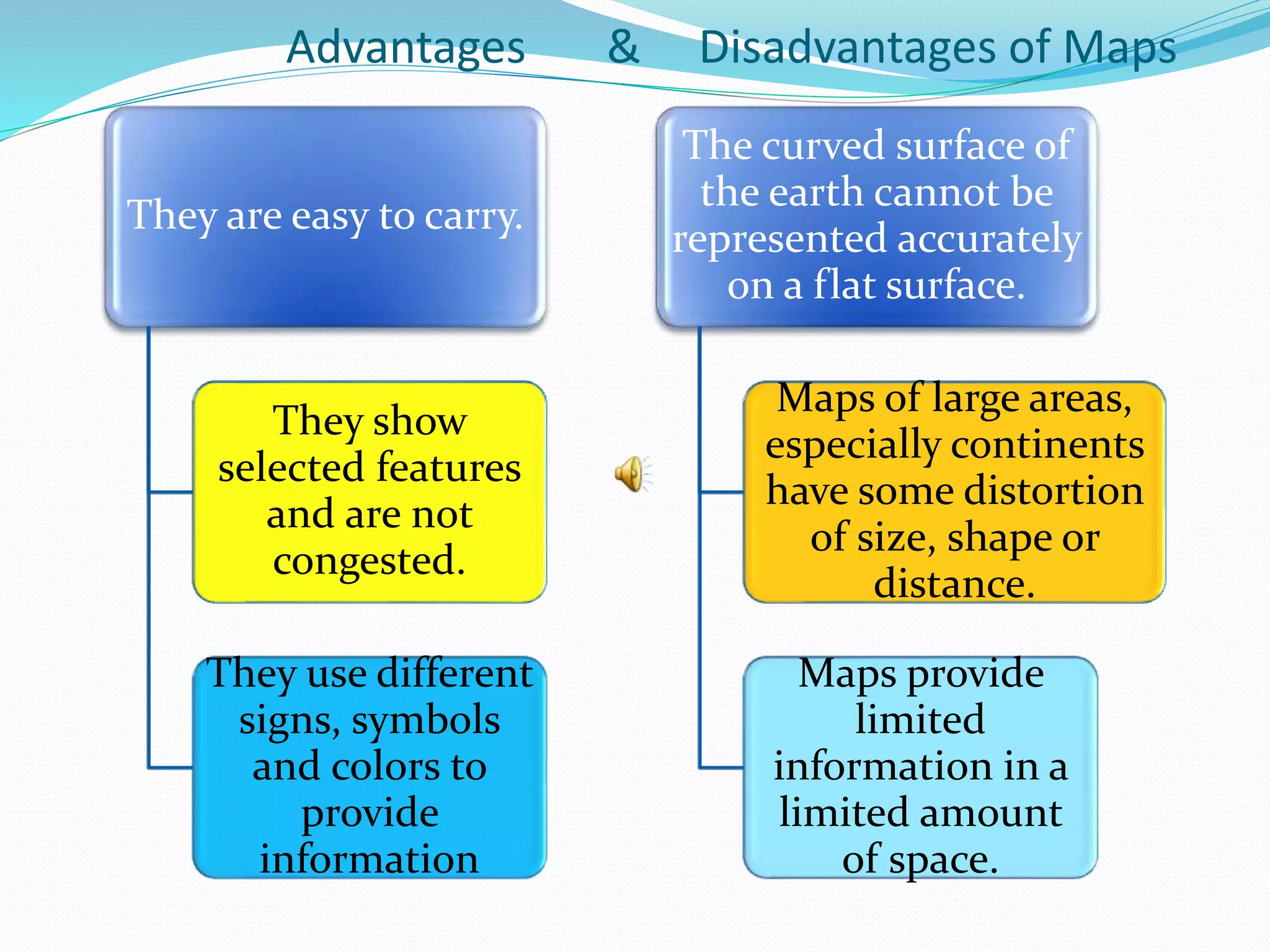
Advantages & Disadvantages of Maps
They are easy to carry.
They show
selected features
and are not
congested.
They use different
signs, symbols
and colors to
provide
information
The curved surface of
the earth cannot be
represented accurately
on a flat surface.
Maps of large areas,
especially continents
have some distortion
of size, shape or
distance.
Maps provide
limited
information in a
limited amount
of space.
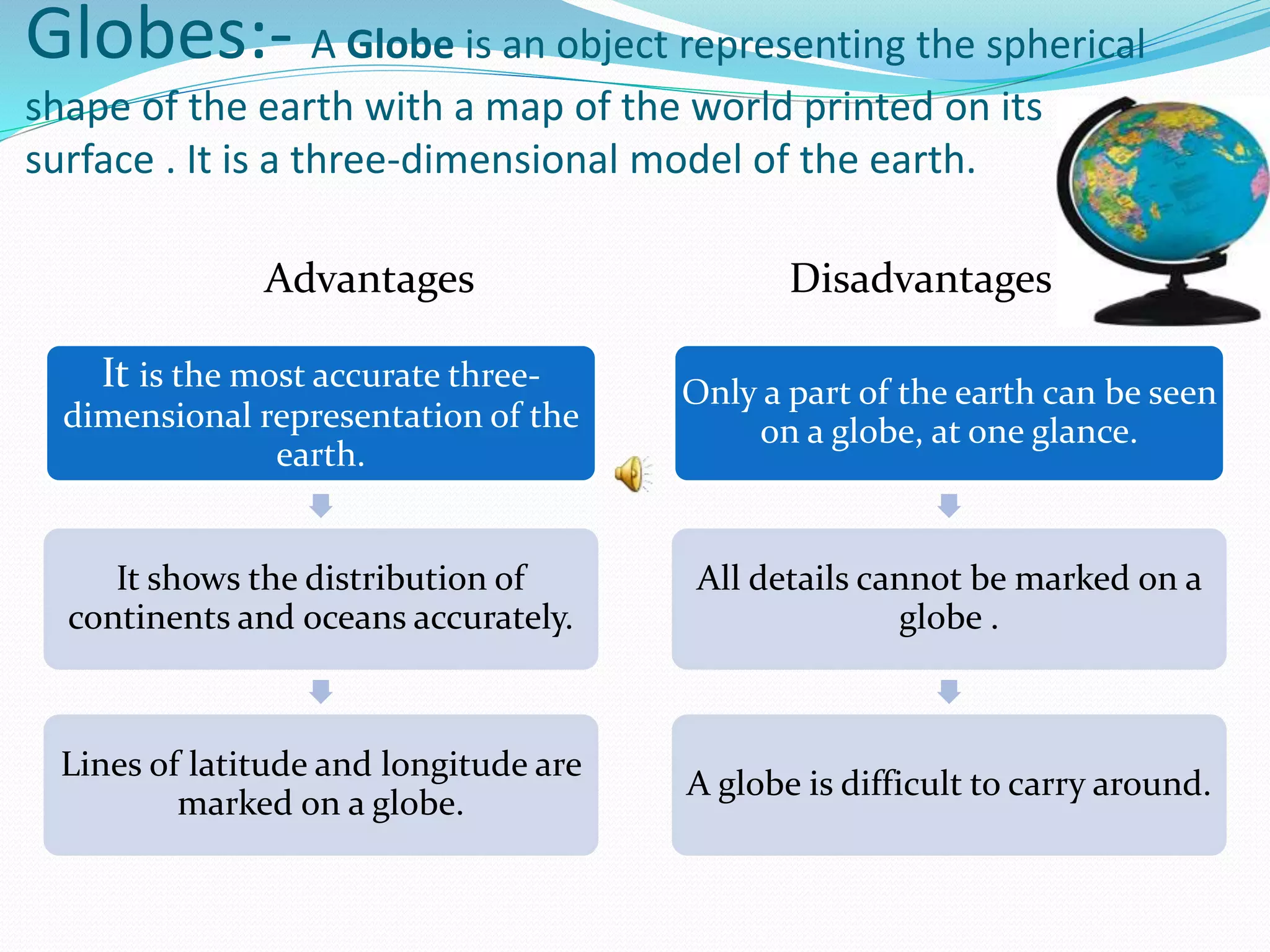
Globes:- A Globe is an object representing the spherical
shape of the earth with a map of the world printed on its
surface . It is a three-dimensional model of the earth.
It is the most accurate three-
dimensional representation of the
earth.
It shows the distribution of
continents and oceans accurately.
Lines of latitude and longitude are
marked on a globe.
Only a part of the earth can be seen
on a globe, at one glance.
All details cannot be marked on a
globe .
A globe is difficult to carry around.
Advantages Disadvantages
Sketches:- A Sketch is a rough drawing showing the
relative locations of a few chosen features of an area. It does
not drawn to scale and gives a rough idea of an area.
Plans:- A Plan is a drawing that shows the horizontal
section of a small area or a building. It is drawn to scale
and also tells us where exactly things are on the ground.
Aerial Photographs and satellite pictures:-
Photographs of the earth are taken from a camera mounted on an
aircraft, an unmanned drone or an artificial satellite. Such photographs
have been used widely in the preparation of accurate match.
Representation of geographical features
through diagrams
 Anticline and Syncline :- anticlines and synclines are a part
of a simple fold which are formed when the layers of earth’s
crust are folded by compression.
 The arches of a fold or the upfolds are known as Anticlines.
 Downfolds or the troughs of a fold are known as Synclines.
Block Mountains:- When cracks or faults occur
in the earth’s crust and the surface between the cracks
sinks, it leaves upstanding blocks on either sides. These
are called Block Mountains.
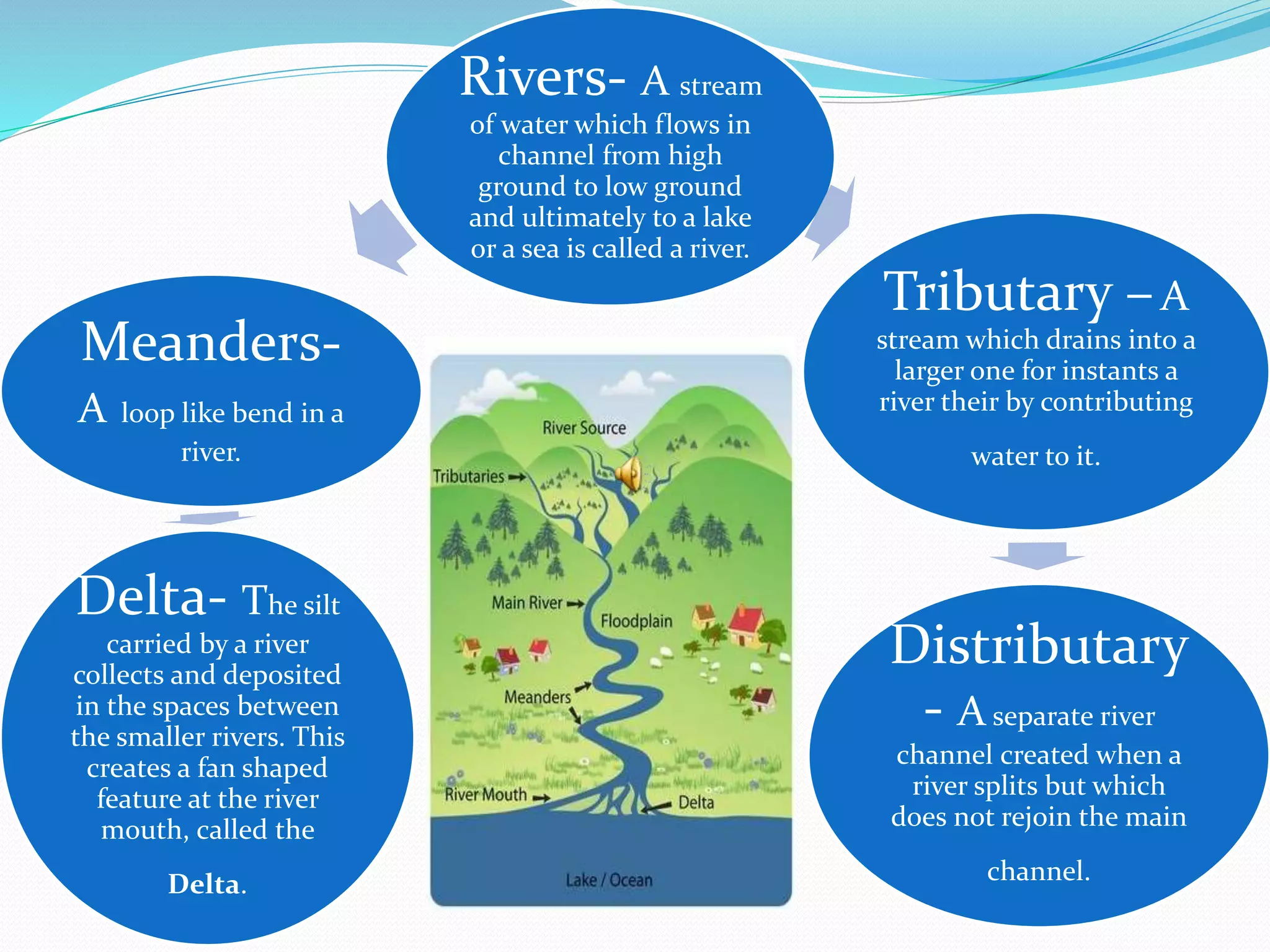
Rivers- A stream
of water which flows in
channel from high
ground to low ground
and ultimately to a lake
or a sea is called a river.
Tributary –A
stream which drains into a
larger one for instants a
river their by contributing
water to it.
Distributary
- A separate river
channel created when a
river splits but which
does not rejoin the main
channel.
Delta- The silt
carried by a river
collects and deposited
in the spaces between
the smaller rivers. This
creates a fan shaped
feature at the river
mouth, called the
Delta.
Meanders-
A loop like bend in a
river.

Ch 1 (maps & diagrams)

  • 2.
    Introduction  There arevarious ways of representing the earth like :-  Maps  Globes  Sketches  Plans  Diagrams  They have their own advantages and disadvantages which we will discuss in this chapter.
  • 3.
    MAPS  A Mapis a drawing of the whole earth or a part of it on a flat surface. It is a symbolic representation drawn on paper that provides information about the earth surface in a simple manner. Types of Maps Political Maps Physical Maps Thematic Maps
  • 4.
    Definitions  Political Maps:-show the boundaries of countries , states etc. and also the location of capital cities and towns.  Physical Maps:- show mountains, valleys, plains, rivers and other surface features which can be represented by different colors.  Thematic Maps:- show features such as climate , agriculture, minerals etc.  In addition to these maps, there are Topographic Maps which give detail information about local landforms, streams, rivers, canals, roads, buildings, railway tracks and other features of smaller areas.
  • 7.
    TYPES OF MAPSBASED ON SCALE  SMALL SCALE MAPS :- These maps show a large land area in a small space.  LARGE SCALE MAPS:- These maps show smaller areas of land in bigger space.
  • 8.
    1. Maps areused for a variety of purposes. They give accurate information about various places. 2.They are easy to carry. 3. They show selected features, making it easier for people to understand and interpret the information. 4. They make use of different signs, symbols to provide distinct information and make it more attractive.
  • 9.
    Advantages & Disadvantagesof Maps They are easy to carry. They show selected features and are not congested. They use different signs, symbols and colors to provide information The curved surface of the earth cannot be represented accurately on a flat surface. Maps of large areas, especially continents have some distortion of size, shape or distance. Maps provide limited information in a limited amount of space.
  • 10.
    Globes:- A Globeis an object representing the spherical shape of the earth with a map of the world printed on its surface . It is a three-dimensional model of the earth. It is the most accurate three- dimensional representation of the earth. It shows the distribution of continents and oceans accurately. Lines of latitude and longitude are marked on a globe. Only a part of the earth can be seen on a globe, at one glance. All details cannot be marked on a globe . A globe is difficult to carry around. Advantages Disadvantages
  • 11.
    Sketches:- A Sketchis a rough drawing showing the relative locations of a few chosen features of an area. It does not drawn to scale and gives a rough idea of an area.
  • 12.
    Plans:- A Planis a drawing that shows the horizontal section of a small area or a building. It is drawn to scale and also tells us where exactly things are on the ground.
  • 13.
    Aerial Photographs andsatellite pictures:- Photographs of the earth are taken from a camera mounted on an aircraft, an unmanned drone or an artificial satellite. Such photographs have been used widely in the preparation of accurate match.
  • 14.
    Representation of geographicalfeatures through diagrams  Anticline and Syncline :- anticlines and synclines are a part of a simple fold which are formed when the layers of earth’s crust are folded by compression.  The arches of a fold or the upfolds are known as Anticlines.  Downfolds or the troughs of a fold are known as Synclines.
  • 15.
    Block Mountains:- Whencracks or faults occur in the earth’s crust and the surface between the cracks sinks, it leaves upstanding blocks on either sides. These are called Block Mountains.
  • 16.
    Rivers- A stream ofwater which flows in channel from high ground to low ground and ultimately to a lake or a sea is called a river. Tributary –A stream which drains into a larger one for instants a river their by contributing water to it. Distributary - A separate river channel created when a river splits but which does not rejoin the main channel. Delta- The silt carried by a river collects and deposited in the spaces between the smaller rivers. This creates a fan shaped feature at the river mouth, called the Delta. Meanders- A loop like bend in a river.

Editor's Notes

  • #6 http://www.mapsopensource.com/india-states-map.html
  • #7 https://www.pinterest.com/pin/485262928586339538/
  • #11 https://www.indiamart.com/proddetail/world-globes-6021109988.html
  • #12 Class 6 geography book
  • #13 www.google.com
  • #14 https://serc.carleton.edu/details/images/33535.html
  • #15 https://www.youtube.com/watch?v=PLA2T7I8sM0
  • #16 https://www.ducksters.com/science/earth_science/mountain_geology.php
  • #17 https://quizlet.com/ca/234262137/journey-of-a-river-diagram/