Project Management Professional
(PMP)
Prepared by
Arch. Saad Al Jabri, PMP
Introduction
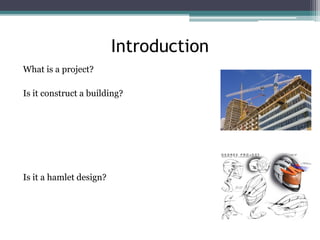
What is a project?
Is it construct a building?
Is it a hamlet design?
Introduction
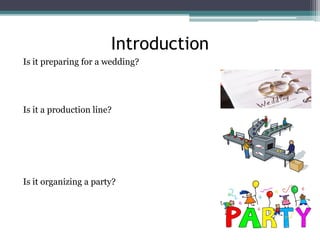
Is it preparing for a wedding?
Is it a production line?
Is it organizing a party?
Project Characteristics
Temporary,
Unique: product, service or
result,
Progressively elaborated:
Moving From the Unknown to
the Known.
Project definition
A project is a temporary endeavor
undertaken to create a unique product, service,
or result.
*This definition is taken from the Glossary of the Project Management Institute, A Guide to the Project Management
Body of Knowledge, (PMBOK® Guide) – Fifth Edition, Project Management Institute, Inc., 2013
A project can create:
1. A product that can be either a component of another item, an
enhancement of an item, or an end item in itself;
2. A service or a capability to perform a service (e.g., a business
function that supports production or distribution);
3. An improvement in the existing product or service lines (e.g., A
Six Sigma project undertaken to reduce defects); or
4. A result, such as an outcome or document (e.g., a research project
that develops knowledge that can be used to determine whether a
trend exists or a new process will benefit society).
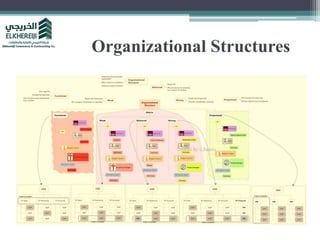
Organizational Structures
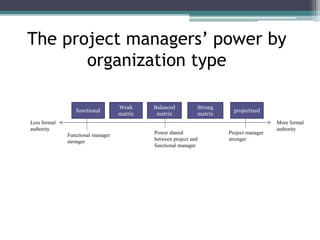
Weak
matrix
Balanced
matrix
Strong
matrix
projectized
Less formal
authority
More formal
authority
Functional manager
stronger
Power shared
between project and
functional manager
Project manager
stronger
The project managers’ power by
organization type
functional
What is Project Management?
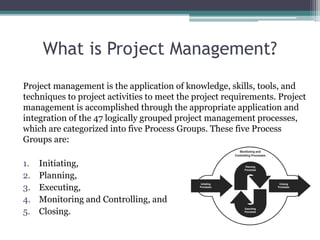
Project management is the application of knowledge, skills, tools, and
techniques to project activities to meet the project requirements. Project
management is accomplished through the appropriate application and
integration of the 47 logically grouped project management processes,
which are categorized into five Process Groups. These five Process
Groups are:
1. Initiating,
2. Planning,
3. Executing,
4. Monitoring and Controlling, and
5. Closing.
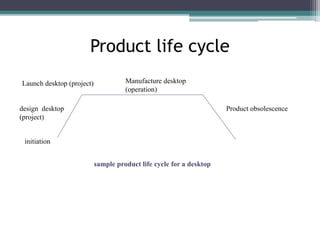
Product life cycle
initiation
design desktop
(project)
Launch desktop (project) Manufacture desktop
(operation)
Product obsolescence
sample product life cycle for a desktop
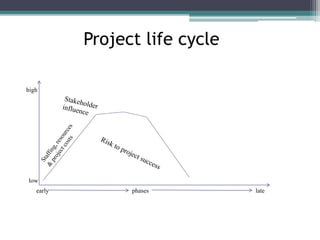
Project life cycle
low
high
early phases late
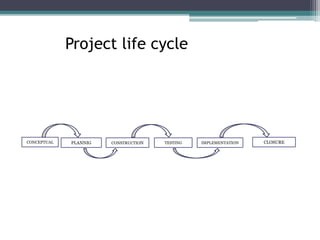
Project life cycle
CONCEPTUAL PLANNIG CONSTRUCTION TESTING IMPLEMENTATION CLOSURE
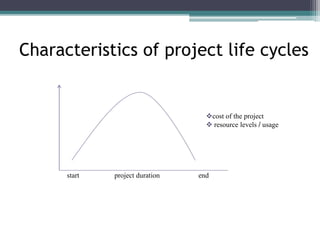
Characteristics of project life cycles
start project duration end
cost of the project
 resource levels / usage
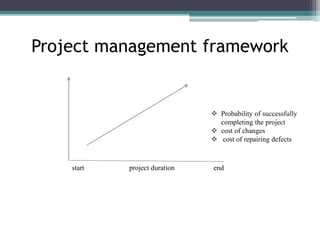
Project management framework
start project duration end
 Probability of successfully
completing the project
 cost of changes
 cost of repairing defects
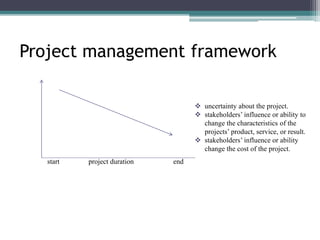
Project management framework
 uncertainty about the project.
 stakeholders’ influence or ability to
change the characteristics of the
projects’ product, service, or result.
 stakeholders’ influence or ability
change the cost of the project.
start project duration end
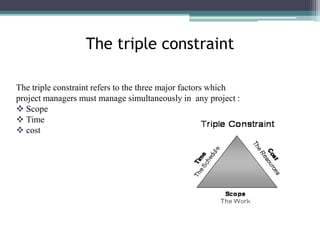
The triple constraint
The triple constraint refers to the three major factors which
project managers must manage simultaneously in any project :
 Scope
 Time
 cost
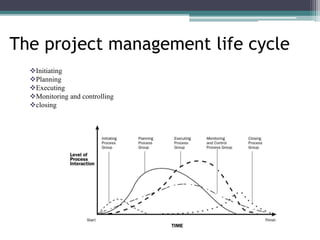
The project management life cycle
Initiating
Planning
Executing
Monitoring and controlling
closing
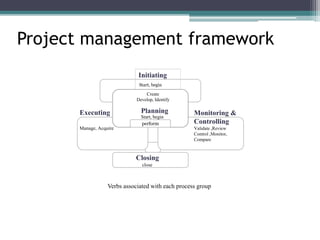
Project management framework
Start, begin
Initiating
Create
Develop, Identify
Planning
perform
Start, begin
Monitoring &
Controlling
Validate ,Review
Control ,Monitor,
Compare
Executing
Manage, Acquire
Closing
close
Verbs associated with each process group
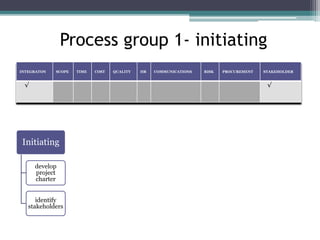
Process group 1- initiating
Initiating
develop
project
charter
identify
stakeholders
INTEGRATON SCOPE TIME COST QUALITY HR COMMUNICATIONS RISK PROCUREMENT STAKEHOLDER
√ √
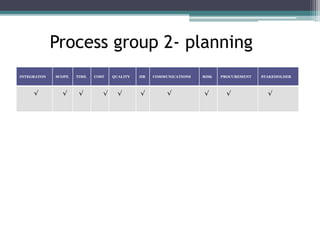
Process group 2- planning
INTEGRATON SCOPE TIME COST QUALITY HR COMMUNICATIONS RISK PROCUREMENT STAKEHOLDER
√ √ √ √ √√ √ √ √√
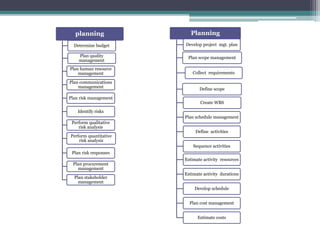
Planning
Develop project mgt. plan
Plan scope management
Collect requirements
Define scope
Create WBS
Plan schedule management
Define activities
Sequence activities
Estimate activity resources
Estimate activity durations
Develop schedule
Plan cost management
Estimate costs
planning
Determine budget
Plan quality
management
Plan human resource
management
Plan communications
management
Plan risk management
Identify risks
Perform qualitative
risk analysis
Perform quantitative
risk analysis
Plan risk responses
Plan procurement
management
Plan stakeholder
management
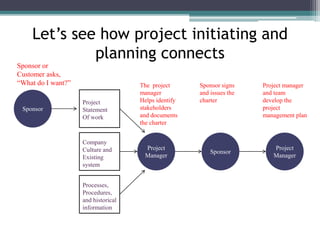
Let’s see how project initiating and
planning connects
Project
Manager
Project
Manager
Sponsor
Sponsor
Project
Statement
Of work
Company
Culture and
Existing
system
Processes,
Procedures,
and historical
information
Sponsor or
Customer asks,
“What do I want?” The project
manager
Helps identify
stakeholders
and documents
the charter
Sponsor signs
and issues the
charter
Project manager
and team
develop the
project
management plan
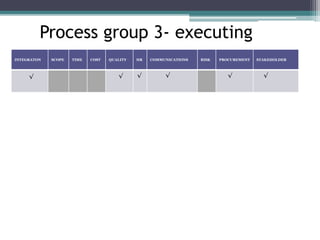
Process group 3- executing
INTEGRATON SCOPE TIME COST QUALITY HR COMMUNICATIONS RISK PROCUREMENT STAKEHOLDER
√ √ √ √ √ √
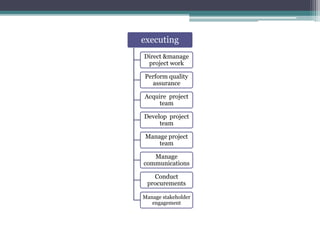
executing
Direct &manage
project work
Perform quality
assurance
Acquire project
team
Develop project
team
Manage project
team
Manage
communications
Conduct
procurements
Manage stakeholder
engagement
INTEGRATON SCOPE TIME COST QUALITY HR COMMUNICATIONS RISK PROCUREMENT STAKEHOLDER
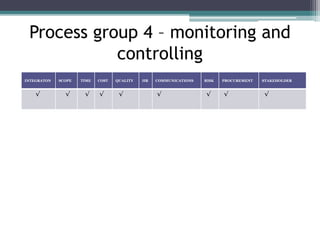
Process group 4 – monitoring and
controlling
√ √ √ √ √ √ √√√
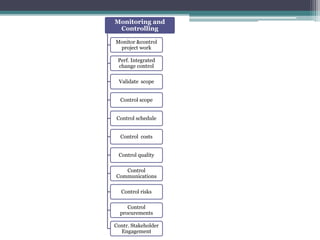
Monitoring and
Controlling
Monitor &control
project work
Perf. Integrated
change control
Validate scope
Control scope
Control schedule
Control costs
Control quality
Control
Communications
Control risks
Control
procurements
Contr. Stakeholder
Engagement
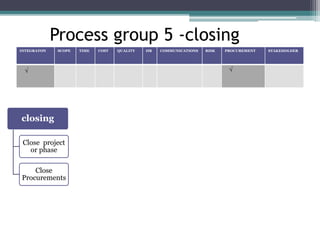
Process group 5 -closing
closing
Close project
or phase
Close
Procurements
INTEGRATON SCOPE TIME COST QUALITY HR COMMUNICATIONS RISK PROCUREMENT STAKEHOLDER
√ √
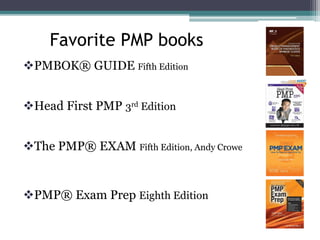
Favorite PMP books
PMBOK® GUIDE Fifth Edition
Head First PMP 3rd Edition
The PMP® EXAM Fifth Edition, Andy Crowe
PMP® Exam Prep Eighth Edition
Thank you.

Project management professional (PMP)

  • 1.
  • 2.
    Introduction What is aproject? Is it construct a building? Is it a hamlet design?
  • 3.
    Introduction Is it preparingfor a wedding? Is it a production line? Is it organizing a party?
  • 4.
    Project Characteristics Temporary, Unique: product,service or result, Progressively elaborated: Moving From the Unknown to the Known.
  • 5.
    Project definition A projectis a temporary endeavor undertaken to create a unique product, service, or result. *This definition is taken from the Glossary of the Project Management Institute, A Guide to the Project Management Body of Knowledge, (PMBOK® Guide) – Fifth Edition, Project Management Institute, Inc., 2013
  • 6.
    A project cancreate: 1. A product that can be either a component of another item, an enhancement of an item, or an end item in itself; 2. A service or a capability to perform a service (e.g., a business function that supports production or distribution); 3. An improvement in the existing product or service lines (e.g., A Six Sigma project undertaken to reduce defects); or 4. A result, such as an outcome or document (e.g., a research project that develops knowledge that can be used to determine whether a trend exists or a new process will benefit society).
  • 7.
  • 8.
    Weak matrix Balanced matrix Strong matrix projectized Less formal authority More formal authority Functionalmanager stronger Power shared between project and functional manager Project manager stronger The project managers’ power by organization type functional
  • 9.
    What is ProjectManagement? Project management is the application of knowledge, skills, tools, and techniques to project activities to meet the project requirements. Project management is accomplished through the appropriate application and integration of the 47 logically grouped project management processes, which are categorized into five Process Groups. These five Process Groups are: 1. Initiating, 2. Planning, 3. Executing, 4. Monitoring and Controlling, and 5. Closing.
  • 10.
    Product life cycle initiation designdesktop (project) Launch desktop (project) Manufacture desktop (operation) Product obsolescence sample product life cycle for a desktop
  • 11.
  • 12.
    Project life cycle CONCEPTUALPLANNIG CONSTRUCTION TESTING IMPLEMENTATION CLOSURE
  • 13.
    Characteristics of projectlife cycles start project duration end cost of the project  resource levels / usage
  • 14.
    Project management framework startproject duration end  Probability of successfully completing the project  cost of changes  cost of repairing defects
  • 15.
    Project management framework uncertainty about the project.  stakeholders’ influence or ability to change the characteristics of the projects’ product, service, or result.  stakeholders’ influence or ability change the cost of the project. start project duration end
  • 16.
    The triple constraint Thetriple constraint refers to the three major factors which project managers must manage simultaneously in any project :  Scope  Time  cost
  • 17.
    The project managementlife cycle Initiating Planning Executing Monitoring and controlling closing
  • 18.
    Project management framework Start,begin Initiating Create Develop, Identify Planning perform Start, begin Monitoring & Controlling Validate ,Review Control ,Monitor, Compare Executing Manage, Acquire Closing close Verbs associated with each process group
  • 19.
    Process group 1-initiating Initiating develop project charter identify stakeholders INTEGRATON SCOPE TIME COST QUALITY HR COMMUNICATIONS RISK PROCUREMENT STAKEHOLDER √ √
  • 20.
    Process group 2-planning INTEGRATON SCOPE TIME COST QUALITY HR COMMUNICATIONS RISK PROCUREMENT STAKEHOLDER √ √ √ √ √√ √ √ √√
  • 21.
    Planning Develop project mgt.plan Plan scope management Collect requirements Define scope Create WBS Plan schedule management Define activities Sequence activities Estimate activity resources Estimate activity durations Develop schedule Plan cost management Estimate costs planning Determine budget Plan quality management Plan human resource management Plan communications management Plan risk management Identify risks Perform qualitative risk analysis Perform quantitative risk analysis Plan risk responses Plan procurement management Plan stakeholder management
  • 22.
    Let’s see howproject initiating and planning connects Project Manager Project Manager Sponsor Sponsor Project Statement Of work Company Culture and Existing system Processes, Procedures, and historical information Sponsor or Customer asks, “What do I want?” The project manager Helps identify stakeholders and documents the charter Sponsor signs and issues the charter Project manager and team develop the project management plan
  • 23.
    Process group 3-executing INTEGRATON SCOPE TIME COST QUALITY HR COMMUNICATIONS RISK PROCUREMENT STAKEHOLDER √ √ √ √ √ √
  • 24.
    executing Direct &manage project work Performquality assurance Acquire project team Develop project team Manage project team Manage communications Conduct procurements Manage stakeholder engagement
  • 25.
    INTEGRATON SCOPE TIMECOST QUALITY HR COMMUNICATIONS RISK PROCUREMENT STAKEHOLDER Process group 4 – monitoring and controlling √ √ √ √ √ √ √√√
  • 26.
    Monitoring and Controlling Monitor &control projectwork Perf. Integrated change control Validate scope Control scope Control schedule Control costs Control quality Control Communications Control risks Control procurements Contr. Stakeholder Engagement
  • 27.
    Process group 5-closing closing Close project or phase Close Procurements INTEGRATON SCOPE TIME COST QUALITY HR COMMUNICATIONS RISK PROCUREMENT STAKEHOLDER √ √
  • 28.
    Favorite PMP books PMBOK®GUIDE Fifth Edition Head First PMP 3rd Edition The PMP® EXAM Fifth Edition, Andy Crowe PMP® Exam Prep Eighth Edition
  • 29.