UNDERSTANDING
PSYCHOLOGY
PSYCHOLOGY
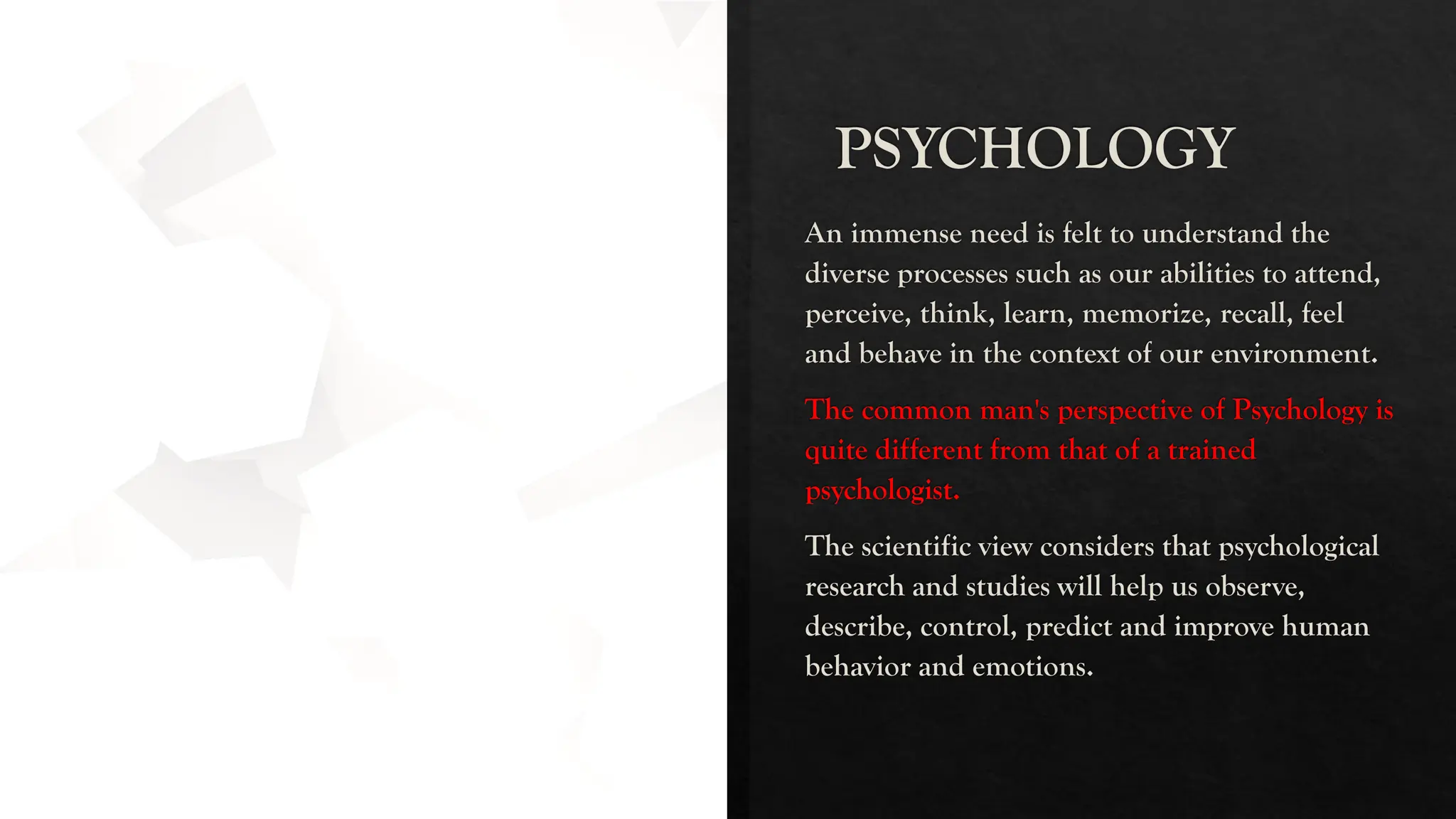
An immense need is felt to understand the
diverse processes such as our abilities to attend,
perceive, think, learn, memorize, recall, feel
and behave in the context of our environment.
The common man's perspective of Psychology is
quite different from that of a trained
psychologist.
The scientific view considers that psychological
research and studies will help us observe,
describe, control, predict and improve human
behavior and emotions.
Psychology is a scientific study of all the
experiences, behaviours and mental processes
like knowing, thinking, reasoning ,
understanding etc.
These mental processes are also part of human
cognition.
The study of Psychology is important as it
helps improve the lives of people. It enables
them to develop an insight into their thoughts
and actions.
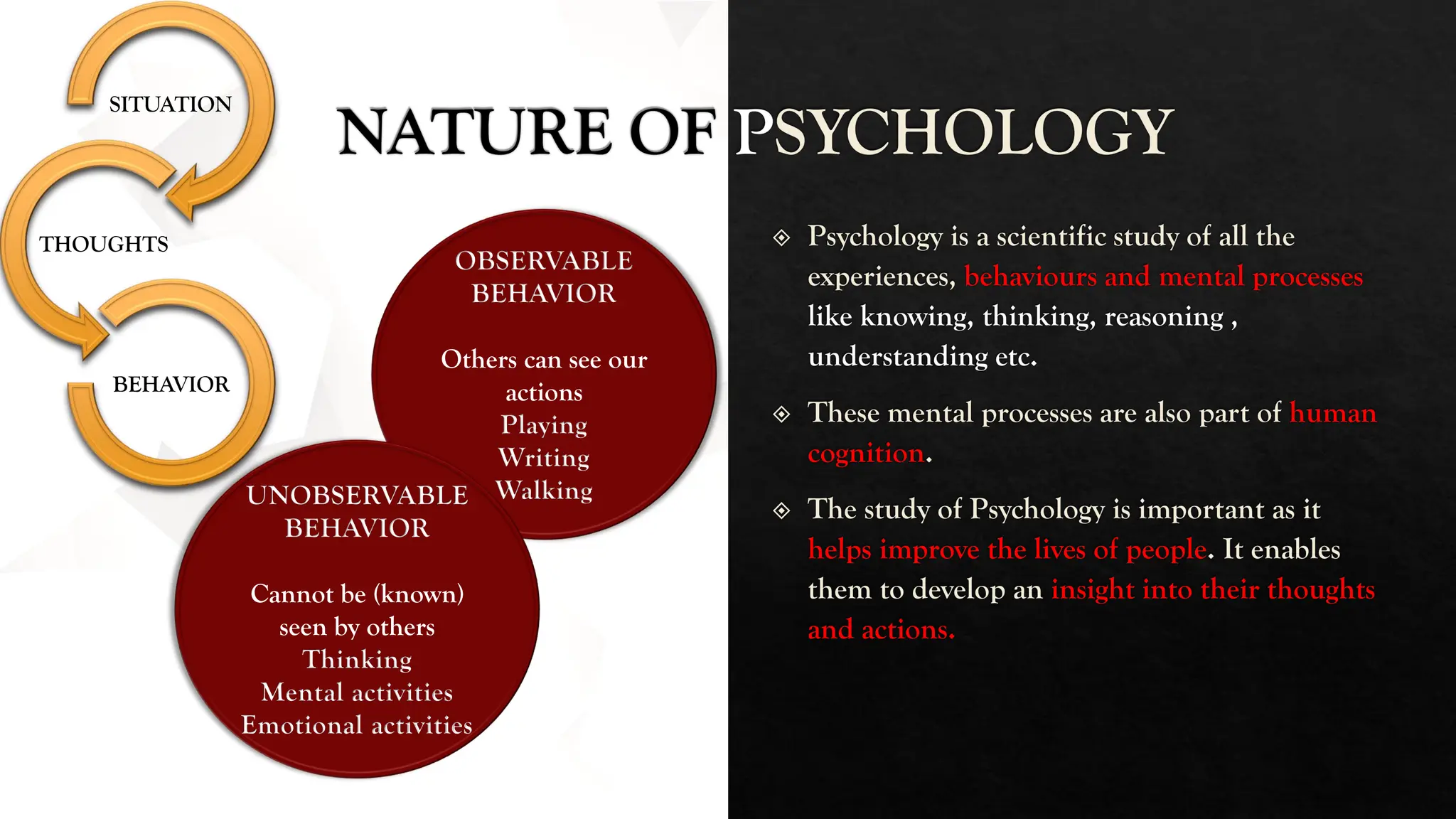
NATURE OF PSYCHOLOGY
SITUATION
THOUGHTS
BEHAVIOR
OBSERVABLE
BEHAVIOR
Others can see our
actions
Playing
Writing
Walking
UNOBSERVABLE
BEHAVIOR
Cannot be (known)
seen by others
Thinking
Mental activities
Emotional activities
EXPERIENCES
The past behaviors and thoughts will help you in forming your experiences.
These experiences are also determined by external factors like climate, home,
family, school, neighbourhood etc. Some of these factors may not be under your
control.
Your experiences are also very specific to you.
Your experiences may also be determined by your feelings and emotions which are
an inherent part of your 'self'.
Human beings try to know their own self and the environment around them.
NATURAL SCIENCE/SOCIAL SCIENCE?
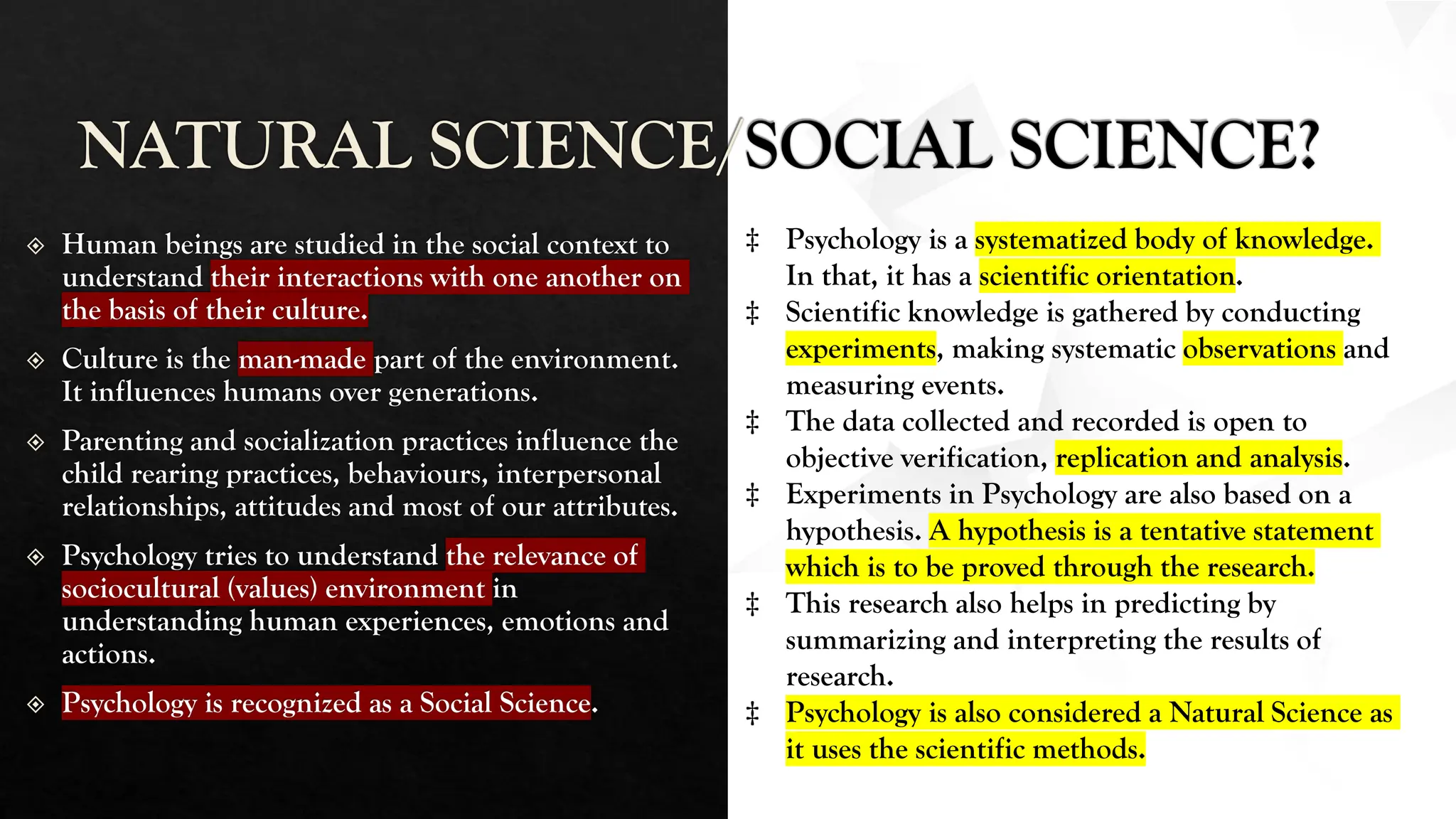
Human beings are studied in the social context to
understand their interactions with one another on
the basis of their culture.
Culture is the man-made part of the environment.
It influences humans over generations.
Parenting and socialization practices influence the
child rearing practices, behaviours, interpersonal
relationships, attitudes and most of our attributes.
Psychology tries to understand the relevance of
sociocultural (values) environment in
understanding human experiences, emotions and
actions.
Psychology is recognized as a Social Science.
‡ Psychology is a systematized body of knowledge.
In that, it has a scientific orientation.
‡ Scientific knowledge is gathered by conducting
experiments, making systematic observations and
measuring events.
‡ The data collected and recorded is open to
objective verification, replication and analysis.
‡ Experiments in Psychology are also based on a
hypothesis. A hypothesis is a tentative statement
which is to be proved through the research.
‡ This research also helps in predicting by
summarizing and interpreting the results of
research.
‡ Psychology is also considered a Natural Science as
it uses the scientific methods.
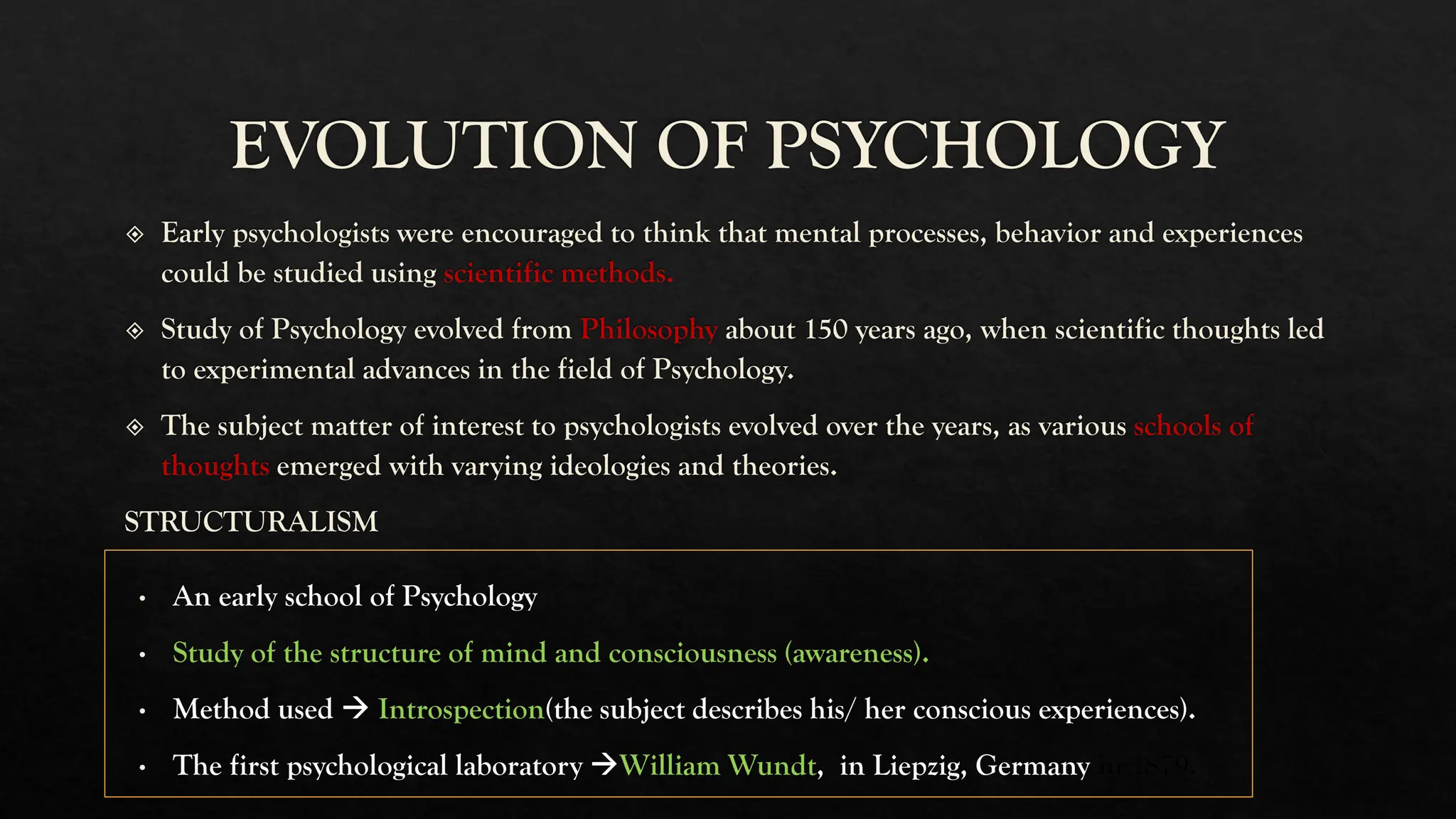
EVOLUTION OF PSYCHOLOGY
Early psychologists were encouraged to think that mental processes, behavior and experiences
could be studied using scientific methods.
Study of Psychology evolved from Philosophy about 150 years ago, when scientific thoughts led
to experimental advances in the field of Psychology.
The subject matter of interest to psychologists evolved over the years, as various schools of
thoughts emerged with varying ideologies and theories.
STRUCTURALISM
An early school of Psychology
Study of the structure of mind and consciousness (awareness).
Method used → Introspection(the subject describes his/ her conscious experiences).
The first psychological laboratory →William Wundt, in Liepzig, Germany in 1879.
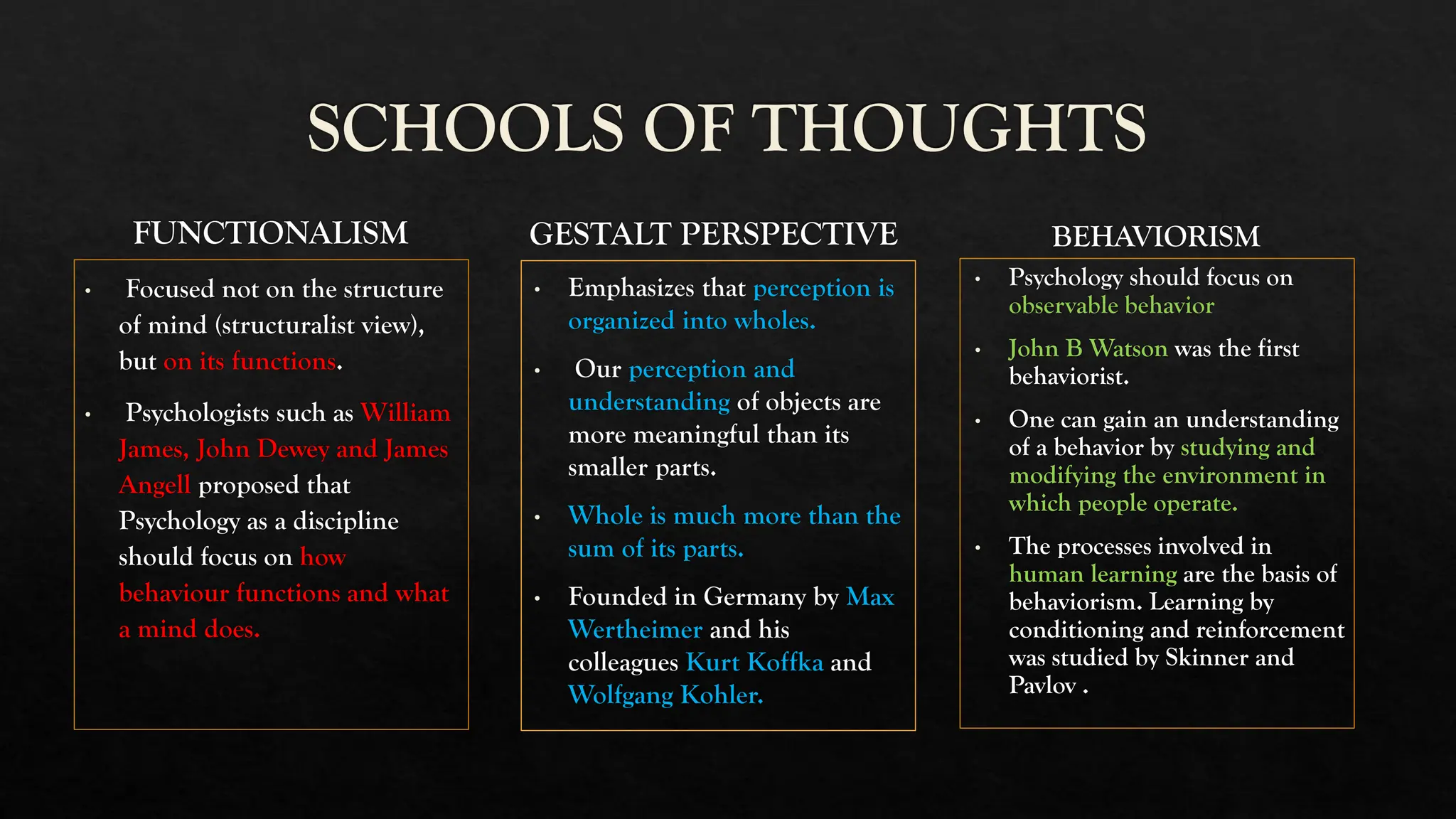
SCHOOLS OF THOUGHTS
FUNCTIONALISM GESTALT PERSPECTIVE BEHAVIORISM
Focused not on the structure
of mind (structuralist view),
but on its functions.
Psychologists such as William
James, John Dewey and James
Angell proposed that
Psychology as a discipline
should focus on how
behaviour functions and what
a mind does.
Emphasizes that perception is
organized into wholes.
Our perception and
understanding of objects are
more meaningful than its
smaller parts.
Whole is much more than the
sum of its parts.
Founded in Germany by Max
Wertheimer and his
colleagues Kurt Koffka and
Wolfgang Kohler.
Psychology should focus on
observable behavior
• John B Watson was the first
behaviorist.
• One can gain an understanding
of a behavior by studying and
modifying the environment in
which people operate.
• The processes involved in
human learning are the basis of
behaviorism. Learning by
conditioning and reinforcement
was studied by Skinner and
Pavlov .
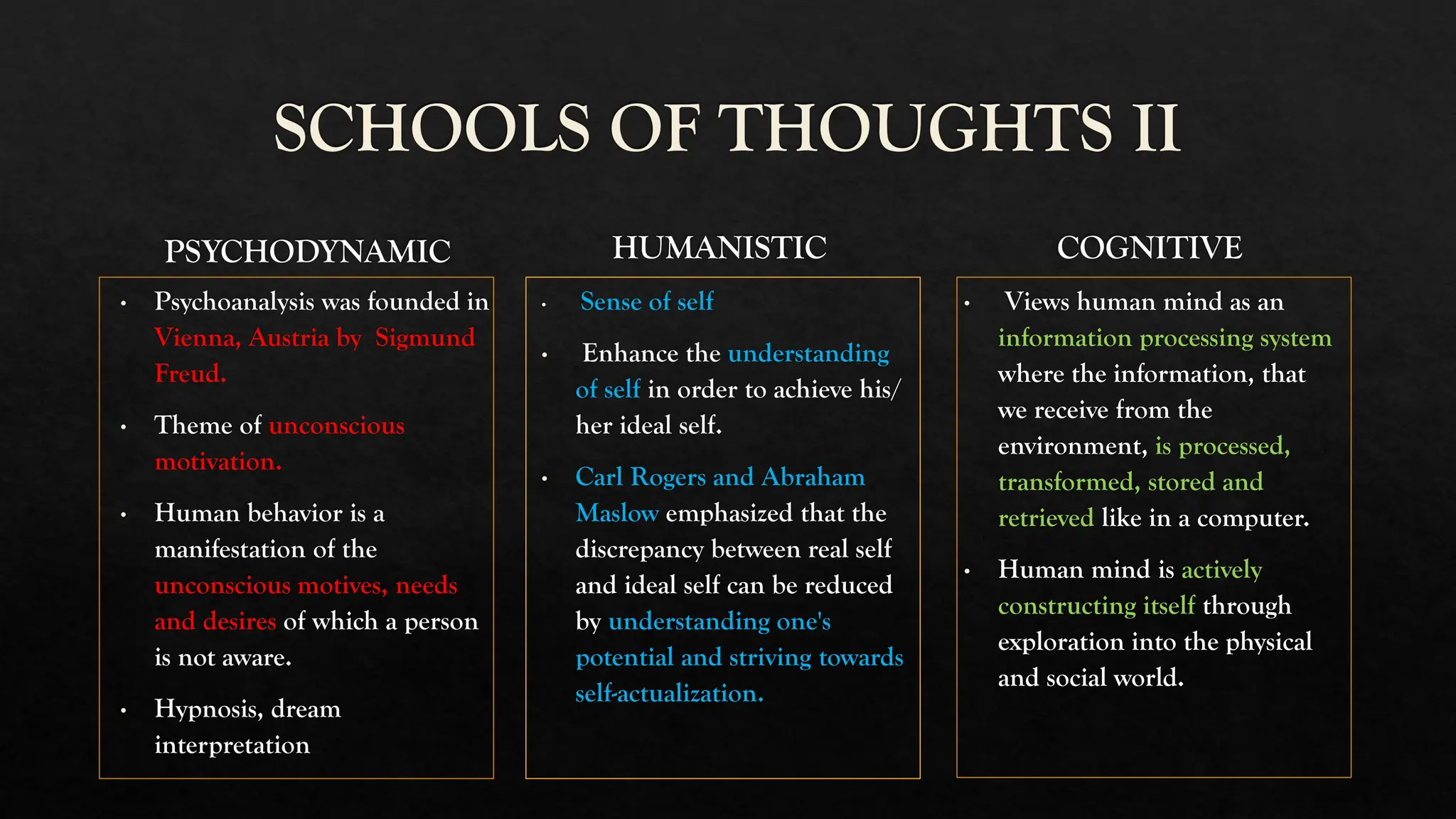
SCHOOLS OF THOUGHTS II
PSYCHODYNAMIC
Psychoanalysis was founded in
Vienna, Austria by Sigmund
Freud.
Theme of unconscious
motivation.
Human behavior is a
manifestation of the
unconscious motives, needs
and desires of which a person
is not aware.
Hypnosis, dream
interpretation
HUMANISTIC
Sense of self
Enhance the understanding
of self in order to achieve his/
her ideal self.
Carl Rogers and Abraham
Maslow emphasized that the
discrepancy between real self
and ideal self can be reduced
by understanding one's
potential and striving towards
self-actualization.
COGNITIVE
Views human mind as an
information processing system
where the information, that
we receive from the
environment, is processed,
transformed, stored and
retrieved like in a computer.
• Human mind is actively
constructing itself through
exploration into the physical
and social world.
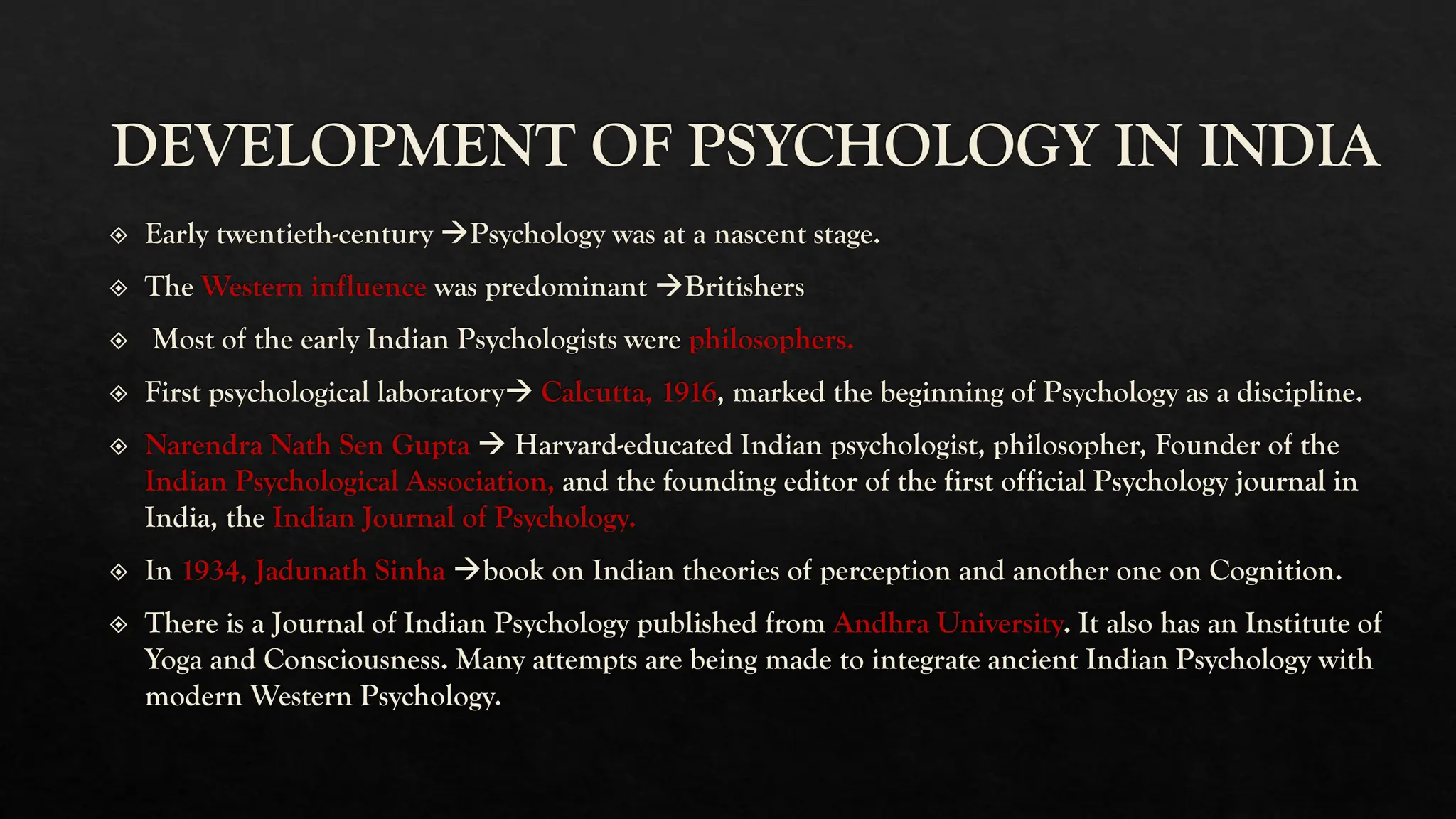
DEVELOPMENT OF PSYCHOLOGY IN INDIA
Early twentieth-century →Psychology was at a nascent stage.
The Western influence was predominant →Britishers
Most of the early Indian Psychologists were philosophers.
First psychological laboratory→ Calcutta, 1916, marked the beginning of Psychology as a discipline.
Narendra Nath Sen Gupta → Harvard-educated Indian psychologist, philosopher, Founder of the
Indian Psychological Association, and the founding editor of the first official Psychology journal in
India, the Indian Journal of Psychology.
In 1934, Jadunath Sinha →book on Indian theories of perception and another one on Cognition.
There is a Journal of Indian Psychology published from Andhra University. It also has an Institute of
Yoga and Consciousness. Many attempts are being made to integrate ancient Indian Psychology with
modern Western Psychology.
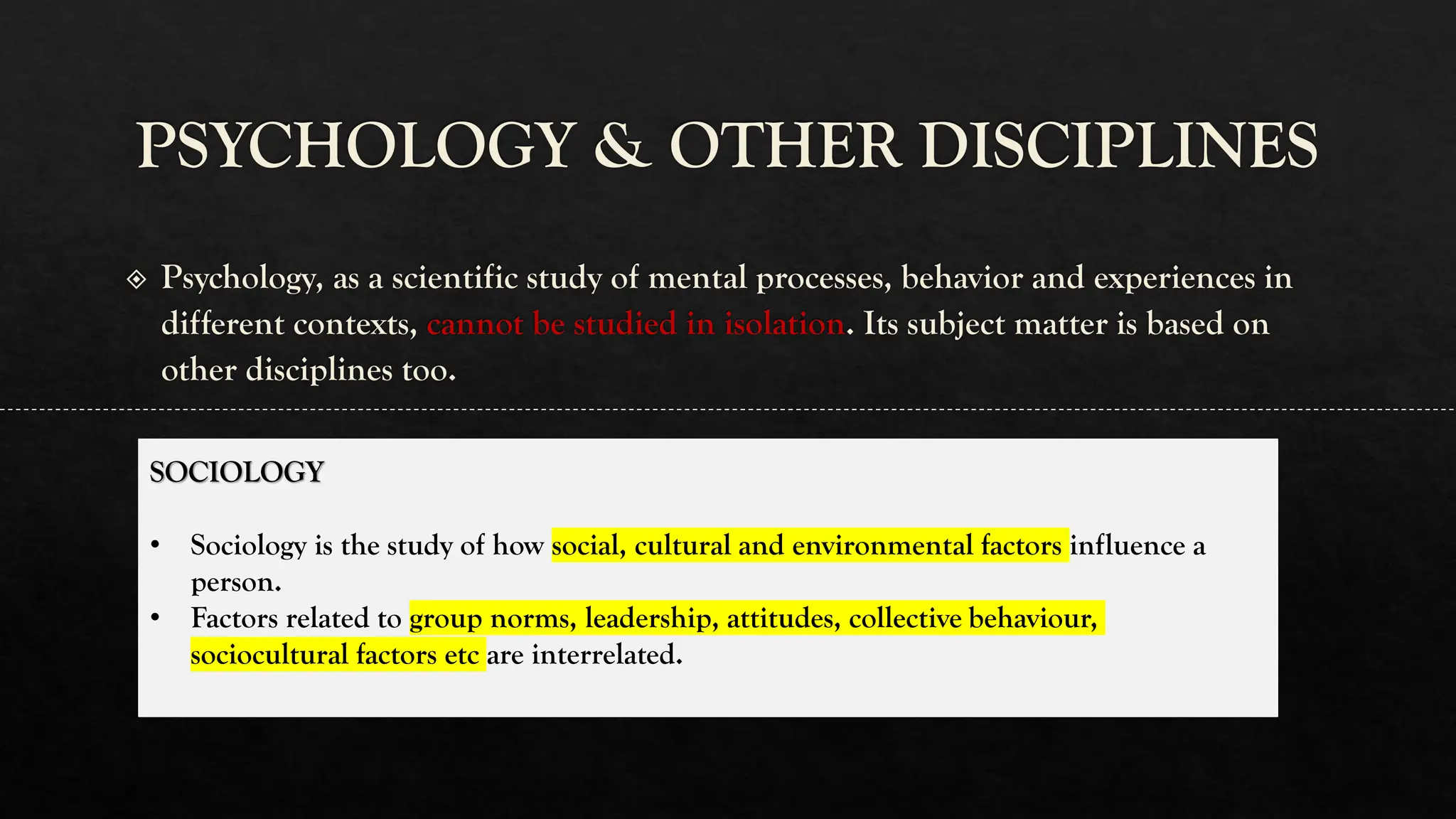
PSYCHOLOGY & OTHER DISCIPLINES
Psychology, as a scientific study of mental processes, behavior and experiences in
different contexts, cannot be studied in isolation. Its subject matter is based on
other disciplines too.
SOCIOLOGY
• Sociology is the study of how social, cultural and environmental factors influence a
person.
• Factors related to group norms, leadership, attitudes, collective behaviour,
sociocultural factors etc are interrelated.
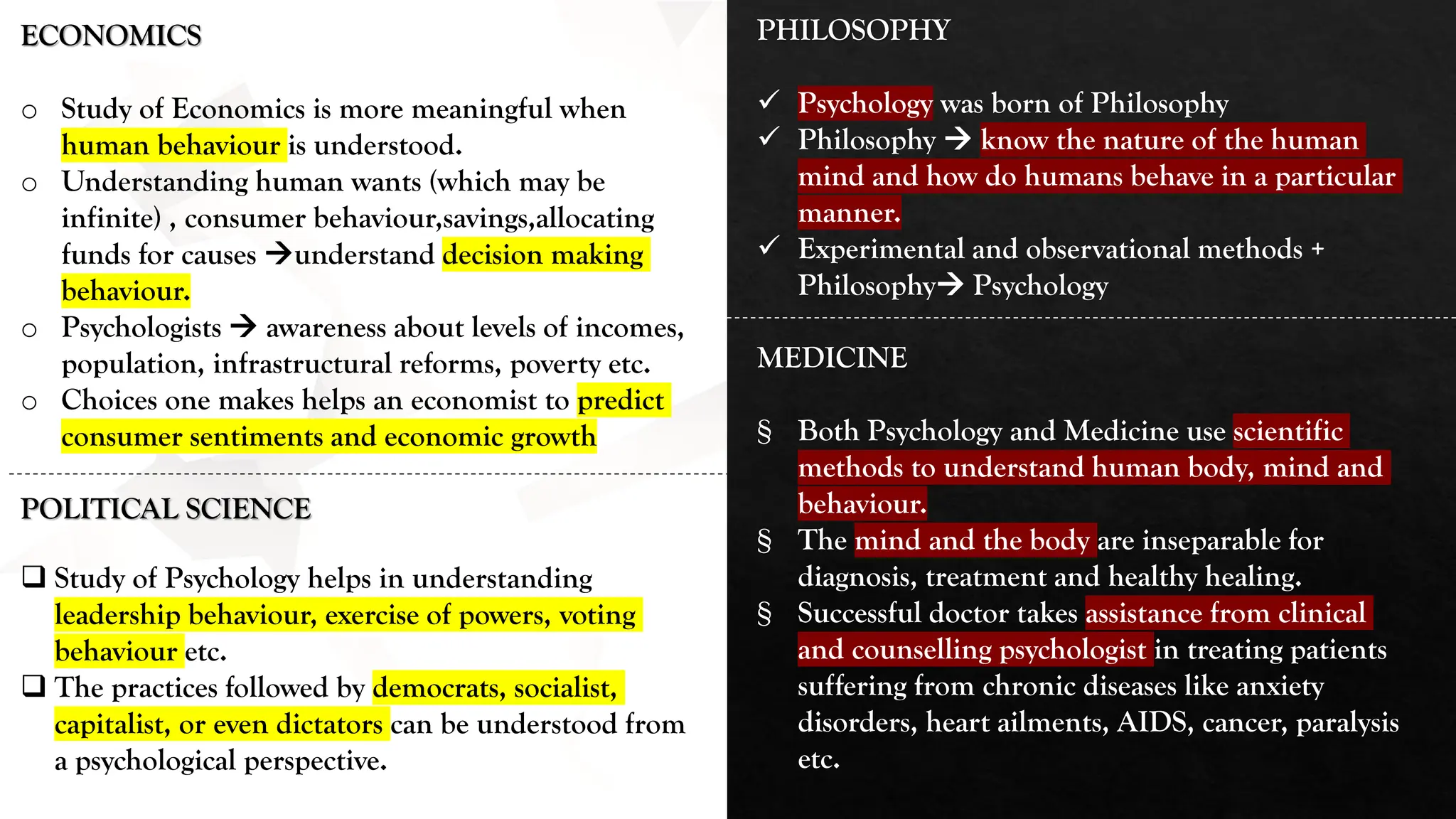
ECONOMICS
o Study of Economics is more meaningful when
human behaviour is understood.
o Understanding human wants (which may be
infinite) , consumer behaviour,savings,allocating
funds for causes →understand decision making
behaviour.
o Psychologists → awareness about levels of incomes,
population, infrastructural reforms, poverty etc.
o Choices one makes helps an economist to predict
consumer sentiments and economic growth
POLITICAL SCIENCE
❑ Study of Psychology helps in understanding
leadership behaviour, exercise of powers, voting
behaviour etc.
❑ The practices followed by democrats, socialist,
capitalist, or even dictators can be understood from
a psychological perspective.
PHILOSOPHY
✓ Psychology was born of Philosophy
✓ Philosophy → know the nature of the human
mind and how do humans behave in a particular
manner.
✓ Experimental and observational methods +
Philosophy→ Psychology
MEDICINE
§ Both Psychology and Medicine use scientific
methods to understand human body, mind and
behaviour.
§ The mind and the body are inseparable for
diagnosis, treatment and healthy healing.
§ Successful doctor takes assistance from clinical
and counselling psychologist in treating patients
suffering from chronic diseases like anxiety
disorders, heart ailments, AIDS, cancer, paralysis
etc.
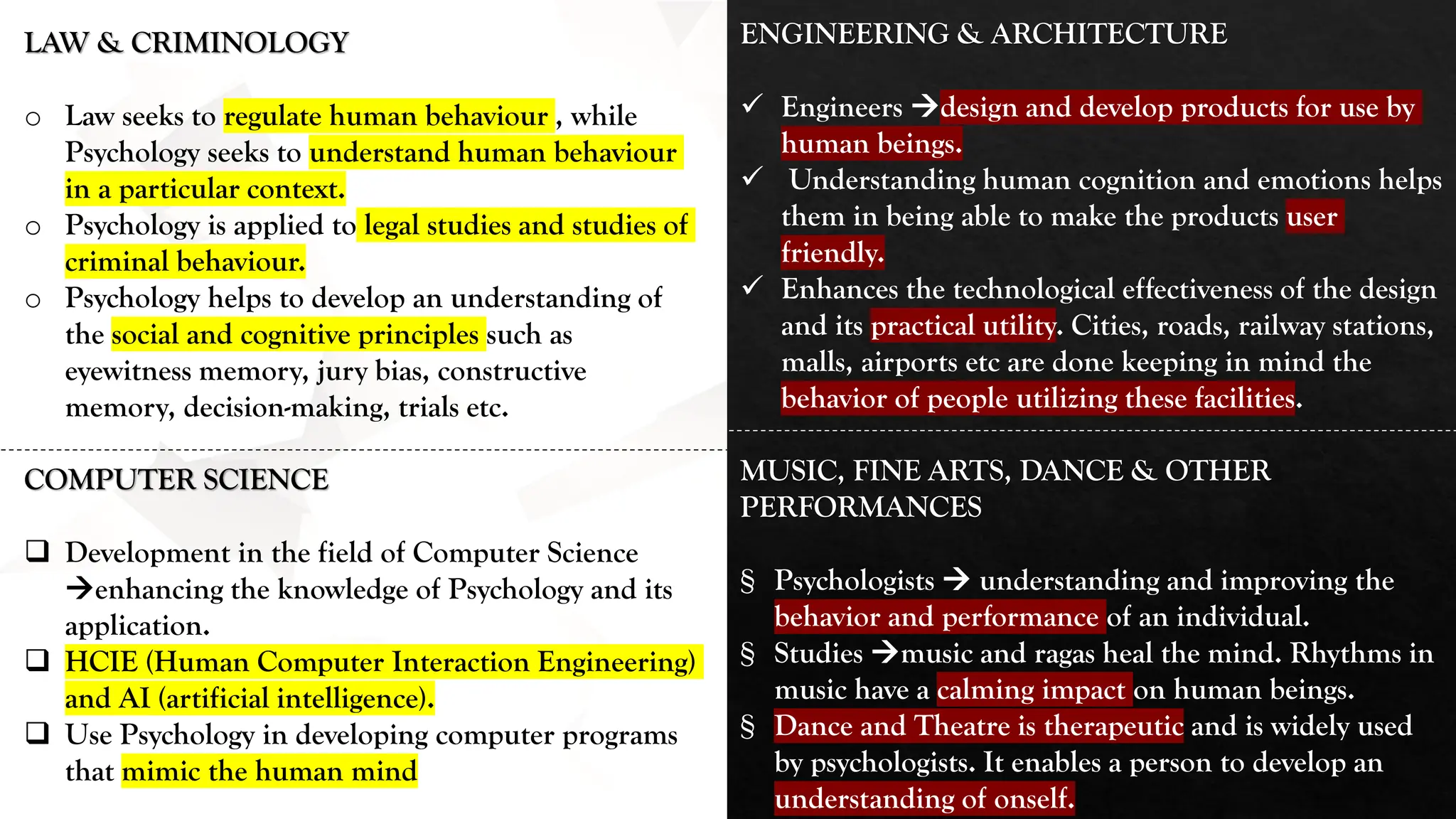
LAW & CRIMINOLOGY
o Law seeks to regulate human behaviour , while
Psychology seeks to understand human behaviour
in a particular context.
o Psychology is applied to legal studies and studies of
criminal behaviour.
o Psychology helps to develop an understanding of
the social and cognitive principles such as
eyewitness memory, jury bias, constructive
memory, decision-making, trials etc.
COMPUTER SCIENCE
❑ Development in the field of Computer Science
→enhancing the knowledge of Psychology and its
application.
❑ HCIE (Human Computer Interaction Engineering)
and AI (artificial intelligence).
❑ Use Psychology in developing computer programs
that mimic the human mind
ENGINEERING & ARCHITECTURE
✓ Engineers →design and develop products for use by
human beings.
✓ Understanding human cognition and emotions helps
them in being able to make the products user
friendly.
✓ Enhances the technological effectiveness of the design
and its practical utility. Cities, roads, railway stations,
malls, airports etc are done keeping in mind the
behavior of people utilizing these facilities.
MUSIC, FINE ARTS, DANCE & OTHER
PERFORMANCES
§ Psychologists → understanding and improving the
behavior and performance of an individual.
§ Studies →music and ragas heal the mind. Rhythms in
music have a calming impact on human beings.
§ Dance and Theatre is therapeutic and is widely used
by psychologists. It enables a person to develop an
understanding of onself.
APPLICATIONS OF PSYCHOLOGY
STUDY OF PSYCHOLOGY :
Is helpful in knowing and understanding a vast array of human thoughts,
emotions and behaviors.
Prepare one for developing an understanding of human beings in different areas
and professions.
Has grown, and has given rise to various subfields where people work.
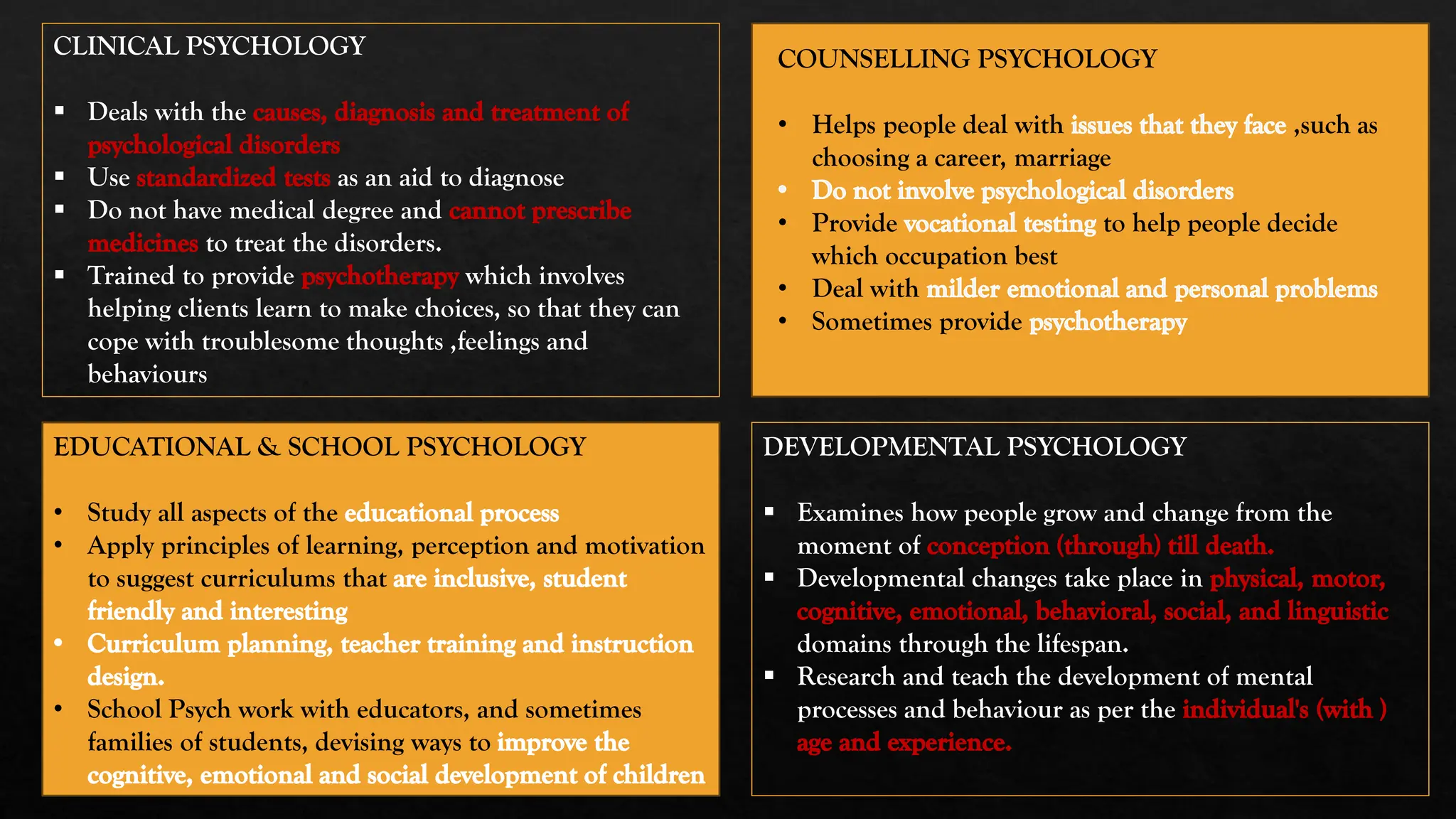
CLINICAL PSYCHOLOGY
▪ Deals with the causes, diagnosis and treatment of
psychological disorders
▪ Use standardized tests as an aid to diagnose
▪ Do not have medical degree and cannot prescribe
medicines to treat the disorders.
▪ Trained to provide psychotherapy which involves
helping clients learn to make choices, so that they can
cope with troublesome thoughts ,feelings and
behaviours
COUNSELLING PSYCHOLOGY
• Helps people deal with issues that they face ,such as
choosing a career, marriage
Do not involve psychological disorders
• Provide vocational testing to help people decide
which occupation best
• Deal with milder emotional and personal problems
• Sometimes provide psychotherapy
EDUCATIONAL & SCHOOL PSYCHOLOGY
• Study all aspects of the educational process
• Apply principles of learning, perception and motivation
to suggest curriculums that are inclusive, student
friendly and interesting
Curriculum planning, teacher training and instruction
design.
• School Psych work with educators, and sometimes
families of students, devising ways to improve the
cognitive, emotional and social development of children
DEVELOPMENTAL PSYCHOLOGY
▪ Examines how people grow and change from the
moment of conception (through) till death.
▪ Developmental changes take place in physical, motor,
cognitive, emotional, behavioral, social, and linguistic
domains through the lifespan.
▪ Research and teach the development of mental
processes and behaviour as per the individual's (with )
age and experience.
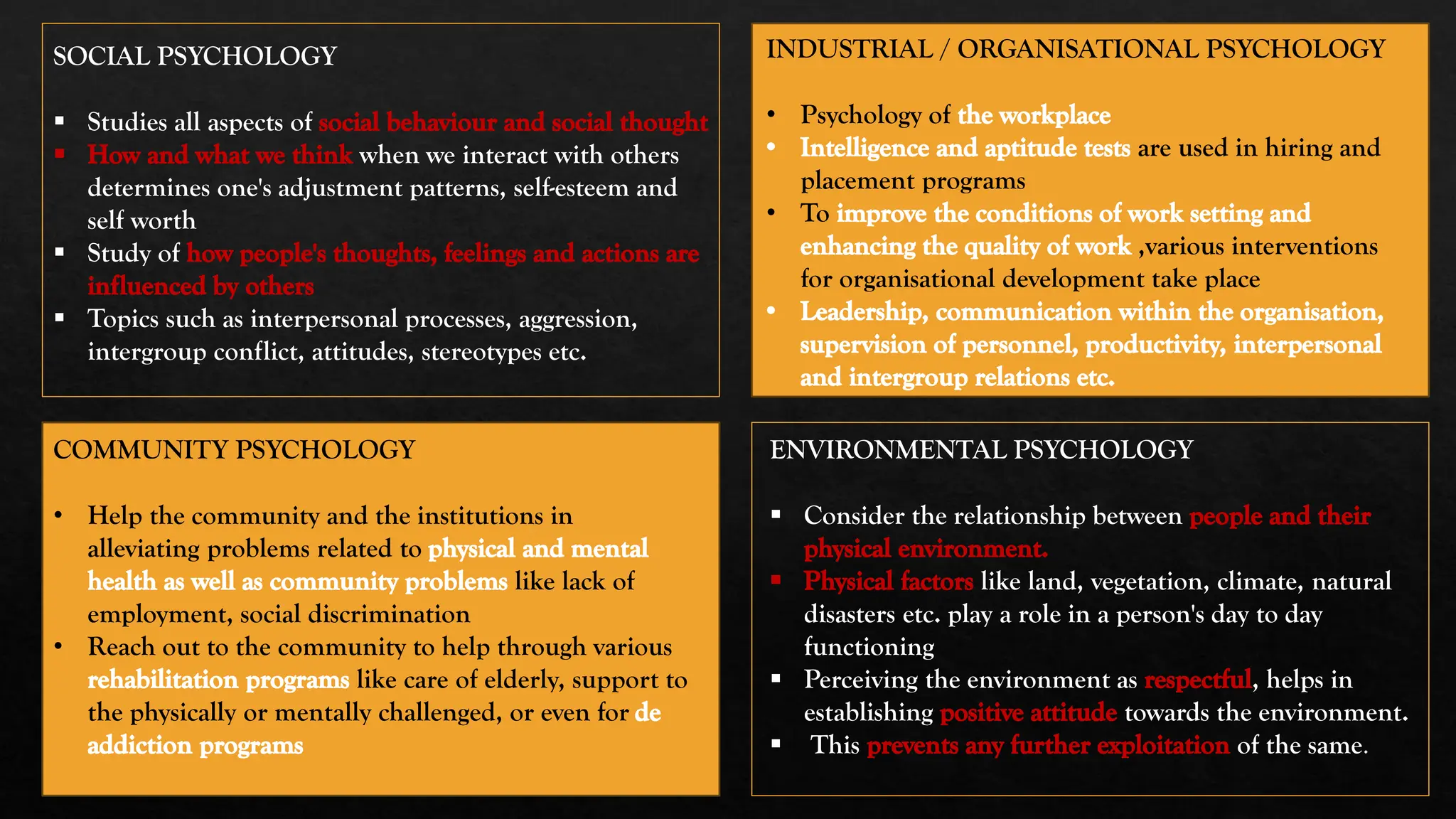
SOCIAL PSYCHOLOGY
▪ Studies all aspects of social behaviour and social thought
How and what we think when we interact with others
determines one's adjustment patterns, self-esteem and
self worth
▪ Study of how people's thoughts, feelings and actions are
influenced by others
▪ Topics such as interpersonal processes, aggression,
intergroup conflict, attitudes, stereotypes etc.
ENVIRONMENTAL PSYCHOLOGY
▪ Consider the relationship between people and their
physical environment.
Physical factors like land, vegetation, climate, natural
disasters etc. play a role in a person's day to day
functioning
▪ Perceiving the environment as respectful, helps in
establishing positive attitude towards the environment.
▪ This prevents any further exploitation of the same.
INDUSTRIAL / ORGANISATIONAL PSYCHOLOGY
• Psychology of the workplace
Intelligence and aptitude tests are used in hiring and
placement programs
• To improve the conditions of work setting and
enhancing the quality of work ,various interventions
for organisational development take place
Leadership, communication within the organisation,
supervision of personnel, productivity, interpersonal
and intergroup relations etc.
COMMUNITY PSYCHOLOGY
• Help the community and the institutions in
alleviating problems related to physical and mental
health as well as community problems like lack of
employment, social discrimination
• Reach out to the community to help through various
rehabilitation programs like care of elderly, support to
the physically or mentally challenged, or even for de
addiction programs
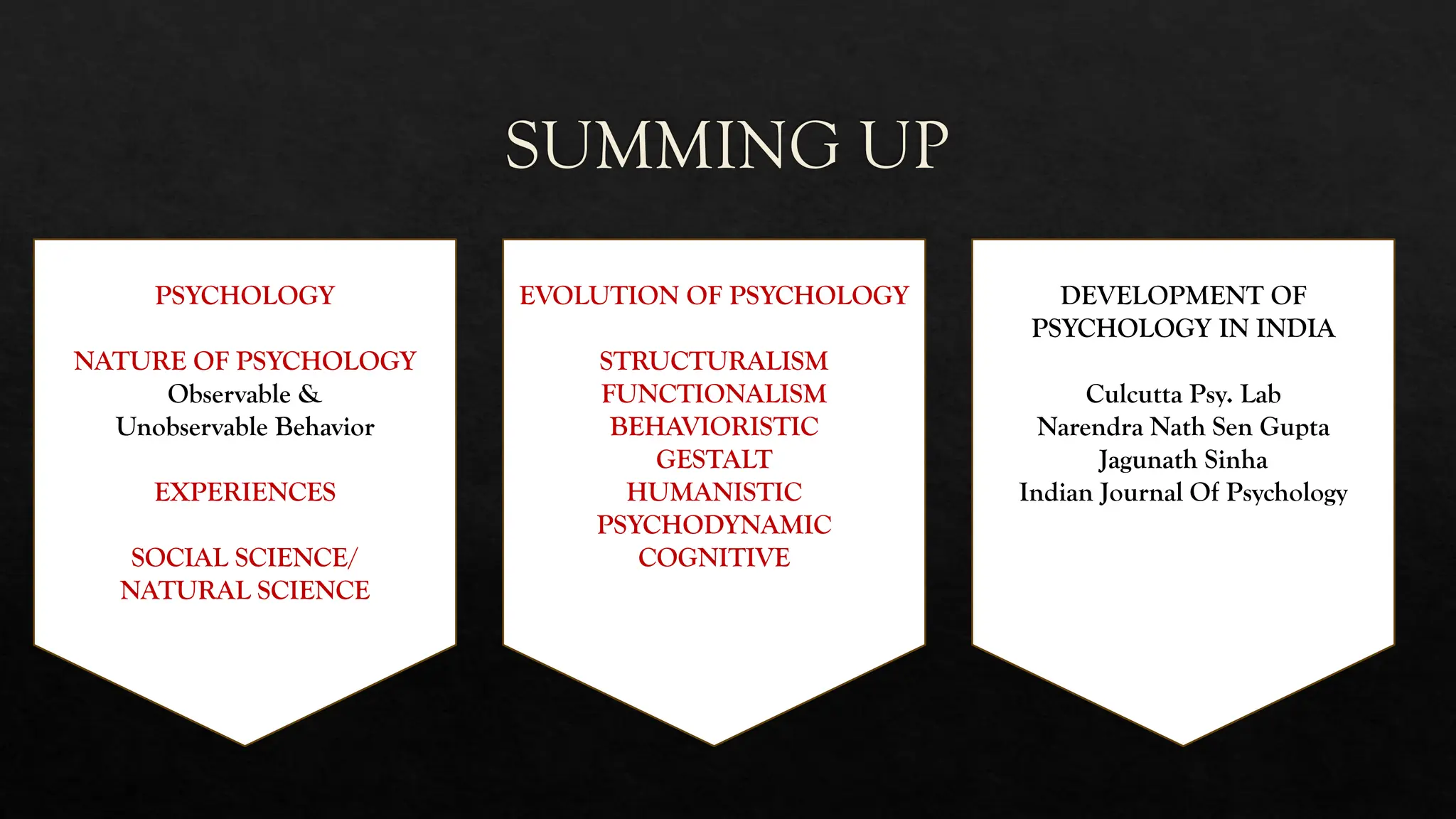
SUMMING UP
EVOLUTION OF PSYCHOLOGY
STRUCTURALISM
FUNCTIONALISM
BEHAVIORISTIC
GESTALT
HUMANISTIC
PSYCHODYNAMIC
COGNITIVE
PSYCHOLOGY
NATURE OF PSYCHOLOGY
Observable &
Unobservable Behavior
EXPERIENCES
SOCIAL SCIENCE/
NATURAL SCIENCE
DEVELOPMENT OF
PSYCHOLOGY IN INDIA
Culcutta Psy. Lab
Narendra Nath Sen Gupta
Jagunath Sinha
Indian Journal Of Psychology
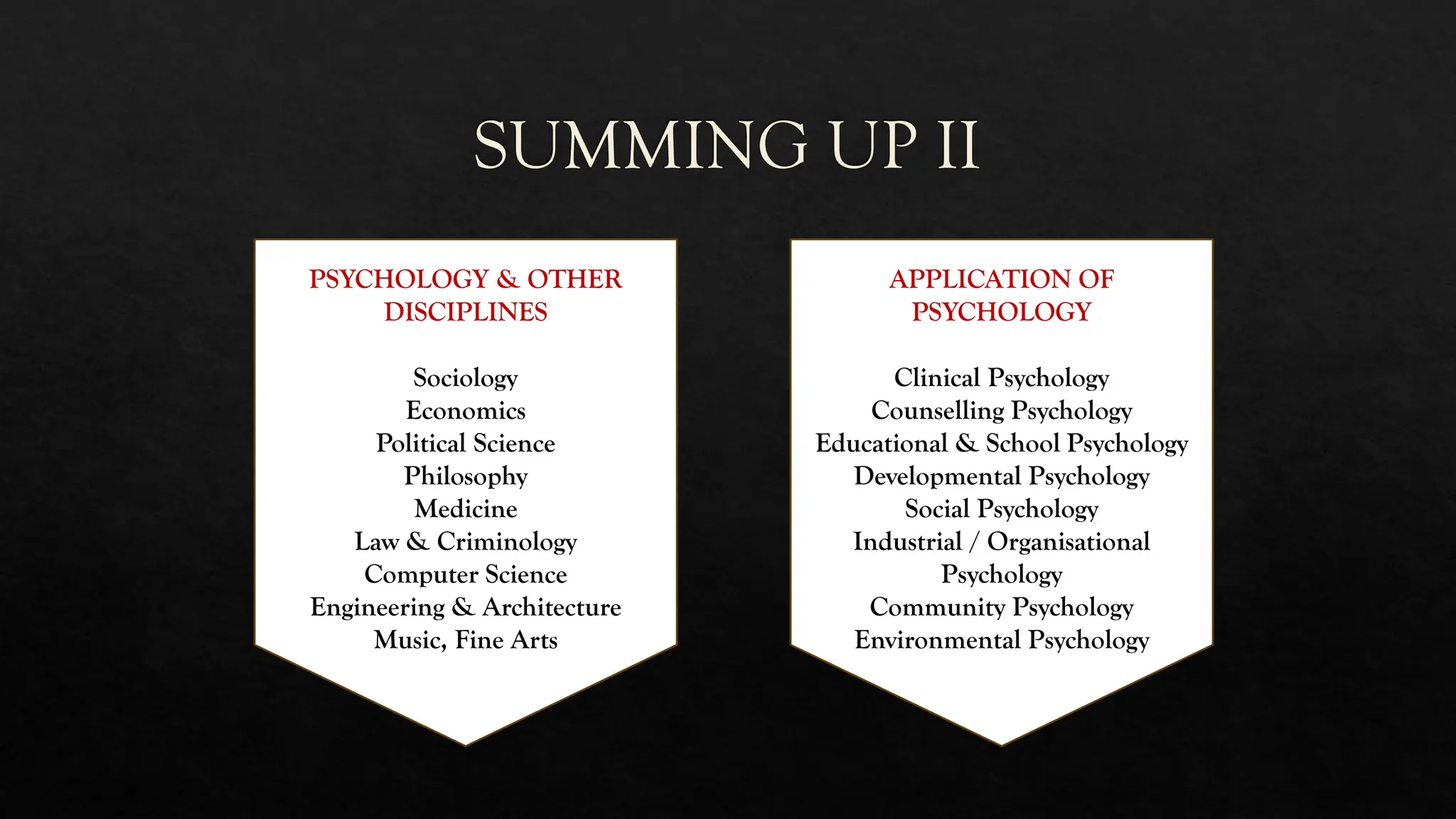
SUMMING UP II
PSYCHOLOGY & OTHER
DISCIPLINES
Sociology
Economics
Political Science
Philosophy
Medicine
Law & Criminology
Computer Science
Engineering & Architecture
Music, Fine Arts
APPLICATION OF
PSYCHOLOGY
Clinical Psychology
Counselling Psychology
Educational & School Psychology
Developmental Psychology
Social Psychology
Industrial / Organisational
Psychology
Community Psychology
Environmental Psychology

UNDERSTANDING PSYCHOLOGY UNIT I OF CBSE

  • 1.
  • 2.
    PSYCHOLOGY An immense needis felt to understand the diverse processes such as our abilities to attend, perceive, think, learn, memorize, recall, feel and behave in the context of our environment. The common man's perspective of Psychology is quite different from that of a trained psychologist. The scientific view considers that psychological research and studies will help us observe, describe, control, predict and improve human behavior and emotions.
  • 3.
    Psychology is ascientific study of all the experiences, behaviours and mental processes like knowing, thinking, reasoning , understanding etc. These mental processes are also part of human cognition. The study of Psychology is important as it helps improve the lives of people. It enables them to develop an insight into their thoughts and actions. NATURE OF PSYCHOLOGY SITUATION THOUGHTS BEHAVIOR OBSERVABLE BEHAVIOR Others can see our actions Playing Writing Walking UNOBSERVABLE BEHAVIOR Cannot be (known) seen by others Thinking Mental activities Emotional activities
  • 4.
    EXPERIENCES The past behaviorsand thoughts will help you in forming your experiences. These experiences are also determined by external factors like climate, home, family, school, neighbourhood etc. Some of these factors may not be under your control. Your experiences are also very specific to you. Your experiences may also be determined by your feelings and emotions which are an inherent part of your 'self'. Human beings try to know their own self and the environment around them.
  • 5.
    NATURAL SCIENCE/SOCIAL SCIENCE? Humanbeings are studied in the social context to understand their interactions with one another on the basis of their culture. Culture is the man-made part of the environment. It influences humans over generations. Parenting and socialization practices influence the child rearing practices, behaviours, interpersonal relationships, attitudes and most of our attributes. Psychology tries to understand the relevance of sociocultural (values) environment in understanding human experiences, emotions and actions. Psychology is recognized as a Social Science. ‡ Psychology is a systematized body of knowledge. In that, it has a scientific orientation. ‡ Scientific knowledge is gathered by conducting experiments, making systematic observations and measuring events. ‡ The data collected and recorded is open to objective verification, replication and analysis. ‡ Experiments in Psychology are also based on a hypothesis. A hypothesis is a tentative statement which is to be proved through the research. ‡ This research also helps in predicting by summarizing and interpreting the results of research. ‡ Psychology is also considered a Natural Science as it uses the scientific methods.
  • 6.
    EVOLUTION OF PSYCHOLOGY Earlypsychologists were encouraged to think that mental processes, behavior and experiences could be studied using scientific methods. Study of Psychology evolved from Philosophy about 150 years ago, when scientific thoughts led to experimental advances in the field of Psychology. The subject matter of interest to psychologists evolved over the years, as various schools of thoughts emerged with varying ideologies and theories. STRUCTURALISM An early school of Psychology Study of the structure of mind and consciousness (awareness). Method used → Introspection(the subject describes his/ her conscious experiences). The first psychological laboratory →William Wundt, in Liepzig, Germany in 1879.
  • 7.
    SCHOOLS OF THOUGHTS FUNCTIONALISMGESTALT PERSPECTIVE BEHAVIORISM Focused not on the structure of mind (structuralist view), but on its functions. Psychologists such as William James, John Dewey and James Angell proposed that Psychology as a discipline should focus on how behaviour functions and what a mind does. Emphasizes that perception is organized into wholes. Our perception and understanding of objects are more meaningful than its smaller parts. Whole is much more than the sum of its parts. Founded in Germany by Max Wertheimer and his colleagues Kurt Koffka and Wolfgang Kohler. Psychology should focus on observable behavior • John B Watson was the first behaviorist. • One can gain an understanding of a behavior by studying and modifying the environment in which people operate. • The processes involved in human learning are the basis of behaviorism. Learning by conditioning and reinforcement was studied by Skinner and Pavlov .
  • 8.
    SCHOOLS OF THOUGHTSII PSYCHODYNAMIC Psychoanalysis was founded in Vienna, Austria by Sigmund Freud. Theme of unconscious motivation. Human behavior is a manifestation of the unconscious motives, needs and desires of which a person is not aware. Hypnosis, dream interpretation HUMANISTIC Sense of self Enhance the understanding of self in order to achieve his/ her ideal self. Carl Rogers and Abraham Maslow emphasized that the discrepancy between real self and ideal self can be reduced by understanding one's potential and striving towards self-actualization. COGNITIVE Views human mind as an information processing system where the information, that we receive from the environment, is processed, transformed, stored and retrieved like in a computer. • Human mind is actively constructing itself through exploration into the physical and social world.
  • 9.
    DEVELOPMENT OF PSYCHOLOGYIN INDIA Early twentieth-century →Psychology was at a nascent stage. The Western influence was predominant →Britishers Most of the early Indian Psychologists were philosophers. First psychological laboratory→ Calcutta, 1916, marked the beginning of Psychology as a discipline. Narendra Nath Sen Gupta → Harvard-educated Indian psychologist, philosopher, Founder of the Indian Psychological Association, and the founding editor of the first official Psychology journal in India, the Indian Journal of Psychology. In 1934, Jadunath Sinha →book on Indian theories of perception and another one on Cognition. There is a Journal of Indian Psychology published from Andhra University. It also has an Institute of Yoga and Consciousness. Many attempts are being made to integrate ancient Indian Psychology with modern Western Psychology.
  • 10.
    PSYCHOLOGY & OTHERDISCIPLINES Psychology, as a scientific study of mental processes, behavior and experiences in different contexts, cannot be studied in isolation. Its subject matter is based on other disciplines too. SOCIOLOGY • Sociology is the study of how social, cultural and environmental factors influence a person. • Factors related to group norms, leadership, attitudes, collective behaviour, sociocultural factors etc are interrelated.
  • 11.
    ECONOMICS o Study ofEconomics is more meaningful when human behaviour is understood. o Understanding human wants (which may be infinite) , consumer behaviour,savings,allocating funds for causes →understand decision making behaviour. o Psychologists → awareness about levels of incomes, population, infrastructural reforms, poverty etc. o Choices one makes helps an economist to predict consumer sentiments and economic growth POLITICAL SCIENCE ❑ Study of Psychology helps in understanding leadership behaviour, exercise of powers, voting behaviour etc. ❑ The practices followed by democrats, socialist, capitalist, or even dictators can be understood from a psychological perspective. PHILOSOPHY ✓ Psychology was born of Philosophy ✓ Philosophy → know the nature of the human mind and how do humans behave in a particular manner. ✓ Experimental and observational methods + Philosophy→ Psychology MEDICINE § Both Psychology and Medicine use scientific methods to understand human body, mind and behaviour. § The mind and the body are inseparable for diagnosis, treatment and healthy healing. § Successful doctor takes assistance from clinical and counselling psychologist in treating patients suffering from chronic diseases like anxiety disorders, heart ailments, AIDS, cancer, paralysis etc.
  • 12.
    LAW & CRIMINOLOGY oLaw seeks to regulate human behaviour , while Psychology seeks to understand human behaviour in a particular context. o Psychology is applied to legal studies and studies of criminal behaviour. o Psychology helps to develop an understanding of the social and cognitive principles such as eyewitness memory, jury bias, constructive memory, decision-making, trials etc. COMPUTER SCIENCE ❑ Development in the field of Computer Science →enhancing the knowledge of Psychology and its application. ❑ HCIE (Human Computer Interaction Engineering) and AI (artificial intelligence). ❑ Use Psychology in developing computer programs that mimic the human mind ENGINEERING & ARCHITECTURE ✓ Engineers →design and develop products for use by human beings. ✓ Understanding human cognition and emotions helps them in being able to make the products user friendly. ✓ Enhances the technological effectiveness of the design and its practical utility. Cities, roads, railway stations, malls, airports etc are done keeping in mind the behavior of people utilizing these facilities. MUSIC, FINE ARTS, DANCE & OTHER PERFORMANCES § Psychologists → understanding and improving the behavior and performance of an individual. § Studies →music and ragas heal the mind. Rhythms in music have a calming impact on human beings. § Dance and Theatre is therapeutic and is widely used by psychologists. It enables a person to develop an understanding of onself.
  • 13.
    APPLICATIONS OF PSYCHOLOGY STUDYOF PSYCHOLOGY : Is helpful in knowing and understanding a vast array of human thoughts, emotions and behaviors. Prepare one for developing an understanding of human beings in different areas and professions. Has grown, and has given rise to various subfields where people work.
  • 14.
    CLINICAL PSYCHOLOGY ▪ Dealswith the causes, diagnosis and treatment of psychological disorders ▪ Use standardized tests as an aid to diagnose ▪ Do not have medical degree and cannot prescribe medicines to treat the disorders. ▪ Trained to provide psychotherapy which involves helping clients learn to make choices, so that they can cope with troublesome thoughts ,feelings and behaviours COUNSELLING PSYCHOLOGY • Helps people deal with issues that they face ,such as choosing a career, marriage Do not involve psychological disorders • Provide vocational testing to help people decide which occupation best • Deal with milder emotional and personal problems • Sometimes provide psychotherapy EDUCATIONAL & SCHOOL PSYCHOLOGY • Study all aspects of the educational process • Apply principles of learning, perception and motivation to suggest curriculums that are inclusive, student friendly and interesting Curriculum planning, teacher training and instruction design. • School Psych work with educators, and sometimes families of students, devising ways to improve the cognitive, emotional and social development of children DEVELOPMENTAL PSYCHOLOGY ▪ Examines how people grow and change from the moment of conception (through) till death. ▪ Developmental changes take place in physical, motor, cognitive, emotional, behavioral, social, and linguistic domains through the lifespan. ▪ Research and teach the development of mental processes and behaviour as per the individual's (with ) age and experience.
  • 15.
    SOCIAL PSYCHOLOGY ▪ Studiesall aspects of social behaviour and social thought How and what we think when we interact with others determines one's adjustment patterns, self-esteem and self worth ▪ Study of how people's thoughts, feelings and actions are influenced by others ▪ Topics such as interpersonal processes, aggression, intergroup conflict, attitudes, stereotypes etc. ENVIRONMENTAL PSYCHOLOGY ▪ Consider the relationship between people and their physical environment. Physical factors like land, vegetation, climate, natural disasters etc. play a role in a person's day to day functioning ▪ Perceiving the environment as respectful, helps in establishing positive attitude towards the environment. ▪ This prevents any further exploitation of the same. INDUSTRIAL / ORGANISATIONAL PSYCHOLOGY • Psychology of the workplace Intelligence and aptitude tests are used in hiring and placement programs • To improve the conditions of work setting and enhancing the quality of work ,various interventions for organisational development take place Leadership, communication within the organisation, supervision of personnel, productivity, interpersonal and intergroup relations etc. COMMUNITY PSYCHOLOGY • Help the community and the institutions in alleviating problems related to physical and mental health as well as community problems like lack of employment, social discrimination • Reach out to the community to help through various rehabilitation programs like care of elderly, support to the physically or mentally challenged, or even for de addiction programs
  • 16.
    SUMMING UP EVOLUTION OFPSYCHOLOGY STRUCTURALISM FUNCTIONALISM BEHAVIORISTIC GESTALT HUMANISTIC PSYCHODYNAMIC COGNITIVE PSYCHOLOGY NATURE OF PSYCHOLOGY Observable & Unobservable Behavior EXPERIENCES SOCIAL SCIENCE/ NATURAL SCIENCE DEVELOPMENT OF PSYCHOLOGY IN INDIA Culcutta Psy. Lab Narendra Nath Sen Gupta Jagunath Sinha Indian Journal Of Psychology
  • 17.
    SUMMING UP II PSYCHOLOGY& OTHER DISCIPLINES Sociology Economics Political Science Philosophy Medicine Law & Criminology Computer Science Engineering & Architecture Music, Fine Arts APPLICATION OF PSYCHOLOGY Clinical Psychology Counselling Psychology Educational & School Psychology Developmental Psychology Social Psychology Industrial / Organisational Psychology Community Psychology Environmental Psychology