Copyright: The Basics
Robert Farrow
Creative Commons Certification Week 2
©️
This work is licensed under a Creative Commons Attribution 4.0 International License.
Copyright: The Basics
This is a short presentation that will teach you
the basics about copyright!
There are some links to further reading at the end…
But let’s start at the beginning…
©️
What is copyright?
• Copyright is a legal right and protection
• Copyright sets out rules and expectations for the reproduction and
uses of an original creative work (literary/artistic/industrial/digital)
• Copyright affects and regulates many aspects of our lives (knowledge
production, the arts, etc.)
• Copyright grants exclusive rights to creators to protect and incentivize
their work
• Copyright concerns the expression of ideas, not ideas themselves
Where does copyright come from?
• The invention of the printing press in the 15th century made mass copying
of creative works possible
• In 1710 the Statute of Anne was the first law to offer authorial protection
from unauthorized copying of their work
• The Berne Convention (1886) established an international approach to
copyright
• The Universal Copyright Convention (1952) was developed by UNESCO as
an alternative to the Berne Convention.
• The Copyright Act of 1976 updated copyright law for the age of mass
communication, codifying ‘fair use’ and rights to reproduce, derive,
distribute, perform and display creative works.
What is the purpose of copyright?
Three perspectives…
1. Incentivize creative production
Michaelangelo, The Creation of Adam. (Public Domain)
2. Preserve the integrity of creative works
3. Establish rules for economic exploitation of works
How copyright works
• In most countries, copyright protection is automatically conferred (unlike a
patent or trademark) onto original intellectual property
• Copyright is a territorial right which means that copyright granted by a
state only extends to the territory of that state; each country has its own
copyright laws and practices, but most countries offer a form of mutual
recognition of copyright
• Copyright holders can extend permissions, allowing others to make copies;
translate; perform; or otherwise adapt works – these derivatives do not
change the copyright status
• Copyright violations are typically redressed through (civil and criminal)
legal procedures, with infringements risking fines, takedown notices and
legal orders
When can a work be copyrighted?
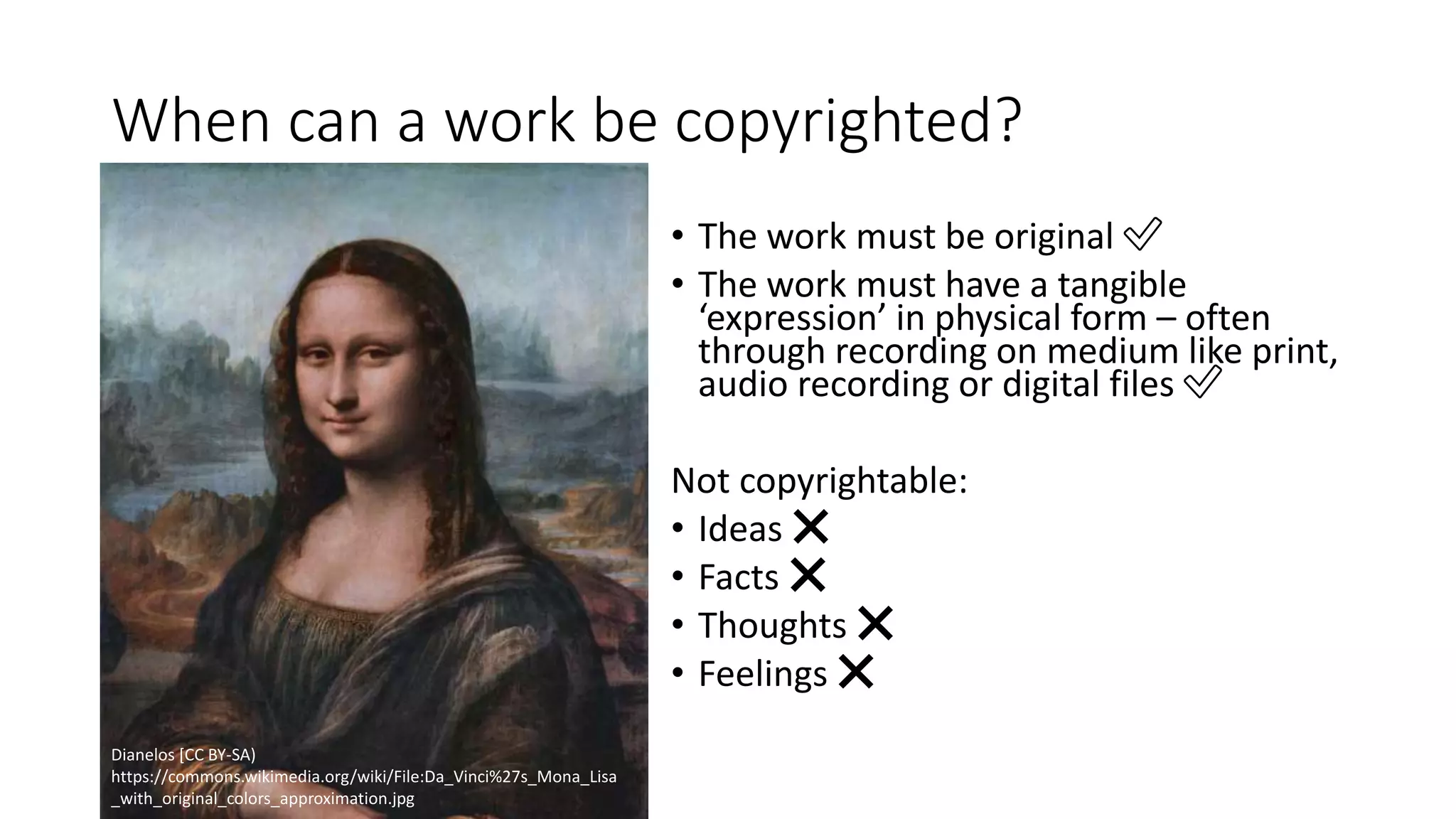
• The work must be original ✅
• The work must have a tangible
‘expression’ in physical form – often
through recording on medium like print,
audio recording or digital files ✅
Not copyrightable:
• Ideas ❌
• Facts ❌
• Thoughts ❌
• Feelings ❌
Dianelos [CC BY-SA)
https://commons.wikimedia.org/wiki/File:Da_Vinci%27s_Mona_Lisa
_with_original_colors_approximation.jpg
What is the ‘Public Domain’?
• The ‘Public Domain’ refers to all creative works to which no exclusive
intellectual property rights apply
• When copyright expires (typically 70 years after death of the author in the
UK and USA) works are considered to be in the Public Domain
• Works in the Public Domain may be used freely by anyone; authorial rights
(including copyright) effectively no longer exist
• ‘Public Domain’ does not usually refer to cases where an author retains
some rights
• Some works may never enter the Public Domain: the UK Crown holds a
perpetual copyright for the King James Bible translation, for instance
Public Domain can include…
• BOOKS • MUSIC • FILM
What are exemptions to copyright?
• Most countries allow people to make some use of copyrighted works
without violating copyright
• These are known as ‘exceptions’ or ‘limitations’ to copyright
• Some countries define these uses very tightly whereas others have a
more formal “fair use” approach
• Common exceptions include using copyrighted works in educational
contexts, or for the purposes of criticism and critique
• This is how a lot of YouTube channels are able to broadcast
copyrighted material
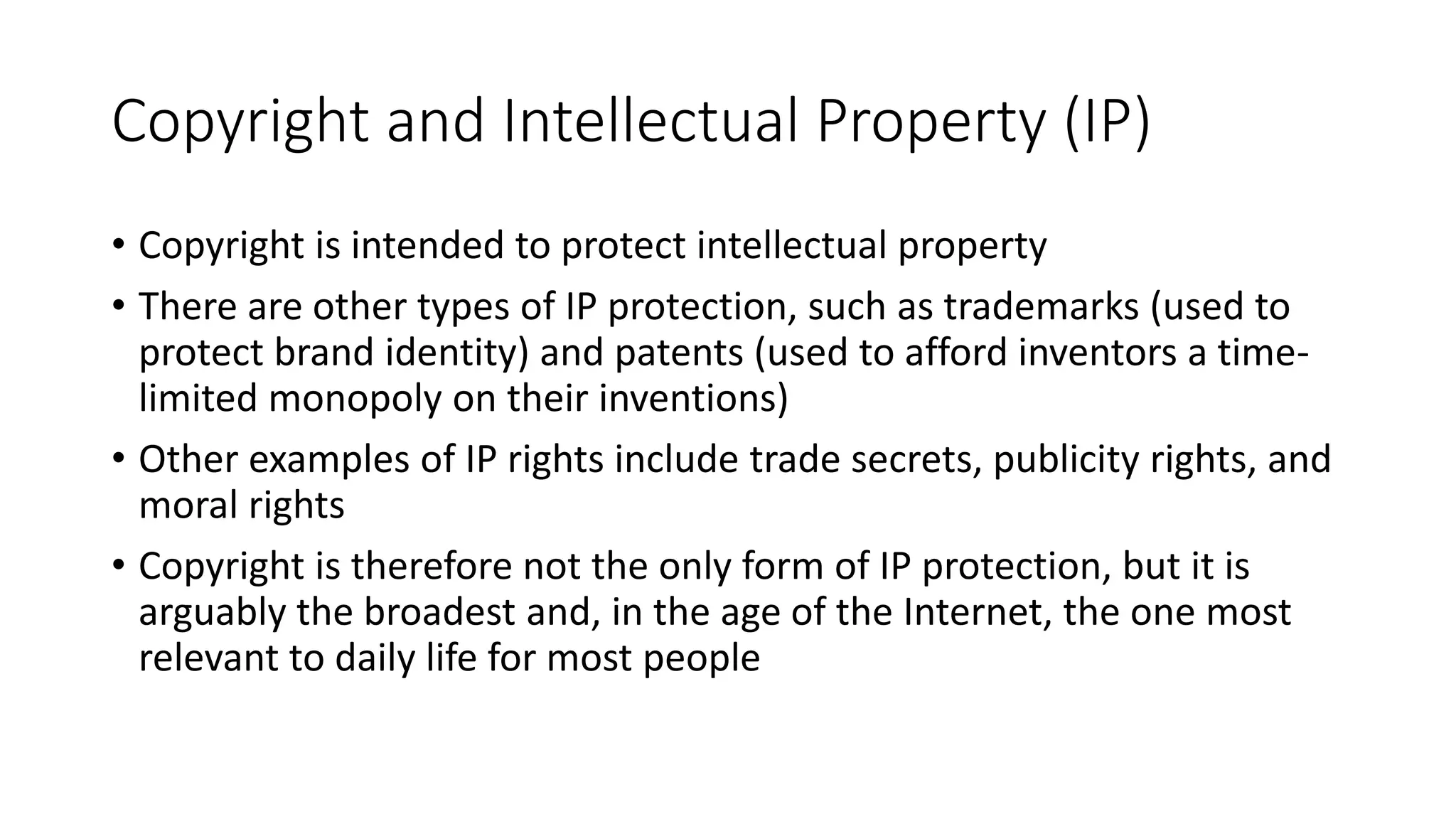
Copyright and Intellectual Property (IP)
• Copyright is intended to protect intellectual property
• There are other types of IP protection, such as trademarks (used to
protect brand identity) and patents (used to afford inventors a time-
limited monopoly on their inventions)
• Other examples of IP rights include trade secrets, publicity rights, and
moral rights
• Copyright is therefore not the only form of IP protection, but it is
arguably the broadest and, in the age of the Internet, the one most
relevant to daily life for most people
Alternatives to traditional copyright
Several alternatives to traditional copyright have been proposed,
including:
• Copyleft https://www.gnu.org/licenses/copyleft.en.html
• Open Licensing (e.g. Creative Commons)
https://creativecommons.org/share-your-work/licensing-
considerations/
• Dedication to Public Domain
https://fairuse.stanford.edu/overview/public-
domain/welcome/#dedicated_works
Find Out More…
• Copyright on Wikipedia https://en.wikipedia.org/wiki/Copyright
• Copyright resources from University College London
https://www.ucl.ac.uk/library/ucl-copyright-advice/copyright-
resources
• Creative Commons https://creativecommons.org/
• UK Copyright Guide https://www.gov.uk/copyright
• List of copyright resources provided by Stanford University Library
https://www.ucl.ac.uk/library/ucl-copyright-advice/copyright-
resources
Non-attributed images found in this presentation are believed to be in the public domain.

What is Copyright?

  • 1.
    Copyright: The Basics RobertFarrow Creative Commons Certification Week 2 ©️ This work is licensed under a Creative Commons Attribution 4.0 International License.
  • 2.
    Copyright: The Basics Thisis a short presentation that will teach you the basics about copyright! There are some links to further reading at the end… But let’s start at the beginning… ©️
  • 3.
    What is copyright? •Copyright is a legal right and protection • Copyright sets out rules and expectations for the reproduction and uses of an original creative work (literary/artistic/industrial/digital) • Copyright affects and regulates many aspects of our lives (knowledge production, the arts, etc.) • Copyright grants exclusive rights to creators to protect and incentivize their work • Copyright concerns the expression of ideas, not ideas themselves
  • 4.
    Where does copyrightcome from? • The invention of the printing press in the 15th century made mass copying of creative works possible • In 1710 the Statute of Anne was the first law to offer authorial protection from unauthorized copying of their work • The Berne Convention (1886) established an international approach to copyright • The Universal Copyright Convention (1952) was developed by UNESCO as an alternative to the Berne Convention. • The Copyright Act of 1976 updated copyright law for the age of mass communication, codifying ‘fair use’ and rights to reproduce, derive, distribute, perform and display creative works.
  • 5.
    What is thepurpose of copyright? Three perspectives…
  • 6.
    1. Incentivize creativeproduction Michaelangelo, The Creation of Adam. (Public Domain)
  • 7.
    2. Preserve theintegrity of creative works
  • 8.
    3. Establish rulesfor economic exploitation of works
  • 9.
    How copyright works •In most countries, copyright protection is automatically conferred (unlike a patent or trademark) onto original intellectual property • Copyright is a territorial right which means that copyright granted by a state only extends to the territory of that state; each country has its own copyright laws and practices, but most countries offer a form of mutual recognition of copyright • Copyright holders can extend permissions, allowing others to make copies; translate; perform; or otherwise adapt works – these derivatives do not change the copyright status • Copyright violations are typically redressed through (civil and criminal) legal procedures, with infringements risking fines, takedown notices and legal orders
  • 10.
    When can awork be copyrighted? • The work must be original ✅ • The work must have a tangible ‘expression’ in physical form – often through recording on medium like print, audio recording or digital files ✅ Not copyrightable: • Ideas ❌ • Facts ❌ • Thoughts ❌ • Feelings ❌ Dianelos [CC BY-SA) https://commons.wikimedia.org/wiki/File:Da_Vinci%27s_Mona_Lisa _with_original_colors_approximation.jpg
  • 11.
    What is the‘Public Domain’? • The ‘Public Domain’ refers to all creative works to which no exclusive intellectual property rights apply • When copyright expires (typically 70 years after death of the author in the UK and USA) works are considered to be in the Public Domain • Works in the Public Domain may be used freely by anyone; authorial rights (including copyright) effectively no longer exist • ‘Public Domain’ does not usually refer to cases where an author retains some rights • Some works may never enter the Public Domain: the UK Crown holds a perpetual copyright for the King James Bible translation, for instance
  • 12.
    Public Domain caninclude… • BOOKS • MUSIC • FILM
  • 13.
    What are exemptionsto copyright? • Most countries allow people to make some use of copyrighted works without violating copyright • These are known as ‘exceptions’ or ‘limitations’ to copyright • Some countries define these uses very tightly whereas others have a more formal “fair use” approach • Common exceptions include using copyrighted works in educational contexts, or for the purposes of criticism and critique • This is how a lot of YouTube channels are able to broadcast copyrighted material
  • 14.
    Copyright and IntellectualProperty (IP) • Copyright is intended to protect intellectual property • There are other types of IP protection, such as trademarks (used to protect brand identity) and patents (used to afford inventors a time- limited monopoly on their inventions) • Other examples of IP rights include trade secrets, publicity rights, and moral rights • Copyright is therefore not the only form of IP protection, but it is arguably the broadest and, in the age of the Internet, the one most relevant to daily life for most people
  • 15.
    Alternatives to traditionalcopyright Several alternatives to traditional copyright have been proposed, including: • Copyleft https://www.gnu.org/licenses/copyleft.en.html • Open Licensing (e.g. Creative Commons) https://creativecommons.org/share-your-work/licensing- considerations/ • Dedication to Public Domain https://fairuse.stanford.edu/overview/public- domain/welcome/#dedicated_works
  • 16.
    Find Out More… •Copyright on Wikipedia https://en.wikipedia.org/wiki/Copyright • Copyright resources from University College London https://www.ucl.ac.uk/library/ucl-copyright-advice/copyright- resources • Creative Commons https://creativecommons.org/ • UK Copyright Guide https://www.gov.uk/copyright • List of copyright resources provided by Stanford University Library https://www.ucl.ac.uk/library/ucl-copyright-advice/copyright- resources Non-attributed images found in this presentation are believed to be in the public domain.