Patent Filling Process
104/28/16 Sagar Kishor Savale
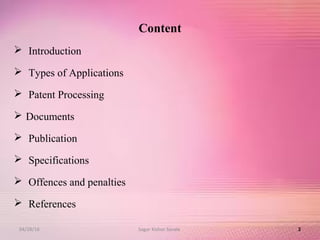
Content
 Introduction
 Types of Applications
 Patent Processing
 Documents
 Publication
 Specifications
 Offences and penalties
 References
204/28/16 Sagar Kishor Savale
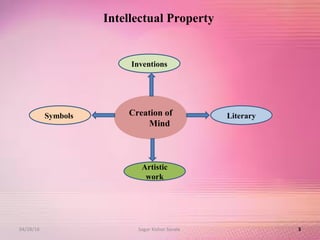
Intellectual Property
Creation of
Mind
Inventions
Artistic
work
LiterarySymbols
304/28/16 Sagar Kishor Savale
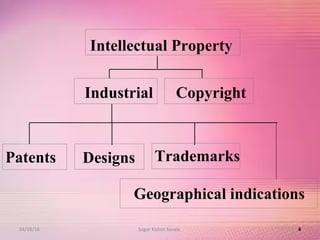
Patents Designs Trademarks
Industrial Copyright
Intellectual Property
Geographical indications
404/28/16 Sagar Kishor Savale
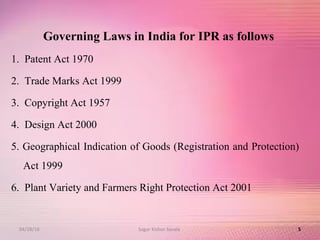
Governing Laws in India for IPR as follows
1. Patent Act 1970
2. Trade Marks Act 1999
3. Copyright Act 1957
4. Design Act 2000
5. Geographical Indication of Goods (Registration and Protection)
Act 1999
6. Plant Variety and Farmers Right Protection Act 2001
504/28/16 Sagar Kishor Savale
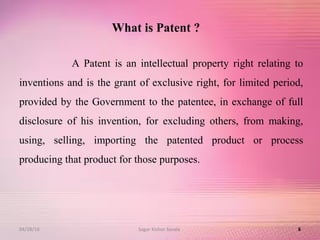
What is Patent ?
A Patent is an intellectual property right relating to
inventions and is the grant of exclusive right, for limited period,
provided by the Government to the patentee, in exchange of full
disclosure of his invention, for excluding others, from making,
using, selling, importing the patented product or process
producing that product for those purposes.
604/28/16 Sagar Kishor Savale
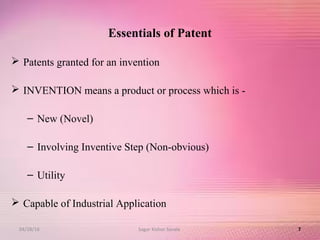
Essentials of Patent
 Patents granted for an invention
 INVENTION means a product or process which is -
– New (Novel)
– Involving Inventive Step (Non-obvious)
– Utility
 Capable of Industrial Application
704/28/16 Sagar Kishor Savale
Patent Administration in India
A patent application can be filed at any of the four patent offices
in India.
Four branches:
Kolkata (Head office)
Mumbai
Delhi
Chennai
804/28/16 Sagar Kishor Savale
Who can file Patent Application in India…?
Either alone or jointly:
 By any person claiming to be true and first inventor(s).
 By any person being the assignee of person claiming to be true
and first inventor(s).
 By the legal representative of any deceased person who can
immediately after his death is entitled to make such application.
904/28/16 Sagar Kishor Savale
Types of Applications
 Ordinary Applications
 Convention Application
 Patent of Addition Application
 Divisional Applications
 PCT Application
1004/28/16 Sagar Kishor Savale
The patent application passes through the following
stages
A. Filing
B. Publication
C. Examination
D. Opposition
E. Grant
1104/28/16 Sagar Kishor Savale
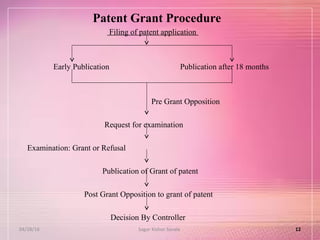
Patent Grant Procedure
Filing of patent application
Early Publication Publication after 18 months
Pre Grant Opposition
Request for examination
Examination: Grant or Refusal
Publication of Grant of patent
Post Grant Opposition to grant of patent
Decision By Controller
1204/28/16 Sagar Kishor Savale
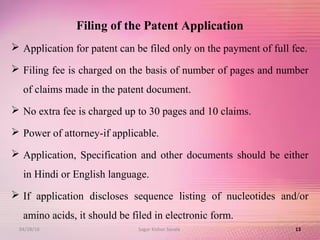
Filing of the Patent Application
 Application for patent can be filed only on the payment of full fee.
 Filing fee is charged on the basis of number of pages and number
of claims made in the patent document.
 No extra fee is charged up to 30 pages and 10 claims.
 Power of attorney-if applicable.
 Application, Specification and other documents should be either
in Hindi or English language.
 If application discloses sequence listing of nucleotides and/or
amino acids, it should be filed in electronic form.
1304/28/16 Sagar Kishor Savale
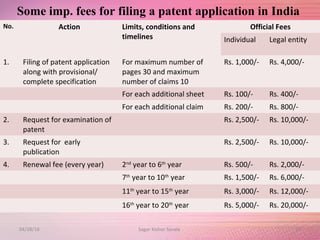
No. Action Limits, conditions and
timelines
Official Fees
Individual Legal entity
1. Filing of patent application
along with provisional/
complete specification
For maximum number of
pages 30 and maximum
number of claims 10
Rs. 1,000/- Rs. 4,000/-
For each additional sheet Rs. 100/- Rs. 400/-
For each additional claim Rs. 200/- Rs. 800/-
2. Request for examination of
patent
Rs. 2,500/- Rs. 10,000/-
3. Request for early
publication
Rs. 2,500/- Rs. 10,000/-
4. Renewal fee (every year) 2nd
year to 6th
year Rs. 500/- Rs. 2,000/-
7th
year to 10th
year Rs. 1,500/- Rs. 6,000/-
11th
year to 15th
year Rs. 3,000/- Rs. 12,000/-
16th
year to 20th
year Rs. 5,000/- Rs. 20,000/-
Some imp. fees for filing a patent application in India
1404/28/16 Sagar Kishor Savale
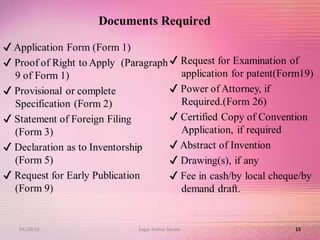
Documents Required
1504/28/16 Sagar Kishor Savale
Requirements for documents
 All documents & copies of document, except affidavits &
drawings sent to the patent office or otherwise furnished to the
Controller shall be written, typewritten or printed in English
language (unless otherwise directed or allowed by the controller)
in legible character size, with lines widely spaced upon one side
only on strong white paper.
 The size of paper should be A4 size with a margin of 4cm on the
top and 3cm on the bottom and right hand part thereof.
1604/28/16 Sagar Kishor Savale
Publication of Patent Application
 Every application shall be published after expiry of 18 months
from the date of filing or date of priority of the application except
the following,
– Application in which secrecy direction is imposed or
– Has been withdrawn before 3 months prior to expiry of 18
months.
 However the applicant can make request for early publication
prior to 18 months on form 9 with prescribed fee of Rs.2500 or
Rs.10000 by individual or legal entity respectively.
1704/28/16 Sagar Kishor Savale
Filing of Request For Examination
 A request for examination can be filed in form 19 only within 48
months from the priority date or filing date whichever is earlier.
Grant of patent
 A patent will be granted to the applicant if -
– The applicant has complied with the objections within the
prescribed time.
– No pre-grant opposition by representation is filed.
– If filed, disposed of in favour of the applicant within the
prescribed time.
 Patent will be granted and sealed with seal of office and notified
in the official journal .
1804/28/16 Sagar Kishor Savale
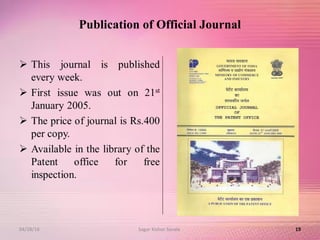
Publication of Official Journal
1904/28/16 Sagar Kishor Savale
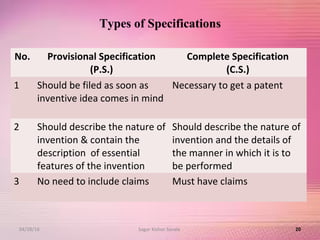
No. Provisional Specification
(P.S.)
Complete Specification
(C.S.)
1 Should be filed as soon as
inventive idea comes in mind
Necessary to get a patent
2 Should describe the nature of
invention & contain the
description of essential
features of the invention
Should describe the nature of
invention and the details of
the manner in which it is to
be performed
3 No need to include claims Must have claims
20
Types of Specifications
04/28/16 Sagar Kishor Savale
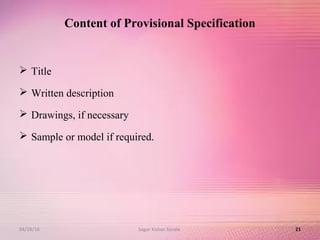
Content of Provisional Specification
 Title
 Written description
 Drawings, if necessary
 Sample or model if required.
2104/28/16 Sagar Kishor Savale
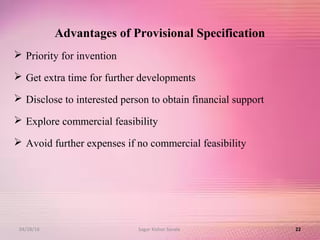
Advantages of Provisional Specification
 Priority for invention
 Get extra time for further developments
 Disclose to interested person to obtain financial support
 Explore commercial feasibility
 Avoid further expenses if no commercial feasibility
2204/28/16 Sagar Kishor Savale
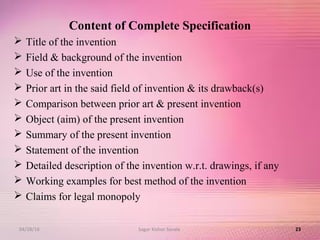
Content of Complete Specification
 Title of the invention
 Field & background of the invention
 Use of the invention
 Prior art in the said field of invention & its drawback(s)
 Comparison between prior art & present invention
 Object (aim) of the present invention
 Summary of the present invention
 Statement of the invention
 Detailed description of the invention w.r.t. drawings, if any
 Working examples for best method of the invention
 Claims for legal monopoly
2304/28/16 Sagar Kishor Savale
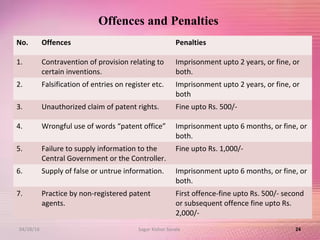
Offences and Penalties
No. Offences Penalties
1. Contravention of provision relating to
certain inventions.
Imprisonment upto 2 years, or fine, or
both.
2. Falsification of entries on register etc. Imprisonment upto 2 years, or fine, or
both
3. Unauthorized claim of patent rights. Fine upto Rs. 500/-
4. Wrongful use of words “patent office” Imprisonment upto 6 months, or fine, or
both.
5. Failure to supply information to the
Central Government or the Controller.
Fine upto Rs. 1,000/-
6. Supply of false or untrue information. Imprisonment upto 6 months, or fine, or
both.
7. Practice by non-registered patent
agents.
First offence-fine upto Rs. 500/- second
or subsequent offence fine upto Rs.
2,000/-
2404/28/16 Sagar Kishor Savale
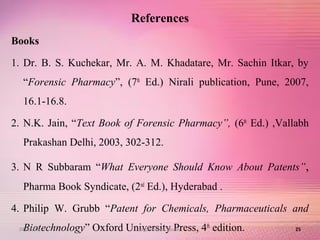
References
Books
1. Dr. B. S. Kuchekar, Mr. A. M. Khadatare, Mr. Sachin Itkar, by
“Forensic Pharmacy”, (7th
Ed.) Nirali publication, Pune, 2007,
16.1-16.8.
2. N.K. Jain, “Text Book of Forensic Pharmacy”, (6th
Ed.) ,Vallabh
Prakashan Delhi, 2003, 302-312.
3. N R Subbaram “What Everyone Should Know About Patents”,
Pharma Book Syndicate, (2nd
Ed.), Hyderabad .
4. Philip W. Grubb “Patent for Chemicals, Pharmaceuticals and
Biotechnology” Oxford University Press, 4th
edition. 2504/28/16 Sagar Kishor Savale
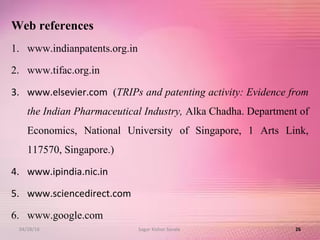
Web references
1. www.indianpatents.org.in
2. www.tifac.org.in
3. www.elsevier.com (TRIPs and patenting activity: Evidence from
the Indian Pharmaceutical Industry, Alka Chadha. Department of
Economics, National University of Singapore, 1 Arts Link,
117570, Singapore.)
4. www.ipindia.nic.in
5. www.sciencedirect.com
6. www.google.com
2604/28/16 Sagar Kishor Savale
2704/28/16 Sagar Kishor Savale

Patent

  • 1.
  • 2.
    Content  Introduction  Typesof Applications  Patent Processing  Documents  Publication  Specifications  Offences and penalties  References 204/28/16 Sagar Kishor Savale
  • 3.
  • 4.
    Patents Designs Trademarks IndustrialCopyright Intellectual Property Geographical indications 404/28/16 Sagar Kishor Savale
  • 5.
    Governing Laws inIndia for IPR as follows 1. Patent Act 1970 2. Trade Marks Act 1999 3. Copyright Act 1957 4. Design Act 2000 5. Geographical Indication of Goods (Registration and Protection) Act 1999 6. Plant Variety and Farmers Right Protection Act 2001 504/28/16 Sagar Kishor Savale
  • 6.
    What is Patent? A Patent is an intellectual property right relating to inventions and is the grant of exclusive right, for limited period, provided by the Government to the patentee, in exchange of full disclosure of his invention, for excluding others, from making, using, selling, importing the patented product or process producing that product for those purposes. 604/28/16 Sagar Kishor Savale
  • 7.
    Essentials of Patent Patents granted for an invention  INVENTION means a product or process which is - – New (Novel) – Involving Inventive Step (Non-obvious) – Utility  Capable of Industrial Application 704/28/16 Sagar Kishor Savale
  • 8.
    Patent Administration inIndia A patent application can be filed at any of the four patent offices in India. Four branches: Kolkata (Head office) Mumbai Delhi Chennai 804/28/16 Sagar Kishor Savale
  • 9.
    Who can filePatent Application in India…? Either alone or jointly:  By any person claiming to be true and first inventor(s).  By any person being the assignee of person claiming to be true and first inventor(s).  By the legal representative of any deceased person who can immediately after his death is entitled to make such application. 904/28/16 Sagar Kishor Savale
  • 10.
    Types of Applications Ordinary Applications  Convention Application  Patent of Addition Application  Divisional Applications  PCT Application 1004/28/16 Sagar Kishor Savale
  • 11.
    The patent applicationpasses through the following stages A. Filing B. Publication C. Examination D. Opposition E. Grant 1104/28/16 Sagar Kishor Savale
  • 12.
    Patent Grant Procedure Filingof patent application Early Publication Publication after 18 months Pre Grant Opposition Request for examination Examination: Grant or Refusal Publication of Grant of patent Post Grant Opposition to grant of patent Decision By Controller 1204/28/16 Sagar Kishor Savale
  • 13.
    Filing of thePatent Application  Application for patent can be filed only on the payment of full fee.  Filing fee is charged on the basis of number of pages and number of claims made in the patent document.  No extra fee is charged up to 30 pages and 10 claims.  Power of attorney-if applicable.  Application, Specification and other documents should be either in Hindi or English language.  If application discloses sequence listing of nucleotides and/or amino acids, it should be filed in electronic form. 1304/28/16 Sagar Kishor Savale
  • 14.
    No. Action Limits,conditions and timelines Official Fees Individual Legal entity 1. Filing of patent application along with provisional/ complete specification For maximum number of pages 30 and maximum number of claims 10 Rs. 1,000/- Rs. 4,000/- For each additional sheet Rs. 100/- Rs. 400/- For each additional claim Rs. 200/- Rs. 800/- 2. Request for examination of patent Rs. 2,500/- Rs. 10,000/- 3. Request for early publication Rs. 2,500/- Rs. 10,000/- 4. Renewal fee (every year) 2nd year to 6th year Rs. 500/- Rs. 2,000/- 7th year to 10th year Rs. 1,500/- Rs. 6,000/- 11th year to 15th year Rs. 3,000/- Rs. 12,000/- 16th year to 20th year Rs. 5,000/- Rs. 20,000/- Some imp. fees for filing a patent application in India 1404/28/16 Sagar Kishor Savale
  • 15.
  • 16.
    Requirements for documents All documents & copies of document, except affidavits & drawings sent to the patent office or otherwise furnished to the Controller shall be written, typewritten or printed in English language (unless otherwise directed or allowed by the controller) in legible character size, with lines widely spaced upon one side only on strong white paper.  The size of paper should be A4 size with a margin of 4cm on the top and 3cm on the bottom and right hand part thereof. 1604/28/16 Sagar Kishor Savale
  • 17.
    Publication of PatentApplication  Every application shall be published after expiry of 18 months from the date of filing or date of priority of the application except the following, – Application in which secrecy direction is imposed or – Has been withdrawn before 3 months prior to expiry of 18 months.  However the applicant can make request for early publication prior to 18 months on form 9 with prescribed fee of Rs.2500 or Rs.10000 by individual or legal entity respectively. 1704/28/16 Sagar Kishor Savale
  • 18.
    Filing of RequestFor Examination  A request for examination can be filed in form 19 only within 48 months from the priority date or filing date whichever is earlier. Grant of patent  A patent will be granted to the applicant if - – The applicant has complied with the objections within the prescribed time. – No pre-grant opposition by representation is filed. – If filed, disposed of in favour of the applicant within the prescribed time.  Patent will be granted and sealed with seal of office and notified in the official journal . 1804/28/16 Sagar Kishor Savale
  • 19.
    Publication of OfficialJournal 1904/28/16 Sagar Kishor Savale
  • 20.
    No. Provisional Specification (P.S.) CompleteSpecification (C.S.) 1 Should be filed as soon as inventive idea comes in mind Necessary to get a patent 2 Should describe the nature of invention & contain the description of essential features of the invention Should describe the nature of invention and the details of the manner in which it is to be performed 3 No need to include claims Must have claims 20 Types of Specifications 04/28/16 Sagar Kishor Savale
  • 21.
    Content of ProvisionalSpecification  Title  Written description  Drawings, if necessary  Sample or model if required. 2104/28/16 Sagar Kishor Savale
  • 22.
    Advantages of ProvisionalSpecification  Priority for invention  Get extra time for further developments  Disclose to interested person to obtain financial support  Explore commercial feasibility  Avoid further expenses if no commercial feasibility 2204/28/16 Sagar Kishor Savale
  • 23.
    Content of CompleteSpecification  Title of the invention  Field & background of the invention  Use of the invention  Prior art in the said field of invention & its drawback(s)  Comparison between prior art & present invention  Object (aim) of the present invention  Summary of the present invention  Statement of the invention  Detailed description of the invention w.r.t. drawings, if any  Working examples for best method of the invention  Claims for legal monopoly 2304/28/16 Sagar Kishor Savale
  • 24.
    Offences and Penalties No.Offences Penalties 1. Contravention of provision relating to certain inventions. Imprisonment upto 2 years, or fine, or both. 2. Falsification of entries on register etc. Imprisonment upto 2 years, or fine, or both 3. Unauthorized claim of patent rights. Fine upto Rs. 500/- 4. Wrongful use of words “patent office” Imprisonment upto 6 months, or fine, or both. 5. Failure to supply information to the Central Government or the Controller. Fine upto Rs. 1,000/- 6. Supply of false or untrue information. Imprisonment upto 6 months, or fine, or both. 7. Practice by non-registered patent agents. First offence-fine upto Rs. 500/- second or subsequent offence fine upto Rs. 2,000/- 2404/28/16 Sagar Kishor Savale
  • 25.
    References Books 1. Dr. B.S. Kuchekar, Mr. A. M. Khadatare, Mr. Sachin Itkar, by “Forensic Pharmacy”, (7th Ed.) Nirali publication, Pune, 2007, 16.1-16.8. 2. N.K. Jain, “Text Book of Forensic Pharmacy”, (6th Ed.) ,Vallabh Prakashan Delhi, 2003, 302-312. 3. N R Subbaram “What Everyone Should Know About Patents”, Pharma Book Syndicate, (2nd Ed.), Hyderabad . 4. Philip W. Grubb “Patent for Chemicals, Pharmaceuticals and Biotechnology” Oxford University Press, 4th edition. 2504/28/16 Sagar Kishor Savale
  • 26.
    Web references 1. www.indianpatents.org.in 2.www.tifac.org.in 3. www.elsevier.com (TRIPs and patenting activity: Evidence from the Indian Pharmaceutical Industry, Alka Chadha. Department of Economics, National University of Singapore, 1 Arts Link, 117570, Singapore.) 4. www.ipindia.nic.in 5. www.sciencedirect.com 6. www.google.com 2604/28/16 Sagar Kishor Savale
  • 27.