This project has been funded with support from the European Commission. This publication reflects the views only of the authors, and the Commission
cannot be held responsible for any use which may be made of the information contained therein.
This document is licensed under a Creative Commons Attribution-ShareAlike 4.0 International license except where otherwise noted.
OER Innovation and
Business Models Circle
2nd May 2022 1300 CEST / 1200 BST
Mihajela Crnko, Knowledge for All
Sahan Bukathwela, Knowledge for All
Dr. Robert Farrow, The Open University (UK)
Welcome and Housekeeping
Purpose of this event
Use of recording
House rules
Introductions
Please give a very brief introduction to your role and
interest in open educational resources
Introduction to ENCORE+
European Network for Catalysing
Open Resources in Education
https://encoreproject.eu/
ENCORE+
ENCORE+ is a Knowledge Alliance project funded by the European
Commission under Erasmus+
Supporting the uptake of open education resources (OER)
Catalysing and sharing innovative practice across education and business
Developing stakeholder communities for knowledge exchange
5
6
Partners
● International Council for Distance Education (Norway)
● Baden-Wuerttemberg Cooperative State University (Germany)
● The Open University (UK)
● Universidad Internacional De La Rioja (Spain)
● Knowledge 4 All Foundation (UK)
● Joubel (Norway)
● Fondazione Politecnico di Milano (Italy)
● Instructure Global (UK)
● Dublin City University (Ireland)
Introduction to ENCORE+
Background and Rationale
Open Educational Resources (OER)
Open Educational Resources (OER) are teaching, learning and research
materials in any medium – digital or otherwise – that are in the public
domain and/or released under an open license that permits no-cost access,
use, adaptation and redistribution by others with no or limited
restrictions. They are free at the point of use and ‘free’ in the sense that
they provide users with greater freedoms in how resources are shared,
used, customised and iterated.
Compatible definitions of OER are provided by UNESCO, Hewlett
Foundation and OER Commons.
8
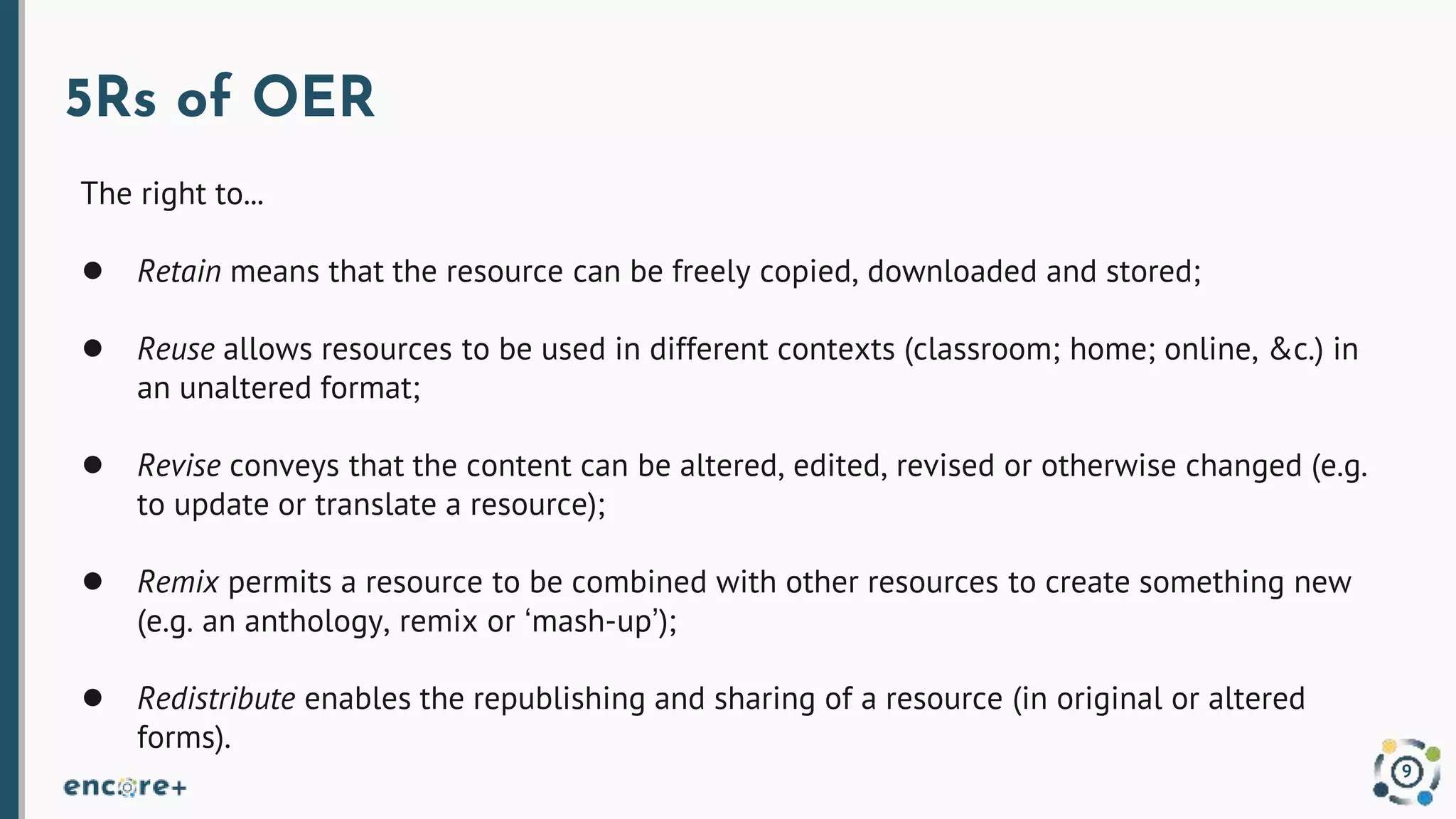
5Rs of OER
The right to...
● Retain means that the resource can be freely copied, downloaded and stored;
● Reuse allows resources to be used in different contexts (classroom; home; online, &c.) in
an unaltered format;
● Revise conveys that the content can be altered, edited, revised or otherwise changed (e.g.
to update or translate a resource);
● Remix permits a resource to be combined with other resources to create something new
(e.g. an anthology, remix or ‘mash-up’);
● Redistribute enables the republishing and sharing of a resource (in original or altered
forms).
9
10
https://encoreproject.eu/2021/09/13/oer-innovation-briefing/
for more background on OER
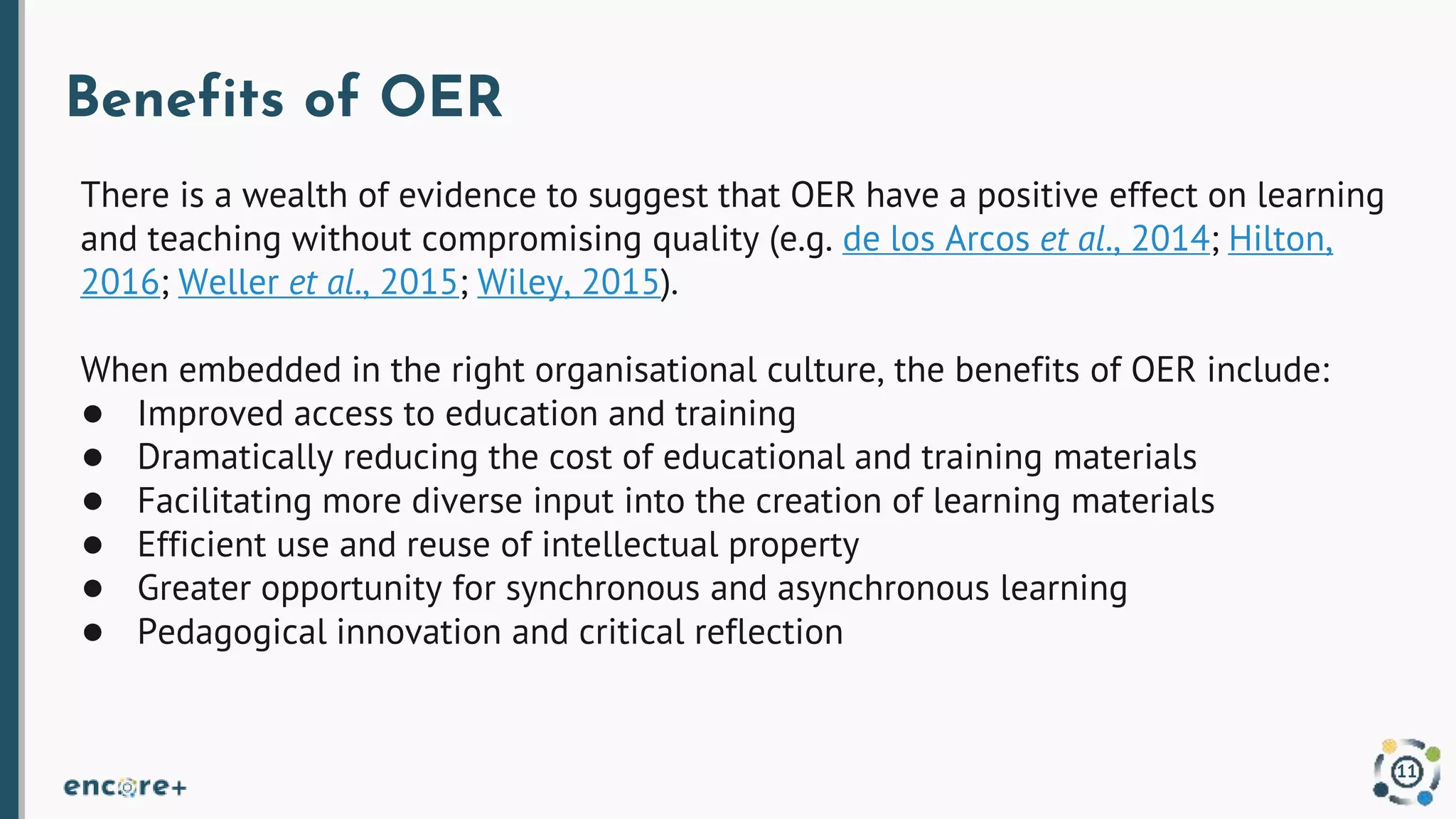
Benefits of OER
There is a wealth of evidence to suggest that OER have a positive effect on learning
and teaching without compromising quality (e.g. de los Arcos et al., 2014; Hilton,
2016; Weller et al., 2015; Wiley, 2015).
When embedded in the right organisational culture, the benefits of OER include:
● Improved access to education and training
● Dramatically reducing the cost of educational and training materials
● Facilitating more diverse input into the creation of learning materials
● Efficient use and reuse of intellectual property
● Greater opportunity for synchronous and asynchronous learning
● Pedagogical innovation and critical reflection
11
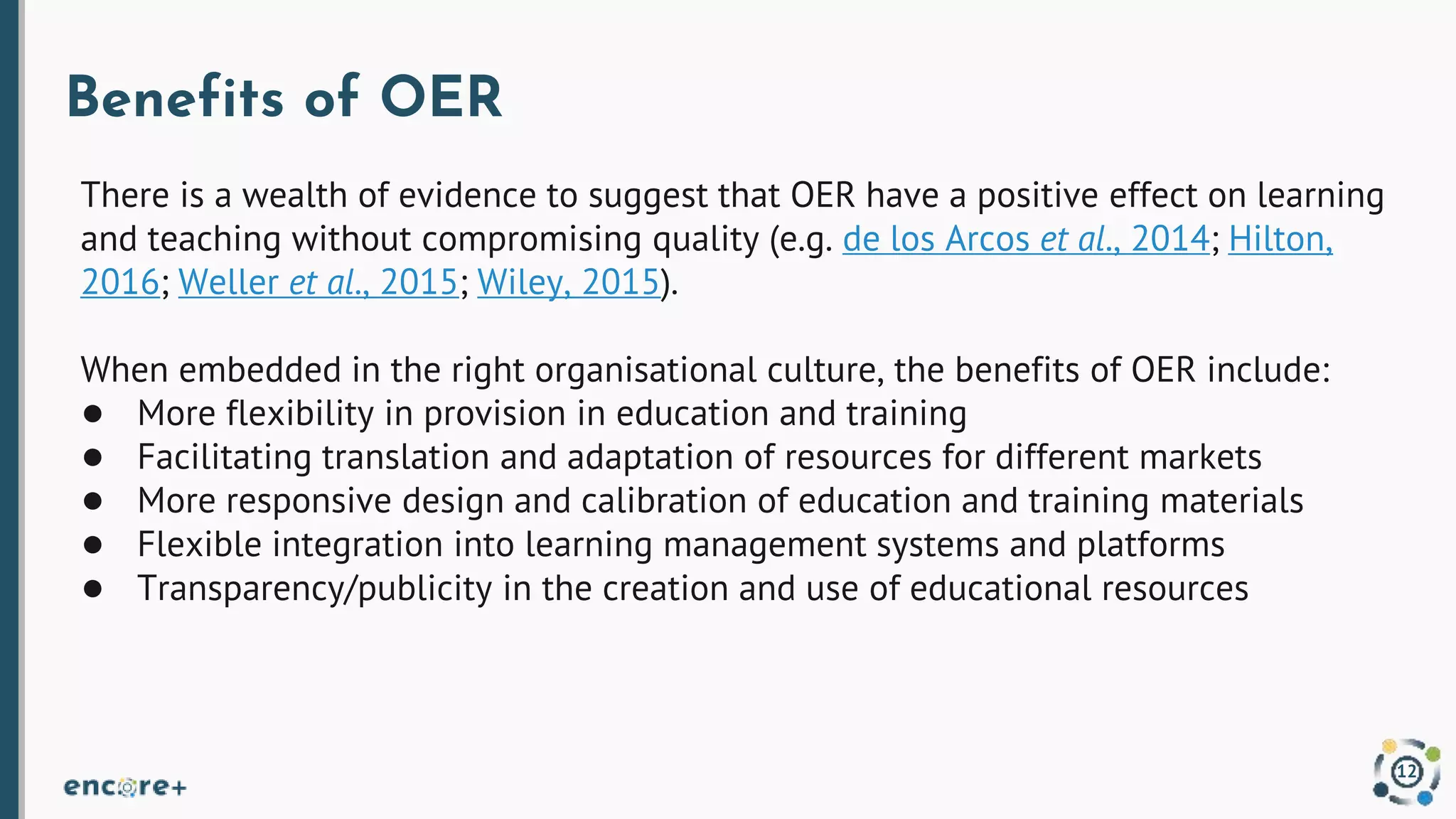
Benefits of OER
There is a wealth of evidence to suggest that OER have a positive effect on learning
and teaching without compromising quality (e.g. de los Arcos et al., 2014; Hilton,
2016; Weller et al., 2015; Wiley, 2015).
When embedded in the right organisational culture, the benefits of OER include:
● More flexibility in provision in education and training
● Facilitating translation and adaptation of resources for different markets
● More responsive design and calibration of education and training materials
● Flexible integration into learning management systems and platforms
● Transparency/publicity in the creation and use of educational resources
12
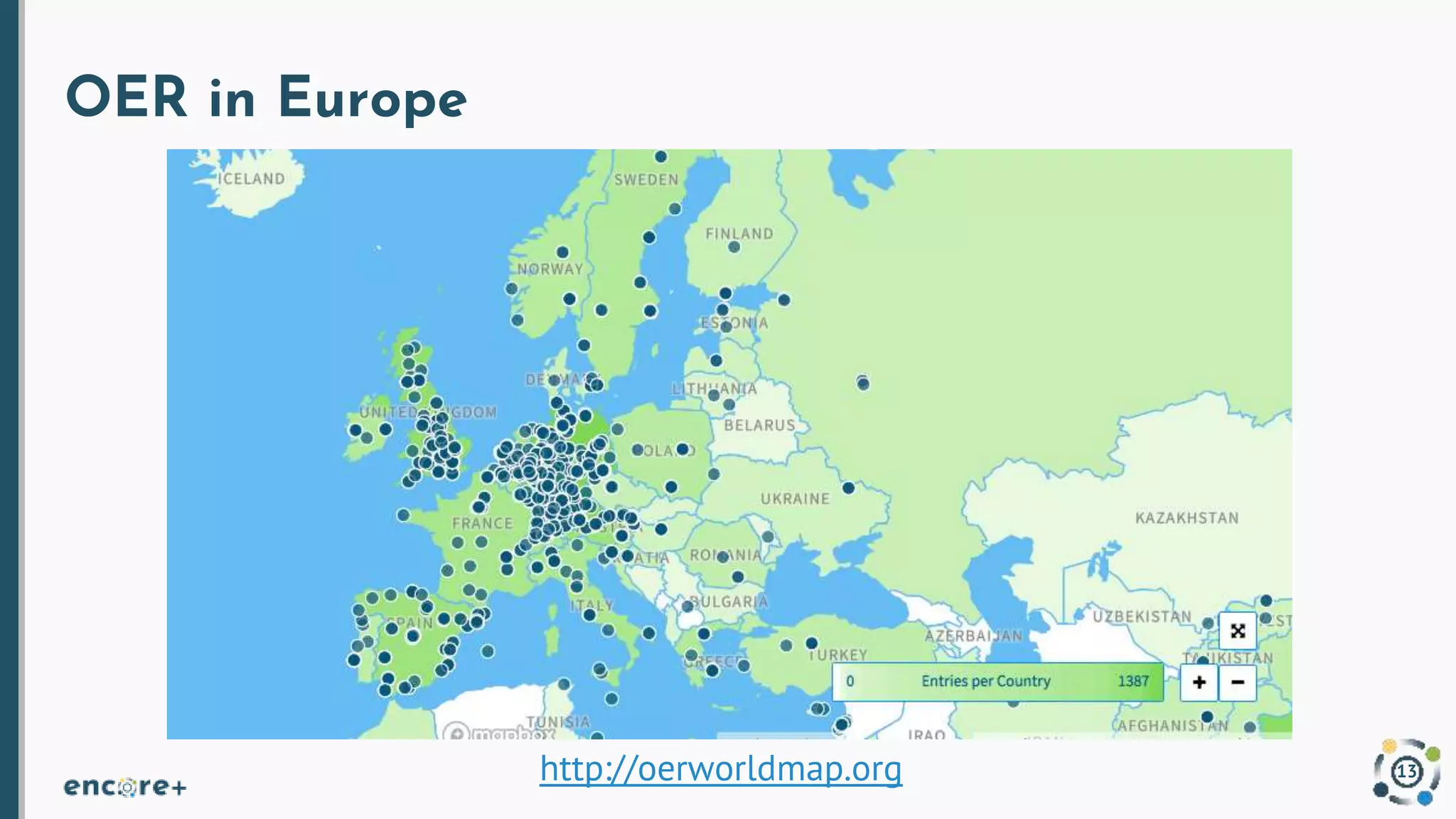
OER in Europe
13
http://oerworldmap.org
OER in Europe
● OER World Map includes details of 1400+ organisations, 900+ services, 500+
projects and 300+ policies in support of OER
● However, activity is typically uncoordinated, and happens in clusters
(national/regional, disciplinary, technological, etc.)
● Limited interactions between academia, public and private sectors
● Covid-19 has forced greater use of online learning and need for resources which
can be met by OER
14
ENCORE+ Background and Rationale
● The European Network for Catalysing Open Resources in Education (ENCORE+)
responds to the priorities of opening up and modernising the European
education and training sector through a coordinated European OER ecosystem
● ENCORE+ brings together meaningful and focused human networks;
technological solutions for sharing and discovering OER; policy reviews; quality
criteria; and generating business models which draw on the affordances of OER
to support innovation
● ENCORE+ supports uptake of OER through business and academia by
formulating value propositions for using OER in education, training and
business
15
ENCORE+ Background and Rationale
● ENCORE+ directly addresses several European and international policy
priorities:
○ Stimulating innovation in businesses through learning and training
innovation
○ Reducing barriers to education affording learners the opportunity to up-
skill or re-skill at a lower or nearly no cost, and in a flexible way
○ Supporting the modernisation of higher education in Europe, including
digitalisation
○ Bridging non-formal & formal education by advancing recognition of open
learning
16
17
https://en.unesco.org/themes/building-
knowledge-societies/oer/recommendation
Introduction to ENCORE+
5 Key Challenges for the OER Ecosystem
19
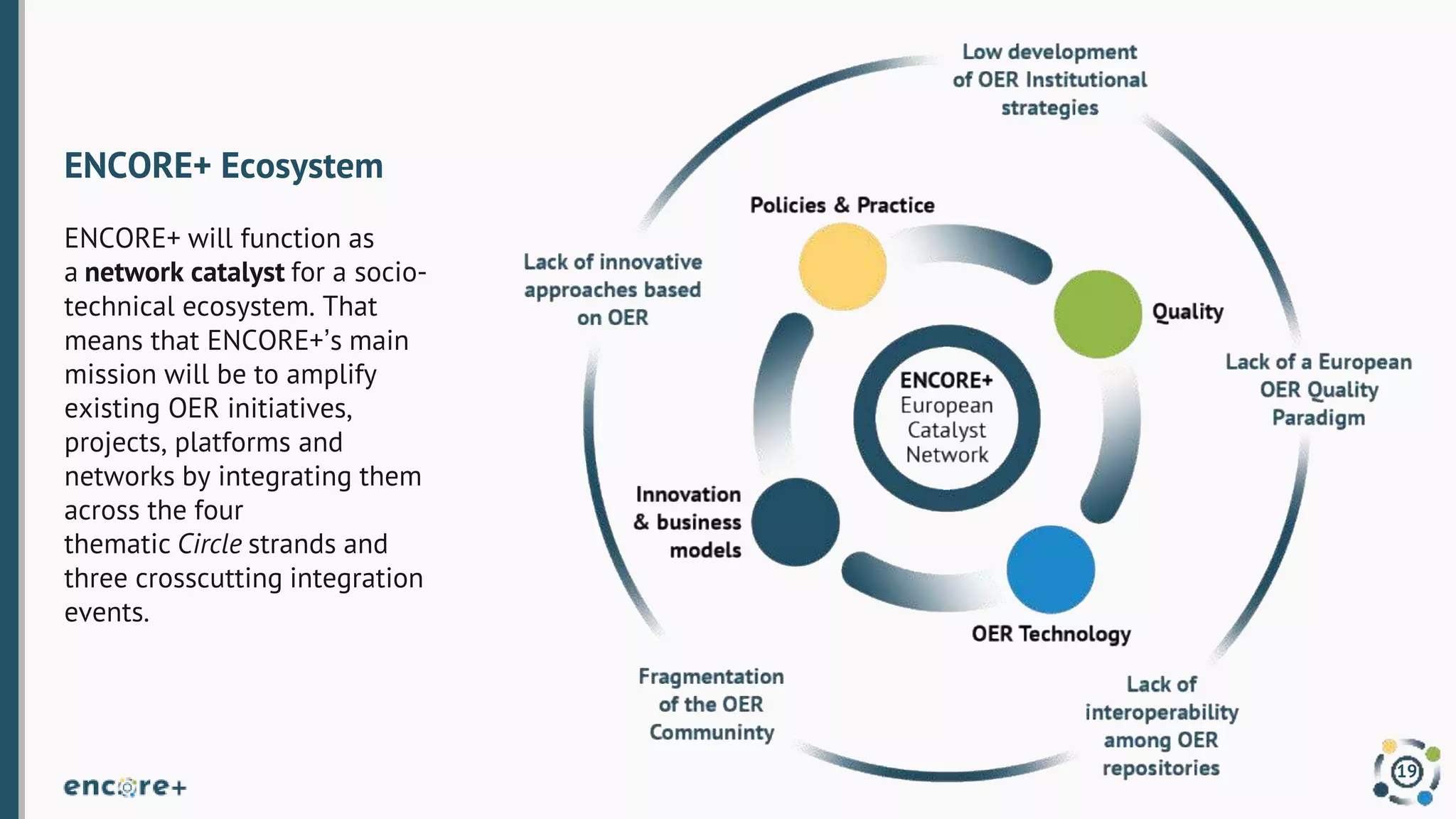
ENCORE+ Ecosystem
ENCORE+ will function as
a network catalyst for a socio-
technical ecosystem. That
means that ENCORE+’s main
mission will be to amplify
existing OER initiatives,
projects, platforms and
networks by integrating them
across the four
thematic Circle strands and
three crosscutting integration
events.
5 Key Challenges
20
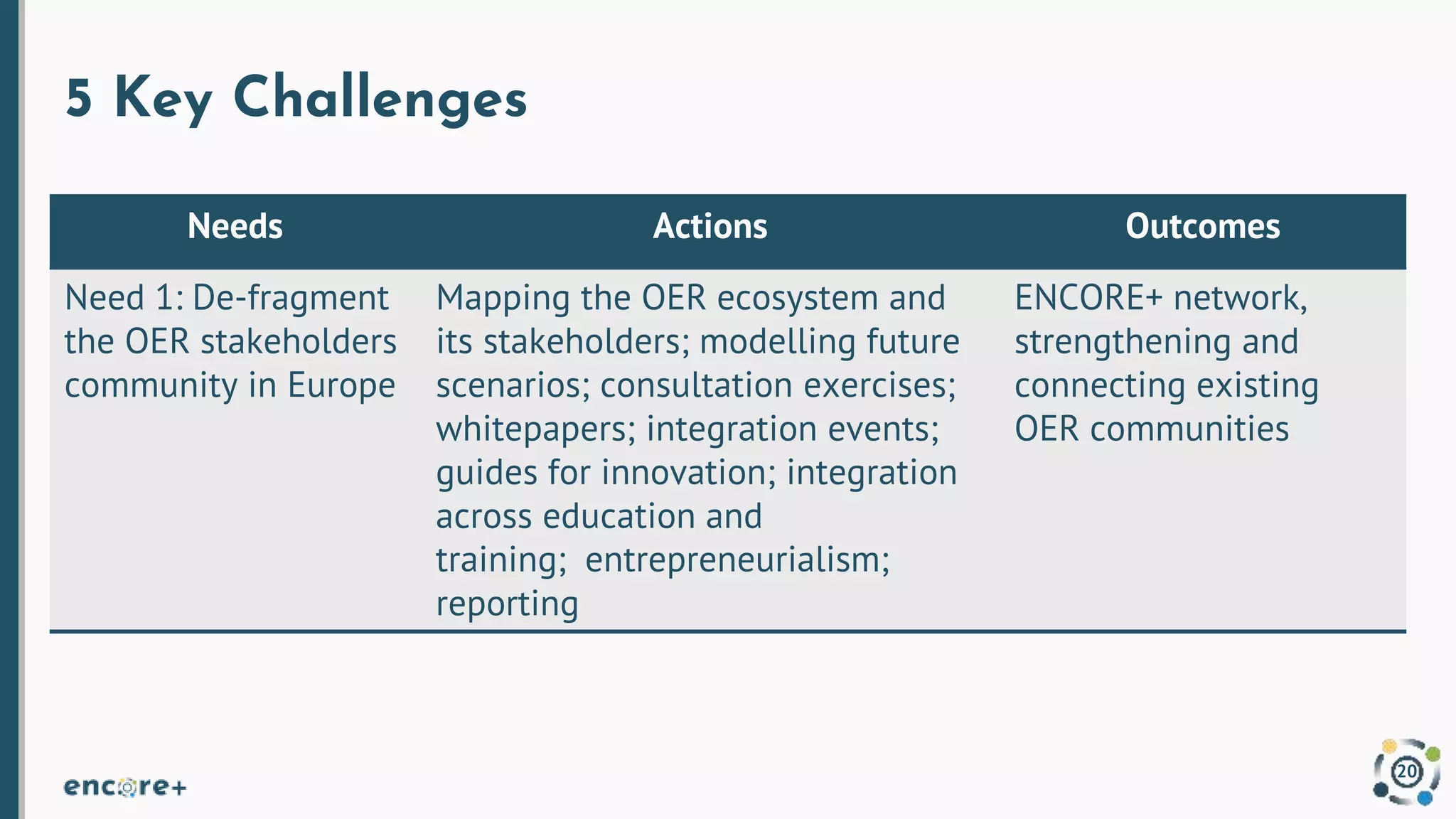
Needs Actions Outcomes
Need 1: De-fragment
the OER stakeholders
community in Europe
Mapping the OER ecosystem and
its stakeholders; modelling future
scenarios; consultation exercises;
whitepapers; integration events;
guides for innovation; integration
across education and
training; entrepreneurialism;
reporting
ENCORE+ network,
strengthening and
connecting existing
OER communities
5 Key Challenges
21
Needs Actions Outcomes
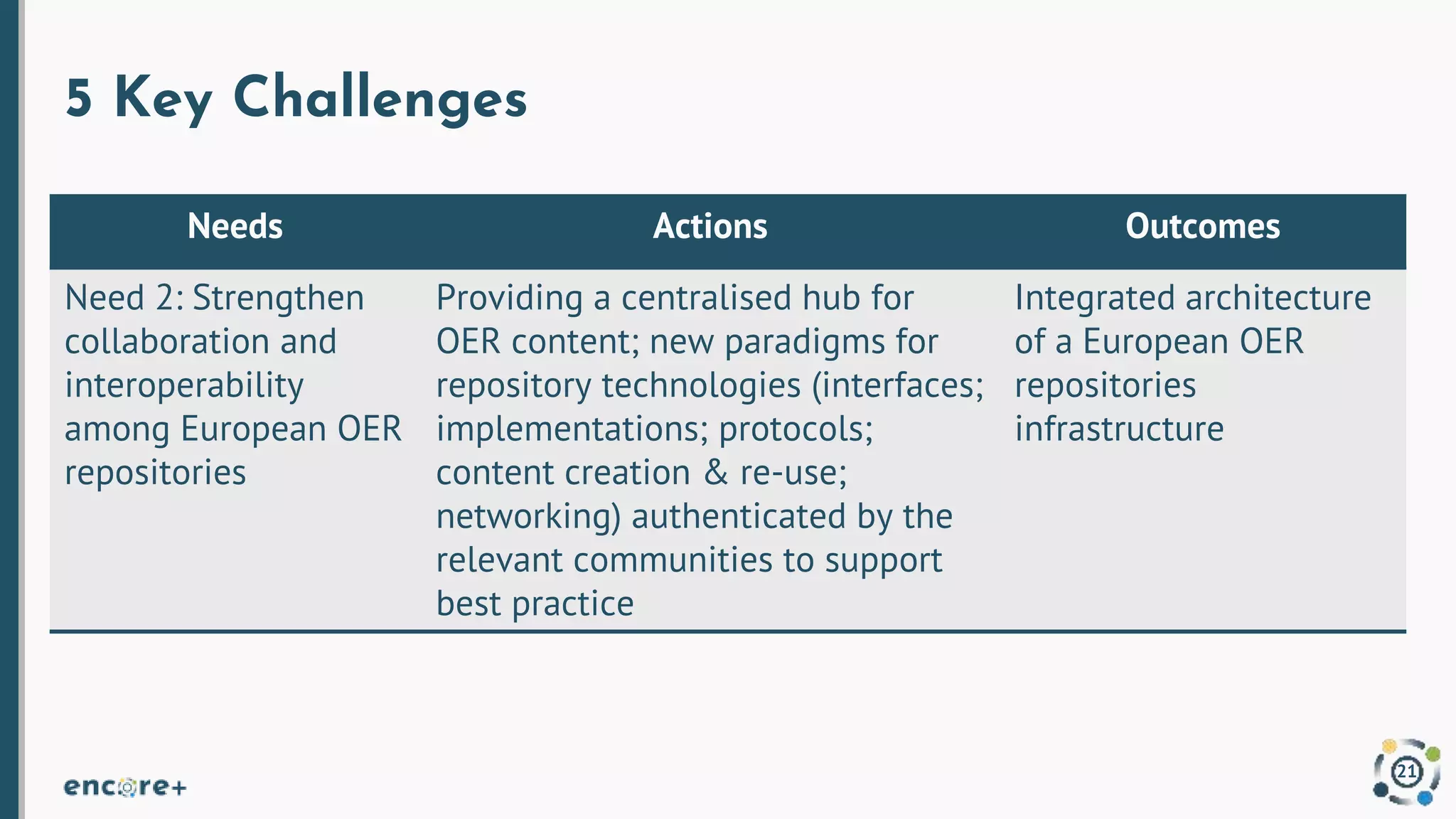
Need 2: Strengthen
collaboration and
interoperability
among European OER
repositories
Providing a centralised hub for
OER content; new paradigms for
repository technologies (interfaces;
implementations; protocols;
content creation & re-use;
networking) authenticated by the
relevant communities to support
best practice
Integrated architecture
of a European OER
repositories
infrastructure
5 Key Challenges
22
Needs Actions Outcomes
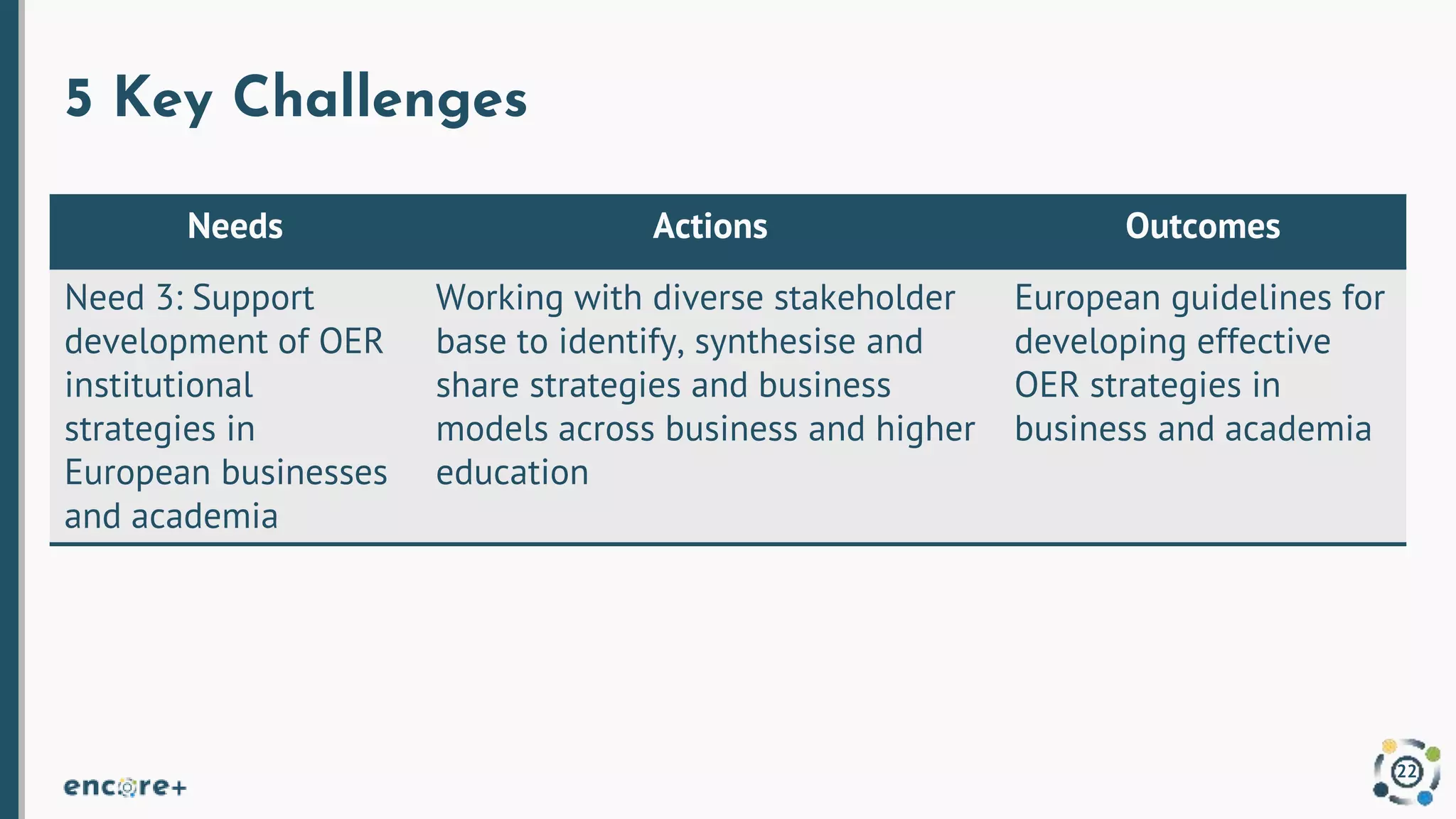
Need 3: Support
development of OER
institutional
strategies in
European businesses
and academia
Working with diverse stakeholder
base to identify, synthesise and
share strategies and business
models across business and higher
education
European guidelines for
developing effective
OER strategies in
business and academia
5 Key Challenges
23
Needs Actions Outcomes
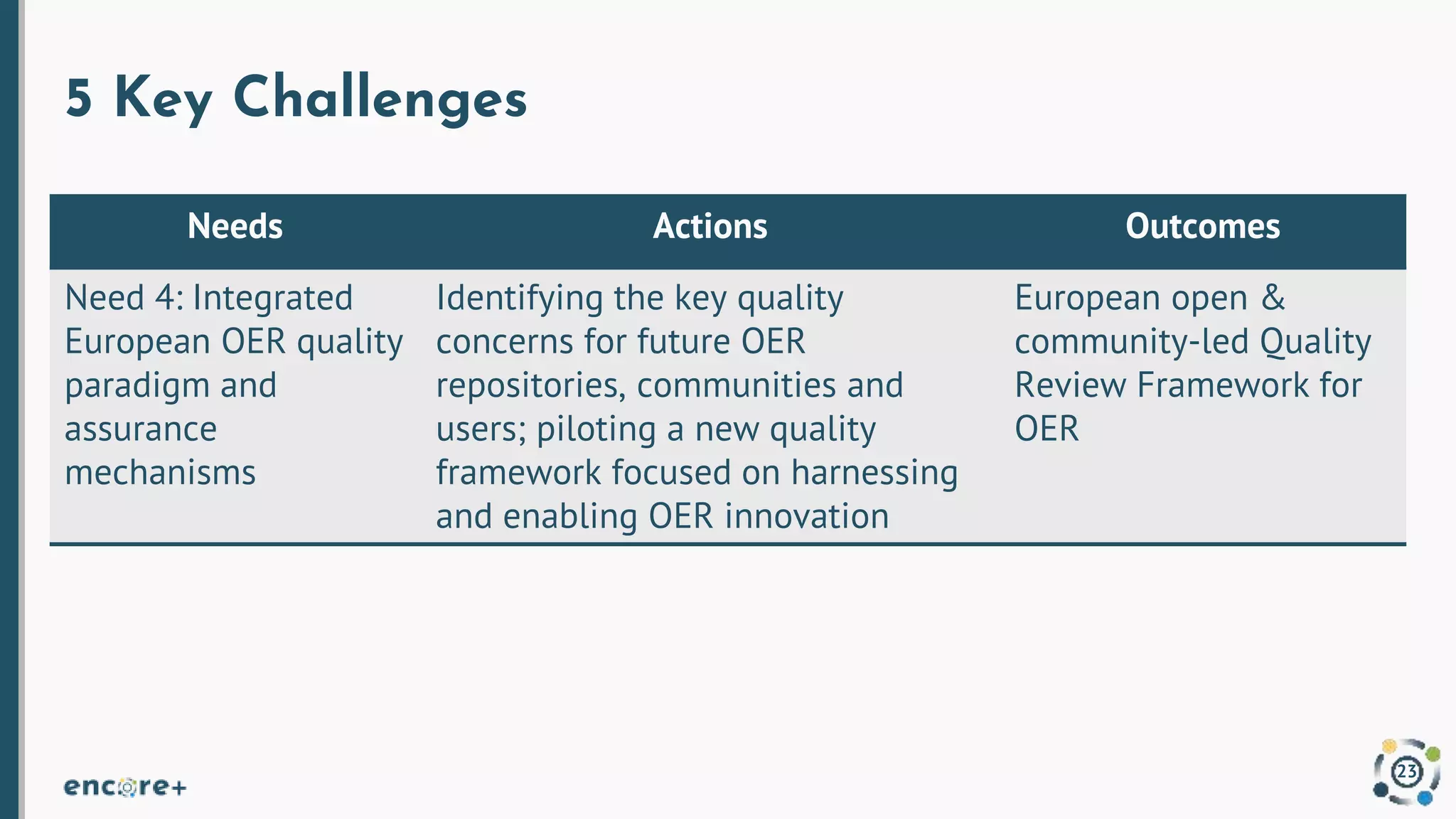
Need 4: Integrated
European OER quality
paradigm and
assurance
mechanisms
Identifying the key quality
concerns for future OER
repositories, communities and
users; piloting a new quality
framework focused on harnessing
and enabling OER innovation
European open &
community-led Quality
Review Framework for
OER
5 Key Challenges
24
Needs Actions Outcomes
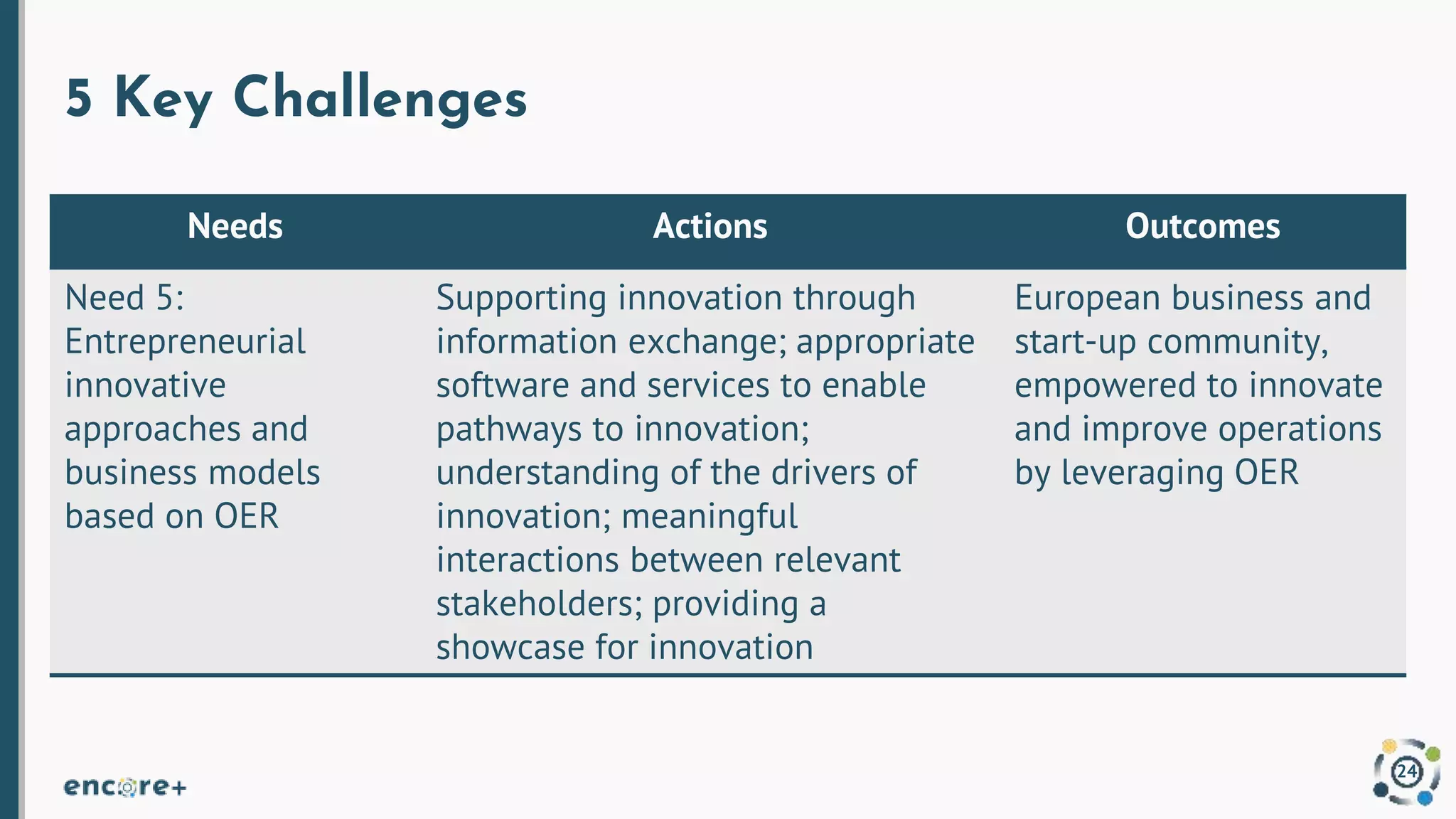
Need 5:
Entrepreneurial
innovative
approaches and
business models
based on OER
Supporting innovation through
information exchange; appropriate
software and services to enable
pathways to innovation;
understanding of the drivers of
innovation; meaningful
interactions between relevant
stakeholders; providing a
showcase for innovation
European business and
start-up community,
empowered to innovate
and improve operations
by leveraging OER
25
26
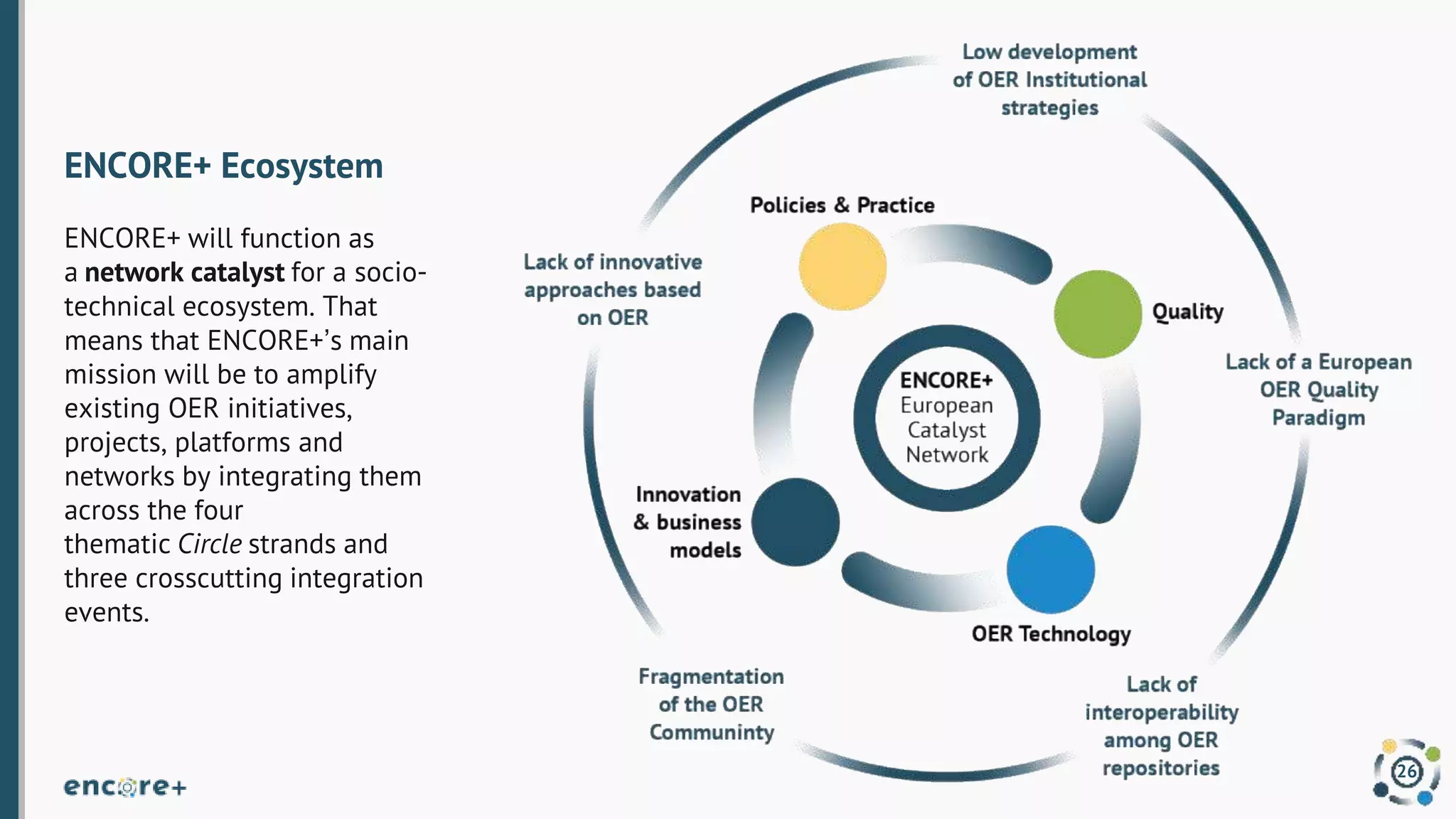
ENCORE+ Ecosystem
ENCORE+ will function as
a network catalyst for a socio-
technical ecosystem. That
means that ENCORE+’s main
mission will be to amplify
existing OER initiatives,
projects, platforms and
networks by integrating them
across the four
thematic Circle strands and
three crosscutting integration
events.
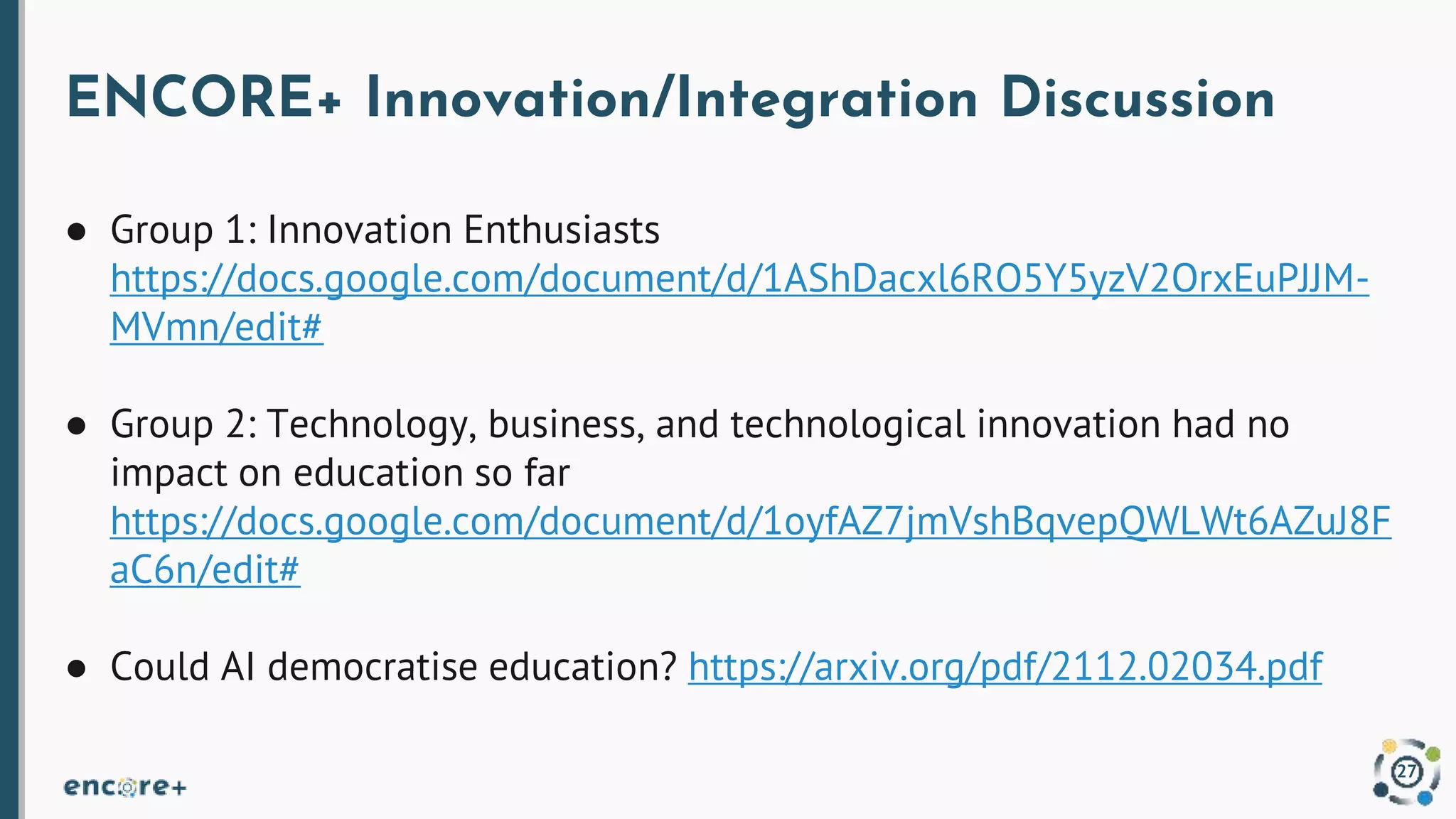
ENCORE+ Innovation/Integration Discussion
● Group 1: Innovation Enthusiasts
https://docs.google.com/document/d/1AShDacxl6RO5Y5yzV2OrxEuPJJM-
MVmn/edit#
● Group 2: Technology, business, and technological innovation had no
impact on education so far
https://docs.google.com/document/d/1oyfAZ7jmVshBqvepQWLWt6AZuJ8F
aC6n/edit#
● Could AI democratise education? https://arxiv.org/pdf/2112.02034.pdf
27
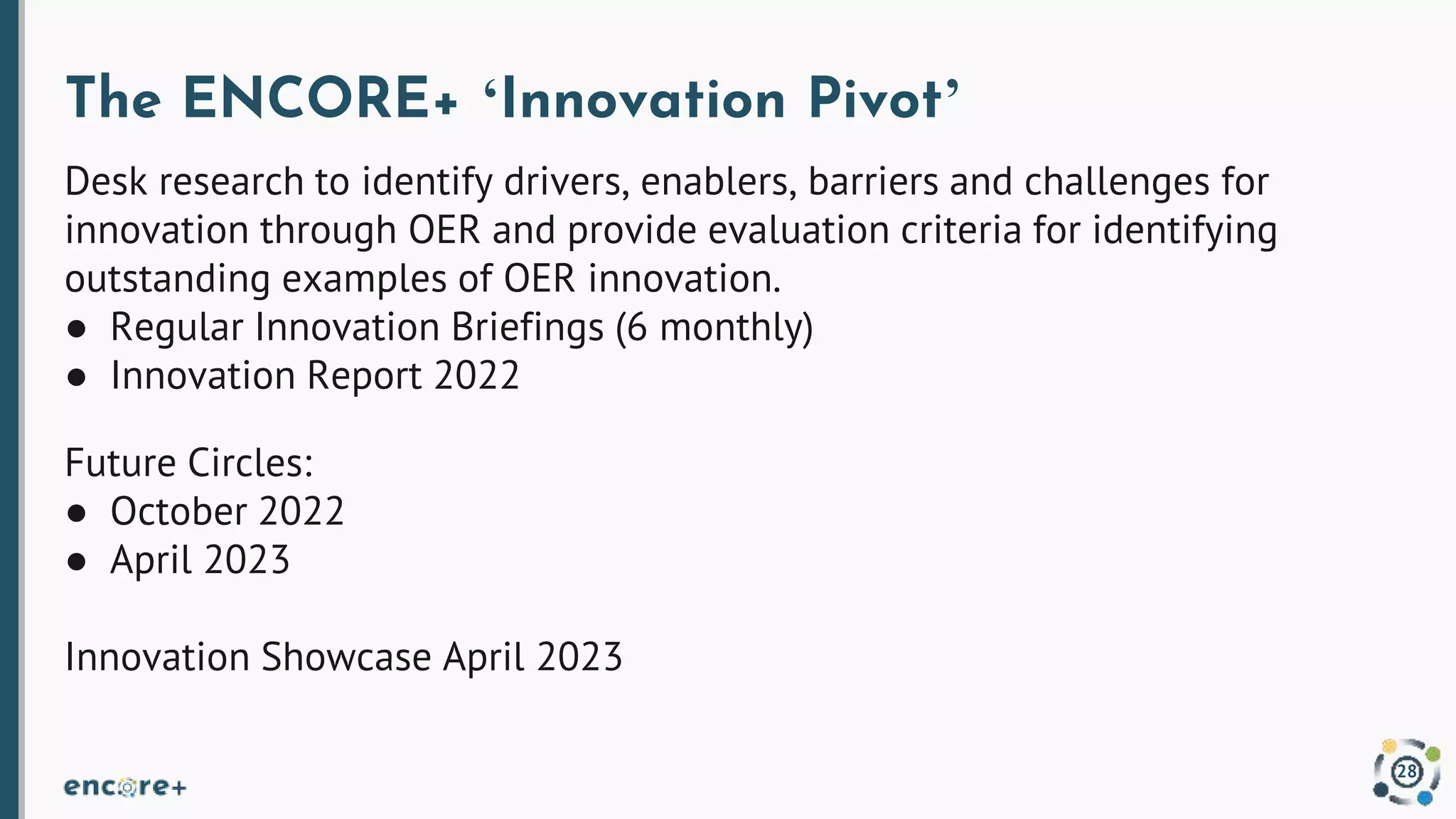
The ENCORE+ ‘Innovation Pivot’
Desk research to identify drivers, enablers, barriers and challenges for
innovation through OER and provide evaluation criteria for identifying
outstanding examples of OER innovation.
● Regular Innovation Briefings (6 monthly)
● Innovation Report 2022
Future Circles:
● October 2022
● April 2023
Innovation Showcase April 2023
28
29
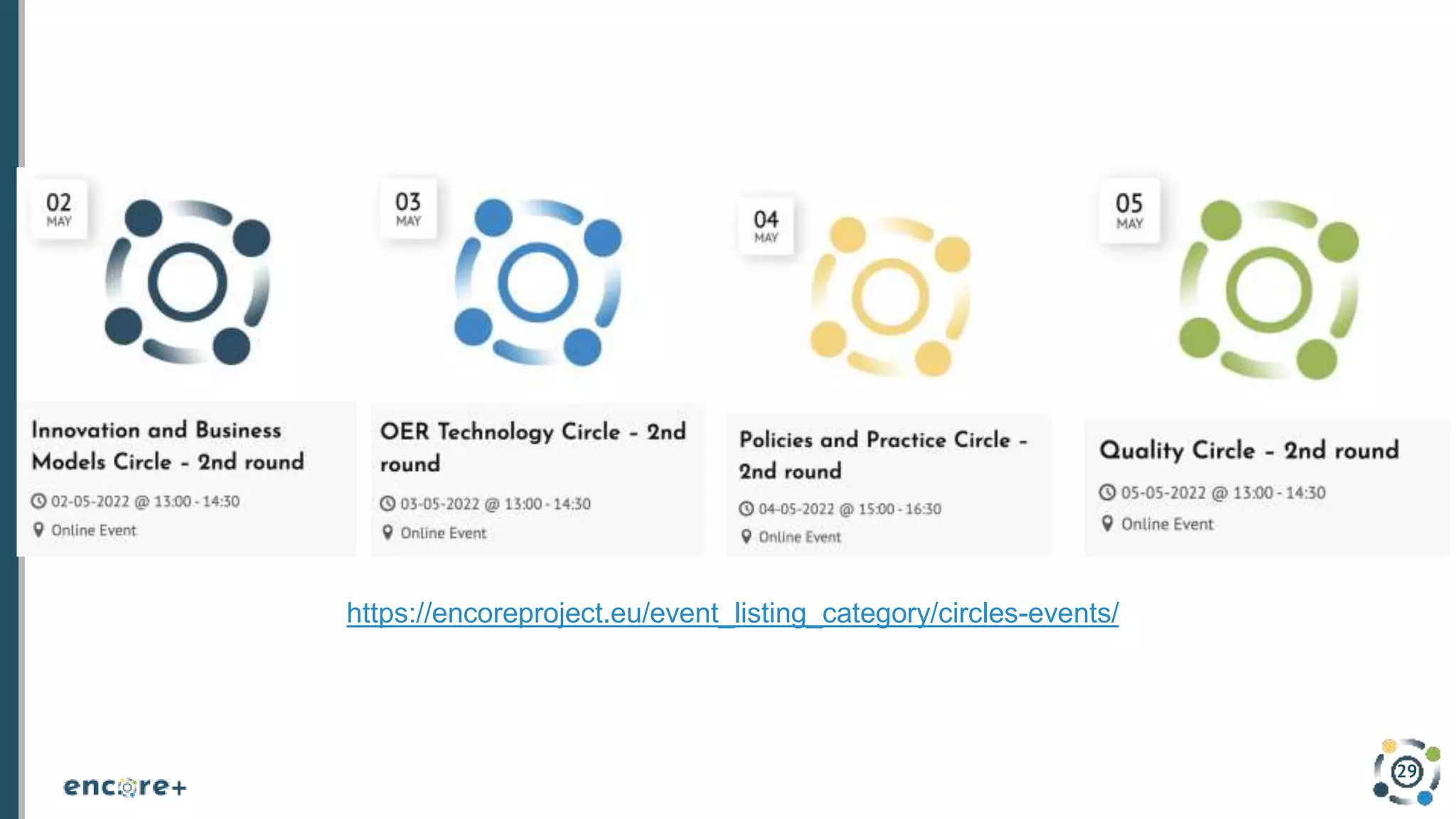
https://encoreproject.eu/event_listing_category/circles-events/
Supporting ENCORE+
● Invite 5 personal contacts to join ENCORE+ Circles
● Subscribe to project channels (newsletter, blog)
● Share your experiences and inspiration!
30
Project partners:
Thank You!
Project partners:
Contacts
Robert Farrow, The Open University (UK)
rob.farrow@open.ac.uk / @philosopher1978
Juliane Granly, ICDE
granly@icde.org
Website
For further and updated information
about this project please see:
www.encoreproject.eu
info@encoreproject.eu

ENCORE+ Innovation and Business Models Circle 2

  • 1.
    This project hasbeen funded with support from the European Commission. This publication reflects the views only of the authors, and the Commission cannot be held responsible for any use which may be made of the information contained therein. This document is licensed under a Creative Commons Attribution-ShareAlike 4.0 International license except where otherwise noted. OER Innovation and Business Models Circle 2nd May 2022 1300 CEST / 1200 BST Mihajela Crnko, Knowledge for All Sahan Bukathwela, Knowledge for All Dr. Robert Farrow, The Open University (UK)
  • 2.
    Welcome and Housekeeping Purposeof this event Use of recording House rules
  • 3.
    Introductions Please give avery brief introduction to your role and interest in open educational resources
  • 4.
    Introduction to ENCORE+ EuropeanNetwork for Catalysing Open Resources in Education https://encoreproject.eu/
  • 5.
    ENCORE+ ENCORE+ is aKnowledge Alliance project funded by the European Commission under Erasmus+ Supporting the uptake of open education resources (OER) Catalysing and sharing innovative practice across education and business Developing stakeholder communities for knowledge exchange 5
  • 6.
    6 Partners ● International Councilfor Distance Education (Norway) ● Baden-Wuerttemberg Cooperative State University (Germany) ● The Open University (UK) ● Universidad Internacional De La Rioja (Spain) ● Knowledge 4 All Foundation (UK) ● Joubel (Norway) ● Fondazione Politecnico di Milano (Italy) ● Instructure Global (UK) ● Dublin City University (Ireland)
  • 7.
  • 8.
    Open Educational Resources(OER) Open Educational Resources (OER) are teaching, learning and research materials in any medium – digital or otherwise – that are in the public domain and/or released under an open license that permits no-cost access, use, adaptation and redistribution by others with no or limited restrictions. They are free at the point of use and ‘free’ in the sense that they provide users with greater freedoms in how resources are shared, used, customised and iterated. Compatible definitions of OER are provided by UNESCO, Hewlett Foundation and OER Commons. 8
  • 9.
    5Rs of OER Theright to... ● Retain means that the resource can be freely copied, downloaded and stored; ● Reuse allows resources to be used in different contexts (classroom; home; online, &c.) in an unaltered format; ● Revise conveys that the content can be altered, edited, revised or otherwise changed (e.g. to update or translate a resource); ● Remix permits a resource to be combined with other resources to create something new (e.g. an anthology, remix or ‘mash-up’); ● Redistribute enables the republishing and sharing of a resource (in original or altered forms). 9
  • 10.
  • 11.
    Benefits of OER Thereis a wealth of evidence to suggest that OER have a positive effect on learning and teaching without compromising quality (e.g. de los Arcos et al., 2014; Hilton, 2016; Weller et al., 2015; Wiley, 2015). When embedded in the right organisational culture, the benefits of OER include: ● Improved access to education and training ● Dramatically reducing the cost of educational and training materials ● Facilitating more diverse input into the creation of learning materials ● Efficient use and reuse of intellectual property ● Greater opportunity for synchronous and asynchronous learning ● Pedagogical innovation and critical reflection 11
  • 12.
    Benefits of OER Thereis a wealth of evidence to suggest that OER have a positive effect on learning and teaching without compromising quality (e.g. de los Arcos et al., 2014; Hilton, 2016; Weller et al., 2015; Wiley, 2015). When embedded in the right organisational culture, the benefits of OER include: ● More flexibility in provision in education and training ● Facilitating translation and adaptation of resources for different markets ● More responsive design and calibration of education and training materials ● Flexible integration into learning management systems and platforms ● Transparency/publicity in the creation and use of educational resources 12
  • 13.
  • 14.
    OER in Europe ●OER World Map includes details of 1400+ organisations, 900+ services, 500+ projects and 300+ policies in support of OER ● However, activity is typically uncoordinated, and happens in clusters (national/regional, disciplinary, technological, etc.) ● Limited interactions between academia, public and private sectors ● Covid-19 has forced greater use of online learning and need for resources which can be met by OER 14
  • 15.
    ENCORE+ Background andRationale ● The European Network for Catalysing Open Resources in Education (ENCORE+) responds to the priorities of opening up and modernising the European education and training sector through a coordinated European OER ecosystem ● ENCORE+ brings together meaningful and focused human networks; technological solutions for sharing and discovering OER; policy reviews; quality criteria; and generating business models which draw on the affordances of OER to support innovation ● ENCORE+ supports uptake of OER through business and academia by formulating value propositions for using OER in education, training and business 15
  • 16.
    ENCORE+ Background andRationale ● ENCORE+ directly addresses several European and international policy priorities: ○ Stimulating innovation in businesses through learning and training innovation ○ Reducing barriers to education affording learners the opportunity to up- skill or re-skill at a lower or nearly no cost, and in a flexible way ○ Supporting the modernisation of higher education in Europe, including digitalisation ○ Bridging non-formal & formal education by advancing recognition of open learning 16
  • 17.
  • 18.
    Introduction to ENCORE+ 5Key Challenges for the OER Ecosystem
  • 19.
    19 ENCORE+ Ecosystem ENCORE+ willfunction as a network catalyst for a socio- technical ecosystem. That means that ENCORE+’s main mission will be to amplify existing OER initiatives, projects, platforms and networks by integrating them across the four thematic Circle strands and three crosscutting integration events.
  • 20.
    5 Key Challenges 20 NeedsActions Outcomes Need 1: De-fragment the OER stakeholders community in Europe Mapping the OER ecosystem and its stakeholders; modelling future scenarios; consultation exercises; whitepapers; integration events; guides for innovation; integration across education and training; entrepreneurialism; reporting ENCORE+ network, strengthening and connecting existing OER communities
  • 21.
    5 Key Challenges 21 NeedsActions Outcomes Need 2: Strengthen collaboration and interoperability among European OER repositories Providing a centralised hub for OER content; new paradigms for repository technologies (interfaces; implementations; protocols; content creation & re-use; networking) authenticated by the relevant communities to support best practice Integrated architecture of a European OER repositories infrastructure
  • 22.
    5 Key Challenges 22 NeedsActions Outcomes Need 3: Support development of OER institutional strategies in European businesses and academia Working with diverse stakeholder base to identify, synthesise and share strategies and business models across business and higher education European guidelines for developing effective OER strategies in business and academia
  • 23.
    5 Key Challenges 23 NeedsActions Outcomes Need 4: Integrated European OER quality paradigm and assurance mechanisms Identifying the key quality concerns for future OER repositories, communities and users; piloting a new quality framework focused on harnessing and enabling OER innovation European open & community-led Quality Review Framework for OER
  • 24.
    5 Key Challenges 24 NeedsActions Outcomes Need 5: Entrepreneurial innovative approaches and business models based on OER Supporting innovation through information exchange; appropriate software and services to enable pathways to innovation; understanding of the drivers of innovation; meaningful interactions between relevant stakeholders; providing a showcase for innovation European business and start-up community, empowered to innovate and improve operations by leveraging OER
  • 25.
  • 26.
    26 ENCORE+ Ecosystem ENCORE+ willfunction as a network catalyst for a socio- technical ecosystem. That means that ENCORE+’s main mission will be to amplify existing OER initiatives, projects, platforms and networks by integrating them across the four thematic Circle strands and three crosscutting integration events.
  • 27.
    ENCORE+ Innovation/Integration Discussion ●Group 1: Innovation Enthusiasts https://docs.google.com/document/d/1AShDacxl6RO5Y5yzV2OrxEuPJJM- MVmn/edit# ● Group 2: Technology, business, and technological innovation had no impact on education so far https://docs.google.com/document/d/1oyfAZ7jmVshBqvepQWLWt6AZuJ8F aC6n/edit# ● Could AI democratise education? https://arxiv.org/pdf/2112.02034.pdf 27
  • 28.
    The ENCORE+ ‘InnovationPivot’ Desk research to identify drivers, enablers, barriers and challenges for innovation through OER and provide evaluation criteria for identifying outstanding examples of OER innovation. ● Regular Innovation Briefings (6 monthly) ● Innovation Report 2022 Future Circles: ● October 2022 ● April 2023 Innovation Showcase April 2023 28
  • 29.
  • 30.
    Supporting ENCORE+ ● Invite5 personal contacts to join ENCORE+ Circles ● Subscribe to project channels (newsletter, blog) ● Share your experiences and inspiration! 30
  • 31.
  • 32.
    Project partners: Contacts Robert Farrow,The Open University (UK) rob.farrow@open.ac.uk / @philosopher1978 Juliane Granly, ICDE granly@icde.org Website For further and updated information about this project please see: www.encoreproject.eu info@encoreproject.eu

Editor's Notes

  • #3 Do we want a slide with house rules?
  • #5 JG handover to RF here
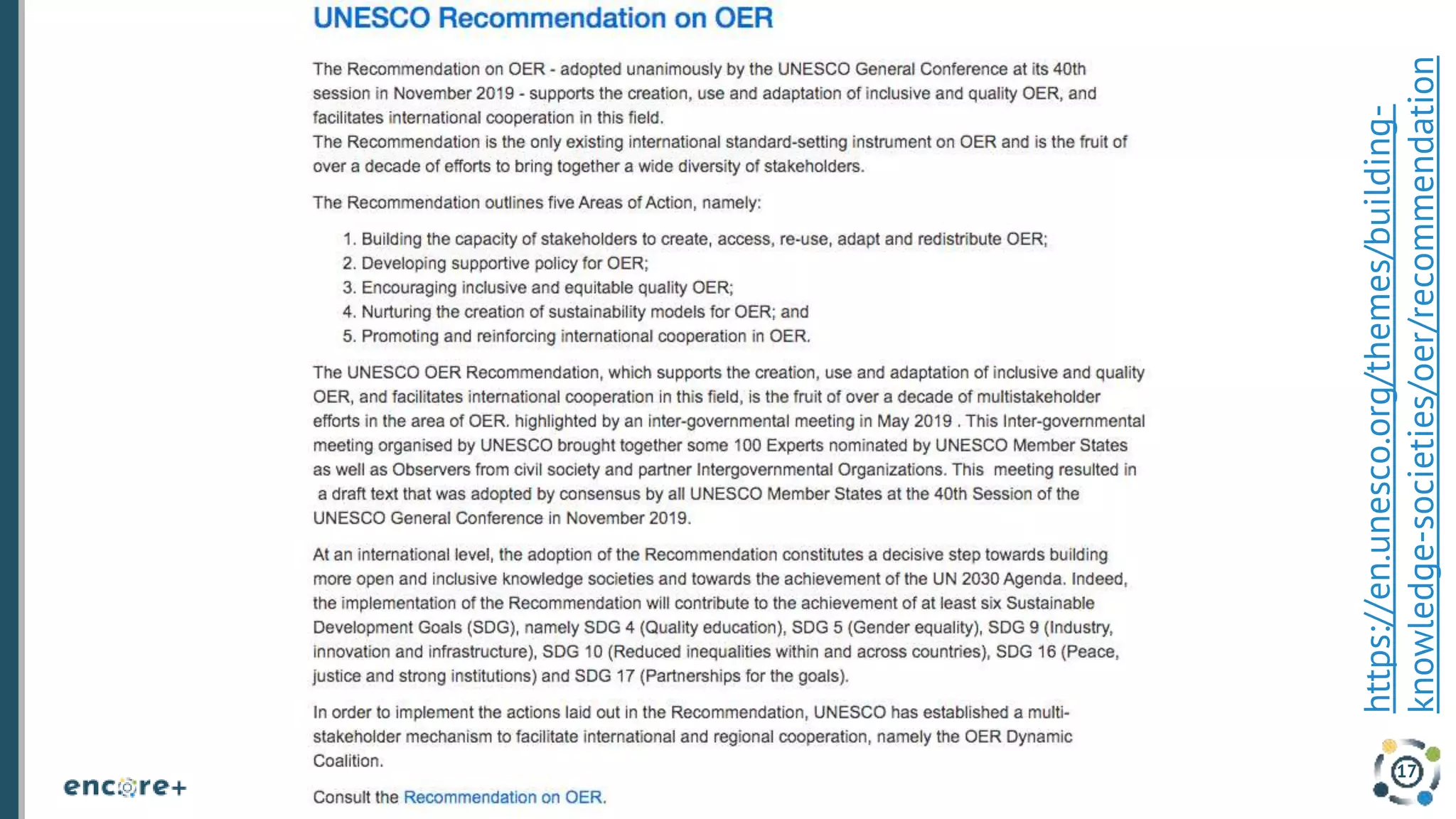
  • #18 In 2019, the UNESCO Recommendation on OER was unanimously accepted to support the creation, use and adaptation of inclusive and quality OER, and to facilitate international cooperation - the result of more than 10 years of advocacy. 
  • #28 Placeholder – Roadmap to WP6
  • #29 Placeholder – Roadmap to WP6