Copyright Law   Protecting the Rights of Artists
What is Copyright Law?

• Copyright, a form of intellectual property law, protects original
  works of authorship including literary, dramatic, musical, and
  artistic works, such as poetry, novels, movies, songs, computer
  software, and architecture.

• Copyright does not protect facts, ideas, systems, or methods of
  operation, although it may protect the way these things are
  expressed.

• Copyright laws grant exclusive rights to the creator of an original
  piece of work.
   • Usually these rights are extended for a limited time.
What are the Rights Granted by Copyright Law

•Technically, it is "the right to copy"your work.

•But also gives the copyright holder the right:
  •To be credited for the work.
  •To determine who may adapt the work to other forms.
  •To decide who may perform the work.
  •To decide who may financially benefit from it.
How Long Does a Copyright Last?

•For works created after January 1, 1978, copyright
 protection lasts for the life of the author plus an
 additional 70 years.

•For an anonymous work, a pseudonymous work, or a
 work made for hire, the copyright endures for a term of
 95 years from the year of its first publication or a term of
 120 years from the year of its creation, whichever
 expires first.
Copyright Infringement

•If you use a copyrighted work without authorization, the
 owner may be entitled to bring an infringement action
 against you.

•Anyone found to have infringed a copyrighted work may
 be liable for statutory damages up to $30,000 for each
 work infringed and, if willful infringement is proven by
 the copyright owner, that amount may be increased up
 to $150,000 for each work infringed.
  •In addition, an infringer of a work may also be liable
   for the attorney's fees incurred by the copyright
   owner to enforce his or her rights.
Fair-Use Doctrine

•Under the fair use doctrine of the U.S. copyright statute,
 it is permissible to use limited portions of a work.

•The reproduction of a particular work may be
 considered fair if it is used for:
  •criticism
  •comment
  •news reporting
  •teaching
  •scholarship
  •research
Determining Fair Use

•To determine fair use, consider the following:
  •The purpose and character of the use, including
   whether such use is of commercial nature or is for
   nonprofit educational purposes.
  •The nature of the copyrighted work.
  •The amount and substantiality of the portion used in
   relation to the copyrighted work as a whole
  •The effect of the use upon the potential market for, or
   value of, the copyrighted work
Public Domain

•Photos that are in the public domain are not protected
 by copyright laws and can be used without permission
 or the payment of fees.

•Images enter the public domain:
  •After the copyright has expired,
  •If the image is a work of the U.S. government,
  •Or the copyright holder fails to satisfy copyright
   formalities.
How do I Copyright my Work?

•Your work is under copyright protection the moment it is
 created and fixed in a tangible form that it is perceptible
 either directly or with the aid of a machine or device.

•Registration with the US Copyright Office is voluntary.
  •However, you will have to register if you wish to bring
   a lawsuit for infringement of a U.S. work.
  •To register a work, submit a completed application
   form, a nonrefundable filing fee, and a nonreturnable
   copy or copies of the work to be registered.
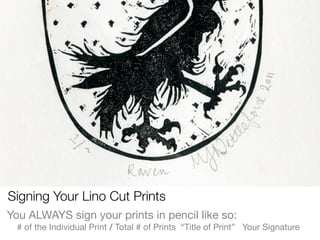
Signing Your Lino Cut Prints
You ALWAYS sign your prints in pencil like so:
  # of the Individual Print / Total # of Prints “Title of Print” Your Signature

Copyright Law

  • 1.
    Copyright Law Protecting the Rights of Artists
  • 2.
    What is CopyrightLaw? • Copyright, a form of intellectual property law, protects original works of authorship including literary, dramatic, musical, and artistic works, such as poetry, novels, movies, songs, computer software, and architecture. • Copyright does not protect facts, ideas, systems, or methods of operation, although it may protect the way these things are expressed. • Copyright laws grant exclusive rights to the creator of an original piece of work. • Usually these rights are extended for a limited time.
  • 3.
    What are theRights Granted by Copyright Law •Technically, it is "the right to copy"your work. •But also gives the copyright holder the right: •To be credited for the work. •To determine who may adapt the work to other forms. •To decide who may perform the work. •To decide who may financially benefit from it.
  • 4.
    How Long Doesa Copyright Last? •For works created after January 1, 1978, copyright protection lasts for the life of the author plus an additional 70 years. •For an anonymous work, a pseudonymous work, or a work made for hire, the copyright endures for a term of 95 years from the year of its first publication or a term of 120 years from the year of its creation, whichever expires first.
  • 5.
    Copyright Infringement •If youuse a copyrighted work without authorization, the owner may be entitled to bring an infringement action against you. •Anyone found to have infringed a copyrighted work may be liable for statutory damages up to $30,000 for each work infringed and, if willful infringement is proven by the copyright owner, that amount may be increased up to $150,000 for each work infringed. •In addition, an infringer of a work may also be liable for the attorney's fees incurred by the copyright owner to enforce his or her rights.
  • 6.
    Fair-Use Doctrine •Under thefair use doctrine of the U.S. copyright statute, it is permissible to use limited portions of a work. •The reproduction of a particular work may be considered fair if it is used for: •criticism •comment •news reporting •teaching •scholarship •research
  • 7.
    Determining Fair Use •Todetermine fair use, consider the following: •The purpose and character of the use, including whether such use is of commercial nature or is for nonprofit educational purposes. •The nature of the copyrighted work. •The amount and substantiality of the portion used in relation to the copyrighted work as a whole •The effect of the use upon the potential market for, or value of, the copyrighted work
  • 8.
    Public Domain •Photos thatare in the public domain are not protected by copyright laws and can be used without permission or the payment of fees. •Images enter the public domain: •After the copyright has expired, •If the image is a work of the U.S. government, •Or the copyright holder fails to satisfy copyright formalities.
  • 9.
    How do ICopyright my Work? •Your work is under copyright protection the moment it is created and fixed in a tangible form that it is perceptible either directly or with the aid of a machine or device. •Registration with the US Copyright Office is voluntary. •However, you will have to register if you wish to bring a lawsuit for infringement of a U.S. work. •To register a work, submit a completed application form, a nonrefundable filing fee, and a nonreturnable copy or copies of the work to be registered.
  • 10.
    Signing Your LinoCut Prints You ALWAYS sign your prints in pencil like so: # of the Individual Print / Total # of Prints “Title of Print” Your Signature

Editor's Notes