Copyright Act
What is Copyright?
Copyright is a right given by the law to
creators of literary, dramatic, musical
 and artistic works and producers of
   cinematograph films and sound
               recordings.

                                           2
What is copyright?
•   It is a bundle of rights including, rights of
•   reproduction,
•   communication to the public,
•   adaptation and translation of the work.
•   There could be slight variations in the
    composition of the rights depending on
    the work.

                                                    3
Whose rights are protected by
               copyright?

• Copyright protects the rights of authors, i.e.,
  creators of intellectual property in the form of
  literary, musical, dramatic and artistic works
  and cinematograph films and sound
  recordings.


                                                 4
What are the rights in the case of a
              literary work?
• In the case of a literary work (except computer programme),
  copyright means the exclusive right.
• To reproduce the work .
• To issue copies of the work to the public
• To perform the work in public
• To communicate the work to the public.
• To make cinematograph film or sound recording in respect of
  the work
• To make any translation of the work
• To make any adaptation of the work.

                                                            5
• Is translation of an original work also protected by copyright?
       - Yes. All the rights of the original work apply to a
  translation also.
• Are computer programmes protected under Copyright Act?
     -- Yes. Computer programmes are protected under the
  Copyright Act. They are treated as literary works.
• Are there any special rights in computer programmes?
    --Yes. In addition to all the rights applicable to a literary
  work, owner of the copyright in a computer programme
  enjoys the rights to sell or give on hire or offer for sale or hire,
  regardless of whether such a copy has been sold or given on
  hire on earlier occasion.


                                                                     6
What is the procedure for registration of a
     work under the Copyright Act,1957?
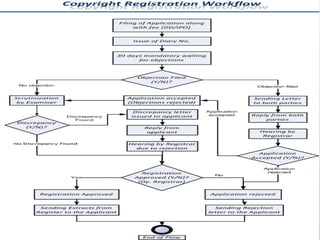
• Copyright comes into existence as soon as a work is created
  and no formality is required to be completed for acquiring
  copyright. However, facilities exist for having the work
  registered in the Register of Copyrights maintained in the
  Copyright Office of the Department of Education. The entries
  made in the Register of Copyrights serve as prima-facie
  evidence in the court of law. The Copyright Office has been
  set up to provide registration facilities to all types of works
  and is headed by a Registrar of Copyrights and is located at
  B.2/W.3, C.R. Barracks, Kasturba Gandhi Marg, New Delhi-
  110 003.

                                                                7
What is the term of protection of
                copyright?
• The general rule is that copyright lasts for 60 years.
  In the case of original literary, dramatic, musical and
  artistic works the 60-year period is counted from the
  year following the death of the author. In the case
  of cinematograph films, sound recordings,
  photographs, posthumous publications, anonymous
  and pseudonymous publications, works of
  government and works of international
  organisations, the 60-year period is counted from the
  date of publication.
                                                       9
What is infringement?

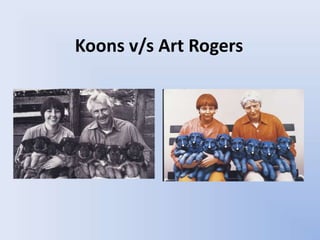
• use of whole or part of an image without permission;
• use beyond the scope of a license;
• adapting an image without permission
  (art rendering, collage);
• asking another photographer to recreate the image.
Which are the common copyright
             infringements?
• Making infringing copies for sale or hire or selling or
  letting them for hire;
• any place for the performance of works in public
  where such performance constitutes infringement of
  copyright;


                                                      11
Which are the common copyright
        infringements?
• Distributing infringing copies for the purpose of
  trade or to such an extent so as to affect
  prejudicially the interest of the owner of
  copyright ;
• Public exhibition of infringing copies by way of
  trade; and
• Importation of infringing copies into India.


                                                 12
Koons v/s Art Rogers
How to transfer rights


  In writing and signed by the
  party transferring the rights
Exemptions
• for the purpose of research or private study,
• for learning and teaching in a classroom.
• for criticism or review,
• for reporting current events,
• in connection with judicial proceeding,
• performance by an amateur club or society if
  the performance is given to a non-paying
  audience, and
• the making of sound recordings of literary,
  dramatic or musical works under certain
  conditions.
                                                  15

Copyright act

  • 1.
  • 2.
    What is Copyright? Copyrightis a right given by the law to creators of literary, dramatic, musical and artistic works and producers of cinematograph films and sound recordings. 2
  • 3.
    What is copyright? • It is a bundle of rights including, rights of • reproduction, • communication to the public, • adaptation and translation of the work. • There could be slight variations in the composition of the rights depending on the work. 3
  • 4.
    Whose rights areprotected by copyright? • Copyright protects the rights of authors, i.e., creators of intellectual property in the form of literary, musical, dramatic and artistic works and cinematograph films and sound recordings. 4
  • 5.
    What are therights in the case of a literary work? • In the case of a literary work (except computer programme), copyright means the exclusive right. • To reproduce the work . • To issue copies of the work to the public • To perform the work in public • To communicate the work to the public. • To make cinematograph film or sound recording in respect of the work • To make any translation of the work • To make any adaptation of the work. 5
  • 6.
    • Is translationof an original work also protected by copyright? - Yes. All the rights of the original work apply to a translation also. • Are computer programmes protected under Copyright Act? -- Yes. Computer programmes are protected under the Copyright Act. They are treated as literary works. • Are there any special rights in computer programmes? --Yes. In addition to all the rights applicable to a literary work, owner of the copyright in a computer programme enjoys the rights to sell or give on hire or offer for sale or hire, regardless of whether such a copy has been sold or given on hire on earlier occasion. 6
  • 7.
    What is theprocedure for registration of a work under the Copyright Act,1957? • Copyright comes into existence as soon as a work is created and no formality is required to be completed for acquiring copyright. However, facilities exist for having the work registered in the Register of Copyrights maintained in the Copyright Office of the Department of Education. The entries made in the Register of Copyrights serve as prima-facie evidence in the court of law. The Copyright Office has been set up to provide registration facilities to all types of works and is headed by a Registrar of Copyrights and is located at B.2/W.3, C.R. Barracks, Kasturba Gandhi Marg, New Delhi- 110 003. 7
  • 9.
    What is theterm of protection of copyright? • The general rule is that copyright lasts for 60 years. In the case of original literary, dramatic, musical and artistic works the 60-year period is counted from the year following the death of the author. In the case of cinematograph films, sound recordings, photographs, posthumous publications, anonymous and pseudonymous publications, works of government and works of international organisations, the 60-year period is counted from the date of publication. 9
  • 10.
    What is infringement? •use of whole or part of an image without permission; • use beyond the scope of a license; • adapting an image without permission (art rendering, collage); • asking another photographer to recreate the image.
  • 11.
    Which are thecommon copyright infringements? • Making infringing copies for sale or hire or selling or letting them for hire; • any place for the performance of works in public where such performance constitutes infringement of copyright; 11
  • 12.
    Which are thecommon copyright infringements? • Distributing infringing copies for the purpose of trade or to such an extent so as to affect prejudicially the interest of the owner of copyright ; • Public exhibition of infringing copies by way of trade; and • Importation of infringing copies into India. 12
  • 13.
  • 14.
    How to transferrights In writing and signed by the party transferring the rights
  • 15.
    Exemptions • for thepurpose of research or private study, • for learning and teaching in a classroom. • for criticism or review, • for reporting current events, • in connection with judicial proceeding, • performance by an amateur club or society if the performance is given to a non-paying audience, and • the making of sound recordings of literary, dramatic or musical works under certain conditions. 15