IP Protection under Copyright
Dr. Seweta Srivastava
Assistant Professor
Lovely Professional University,
Jalandhar, Punjab, India
Copyrights
What is copyright?
• The legal right granted to an author,
composer, playwright, publisher, or
distributor to exclusive publication,
production, sale, or distribution of a literary,
musical, dramatic, or artistic work.
• A copyright is a form of protection given to
authors or creators of original works.
• Gives authors or artists the legal right to
exclude others from using their works.
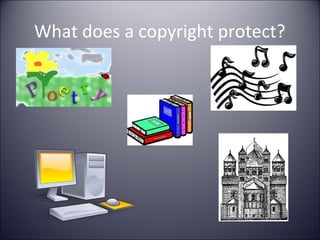
What does a copyright protect?
Copyright Information
• Copyright is automatic when a protectable
work has been fixed in a tangible medium
such as a floppy disk or hard drive.
• A poem or picture is as much protected on a
disk as on a piece of paper or on a canvas.
When is your work protected?
Your work is protected by a copyright as soon as
it is created and fixed in a tangible form.
What rights are granted with a
copyright?
• Basically, a copyright entitles you as the
author of the work to do the following or let
others do the following:
– Make copies of your work
– Distribute copies of your work
– Perform your work publicly
– Display your work publicly
– Make derivative works
Intellectual Property
Copyright – History
Stationer’s company 1557
Company members (printers and booksellers) could
purchase a manuscript and, once purchased, had a
monopoly on printing, publishing and selling the
manuscript (and they could trade the right)
Statute of Anne 1709
Gave the author of manuscripts the exclusive right of
reproduction (for existing works not already
purchased by a printer/bookseller – for 21 years and
for new works – 14 years).
COPYRIGHT
What is protected
Original works
• literary,
•dramatic,
•musical
• artistic
In subject matter other than works
•Sound recordings
•Cinematograph films
•Television/sound broadcasts
•Published editions of works
COPYRIGHT
Copyright Holder Rights
Economic
•Reproduce in material form
•Publish
•Perform/communicate to the public
•Make adaption
•Duration – generally 70 years of death of creator or
if not published in creator lifetime, 70 years after
made public
Moral
•Right of attribution
•Right against false attribution of authorship
•Right of integrity of authorship
•Duration – author’s lifetime
Intellectual Property
Copyright – History
Stationer’s company 1557
Company members (printers and booksellers) could
purchase a manuscript and, once purchased, had a
monopoly on printing, publishing and selling the
manuscript (and they could trade the right)
Statute of Anne 1709
Gave the author of manuscripts the exclusive right of
reproduction (for existing works not already
purchased by a printer/bookseller – for 21 years and
for new works – 14 years).
COPYRIGHT
Elements (Copyright Act 1968)
•Creative
•literary, dramatic, musical and artistic plus other
works (later, sound recordings, films, radio/TV
broadcasts etc)
•In a material form (not just an idea or
information)
•Original
COPYRIGHT
What is protected
Original works
• literary,
•dramatic,
•musical
• artistic
In subject matter other than works
•Sound recordings
•Cinematograph films
•Television/sound broadcasts
•Published editions of works
COPYRIGHT
Copyright Holder Rights
Economic
•Reproduce in material form
•Publish
•Perform/communicate to the public
•Make adaption
•Duration – generally 70 years of death of creator or
if not published in creator lifetime, 70 years after
made public
Moral
•Right of attribution
•Right against false attribution of authorship
•Right of integrity of authorship
•Duration – author’s lifetime
COPYRIGHT
The Digital Agenda Act 2000
(context: US Digital Millennium Copyright Act 1998 and WIPO
Copyright Treaty)
Has the balance shifted from prohibition on unauthorised
copying to unauthorised access?
New right:
to communicate to the public - make available online or
electronically transmit (over a path or a combination of
paths, provided over a material substance or otherwise) a
work or other subject matter
Make available online – public may access from a place
and time individually chosen by the individual
(could be one member of the public at a time – Telstra v
APRA)
COPYRIGHT
Digital Agenda Act 2000 (cont’d)
NB: Shift is to give copyright holders the decision on what
is put online (and terms of access on line) – regardless of
the purpose of individual access
Prohibition on circumvention service device/service (to
get around technological access control) except for
permitted purpose (fair dealing is not a permitted
purpose)
Exception – browsing and caching(??)
COPYRIGHT
User Generated content
•What is it?
•Who is the author? Who is the owner?
(noting it is estimated 70% of material on YouTube is
made up of unauthorised copyright material)
•Is it direct infringement – reproduction/publication or more
than a sample of content
•Was it fair use/fair dealing
•Was a substantial part of the work used
•For what purpose
Example: Mash-up presidential candidates repeating the word
‘change’ with the David Bowie song Changes
What is not protected?
· ideas, concepts, or discoveries
· titles, names, short phrases, and slogans
· works that are not fixed in a tangible form
of expression such as improvised speech
or dance
· works consisting entirely of information
that is commonly available and contains
no originality
· anything written or created by the US
government
What rights does the owner control?
• Rights to:
· make copies of the work
· distribute copies of the work
· perform the work publicly (such as for
plays, film, or music)
· display the work publicly (such as for
artwork, or any material used on the
internet or television)
· make “derivative works” (including making
modifications, adaptations or other new
uses of a work, or translating the work to
How long does copyright protection last?
· for the life of the author, plus 60
years
· 95 years for corporations
What if I use copyrighted work?
• If you use copyrighted work and author finds
out, he/she must notify you in writing if
he/she wants you to remove it.
• You MUST remove it.
When can you use copyrighted
material?
• Personal, academic, not-for-
profit use – some authors will
let you use
• Give the author credit
– Linking to author’s site
• This falls under “Fair Use”
Fair Use
• A doctrine in the US copyright law that allows
limited use of copyrighted material without
requiring permission from the rights holders
such as for commentary, criticism, news
reporting, research, teaching or scholarship.
What should I do?
• Use your best judgment
– Everything on Web is copyrighted property of
someone
– Academic use does NOT automatically protect you
from being sued for copyright infringement.
– http://www.ala.org/washoff/teach.html for
coverage on academic use
Free Stuff
• You can find totally free graphic sites on the
Web by entering “free graphics” into a search
engine.
• Images usually are poor quality
• Worth it; free
Finding Images
• Your responsibility to find out if it is free for
your use or not.
• Law – every image is protected by copyright
automatically when it’s created
• Question – Does owner care if you use it?
File Sharing Cases:
LimeWire (2010) and Napster (2001)
• In both cases, the file sharing companies (i.e.
LimeWire and Napster) were found to have
enabled the sharing of files that were
protected by copyrights
• Lesson: Pay for your music: It’s not fair to the
copyright holder if you don’t
®
Copyright Act
• 1709 First Copyright Act (UK)
• 1957 Indian Copyright Act
Amended 1983, 1984, 1992, 1994 and 1999
• International Convention
Bern Convention 1886, 1908, 1928,1948, 1989, 1990
Universal Copyright Convention 1952
• TERM LIFE+60 YRS
28
29
Copyright - Extension
IT Revolution !
Recordings
Broadcastings
Audio visual works
Computer programs
Digital databases
Internet/web
Cable and Satellite T.V.
Indian Copyright Amendment Bill
Passed by Rajya Sabha on 17th
May, 2012
Passed by Lok Sabha on 22nd
May, 2012
30
IPR & Copyright
 Avoid verbatim reproduction (Plagiarism) - Likely to cause Copyright
violations.
 Always acknowledge / obtain prior permission.
 Abstract / Summary may be written in one’s own language / quote the
source.
“Copyright” / “All rights reserved”
“Do not use, reprint, reproduce or distribute without prior permission”
Quoting Medical References from Journals and Books
Copyright violations could lead to criminal/civil suits
Could lead to imprisonment too !
Ownership of Rights
• Literary – author
• Drama – Dramatist
• Music – Composer
• Artistic work – Artist e.g. Painter, sculptor, architect
• Photograph – Photographer
• Author of Computer Programme – Person who causes
the work to be created
• Cinematograph film – producer
• Sound Recording - producer
31
Author as Owner of Rights:
Exceptions
• In the course of employment –
employer
• Employment by newspaper, magazine
– employer has publishing right; other
rights with author
• Photograph, painting, cinema for
valuable consideration – person who
pays money
32
• Lecture delivered in public – Person
delivering
• Government Work – Government
• Public Undertaking Work – public
undertaking
• Work of International Organization –
International Organization
33
Continue…..
• Work of apprentice – to Teacher
• If teacher writes a book then teacher because he
is employed to teach and not write
• Question Papers – Paper setter
• Encyclopedia, dictionary – editor for collection
• Music under contract by film producer – film
producer
34
Continue…..
Securing Copyright
• Formality free protection
• Voluntary Registration (S. 44 & 45)
• Registration does not as a matter of law
establish that what is registered is in fact
and in law copyrightable subject matter
35
Duration of Copyright
• Literary, dramatic, Musical and Artistic Works
published during life time of author: Life + 60
years
• All Other Works: 60 years from date of
publication
– Posthumous, Anonymous Works
– Works of Government and Organizations
– Cinema and Sound Recording
– Photograph
36
Related Rights
• Rights granted by law to
communicators of works to the public
–Performers
–Broadcasting Organizations
37
Performer’s Rights
• Recording, broadcasting and
communicating to the public of a live
performance
• Presumption of transfer of performer’s
right to cinematographic film producer
• Duration: 50 years
38
Rights Of Broadcasting
Organizations
• Broadcast Reproduction Right
• Re-broadcasting, Recording and
Communicating to the Public of a
Broadcast
• Duration: 25 Years
39
40
Therapeutic Goods Legislation Amendment
(Copyright), 2011 Australia
To block frivolous
Copyright infringement
suits in Pharma /
Medicine product inserts.
41
Be Aware / Beware of the Web /
Domain in the new global
regime
× Use of internet for selling / marketing
× Downloading from Internet (except for
personal use)
Copyright Protection in the Music
Industry
• Singers
– Record Labels
• Song Writers
– Broadcast Music, Inc.
(BMI)
– The American Society of
Composers, Authors and
Publishers (ASCAP)
Steps to Copyright
• Create
• Register Your Copyright
– www.copyright.gov
– Can be done
electronically
• Send the Package to the
Copyright Office
– May not be necessary if
you register online
Questions?

Copyrights

  • 1.
    IP Protection underCopyright Dr. Seweta Srivastava Assistant Professor Lovely Professional University, Jalandhar, Punjab, India
  • 2.
  • 3.
    What is copyright? •The legal right granted to an author, composer, playwright, publisher, or distributor to exclusive publication, production, sale, or distribution of a literary, musical, dramatic, or artistic work. • A copyright is a form of protection given to authors or creators of original works. • Gives authors or artists the legal right to exclude others from using their works.
  • 4.
    What does acopyright protect?
  • 5.
    Copyright Information • Copyrightis automatic when a protectable work has been fixed in a tangible medium such as a floppy disk or hard drive. • A poem or picture is as much protected on a disk as on a piece of paper or on a canvas.
  • 6.
    When is yourwork protected? Your work is protected by a copyright as soon as it is created and fixed in a tangible form.
  • 7.
    What rights aregranted with a copyright? • Basically, a copyright entitles you as the author of the work to do the following or let others do the following: – Make copies of your work – Distribute copies of your work – Perform your work publicly – Display your work publicly – Make derivative works
  • 8.
    Intellectual Property Copyright –History Stationer’s company 1557 Company members (printers and booksellers) could purchase a manuscript and, once purchased, had a monopoly on printing, publishing and selling the manuscript (and they could trade the right) Statute of Anne 1709 Gave the author of manuscripts the exclusive right of reproduction (for existing works not already purchased by a printer/bookseller – for 21 years and for new works – 14 years).
  • 9.
    COPYRIGHT What is protected Originalworks • literary, •dramatic, •musical • artistic In subject matter other than works •Sound recordings •Cinematograph films •Television/sound broadcasts •Published editions of works
  • 10.
    COPYRIGHT Copyright Holder Rights Economic •Reproducein material form •Publish •Perform/communicate to the public •Make adaption •Duration – generally 70 years of death of creator or if not published in creator lifetime, 70 years after made public Moral •Right of attribution •Right against false attribution of authorship •Right of integrity of authorship •Duration – author’s lifetime
  • 11.
    Intellectual Property Copyright –History Stationer’s company 1557 Company members (printers and booksellers) could purchase a manuscript and, once purchased, had a monopoly on printing, publishing and selling the manuscript (and they could trade the right) Statute of Anne 1709 Gave the author of manuscripts the exclusive right of reproduction (for existing works not already purchased by a printer/bookseller – for 21 years and for new works – 14 years).
  • 12.
    COPYRIGHT Elements (Copyright Act1968) •Creative •literary, dramatic, musical and artistic plus other works (later, sound recordings, films, radio/TV broadcasts etc) •In a material form (not just an idea or information) •Original
  • 13.
    COPYRIGHT What is protected Originalworks • literary, •dramatic, •musical • artistic In subject matter other than works •Sound recordings •Cinematograph films •Television/sound broadcasts •Published editions of works
  • 14.
    COPYRIGHT Copyright Holder Rights Economic •Reproducein material form •Publish •Perform/communicate to the public •Make adaption •Duration – generally 70 years of death of creator or if not published in creator lifetime, 70 years after made public Moral •Right of attribution •Right against false attribution of authorship •Right of integrity of authorship •Duration – author’s lifetime
  • 15.
    COPYRIGHT The Digital AgendaAct 2000 (context: US Digital Millennium Copyright Act 1998 and WIPO Copyright Treaty) Has the balance shifted from prohibition on unauthorised copying to unauthorised access? New right: to communicate to the public - make available online or electronically transmit (over a path or a combination of paths, provided over a material substance or otherwise) a work or other subject matter Make available online – public may access from a place and time individually chosen by the individual (could be one member of the public at a time – Telstra v APRA)
  • 16.
    COPYRIGHT Digital Agenda Act2000 (cont’d) NB: Shift is to give copyright holders the decision on what is put online (and terms of access on line) – regardless of the purpose of individual access Prohibition on circumvention service device/service (to get around technological access control) except for permitted purpose (fair dealing is not a permitted purpose) Exception – browsing and caching(??)
  • 17.
    COPYRIGHT User Generated content •Whatis it? •Who is the author? Who is the owner? (noting it is estimated 70% of material on YouTube is made up of unauthorised copyright material) •Is it direct infringement – reproduction/publication or more than a sample of content •Was it fair use/fair dealing •Was a substantial part of the work used •For what purpose Example: Mash-up presidential candidates repeating the word ‘change’ with the David Bowie song Changes
  • 18.
    What is notprotected? · ideas, concepts, or discoveries · titles, names, short phrases, and slogans · works that are not fixed in a tangible form of expression such as improvised speech or dance · works consisting entirely of information that is commonly available and contains no originality · anything written or created by the US government
  • 19.
    What rights doesthe owner control? • Rights to: · make copies of the work · distribute copies of the work · perform the work publicly (such as for plays, film, or music) · display the work publicly (such as for artwork, or any material used on the internet or television) · make “derivative works” (including making modifications, adaptations or other new uses of a work, or translating the work to
  • 20.
    How long doescopyright protection last? · for the life of the author, plus 60 years · 95 years for corporations
  • 21.
    What if Iuse copyrighted work? • If you use copyrighted work and author finds out, he/she must notify you in writing if he/she wants you to remove it. • You MUST remove it.
  • 22.
    When can youuse copyrighted material? • Personal, academic, not-for- profit use – some authors will let you use • Give the author credit – Linking to author’s site • This falls under “Fair Use”
  • 23.
    Fair Use • Adoctrine in the US copyright law that allows limited use of copyrighted material without requiring permission from the rights holders such as for commentary, criticism, news reporting, research, teaching or scholarship.
  • 24.
    What should Ido? • Use your best judgment – Everything on Web is copyrighted property of someone – Academic use does NOT automatically protect you from being sued for copyright infringement. – http://www.ala.org/washoff/teach.html for coverage on academic use
  • 25.
    Free Stuff • Youcan find totally free graphic sites on the Web by entering “free graphics” into a search engine. • Images usually are poor quality • Worth it; free
  • 26.
    Finding Images • Yourresponsibility to find out if it is free for your use or not. • Law – every image is protected by copyright automatically when it’s created • Question – Does owner care if you use it?
  • 27.
    File Sharing Cases: LimeWire(2010) and Napster (2001) • In both cases, the file sharing companies (i.e. LimeWire and Napster) were found to have enabled the sharing of files that were protected by copyrights • Lesson: Pay for your music: It’s not fair to the copyright holder if you don’t ®
  • 28.
    Copyright Act • 1709First Copyright Act (UK) • 1957 Indian Copyright Act Amended 1983, 1984, 1992, 1994 and 1999 • International Convention Bern Convention 1886, 1908, 1928,1948, 1989, 1990 Universal Copyright Convention 1952 • TERM LIFE+60 YRS 28
  • 29.
    29 Copyright - Extension ITRevolution ! Recordings Broadcastings Audio visual works Computer programs Digital databases Internet/web Cable and Satellite T.V. Indian Copyright Amendment Bill Passed by Rajya Sabha on 17th May, 2012 Passed by Lok Sabha on 22nd May, 2012
  • 30.
    30 IPR & Copyright Avoid verbatim reproduction (Plagiarism) - Likely to cause Copyright violations.  Always acknowledge / obtain prior permission.  Abstract / Summary may be written in one’s own language / quote the source. “Copyright” / “All rights reserved” “Do not use, reprint, reproduce or distribute without prior permission” Quoting Medical References from Journals and Books Copyright violations could lead to criminal/civil suits Could lead to imprisonment too !
  • 31.
    Ownership of Rights •Literary – author • Drama – Dramatist • Music – Composer • Artistic work – Artist e.g. Painter, sculptor, architect • Photograph – Photographer • Author of Computer Programme – Person who causes the work to be created • Cinematograph film – producer • Sound Recording - producer 31
  • 32.
    Author as Ownerof Rights: Exceptions • In the course of employment – employer • Employment by newspaper, magazine – employer has publishing right; other rights with author • Photograph, painting, cinema for valuable consideration – person who pays money 32
  • 33.
    • Lecture deliveredin public – Person delivering • Government Work – Government • Public Undertaking Work – public undertaking • Work of International Organization – International Organization 33 Continue…..
  • 34.
    • Work ofapprentice – to Teacher • If teacher writes a book then teacher because he is employed to teach and not write • Question Papers – Paper setter • Encyclopedia, dictionary – editor for collection • Music under contract by film producer – film producer 34 Continue…..
  • 35.
    Securing Copyright • Formalityfree protection • Voluntary Registration (S. 44 & 45) • Registration does not as a matter of law establish that what is registered is in fact and in law copyrightable subject matter 35
  • 36.
    Duration of Copyright •Literary, dramatic, Musical and Artistic Works published during life time of author: Life + 60 years • All Other Works: 60 years from date of publication – Posthumous, Anonymous Works – Works of Government and Organizations – Cinema and Sound Recording – Photograph 36
  • 37.
    Related Rights • Rightsgranted by law to communicators of works to the public –Performers –Broadcasting Organizations 37
  • 38.
    Performer’s Rights • Recording,broadcasting and communicating to the public of a live performance • Presumption of transfer of performer’s right to cinematographic film producer • Duration: 50 years 38
  • 39.
    Rights Of Broadcasting Organizations •Broadcast Reproduction Right • Re-broadcasting, Recording and Communicating to the Public of a Broadcast • Duration: 25 Years 39
  • 40.
    40 Therapeutic Goods LegislationAmendment (Copyright), 2011 Australia To block frivolous Copyright infringement suits in Pharma / Medicine product inserts.
  • 41.
    41 Be Aware /Beware of the Web / Domain in the new global regime × Use of internet for selling / marketing × Downloading from Internet (except for personal use)
  • 42.
    Copyright Protection inthe Music Industry • Singers – Record Labels • Song Writers – Broadcast Music, Inc. (BMI) – The American Society of Composers, Authors and Publishers (ASCAP)
  • 43.
    Steps to Copyright •Create • Register Your Copyright – www.copyright.gov – Can be done electronically • Send the Package to the Copyright Office – May not be necessary if you register online
  • 44.

Editor's Notes

  • #3 Have you seen this symbol? I’m sure you have…this is the copyright symbol.
  • #5 Copyrights protect original works of authorship including literary, dramatic, musical, and artistic works. Can you all think of some examples of literary, dramatic, musical, or artistic works that copyrights protect? (call on a couple of students) Poetry Novels Music* Computer Software Architecture *The second half of this presentation is going to focus on music.
  • #7 When is your work under copyright protection? Read from slide. Example: If you write a poem, when is your poem protected by a copyright? (call on a student) Answer: Your poem is under copyright protection as soon as you create your poem and write it down on a piece of paper.
  • #8 What rights are granted with a copyright? Read from slide. (When finished speaking on the slide, click the picture; link will go to US Copyright Office webpage – click play on “Copyright Exposed” video)
  • #18 OECD Report: Participative Web and User-Created Content: Web 2.0, Wikis and Social Networking 2007. Def content that is made publicly available over the internet Which reflects a certain amount of creative effort and is created outside of professional routines and practices. Includes blogs, wikis, podcasting (I tunes), social network sites (YouTube, Facebook) Citizen journalism.
  • #19 Remind the audience that other laws may protect these categories, for example, short phrases could have trademark protection. Section 102(b) excludes ideas, processes, etc. Section 105 –copyright not available for US Government works-but government may hold a copyright Copyright does not protect the IDEA only the EXPRESSION of the Idea. Question always for a creative person, where to draw the line, where does the idea stop and the expression start? How much can you be influenced by an idea without taking copyrightable expression?
  • #20 Section 106 describes exclusive rights a copyright holder controls. These rights are exclusive to the copyright owner and permission is needed, unless there is a specific exception such as fair use, or limited use for preservation by libraries or for use in education under the TEACH Act which permits certain performances and displays. These exemptions are limited so its better if uncertain to assume that permission is needed to use a work. (For statutory limitations, see Sections 107 (fair use) 108 (libraries and archives) 110 (education). Other exemptions exists under the Copyright Act as well). Copyright is like owning a bundle of sticks (like pick up sticks). You can give different users different rights/sticks. The same image can be used on a magazine cover, in an advertisement, in a website design or incorporated in a documentary film, for example.
  • #21 The current act has been effective since 1978. Under the old Act of 1909, there was a 2 tier system for published and unpublished works. Published works required registration and subsequent renewal during the 28th year. As there have been many amendments extending the second renewal term, the term for pre 1978 works is very confusing. It is best to consult some very comprehensive charts available through the Copyright Office website where you can find circulars on copyright duration or some university websites such as Cornell Law School www.copyright.gov Circular 15a-Duration of Copyright Circular 15t -Extension of copyright term http://www.copyright.cornell.edu/training/Hirtle_Public_Domain.htm
  • #28 In recent years there have been two more notable file sharing cases (1) Arista Records LLC, et al. v. Lime Group LLC, et al. and (2) A&M Records, Inc. v. Napster, Inc.
  • #43 Record labels protect singers by coordinating enforcement of copyright protection of sound recordings and music videos. BMI and ASCAP protect song writers, lyricists, composers, and music publishers by collecting license fees and distributing them to those members whose works have been performed.
  • #44 Now that we have learned all about copyrights, it’s time to learn the steps to actually obtain a registered copyright. Step 1 is to create. Compose a song, write a play, paint a picture, pen a poem, or express or creativity. Step 2 is to register your copyright. Complete an application and make sure to include the correct filing fee. Also, make sure to include nonrefundable copies. The Copyright Office has moved to an electronic filing system. Thus, you can register your copyright online. Electronic filings are less expensive and processed more quickly than paper filings. Step 3 is to send the package to the Copyright Office. The Copyright Office receives your package, and your registration becomes effective on that day. Approximately 2,400 submissions are received each business day. The Copyright Office examines your application and your deposit to make sure they are acceptable and meet the requirements of the Copyright law and regulations. Your registration is assigned a number and a certificate of registration is issued. You receive that certificate in the mail about 4 months after you submit your package. - If you file electronically you may attached an electronic copy of your deposit. However, even if you register online, if the Library of Congress requires a hard-copy deposit of your work, you must send what the Library defines as the "best edition" of your work.