Intellectual Property Considering trademarks, patents, copyright and fair use  2004  http://www.cincinnati.com/nie/archive/02-17-04/
What Is Intellectual Property? Creative works protected by laws indicating property rights The laws include : Trademark  TM  Trade secret Right of publicity Patent Copyright C R
What Is Protected? Trademarks protect identifying symbols, words, or designs of goods or services Trade Secrets   protect confidential business information, including exclusive rights to materials (software, processes, designs, blueprints, formulas; i.e., KFC original recipe) Rights of Publicity protect an individual's right to benefit from identity (example - celebrity endorsements) Patents   protect novel & useful inventions Copyrights   protect expression of creators http://www.copyrightauthority.com/copyright-symbol/
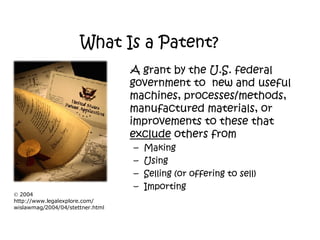
What Is a Patent? A grant by the U.S. federal government to  new and useful machines, processes/methods, manufactured materials, or improvements to these that  exclude  others from Making Using Selling (or offering to sell) Importing 2004 http://www.legalexplore.com/ wislawmag/2004/04/stettner.html
Requirements of a Patent   Three key elements  Novel (a new idea) Inventive Useful (but not necessarily commercially useful) Formal review process before patent is granted by the U.S. Patent and Trademark Office (PTO) Each country must formally grant patents 2005 http://www.d-r-t.com/customdesigned.htm
The Patent Process Preparation of patent application by a patent attorney and the inventor(s) U.S. Patent and Trademark Office reviews and contacts applicant U.S. Patent and Trademark Office sends a notice of allowance or final rejection Average time to issue is 36 months; average cost for U.S patent is $16,000 Term of patent is now up to 20 years from filing 2004 http://www.travelhistory.org/adventure/TouringFromNorthToSouth-1908/white-patent.jpg
Benefits  and Limitations  of Patents   Benefits Monopoly: no one can practice claims without a license U.S. rule is first to invent, not first to file Limitations If public use, sale, or publication occurs less than 1 year prior to filing, U.S. filing permitted, but lose most foreign rights  Formal process takes 2-4 years Granted by each country Expensive 2005 http://www.findoil.com/patent/patent.html
What Is Copyright? Laws that carry ownership in the EXPRESSION of an original work by its creator: writings, software, multimedia, photos, drawings, music   No formal process is required to get copyright protection; once a creator’s work is in a tangible form, it is protected 2005 http://www.copyrightauthority.com/copyright-symbol/
Rights Under Copyright The owner has the right to and may authorize others to  Reproduce Distribute Create other forms of original work (modify) Perform certain types of work Display certain types of work 2004 http://www.xenu.net/copyright.html
Benefits and Limitations Copyrights Benefits No formal process to protect Term of protection: creator’s life + 70 yrs. U.S. protection extends internationally Limitations Only expression is protected, not the ideas, concepts, facts Others may independently create an “original” of the same or similar work without any knowledge of another’s work Several exceptions to creator’s rights http://www.efuse.com/Plan/  copyright.html
Fair Use "Fair use" is the right of the public to make reasonable use of copyrighted material in special circumstances without the  copyright owner's permission .  The United States Copyright Act recognizes that fair use of a copyrighted work may be used "for purposes such as criticism, comment, news reporting, teaching, or research."
Factors to be considered in Fair Use (1) the purpose and character of the use, including whether the use is for a commercial purpose or is for non-profit educational purposes;  (2) what kind of work is the copyrighted work (for instance, is it creative or factual);  (3) the amount and importance of the portion used in relation to the copyrighted work as a whole; and  (4) the effect of the use upon the potential commercial market for or value of the copyrighted work.
Determining Fair Use Fair use  can not  be assumed simply because the use...  is for nonprofit, educational purposes, or gives credit for the source of the work, or  limits the amount of material used  Fair use of a copyrighted work is not always easy to determine and there have been many lawsuits to determine if uses are "fair."  If in doubt about whether or not a use is “fair”, request permission from the  copyright holder .
So, what does this all mean for you …as a  student ? ALWAYS   record bibliographic information you use in a project (author/creator, complete title, place of publication, publisher and copyright date) and where you located it (which library, what call number, complete website, etc.). Give credit for everything that you use. Don't just paraphrase. Use quotes. Include copyright information beside or under images (photographs, charts, maps, pictures, graphics).  Try to choose graphics from sources that grant permission to use their materials freely. Without granted permission, ALWAYS give credit to the original source  [This applies to pictures or images that you use in reports, on posters, or in Powerpoint presentations.] Make only ONE copy of articles, etc. for personal use when you are working on school assignments. Follow this rule unless the source gives other directions regarding use or copyrights.  For graphics or photographs used in a presentation make sure you include the following information next to the image: the letter "c" or the word "copyright", the name of the creator of the image, then the copyright date. If this information is not available in or on your source, you can list the bibliographic information or web address of the source.

Copyright Slide Show

  • 1.
    Intellectual Property Consideringtrademarks, patents, copyright and fair use  2004 http://www.cincinnati.com/nie/archive/02-17-04/
  • 2.
    What Is IntellectualProperty? Creative works protected by laws indicating property rights The laws include : Trademark TM Trade secret Right of publicity Patent Copyright C R
  • 3.
    What Is Protected?Trademarks protect identifying symbols, words, or designs of goods or services Trade Secrets protect confidential business information, including exclusive rights to materials (software, processes, designs, blueprints, formulas; i.e., KFC original recipe) Rights of Publicity protect an individual's right to benefit from identity (example - celebrity endorsements) Patents protect novel & useful inventions Copyrights protect expression of creators http://www.copyrightauthority.com/copyright-symbol/
  • 4.
    What Is aPatent? A grant by the U.S. federal government to new and useful machines, processes/methods, manufactured materials, or improvements to these that exclude others from Making Using Selling (or offering to sell) Importing 2004 http://www.legalexplore.com/ wislawmag/2004/04/stettner.html
  • 5.
    Requirements of aPatent Three key elements Novel (a new idea) Inventive Useful (but not necessarily commercially useful) Formal review process before patent is granted by the U.S. Patent and Trademark Office (PTO) Each country must formally grant patents 2005 http://www.d-r-t.com/customdesigned.htm
  • 6.
    The Patent ProcessPreparation of patent application by a patent attorney and the inventor(s) U.S. Patent and Trademark Office reviews and contacts applicant U.S. Patent and Trademark Office sends a notice of allowance or final rejection Average time to issue is 36 months; average cost for U.S patent is $16,000 Term of patent is now up to 20 years from filing 2004 http://www.travelhistory.org/adventure/TouringFromNorthToSouth-1908/white-patent.jpg
  • 7.
    Benefits andLimitations of Patents Benefits Monopoly: no one can practice claims without a license U.S. rule is first to invent, not first to file Limitations If public use, sale, or publication occurs less than 1 year prior to filing, U.S. filing permitted, but lose most foreign rights Formal process takes 2-4 years Granted by each country Expensive 2005 http://www.findoil.com/patent/patent.html
  • 8.
    What Is Copyright?Laws that carry ownership in the EXPRESSION of an original work by its creator: writings, software, multimedia, photos, drawings, music No formal process is required to get copyright protection; once a creator’s work is in a tangible form, it is protected 2005 http://www.copyrightauthority.com/copyright-symbol/
  • 9.
    Rights Under CopyrightThe owner has the right to and may authorize others to Reproduce Distribute Create other forms of original work (modify) Perform certain types of work Display certain types of work 2004 http://www.xenu.net/copyright.html
  • 10.
    Benefits and LimitationsCopyrights Benefits No formal process to protect Term of protection: creator’s life + 70 yrs. U.S. protection extends internationally Limitations Only expression is protected, not the ideas, concepts, facts Others may independently create an “original” of the same or similar work without any knowledge of another’s work Several exceptions to creator’s rights http://www.efuse.com/Plan/ copyright.html
  • 11.
    Fair Use "Fairuse" is the right of the public to make reasonable use of copyrighted material in special circumstances without the copyright owner's permission . The United States Copyright Act recognizes that fair use of a copyrighted work may be used "for purposes such as criticism, comment, news reporting, teaching, or research."
  • 12.
    Factors to beconsidered in Fair Use (1) the purpose and character of the use, including whether the use is for a commercial purpose or is for non-profit educational purposes; (2) what kind of work is the copyrighted work (for instance, is it creative or factual); (3) the amount and importance of the portion used in relation to the copyrighted work as a whole; and (4) the effect of the use upon the potential commercial market for or value of the copyrighted work.
  • 13.
    Determining Fair UseFair use can not be assumed simply because the use... is for nonprofit, educational purposes, or gives credit for the source of the work, or limits the amount of material used Fair use of a copyrighted work is not always easy to determine and there have been many lawsuits to determine if uses are "fair." If in doubt about whether or not a use is “fair”, request permission from the copyright holder .
  • 14.
    So, what doesthis all mean for you …as a student ? ALWAYS record bibliographic information you use in a project (author/creator, complete title, place of publication, publisher and copyright date) and where you located it (which library, what call number, complete website, etc.). Give credit for everything that you use. Don't just paraphrase. Use quotes. Include copyright information beside or under images (photographs, charts, maps, pictures, graphics). Try to choose graphics from sources that grant permission to use their materials freely. Without granted permission, ALWAYS give credit to the original source [This applies to pictures or images that you use in reports, on posters, or in Powerpoint presentations.] Make only ONE copy of articles, etc. for personal use when you are working on school assignments. Follow this rule unless the source gives other directions regarding use or copyrights. For graphics or photographs used in a presentation make sure you include the following information next to the image: the letter "c" or the word "copyright", the name of the creator of the image, then the copyright date. If this information is not available in or on your source, you can list the bibliographic information or web address of the source.