PREPARED BY
Soumik Banerjee
Ist Sem,Mpharma
Pharmaceutical Regulatory Affairs
Sri Adichunchanagiri College of
Pharmacy
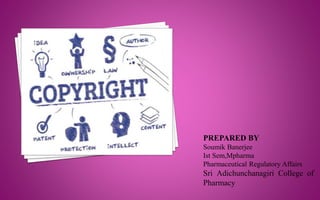
 Copyright is a right given by the law to creators of
literary, dramatic, musical and artistic works and
producers of cinematograph films and sound
recordings.
 Copyright also includes the set of exclusive rights
granted to the author or creator of an original work,
including the right to copy, distribute and adapt the
work.
 The Copyright Act, 1957 came into effect from January
1958. This Act has been amended five times since then, i.e.,
in 1983, 1984, 1992, 1994 and 1999, with the amendment of
1994 being the most substantial.
 Prior to the Act of 1957, the Law of Copyrights in the
country was governed by the Copyright Act of 1914. This
Act was essentially the extension of the British Copyright
Act, 1911 to India.
 Even the Copyright Act, 1957 borrowed extensively from
the new Copyright Act of the United Kingdom of 1956.
The Copyright Act, 1957 continues with the common law
traditions.
 The Indian Copyright Act today is compliant with
most international conventions and treaties in the field
of copyrights.
 India is a member of the Berne Convention of 1886
(as modified at Paris in 1971),
 The Universal Copyright Convention of 1951 and
 The Agreement on Trade Related Aspects of
Intellectual Property Rights (TRIPS)
 Two new treaties, collectively termed as Internet Treaties, were
negotiated in 1996 under the auspices of the World Intellectual
Property Organization (WIPO).
 These treaties are called the ‘WIPO Copyrights Treaty (WCT)’
and the ‘WIPO Performances and Phonograms Treaty
(WPPT)’.
 These treaties were negotiated essentially to provide for protection
of the rights of copyright holders, performers and producers of
phonograms in the Internet and digital era.
 India is not a member of these treaties; amendments are being
mooted to make Act in compliant with the above treaties in order
to provide protection to copyright in the digital era.
A Work has to be in a tangible form
It has to be Creative under one of the
category mentioned
It is the expression part not the idea
part
Originality is the criteria
 To reproduce work in any material form
 To issue copies
 To make translation
 To make any adaptation
 Reproduce two dimensional drawing in three
dimensional object
 First owner of Copyright:
 The author of a work shall be the first owner of the copyright.
Who is an author?
 In the case of a literary or dramatic work the author, i.e.,
the person who creates the work.
 In the case of a musical work, the composer. In the case of
a cinematograph film, the producer.
 In the case of a sound recording, the producer.
 In the case of a photograph, the photographer.
 In the case of a computer generated work, the person who
causes the work to be created.
 Copyright shall subsist in any literary, dramatic, musical or artistic
work published within the life time of the author until sixty years
from the beginning of the calendar year next following the year in
which the author dies ‘Calendar Year’ means the year
commencing on the first day of January.
 In the case of anonymous or pseudonymous works it is 60 years
from year of publication.
 In the case of posthumous publications it is 60 years from year
of publication.
 The period of copyright for photograph, cinematograph and sound
recording is until 60 years from the year of publication.
 If the first owner is government it is 60 years from the year of
publication.
 Temporal
Copyright does not continue indefinitely. The law
provides for a period of time, a duration, during which
the rights of the copyright owner exist.
 Geographic
The owner of the copyright in a work is protected by
the law of a country against acts restricted by copyright
which are done in that country. For protection against
such acts done in another country, he must refer to the
law of that other country.
 Permitted Use
• Certain acts normally restricted by copyright may, in
circumstances specified in the law, be done without the
authorization of the copyright owner.
• Some examples of such exceptions are described as
“fair use.” Such examples include reproduction of a
work exclusively for the personal and private use of the
person who makes the reproduction;
• another example is the making of quotations from a
protected work, provided that the source of the
quotation, including the name of the author, is
mentioned and that the extent of the quotation is
compatible with fair practice.
 Section 9 of the Copyright Act requires for
establishment of an office to be called the
Copyright Office for the purpose of the Act. The
Copyright Office is to be under the immediate
control of a Registrar of Copyrights to be
appointed by the Central Government
 The Copyright Office is currently located at the
following address: B-2/W-3, Curzon Road
Barracks Kasturba Gandhi Marg New Delhi -
110001
 Section 11 of the Copyright Act requires the Central
Government to constitute a Copyright Board headed by
a Chairman with not less than two and not more than
14 other members.
 Section 12 of the Copyright Act also lays down the
powers of the Copyright Board and deems it to be a
civil court for the purposes of Sections 345 and 346 of
the Code of Criminal Procedure
 The Chairman of the Board is of the level of a judge of
a High Court. The Board has the power to:
– hear appeals against the orders of the Registrar of
Copyright;
– hear applications for rectification of entries in the
Register of Copyrights;
– adjudicate upon disputes on assignment
 grant compulsory licence to produce and publish a
translation of a literary or dramatic work in any
language after a period of seven years from the first
publication of the work.
 hear and decide disputes as to whether a work has been
published or about the date of publication or about the
term of copyright of a work in another country.
 CEAC The government has set up a Copyright
Enforcement Advisory Council (CEAC)
 Chairman
 Additional Secretary, Department of Education, Ministry
of Human Resource Development (Ex-officio)
 Vice-Chairman
 Joint Secretary in-charge of Book Promotion and
Copyright Division, Department of Education (Ex-officio)
 The rights of an owner of copyright are infringed
when one of the acts requiring authorization of the
owner is done by someone else without his consent.
 The unauthorized copying of copyright materials for
commercial purposes and the unauthorized commercial
dealing in copied materials is known as “piracy”.
 Infringing a copy means
 In relation to a literary, dramatic, musical or artistic
work, a reproduction thereof otherwise than in the form
of a cinematograph film,
 In relation to cinematograph film, a copy of the film
made on any medium by any means,
 In relation to a sound recording any other recording,
embodying the same sound recording, made by any
means
 Making infringing copies for sale or hire or selling or
letting them for hire; –
 Permitting any place for the performance of works in
public where such performance constitutes
infringement of copyright;
 Distributing infringing copies for the purpose of
trade or to such an extent so as to affect prejudicially
the interest of the owner of copyright ;
 Public exhibition of infringing copies by way of trade
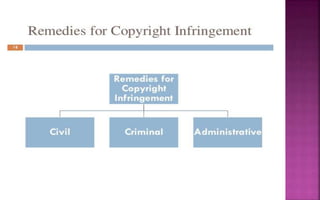
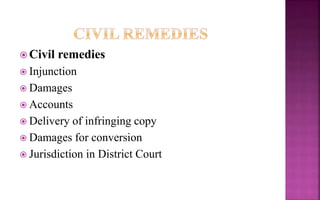
 Civil remedies
 Injunction
 Damages
 Accounts
 Delivery of infringing copy
 Damages for conversion
 Jurisdiction in District Court
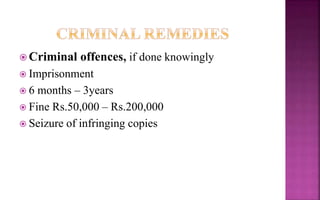
 Criminal offences, if done knowingly
 Imprisonment
 6 months – 3years
 Fine Rs.50,000 – Rs.200,000
 Seizure of infringing copies
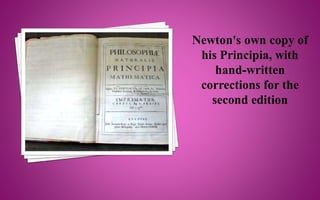
Newton's own copy of
his Principia, with
hand-written
corrections for the
second edition
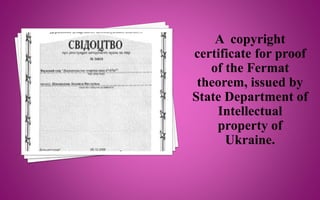
A copyright
certificate for proof
of the Fermat
theorem, issued by
State Department of
Intellectual
property of
Ukraine.
Newspaper advert
“United States and
Foriegn
Copyright.Patents and
Trade –Marks A
Copyright will protect
you from Pirates.And
make you a fortune”.
 Copyright.gov.in
 Legalserviceindia.com
 Indiacode.nic.in
 Images from Google
 Wikipedia
Copyright

Copyright

  • 1.
    PREPARED BY Soumik Banerjee IstSem,Mpharma Pharmaceutical Regulatory Affairs Sri Adichunchanagiri College of Pharmacy
  • 2.
     Copyright isa right given by the law to creators of literary, dramatic, musical and artistic works and producers of cinematograph films and sound recordings.  Copyright also includes the set of exclusive rights granted to the author or creator of an original work, including the right to copy, distribute and adapt the work.
  • 3.
     The CopyrightAct, 1957 came into effect from January 1958. This Act has been amended five times since then, i.e., in 1983, 1984, 1992, 1994 and 1999, with the amendment of 1994 being the most substantial.  Prior to the Act of 1957, the Law of Copyrights in the country was governed by the Copyright Act of 1914. This Act was essentially the extension of the British Copyright Act, 1911 to India.  Even the Copyright Act, 1957 borrowed extensively from the new Copyright Act of the United Kingdom of 1956. The Copyright Act, 1957 continues with the common law traditions.
  • 4.
     The IndianCopyright Act today is compliant with most international conventions and treaties in the field of copyrights.  India is a member of the Berne Convention of 1886 (as modified at Paris in 1971),  The Universal Copyright Convention of 1951 and  The Agreement on Trade Related Aspects of Intellectual Property Rights (TRIPS)
  • 5.
     Two newtreaties, collectively termed as Internet Treaties, were negotiated in 1996 under the auspices of the World Intellectual Property Organization (WIPO).  These treaties are called the ‘WIPO Copyrights Treaty (WCT)’ and the ‘WIPO Performances and Phonograms Treaty (WPPT)’.  These treaties were negotiated essentially to provide for protection of the rights of copyright holders, performers and producers of phonograms in the Internet and digital era.  India is not a member of these treaties; amendments are being mooted to make Act in compliant with the above treaties in order to provide protection to copyright in the digital era.
  • 6.
    A Work hasto be in a tangible form It has to be Creative under one of the category mentioned It is the expression part not the idea part Originality is the criteria
  • 7.
     To reproducework in any material form  To issue copies  To make translation  To make any adaptation  Reproduce two dimensional drawing in three dimensional object
  • 8.
     First ownerof Copyright:  The author of a work shall be the first owner of the copyright. Who is an author?  In the case of a literary or dramatic work the author, i.e., the person who creates the work.  In the case of a musical work, the composer. In the case of a cinematograph film, the producer.  In the case of a sound recording, the producer.  In the case of a photograph, the photographer.  In the case of a computer generated work, the person who causes the work to be created.
  • 9.
     Copyright shallsubsist in any literary, dramatic, musical or artistic work published within the life time of the author until sixty years from the beginning of the calendar year next following the year in which the author dies ‘Calendar Year’ means the year commencing on the first day of January.  In the case of anonymous or pseudonymous works it is 60 years from year of publication.  In the case of posthumous publications it is 60 years from year of publication.  The period of copyright for photograph, cinematograph and sound recording is until 60 years from the year of publication.  If the first owner is government it is 60 years from the year of publication.
  • 10.
     Temporal Copyright doesnot continue indefinitely. The law provides for a period of time, a duration, during which the rights of the copyright owner exist.  Geographic The owner of the copyright in a work is protected by the law of a country against acts restricted by copyright which are done in that country. For protection against such acts done in another country, he must refer to the law of that other country.
  • 11.
     Permitted Use •Certain acts normally restricted by copyright may, in circumstances specified in the law, be done without the authorization of the copyright owner. • Some examples of such exceptions are described as “fair use.” Such examples include reproduction of a work exclusively for the personal and private use of the person who makes the reproduction; • another example is the making of quotations from a protected work, provided that the source of the quotation, including the name of the author, is mentioned and that the extent of the quotation is compatible with fair practice.
  • 12.
     Section 9of the Copyright Act requires for establishment of an office to be called the Copyright Office for the purpose of the Act. The Copyright Office is to be under the immediate control of a Registrar of Copyrights to be appointed by the Central Government  The Copyright Office is currently located at the following address: B-2/W-3, Curzon Road Barracks Kasturba Gandhi Marg New Delhi - 110001
  • 13.
     Section 11of the Copyright Act requires the Central Government to constitute a Copyright Board headed by a Chairman with not less than two and not more than 14 other members.  Section 12 of the Copyright Act also lays down the powers of the Copyright Board and deems it to be a civil court for the purposes of Sections 345 and 346 of the Code of Criminal Procedure
  • 14.
     The Chairmanof the Board is of the level of a judge of a High Court. The Board has the power to: – hear appeals against the orders of the Registrar of Copyright; – hear applications for rectification of entries in the Register of Copyrights; – adjudicate upon disputes on assignment
  • 15.
     grant compulsorylicence to produce and publish a translation of a literary or dramatic work in any language after a period of seven years from the first publication of the work.  hear and decide disputes as to whether a work has been published or about the date of publication or about the term of copyright of a work in another country.
  • 17.
     CEAC Thegovernment has set up a Copyright Enforcement Advisory Council (CEAC)
  • 18.
     Chairman  AdditionalSecretary, Department of Education, Ministry of Human Resource Development (Ex-officio)  Vice-Chairman  Joint Secretary in-charge of Book Promotion and Copyright Division, Department of Education (Ex-officio)
  • 19.
     The rightsof an owner of copyright are infringed when one of the acts requiring authorization of the owner is done by someone else without his consent.  The unauthorized copying of copyright materials for commercial purposes and the unauthorized commercial dealing in copied materials is known as “piracy”.
  • 20.
     Infringing acopy means  In relation to a literary, dramatic, musical or artistic work, a reproduction thereof otherwise than in the form of a cinematograph film,  In relation to cinematograph film, a copy of the film made on any medium by any means,  In relation to a sound recording any other recording, embodying the same sound recording, made by any means
  • 21.
     Making infringingcopies for sale or hire or selling or letting them for hire; –  Permitting any place for the performance of works in public where such performance constitutes infringement of copyright;  Distributing infringing copies for the purpose of trade or to such an extent so as to affect prejudicially the interest of the owner of copyright ;  Public exhibition of infringing copies by way of trade
  • 23.
     Civil remedies Injunction  Damages  Accounts  Delivery of infringing copy  Damages for conversion  Jurisdiction in District Court
  • 24.
     Criminal offences,if done knowingly  Imprisonment  6 months – 3years  Fine Rs.50,000 – Rs.200,000  Seizure of infringing copies
  • 26.
    Newton's own copyof his Principia, with hand-written corrections for the second edition
  • 27.
    A copyright certificate forproof of the Fermat theorem, issued by State Department of Intellectual property of Ukraine.
  • 28.
    Newspaper advert “United Statesand Foriegn Copyright.Patents and Trade –Marks A Copyright will protect you from Pirates.And make you a fortune”.
  • 29.
     Copyright.gov.in  Legalserviceindia.com Indiacode.nic.in  Images from Google  Wikipedia