Intellectual Property
Rights
Indian Perspective
Presented by :
Anirudh Pandey
10eiecs005
VIIIth semester
CONTENTS
• Introduction to Intellectual Property
• What are Intellectual Property Rights?
• Patents
• Trademarks
• Industrial Designs
• Copyright and Related Laws
• Case Studies
• Facts
• Conclusion
Introduction to Intellectual Property
• Intellectual Property refers to creation of mind i.e. inventions,
industrial designs for article, literary & artistic work, symbols etc. used
in commerce.
• Two categories: Industrial property & Copyright.
• Industrial property: Trademarks, Patents etc.
• Copyright covers Artistic works, Literary works etc..
What Are Intellectual Property Rights ?
• Rights which can be used for protecting different aspects of an
inventive work for multiple protection.
• Outlined in Article 27 of the Universal Declaration of Human
Rights.
• IPR are largely territorial rights except copyright, which is global
in nature.
• IPR can be assigned, gifted, sold and licensed like any other
property.
Continued…….
• Intellectual property rights as a collective term includes the
following independent IP rights:
• Patents
• Copyrights
• Trademarks
• Registered ( industrial) design
• Geographical indications, and
• Protection of undisclosed information
Patents
• An exclusive right granted by a country to the owner of an
invention to make, use, manufacture and market the invention
• The patent right is territorial in nature.
• Patents provide incentives to individuals by recognizing their
creativity & these incentives encourage innovation.
• India is a member-state of Word Intellectual Property
Organisation (WIPO), Paris Convention, Patent Cooperation
Treaty and Budapest Treaty.
Patents In India
• The Patents Act, 1970 (No. 39 of 1970) as amended by the
Patents (Amendment) Act, 2005.
• Patent Offices, under the Department of Industrial Policy &
Promotion, Ministry of Commerce & Industry.
• Patent Offices are located at Kolkata, Mumbai, Chennai and
Delhi to deal with the applications for patents.
• Patent Information System (PIS) & Intellectual Property Training
Institute (IPTI) located at Nagpur.
Trademarks
• A distinctive sign that provides to the owner of the mark by
ensuring the exclusive right to use it to identify goods or
services.
• Well-known, Associated trademarks, Service marks,
Certification Trademarks, Collective Marks.
• Term of Registered Trademark: 10 years and Renewable.
• To register a trademark: appropriate national or regional
trademark office. WIPO administers an international registration
system for trademarks.
Industrial Designs
• The ornamental or aesthetic aspects of an article which may
consist of 3D or 2D features, such as shape or surface,
patterns, lines or color.
• It makes an article attractive and appealing; hence, they add to
the commercial value of a product and increase its marketability.
• Any technical features of the article not protected by it.
Continued…..
• Applicants can file a single international application either with
WIPO or the national or regional office of a country party to the
treaty.
• The design should be new or original, not previously published
or used in any country before Registration.
• Total term of a registered design is 10 years + 5 years Extended
Period.
Geographical Indication
• A sign used on goods that have a specific geographical origin
and possess qualities or a reputation due to that place of origin.
• Registration of a GI: 10 years & renewable.
• The Geographical Indication of Goods (Registration and
Protection) Act came into being in 2000.
• Imprisonment for a term between 6 months to 3 years and a fine
between 50000 rupees to 2 lakh rupees in Act.
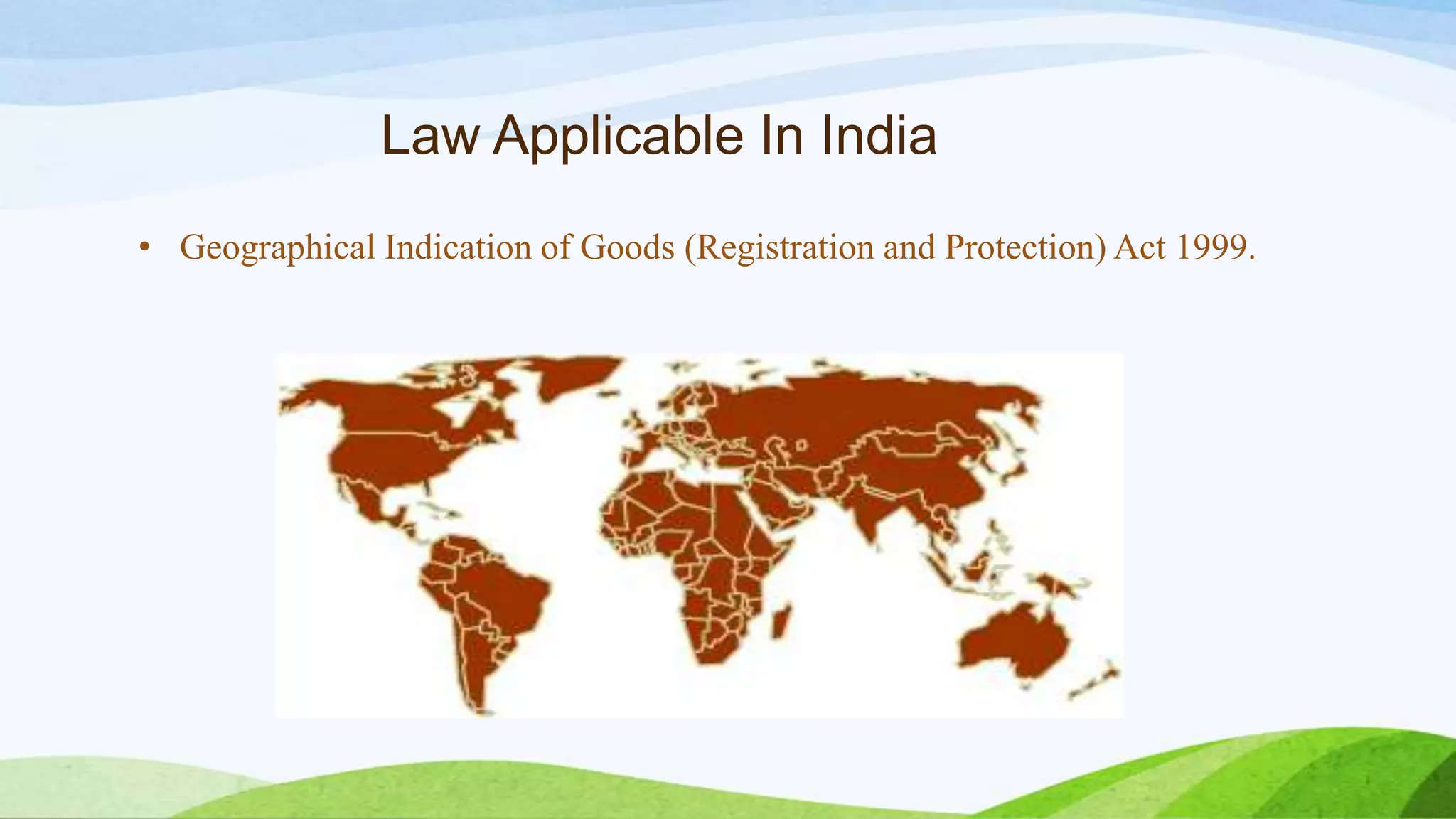
Law Applicable In India
• Geographical Indication of Goods (Registration and Protection) Act 1999.
Copyrights
• Copyright is a legal concept, enacted by most governments,
that grants the creator of an original work exclusive rights to its
use and distribution.
• A right, which is available for creating an original literary or
dramatic or musical or artistic work.
• In India, The Copyright Act, 1957 as amended in 1983, 1984,
1992, 1994 and 1999 is available.
• Registration can be done at the Office of the Registrar of
Copyrights in New Delhi.
• Protection for the expression of an idea and not for the idea
itself.
Continued…..
• The owner may assign to any person the copyright.
• Giving owner, incentives in the form of recognition and fair
economic reward increases their activity.
• The work is open for public inspection once the copyright is
registered.
• A provision of ‘fair use’ in the law, which allows copyrighted work
to be used for teaching and research and development.
Case Studies
• Bangalore Aug 10, 2003: Banashankari police arrested three
software engineers for illegally copying software from a
company they were working for.
• Chennai, February 2000: Pirated software worth Rs.1.11 crore
(US$ 253,200) was seized by the Chennai police A total of 6
employees were arrested which included the Managing Director
of one outlet and proprietors of each of the outlets.
Facts
• In India, small and medium scale Industries are the ones who come
out with maximum(90%) innovations.
• B.E students who do projects in their respective discipline, can register
their projects under IPR if its really innovative.
• As soon as the duration of the protection through IPR is over, it
becomes a public domain.
• Many companies use this IPR as a weapon to compete with the other
players in the market.
Facts Continued…
• IPR is given to a product, only when its used for commercial purpose.
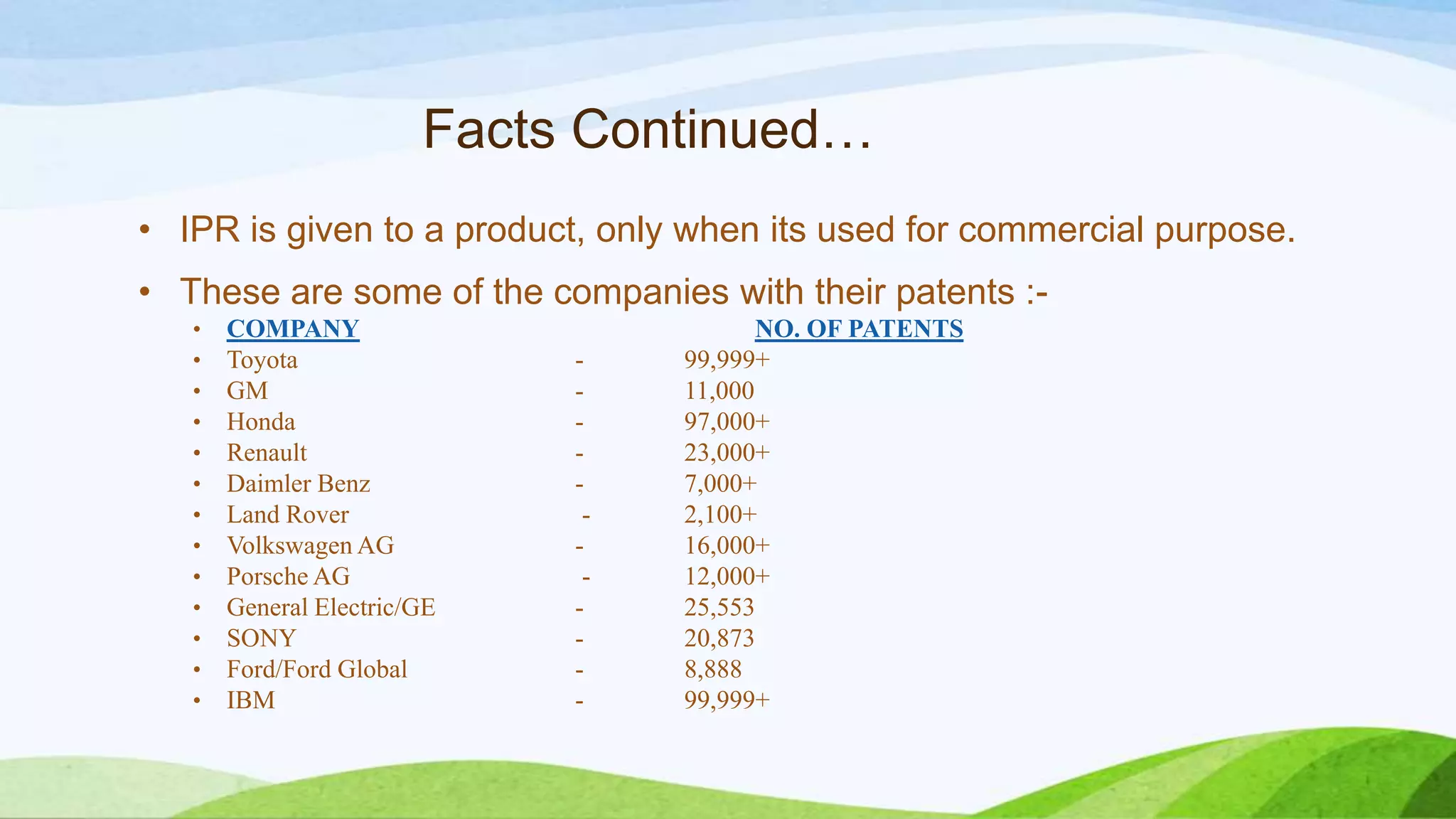
• These are some of the companies with their patents :-
• COMPANY NO. OF PATENTS
• Toyota - 99,999+
• GM - 11,000
• Honda - 97,000+
• Renault - 23,000+
• Daimler Benz - 7,000+
• Land Rover - 2,100+
• Volkswagen AG - 16,000+
• Porsche AG - 12,000+
• General Electric/GE - 25,553
• SONY - 20,873
• Ford/Ford Global - 8,888
• IBM - 99,999+
CONCLUSION
• Intellectual property rights reward creativity and human
endeavor, which fuel the progress of humankind.
• Understanding the country’s IP Rights and following the best
practices can drastically reduce the risk of losing the company’s
intellectual property.
• Indian government has initiated various steps towards
Intellectual Properties Rights Protection.
References And Bibliography
• WWW.Wikipidea.org
Intellectual property rights

Intellectual property rights

  • 1.
    Intellectual Property Rights Indian Perspective Presentedby : Anirudh Pandey 10eiecs005 VIIIth semester
  • 2.
    CONTENTS • Introduction toIntellectual Property • What are Intellectual Property Rights? • Patents • Trademarks • Industrial Designs • Copyright and Related Laws • Case Studies • Facts • Conclusion
  • 3.
    Introduction to IntellectualProperty • Intellectual Property refers to creation of mind i.e. inventions, industrial designs for article, literary & artistic work, symbols etc. used in commerce. • Two categories: Industrial property & Copyright. • Industrial property: Trademarks, Patents etc. • Copyright covers Artistic works, Literary works etc..
  • 4.
    What Are IntellectualProperty Rights ? • Rights which can be used for protecting different aspects of an inventive work for multiple protection. • Outlined in Article 27 of the Universal Declaration of Human Rights. • IPR are largely territorial rights except copyright, which is global in nature. • IPR can be assigned, gifted, sold and licensed like any other property.
  • 5.
    Continued……. • Intellectual propertyrights as a collective term includes the following independent IP rights: • Patents • Copyrights • Trademarks • Registered ( industrial) design • Geographical indications, and • Protection of undisclosed information
  • 6.
    Patents • An exclusiveright granted by a country to the owner of an invention to make, use, manufacture and market the invention • The patent right is territorial in nature. • Patents provide incentives to individuals by recognizing their creativity & these incentives encourage innovation. • India is a member-state of Word Intellectual Property Organisation (WIPO), Paris Convention, Patent Cooperation Treaty and Budapest Treaty.
  • 7.
    Patents In India •The Patents Act, 1970 (No. 39 of 1970) as amended by the Patents (Amendment) Act, 2005. • Patent Offices, under the Department of Industrial Policy & Promotion, Ministry of Commerce & Industry. • Patent Offices are located at Kolkata, Mumbai, Chennai and Delhi to deal with the applications for patents. • Patent Information System (PIS) & Intellectual Property Training Institute (IPTI) located at Nagpur.
  • 8.
    Trademarks • A distinctivesign that provides to the owner of the mark by ensuring the exclusive right to use it to identify goods or services. • Well-known, Associated trademarks, Service marks, Certification Trademarks, Collective Marks. • Term of Registered Trademark: 10 years and Renewable. • To register a trademark: appropriate national or regional trademark office. WIPO administers an international registration system for trademarks.
  • 9.
    Industrial Designs • Theornamental or aesthetic aspects of an article which may consist of 3D or 2D features, such as shape or surface, patterns, lines or color. • It makes an article attractive and appealing; hence, they add to the commercial value of a product and increase its marketability. • Any technical features of the article not protected by it.
  • 10.
    Continued….. • Applicants canfile a single international application either with WIPO or the national or regional office of a country party to the treaty. • The design should be new or original, not previously published or used in any country before Registration. • Total term of a registered design is 10 years + 5 years Extended Period.
  • 11.
    Geographical Indication • Asign used on goods that have a specific geographical origin and possess qualities or a reputation due to that place of origin. • Registration of a GI: 10 years & renewable. • The Geographical Indication of Goods (Registration and Protection) Act came into being in 2000. • Imprisonment for a term between 6 months to 3 years and a fine between 50000 rupees to 2 lakh rupees in Act.
  • 12.
    Law Applicable InIndia • Geographical Indication of Goods (Registration and Protection) Act 1999.
  • 13.
    Copyrights • Copyright isa legal concept, enacted by most governments, that grants the creator of an original work exclusive rights to its use and distribution. • A right, which is available for creating an original literary or dramatic or musical or artistic work. • In India, The Copyright Act, 1957 as amended in 1983, 1984, 1992, 1994 and 1999 is available. • Registration can be done at the Office of the Registrar of Copyrights in New Delhi. • Protection for the expression of an idea and not for the idea itself.
  • 14.
    Continued….. • The ownermay assign to any person the copyright. • Giving owner, incentives in the form of recognition and fair economic reward increases their activity. • The work is open for public inspection once the copyright is registered. • A provision of ‘fair use’ in the law, which allows copyrighted work to be used for teaching and research and development.
  • 15.
    Case Studies • BangaloreAug 10, 2003: Banashankari police arrested three software engineers for illegally copying software from a company they were working for. • Chennai, February 2000: Pirated software worth Rs.1.11 crore (US$ 253,200) was seized by the Chennai police A total of 6 employees were arrested which included the Managing Director of one outlet and proprietors of each of the outlets.
  • 16.
    Facts • In India,small and medium scale Industries are the ones who come out with maximum(90%) innovations. • B.E students who do projects in their respective discipline, can register their projects under IPR if its really innovative. • As soon as the duration of the protection through IPR is over, it becomes a public domain. • Many companies use this IPR as a weapon to compete with the other players in the market.
  • 17.
    Facts Continued… • IPRis given to a product, only when its used for commercial purpose. • These are some of the companies with their patents :- • COMPANY NO. OF PATENTS • Toyota - 99,999+ • GM - 11,000 • Honda - 97,000+ • Renault - 23,000+ • Daimler Benz - 7,000+ • Land Rover - 2,100+ • Volkswagen AG - 16,000+ • Porsche AG - 12,000+ • General Electric/GE - 25,553 • SONY - 20,873 • Ford/Ford Global - 8,888 • IBM - 99,999+
  • 18.
    CONCLUSION • Intellectual propertyrights reward creativity and human endeavor, which fuel the progress of humankind. • Understanding the country’s IP Rights and following the best practices can drastically reduce the risk of losing the company’s intellectual property. • Indian government has initiated various steps towards Intellectual Properties Rights Protection.
  • 19.