A
Paul Keller | 27 july 2009
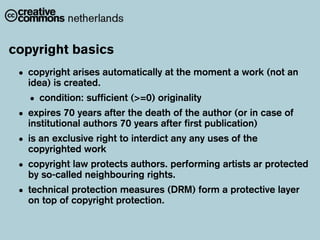
copyright basics
 • copyright arises automatically at the moment a work (not an
   idea) is created.
   • condition: sufficient (>=0) originality
 • expires 70 years after the death of first author (or in case of
   institutional authors 70 years after
                                        the
                                             publication)
 • is an exclusive right to interdict any any uses of the
   copyrighted work
 • copyright law protects authors. performing artists ar protected
   by so-called neighbouring rights.
 • technical copyright protection. (DRM) form a protective layer
   on top of
             protection measures
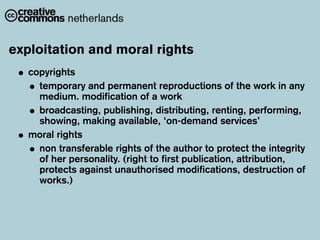
exploitation and moral rights
 • copyrights
   • temporary and permanent reproductions of the work in any
     medium. modification of a work
   • broadcasting, publishing, distributing, renting, performing,
     showing, making available, ‘on-demand services’
 • moral rights
   • non transferable rights of the author to protect the integrity
     of her personality. (right to first publication, attribution,
     protects against unauthorised modifications, destruction of
     works.)
exceptions and limitations
 • there are a(fair use rights in the US). there is no international
   protection
               number of exceptions and limitations of copyright

   standardisation of these rights.
   • the right to make quotations
   • private copying
   • educational exceptions
   • reporting about public intrest events
   • re use of press material by the press
personality/publicity rights
 • publicity rights allow used for commercial purposes in public.
   image or likeness is
                          individuals to control how their voice,

 • are different form copyrights or any other intellectual property
   right.
 • are not internationally harmonized to the same extend as
   copyright.
 • protect the (usually not the person holding copyright).
   recordings
               persons depicted in photos, videos and audio

 • rule of of anyoneaother than thework includes the voicework
   image
           thumb: If CC-licensed
                                   licensor, a user of the
                                                           or

   may need to get permission from those individuals before
   using the work for commercial purposes.
The challenges posed by copyright
 •   do not sufficiently recognize that there are other motivations
     for knowledge production than rent seeking.
 •   limits authors who want to share information and works
 •   limits access to information especially for so called orphan
     works (that have become accessible via digital networks)
 •   pursue a one size fits all approach that threats professionals,
     non-professionals, government actors, educational users and
     large commercial distributers the same.
A
about Creative Commons
 •   Creative Commons is a nonprofit organization We work to
     increase the amount of creativity (cultural, educational, and
     scientific content) in “the commons” — the body of work that
     is available to the public for free and legal sharing, use,
     repurposing, and remixing.
 •   CC provides free, easy-to-use legal tools Our tools give
     everyone from individual creators to large companies and
     institutions a simple, standardized way to grant copyright
     permissions to their creative work. The Creative Commons
     licenses enable people to easily change their copyright terms
     from the default of “all rights reserved” to “some rights
     reserved.”
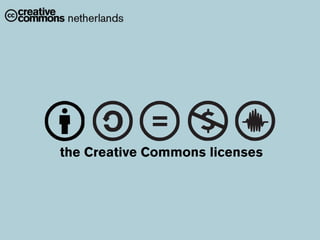
the Creative Commons licenses
the Creative Commons licenses (1)
 •   the Creative Commons licenses are the most widely used
     open content licenses:
     • more than a 100 million photographs on flickr.com are
        available under a creative commons licens
     • it is the standard copyright license used by wikipedia.org
     • It is quickly becoming the standard licensing scheme for
        Open Educational Ressources (OER).
 •   they are an instrument for creators to exercise their copy
     rights: to give away certain rights while reserving others
 •   Creative Commons offers six different standard licenses that
     can be used by anyone free of charge:
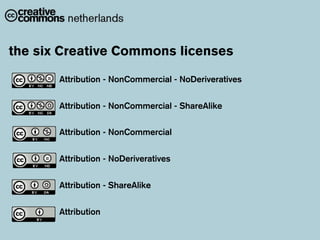
the six Creative Commons licenses

       Attribution - NonCommercial - NoDeriveratives


       Attribution - NonCommercial - ShareAlike


       Attribution - NonCommercial


       Attribution - NoDeriveratives


       Attribution - ShareAlike


       Attribution
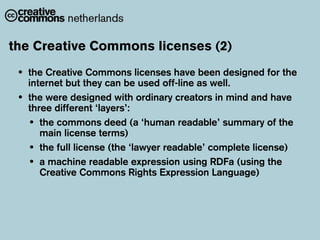
the Creative Commons licenses (2)
 •   the Creative Commons licenses have been designed for the
     internet but they can be used off-line as well.
 •   the were designed with ordinary creators in mind and have
     three different ‘layers’:
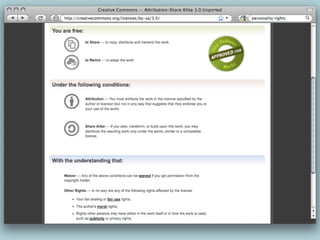
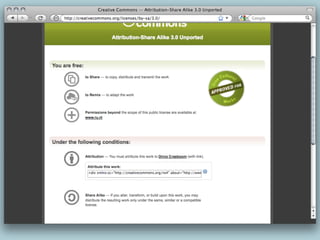
     • the commons deed (a ‘human readable’ summary of the
        main license terms)
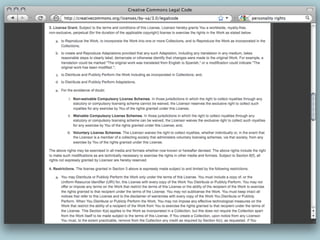
     • the full license (the ‘lawyer readable’ complete license)
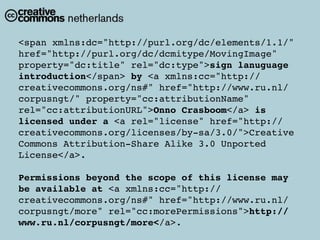
     • a machine readable expression using RDFa (using the
        Creative Commons Rights Expression Language)
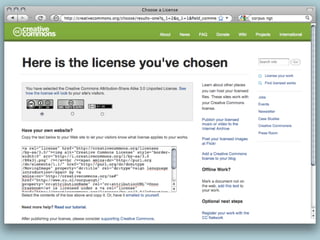
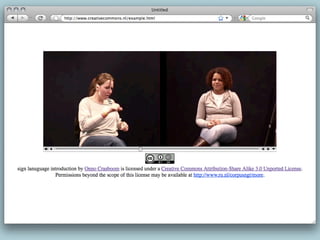
<span xmlns:dc="http://purl.org/dc/elements/1.1/"
href="http://purl.org/dc/dcmitype/MovingImage"
property="dc:title" rel="dc:type">sign lanuguage
introduction</span> by <a xmlns:cc="http://
creativecommons.org/ns#" href="http://www.ru.nl/
corpusngt/" property="cc:attributionName"
rel="cc:attributionURL">Onno Crasboom</a> is
licensed under a <a rel="license" href="http://
creativecommons.org/licenses/by-sa/3.0/">Creative
Commons Attribution-Share Alike 3.0 Unported
License</a>.

Permissions beyond the scope of this license may
be available at <a xmlns:cc="http://
creativecommons.org/ns#" href="http://www.ru.nl/
corpusngt/more" rel="cc:morePermissions">http://
www.ru.nl/corpusngt/more</a>.
the Creative Commons Licenses (rights)
 •   all six Creative Commons licenses allow everyone to:
     • to Share - to copy, distribute, display, and perform the
        work (for non-commercial purposes)
     • to transfer the work into another format
     • under the condition that the user gives proper attribution
        to the original author and provides a link to the licenses

     •   the licensor can choose if she wants to limit these rights to
         non-commercial uses of the licensed work or allow reuse
         and distribution for commercial purposes as well.
the Creative Commons licenses (reuse)
 •   the author can further determine if he wants to allow
     distribution or performance of derivative works (remixes) or
     not (No Derivative Works)

 •   it is also possible to make the right to distribute remixes
     conditional on the fact that they are also released under a
     Creative Commons license that allows remixing
     (ShareAlike)
Important characteristics
 •   expressly drafted not to limit 'fair use' rights
 •   a non-exclusive, irrevocable public license
 •   CC licensor enters into a separate license agreement with
     each user
 •   no warranties
 •   license terminates immediately upon breach
 •   does not cover personality rights
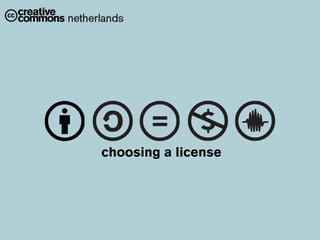
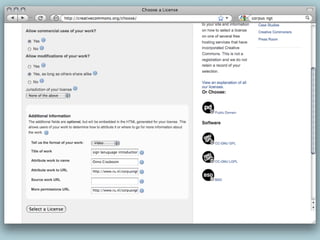
choosing a license
Creative Commons
Creative Commons
Creative Commons
Creative Commons

Creative Commons

  • 1.
    A Paul Keller |27 july 2009
  • 2.
    copyright basics •copyright arises automatically at the moment a work (not an idea) is created. • condition: sufficient (>=0) originality • expires 70 years after the death of first author (or in case of institutional authors 70 years after the publication) • is an exclusive right to interdict any any uses of the copyrighted work • copyright law protects authors. performing artists ar protected by so-called neighbouring rights. • technical copyright protection. (DRM) form a protective layer on top of protection measures
  • 3.
    exploitation and moralrights • copyrights • temporary and permanent reproductions of the work in any medium. modification of a work • broadcasting, publishing, distributing, renting, performing, showing, making available, ‘on-demand services’ • moral rights • non transferable rights of the author to protect the integrity of her personality. (right to first publication, attribution, protects against unauthorised modifications, destruction of works.)
  • 4.
    exceptions and limitations • there are a(fair use rights in the US). there is no international protection number of exceptions and limitations of copyright standardisation of these rights. • the right to make quotations • private copying • educational exceptions • reporting about public intrest events • re use of press material by the press
  • 5.
    personality/publicity rights •publicity rights allow used for commercial purposes in public. image or likeness is individuals to control how their voice, • are different form copyrights or any other intellectual property right. • are not internationally harmonized to the same extend as copyright. • protect the (usually not the person holding copyright). recordings persons depicted in photos, videos and audio • rule of of anyoneaother than thework includes the voicework image thumb: If CC-licensed licensor, a user of the or may need to get permission from those individuals before using the work for commercial purposes.
  • 6.
    The challenges posedby copyright • do not sufficiently recognize that there are other motivations for knowledge production than rent seeking. • limits authors who want to share information and works • limits access to information especially for so called orphan works (that have become accessible via digital networks) • pursue a one size fits all approach that threats professionals, non-professionals, government actors, educational users and large commercial distributers the same.
  • 7.
  • 8.
    about Creative Commons • Creative Commons is a nonprofit organization We work to increase the amount of creativity (cultural, educational, and scientific content) in “the commons” — the body of work that is available to the public for free and legal sharing, use, repurposing, and remixing. • CC provides free, easy-to-use legal tools Our tools give everyone from individual creators to large companies and institutions a simple, standardized way to grant copyright permissions to their creative work. The Creative Commons licenses enable people to easily change their copyright terms from the default of “all rights reserved” to “some rights reserved.”
  • 9.
  • 10.
    the Creative Commonslicenses (1) • the Creative Commons licenses are the most widely used open content licenses: • more than a 100 million photographs on flickr.com are available under a creative commons licens • it is the standard copyright license used by wikipedia.org • It is quickly becoming the standard licensing scheme for Open Educational Ressources (OER). • they are an instrument for creators to exercise their copy rights: to give away certain rights while reserving others • Creative Commons offers six different standard licenses that can be used by anyone free of charge:
  • 11.
    the six CreativeCommons licenses Attribution - NonCommercial - NoDeriveratives Attribution - NonCommercial - ShareAlike Attribution - NonCommercial Attribution - NoDeriveratives Attribution - ShareAlike Attribution
  • 12.
    the Creative Commonslicenses (2) • the Creative Commons licenses have been designed for the internet but they can be used off-line as well. • the were designed with ordinary creators in mind and have three different ‘layers’: • the commons deed (a ‘human readable’ summary of the main license terms) • the full license (the ‘lawyer readable’ complete license) • a machine readable expression using RDFa (using the Creative Commons Rights Expression Language)
  • 15.
    <span xmlns:dc="http://purl.org/dc/elements/1.1/" href="http://purl.org/dc/dcmitype/MovingImage" property="dc:title" rel="dc:type">signlanuguage introduction</span> by <a xmlns:cc="http:// creativecommons.org/ns#" href="http://www.ru.nl/ corpusngt/" property="cc:attributionName" rel="cc:attributionURL">Onno Crasboom</a> is licensed under a <a rel="license" href="http:// creativecommons.org/licenses/by-sa/3.0/">Creative Commons Attribution-Share Alike 3.0 Unported License</a>. Permissions beyond the scope of this license may be available at <a xmlns:cc="http:// creativecommons.org/ns#" href="http://www.ru.nl/ corpusngt/more" rel="cc:morePermissions">http:// www.ru.nl/corpusngt/more</a>.
  • 16.
    the Creative CommonsLicenses (rights) • all six Creative Commons licenses allow everyone to: • to Share - to copy, distribute, display, and perform the work (for non-commercial purposes) • to transfer the work into another format • under the condition that the user gives proper attribution to the original author and provides a link to the licenses • the licensor can choose if she wants to limit these rights to non-commercial uses of the licensed work or allow reuse and distribution for commercial purposes as well.
  • 17.
    the Creative Commonslicenses (reuse) • the author can further determine if he wants to allow distribution or performance of derivative works (remixes) or not (No Derivative Works) • it is also possible to make the right to distribute remixes conditional on the fact that they are also released under a Creative Commons license that allows remixing (ShareAlike)
  • 18.
    Important characteristics • expressly drafted not to limit 'fair use' rights • a non-exclusive, irrevocable public license • CC licensor enters into a separate license agreement with each user • no warranties • license terminates immediately upon breach • does not cover personality rights
  • 19.