COPYRIGHT AND COPYRIGHT
INFRINGEMENT
INTRODUCTION TO COPYRIGHT
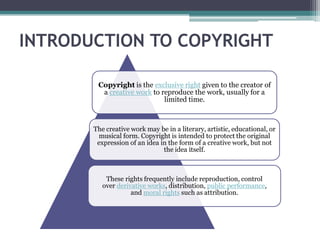
Copyright is the exclusive right given to the creator of
a creative work to reproduce the work, usually for a
limited time.
The creative work may be in a literary, artistic, educational, or
musical form. Copyright is intended to protect the original
expression of an idea in the form of a creative work, but not
the idea itself.
These rights frequently include reproduction, control
over derivative works, distribution, public performance,
and moral rights such as attribution.
THE COPYRIGHT ACT,1957
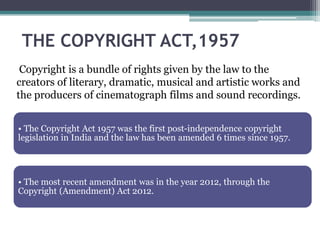
Copyright is a bundle of rights given by the law to the
creators of literary, dramatic, musical and artistic works and
the producers of cinematograph films and sound recordings.
• The Copyright Act 1957 was the first post-independence copyright
legislation in India and the law has been amended 6 times since 1957.
• The most recent amendment was in the year 2012, through the
Copyright (Amendment) Act 2012.
DURATION OF COPYRIGHT
PROTECTION
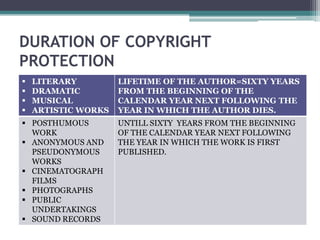
 LITERARY
 DRAMATIC
 MUSICAL
 ARTISTIC WORKS
LIFETIME OF THE AUTHOR=SIXTY YEARS
FROM THE BEGINNING OF THE
CALENDAR YEAR NEXT FOLLOWING THE
YEAR IN WHICH THE AUTHOR DIES.
 POSTHUMOUS
WORK
 ANONYMOUS AND
PSEUDONYMOUS
WORKS
 CINEMATOGRAPH
FILMS
 PHOTOGRAPHS
 PUBLIC
UNDERTAKINGS
 SOUND RECORDS
UNTILL SIXTY YEARS FROM THE BEGINNING
OF THE CALENDAR YEAR NEXT FOLLOWING
THE YEAR IN WHICH THE WORK IS FIRST
PUBLISHED.
RIGHTS UNDER COPYRIGHT LAW
Copyright is the soul of Film, Audio-visual recording,
Literature in Book forms and Computer Software Industry.
The author of a copyrighted work enjoys the following
exclusive economic rights:
• Right to reproduce
• Right to publish
• To adapt and translate
• To communicate/perform in public
• To assign, license or bequeath the copyright to another party.
RIGHTS UNDER COPYRIGHT LAW
In relation to films and records, it gives exclusive rights to
the owner to make copies of the film and communicate the
film to the public by broadcasting means.
In relation to computer software it gives exclusive rights to
sell or give rental any copy of computer program.
INFRINGEMENT OF COPYRIGHT
LAW
• Copyright infringement occurs when any person does any of the
mentioned rights and activities with respect to a copyrighted
work
WITHOUT A LICENSE.
• It leads to economic loss to the owners of copyright. Besides
economic loss, it also adversely affects creativity
• PIRACY: The term "piracy" has been used to refer to the
unauthorized
copying, distribution and selling of works in copyright
• Infringement relevant in today’s world of Internet: Plagiarizing
Marketing Copy, Plagiarizing Personal Literature, Newspaper
Infringement, Mashup Copyright Issues, Photography
Infringement.
SECTION 51. WHEN COPYRIGHT
INFRINGED
• does anything, the exclusive right to do which is by this Act conferred
upon the owner of the copyright, or
• permits for profit any place to be used for the communication of the
work to the public where such communication constitutes an
infringement of the copyright in the work, unless he was not aware and
had no reasonable ground for believing that such communication to the
public would be an infringement of copyright; or
• permits for profit any place to be used for the communication of the
work to the public where such communication constitutes an
infringement of the copyright in the work, unless he was not aware and
had no reasonable ground for believing that such communication to the
public would be an infringement of copyright; "
• makes for sale or hire, or sells or lets for hire, or by way of trade displays
or offers for sale or hire, or
• distributes either for the purpose of trade or to such an extent as to
affect prejudicially the owner of the copyright, or
• by way of trade exhibits in public, or
• imports into India, " any infringing copies of the work: [Provided that
nothing in sub-clause shall apply to the import of one copy of any work,
for the private and domestic use of the importer.]
Copyright in a work
shall be deemed to
be infringed— when
any person, without
a licence granted by
the owner of the
copyright or the
Registrar of
Copyrights under
this Act or in
contravention of
the conditions of a
licence so granted
or of any condition
imposed by a
competent
authority under this
Act—
EXEMPTIONS FROM COPYRIGHT
VIOLATIONS
The enjoyment of every property is subject to restrictions imposed by the
state. The act exempts several activities from the obligations of copyright
violation.
In relation to Literary Work-
 Fair dealing with literary, dramatic, musical,artistic work for the
purpose of private use, research, criticism or review, reporting current
events in a newspaper/mazinee/broadcast/cinematographic
film/still photographs.
 Reproduction of work for the purpose of the state or functioning of
law for e.g judicial or legislative proceedings
 Reading or recitation in public from a published literary or dramatic
work
 Publication of the short passages of such works for educational
purposes-by a teacher or pupil in the course of instruction .
 Making of up to 3 copies of a book for a public library, if such book is
not available for reading/sale in India
EXEMPTION FROM COPYRIGHT
VIOLATIONS
 Reproduction of an article on current economical, political, social or
religious matters in newpapers, magazine etc unless the author has
expressly reserved this right to himself.
 Reproduction or publication of any matter published in official
Gazettes including acts enacted by the parliament or state
legislature in the case of Reproduction of Acts, all commentaries &
other matter also have be published.
 Reproduction or publication of any committees, commission,
council appointed by the legislature, unless the government has
prohibited it
 Reproduction or publication of any judgment or order of court,
tribunal or other judical authority, unless it has been prohibited by
the court.
EXEMPTION FROM COPYRIGHT
VIOLATION
In relation to computer related copyright-
 Making of copies or adaptation of computer program for utilizing it.
 Making of a copy to protect against the loss of the original.
 The observation study or test of functioning of the computer program to
determine the ideas & principles that underline any element of the
program while performing such acts that are necessary for the functions
for which the computer program was supplied..
 The making of copies or adaptation of the computer program from a
personally legally obtained copy, for non-commercial personal use.
REMEDIES AGAINST COPYRIGHT
INFRINGEMENT
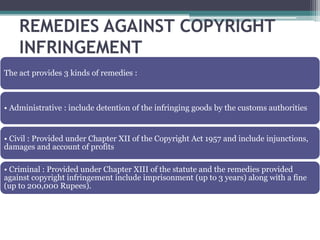
The act provides 3 kinds of remedies :
• Administrative : include detention of the infringing goods by the customs authorities
• Civil : Provided under Chapter XII of the Copyright Act 1957 and include injunctions,
damages and account of profits
• Criminal : Provided under Chapter XIII of the statute and the remedies provided
against copyright infringement include imprisonment (up to 3 years) along with a fine
(up to 200,000 Rupees).
THANK YOU
By- Dhara Sharma
LLM (Business Law)

Copyright and its infringement

  • 1.
  • 2.
    INTRODUCTION TO COPYRIGHT Copyrightis the exclusive right given to the creator of a creative work to reproduce the work, usually for a limited time. The creative work may be in a literary, artistic, educational, or musical form. Copyright is intended to protect the original expression of an idea in the form of a creative work, but not the idea itself. These rights frequently include reproduction, control over derivative works, distribution, public performance, and moral rights such as attribution.
  • 3.
    THE COPYRIGHT ACT,1957 Copyrightis a bundle of rights given by the law to the creators of literary, dramatic, musical and artistic works and the producers of cinematograph films and sound recordings. • The Copyright Act 1957 was the first post-independence copyright legislation in India and the law has been amended 6 times since 1957. • The most recent amendment was in the year 2012, through the Copyright (Amendment) Act 2012.
  • 4.
    DURATION OF COPYRIGHT PROTECTION LITERARY  DRAMATIC  MUSICAL  ARTISTIC WORKS LIFETIME OF THE AUTHOR=SIXTY YEARS FROM THE BEGINNING OF THE CALENDAR YEAR NEXT FOLLOWING THE YEAR IN WHICH THE AUTHOR DIES.  POSTHUMOUS WORK  ANONYMOUS AND PSEUDONYMOUS WORKS  CINEMATOGRAPH FILMS  PHOTOGRAPHS  PUBLIC UNDERTAKINGS  SOUND RECORDS UNTILL SIXTY YEARS FROM THE BEGINNING OF THE CALENDAR YEAR NEXT FOLLOWING THE YEAR IN WHICH THE WORK IS FIRST PUBLISHED.
  • 5.
    RIGHTS UNDER COPYRIGHTLAW Copyright is the soul of Film, Audio-visual recording, Literature in Book forms and Computer Software Industry. The author of a copyrighted work enjoys the following exclusive economic rights: • Right to reproduce • Right to publish • To adapt and translate • To communicate/perform in public • To assign, license or bequeath the copyright to another party.
  • 6.
    RIGHTS UNDER COPYRIGHTLAW In relation to films and records, it gives exclusive rights to the owner to make copies of the film and communicate the film to the public by broadcasting means. In relation to computer software it gives exclusive rights to sell or give rental any copy of computer program.
  • 7.
    INFRINGEMENT OF COPYRIGHT LAW •Copyright infringement occurs when any person does any of the mentioned rights and activities with respect to a copyrighted work WITHOUT A LICENSE. • It leads to economic loss to the owners of copyright. Besides economic loss, it also adversely affects creativity • PIRACY: The term "piracy" has been used to refer to the unauthorized copying, distribution and selling of works in copyright • Infringement relevant in today’s world of Internet: Plagiarizing Marketing Copy, Plagiarizing Personal Literature, Newspaper Infringement, Mashup Copyright Issues, Photography Infringement.
  • 8.
    SECTION 51. WHENCOPYRIGHT INFRINGED • does anything, the exclusive right to do which is by this Act conferred upon the owner of the copyright, or • permits for profit any place to be used for the communication of the work to the public where such communication constitutes an infringement of the copyright in the work, unless he was not aware and had no reasonable ground for believing that such communication to the public would be an infringement of copyright; or • permits for profit any place to be used for the communication of the work to the public where such communication constitutes an infringement of the copyright in the work, unless he was not aware and had no reasonable ground for believing that such communication to the public would be an infringement of copyright; " • makes for sale or hire, or sells or lets for hire, or by way of trade displays or offers for sale or hire, or • distributes either for the purpose of trade or to such an extent as to affect prejudicially the owner of the copyright, or • by way of trade exhibits in public, or • imports into India, " any infringing copies of the work: [Provided that nothing in sub-clause shall apply to the import of one copy of any work, for the private and domestic use of the importer.] Copyright in a work shall be deemed to be infringed— when any person, without a licence granted by the owner of the copyright or the Registrar of Copyrights under this Act or in contravention of the conditions of a licence so granted or of any condition imposed by a competent authority under this Act—
  • 9.
    EXEMPTIONS FROM COPYRIGHT VIOLATIONS Theenjoyment of every property is subject to restrictions imposed by the state. The act exempts several activities from the obligations of copyright violation. In relation to Literary Work-  Fair dealing with literary, dramatic, musical,artistic work for the purpose of private use, research, criticism or review, reporting current events in a newspaper/mazinee/broadcast/cinematographic film/still photographs.  Reproduction of work for the purpose of the state or functioning of law for e.g judicial or legislative proceedings  Reading or recitation in public from a published literary or dramatic work  Publication of the short passages of such works for educational purposes-by a teacher or pupil in the course of instruction .  Making of up to 3 copies of a book for a public library, if such book is not available for reading/sale in India
  • 10.
    EXEMPTION FROM COPYRIGHT VIOLATIONS Reproduction of an article on current economical, political, social or religious matters in newpapers, magazine etc unless the author has expressly reserved this right to himself.  Reproduction or publication of any matter published in official Gazettes including acts enacted by the parliament or state legislature in the case of Reproduction of Acts, all commentaries & other matter also have be published.  Reproduction or publication of any committees, commission, council appointed by the legislature, unless the government has prohibited it  Reproduction or publication of any judgment or order of court, tribunal or other judical authority, unless it has been prohibited by the court.
  • 11.
    EXEMPTION FROM COPYRIGHT VIOLATION Inrelation to computer related copyright-  Making of copies or adaptation of computer program for utilizing it.  Making of a copy to protect against the loss of the original.  The observation study or test of functioning of the computer program to determine the ideas & principles that underline any element of the program while performing such acts that are necessary for the functions for which the computer program was supplied..  The making of copies or adaptation of the computer program from a personally legally obtained copy, for non-commercial personal use.
  • 12.
    REMEDIES AGAINST COPYRIGHT INFRINGEMENT Theact provides 3 kinds of remedies : • Administrative : include detention of the infringing goods by the customs authorities • Civil : Provided under Chapter XII of the Copyright Act 1957 and include injunctions, damages and account of profits • Criminal : Provided under Chapter XIII of the statute and the remedies provided against copyright infringement include imprisonment (up to 3 years) along with a fine (up to 200,000 Rupees).
  • 13.
    THANK YOU By- DharaSharma LLM (Business Law)