INTRODUCTION TO
COPYRIGHT IN INDIA
By Prathiba M. Singh, Advocate,
LLM (Cantab)
Structure of the Presentation
 Three parts
 (1) Copyright in India
 (2) Case Study: Copyrighting DNA
 (3) Infringement of Copyright
What is Copyright?
 “The exclusive right given by law for a
certain term of years to an author,
composer etc. (or his assignee) to print,
publish and sell copies of his original work”
(Oxford English Dictionary)
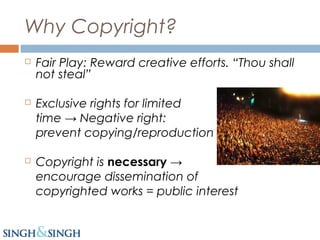
Why Copyright?
 Fair Play: Reward creative efforts. “Thou shall
not steal”
 Exclusive rights for limited
time → Negative right:
prevent copying/reproduction
 Copyright is necessary →
encourage dissemination of
copyrighted works = public interest
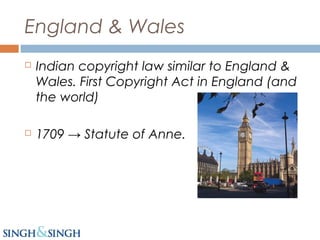
England & Wales
 Indian copyright law similar to England &
Wales. First Copyright Act in England (and
the world)
 1709 → Statute of Anne.
United States
 First Act in 1790: did not protect foreign
authors
 Indigenous American literature
suffered
 Today: Copyright Act 1976 one
of the major copyright laws in
the world
The Copyright Act 1957
Indian Perspectives
Copyright in India
 First Act in 1914, followed by the Copyright
Act 1957.
 1957 Act: adopted many English
provisions, introduced new ideas and
concepts.
Copyright Act 1957 – Main
Features
 Valid from 21 January 1958
 Created Copyright Office and Copyright
Board
 Introduced civil and criminal remedies
against infringement
Copyright Act 1957 – Main
Features (II)
 Performing rights societies’ rights (for
instance, music royalties)
 Definition of categories in which copyright
actually subsists
 International copyright
 Definition of infringement
Copyright (Amendment) Act
1983 and 1984
Objectives
 Berne and Universal Copyright
Conventions  grant of compulsory
licences by developing
countries, publication by
deceased authors
 1984 Act: discouraging
and preventing widespread video piracy.
Copyright (Amendment) Act
1992
 Defined ambit of the Copyright Board’s
powers
 Introducing special
rights for performers
 Assignment and licences of copyright
 Rights of copyright owners
Term of Copyright
 Depends on nature of work/owner of
copyright and whether the work has been
published
 Most works: 60 years
 Broadcast Reproduction: 25 years
About Fixation, Labour, Skill and Capital
The Nature of Copyright
 Statute-based, no registration necessary
 Copyright = intellectual property
 Combines different rights (literary works:
the right to reproduce in hardback and
paperback editions, the right of translation
adaptation)
Labour, Skill and Capital
 “It is the product of the labour, skill and
capital of one man which must not be
appropriated by another.” (- per Lord
Atkinson, Macmillan v Cooper AIR 1924 PC
75)
It‘s All About the Idea: Or isn‘t
It?
 Copyright in form or expression, not in idea:
“There is nothing in the notion of copyright to
prevent a second person from producing an
identical result...”
(Gregory Committee
Report, 1952, para 9)
 Copyright only in material form  principle of
fixation
What Copyright Protects
 Original Literary, Dramatic, Musical and
Artistic Works
 Cinematograph Films
 Sound Recordings
Literary Works
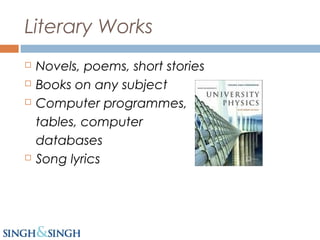
 Novels, poems, short stories
 Books on any subject
 Computer programmes,
tables, computer
databases
 Song lyrics
Computer Software
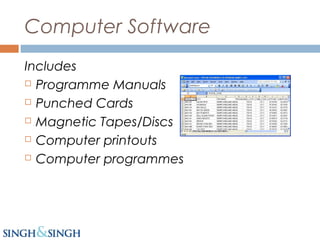
Includes
 Programme Manuals
 Punched Cards
 Magnetic Tapes/Discs
 Computer printouts
 Computer programmes
Work in the biotech industry involving
copyrightable subject matter:
Modification of genes of plants, animals
To identify causes of diseases
To make assays for the testing of various
diseases
Manufacture of vaccines
Spotlight on Copyright for the
Biotech industry
DNA and Copyright
 1980s/1990s: scholars proposed that
biotechnology work = copyrightable
 Copyright as alternative to patent law
 Diamond v Chakraborty: 447 US 303 (living
organisms patentable)
 Practical problems prevented grants
 Computer industry successfully lobbied for
amendment of 1976 Copyright Act
Arguments against copyrighting
of DNA
 Facts lack originality
 Doctrine of merger and non-equivalence
of DNA/computer programmes
 Utilitarian prohibitions
Arguments for Protection
 Copyright Subject Matter
 Analogy between “Literary Works” and
computer programmes
 DNA as a Compilation
 Sweat of the Brow Doctrine
Copyright Subject Matter
The work concerned has to be
 Original
 Work of authorship
 Fixed
In the United States, Congress intended a
wide reading of the term “literary works”
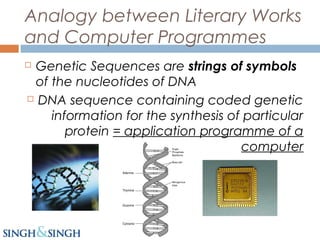
Analogy between Literary Works
and Computer Programmes
 Genetic Sequences are strings of symbols
of the nucleotides of DNA
 DNA sequence containing coded genetic
information for the synthesis of particular
protein = application programme of a
computer
DNA as a Compilation
 Combining various elements of DNA
constitutes a compilation: involves
assembling of pre-existing materials
 Selection and arrangement of
sequence elements are
copyrightable
“Sweat of the Brow” Doctrine
 Originality in the labour expended in the
collection and assembly of data:
adaptable to DNA sequences
 Researchers spend
considerable time and effort
to discern the sequence of a gene: they
should have copyright due to hard work
Why Patents Don’t (Always)
Work
 Patents confer monopolies and exclude
competitors from conducting research
 Can offer rewards disproportionate to risk:
Genentech Inc’s Patent [1989] RPC 147, CA
 Public interest would be injured if every
corporation could patent anytime, anywhere.
Without them, corporations may lack incentive to
conduct research
 No guarantee for independent researchers that
their efforts will pay off
Copyright and Related
Rights to the Rescue?
 Despite conferral of a monopoly, usually
another option available: Copyright could
be an option in cases without
inventiveness
 Advantage of copyright system: no ban
on creation of genomes, merely royalties;
licensing schemes can be regulated.
Sequence = Original Literary
Work?
 S. 3 of Copyright, Design and Patents Act
1988 defines “literary work”
 Includes a) table or compilation and b)
computer programme
 DNA sequence could be literary work as
well: created by human mind, written
Telegraph Code Cases
 Based on these, there is copyright in
seemingly arbitrary instances of letters
 Anderson & Co v Lieber Code Co [1917] 2
KB 469
 Ager v Peninsular and Oriental Steam
Navigation Co. (1884) 26 Ch D 637
 Ager v Collingridge (1886) 2 TLR 291
 Express Newspapers plc v Liverpool Daily
Post and Echo plc [1985] FSR 306
Originality
 Work may be original, even if derived from
previous material, provided further
independent skill, useful labour,
knowledge or judgment have been
bestowed on its creation
 Even if nature of subject matter can lead
competent author with one solution:
Walter v Lane [1900] AC 539
Infringement of Copyright in
Molecular Sequences
 CDPA 1988, s. 16: copyright owner with
exclusive right “to copy the work”
 16(3): infringement by copying work “as a
whole or any substantial part”
 Infringement cannot take place outside
UK or when a legal copy has been
purchased from which one adopts a
scissor/paste approach: Warne & Co v
Seebohm (1888) 39 Ch. D. 73
Infringement in Chemical Form?
 S. 178 of the CDPA 1988: “writing” defined
as “any form of notation or code, whether
by hand or otherwise and regardless of
the method by which, or the medium in
on which, it is recorded”
 No understanding by the human mind
required: Apple Computer Inc v Computer
Edge Pty Ltd [1984] FSR 496
Infringing Copy
 Thing in question has to derive from
original literary work
 What is required is the reproduction of a
substantial part of what is original in the
copyrighted work: Warwick Film
Productions Ltd v Eisinger 1 Ch 508,
Ladbroke v William Hill (Football) Ltd [1964]
1 WLR 273, per Lord Pearson
Indian position - Eastern book
Company case
 This case relates to compilation of Supreme
Court judgements
 Test for originality
 The middle path approach adopted for
Derivative works
 Sweat of the Brow Vs. Modicum of creativity
 U.K. approach (Ladbroke) Vs. U.S.A. (Feist)
 India follows the Canadian approach – CCH
Canada
Case laws on Copyright
 There is no reported case on the
copyrightability of biotech subject matter
 There is one case currently pending with
respect to plant varieties on the basis of
copyright and trade secrecy/confidential
information
J. Mitra Company Pvt. Ltd. Vs. Span Diagnostics– CS
(OS) No. 2020/2006 - Judgment dated 22.02.2008 passed by Ld.
Single Judge of Delhi High Court, Hon’ble Mr. Justice Sanjay
Kishan Kaul
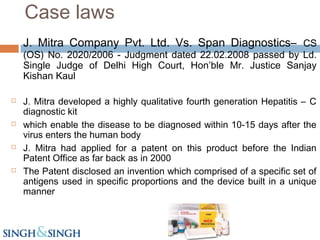
 J. Mitra developed a highly qualitative fourth generation Hepatitis – C
diagnostic kit
 which enable the disease to be diagnosed within 10-15 days after the
virus enters the human body
 J. Mitra had applied for a patent on this product before the Indian
Patent Office as far back as in 2000
 The Patent disclosed an invention which comprised of a specific set of
antigens used in specific proportions and the device built in a unique
manner
Case laws
J. Mitra Company Pvt. Ltd. Vs. Span Diagnostics
(Contd..)
 Span Diagnostics copied the HCV Tridot product
 Span had initially opposed the grant of patent and the patent
office in India had rejected the objections and had granted the
patent to J. Mitra in 2006
 After the grant of the patent, J. Mitra filed a case against Span
Diagnostic seeking injunction against the manufacture of Signal
HCV which was the copied device of Span – Argued that antigens
are commonly known and the methodology is nothing but protein
sequences
Case laws
J. Mitra Company Pvt. Ltd. Vs. Span Diagnostics
(Contd..)
 Vide judgment dated 22.02.2008, Hon’ble Mr. Justice Sanjay Kishan
Kaul of the Delhi High Court has held that:
 Sufficient documents were filed showing the research conducted
by J. Mitra.
 The international preliminary examination report issued by the
PCT Office does not have a bearing on the validity of the patent.
The validity patent has to be examined by the court considering
the merits of the case.
 That the defendant showed no research or development towards
its infringing product
Case laws
J. Mitra Company Pvt. Ltd. Vs. Span Diagnostics
(Contd..)
 That the defendant had not been able to show that it had
developed the product or had applied for the approval of the
product prior to the patent application of J. Mitra.
 That J. Mitra’s patent was an invention and none of the earlier
U.S. patents relied upon by the defendant Span were identical to
J. Mitra’s product
 The other products shown by the defendant are different types of
tests and not the Rapid fourth generation test device as patented
by J. Mitra
 Evaluation of W.H.O. reveals 98.9% specificity and 100%
sensitivity of J. Mitra’s product
Case laws
J. Mitra Company Pvt. Ltd. Vs. Span Diagnostics
(Contd..)
 The only difference between the plaintiffs and defendants device
was that J. Mitra’s device had three dots and Span’s device had
two dots
 The life of a patent being limited in nature i.e. in this case only till
2020, it is necessary to protect the patent and restrain Span
Case laws
When (Copy)right becomes wrong
Infringement of Copyright
Statutory Definition
 Copyright Act 1957, s. 51
 Infringement: exercising rights of the
copyright owner
 Making, distributing, exhibiting and
importing infringing copies of the work
Factors Determining
Infringement
Copying
 Causal Connection
 Subconscious Copying
 Indirect Copying
Substantial Taking
 Unaltered copying
 Extent of defendant’s alteration
 Character of Plaintiff’s and Defendant’s works
 Nature and Extent of Plaintiff’s Effort
General Principles
R.C Anand v Delux Films
(1) No copyright in an idea. Violation
of copyright confined to form, manner
and arrangement, as well as expression
of idea by the author
(2) Where same idea developed in
different manner, similarities happen.
Court to rule on whether similarities are
merely substantial or fundamental
General Principles (2)
(3) Safest Test: Does the reader/
spectator/viewer have the
opinion/get the unshakeable
impression that the second work is a
copy of the original? (“the viewer test”)
(4) Same theme, different presentation →
Completely new work, no infringement
General Principles (3)
(5) Where there are only incidental
similarities, there is no copyright
infringement
(6) Copyright infringement = piracy
it must be clearly proven
(7) Very difficult to prove
violation of copyright of
stage play by a film
producer: the “viewer test” is applicable
Strengthening Copyright, Enhancing the
Reach of the Law
Remedies for Copyright
Infringement
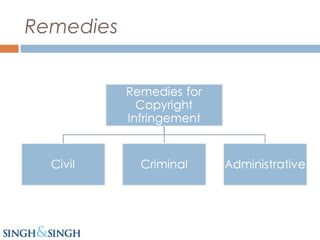
Remedies
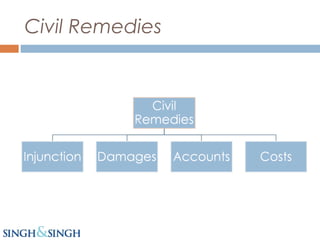
Civil Remedies
Civil Remedies (2)
Injunction
 Only effective remedy
 Court has to weigh the
damage to the plaintiff if the
injunction is not granted, as
opposed to the damage to the defendant if
it is
 Interlocutory injunction is the preferred
method for preventing infringement,
sometimes an ex parte injunction
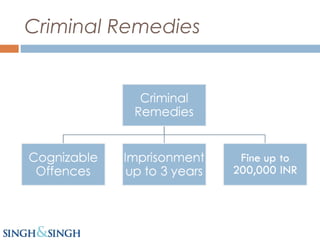
Criminal Remedies
Criminal Remedies
 Copyright Act 1957, s.64 empowers the
Police (any officer not below the rank of
sub-inspector) to seize infringing copies
without warrant
 Police Raids (Power of search, seizure &
arrest without a warrant)
 Fines (min. 50,000-200,000 INR)
 Imprisonment (6 months to 3 years)
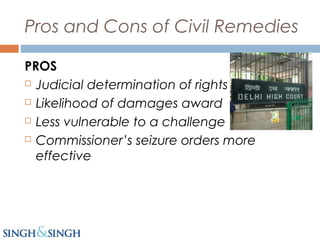
Pros and Cons of Civil Remedies
PROS
 Judicial determination of rights
 Likelihood of damages award
 Less vulnerable to a challenge
 Commissioner’s seizure orders more
effective
Pros and Cons of Civil Remedies
(2)
CONS
 Delays – Trial, Appeal Stages
 Damages not usually awarded
 No severe punishment for violation of
rights
Pros and Cons of Criminal
Remedies
PROS
 Quick remedy
 Greater opportunity to quickly counteract
violation, with arrest acting as a deterrent
CONS
 Chances of seizure of goods low
 Difficulty in coordinating with the police
Conclusion
 Protection for DNA and protein sequences is
in the nascent stage globally and in India;
 A tilt exists towards patenting;
 Copyright may be a viable option but there are
problems with establishing priority etc.,
 A strong copyright registration mechanism is
needed if the biotech industry is to adopting
Copyright protection
Conclusion
 Requires complete overhauling of the Copyright
offices
 At present most copyrightable works are not
registered
 Even copyright registrations where the traditional
examination and opposition procedures are not
followed, take time sometimes even 3 years to get
registered
 For biotech industry, a vibrant and robust copyright
registration regime, is necessary
 Priority would be difficult to establish.

Copyright ppt 1

  • 1.
    INTRODUCTION TO COPYRIGHT ININDIA By Prathiba M. Singh, Advocate, LLM (Cantab)
  • 2.
    Structure of thePresentation  Three parts  (1) Copyright in India  (2) Case Study: Copyrighting DNA  (3) Infringement of Copyright
  • 3.
    What is Copyright? “The exclusive right given by law for a certain term of years to an author, composer etc. (or his assignee) to print, publish and sell copies of his original work” (Oxford English Dictionary)
  • 4.
    Why Copyright?  FairPlay: Reward creative efforts. “Thou shall not steal”  Exclusive rights for limited time → Negative right: prevent copying/reproduction  Copyright is necessary → encourage dissemination of copyrighted works = public interest
  • 5.
    England & Wales Indian copyright law similar to England & Wales. First Copyright Act in England (and the world)  1709 → Statute of Anne.
  • 6.
    United States  FirstAct in 1790: did not protect foreign authors  Indigenous American literature suffered  Today: Copyright Act 1976 one of the major copyright laws in the world
  • 7.
    The Copyright Act1957 Indian Perspectives
  • 8.
    Copyright in India First Act in 1914, followed by the Copyright Act 1957.  1957 Act: adopted many English provisions, introduced new ideas and concepts.
  • 9.
    Copyright Act 1957– Main Features  Valid from 21 January 1958  Created Copyright Office and Copyright Board  Introduced civil and criminal remedies against infringement
  • 10.
    Copyright Act 1957– Main Features (II)  Performing rights societies’ rights (for instance, music royalties)  Definition of categories in which copyright actually subsists  International copyright  Definition of infringement
  • 11.
    Copyright (Amendment) Act 1983and 1984 Objectives  Berne and Universal Copyright Conventions  grant of compulsory licences by developing countries, publication by deceased authors  1984 Act: discouraging and preventing widespread video piracy.
  • 12.
    Copyright (Amendment) Act 1992 Defined ambit of the Copyright Board’s powers  Introducing special rights for performers  Assignment and licences of copyright  Rights of copyright owners
  • 13.
    Term of Copyright Depends on nature of work/owner of copyright and whether the work has been published  Most works: 60 years  Broadcast Reproduction: 25 years
  • 14.
    About Fixation, Labour,Skill and Capital The Nature of Copyright
  • 15.
    The Nature ofCopyright  Statute-based, no registration necessary  Copyright = intellectual property  Combines different rights (literary works: the right to reproduce in hardback and paperback editions, the right of translation adaptation)
  • 16.
    Labour, Skill andCapital  “It is the product of the labour, skill and capital of one man which must not be appropriated by another.” (- per Lord Atkinson, Macmillan v Cooper AIR 1924 PC 75)
  • 17.
    It‘s All Aboutthe Idea: Or isn‘t It?  Copyright in form or expression, not in idea: “There is nothing in the notion of copyright to prevent a second person from producing an identical result...” (Gregory Committee Report, 1952, para 9)  Copyright only in material form  principle of fixation
  • 18.
    What Copyright Protects Original Literary, Dramatic, Musical and Artistic Works  Cinematograph Films  Sound Recordings
  • 19.
    Literary Works  Novels,poems, short stories  Books on any subject  Computer programmes, tables, computer databases  Song lyrics
  • 20.
    Computer Software Includes  ProgrammeManuals  Punched Cards  Magnetic Tapes/Discs  Computer printouts  Computer programmes
  • 21.
    Work in thebiotech industry involving copyrightable subject matter: Modification of genes of plants, animals To identify causes of diseases To make assays for the testing of various diseases Manufacture of vaccines Spotlight on Copyright for the Biotech industry
  • 22.
    DNA and Copyright 1980s/1990s: scholars proposed that biotechnology work = copyrightable  Copyright as alternative to patent law  Diamond v Chakraborty: 447 US 303 (living organisms patentable)  Practical problems prevented grants  Computer industry successfully lobbied for amendment of 1976 Copyright Act
  • 23.
    Arguments against copyrighting ofDNA  Facts lack originality  Doctrine of merger and non-equivalence of DNA/computer programmes  Utilitarian prohibitions
  • 24.
    Arguments for Protection Copyright Subject Matter  Analogy between “Literary Works” and computer programmes  DNA as a Compilation  Sweat of the Brow Doctrine
  • 25.
    Copyright Subject Matter Thework concerned has to be  Original  Work of authorship  Fixed In the United States, Congress intended a wide reading of the term “literary works”
  • 26.
    Analogy between LiteraryWorks and Computer Programmes  Genetic Sequences are strings of symbols of the nucleotides of DNA  DNA sequence containing coded genetic information for the synthesis of particular protein = application programme of a computer
  • 27.
    DNA as aCompilation  Combining various elements of DNA constitutes a compilation: involves assembling of pre-existing materials  Selection and arrangement of sequence elements are copyrightable
  • 28.
    “Sweat of theBrow” Doctrine  Originality in the labour expended in the collection and assembly of data: adaptable to DNA sequences  Researchers spend considerable time and effort to discern the sequence of a gene: they should have copyright due to hard work
  • 29.
    Why Patents Don’t(Always) Work  Patents confer monopolies and exclude competitors from conducting research  Can offer rewards disproportionate to risk: Genentech Inc’s Patent [1989] RPC 147, CA  Public interest would be injured if every corporation could patent anytime, anywhere. Without them, corporations may lack incentive to conduct research  No guarantee for independent researchers that their efforts will pay off
  • 30.
    Copyright and Related Rightsto the Rescue?  Despite conferral of a monopoly, usually another option available: Copyright could be an option in cases without inventiveness  Advantage of copyright system: no ban on creation of genomes, merely royalties; licensing schemes can be regulated.
  • 31.
    Sequence = OriginalLiterary Work?  S. 3 of Copyright, Design and Patents Act 1988 defines “literary work”  Includes a) table or compilation and b) computer programme  DNA sequence could be literary work as well: created by human mind, written
  • 32.
    Telegraph Code Cases Based on these, there is copyright in seemingly arbitrary instances of letters  Anderson & Co v Lieber Code Co [1917] 2 KB 469  Ager v Peninsular and Oriental Steam Navigation Co. (1884) 26 Ch D 637  Ager v Collingridge (1886) 2 TLR 291  Express Newspapers plc v Liverpool Daily Post and Echo plc [1985] FSR 306
  • 33.
    Originality  Work maybe original, even if derived from previous material, provided further independent skill, useful labour, knowledge or judgment have been bestowed on its creation  Even if nature of subject matter can lead competent author with one solution: Walter v Lane [1900] AC 539
  • 34.
    Infringement of Copyrightin Molecular Sequences  CDPA 1988, s. 16: copyright owner with exclusive right “to copy the work”  16(3): infringement by copying work “as a whole or any substantial part”  Infringement cannot take place outside UK or when a legal copy has been purchased from which one adopts a scissor/paste approach: Warne & Co v Seebohm (1888) 39 Ch. D. 73
  • 35.
    Infringement in ChemicalForm?  S. 178 of the CDPA 1988: “writing” defined as “any form of notation or code, whether by hand or otherwise and regardless of the method by which, or the medium in on which, it is recorded”  No understanding by the human mind required: Apple Computer Inc v Computer Edge Pty Ltd [1984] FSR 496
  • 36.
    Infringing Copy  Thingin question has to derive from original literary work  What is required is the reproduction of a substantial part of what is original in the copyrighted work: Warwick Film Productions Ltd v Eisinger 1 Ch 508, Ladbroke v William Hill (Football) Ltd [1964] 1 WLR 273, per Lord Pearson
  • 37.
    Indian position -Eastern book Company case  This case relates to compilation of Supreme Court judgements  Test for originality  The middle path approach adopted for Derivative works  Sweat of the Brow Vs. Modicum of creativity  U.K. approach (Ladbroke) Vs. U.S.A. (Feist)  India follows the Canadian approach – CCH Canada
  • 38.
    Case laws onCopyright  There is no reported case on the copyrightability of biotech subject matter  There is one case currently pending with respect to plant varieties on the basis of copyright and trade secrecy/confidential information
  • 39.
    J. Mitra CompanyPvt. Ltd. Vs. Span Diagnostics– CS (OS) No. 2020/2006 - Judgment dated 22.02.2008 passed by Ld. Single Judge of Delhi High Court, Hon’ble Mr. Justice Sanjay Kishan Kaul  J. Mitra developed a highly qualitative fourth generation Hepatitis – C diagnostic kit  which enable the disease to be diagnosed within 10-15 days after the virus enters the human body  J. Mitra had applied for a patent on this product before the Indian Patent Office as far back as in 2000  The Patent disclosed an invention which comprised of a specific set of antigens used in specific proportions and the device built in a unique manner Case laws
  • 40.
    J. Mitra CompanyPvt. Ltd. Vs. Span Diagnostics (Contd..)  Span Diagnostics copied the HCV Tridot product  Span had initially opposed the grant of patent and the patent office in India had rejected the objections and had granted the patent to J. Mitra in 2006  After the grant of the patent, J. Mitra filed a case against Span Diagnostic seeking injunction against the manufacture of Signal HCV which was the copied device of Span – Argued that antigens are commonly known and the methodology is nothing but protein sequences Case laws
  • 41.
    J. Mitra CompanyPvt. Ltd. Vs. Span Diagnostics (Contd..)  Vide judgment dated 22.02.2008, Hon’ble Mr. Justice Sanjay Kishan Kaul of the Delhi High Court has held that:  Sufficient documents were filed showing the research conducted by J. Mitra.  The international preliminary examination report issued by the PCT Office does not have a bearing on the validity of the patent. The validity patent has to be examined by the court considering the merits of the case.  That the defendant showed no research or development towards its infringing product Case laws
  • 42.
    J. Mitra CompanyPvt. Ltd. Vs. Span Diagnostics (Contd..)  That the defendant had not been able to show that it had developed the product or had applied for the approval of the product prior to the patent application of J. Mitra.  That J. Mitra’s patent was an invention and none of the earlier U.S. patents relied upon by the defendant Span were identical to J. Mitra’s product  The other products shown by the defendant are different types of tests and not the Rapid fourth generation test device as patented by J. Mitra  Evaluation of W.H.O. reveals 98.9% specificity and 100% sensitivity of J. Mitra’s product Case laws
  • 43.
    J. Mitra CompanyPvt. Ltd. Vs. Span Diagnostics (Contd..)  The only difference between the plaintiffs and defendants device was that J. Mitra’s device had three dots and Span’s device had two dots  The life of a patent being limited in nature i.e. in this case only till 2020, it is necessary to protect the patent and restrain Span Case laws
  • 44.
    When (Copy)right becomeswrong Infringement of Copyright
  • 45.
    Statutory Definition  CopyrightAct 1957, s. 51  Infringement: exercising rights of the copyright owner  Making, distributing, exhibiting and importing infringing copies of the work
  • 46.
    Factors Determining Infringement Copying  CausalConnection  Subconscious Copying  Indirect Copying Substantial Taking  Unaltered copying  Extent of defendant’s alteration  Character of Plaintiff’s and Defendant’s works  Nature and Extent of Plaintiff’s Effort
  • 47.
    General Principles R.C Anandv Delux Films (1) No copyright in an idea. Violation of copyright confined to form, manner and arrangement, as well as expression of idea by the author (2) Where same idea developed in different manner, similarities happen. Court to rule on whether similarities are merely substantial or fundamental
  • 48.
    General Principles (2) (3)Safest Test: Does the reader/ spectator/viewer have the opinion/get the unshakeable impression that the second work is a copy of the original? (“the viewer test”) (4) Same theme, different presentation → Completely new work, no infringement
  • 49.
    General Principles (3) (5)Where there are only incidental similarities, there is no copyright infringement (6) Copyright infringement = piracy it must be clearly proven (7) Very difficult to prove violation of copyright of stage play by a film producer: the “viewer test” is applicable
  • 50.
    Strengthening Copyright, Enhancingthe Reach of the Law Remedies for Copyright Infringement
  • 51.
  • 52.
  • 53.
    Civil Remedies (2) Injunction Only effective remedy  Court has to weigh the damage to the plaintiff if the injunction is not granted, as opposed to the damage to the defendant if it is  Interlocutory injunction is the preferred method for preventing infringement, sometimes an ex parte injunction
  • 54.
  • 55.
    Criminal Remedies  CopyrightAct 1957, s.64 empowers the Police (any officer not below the rank of sub-inspector) to seize infringing copies without warrant  Police Raids (Power of search, seizure & arrest without a warrant)  Fines (min. 50,000-200,000 INR)  Imprisonment (6 months to 3 years)
  • 56.
    Pros and Consof Civil Remedies PROS  Judicial determination of rights  Likelihood of damages award  Less vulnerable to a challenge  Commissioner’s seizure orders more effective
  • 57.
    Pros and Consof Civil Remedies (2) CONS  Delays – Trial, Appeal Stages  Damages not usually awarded  No severe punishment for violation of rights
  • 58.
    Pros and Consof Criminal Remedies PROS  Quick remedy  Greater opportunity to quickly counteract violation, with arrest acting as a deterrent CONS  Chances of seizure of goods low  Difficulty in coordinating with the police
  • 59.
    Conclusion  Protection forDNA and protein sequences is in the nascent stage globally and in India;  A tilt exists towards patenting;  Copyright may be a viable option but there are problems with establishing priority etc.,  A strong copyright registration mechanism is needed if the biotech industry is to adopting Copyright protection
  • 60.
    Conclusion  Requires completeoverhauling of the Copyright offices  At present most copyrightable works are not registered  Even copyright registrations where the traditional examination and opposition procedures are not followed, take time sometimes even 3 years to get registered  For biotech industry, a vibrant and robust copyright registration regime, is necessary  Priority would be difficult to establish.

Editor's Notes

  • #2 40 effective slides + 7 cover slides
  • #7 The Copyright Act 1976 is mentioned in order to create a link to the discussion on the copyrighting of DNA that will be highlighted in Slides 25 to 30. After all, the scholarly debate on DNA and copyrighting first developed in the United States and was even taken up by the country‘s Supreme Court in the cases of Diamond v. Chakrabarty, 447 U.S. 303 (1980) and Gottschalk v. Benson, 409 U.S. 63 (1973)
  • #10 In legislative terms, the remarks on the Copyright Act 1957 should be more extensive and in-depth than Slides 9 to 11 indicates. The amendment acts are featured for purposes of completeness and in order to illustrate the evolution of the law of copyright in India. If time runs short, it is entirely possible to skip Slides 12 and 13.
  • #23 James G. Silva, Esq: Copyright Protection Of Biotechnology Works: Into The Dustbin Of History? (2000 B.C. Intell. Prop. & Tech. F. 012801)
  • #24 1) Facts lack originality: “The first person to find and report a particular fact; he or she has merely discovered its existence…one who discovers a fact is not its “maker” or “originator” (Feist) 2.) Non-equivalence with computer programmes: Selection of DNA elements requires little creativity. DNA instructions for producing proteins can only exist as nucleotide sequences (effectively, only one programme language!). Computers, on the other hand, can have instructions expressed in different languages. 3.) Utilitarian aspect of DNA: DNA has a “useful” role to fulfill. Any aesthetic aspect of the helix cannot be separated from its practical application. Therefore, DNA is not copyrightable.
  • #29 This is a reiteration of the “Labour, Skills and Capital” Doctrine in slide 18