Management Function
By: Ms. Shanta Peter
Controlling
Definition
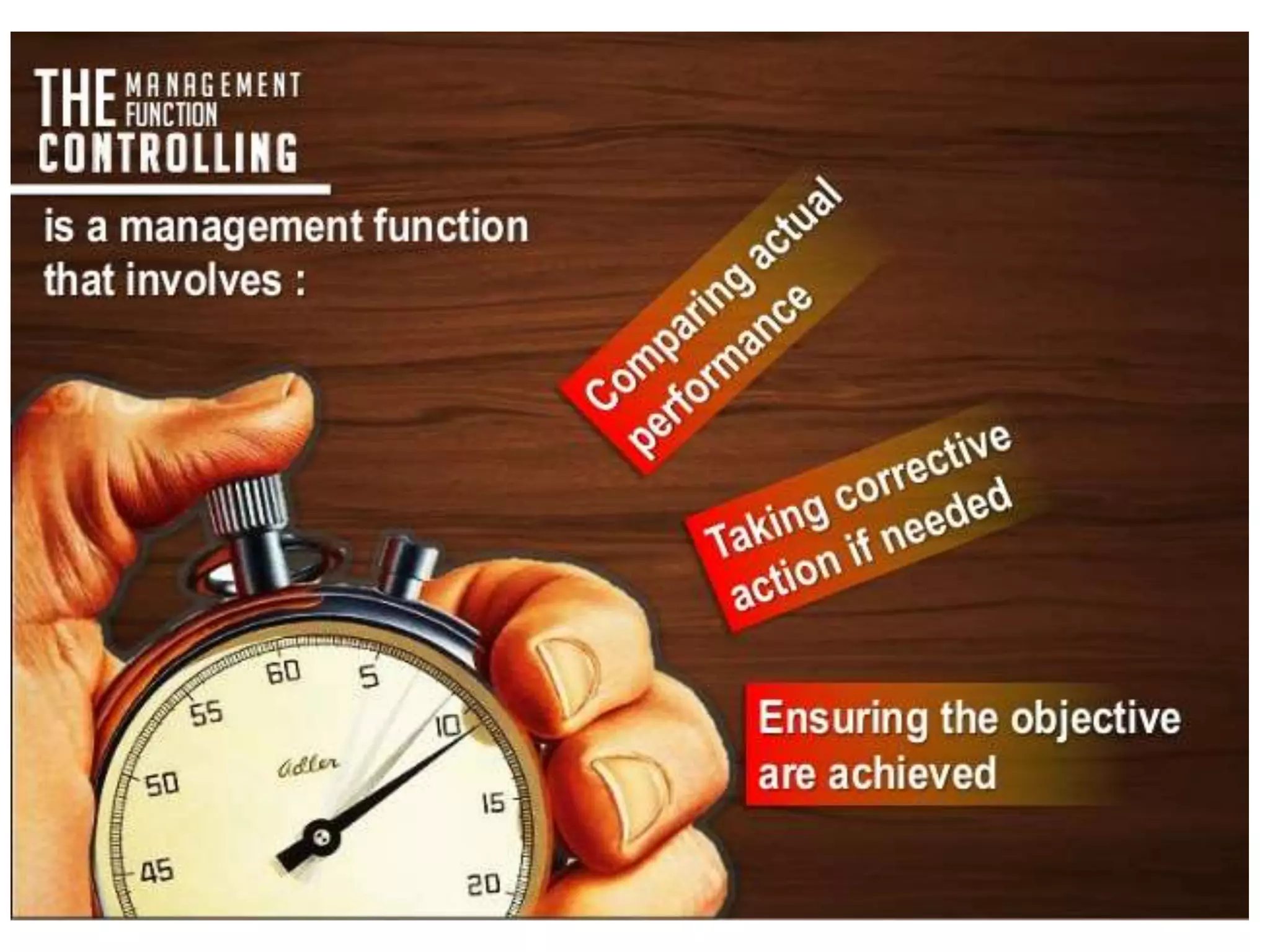
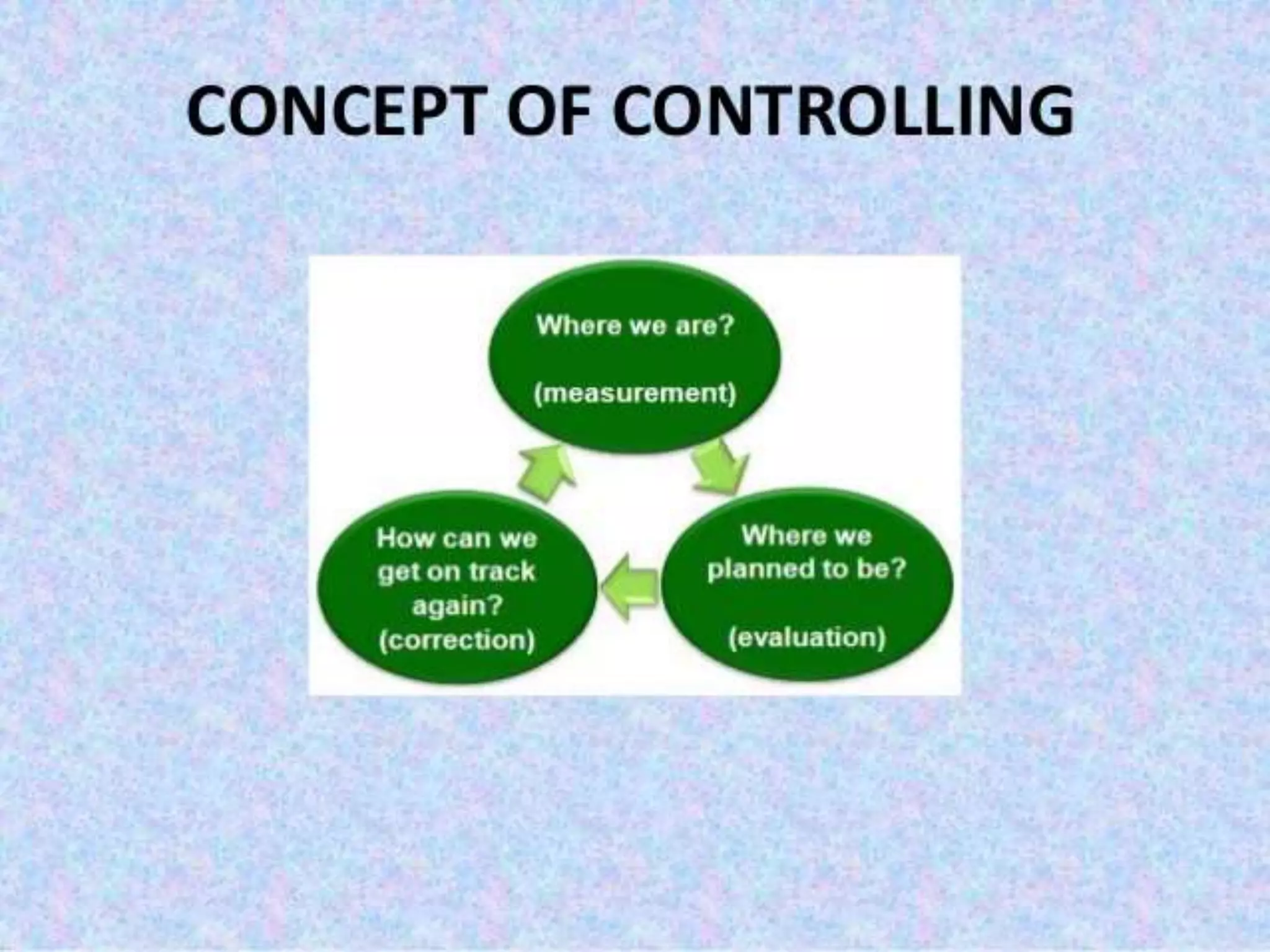
• Is the process of monitoring activities to ensure
that they are being accomplished as planned and
correcting any significant deviations
• Control is checking current performance
against pre-determined standards
contained in the plans, with a view to
ensure adequate progress and satisfactory
performance.
• Control like a ship’s rudder….
Keeps an organization moving in the
desired direction
Controlling has got two basic purposes
• It facilitates co-ordination
• It helps in planning
Purposes
• Ensure achievement of objectives
• Help to motivate employees
• Improves communication between supervisor &
subordinate
• Helps the organization to determine if its meeting
its goal
• To comply with essential organization rules and
policies
Features/characteristics
of Controlling
• Continuous function- it is performed by managers at
all levels and in all type of concerns.
• Forward looking- Controlling always look to future so
that follow-up can be made whenever required.
• Dynamic process- since controlling requires taking
review methods, changes have to be made wherever
possible.
• Related with planning- Without planning, controlling
is a meaningless -without controlling, planning is useless.
Planning presupposes controlling and controlling succeeds
planning 

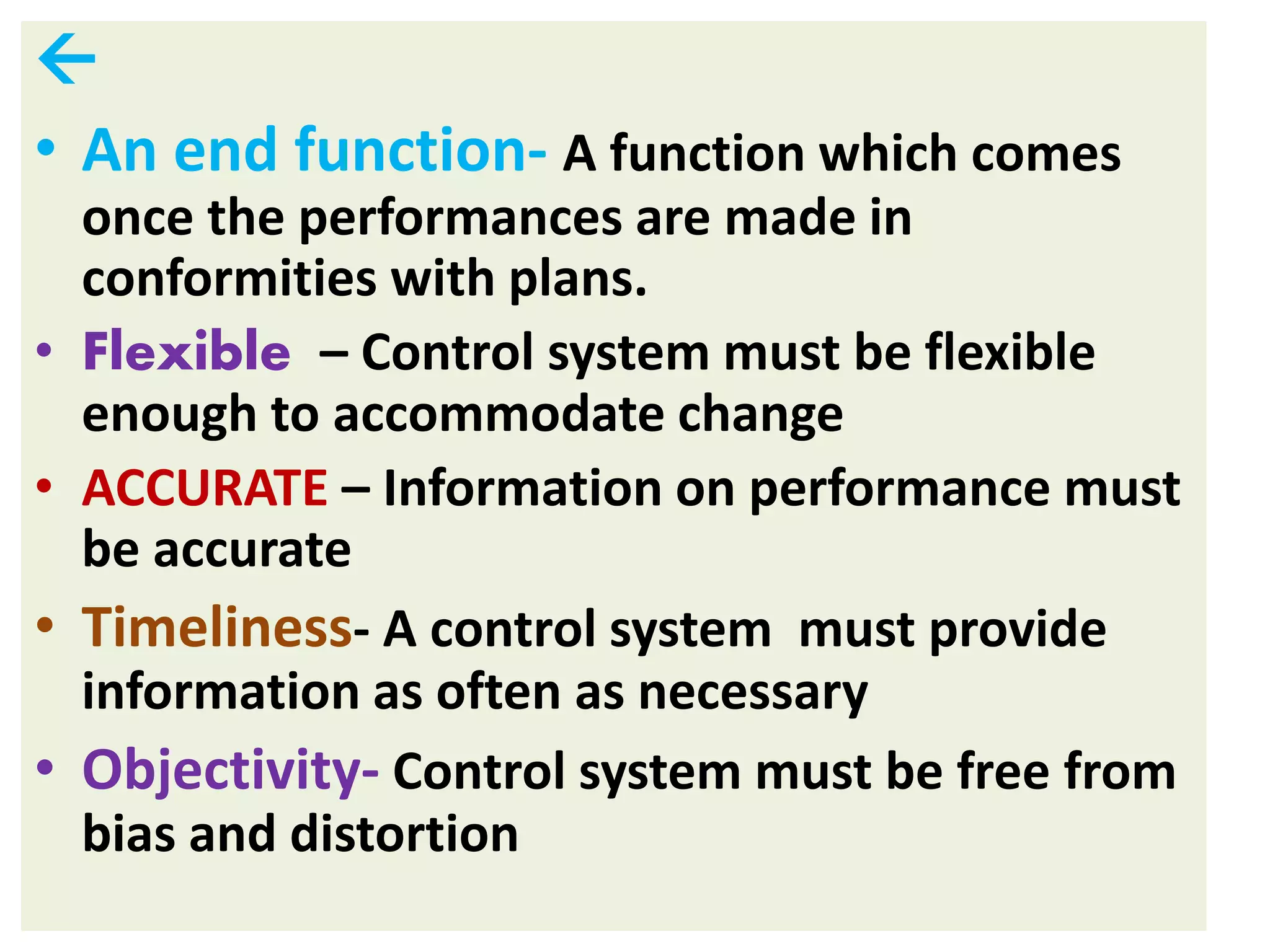
• An end function- A function which comes
once the performances are made in
conformities with plans.
• Flexible – Control system must be flexible
enough to accommodate change
• ACCURATE – Information on performance must
be accurate
• Timeliness- A control system must provide
information as often as necessary
• Objectivity- Control system must be free from
bias and distortion
Areas of Control
• Physical resources – quality control.
inventory , equipment
• Human resources - selection and placement,
training and development , perf. appraisal and
compensation
• Information resources- Public relation
• Financial resources – budgets --
Types of Control
• Preliminary – Feed-Forward control –
done before a work activity begins – make sure the
proper direction and the right resources are available
to accomplish them
• Concurrent: -Steering control-
Focus on what happens during the work process
Monitor ongoing operation and activities to make sure
that thing’s are been done correctly-correct problems
as they occur
• Post action : Feedback controls – take place after an
action is completed –
They focus on results as opposed to inputs and activities
TYPES (Mangers have 2 broad options
with respect to control)
Internal Control
• control motivated individuals to exercise self
control in fulfilling job expectations
• Individuals have clear performance objectives
and proper resource support
External controls
• Personal supervision and the use of formal
administrative systems
• Performance appraisal systems, compensation and
benefit systems, employee discipline system
• Management by objectives
How to Control?
• Ensure that work is done according to objectives
• Help to recognize gap in the staff performance,
knowledge and understanding and arrange for
appropriate training
• Recognize good work of staff and recommend for
promotion and advance training
• Ensure that resources provided are adequate and
are being properly used
• Enable the management to identify the causes of
work difference
Effective Controls
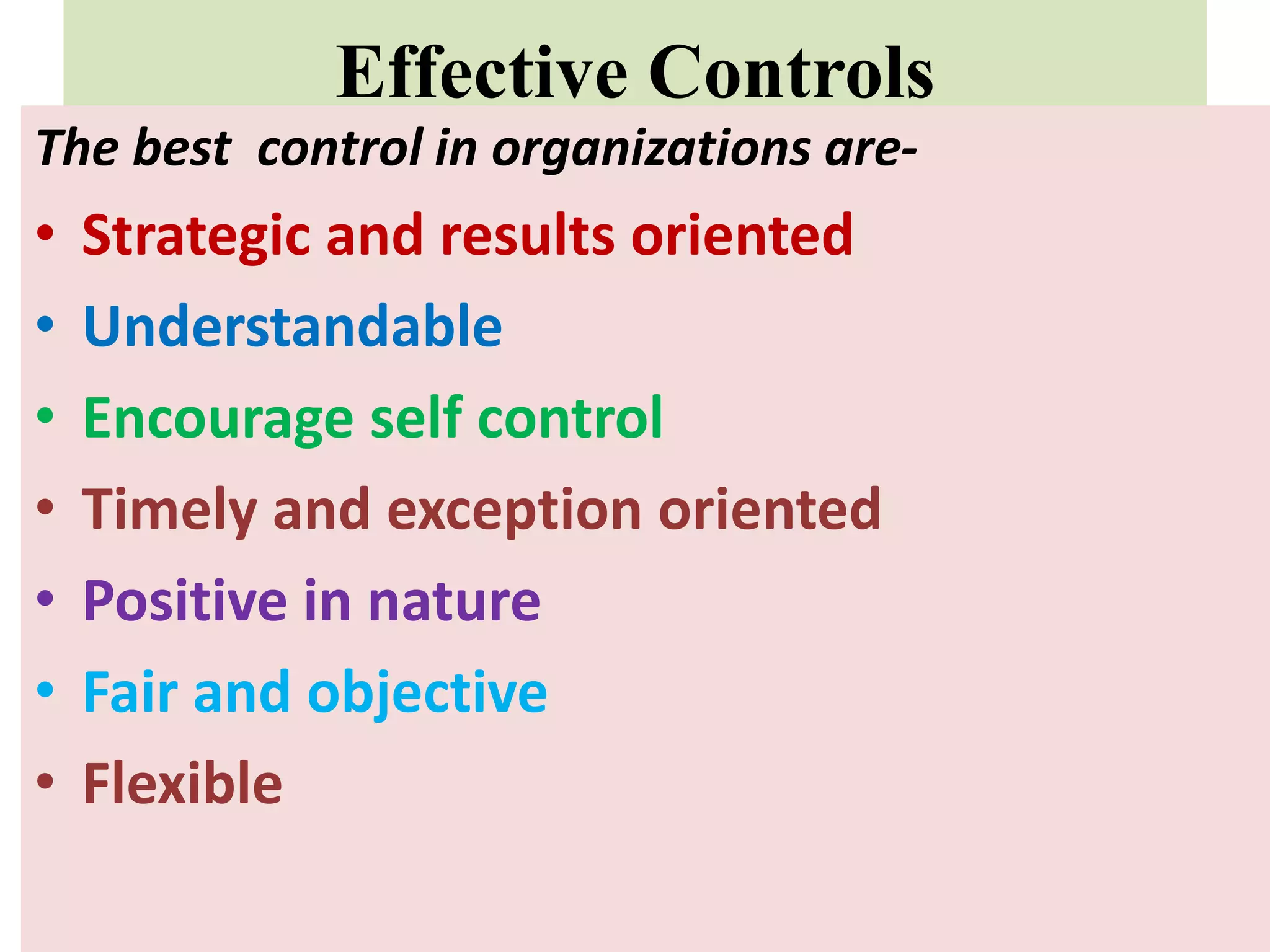
The best control in organizations are-
• Strategic and results oriented
• Understandable
• Encourage self control
• Timely and exception oriented
• Positive in nature
• Fair and objective
• Flexible
Methods of Control system:
• Personal observation
• Using work schedule
• Clarify activities all the time
• Checking record and report
• Instruction
Controlling – its relation to other Functions
• Planning – is the basis – reciprocal relationship
Plan – goals – objectives --directs the behavior and
activities
--- affects controlling
• Action as essence of control- emphasizes what
actions can be taken , important for
organizational effectiveness
• Delegation is the key control action can be taken
only by managers has responsibility and authority
to get things done
• Information as a guide –control action- guide by
adequate information
Mgt information and mgt control is closely inter related
Nursing service Control system
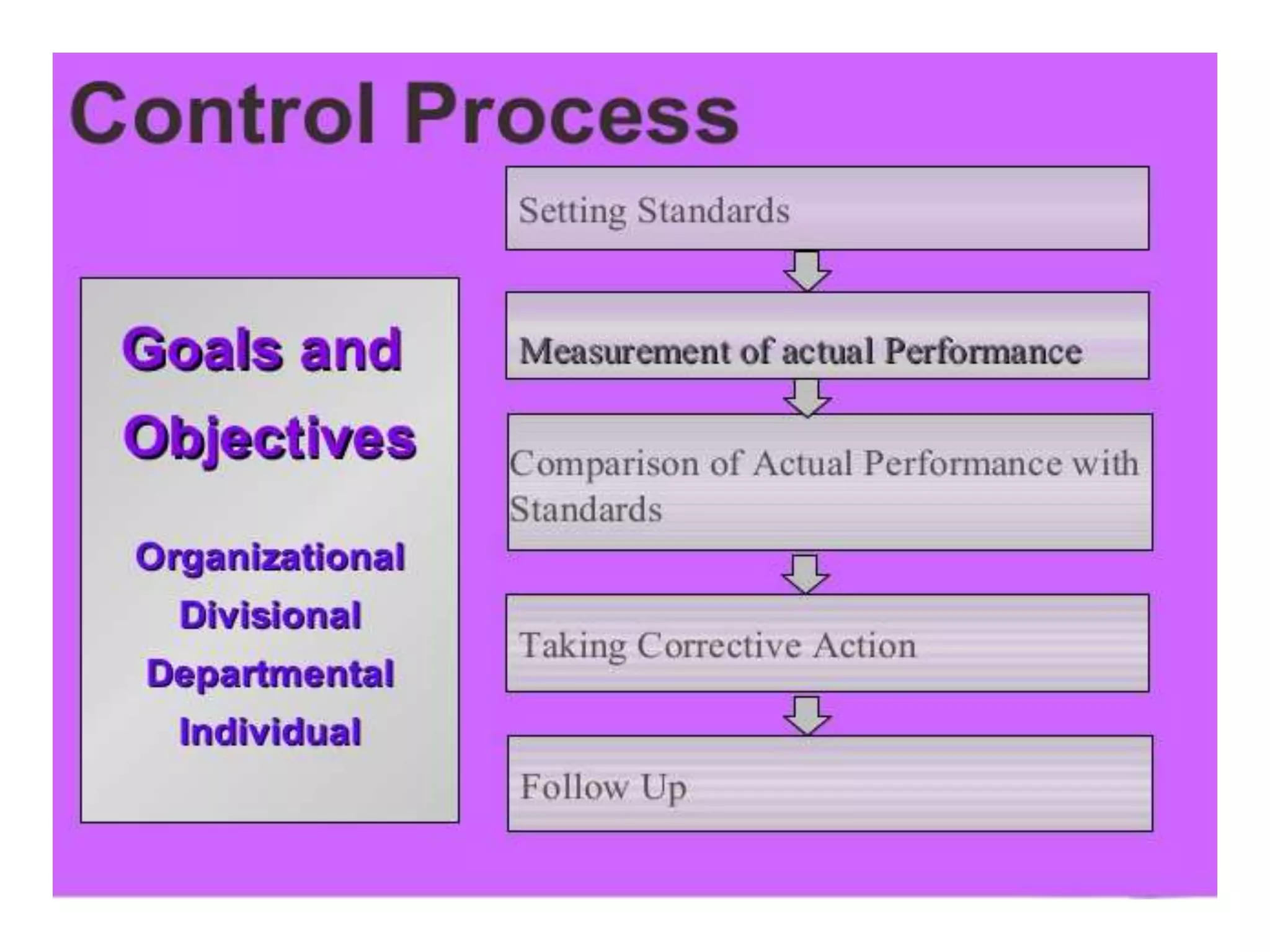
• Establishing standards for measuring
performance
• Establishing methods for actual performances
• Measuring actual performance
• Compare result with standards and objectives
• Reinforcing strengths or success
Controlling the problem employee
• Absenteeism – tardiness…… personality
conflicts.... excessive gripping... displays of
dissatisfaction.. resentment, pessimism or
indifference
• Substance abuser--------------chronic disruptive
behavior
It lead to – affect on unit productivity—
peer to feel anger and resentment
towards the troublesome worker
1. Gather facts – running commentary
2. Develop written plan with employee for a
change in behavior
3. Obtain signatures and schedule for meeting
for 2 weeks later
4. Document significant positive /negative
behavior during the next 2 weeks
5. Hold a second meeting
6. Meet with employee again .................
7. ..................................................(1)
Why to Control ?
• Managing people performance
• Coping with uncertainty
• Detecting irregularities
• Identifying opportunities
• Handling complex situations
• Delegation
• Minimizing goals
• Basis for planning
Importance of Control
Adjustment in operations
• Objectives – basis of control
• Adjustment done through control
Policy verification
• Policies generate the need for control
• Managers set certain policies which become
the basis and reason for control
• Verify the quality of policies
Organizational Control systems
1.Management processes
• mission
• Policies and procedures
• selection and training
• Performance appraisal
• Job design and work structures
• performance modeling, norms, and org culture
2.Compensation and benefits
• Attract talented people and retain them
• Motivate people to exert maximum effort in their work
• Recognize the value of their performance contributions

3.Employee discipline
• Discipline is defined as influencing behavior
through reprimand
• Positive discipline tries to involve people
more positively and directly in making
decisions to improve their behavior
“ The HOT STOVE Rule”
To be effective discipline should be –
IMMEDIATE
Focus on activity not personality----
Consistent---informative ---
Occur in a supportive setting ---
Support realistic rules
Managerial responsibility
• Created through assignment of activities to
various individuals
• Starts at the top level and goes down to the
bottom level
• Manager is responsible for the ultimate
performance of his subordinates
Psychological pressure
• - on individuals to perform better
• Rewards and punishments based on the
performance
Coordination in action
• Coordination is achieved through proper
performance
• Manager coordinates the activities of the
subordinates to achieve the organizational
goal
Organizational efficiency and effectiveness
• Proper control ensure organizational efficiency
and effectiveness
Controlling .

Controlling .

  • 1.
  • 2.
    Controlling Definition • Is theprocess of monitoring activities to ensure that they are being accomplished as planned and correcting any significant deviations • Control is checking current performance against pre-determined standards contained in the plans, with a view to ensure adequate progress and satisfactory performance.
  • 3.
    • Control likea ship’s rudder…. Keeps an organization moving in the desired direction Controlling has got two basic purposes • It facilitates co-ordination • It helps in planning
  • 6.
    Purposes • Ensure achievementof objectives • Help to motivate employees • Improves communication between supervisor & subordinate • Helps the organization to determine if its meeting its goal • To comply with essential organization rules and policies
  • 8.
    Features/characteristics of Controlling • Continuousfunction- it is performed by managers at all levels and in all type of concerns. • Forward looking- Controlling always look to future so that follow-up can be made whenever required. • Dynamic process- since controlling requires taking review methods, changes have to be made wherever possible. • Related with planning- Without planning, controlling is a meaningless -without controlling, planning is useless. Planning presupposes controlling and controlling succeeds planning 
  • 9.
     • An endfunction- A function which comes once the performances are made in conformities with plans. • Flexible – Control system must be flexible enough to accommodate change • ACCURATE – Information on performance must be accurate • Timeliness- A control system must provide information as often as necessary • Objectivity- Control system must be free from bias and distortion
  • 10.
    Areas of Control •Physical resources – quality control. inventory , equipment • Human resources - selection and placement, training and development , perf. appraisal and compensation • Information resources- Public relation • Financial resources – budgets --
  • 11.
    Types of Control •Preliminary – Feed-Forward control – done before a work activity begins – make sure the proper direction and the right resources are available to accomplish them • Concurrent: -Steering control- Focus on what happens during the work process Monitor ongoing operation and activities to make sure that thing’s are been done correctly-correct problems as they occur • Post action : Feedback controls – take place after an action is completed – They focus on results as opposed to inputs and activities
  • 12.
    TYPES (Mangers have2 broad options with respect to control) Internal Control • control motivated individuals to exercise self control in fulfilling job expectations • Individuals have clear performance objectives and proper resource support External controls • Personal supervision and the use of formal administrative systems • Performance appraisal systems, compensation and benefit systems, employee discipline system • Management by objectives
  • 13.
    How to Control? •Ensure that work is done according to objectives • Help to recognize gap in the staff performance, knowledge and understanding and arrange for appropriate training • Recognize good work of staff and recommend for promotion and advance training • Ensure that resources provided are adequate and are being properly used • Enable the management to identify the causes of work difference
  • 14.
    Effective Controls The bestcontrol in organizations are- • Strategic and results oriented • Understandable • Encourage self control • Timely and exception oriented • Positive in nature • Fair and objective • Flexible
  • 15.
    Methods of Controlsystem: • Personal observation • Using work schedule • Clarify activities all the time • Checking record and report • Instruction
  • 16.
    Controlling – itsrelation to other Functions • Planning – is the basis – reciprocal relationship Plan – goals – objectives --directs the behavior and activities --- affects controlling • Action as essence of control- emphasizes what actions can be taken , important for organizational effectiveness • Delegation is the key control action can be taken only by managers has responsibility and authority to get things done • Information as a guide –control action- guide by adequate information Mgt information and mgt control is closely inter related
  • 17.
    Nursing service Controlsystem • Establishing standards for measuring performance • Establishing methods for actual performances • Measuring actual performance • Compare result with standards and objectives • Reinforcing strengths or success
  • 18.
    Controlling the problememployee • Absenteeism – tardiness…… personality conflicts.... excessive gripping... displays of dissatisfaction.. resentment, pessimism or indifference • Substance abuser--------------chronic disruptive behavior It lead to – affect on unit productivity— peer to feel anger and resentment towards the troublesome worker
  • 19.
    1. Gather facts– running commentary 2. Develop written plan with employee for a change in behavior 3. Obtain signatures and schedule for meeting for 2 weeks later 4. Document significant positive /negative behavior during the next 2 weeks 5. Hold a second meeting 6. Meet with employee again ................. 7. ..................................................(1)
  • 20.
    Why to Control? • Managing people performance • Coping with uncertainty • Detecting irregularities • Identifying opportunities • Handling complex situations • Delegation • Minimizing goals • Basis for planning
  • 21.
    Importance of Control Adjustmentin operations • Objectives – basis of control • Adjustment done through control Policy verification • Policies generate the need for control • Managers set certain policies which become the basis and reason for control • Verify the quality of policies
  • 22.
    Organizational Control systems 1.Managementprocesses • mission • Policies and procedures • selection and training • Performance appraisal • Job design and work structures • performance modeling, norms, and org culture 2.Compensation and benefits • Attract talented people and retain them • Motivate people to exert maximum effort in their work • Recognize the value of their performance contributions 
  • 23.
    3.Employee discipline • Disciplineis defined as influencing behavior through reprimand • Positive discipline tries to involve people more positively and directly in making decisions to improve their behavior
  • 24.
    “ The HOTSTOVE Rule” To be effective discipline should be – IMMEDIATE Focus on activity not personality---- Consistent---informative --- Occur in a supportive setting --- Support realistic rules
  • 25.
    Managerial responsibility • Createdthrough assignment of activities to various individuals • Starts at the top level and goes down to the bottom level • Manager is responsible for the ultimate performance of his subordinates Psychological pressure • - on individuals to perform better • Rewards and punishments based on the performance
  • 26.
    Coordination in action •Coordination is achieved through proper performance • Manager coordinates the activities of the subordinates to achieve the organizational goal Organizational efficiency and effectiveness • Proper control ensure organizational efficiency and effectiveness