Coaching -- Mentoring
Teaching
Training
Employee coaching is the process of
providing employees with the training they
need on-
how to do their job,
and
feedback on their
performance.
Definition : Coaching is
A directive process by a manager to
train and orient an employee to the
realities of the workplace and to help the
employee remove barriers
to optimum work performance
WHAT IS EMPLOYEE COACHING?
• Setting needed performance expectations
• Providing the necessary training
• Monitoring performance against expectation
• Providing feedback on results
• Providing support and encouragement
• Helping employees understand what they do well
and where they need to improve.
• Helping employees determine how to make
needed adjustments so they do things right.
• Celebrating success.
Opportunities for coaching
• Appearing un-motivated
• Excessive errors
• Missing deadlines
• Falling below standards
• Displaying need to fine tune skills
Purpose of coaching
COACHING……….
• Informs what they have done well and what
they need to improve.
• Teaches, providing with the knowledge and
skills they need to succeed. .
• Guides and advises nurses instructing them
steps to improve their performance.
• Recognizes and builds on their
accomplishments
Contd…. Purpose -COACHING….
• Motivates and helps them develop greater levels
of competence
• Solve job problems and improve communication
skills.
• Empowers staff to work efficiently and be
accountable for their own performance.
• Develops their skills and abilities, helping and
preparing them grow and advance professionally
Benefits of coaching
• Improve quality and productivity
• Boosts enthusiasm and morale
• Strengthen relationship and communication
• Increase job satisfaction
• Build trust and enhance loyalty
Are you a Coach
or
A Driver ?
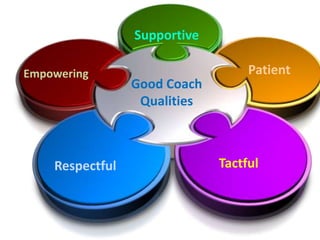
Good Coach
Qualities
Supportive
Patient
TactfulRespectful
Empowering
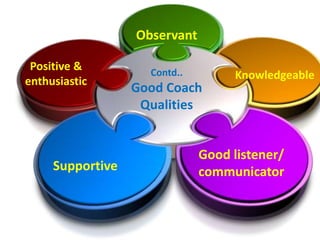
Contd..
Good Coach
Qualities
Observant
Good listener/
communicatorSupportive
Positive &
enthusiastic Knowledgeable
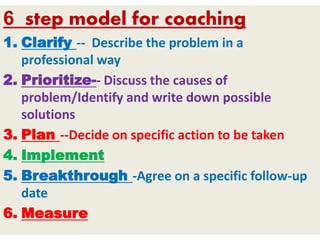
6 step model for coaching
1. Clarify -- Describe the problem in a
professional way
2. Prioritize-- Discuss the causes of
problem/Identify and write down possible
solutions
3. Plan --Decide on specific action to be taken
4. Implement
5. Breakthrough -Agree on a specific follow-up
date
6. Measure
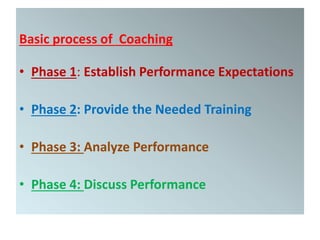
Basic process of Coaching
• Phase 1: Establish Performance Expectations
• Phase 2: Provide the Needed Training
• Phase 3: Analyze Performance
• Phase 4: Discuss Performance
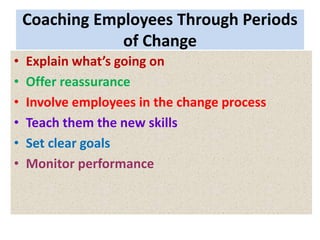
Coaching Employees Through Periods
of Change
• Explain what’s going on
• Offer reassurance
• Involve employees in the change process
• Teach them the new skills
• Set clear goals
• Monitor performance
WHY COACHING EFFORTS FAIL ?
• The Staff doesn’t trust the head nurse
• The H. Nurse hasn’t established
credibility in staff view that what she is
talking about
• H. Nurse sets a threatening atmosphere
for the discussion.
• H. Nurse hasn’t trained the employee
how to perform as expected.
• Staff doesn’t feel they’ve been told the
performance expectations and how
they’re going to be measured.
…Contd….
• Staff doesn’t feel that head nurse feedback is
accurate and objective.
• The H. Nurse can’t provide specific examples
of what the staff needs to improve.
• The H. Nurse does not praise things done
well. only concentrates on what the staff
needs to improve.
Coaching – misconceptions
• It is not new managers tool box
• Coaching is too time consuming
• Coaching is taxing as it requires patience
• Coaching is left up to each employee
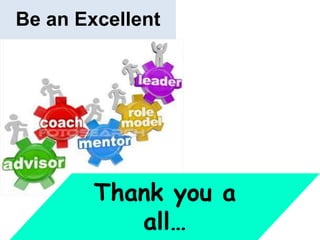
Be an Excellent
…
Thank you a
all…

Coaching

  • 2.
  • 3.
    Employee coaching isthe process of providing employees with the training they need on- how to do their job, and feedback on their performance.
  • 4.
    Definition : Coachingis A directive process by a manager to train and orient an employee to the realities of the workplace and to help the employee remove barriers to optimum work performance
  • 5.
    WHAT IS EMPLOYEECOACHING? • Setting needed performance expectations • Providing the necessary training • Monitoring performance against expectation • Providing feedback on results • Providing support and encouragement • Helping employees understand what they do well and where they need to improve. • Helping employees determine how to make needed adjustments so they do things right. • Celebrating success.
  • 6.
    Opportunities for coaching •Appearing un-motivated • Excessive errors • Missing deadlines • Falling below standards • Displaying need to fine tune skills
  • 7.
    Purpose of coaching COACHING………. •Informs what they have done well and what they need to improve. • Teaches, providing with the knowledge and skills they need to succeed. . • Guides and advises nurses instructing them steps to improve their performance. • Recognizes and builds on their accomplishments
  • 8.
    Contd…. Purpose -COACHING…. •Motivates and helps them develop greater levels of competence • Solve job problems and improve communication skills. • Empowers staff to work efficiently and be accountable for their own performance. • Develops their skills and abilities, helping and preparing them grow and advance professionally
  • 9.
    Benefits of coaching •Improve quality and productivity • Boosts enthusiasm and morale • Strengthen relationship and communication • Increase job satisfaction • Build trust and enhance loyalty
  • 10.
    Are you aCoach or A Driver ?
  • 11.
  • 12.
  • 13.
    6 step modelfor coaching 1. Clarify -- Describe the problem in a professional way 2. Prioritize-- Discuss the causes of problem/Identify and write down possible solutions 3. Plan --Decide on specific action to be taken 4. Implement 5. Breakthrough -Agree on a specific follow-up date 6. Measure
  • 14.
    Basic process ofCoaching • Phase 1: Establish Performance Expectations • Phase 2: Provide the Needed Training • Phase 3: Analyze Performance • Phase 4: Discuss Performance
  • 15.
    Coaching Employees ThroughPeriods of Change • Explain what’s going on • Offer reassurance • Involve employees in the change process • Teach them the new skills • Set clear goals • Monitor performance
  • 16.
    WHY COACHING EFFORTSFAIL ? • The Staff doesn’t trust the head nurse • The H. Nurse hasn’t established credibility in staff view that what she is talking about • H. Nurse sets a threatening atmosphere for the discussion. • H. Nurse hasn’t trained the employee how to perform as expected. • Staff doesn’t feel they’ve been told the performance expectations and how they’re going to be measured.
  • 17.
    …Contd…. • Staff doesn’tfeel that head nurse feedback is accurate and objective. • The H. Nurse can’t provide specific examples of what the staff needs to improve. • The H. Nurse does not praise things done well. only concentrates on what the staff needs to improve.
  • 18.
    Coaching – misconceptions •It is not new managers tool box • Coaching is too time consuming • Coaching is taxing as it requires patience • Coaching is left up to each employee
  • 19.