By: Ms. Shanta Peter
1
2
ASSESSMENT
Act of Evaluation
3
OBJECIVES :
• Discuss the role of Nurses in Health
Assessment Process
• List and explain the types, methods
techniques, components of Assessment
4
• Health assessment is an essential nursing
function which provides foundation for quality
nursing care and intervention
• It helps to identify the strengths of the clients
in promoting health
• Health assessment helps to identify client’s
needs, clinical problems
• To Evaluate responses of the person to health
problems and intervention
Health Assessment
5
NURSE
&
Health Assessment
An accurate and thorough Health Assessment
Reflects the
KNOWLEDGE & SKILLS
of a PROFESSIONAL NURSE
6
ASSESSMENT
Is the first step to determine heath
status. It is gathering of information
to have all the “necessary puzzle pieces” to make a
clear picture of the person’s health status
Definition : Assessment is the deliberate and
systematic collection of data to determine clients
current and past health status, functional status and
to determine client’s present and coping pattern
( Carpenito)
7
• Assessment is a part of each activity
the nurse does for and
with the patient
(Atkinson & Muray – 1991
Nursing assessment focus upon the
client’s response to a health problem
8
“ Nursing assessment should include client’s
perceived needs, health problems related
experience, health practices values and life styles”
( Bandman and Bandman (1995)
• To be most useful- the data collected should be
relevant to a particular health problem
• Therefore – nurses should think critically
about what to assess 9
10
11
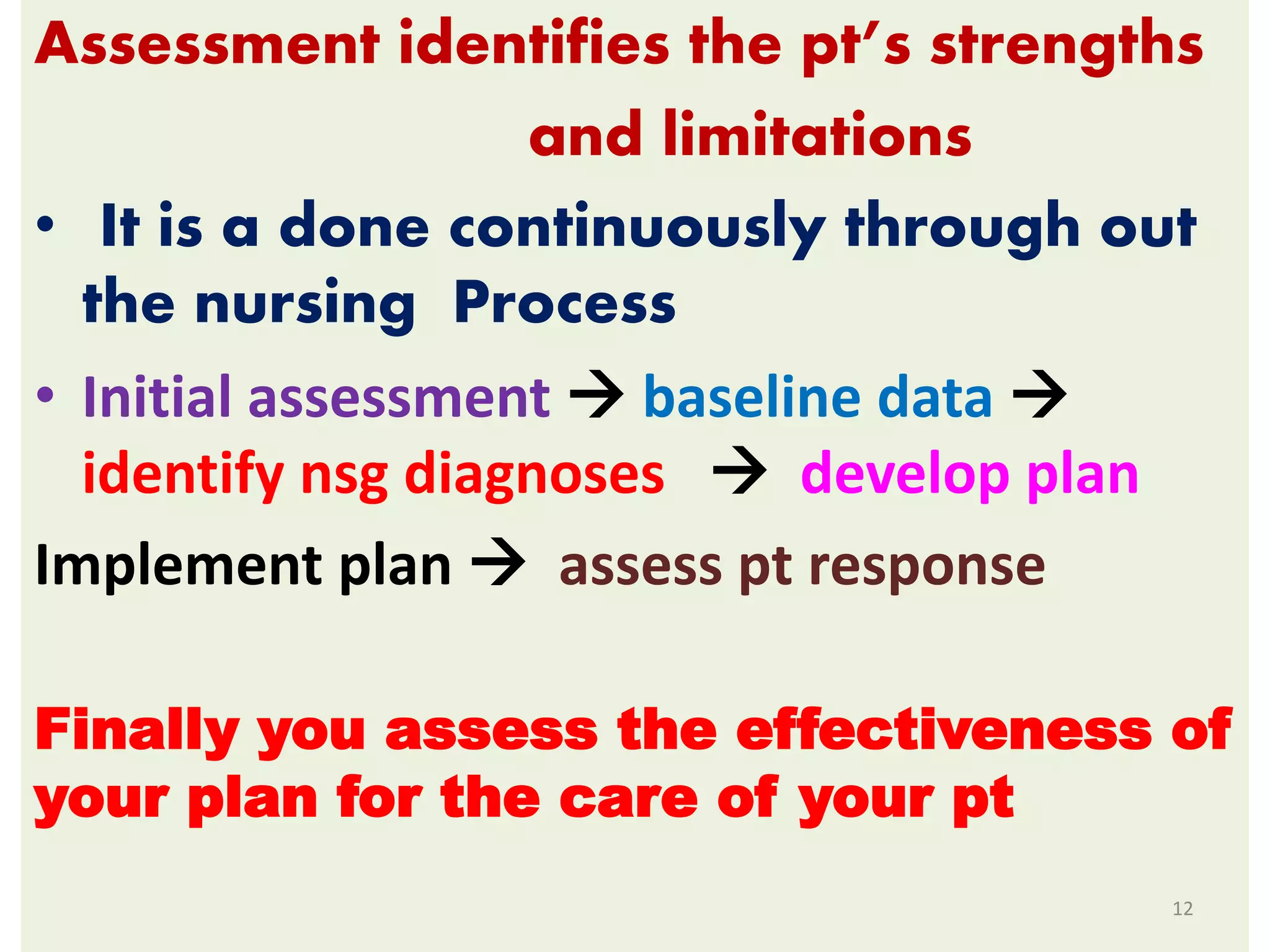
Assessment identifies the pt’s strengths
and limitations
• It is a done continuously through out
the nursing Process
• Initial assessment  baseline data 
identify nsg diagnoses  develop plan
Implement plan  assess pt response
Finally you assess the effectiveness of
your plan for the care of your pt
12
• What you do?
• Where do you begin ?
You begin with Assessment
13
Types of patients & Assessment
• Pediatric – neonate ,infant, children of all categories)
• Adolescent
• Young adults & adults
• Geriatric/elderly
Conscious
Unconscious
Delirious
• Psychiatric – Different categories
• Hysteric
ACUTE --- CHRONIC patients
14
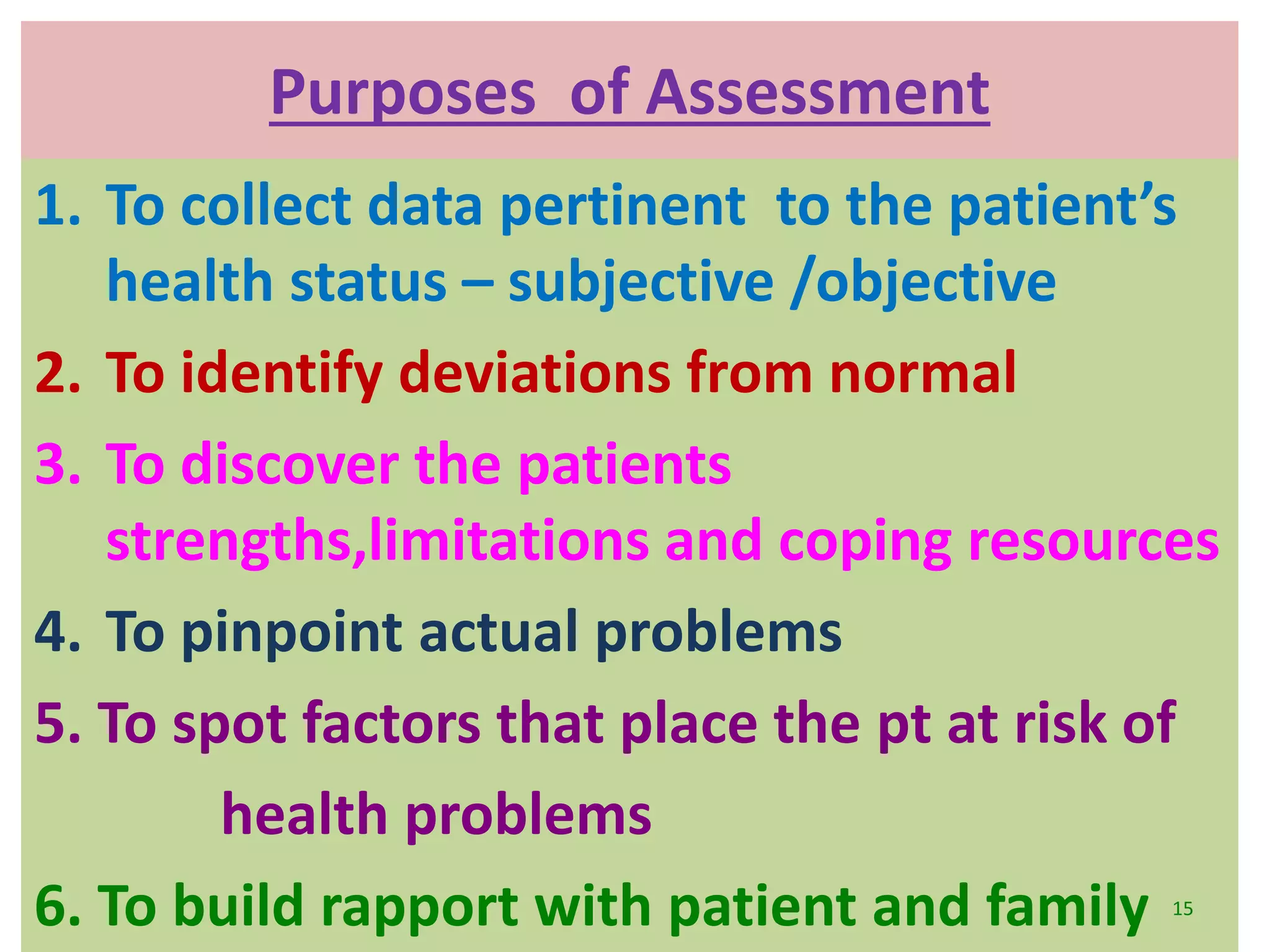
Purposes of Assessment
1. To collect data pertinent to the patient’s
health status – subjective /objective
2. To identify deviations from normal
3. To discover the patients
strengths,limitations and coping resources
4. To pinpoint actual problems
5. To spot factors that place the pt at risk of
health problems
6. To build rapport with patient and family 15
TYPES OF ASSESSMENT
16
INITIAL
Assessment
FOCUS
Assessment
EMERGENCY
Assessment
TIME LAPSED
Assessment
ASSESSMENT
Initial Assessment
It is done within specified time after admission
to Hospital
Purpose: To establish a complete data base for
problem identification, reference and future
comparison Eg: Admission assessment
Focus or Ongoing Assessment
Purpose: To determine the status of a specific
problem identified in the earlier assessment
& to identify new or overlooked problem
Eg: Hrly fluid intake output assessment 17
Emergency Assessment
During any physiologic and psychologic crisis
of the patient
Purpose: To identify life threatening problems
eg. ●ABC assessment in Cardiac arrest
●Assessment of suicidal attempt on violence
Time lapsed Assessment
Several months after the initial assessment
Purpose: To compare current status to baseline
data previously obtained
Eg Reassessment of clients functional health
patterns in home care 18
On-Going Assessment
• Ongoing – Systematic monitoring of
specific problems
Eg. Pain Assessment -( Pain score )
19
Methods of Assessment
The primary methods are –
●Observing
●Interviewing
●Examining
20
“The most practical lesson that can
be given to a nurse to teach them
what to observe “
Florence Nightingale ( 1859)
“For it may be said, not that the habit of
ready and correct observation will by itself
make us useful nurses. But that without it
we shall be useless with all our devotion “
(Nursing- what it is and what it not : F. Nightingale Page
160. (1860)
21
Observing
Is a conscious deliberate skill developed
only through and with an organized
approach.
Eg. Data observed with 4 senses – vision,
hearing, smell and touch
Interviewing
Is a planned communication or a conversation with
a purpose Eg. History taking
2 approaches : Directive , non directive
22
23
EXAMINING
Physical Examination
• Systematic data collection method –
Observational skills to detect health problems
Assessment sequencing
• Head – to- Toe assessment
• Body system assessment (Signs and symptoms
– complaints – lead to clues )
24
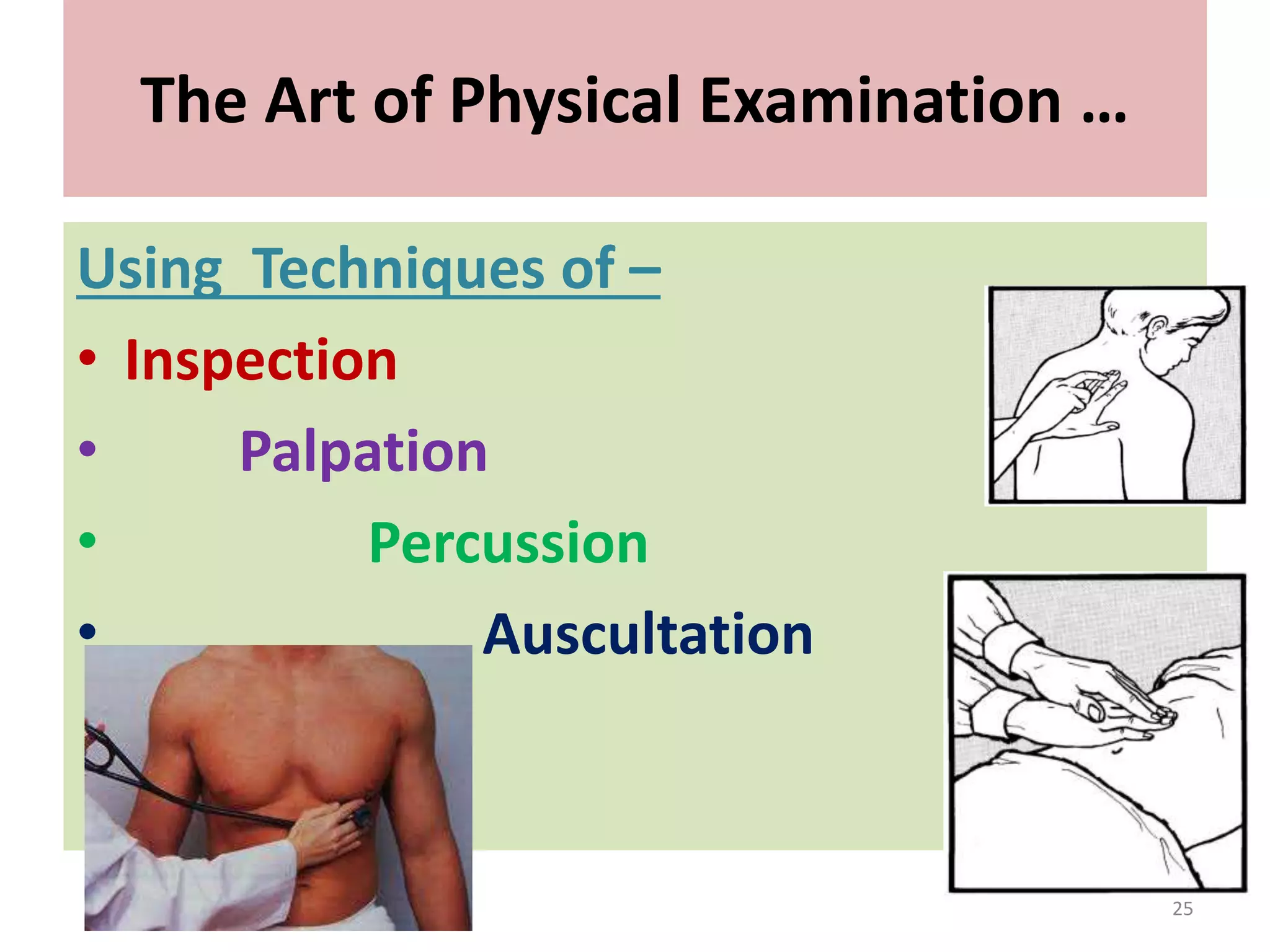
The Art of Physical Examination …
Using Techniques of –
• Inspection
• Palpation
• Percussion
• Auscultation
25
INSPECTION : close and careful visualization of
the person and of each body system
Eg Rashes…. Color changes … edema
PALPATION
• Temp •Texture
• Moisture •organ size & location
• Rigidity & spasticity •Crepitation /vibration
• Position& size •Tenderness/pain
•Presence of lumps & masses
26
PERCUSSION :
Assess underlying structures of
location,
size, density of underlying tissues
AUSCULTATION :
Listening to sounds produced
by the body
• Stethoscope --
• Doppler
• Feto- scope
27
4 Closely Related Activities
ASSESSMENT
Process
Collecting Data
Validating Data
Documenting
Data
Organizing Data
REPORT
DATA
28
1. Collecting Data : Gathering Information
Sources of data
Primary or Secondary
PRIMARY SOURCE ----- patient –
Alert, oriented patient is most reliable source
Aged, mentally deterioration seriously ill ???
SECONDARY SOURCE – Family members ,
significant others, medical records,
diagnostic procedures
29
1. COLLECTING DATA
Process of gathering information
Nurse collects …..
A. Subjective –(Symptom)
Verbal statement by the patient
Eg… Nausea , pain , fatigue ,itching
B. Objective--- (Signs) (overt ) data
-Detected by an observer - can be measured over
an accepted standard
Can be seen, felt, heard, smelt – information by
observation or examination
Eg. Discoloration of the skin
30
PQRST Method for PAIN Assessment
• O = Onset What you were doing when the pain
started ?
Was the onset sudden or gradual ?
• P = Provokes - What causes pain?
What makes it better? What makes it Worse?
• Q = Quality What does it feel like?
Is it sharp? Dull?
Stabbing? Burning? Crushing?
( Try to let patient describe the pain)
31
• R = Radiates Where does the pain radiate?
–Is it in one place?
–Does it go anywhere else?
• Did it start elsewhere and now localized to one
spot?
• S = Severity
How severe is the pain on a scale of 1 - 10
(This is a difficult one as the rating will differ from
patient to patient )
• T = Time
–Time pain started?
–How long did it last?
32
While Collecting data …..
When you communicate to collect data
Aware of verbal /nonverbal messages to patient
• Genuineness : be open ,honest and sincere
with patient
• Respect : be Non judgemental, let him feel
accepted as a unique individual
• Empathy: Is knowing what patient means and
acknowledge and understanding how he /she
feels
33
ORGANIZING DATA
• Cluster the data into groups of information
( identify the pattern of illness) (Data base)
34
VALIDATING DATA
• Double checking or verifying the data whether
it is factual or accurate
• The assessment information must be accurate,
factual and complete –
• Nursing diagnosis and interventions based on
this
35
DOCUMENTING DATA
• Accurate documentation is essential which include
all data collected about client’s health status.
Record in a FACTUAL manner NOT interpretation
• Eg. Recording the breakfast intake as –
Ate 2 pieces of Bread toast , 1 egg and
a cup of coffee
Instead of “Good appetite”
36
REPORTING - When you will Report?
• Depending on each Patient---
• Disease conditions – potential problems
• Family interests
• Psychological upset – may lead to suicidal
attempt
37
Skills require for Health Assessment
A. Cognitive skills : Assessment is a “thinking “process
• Critical thinking --- why , how .. What
• Clinical decision making use knowledge & experience
B. Problem solving Skill – with
Scientific methods- experience –
“ intuition” (with experience)
C. Psychomotor skills – Assessment is “doing”
D. Affective/Interpersonal Skill –
Assessment is “feeling” trust and mutual respect
E.Ethical skills : Assessment is “ being responsible &
accountable” for your practice
38
Medical Assessment Vs
Nursing Assessment
Assessment is the part of medical practice
the process is same BUT
The outcome differ
• Medical assessment Diagnosis and treatment
• Nursing assessment - focus on patient as a person
and reach to the optimal level of wellness
(Holistic Approach)
• Both should compliment—not CONTRADICT
• Nursing assessment contribute to identification of
medical problems
39
40
Assessment is being ACCOUNTABLE
& RESPONSIBLE for your practice
41
42
All

Nursing Health Assessment

  • 1.
  • 2.
  • 3.
  • 4.
    OBJECIVES : • Discussthe role of Nurses in Health Assessment Process • List and explain the types, methods techniques, components of Assessment 4
  • 5.
    • Health assessmentis an essential nursing function which provides foundation for quality nursing care and intervention • It helps to identify the strengths of the clients in promoting health • Health assessment helps to identify client’s needs, clinical problems • To Evaluate responses of the person to health problems and intervention Health Assessment 5
  • 6.
    NURSE & Health Assessment An accurateand thorough Health Assessment Reflects the KNOWLEDGE & SKILLS of a PROFESSIONAL NURSE 6
  • 7.
    ASSESSMENT Is the firststep to determine heath status. It is gathering of information to have all the “necessary puzzle pieces” to make a clear picture of the person’s health status Definition : Assessment is the deliberate and systematic collection of data to determine clients current and past health status, functional status and to determine client’s present and coping pattern ( Carpenito) 7
  • 8.
    • Assessment isa part of each activity the nurse does for and with the patient (Atkinson & Muray – 1991 Nursing assessment focus upon the client’s response to a health problem 8
  • 9.
    “ Nursing assessmentshould include client’s perceived needs, health problems related experience, health practices values and life styles” ( Bandman and Bandman (1995) • To be most useful- the data collected should be relevant to a particular health problem • Therefore – nurses should think critically about what to assess 9
  • 10.
  • 11.
  • 12.
    Assessment identifies thept’s strengths and limitations • It is a done continuously through out the nursing Process • Initial assessment  baseline data  identify nsg diagnoses  develop plan Implement plan  assess pt response Finally you assess the effectiveness of your plan for the care of your pt 12
  • 13.
    • What youdo? • Where do you begin ? You begin with Assessment 13
  • 14.
    Types of patients& Assessment • Pediatric – neonate ,infant, children of all categories) • Adolescent • Young adults & adults • Geriatric/elderly Conscious Unconscious Delirious • Psychiatric – Different categories • Hysteric ACUTE --- CHRONIC patients 14
  • 15.
    Purposes of Assessment 1.To collect data pertinent to the patient’s health status – subjective /objective 2. To identify deviations from normal 3. To discover the patients strengths,limitations and coping resources 4. To pinpoint actual problems 5. To spot factors that place the pt at risk of health problems 6. To build rapport with patient and family 15
  • 16.
  • 17.
    Initial Assessment It isdone within specified time after admission to Hospital Purpose: To establish a complete data base for problem identification, reference and future comparison Eg: Admission assessment Focus or Ongoing Assessment Purpose: To determine the status of a specific problem identified in the earlier assessment & to identify new or overlooked problem Eg: Hrly fluid intake output assessment 17
  • 18.
    Emergency Assessment During anyphysiologic and psychologic crisis of the patient Purpose: To identify life threatening problems eg. ●ABC assessment in Cardiac arrest ●Assessment of suicidal attempt on violence Time lapsed Assessment Several months after the initial assessment Purpose: To compare current status to baseline data previously obtained Eg Reassessment of clients functional health patterns in home care 18
  • 19.
    On-Going Assessment • Ongoing– Systematic monitoring of specific problems Eg. Pain Assessment -( Pain score ) 19
  • 20.
    Methods of Assessment Theprimary methods are – ●Observing ●Interviewing ●Examining 20
  • 21.
    “The most practicallesson that can be given to a nurse to teach them what to observe “ Florence Nightingale ( 1859) “For it may be said, not that the habit of ready and correct observation will by itself make us useful nurses. But that without it we shall be useless with all our devotion “ (Nursing- what it is and what it not : F. Nightingale Page 160. (1860) 21
  • 22.
    Observing Is a consciousdeliberate skill developed only through and with an organized approach. Eg. Data observed with 4 senses – vision, hearing, smell and touch Interviewing Is a planned communication or a conversation with a purpose Eg. History taking 2 approaches : Directive , non directive 22
  • 23.
  • 24.
    EXAMINING Physical Examination • Systematicdata collection method – Observational skills to detect health problems Assessment sequencing • Head – to- Toe assessment • Body system assessment (Signs and symptoms – complaints – lead to clues ) 24
  • 25.
    The Art ofPhysical Examination … Using Techniques of – • Inspection • Palpation • Percussion • Auscultation 25
  • 26.
    INSPECTION : closeand careful visualization of the person and of each body system Eg Rashes…. Color changes … edema PALPATION • Temp •Texture • Moisture •organ size & location • Rigidity & spasticity •Crepitation /vibration • Position& size •Tenderness/pain •Presence of lumps & masses 26
  • 27.
    PERCUSSION : Assess underlyingstructures of location, size, density of underlying tissues AUSCULTATION : Listening to sounds produced by the body • Stethoscope -- • Doppler • Feto- scope 27
  • 28.
    4 Closely RelatedActivities ASSESSMENT Process Collecting Data Validating Data Documenting Data Organizing Data REPORT DATA 28
  • 29.
    1. Collecting Data: Gathering Information Sources of data Primary or Secondary PRIMARY SOURCE ----- patient – Alert, oriented patient is most reliable source Aged, mentally deterioration seriously ill ??? SECONDARY SOURCE – Family members , significant others, medical records, diagnostic procedures 29
  • 30.
    1. COLLECTING DATA Processof gathering information Nurse collects ….. A. Subjective –(Symptom) Verbal statement by the patient Eg… Nausea , pain , fatigue ,itching B. Objective--- (Signs) (overt ) data -Detected by an observer - can be measured over an accepted standard Can be seen, felt, heard, smelt – information by observation or examination Eg. Discoloration of the skin 30
  • 31.
    PQRST Method forPAIN Assessment • O = Onset What you were doing when the pain started ? Was the onset sudden or gradual ? • P = Provokes - What causes pain? What makes it better? What makes it Worse? • Q = Quality What does it feel like? Is it sharp? Dull? Stabbing? Burning? Crushing? ( Try to let patient describe the pain) 31
  • 32.
    • R =Radiates Where does the pain radiate? –Is it in one place? –Does it go anywhere else? • Did it start elsewhere and now localized to one spot? • S = Severity How severe is the pain on a scale of 1 - 10 (This is a difficult one as the rating will differ from patient to patient ) • T = Time –Time pain started? –How long did it last? 32
  • 33.
    While Collecting data….. When you communicate to collect data Aware of verbal /nonverbal messages to patient • Genuineness : be open ,honest and sincere with patient • Respect : be Non judgemental, let him feel accepted as a unique individual • Empathy: Is knowing what patient means and acknowledge and understanding how he /she feels 33
  • 34.
    ORGANIZING DATA • Clusterthe data into groups of information ( identify the pattern of illness) (Data base) 34
  • 35.
    VALIDATING DATA • Doublechecking or verifying the data whether it is factual or accurate • The assessment information must be accurate, factual and complete – • Nursing diagnosis and interventions based on this 35
  • 36.
    DOCUMENTING DATA • Accuratedocumentation is essential which include all data collected about client’s health status. Record in a FACTUAL manner NOT interpretation • Eg. Recording the breakfast intake as – Ate 2 pieces of Bread toast , 1 egg and a cup of coffee Instead of “Good appetite” 36
  • 37.
    REPORTING - Whenyou will Report? • Depending on each Patient--- • Disease conditions – potential problems • Family interests • Psychological upset – may lead to suicidal attempt 37
  • 38.
    Skills require forHealth Assessment A. Cognitive skills : Assessment is a “thinking “process • Critical thinking --- why , how .. What • Clinical decision making use knowledge & experience B. Problem solving Skill – with Scientific methods- experience – “ intuition” (with experience) C. Psychomotor skills – Assessment is “doing” D. Affective/Interpersonal Skill – Assessment is “feeling” trust and mutual respect E.Ethical skills : Assessment is “ being responsible & accountable” for your practice 38
  • 39.
    Medical Assessment Vs NursingAssessment Assessment is the part of medical practice the process is same BUT The outcome differ • Medical assessment Diagnosis and treatment • Nursing assessment - focus on patient as a person and reach to the optimal level of wellness (Holistic Approach) • Both should compliment—not CONTRADICT • Nursing assessment contribute to identification of medical problems 39
  • 40.
    40 Assessment is beingACCOUNTABLE & RESPONSIBLE for your practice
  • 41.
  • 42.