MANAGERIAL INTEREST IN
CONFLICT AND CONFLICT STUDIES
Meaning and Definition
Conflict is when two or more
values, perspectives and
opinions are contradictory in
nature and haven't been aligned
or agreed .
Group of people with
Complementary skills who are
committed to a common
purpose , performance and
goals bring different ideas,
values, beliefs. These same
difference inevitably lead to
conflict.
Overview
Conflict is inevitable.
No matter where one works, sooner or later the person is going to find
himself in a disagreement with someone.
Everyone has heard of disputes that erupt into expensive and divisive
lawsuits.
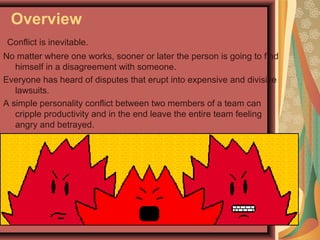
A simple personality conflict between two members of a team can
cripple productivity and in the end leave the entire team feeling
angry and betrayed.
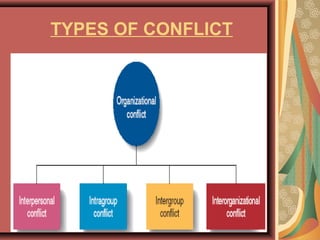
TYPES OF CONFLICT
Organizational Conflict
The discord that arises when goals, interests or values of
different individuals or groups are
incompatible
and those people
block or thwart
each other’s efforts
to achieve their
objectives.
• Interpersonal Conflict
Conflict between individuals due to differences in
their goals or values.
• Intragroup Conflict
Conflict within a group or team.
•Intergroup Conflict
Conflict between two or more
teams, groups or departments.
Managers play a key role in
resolution of this conflict
•Interorganizational Conflict
Conflict that arises across
organizations.
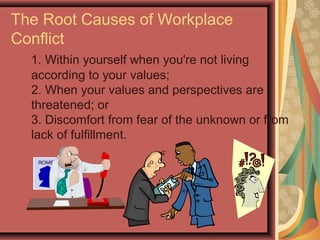
The Root Causes of Workplace
Conflict
1. Within yourself when you're not living
according to your values;
2. When your values and perspectives are
threatened; or
3. Discomfort from fear of the unknown or from
lack of fulfillment.
Conflict is a problem when it:
1. Hampers productivity.
2. Lowers morale.
3. Causes more and continued
conflicts.
4. Causes inappropriate behaviors.
stages of conflict
"Disputes of right" and "disputes
of interest"
Developmental stages
where potential for conflict exists - in
other words where people recognize
that lack of resources, diversity of
language or culture may possibly
result in conflict if people are not
sensitive to the diversity
• latent conflict where a competitive
situation could easily spill over into conflict -
e.g. at a political rally or in the workplace
where there are obvious differences
between groups of people.
open conflict - which can be triggered by
an incident and suddenly become real
conflict.
aftermath conflict - the situation where a
particular problem may have been resolved
but the potential for conflict still exists. In
fact the potential may be even greater than
before, if one person or group perceives
itself as being involved in a win-loose
situation.
What is conflict management?
Conflict management is the principle that
all conflict cannot necessarily be resolved
but learning how to manage conflicts can
decrease the odds of non productive
escalation.
It involves skills related to conflict
resolution, self awareness about conflict
modes, conflict communication skills and
establishing a structure for management of
conflict in your environment.
Managerial Actions that Cause
Workplace Conflicts
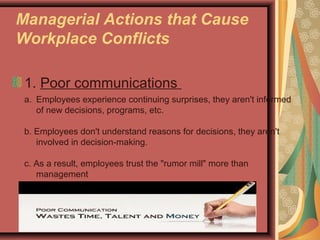
1. Poor communications
a. Employees experience continuing surprises, they aren't informed
of new decisions, programs, etc.
b. Employees don't understand reasons for decisions, they aren't
involved in decision-making.
c. As a result, employees trust the "rumor mill" more than
management
2. The alignment or the amount of
resources is insufficient.
a. Disagreement about "who does what".
b. Stress from working with inadequate resources
3. "Personal chemistry", including
conflicting values or actions among
managers and employees
a. Strong personal natures don't match.
b. We often don't like in others what we don't like in
ourselves.
4. Leadership problems
a. Avoiding conflict, "passing the buck" with little
follow-through on decisions.
b. Employees see the same continued issues in the
workplace.
c. Supervisors don't understand the jobs of their
subordinates.
Key Managerial Actions /
Structures to Minimize Conflicts
Regularly review job descriptions.
Ensure:
a. Job roles don't conflict.
b. No tasks "fall in a crack".
2. Intentionally build relationships with all
subordinates:
a. Meet at least once a month alone with
them in office.
b. Ask about accomplishments, challenges
and issues.
3. Get regular, written status reports and
include:
a. Accomplishments.
b. Currents issues and needs from
management.
c. Plans for the upcoming period.
4. Conduct basic training about:
a. Interpersonal communications.
b. Conflict management.
c. Delegation.
5. Develop procedures for routine tasks
and include the employees' input:
a. Have employees write procedures when possible and
appropriate.
b. Get employees' review of the procedures.
c. Distribute the procedures.
d. Train employees about the procedures.
6. Regularly hold management meetings,
for example, every month, to communicate
new initiatives and status of current
programs.
7. Consider an anonymous suggestion box
in which employees can provide
suggestions
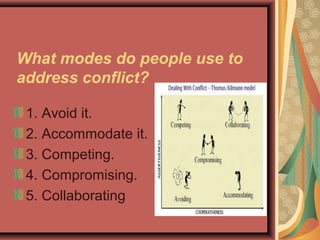
What modes do people use to
address conflict?
1. Avoid it.
2. Accommodate it.
3. Competing.
4. Compromising.
5. Collaborating
AVODING MODE
Low assertive and low cooperation
Skills
Ability to withdraw
Ability to side step
Ability to leave things unsolved
Sense of timing
Accommodating mode
Low assertiveness and high
cooperation
Accommodating skills
Forgetting your desires
Selflessness
Ability to yield
Obeying orders
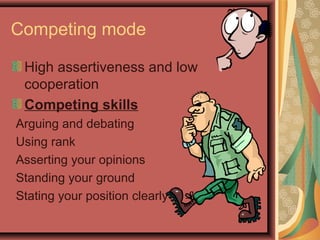
Competing mode
High assertiveness and low
cooperation
Competing skills
Arguing and debating
Using rank
Asserting your opinions
Standing your ground
Stating your position clearly
Compromising mode
Moderate assertiveness and
moderate cooperation
Compromising skills
Negotiations
Finding a middle ground
Assessing value
Making concessions
Collaborating mode
High assertiveness high cooperation
Collaborating skills
Active listening
Non threatening confrontation
Identifying concerns
Analyzing input
Manage a Conflict Within Yourself -
"Core Process"
1. Name the conflict, or identify the
issue, including what you want that
you aren't getting. Consider:
a. Writing your thoughts down to come to a
conclusion.
b. Talk to someone, including asking them to help
you summarize the conflict in 5 sentences or less.
2. Get perspective by discussing the
issue with your friend or by putting it
down in writing. Consider:
a. How important is this issue?
b. Does the issue seem worse because you're
tired, angry at something else, etc.?
c. What's your role in this issue?
3. Pick at least one thing you can do
about the conflict.
a. Identify at least three courses of action.
b. For each course, write at least three pros and
cons.
c. Select an action - if there is no clear course of
action, pick the alternative that will not hurt, or be
least hurtful, to yourself and others.
d. Briefly discuss that course of action with a
friend.
4. Then do something.
a. Wait at least a day before you do anything
about the conflict. This gives you a cooling off
period.
b. Then take an action.
c. Have in your own mind, a date when you will act
again if you see no clear improvement.
To Manage a Conflict With
Another - "Core Process"
1. Know what you don't like about yourself, early
on in your career. We often don't like in others
what we don't want to see in ourselves.
a. Write down 5 traits that really bug you when
see them in others.
b. Be aware that these traits are your "hot
buttons".
2. Manage yourself. If you and/or the
other person are getting heated up,
then manage yourself to stay calm by
a. Speaking to the person as if the other person is not
heated up - this can be very effective!
b. Avoid use of the word "you" - this avoids blaming.
c. Nod your head to assure them you heard them.
d. Maintain eye contact with them.
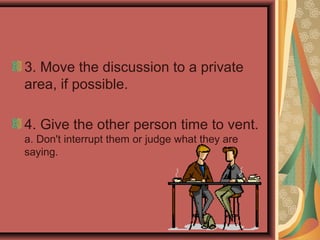
3. Move the discussion to a private
area, if possible.
4. Give the other person time to vent.
a. Don't interrupt them or judge what they are
saying.
5. Verify that you're accurately
hearing each other
a. Ask the other person to let you rephrase (uninterrupted)
what you are hearing from them to ensure you are hearing
them.
b. To understand them more, ask open-ended questions.
Avoid "why" questions - those questions often make
people feel defensive.
6. Repeat the above step, this time
for them to verify that they are
hearing you. When you present your
position
a. Use "I", not "you".
b. Talk in terms of the present as much as
possible.
c. Mention your feelings.
7. Acknowledge where you disagree and
where you agree.
8. Work the issue, not the person.
9. If possible, identify at least one action
that can be done by one or both of you.
a. Ask the other person if they will support the
action.
b. If they will not, then ask for a "cooling off
period".
10. Thank the person for working with you.
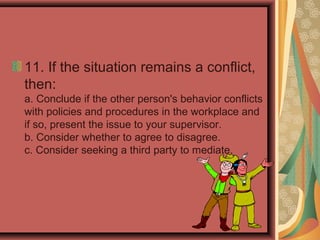
11. If the situation remains a conflict,
then:
a. Conclude if the other person's behavior conflicts
with policies and procedures in the workplace and
if so, present the issue to your supervisor.
b. Consider whether to agree to disagree.
c. Consider seeking a third party to mediate.
CONCLUSION
Conflicts are part of life, in fact, some
conflicts are useful( functional), contributing
to growth and development. Conflicts occur
when the concerns are narrow, different
goals are seen as conflicting, resources and
power are perceived as limited, differences in
values and norms are regarded as
undesirable, and some individuals or groups
are dependent on others. Conflicts can be
presented through the participatory mode of
management.

Managerial interest

  • 1.
    MANAGERIAL INTEREST IN CONFLICTAND CONFLICT STUDIES
  • 2.
    Meaning and Definition Conflictis when two or more values, perspectives and opinions are contradictory in nature and haven't been aligned or agreed . Group of people with Complementary skills who are committed to a common purpose , performance and goals bring different ideas, values, beliefs. These same difference inevitably lead to conflict.
  • 3.
    Overview Conflict is inevitable. Nomatter where one works, sooner or later the person is going to find himself in a disagreement with someone. Everyone has heard of disputes that erupt into expensive and divisive lawsuits. A simple personality conflict between two members of a team can cripple productivity and in the end leave the entire team feeling angry and betrayed.
  • 4.
  • 5.
    Organizational Conflict The discordthat arises when goals, interests or values of different individuals or groups are incompatible and those people block or thwart each other’s efforts to achieve their objectives.
  • 6.
    • Interpersonal Conflict Conflictbetween individuals due to differences in their goals or values. • Intragroup Conflict Conflict within a group or team.
  • 7.
    •Intergroup Conflict Conflict betweentwo or more teams, groups or departments. Managers play a key role in resolution of this conflict •Interorganizational Conflict Conflict that arises across organizations.
  • 8.
    The Root Causesof Workplace Conflict 1. Within yourself when you're not living according to your values; 2. When your values and perspectives are threatened; or 3. Discomfort from fear of the unknown or from lack of fulfillment.
  • 9.
    Conflict is aproblem when it: 1. Hampers productivity. 2. Lowers morale. 3. Causes more and continued conflicts. 4. Causes inappropriate behaviors.
  • 10.
    stages of conflict "Disputesof right" and "disputes of interest"
  • 11.
    Developmental stages where potentialfor conflict exists - in other words where people recognize that lack of resources, diversity of language or culture may possibly result in conflict if people are not sensitive to the diversity
  • 12.
    • latent conflictwhere a competitive situation could easily spill over into conflict - e.g. at a political rally or in the workplace where there are obvious differences between groups of people.
  • 13.
    open conflict -which can be triggered by an incident and suddenly become real conflict. aftermath conflict - the situation where a particular problem may have been resolved but the potential for conflict still exists. In fact the potential may be even greater than before, if one person or group perceives itself as being involved in a win-loose situation.
  • 14.
    What is conflictmanagement? Conflict management is the principle that all conflict cannot necessarily be resolved but learning how to manage conflicts can decrease the odds of non productive escalation. It involves skills related to conflict resolution, self awareness about conflict modes, conflict communication skills and establishing a structure for management of conflict in your environment.
  • 15.
    Managerial Actions thatCause Workplace Conflicts 1. Poor communications a. Employees experience continuing surprises, they aren't informed of new decisions, programs, etc. b. Employees don't understand reasons for decisions, they aren't involved in decision-making. c. As a result, employees trust the "rumor mill" more than management
  • 16.
    2. The alignmentor the amount of resources is insufficient. a. Disagreement about "who does what". b. Stress from working with inadequate resources
  • 17.
    3. "Personal chemistry",including conflicting values or actions among managers and employees a. Strong personal natures don't match. b. We often don't like in others what we don't like in ourselves.
  • 18.
    4. Leadership problems a.Avoiding conflict, "passing the buck" with little follow-through on decisions. b. Employees see the same continued issues in the workplace. c. Supervisors don't understand the jobs of their subordinates.
  • 19.
    Key Managerial Actions/ Structures to Minimize Conflicts Regularly review job descriptions. Ensure: a. Job roles don't conflict. b. No tasks "fall in a crack".
  • 20.
    2. Intentionally buildrelationships with all subordinates: a. Meet at least once a month alone with them in office. b. Ask about accomplishments, challenges and issues. 3. Get regular, written status reports and include: a. Accomplishments. b. Currents issues and needs from management. c. Plans for the upcoming period.
  • 21.
    4. Conduct basictraining about: a. Interpersonal communications. b. Conflict management. c. Delegation. 5. Develop procedures for routine tasks and include the employees' input: a. Have employees write procedures when possible and appropriate. b. Get employees' review of the procedures. c. Distribute the procedures. d. Train employees about the procedures.
  • 22.
    6. Regularly holdmanagement meetings, for example, every month, to communicate new initiatives and status of current programs. 7. Consider an anonymous suggestion box in which employees can provide suggestions
  • 23.
    What modes dopeople use to address conflict? 1. Avoid it. 2. Accommodate it. 3. Competing. 4. Compromising. 5. Collaborating
  • 24.
    AVODING MODE Low assertiveand low cooperation Skills Ability to withdraw Ability to side step Ability to leave things unsolved Sense of timing
  • 25.
    Accommodating mode Low assertivenessand high cooperation Accommodating skills Forgetting your desires Selflessness Ability to yield Obeying orders
  • 26.
    Competing mode High assertivenessand low cooperation Competing skills Arguing and debating Using rank Asserting your opinions Standing your ground Stating your position clearly
  • 27.
    Compromising mode Moderate assertivenessand moderate cooperation Compromising skills Negotiations Finding a middle ground Assessing value Making concessions
  • 28.
    Collaborating mode High assertivenesshigh cooperation Collaborating skills Active listening Non threatening confrontation Identifying concerns Analyzing input
  • 29.
    Manage a ConflictWithin Yourself - "Core Process" 1. Name the conflict, or identify the issue, including what you want that you aren't getting. Consider: a. Writing your thoughts down to come to a conclusion. b. Talk to someone, including asking them to help you summarize the conflict in 5 sentences or less.
  • 30.
    2. Get perspectiveby discussing the issue with your friend or by putting it down in writing. Consider: a. How important is this issue? b. Does the issue seem worse because you're tired, angry at something else, etc.? c. What's your role in this issue?
  • 31.
    3. Pick atleast one thing you can do about the conflict. a. Identify at least three courses of action. b. For each course, write at least three pros and cons. c. Select an action - if there is no clear course of action, pick the alternative that will not hurt, or be least hurtful, to yourself and others. d. Briefly discuss that course of action with a friend.
  • 32.
    4. Then dosomething. a. Wait at least a day before you do anything about the conflict. This gives you a cooling off period. b. Then take an action. c. Have in your own mind, a date when you will act again if you see no clear improvement.
  • 33.
    To Manage aConflict With Another - "Core Process" 1. Know what you don't like about yourself, early on in your career. We often don't like in others what we don't want to see in ourselves. a. Write down 5 traits that really bug you when see them in others. b. Be aware that these traits are your "hot buttons".
  • 34.
    2. Manage yourself.If you and/or the other person are getting heated up, then manage yourself to stay calm by a. Speaking to the person as if the other person is not heated up - this can be very effective! b. Avoid use of the word "you" - this avoids blaming. c. Nod your head to assure them you heard them. d. Maintain eye contact with them.
  • 35.
    3. Move thediscussion to a private area, if possible. 4. Give the other person time to vent. a. Don't interrupt them or judge what they are saying.
  • 36.
    5. Verify thatyou're accurately hearing each other a. Ask the other person to let you rephrase (uninterrupted) what you are hearing from them to ensure you are hearing them. b. To understand them more, ask open-ended questions. Avoid "why" questions - those questions often make people feel defensive.
  • 37.
    6. Repeat theabove step, this time for them to verify that they are hearing you. When you present your position a. Use "I", not "you". b. Talk in terms of the present as much as possible. c. Mention your feelings.
  • 38.
    7. Acknowledge whereyou disagree and where you agree. 8. Work the issue, not the person. 9. If possible, identify at least one action that can be done by one or both of you. a. Ask the other person if they will support the action. b. If they will not, then ask for a "cooling off period". 10. Thank the person for working with you.
  • 39.
    11. If thesituation remains a conflict, then: a. Conclude if the other person's behavior conflicts with policies and procedures in the workplace and if so, present the issue to your supervisor. b. Consider whether to agree to disagree. c. Consider seeking a third party to mediate.
  • 40.
    CONCLUSION Conflicts are partof life, in fact, some conflicts are useful( functional), contributing to growth and development. Conflicts occur when the concerns are narrow, different goals are seen as conflicting, resources and power are perceived as limited, differences in values and norms are regarded as undesirable, and some individuals or groups are dependent on others. Conflicts can be presented through the participatory mode of management.