Impacts of   Water pollution
Water - Source of life
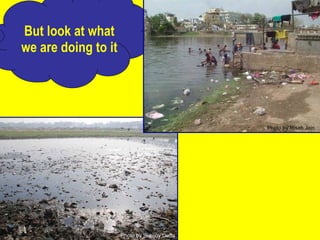
But look at what we are doing to it Photo by Subijoy Dutta Photo by Risab Jain
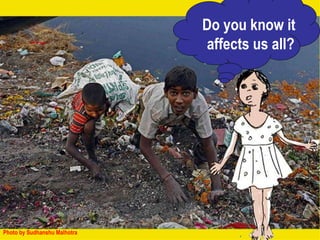
Photo by Sudhanshu Malhotra Do you know it  affects us all?
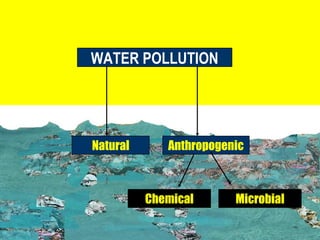
Natural Chemical Anthropogenic Microbial WATER POLLUTION
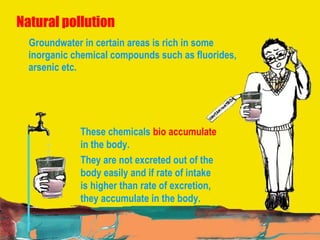
Natural pollution Groundwater in certain areas is rich in some inorganic chemical compounds such as fluorides, arsenic etc.  These chemicals  bio accumulate  in the body.  They are not excreted out of the body easily and if rate of intake is higher than rate of excretion, they accumulate in the body.
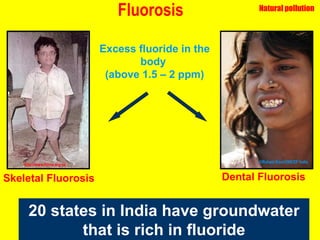
Fluorosis ©Ruhani Kaur/UNICEF India  http://www.fannz.org.nz 20 states in India have groundwater that is rich in fluoride Dental Fluorosis Skeletal Fluorosis Excess fluoride in the body  (above 1.5 – 2 ppm) Natural pollution
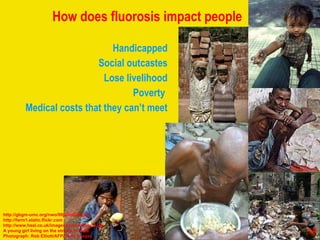
How does fluorosis impact people Handicapped Social outcastes Lose livelihood Poverty  Medical costs that they can’t meet http://gbgm-umc.org/nwo/99ja/india3.jpg http://farm1.static.flickr.com http://www.heal.co.uk/images/child-labour-3.jpg A young girl living on the streets in India. Photograph: Rob Elliott/AFP/Getty Images
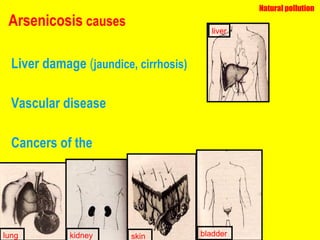
Arsenicosis  causes Liver damage  ( jaundice, cirrhosis) Vascular disease Cancers of the lung kidney bladder skin Natural pollution liver
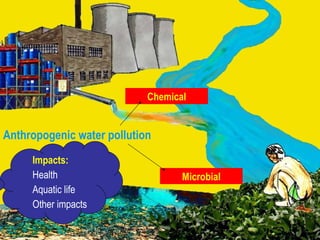
Anthropogenic water pollution Impacts: Health  Aquatic life Other impacts Chemical Microbial
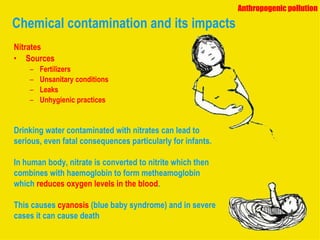
Nitrates Sources Fertilizers Unsanitary conditions Leaks Unhygienic practices Chemical contamination and its impacts Drinking water contaminated with nitrates can lead to serious, even fatal consequences particularly for infants. In human body, nitrate is converted to nitrite which then combines with   haemoglobin   to form metheamoglobin which  reduces oxygen levels in the blood .  This causes   cyanosis   (blue baby syndrome) and in severe cases it can cause death Anthropogenic pollution
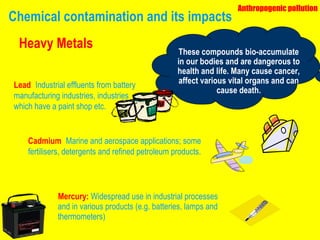
Chemical contamination and its impacts Mercury:   Widespread use in industrial processes and in various products (e.g. batteries, lamps and thermometers) These compounds bio-accumulate in our bodies and are dangerous to health and life. Many cause cancer, affect various vital organs and can cause death. Anthropogenic pollution Heavy Metals Lead :  Industrial effluents from battery manufacturing industries, industries which have a paint shop etc. Cadmium :  Marine and aerospace applications; some fertilisers, detergents and refined petroleum products.
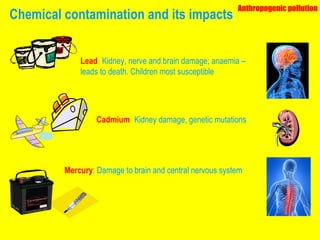
Chemical contamination and its impacts Anthropogenic pollution Lead :  Kidney, nerve and brain damage; anaemia – leads to death. Children most susceptible Cadmium :  Kidney damage, genetic mutations Mercury : Damage to brain and central nervous system
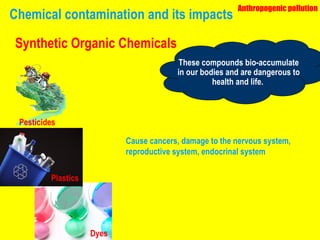
Chemical contamination and its impacts Anthropogenic pollution Synthetic Organic Chemicals These compounds bio-accumulate in our bodies and are dangerous to health and life.  Cause cancers, damage to the nervous system, reproductive system, endocrinal system Dyes Plastics Pesticides
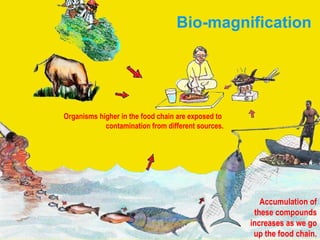
Bio-magnification Accumulation of these compounds increases as we go up the food chain. Organisms higher in the food chain are exposed to  contamination from different sources.
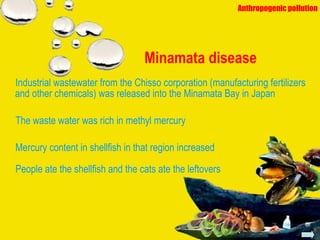
Minamata disease Industrial wastewater from the Chisso corporation (manufacturing fertilizers and other chemicals) was released into the   Minamata Bay in   Japan The waste water was rich in methyl mercury Mercury content in shellfish in that region increased People ate the shellfish and the cats ate the leftovers Anthropogenic pollution
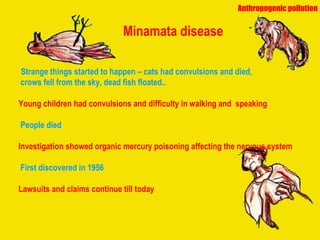
Minamata disease Strange things started to happen – cats had convulsions and died,  crows fell from the sky, dead fish floated.. Young children had convulsions and difficulty in walking and  speaking  People died Investigation showed organic mercury poisoning affecting the nervous system First discovered in 1956 Lawsuits and claims continue till today Anthropogenic pollution
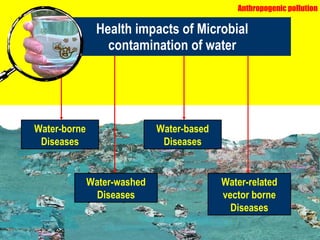
Health impacts of Microbial contamination of water Water-borne Diseases Water-washed Diseases Water-based Diseases Water-related vector borne Diseases Anthropogenic pollution
Water borne diseases  (also water-washed and food borne) Diseases caused by ingestion of water contaminated by human  or animal excrement, which contain pathogenic microorganisms Cholera Diarrhoeal diseases (dysentry) Typhoid Infective jaundice Polio Roundworm
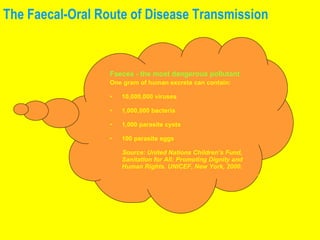
The Faecal-Oral Route of Disease Transmission One gram of human excreta can contain: 10,000,000 viruses 1,000,000 bacteria 1,000 parasite cysts 100 parasite eggs Source: United Nations Children’s Fund, Sanitation for All: Promoting Dignity and Human Rights. UNICEF, New York, 2000. Faeces - the most dangerous pollutant
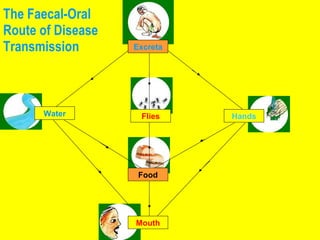
The Faecal-Oral Route of Disease Transmission Food Excreta Hands Water Flies Mouth
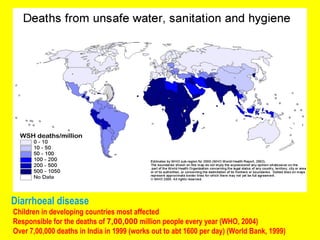
Diarrhoeal disease  Children in developing countries most affected Responsible for the deaths of  7,00,000  million people every year (WHO, 2004)  Over 7,00,000 deaths in India in 1999 (works out to abt 1600 per day) (World Bank, 1999)
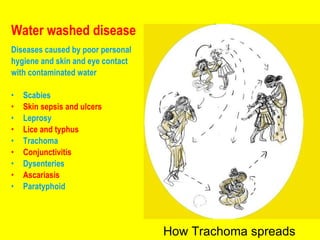
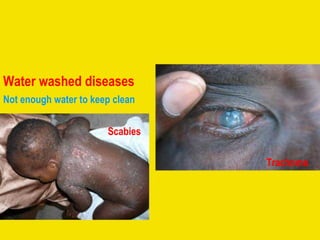
Water washed disease Diseases caused by poor personal  hygiene and skin and eye contact  with contaminated water Scabies Skin sepsis and ulcers Leprosy Lice and typhus Trachoma Conjunctivitis Dysenteries Ascariasis Paratyphoid How Trachoma spreads
Water washed diseases Scabies Trachoma Not enough water to keep clean
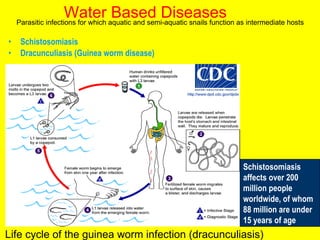
Water based diseases Schistosomiasis Dracunculiasis (Guinea worm disease) Life Cycle of guinea worm infection  Schistosomiasis affects over 200 million people worldwide, of whom 88 million are under 15 years of age  Water Based Diseases Life cycle of the guinea worm infection (dracunculiasis) Parasitic infections for which aquatic and semi-aquatic snails function as intermediate hosts
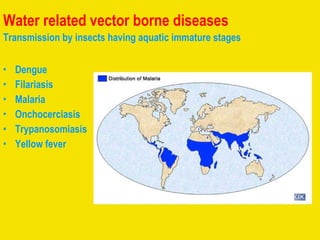
Water related vector borne diseases  Transmission by insects having aquatic immature stages Dengue Filariasis  Malaria  Onchocerciasis Trypanosomiasis  Yellow fever
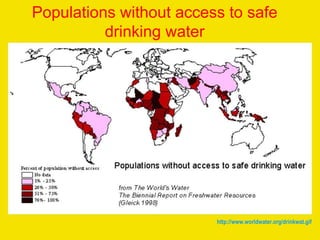
http://www.worldwater.org/drinkwat.gif Populations without access to safe drinking water
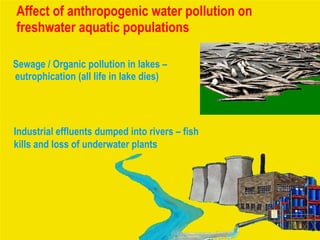
Affect of anthropogenic water pollution on freshwater aquatic populations Sewage / Organic pollution in lakes – eutrophication (all life in lake dies)   Industrial effluents dumped into rivers – fish kills and loss of underwater plants
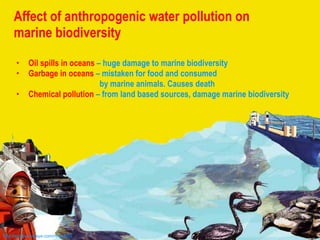
Affect of anthropogenic water pollution on marine biodiversity Oil spills in oceans   – huge damage to marine biodiversity Garbage in oceans   – mistaken for food and consumed  by marine animals. Causes death Chemical pollution  – from land based sources, damage marine biodiversity http://sxmprivateeye.com/node/255
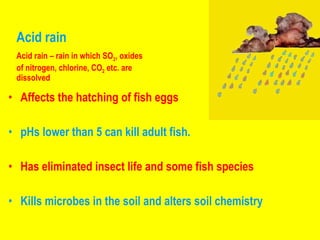
Acid rain Affects the hatching of fish eggs pHs lower than 5 can kill adult fish.  Has eliminated insect life and some fish species  Kills microbes in the soil and alters soil chemistry Acid rain – rain in which SO 2 , oxides  of nitrogen, chlorine, CO 2  etc. are dissolved
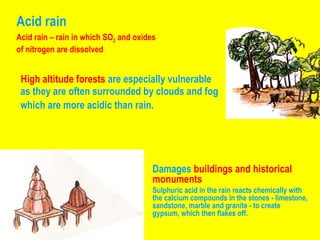
Acid rain High altitude forests  are especially vulnerable as they are often surrounded by clouds and fog which are more acidic than rain.   Acid rain – rain in which SO 2  and oxides  of nitrogen are dissolved Damages  buildings and historical monuments   Sulphuric acid in the rain reacts chemically with the calcium compounds in the stones - limestone, sandstone, marble and granite - to create gypsum, which then flakes off.

What Are We Doing To Our Water

  • 1.
    Impacts of Water pollution
  • 2.
  • 3.
    But look atwhat we are doing to it Photo by Subijoy Dutta Photo by Risab Jain
  • 4.
    Photo by SudhanshuMalhotra Do you know it affects us all?
  • 5.
    Natural Chemical AnthropogenicMicrobial WATER POLLUTION
  • 6.
    Natural pollution Groundwaterin certain areas is rich in some inorganic chemical compounds such as fluorides, arsenic etc. These chemicals bio accumulate in the body. They are not excreted out of the body easily and if rate of intake is higher than rate of excretion, they accumulate in the body.
  • 7.
    Fluorosis ©Ruhani Kaur/UNICEFIndia http://www.fannz.org.nz 20 states in India have groundwater that is rich in fluoride Dental Fluorosis Skeletal Fluorosis Excess fluoride in the body (above 1.5 – 2 ppm) Natural pollution
  • 8.
    How does fluorosisimpact people Handicapped Social outcastes Lose livelihood Poverty Medical costs that they can’t meet http://gbgm-umc.org/nwo/99ja/india3.jpg http://farm1.static.flickr.com http://www.heal.co.uk/images/child-labour-3.jpg A young girl living on the streets in India. Photograph: Rob Elliott/AFP/Getty Images
  • 9.
    Arsenicosis causesLiver damage ( jaundice, cirrhosis) Vascular disease Cancers of the lung kidney bladder skin Natural pollution liver
  • 10.
    Anthropogenic water pollutionImpacts: Health Aquatic life Other impacts Chemical Microbial
  • 11.
    Nitrates Sources FertilizersUnsanitary conditions Leaks Unhygienic practices Chemical contamination and its impacts Drinking water contaminated with nitrates can lead to serious, even fatal consequences particularly for infants. In human body, nitrate is converted to nitrite which then combines with haemoglobin to form metheamoglobin which reduces oxygen levels in the blood . This causes cyanosis (blue baby syndrome) and in severe cases it can cause death Anthropogenic pollution
  • 12.
    Chemical contamination andits impacts Mercury: Widespread use in industrial processes and in various products (e.g. batteries, lamps and thermometers) These compounds bio-accumulate in our bodies and are dangerous to health and life. Many cause cancer, affect various vital organs and can cause death. Anthropogenic pollution Heavy Metals Lead : Industrial effluents from battery manufacturing industries, industries which have a paint shop etc. Cadmium : Marine and aerospace applications; some fertilisers, detergents and refined petroleum products.
  • 13.
    Chemical contamination andits impacts Anthropogenic pollution Lead : Kidney, nerve and brain damage; anaemia – leads to death. Children most susceptible Cadmium : Kidney damage, genetic mutations Mercury : Damage to brain and central nervous system
  • 14.
    Chemical contamination andits impacts Anthropogenic pollution Synthetic Organic Chemicals These compounds bio-accumulate in our bodies and are dangerous to health and life. Cause cancers, damage to the nervous system, reproductive system, endocrinal system Dyes Plastics Pesticides
  • 15.
    Bio-magnification Accumulation ofthese compounds increases as we go up the food chain. Organisms higher in the food chain are exposed to contamination from different sources.
  • 16.
    Minamata disease Industrialwastewater from the Chisso corporation (manufacturing fertilizers and other chemicals) was released into the Minamata Bay in Japan The waste water was rich in methyl mercury Mercury content in shellfish in that region increased People ate the shellfish and the cats ate the leftovers Anthropogenic pollution
  • 17.
    Minamata disease Strangethings started to happen – cats had convulsions and died, crows fell from the sky, dead fish floated.. Young children had convulsions and difficulty in walking and speaking People died Investigation showed organic mercury poisoning affecting the nervous system First discovered in 1956 Lawsuits and claims continue till today Anthropogenic pollution
  • 18.
    Health impacts ofMicrobial contamination of water Water-borne Diseases Water-washed Diseases Water-based Diseases Water-related vector borne Diseases Anthropogenic pollution
  • 19.
    Water borne diseases (also water-washed and food borne) Diseases caused by ingestion of water contaminated by human or animal excrement, which contain pathogenic microorganisms Cholera Diarrhoeal diseases (dysentry) Typhoid Infective jaundice Polio Roundworm
  • 20.
    The Faecal-Oral Routeof Disease Transmission One gram of human excreta can contain: 10,000,000 viruses 1,000,000 bacteria 1,000 parasite cysts 100 parasite eggs Source: United Nations Children’s Fund, Sanitation for All: Promoting Dignity and Human Rights. UNICEF, New York, 2000. Faeces - the most dangerous pollutant
  • 21.
    The Faecal-Oral Routeof Disease Transmission Food Excreta Hands Water Flies Mouth
  • 22.
    Diarrhoeal disease Children in developing countries most affected Responsible for the deaths of 7,00,000 million people every year (WHO, 2004) Over 7,00,000 deaths in India in 1999 (works out to abt 1600 per day) (World Bank, 1999)
  • 23.
    Water washed diseaseDiseases caused by poor personal hygiene and skin and eye contact with contaminated water Scabies Skin sepsis and ulcers Leprosy Lice and typhus Trachoma Conjunctivitis Dysenteries Ascariasis Paratyphoid How Trachoma spreads
  • 24.
    Water washed diseasesScabies Trachoma Not enough water to keep clean
  • 25.
    Water based diseasesSchistosomiasis Dracunculiasis (Guinea worm disease) Life Cycle of guinea worm infection Schistosomiasis affects over 200 million people worldwide, of whom 88 million are under 15 years of age Water Based Diseases Life cycle of the guinea worm infection (dracunculiasis) Parasitic infections for which aquatic and semi-aquatic snails function as intermediate hosts
  • 26.
    Water related vectorborne diseases Transmission by insects having aquatic immature stages Dengue Filariasis Malaria Onchocerciasis Trypanosomiasis Yellow fever
  • 27.
  • 28.
    Affect of anthropogenicwater pollution on freshwater aquatic populations Sewage / Organic pollution in lakes – eutrophication (all life in lake dies) Industrial effluents dumped into rivers – fish kills and loss of underwater plants
  • 29.
    Affect of anthropogenicwater pollution on marine biodiversity Oil spills in oceans – huge damage to marine biodiversity Garbage in oceans – mistaken for food and consumed by marine animals. Causes death Chemical pollution – from land based sources, damage marine biodiversity http://sxmprivateeye.com/node/255
  • 30.
    Acid rain Affectsthe hatching of fish eggs pHs lower than 5 can kill adult fish. Has eliminated insect life and some fish species Kills microbes in the soil and alters soil chemistry Acid rain – rain in which SO 2 , oxides of nitrogen, chlorine, CO 2 etc. are dissolved
  • 31.
    Acid rain Highaltitude forests are especially vulnerable as they are often surrounded by clouds and fog which are more acidic than rain. Acid rain – rain in which SO 2 and oxides of nitrogen are dissolved Damages buildings and historical monuments Sulphuric acid in the rain reacts chemically with the calcium compounds in the stones - limestone, sandstone, marble and granite - to create gypsum, which then flakes off.