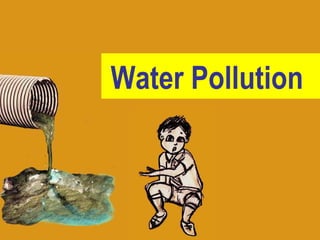
Water Pollution
The Universal Solvent
Some of the stuff that it dissolves / suspends is good for us Others, not so good   Water Pollution
Can you name 5 things that dissolve in water? Know of any 2 that can be called ‘pollutants’ – those dangerous to life ?
If we drink polluted water, we can get sick Cholera Typhoid Jaundice Cancer Organ failure
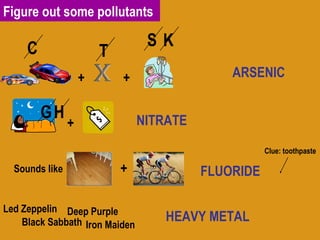
Figure out some pollutants + + _ _ _ _ _ _ _ Led Zeppelin Black Sabbath Deep Purple Iron Maiden _ _ _ _ _  _ _ _ _ _ + _ _ _ _ _ _ _ Sounds like + _ _ _ _ _ _ _ _ Clue: toothpaste C T S K G H
Figure out some pollutants + + ARSENIC Led Zeppelin Black Sabbath Deep Purple Iron Maiden HEAVY METAL + NITRATE Sounds like + FLUORIDE Clue: toothpaste C T S K G H
How do we know that water is polluted? Sometimes it stinks……but not always Sometimes polluted water changes colour…..but not always Sometimes it tastes different ……..but not always
How do we know that water is polluted? Water pollution can be confirmed only by testing it in a lab
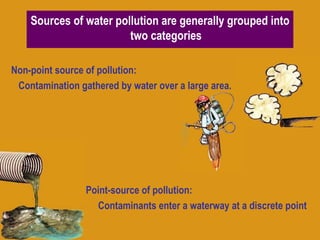
Sources of water pollution are generally grouped into two categories Non-point source of pollution: Contamination gathered by water over a large area.  Point-source of pollution:  Contaminants enter a waterway at a discrete point
Water can get polluted naturally When water seeps into the ground, it absorbs different substances depending on the type of soil and rock that it flows through.
Water can get polluted naturally Some of these substances (arsenic, iron, fluoride etc) can be harmful to health Natural pollution is a non-point source of pollution
Arsenic Fluoride Natural pollution can introduce chemicals that collect in our bodies. Over time this can cause chronic problems and even life – threatening diseases . In groundwater In groundwater
Does Man Pollute Water? “  If you had a bottle of life-preserving fluid on which your life depended, would you pour into it all your sewage and rubbish, along with any other poisonous chemicals you could find? And yet, that is exactly what we are doing to our water supply – all over the world.” This is what a young person like you has to say:
The various ways in which man pollutes water   Untreated or inadequately treated municipal sewage    YUCK!! eutrophication An example of Point source of pollution Yamuna, when it leaves Delhi, resembles a sewer full of the city’s wastes. A few hundred kms downstream is Agra, where this ‘sewer’ is the main municipal drinking water source.
Untreated sewage seeps in and contaminates groundwater aquifers Such aquifers show a higher than acceptable level of nitrate content The various ways in which man pollutes water   Untreated or inadequately treated municipal sewage An example of Point source of pollution Reaches ground water bodies
The various ways in which man pollutes water   When garbage is dumped in a landfill, toxic chemicals leach into the soil and groundwater. Dumping garbage in surface water bodies
Over  10 million people  bathe in the Ganga daily! The various ways in which man pollutes water   Washing and bathing introduces phosphates and other chemicals into water
The various ways in which man pollutes water  Agriculture is a major source of groundwater contamination.  Agriculture An example of Non- Point source of pollution dissolve in irrigation water or rainwater.   They contaminate surface water and groundwater with pollutants like  nitrates, phosphates and non degradable synthetic organic pollutants
The various ways in which man pollutes water   Industry Agro industries – their wastes have high concentration of  dissolved organic matter Chemical Industries – If their wastes are not treated properly,  the chemicals can destroy our soil and water resources. Petroleum refining – water used in the process needs to be  separated from all the oil before releasing it into  nature……but is that done?? An example of Point source of pollution Minamata disease Can you name any Agro Industry? sugar, food processing, pulp and paper, distilleries Name some Chemical industries
The various ways in which man pollutes water   Industry Thermal power plants – water is needed to cool the process. The water gets hot and when it’s released into a larger  water body,  it upsets the ecology by modifying the  delicate temperature balance.  This is called ‘Thermal pollution’ An example of Point source of pollution
Effluent treatment plants Liquid wastes from an industry are treated in effluent treatment plants. Large industries would have in-house effluent treatment plants It’s expensive for small industries to go in for such plants individually In some industrial estates, a group of small industries have a common  effluent treatment plant.
A RE-CAP Water can be polluted by man Water can be polluted naturally Sewage in our water bodies Garbage dumps Washing and bathing Pesticides and fertilizers Industries
Hangman Divide the class into 5 teams Draw as many dashes as in the name of a water pollutant or a pollution cause Team A starts. They guess a letter. The teacher puts in the letter at the correct place, if it is there in that name.  Else, the letter is written down on one side.  A maximum of 10 wrong guesses are allowed. The team gets as many points as letters on the side (maximum of 10). The team with the lowest number of points wins
Eutrophication  (pronounced as you-tro-fi-kay-shun)   When wastes with high organic content (such as sewage wastes) are dumped into a water body like a lake or pond, eutrophication can occur, killing all life in the water body.  Organic wastes are rich in nutrients (nitrates and phosphates) They stimulate excessive plant growth – especially weedy species
Eutrophication On dying, the plants further add to the organic waste in water.  Microorganisms that decompose the organic material in water use up a lot of dissolved oxygen.  This depletes the available oxygen in the water and upsets the ecological balance, since fish and other life forms perish without adequate oxygen.   Eventually all the oxygen is used up.
Eutrophication Anaerobic organisms then attack the organic wastes,  releasing gases such as methane and hydrogen sulphide.  The result is a foul smelling, waste filled body of water, quite like many of  the lakes in India.  These water bodies are also natural groundwater recharge system  and their contamination also leads to groundwater pollution.
Minamata disease Industrial wastewater from the Chisso corporation  (manufacturing fertilizers and other chemicals) was  released into the Minamata Bay in Japan The waste water was rich in methyl mercury Mercury content in shellfish in that region increased People ate the shellfish and the cats ate the leftovers
Strange things started to happen – cats had convulsions and died,  crows fell from the sky, dead fish floated.. Young children had convulsions and difficulty in  walking and speaking People died Investigation showed organic mercury poisoning affecting the  nervous system First discovered in 1956 Lawsuits and claims continue till today  Did you know?  One mercury thermometer can contaminate up to 95,000 litres of water to beyond the drinking water standard.

Water Pollution

  • 1.
  • 2.
  • 3.
    Some of thestuff that it dissolves / suspends is good for us Others, not so good Water Pollution
  • 4.
    Can you name5 things that dissolve in water? Know of any 2 that can be called ‘pollutants’ – those dangerous to life ?
  • 5.
    If we drinkpolluted water, we can get sick Cholera Typhoid Jaundice Cancer Organ failure
  • 6.
    Figure out somepollutants + + _ _ _ _ _ _ _ Led Zeppelin Black Sabbath Deep Purple Iron Maiden _ _ _ _ _ _ _ _ _ _ + _ _ _ _ _ _ _ Sounds like + _ _ _ _ _ _ _ _ Clue: toothpaste C T S K G H
  • 7.
    Figure out somepollutants + + ARSENIC Led Zeppelin Black Sabbath Deep Purple Iron Maiden HEAVY METAL + NITRATE Sounds like + FLUORIDE Clue: toothpaste C T S K G H
  • 8.
    How do weknow that water is polluted? Sometimes it stinks……but not always Sometimes polluted water changes colour…..but not always Sometimes it tastes different ……..but not always
  • 9.
    How do weknow that water is polluted? Water pollution can be confirmed only by testing it in a lab
  • 10.
    Sources of waterpollution are generally grouped into two categories Non-point source of pollution: Contamination gathered by water over a large area. Point-source of pollution: Contaminants enter a waterway at a discrete point
  • 11.
    Water can getpolluted naturally When water seeps into the ground, it absorbs different substances depending on the type of soil and rock that it flows through.
  • 12.
    Water can getpolluted naturally Some of these substances (arsenic, iron, fluoride etc) can be harmful to health Natural pollution is a non-point source of pollution
  • 13.
    Arsenic Fluoride Naturalpollution can introduce chemicals that collect in our bodies. Over time this can cause chronic problems and even life – threatening diseases . In groundwater In groundwater
  • 14.
    Does Man PolluteWater? “ If you had a bottle of life-preserving fluid on which your life depended, would you pour into it all your sewage and rubbish, along with any other poisonous chemicals you could find? And yet, that is exactly what we are doing to our water supply – all over the world.” This is what a young person like you has to say:
  • 15.
    The various waysin which man pollutes water  Untreated or inadequately treated municipal sewage  YUCK!! eutrophication An example of Point source of pollution Yamuna, when it leaves Delhi, resembles a sewer full of the city’s wastes. A few hundred kms downstream is Agra, where this ‘sewer’ is the main municipal drinking water source.
  • 16.
    Untreated sewage seepsin and contaminates groundwater aquifers Such aquifers show a higher than acceptable level of nitrate content The various ways in which man pollutes water  Untreated or inadequately treated municipal sewage An example of Point source of pollution Reaches ground water bodies
  • 17.
    The various waysin which man pollutes water  When garbage is dumped in a landfill, toxic chemicals leach into the soil and groundwater. Dumping garbage in surface water bodies
  • 18.
    Over 10million people bathe in the Ganga daily! The various ways in which man pollutes water  Washing and bathing introduces phosphates and other chemicals into water
  • 19.
    The various waysin which man pollutes water Agriculture is a major source of groundwater contamination. Agriculture An example of Non- Point source of pollution dissolve in irrigation water or rainwater. They contaminate surface water and groundwater with pollutants like nitrates, phosphates and non degradable synthetic organic pollutants
  • 20.
    The various waysin which man pollutes water  Industry Agro industries – their wastes have high concentration of dissolved organic matter Chemical Industries – If their wastes are not treated properly, the chemicals can destroy our soil and water resources. Petroleum refining – water used in the process needs to be separated from all the oil before releasing it into nature……but is that done?? An example of Point source of pollution Minamata disease Can you name any Agro Industry? sugar, food processing, pulp and paper, distilleries Name some Chemical industries
  • 21.
    The various waysin which man pollutes water  Industry Thermal power plants – water is needed to cool the process. The water gets hot and when it’s released into a larger water body, it upsets the ecology by modifying the delicate temperature balance. This is called ‘Thermal pollution’ An example of Point source of pollution
  • 22.
    Effluent treatment plantsLiquid wastes from an industry are treated in effluent treatment plants. Large industries would have in-house effluent treatment plants It’s expensive for small industries to go in for such plants individually In some industrial estates, a group of small industries have a common effluent treatment plant.
  • 23.
    A RE-CAP Watercan be polluted by man Water can be polluted naturally Sewage in our water bodies Garbage dumps Washing and bathing Pesticides and fertilizers Industries
  • 24.
    Hangman Divide theclass into 5 teams Draw as many dashes as in the name of a water pollutant or a pollution cause Team A starts. They guess a letter. The teacher puts in the letter at the correct place, if it is there in that name. Else, the letter is written down on one side. A maximum of 10 wrong guesses are allowed. The team gets as many points as letters on the side (maximum of 10). The team with the lowest number of points wins
  • 25.
    Eutrophication (pronouncedas you-tro-fi-kay-shun) When wastes with high organic content (such as sewage wastes) are dumped into a water body like a lake or pond, eutrophication can occur, killing all life in the water body. Organic wastes are rich in nutrients (nitrates and phosphates) They stimulate excessive plant growth – especially weedy species
  • 26.
    Eutrophication On dying,the plants further add to the organic waste in water. Microorganisms that decompose the organic material in water use up a lot of dissolved oxygen. This depletes the available oxygen in the water and upsets the ecological balance, since fish and other life forms perish without adequate oxygen. Eventually all the oxygen is used up.
  • 27.
    Eutrophication Anaerobic organismsthen attack the organic wastes, releasing gases such as methane and hydrogen sulphide. The result is a foul smelling, waste filled body of water, quite like many of the lakes in India. These water bodies are also natural groundwater recharge system and their contamination also leads to groundwater pollution.
  • 28.
    Minamata disease Industrialwastewater from the Chisso corporation (manufacturing fertilizers and other chemicals) was released into the Minamata Bay in Japan The waste water was rich in methyl mercury Mercury content in shellfish in that region increased People ate the shellfish and the cats ate the leftovers
  • 29.
    Strange things startedto happen – cats had convulsions and died, crows fell from the sky, dead fish floated.. Young children had convulsions and difficulty in walking and speaking People died Investigation showed organic mercury poisoning affecting the nervous system First discovered in 1956 Lawsuits and claims continue till today Did you know? One mercury thermometer can contaminate up to 95,000 litres of water to beyond the drinking water standard.