2008 Junction Transistor Unit 4 Lesson 1- " , Raj Kamal, 1
Transistor and their
Characteristics –
Lesson-1 Junction Transistor
2008 Junction Transistor Unit 4 Lesson 1- " , Raj Kamal, 2
1.1. Junction TransistorJunction Transistor
DefinitionDefinition
The transferred-resistance or transistor
is a multi-junction device that is capable
of
• Current gain
• Voltage gain
• Signal-power gain
2008 Junction Transistor Unit 4 Lesson 1- " , Raj Kamal, 3
Bipolar junction transistorBipolar junction transistor
Invented in 1948 by Bardeen, Brattain and
Shockley
Contains three adjoining, alternately doped
semiconductor regions: Emitter (E), Base (B), and
Collector (C)
The middle region, base, is very thin compared
to the diffusion length of minority carriers
Two kinds: npn and pnp
2008
Junction Transistor Unit 4 Lesson 1-
" , Raj Kamal,
4
Bipolar junction transistor – BJT
Definition
The Bipolar junction transistor is an active
device that works as a voltage-controlled
current source and whose basic action is
control of current at one terminal by
controlling voltage applied at other two
terminals.
2008 Junction Transistor Unit 4 Lesson 1- " , Raj Kamal, 5
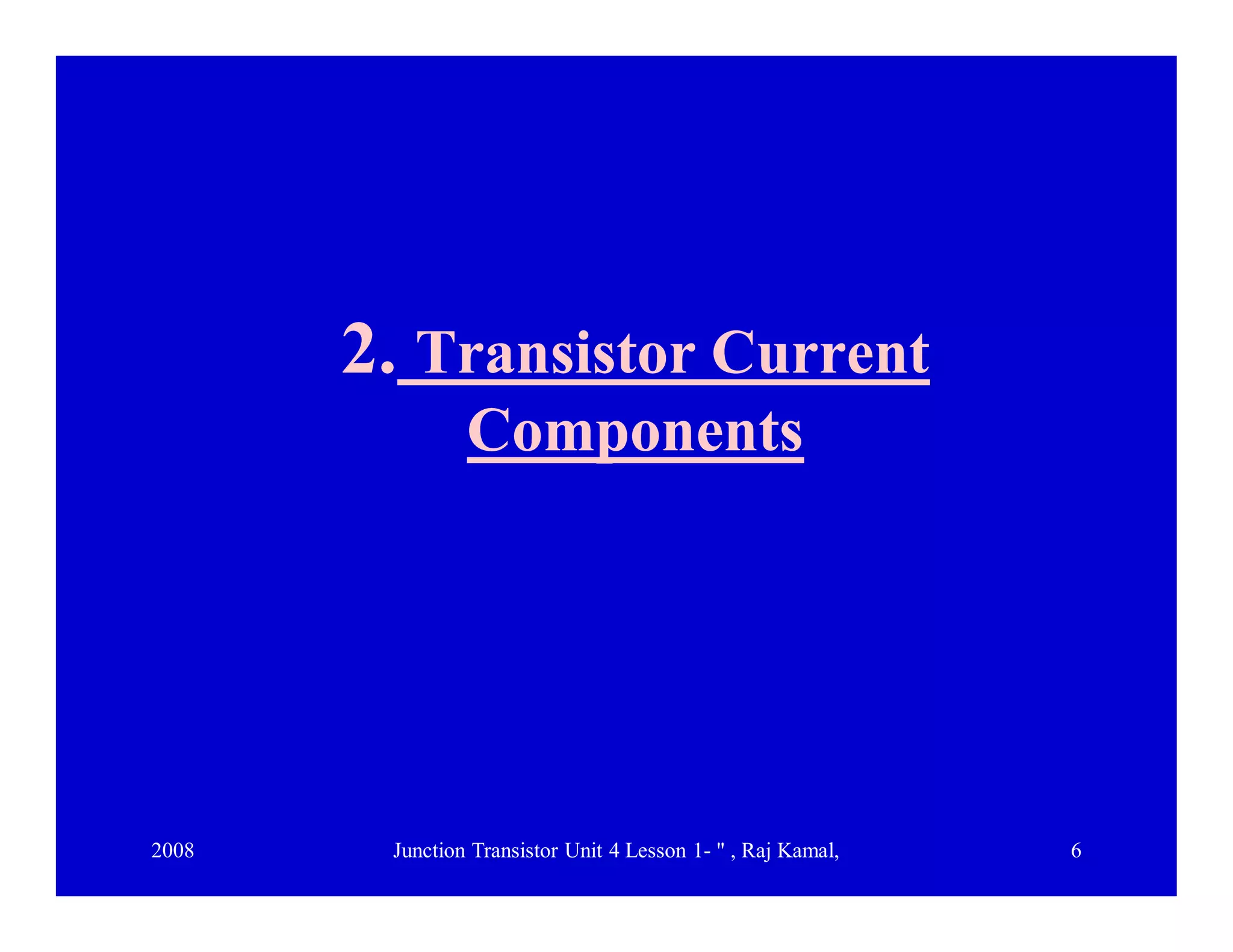
Bipolar Junction Transistor Representation
NPN PNP
2008 Junction Transistor Unit 4 Lesson 1- " , Raj Kamal, 6
2.2. Transistor CurrentTransistor Current
ComponentsComponents
2008 Junction Transistor Unit 4 Lesson 1- " , Raj Kamal, 7
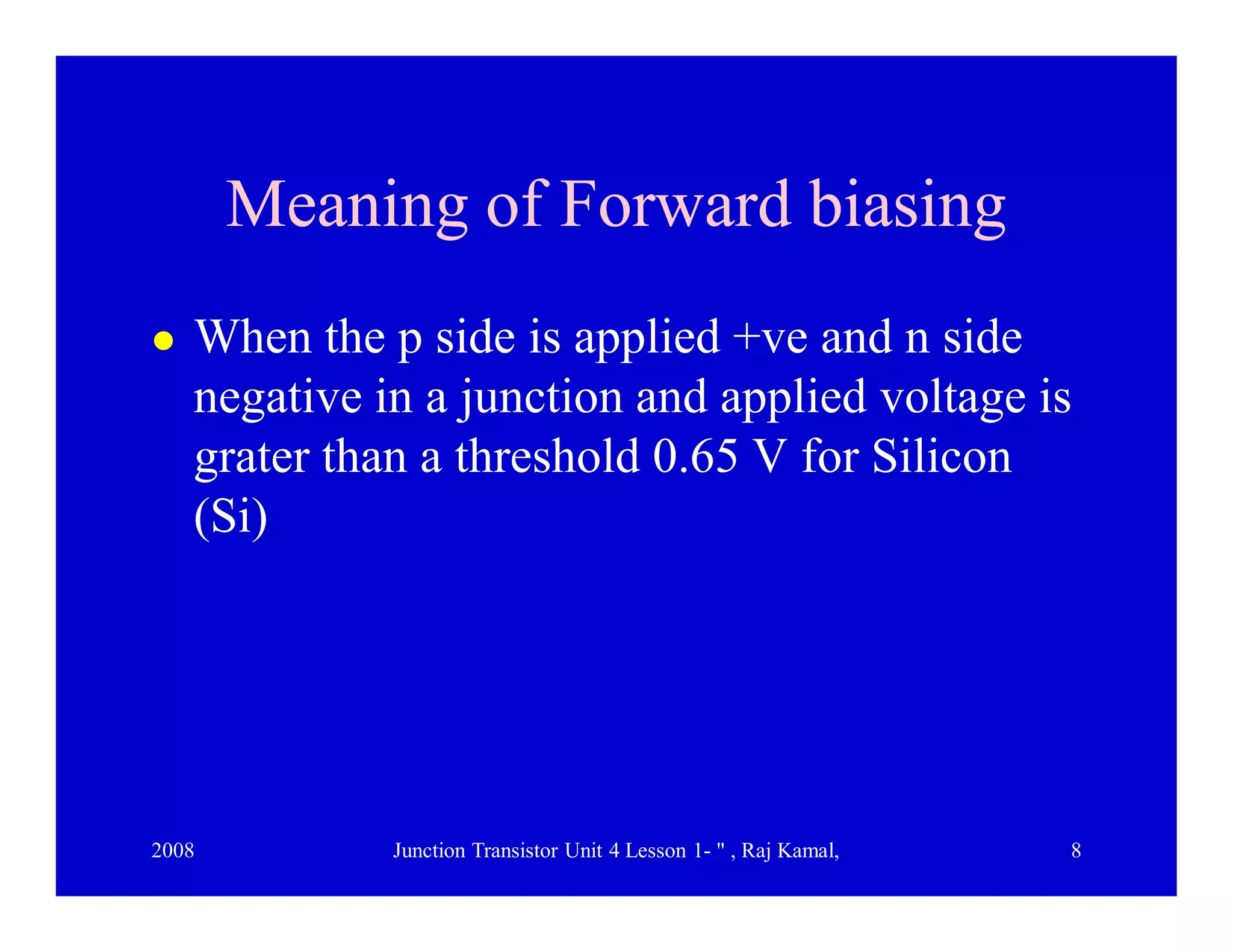
BJT circuit Current ComponentsBJT circuit Current Components
As shown, the currents are positive quantities when the
transistor is operated in forward active mode.
IE = IB + IC and VEB + VBC + VCE = 0 VCE =  VEC
2008 Junction Transistor Unit 4 Lesson 1- " , Raj Kamal, 8
Meaning of Forward biasingMeaning of Forward biasing
 When the p side is applied +ve and n side
negative in a junction and applied voltage is
grater than a threshold 0.65 V for Silicon
(Si)
2008 Junction Transistor Unit 4 Lesson 1- " , Raj Kamal, 9
Meaning of Reverse biasingMeaning of Reverse biasing
 When the p side is applied -ve and n side
+ve in a junction and applied voltage is
between 0 to a breakdown voltage
2008 Junction Transistor Unit 4 Lesson 1- " , Raj Kamal, 10
3.3. Transistor as AmplifierTransistor as Amplifier
2008 Junction Transistor Unit 4 Lesson 1- " , Raj Kamal, 11
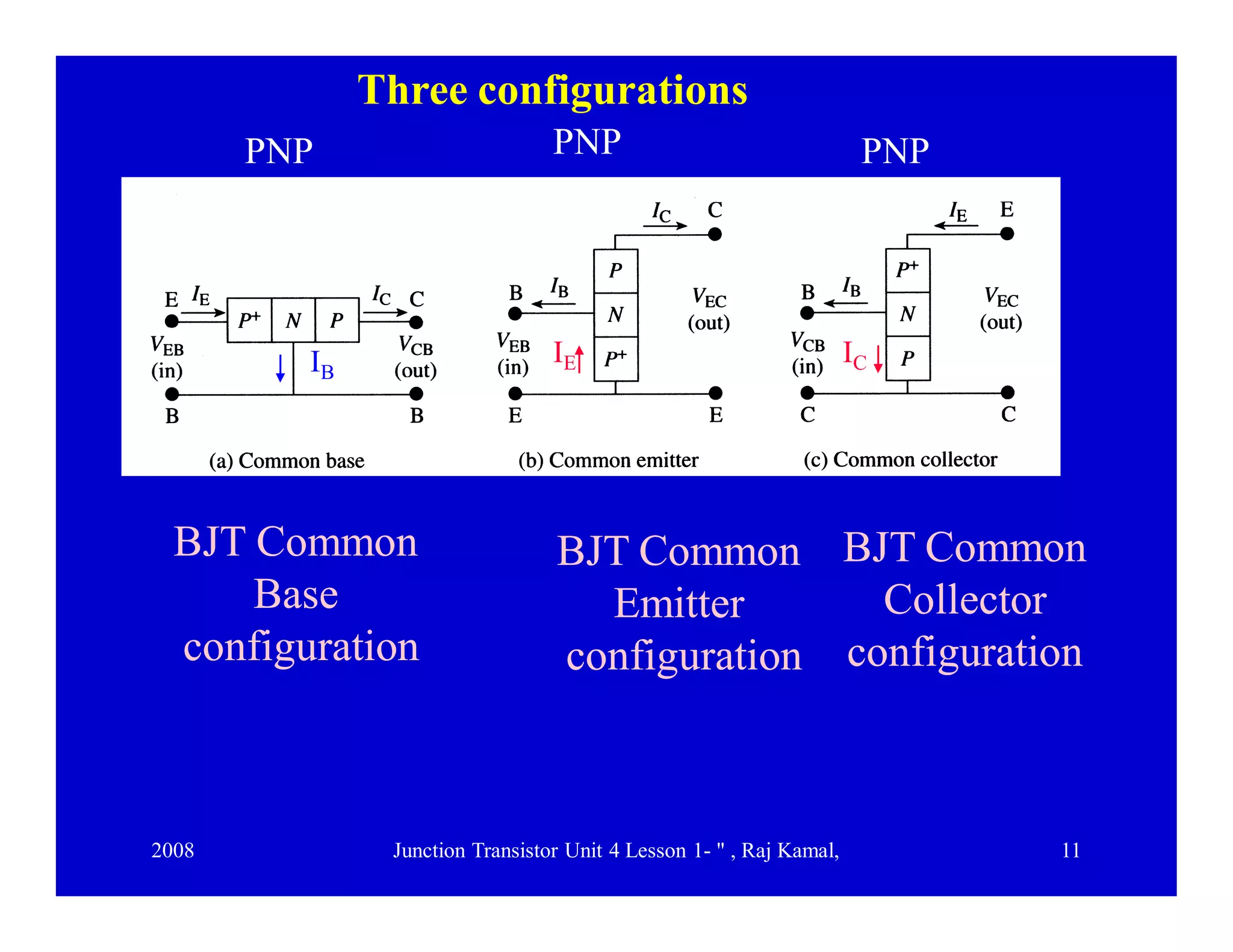
BJT CommonBJT Common
BaseBase
configurationconfiguration
BJT CommonBJT Common
EmitterEmitter
configurationconfiguration
BJT CommonBJT Common
CollectorCollector
configurationconfiguration
PNPPNP PNP
IB
IE IC
Three configurations
2008
Junction Transistor Unit 4 Lesson 1-
" , Raj Kamal,
12
Six Problems
• Draw circuits of CB, CE, CC
configurations for npn and pnp transistors
• Show current directions
2008
Junction Transistor Unit 4 Lesson 1-
" , Raj Kamal,
13
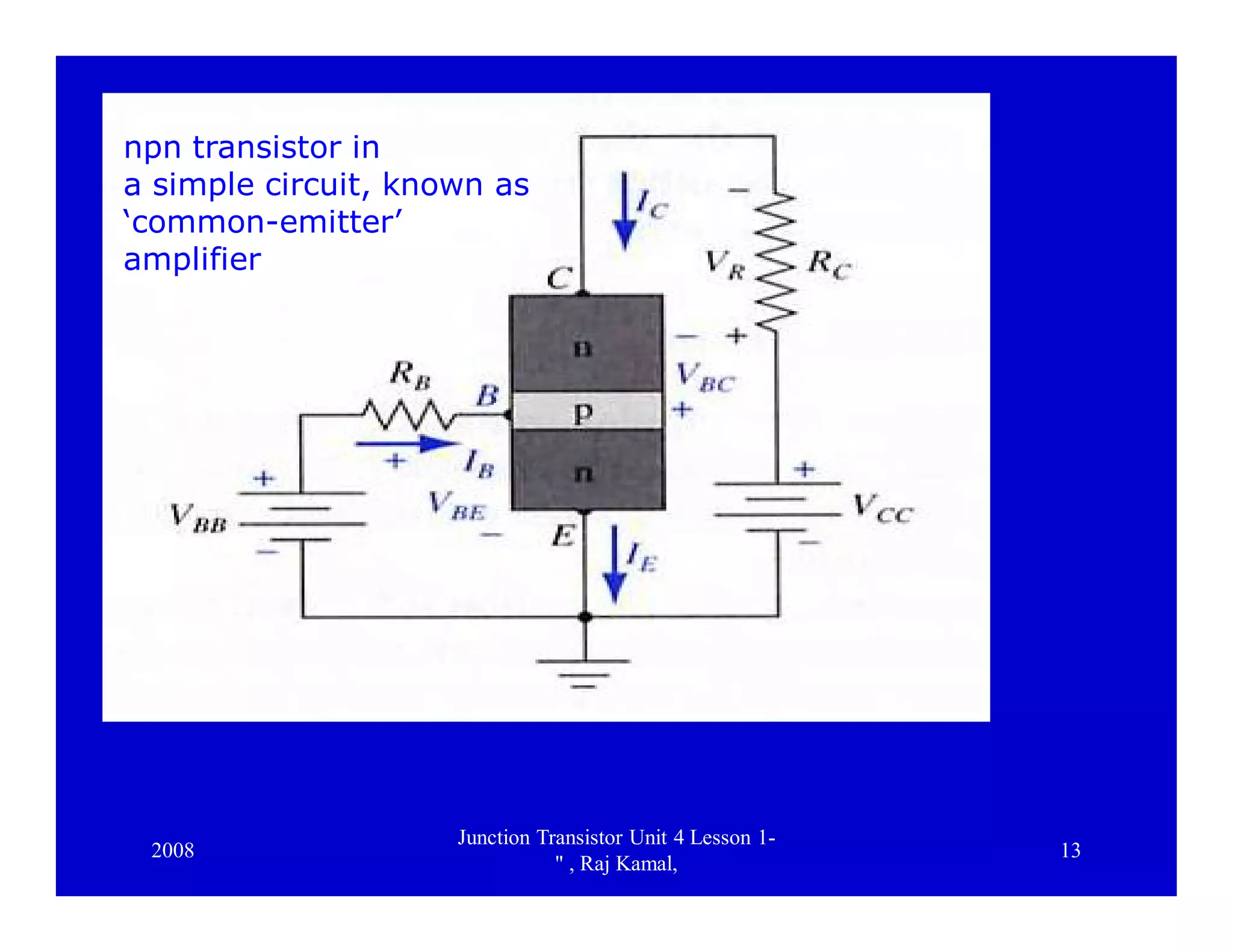
npn transistor in
a simple circuit, known as
‘common-emitter’
amplifier
2008 Junction Transistor Unit 4 Lesson 1- " , Raj Kamal, 14
Characteristics ofCharacteristics of Transistor Amplifier in threeTransistor Amplifier in three
regions of operationsregions of operations
2008 Junction Transistor Unit 4 Lesson 1- " , Raj Kamal, 15
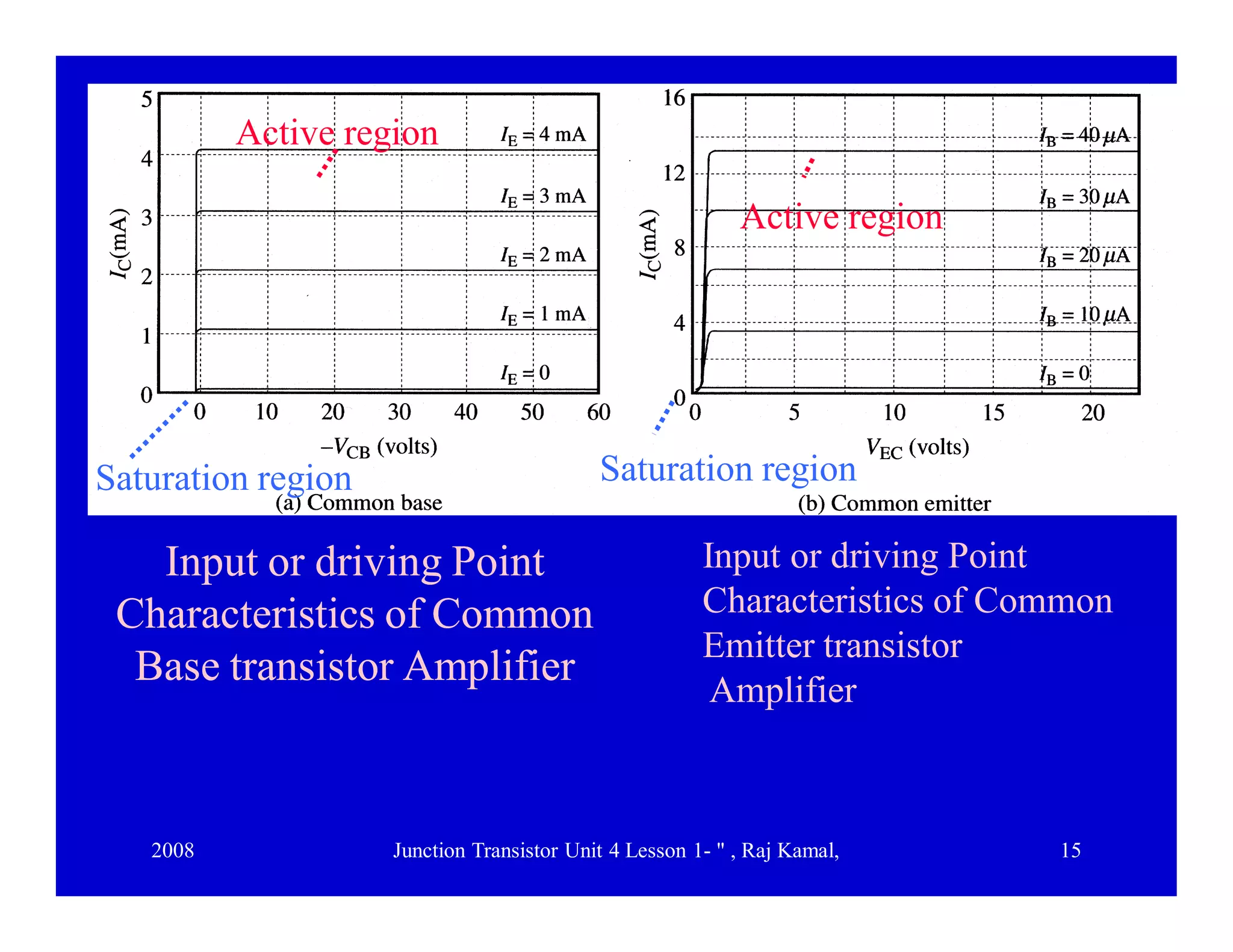
Input or driving PointInput or driving Point
Characteristics of CommonCharacteristics of Common
Base transistor AmplifierBase transistor Amplifier
Input or driving Point
Characteristics of Common
Emitter transistor
Amplifier
Active region
Saturation region Saturation region
Active region
2008 Junction Transistor Unit 4 Lesson 1- " , Raj Kamal, 16
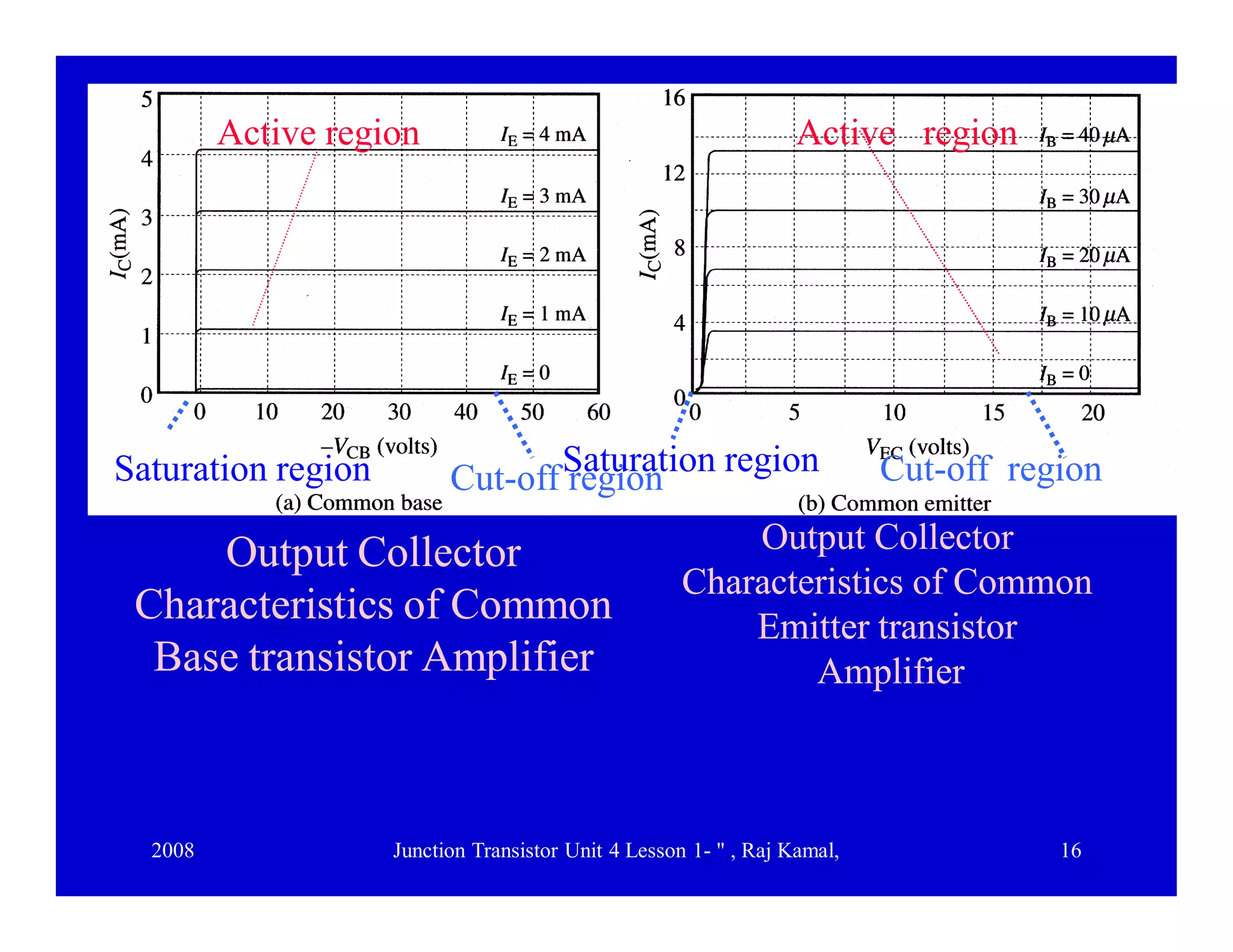
Output CollectorOutput Collector
Characteristics of CommonCharacteristics of Common
Base transistor AmplifierBase transistor Amplifier
Output CollectorOutput Collector
Characteristics of CommonCharacteristics of Common
Emitter transistorEmitter transistor
AmplifierAmplifier
Saturation region Cut-off region Cut-off regionSaturation region
Active region Active region
2008 Junction Transistor Unit 4 Lesson 1- " , Raj Kamal, 17
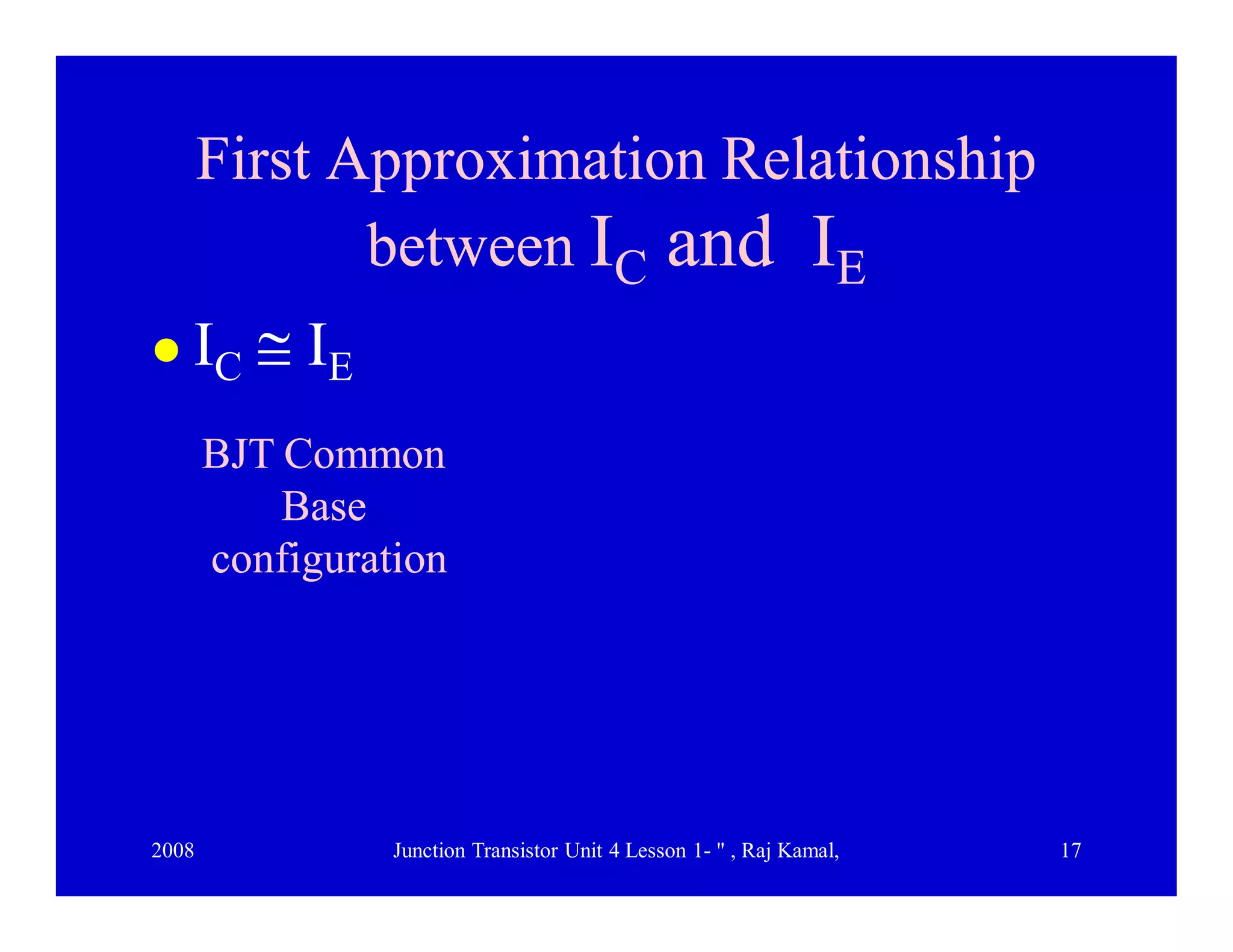
First Approximation RelationshipFirst Approximation Relationship
betweenbetween IICC andand IIEE
 IC  IE
BJT CommonBJT Common
BaseBase
configurationconfiguration
2008
Junction Transistor Unit 4 Lesson 1-
" , Raj Kamal,
18
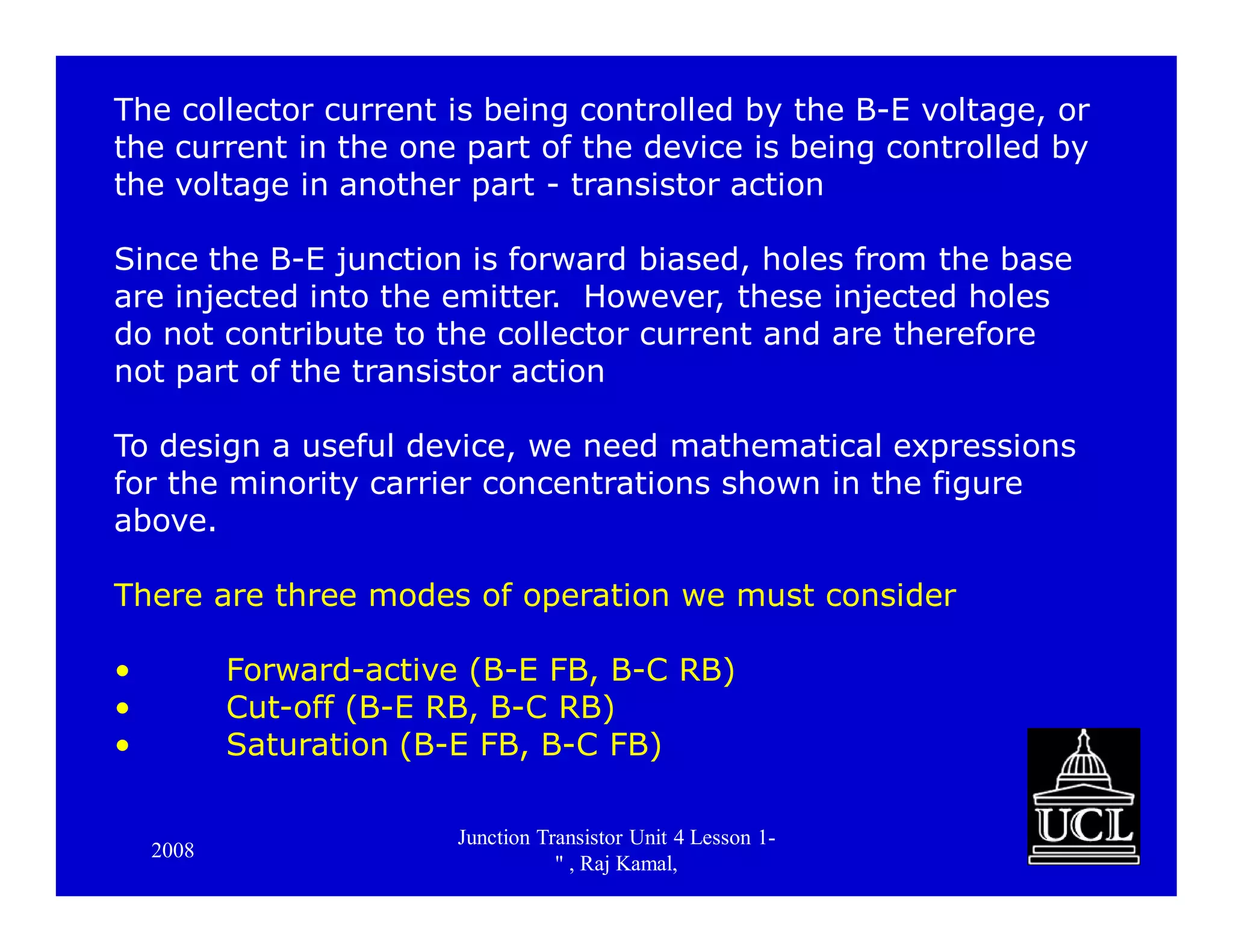
The collector current is being controlled by the B-E voltage, or
the current in the one part of the device is being controlled by
the voltage in another part - transistor action
Since the B-E junction is forward biased, holes from the base
are injected into the emitter. However, these injected holes
do not contribute to the collector current and are therefore
not part of the transistor action
To design a useful device, we need mathematical expressions
for the minority carrier concentrations shown in the figure
above.
There are three modes of operation we must consider
• Forward-active (B-E FB, B-C RB)
• Cut-off (B-E RB, B-C RB)
• Saturation (B-E FB, B-C FB)
2008 Junction Transistor Unit 4 Lesson 1- " , Raj Kamal, 19
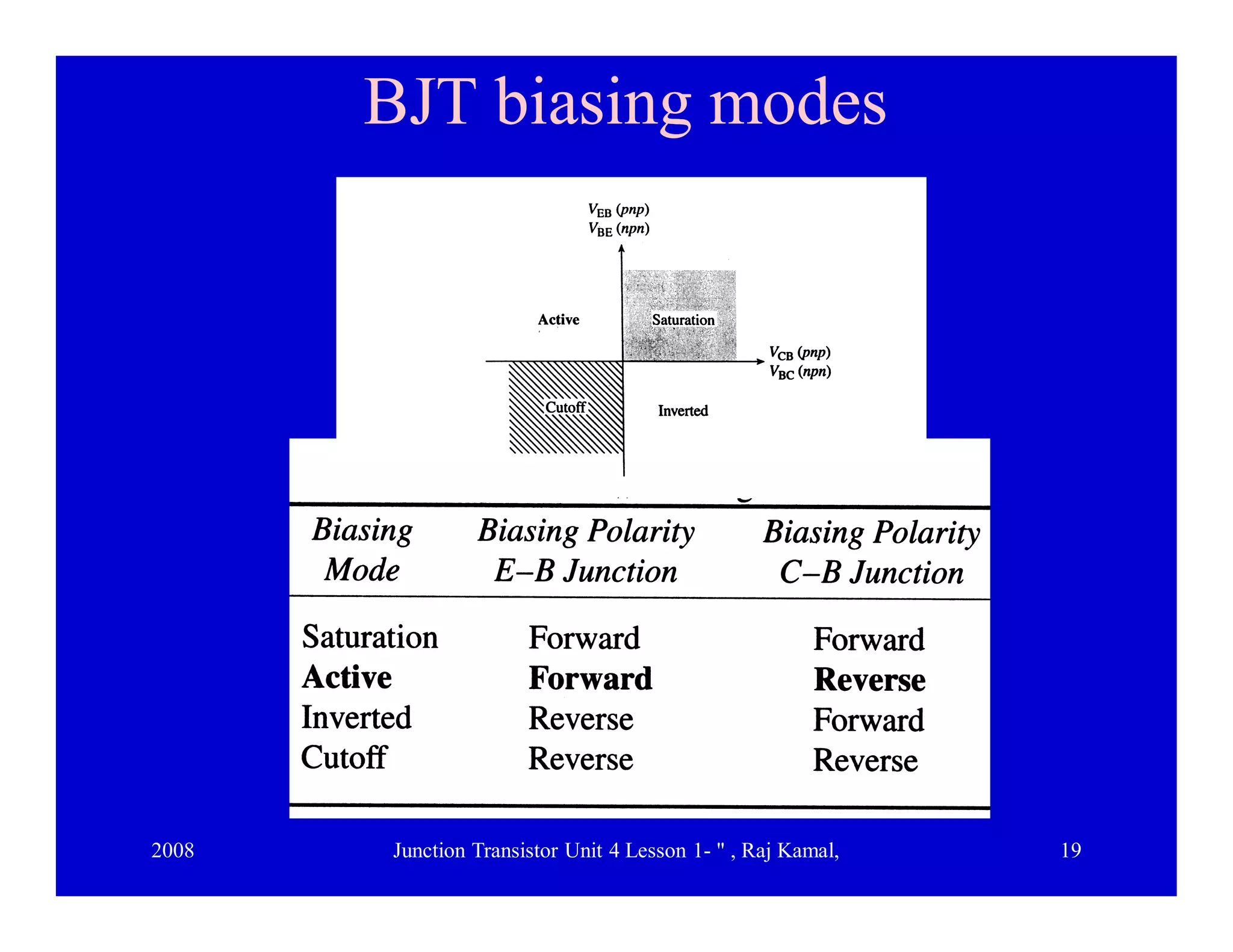
BJT biasing modesBJT biasing modes
2008 Junction Transistor Unit 4 Lesson 1- " , Raj Kamal, 20
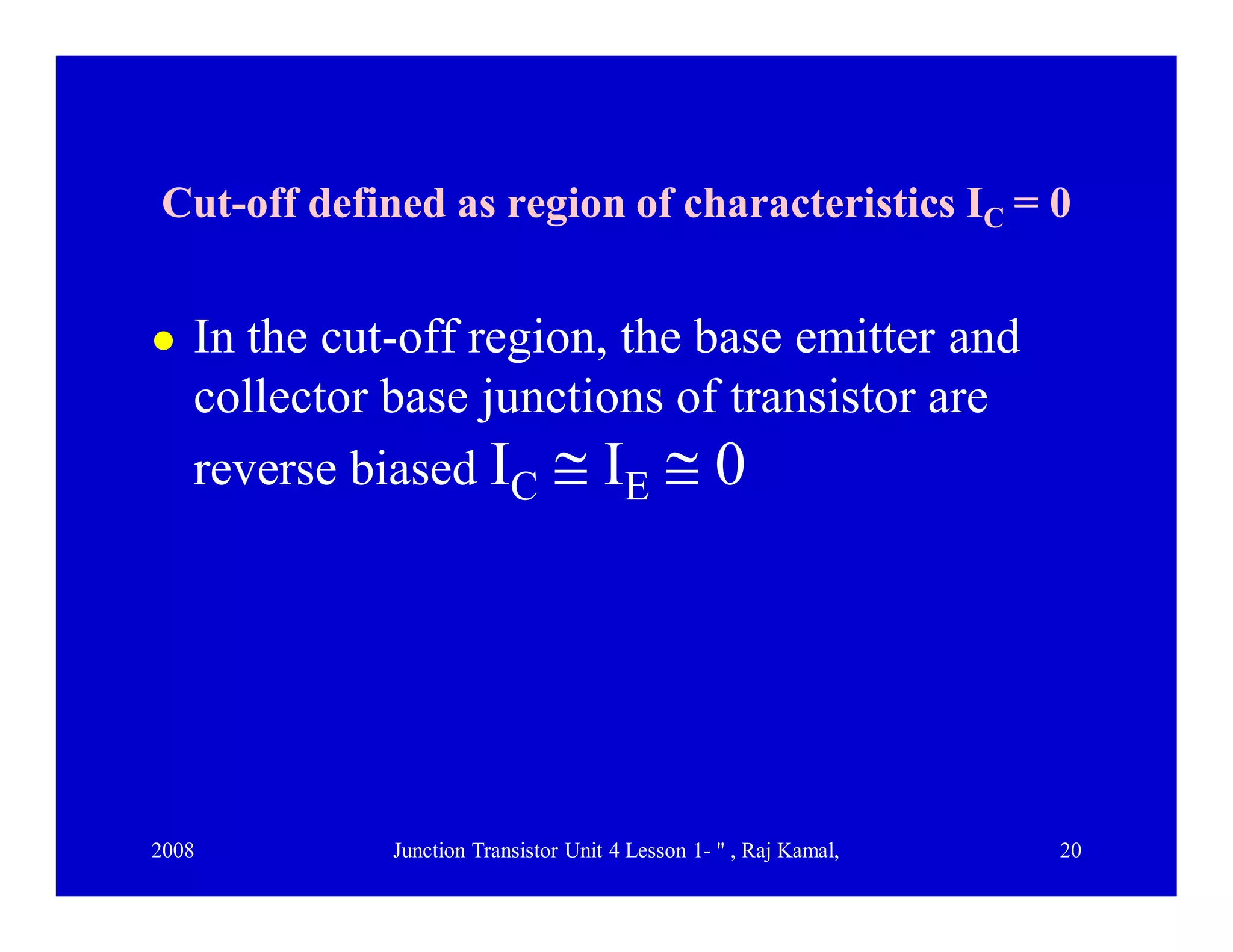
 In the cut-off region, the base emitter and
collector base junctions of transistor are
reverse biased IC  IE  0
CutCut--off defined as region of characteristics Ioff defined as region of characteristics ICC = 0= 0
2008 Junction Transistor Unit 4 Lesson 1- " , Raj Kamal, 21
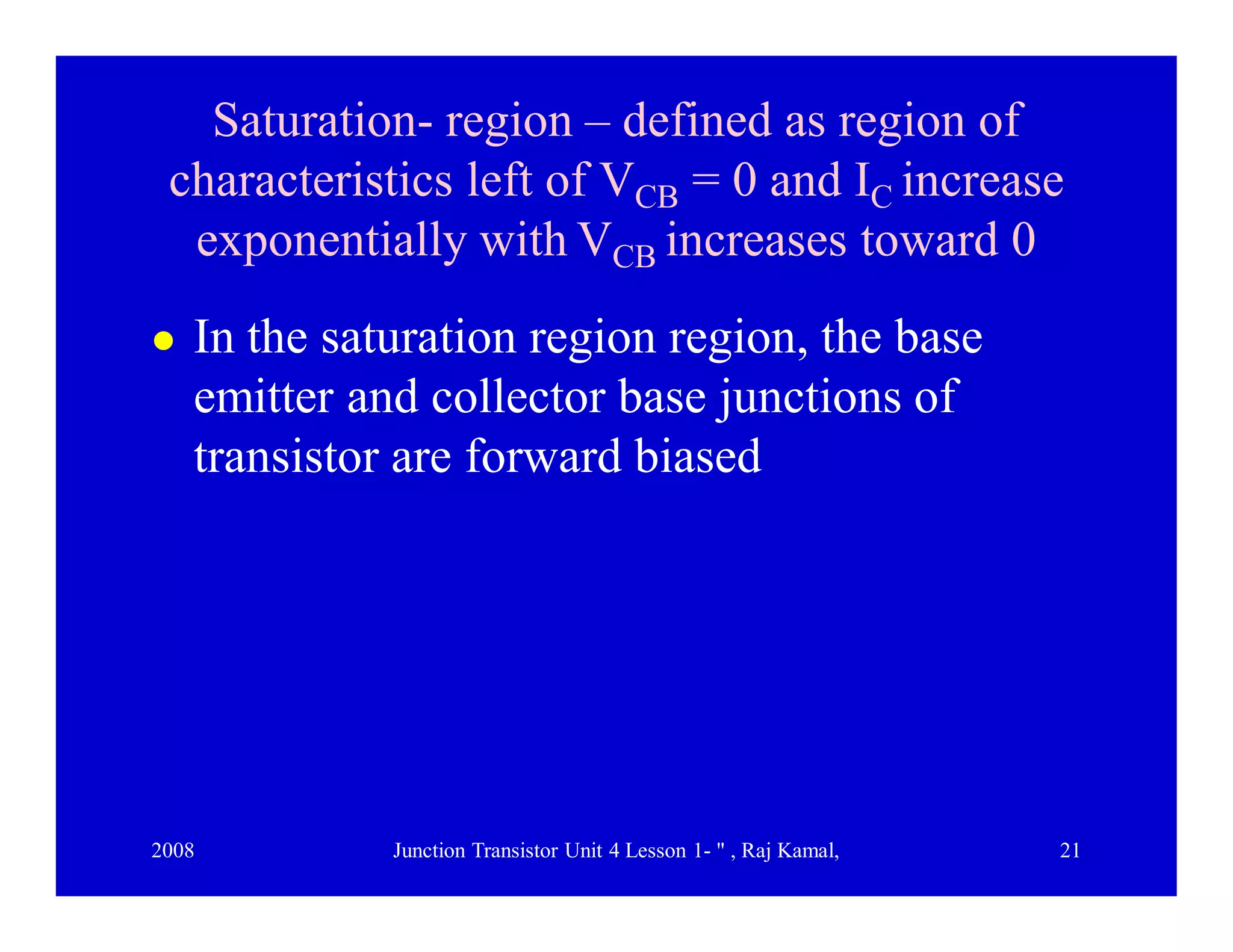
Saturation- region – defined as region of
characteristics left of VCB = 0 and IC increase
exponentially with VCB increases toward 0
 In the saturation region region, the base
emitter and collector base junctions of
transistor are forward biased
2008 Junction Transistor Unit 4 Lesson 1- " , Raj Kamal, 22
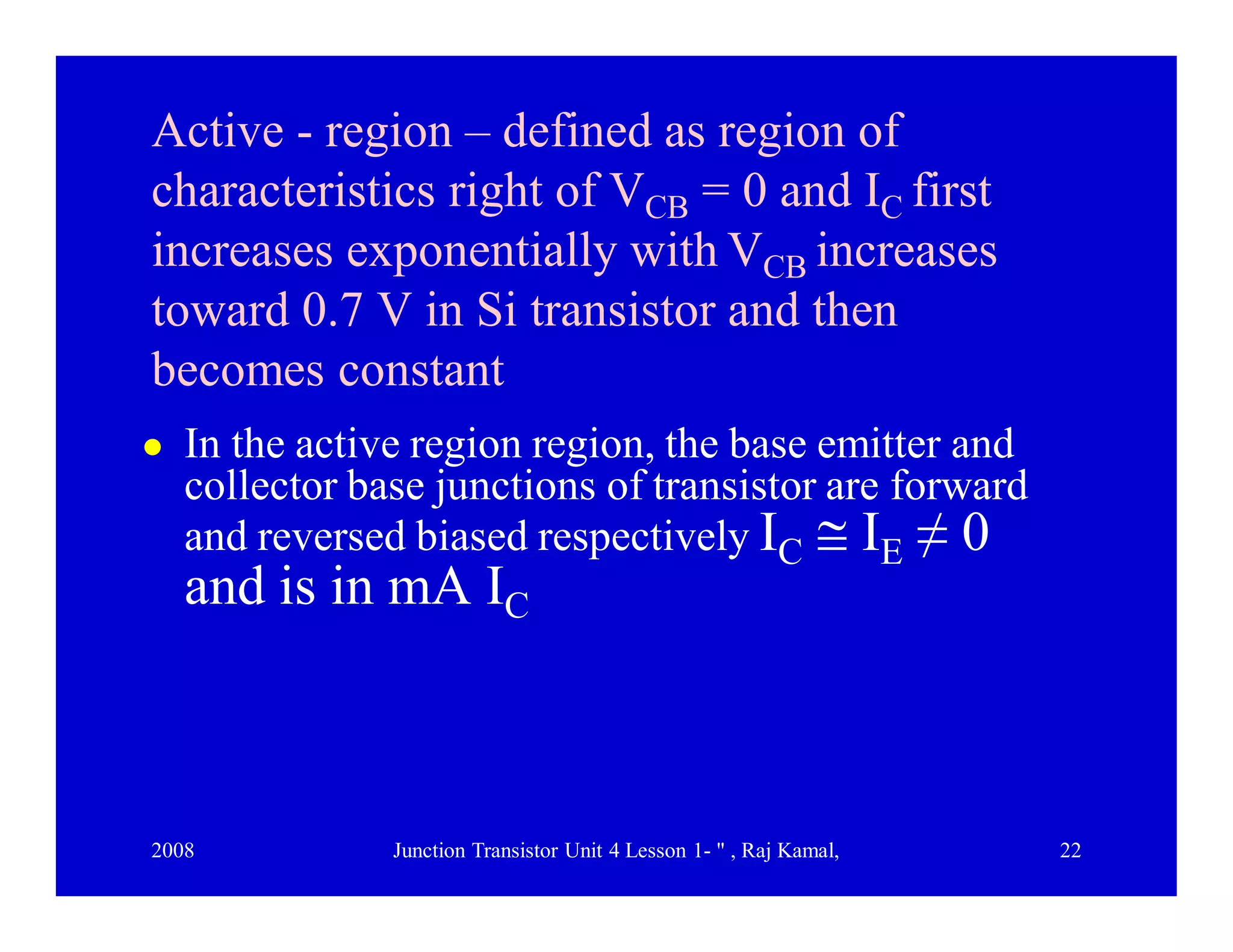
Active - region – defined as region of
characteristics right of VCB = 0 and IC first
increases exponentially with VCB increases
toward 0.7 V in Si transistor and then
becomes constant
 In the active region region, the base emitter and
collector base junctions of transistor are forward
and reversed biased respectively IC  IE ≠ 0
and is in mA IC
2008 Junction Transistor Unit 4 Lesson 1- " , Raj Kamal, 23
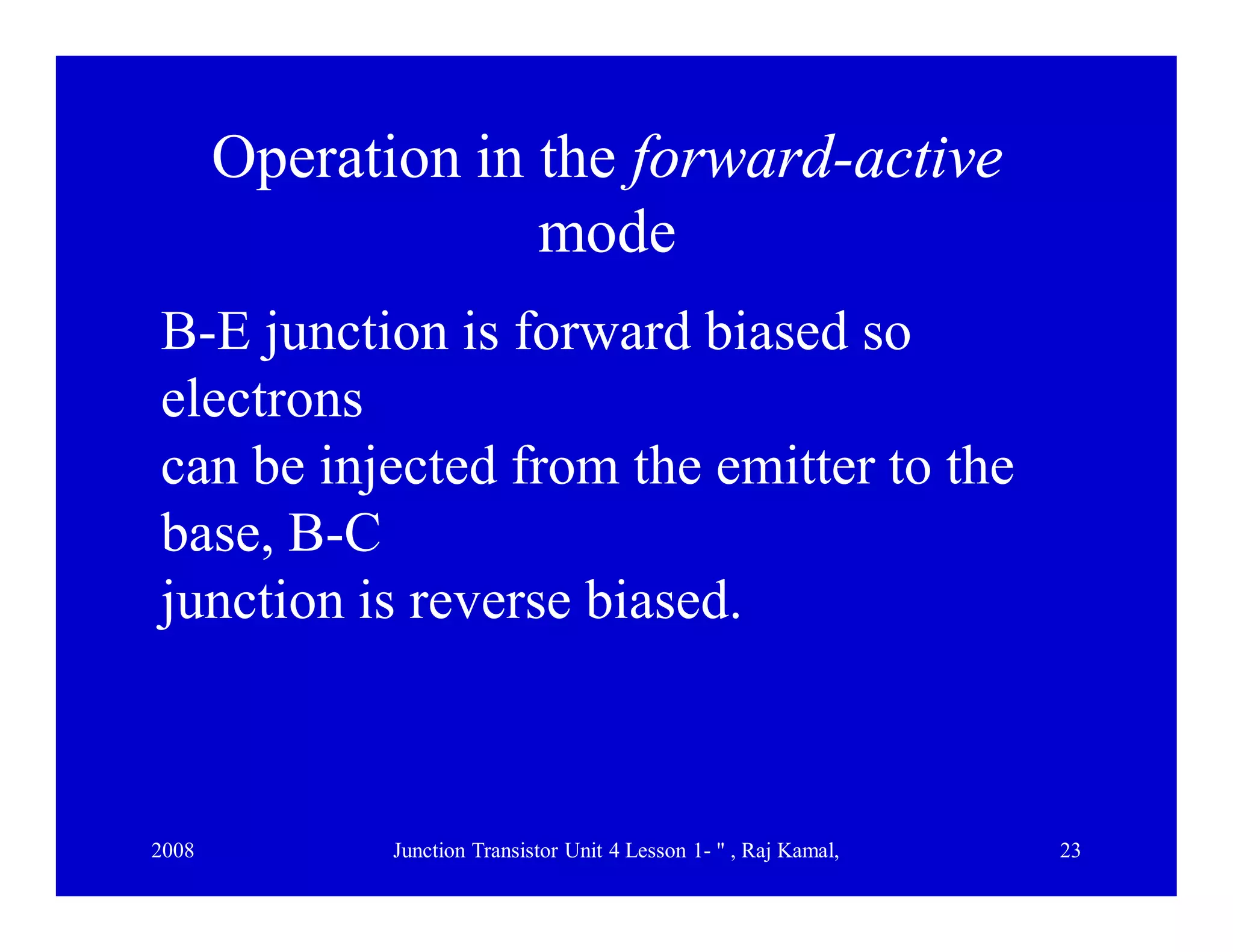
Operation in the forward-active
mode
B-E junction is forward biased so
electrons
can be injected from the emitter to the
base, B-C
junction is reverse biased.
2008 Junction Transistor Unit 4 Lesson 1- " , Raj Kamal, 24
4.4. TransistorTransistor ConstructionConstruction
2008
Junction Transistor Unit 4 Lesson 1-
" , Raj Kamal,
25
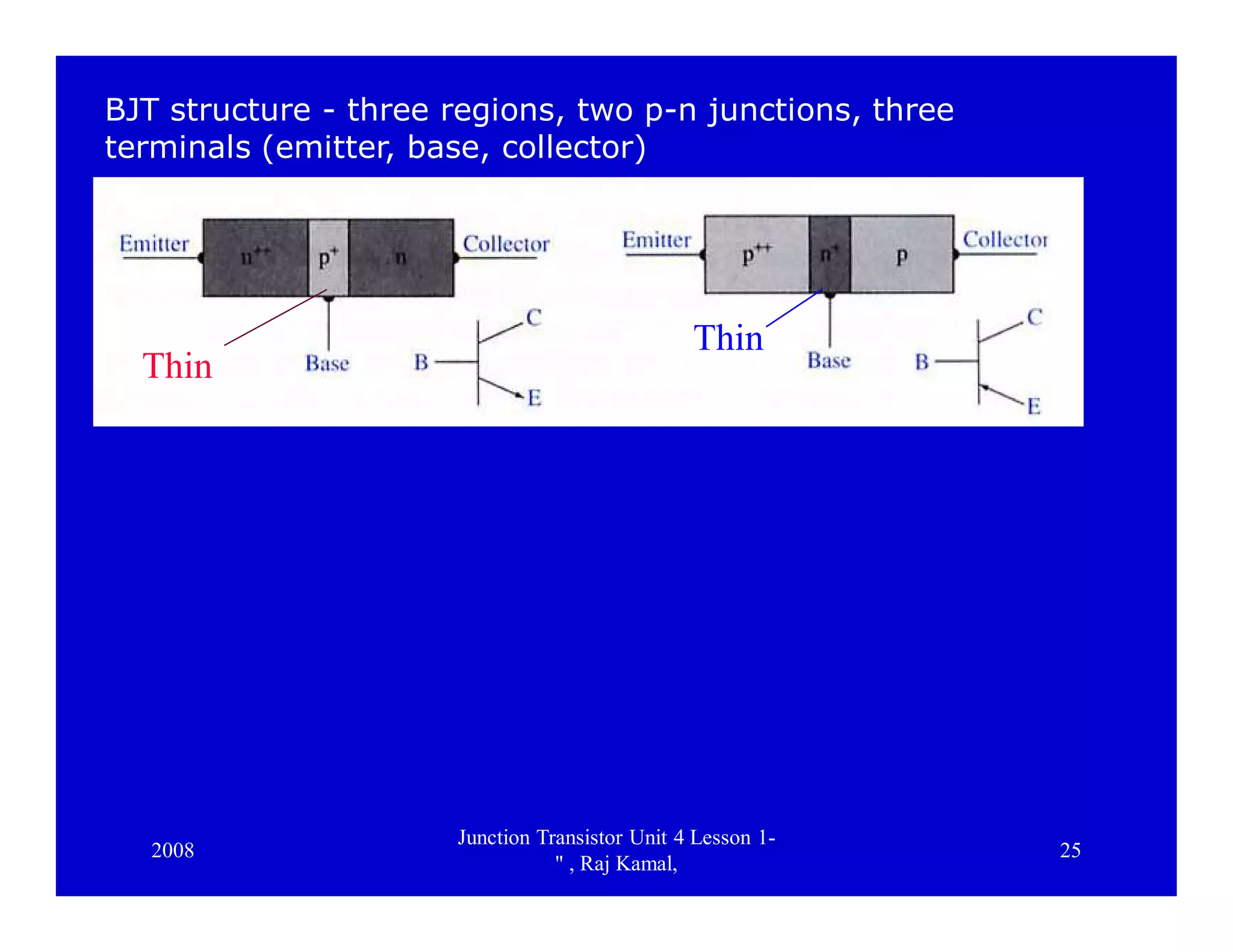
BJT structure - three regions, two p-n junctions, three
terminals (emitter, base, collector)
Thin
Thin
2008 Junction Transistor Unit 4 Lesson 1- " , Raj Kamal, 26
ConstructionConstruction
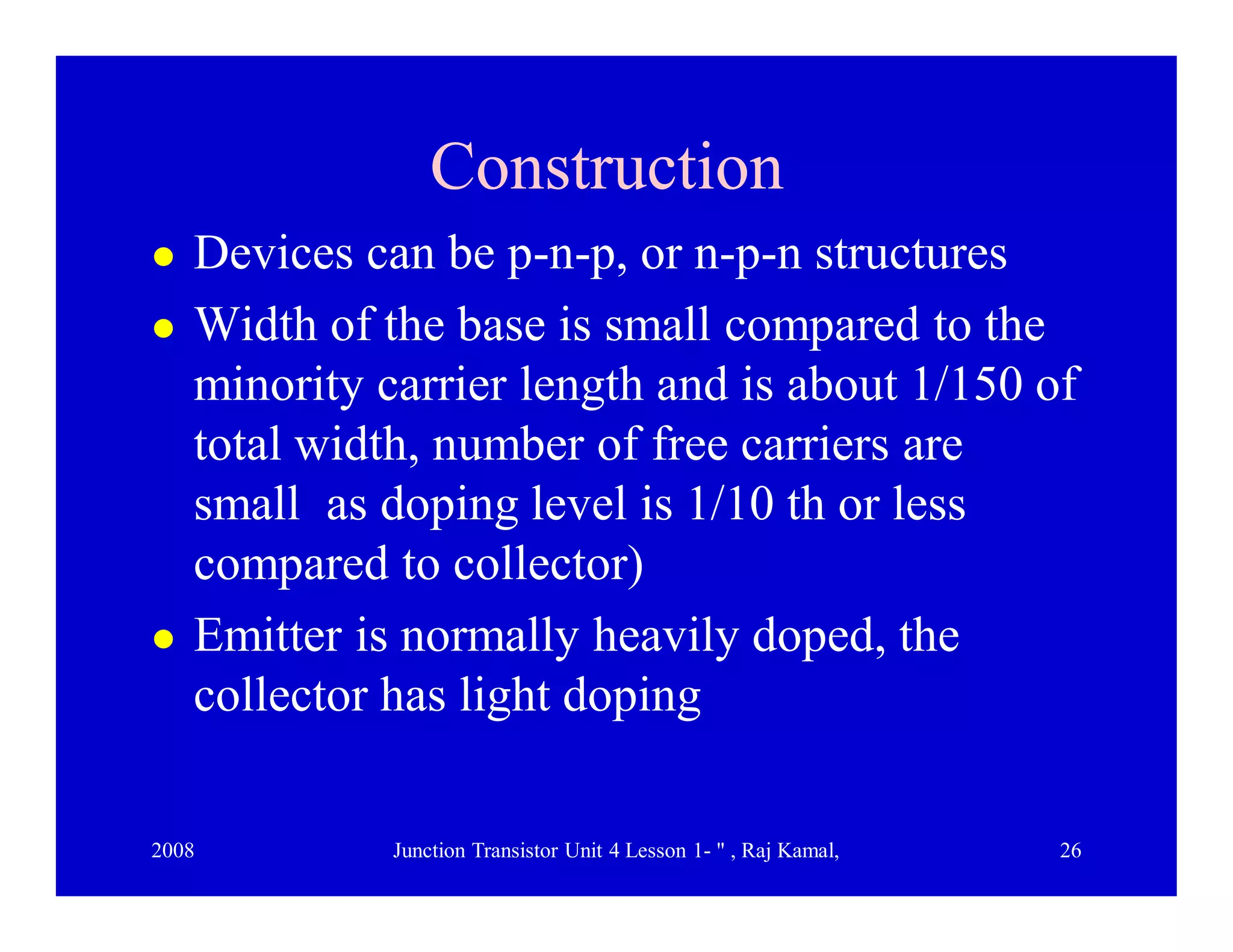
 Devices can be p-n-p, or n-p-n structures
 Width of the base is small compared to the
minority carrier length and is about 1/150 of
total width, number of free carriers are
small as doping level is 1/10 th or less
compared to collector)
 Emitter is normally heavily doped, the
collector has light doping
2008 Junction Transistor Unit 4 Lesson 1- " , Raj Kamal, 27
SummarySummary
We learnt
 (i) pnp transistor
 (ii) npn transistor
 (iii) Current Components
 (iv) Three configurations-
Common base, common emitter
and Common collector
2008 Junction Transistor Unit 4 Lesson 1- " , Raj Kamal, 28
We learnt
 (v) Three regions- cut-off,
saturation and active
 (vi) Transistor construction
2008 Junction Transistor Unit 4 Lesson 1- " , Raj Kamal, 29
End of Lesson 1End of Lesson 1

What are and how are PNP NPN Transistor materials are made ?

  • 1.
    2008 Junction TransistorUnit 4 Lesson 1- " , Raj Kamal, 1 Transistor and their Characteristics – Lesson-1 Junction Transistor
  • 2.
    2008 Junction TransistorUnit 4 Lesson 1- " , Raj Kamal, 2 1.1. Junction TransistorJunction Transistor DefinitionDefinition The transferred-resistance or transistor is a multi-junction device that is capable of • Current gain • Voltage gain • Signal-power gain
  • 3.
    2008 Junction TransistorUnit 4 Lesson 1- " , Raj Kamal, 3 Bipolar junction transistorBipolar junction transistor Invented in 1948 by Bardeen, Brattain and Shockley Contains three adjoining, alternately doped semiconductor regions: Emitter (E), Base (B), and Collector (C) The middle region, base, is very thin compared to the diffusion length of minority carriers Two kinds: npn and pnp
  • 4.
    2008 Junction Transistor Unit4 Lesson 1- " , Raj Kamal, 4 Bipolar junction transistor – BJT Definition The Bipolar junction transistor is an active device that works as a voltage-controlled current source and whose basic action is control of current at one terminal by controlling voltage applied at other two terminals.
  • 5.
    2008 Junction TransistorUnit 4 Lesson 1- " , Raj Kamal, 5 Bipolar Junction Transistor Representation NPN PNP
  • 6.
    2008 Junction TransistorUnit 4 Lesson 1- " , Raj Kamal, 6 2.2. Transistor CurrentTransistor Current ComponentsComponents
  • 7.
    2008 Junction TransistorUnit 4 Lesson 1- " , Raj Kamal, 7 BJT circuit Current ComponentsBJT circuit Current Components As shown, the currents are positive quantities when the transistor is operated in forward active mode. IE = IB + IC and VEB + VBC + VCE = 0 VCE =  VEC
  • 8.
    2008 Junction TransistorUnit 4 Lesson 1- " , Raj Kamal, 8 Meaning of Forward biasingMeaning of Forward biasing  When the p side is applied +ve and n side negative in a junction and applied voltage is grater than a threshold 0.65 V for Silicon (Si)
  • 9.
    2008 Junction TransistorUnit 4 Lesson 1- " , Raj Kamal, 9 Meaning of Reverse biasingMeaning of Reverse biasing  When the p side is applied -ve and n side +ve in a junction and applied voltage is between 0 to a breakdown voltage
  • 10.
    2008 Junction TransistorUnit 4 Lesson 1- " , Raj Kamal, 10 3.3. Transistor as AmplifierTransistor as Amplifier
  • 11.
    2008 Junction TransistorUnit 4 Lesson 1- " , Raj Kamal, 11 BJT CommonBJT Common BaseBase configurationconfiguration BJT CommonBJT Common EmitterEmitter configurationconfiguration BJT CommonBJT Common CollectorCollector configurationconfiguration PNPPNP PNP IB IE IC Three configurations
  • 12.
    2008 Junction Transistor Unit4 Lesson 1- " , Raj Kamal, 12 Six Problems • Draw circuits of CB, CE, CC configurations for npn and pnp transistors • Show current directions
  • 13.
    2008 Junction Transistor Unit4 Lesson 1- " , Raj Kamal, 13 npn transistor in a simple circuit, known as ‘common-emitter’ amplifier
  • 14.
    2008 Junction TransistorUnit 4 Lesson 1- " , Raj Kamal, 14 Characteristics ofCharacteristics of Transistor Amplifier in threeTransistor Amplifier in three regions of operationsregions of operations
  • 15.
    2008 Junction TransistorUnit 4 Lesson 1- " , Raj Kamal, 15 Input or driving PointInput or driving Point Characteristics of CommonCharacteristics of Common Base transistor AmplifierBase transistor Amplifier Input or driving Point Characteristics of Common Emitter transistor Amplifier Active region Saturation region Saturation region Active region
  • 16.
    2008 Junction TransistorUnit 4 Lesson 1- " , Raj Kamal, 16 Output CollectorOutput Collector Characteristics of CommonCharacteristics of Common Base transistor AmplifierBase transistor Amplifier Output CollectorOutput Collector Characteristics of CommonCharacteristics of Common Emitter transistorEmitter transistor AmplifierAmplifier Saturation region Cut-off region Cut-off regionSaturation region Active region Active region
  • 17.
    2008 Junction TransistorUnit 4 Lesson 1- " , Raj Kamal, 17 First Approximation RelationshipFirst Approximation Relationship betweenbetween IICC andand IIEE  IC  IE BJT CommonBJT Common BaseBase configurationconfiguration
  • 18.
    2008 Junction Transistor Unit4 Lesson 1- " , Raj Kamal, 18 The collector current is being controlled by the B-E voltage, or the current in the one part of the device is being controlled by the voltage in another part - transistor action Since the B-E junction is forward biased, holes from the base are injected into the emitter. However, these injected holes do not contribute to the collector current and are therefore not part of the transistor action To design a useful device, we need mathematical expressions for the minority carrier concentrations shown in the figure above. There are three modes of operation we must consider • Forward-active (B-E FB, B-C RB) • Cut-off (B-E RB, B-C RB) • Saturation (B-E FB, B-C FB)
  • 19.
    2008 Junction TransistorUnit 4 Lesson 1- " , Raj Kamal, 19 BJT biasing modesBJT biasing modes
  • 20.
    2008 Junction TransistorUnit 4 Lesson 1- " , Raj Kamal, 20  In the cut-off region, the base emitter and collector base junctions of transistor are reverse biased IC  IE  0 CutCut--off defined as region of characteristics Ioff defined as region of characteristics ICC = 0= 0
  • 21.
    2008 Junction TransistorUnit 4 Lesson 1- " , Raj Kamal, 21 Saturation- region – defined as region of characteristics left of VCB = 0 and IC increase exponentially with VCB increases toward 0  In the saturation region region, the base emitter and collector base junctions of transistor are forward biased
  • 22.
    2008 Junction TransistorUnit 4 Lesson 1- " , Raj Kamal, 22 Active - region – defined as region of characteristics right of VCB = 0 and IC first increases exponentially with VCB increases toward 0.7 V in Si transistor and then becomes constant  In the active region region, the base emitter and collector base junctions of transistor are forward and reversed biased respectively IC  IE ≠ 0 and is in mA IC
  • 23.
    2008 Junction TransistorUnit 4 Lesson 1- " , Raj Kamal, 23 Operation in the forward-active mode B-E junction is forward biased so electrons can be injected from the emitter to the base, B-C junction is reverse biased.
  • 24.
    2008 Junction TransistorUnit 4 Lesson 1- " , Raj Kamal, 24 4.4. TransistorTransistor ConstructionConstruction
  • 25.
    2008 Junction Transistor Unit4 Lesson 1- " , Raj Kamal, 25 BJT structure - three regions, two p-n junctions, three terminals (emitter, base, collector) Thin Thin
  • 26.
    2008 Junction TransistorUnit 4 Lesson 1- " , Raj Kamal, 26 ConstructionConstruction  Devices can be p-n-p, or n-p-n structures  Width of the base is small compared to the minority carrier length and is about 1/150 of total width, number of free carriers are small as doping level is 1/10 th or less compared to collector)  Emitter is normally heavily doped, the collector has light doping
  • 27.
    2008 Junction TransistorUnit 4 Lesson 1- " , Raj Kamal, 27 SummarySummary We learnt  (i) pnp transistor  (ii) npn transistor  (iii) Current Components  (iv) Three configurations- Common base, common emitter and Common collector
  • 28.
    2008 Junction TransistorUnit 4 Lesson 1- " , Raj Kamal, 28 We learnt  (v) Three regions- cut-off, saturation and active  (vi) Transistor construction
  • 29.
    2008 Junction TransistorUnit 4 Lesson 1- " , Raj Kamal, 29 End of Lesson 1End of Lesson 1