CHAPTER 7
The Incas
EARLY PEOPLES OF PERU
Western South America includes a wide variety of
climates and terrains:
 Narrow coastal plain that turns into a dry, lifeless
desert with occasional river valleys
 Snow-capped Andes Mountains
 High plateau
 Jungles inland

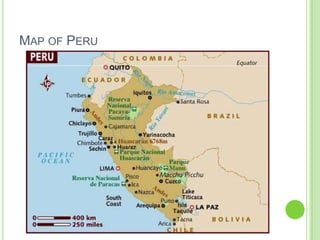
MAP OF PERU
EARLY PEOPLES OF PERU
Native American peoples developed many different
styles of life across South America
 Hunters/gatherers, farmers, fishermen
 Farmers used irrigation methods to grow
corn, beans, squash, and cotton
 Potatoes were also grown and included over 700
different varieties
 Domestication of the llama and alpaca

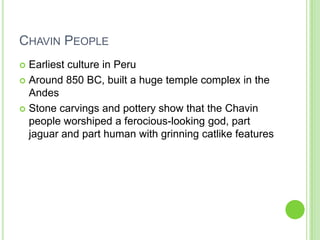
CHAVIN PEOPLE
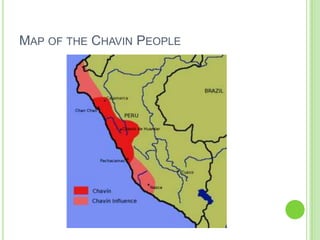
Earliest culture in Peru
 Around 850 BC, built a huge temple complex in the
Andes
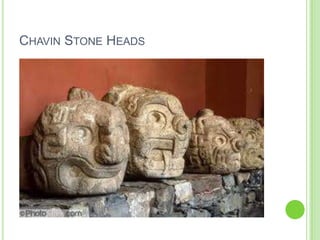
 Stone carvings and pottery show that the Chavin
people worshiped a ferocious-looking god, part
jaguar and part human with grinning catlike features

MAP OF THE CHAVIN PEOPLE
CHAVIN STONE HEADS
MOHICA PEOPLE
Between 100-700 AD, the Mohica people forged an
empire along the arid north coast of Peru
 The Mohicas were skilled farmers who developed
new methods of terracing, irrigation, and fertilization
of the soil
 Their leaders built roads and organized networks of
relay runners to carry messages---ideas the Incas
would later use

MOHICA PEOPLE
Remains of Mohica cities and temples dot the land
 To build one temple, workers had to produce 130
MILLION sun-dried adobe bricks
 The people perfected skills in textile
production, goldwork, and woodcarving
 They produced remarkable pots decorated with
realistic scenes of daily life

NAZCA PEOPLE
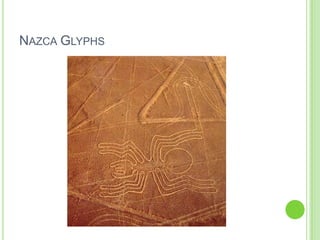
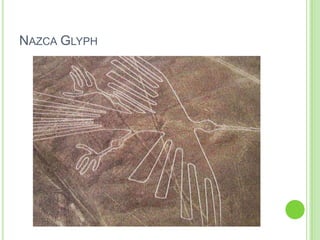
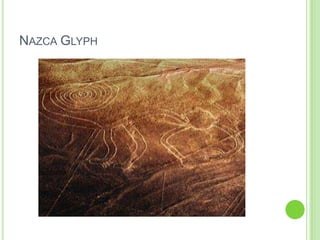
In southern Peru, the Nazca people etched glyphs
in the desert
 Glyph---pictograph or other symbol carved into a
surface
 Nazca glyphs include straight lines that run for
miles, as well as giant figures of birds, whales, and
other creatures

NAZCA GLYPHS
NAZCA GLYPH
NAZCA GLYPH
THE INCAN EMPIRE
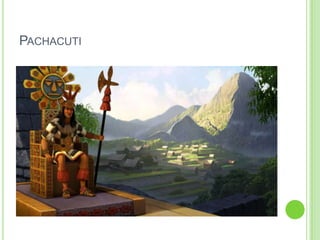
Pachacuti, a skilled warrior and leader, was the
founder of the Incan empire
 In 1438, he proclaimed himself Sapa Inca
(emperor) and set out on a policy of conquest
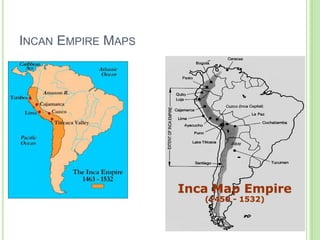
 He and later his son were able to extend Incan rule
from Ecuador in the north to Chile in the South
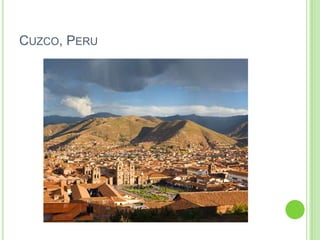
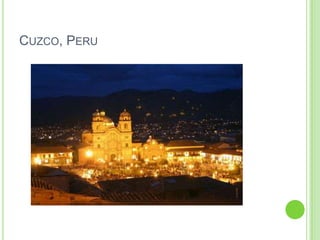
 He made Cuzco the capital of the Incan empire

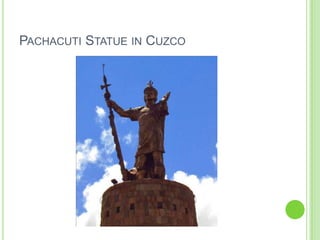
PACHACUTI
PACHACUTI STATUE IN CUZCO
CUZCO, PERU
CUZCO, PERU
INCAN EMPIRE MAPS
INCAN GOVERNMENT
The Sapa Inca exercised absolute power over the
empire
 Claiming that he was divine, he was also the chief
religious leader
 His symbol was gold aka “sweat of the sun”
 He lived in splendor, eating from golden plates and
dressing in richly embroidered clothes
 In fact, the Sapa Inca never wore the same clothes
twice!!!
 His queen, the Coya, carried out important religious
duties and sometimes governed when the Sapa
Inca was absent

INCAN GOVERNMENT
From Cuzco, the Incas ran an efficient government
with a chain of command reaching into every village
 Nobles ruled the provinces along with local
chieftains whom the Incas had conquered
 Below them, officials carried out the day-to-day
business of collecting taxes and enforcing laws
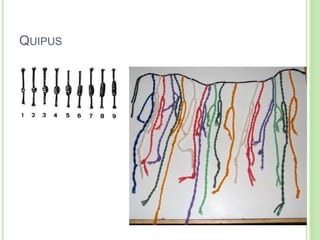
 Specially trained officials kept records on a quipu, a
collection of knotted, colored strings
 Modern scholars think that the quipus noted dates
and events as well as statistics on population and
crops

QUIPUS
INCAN ROADS AND RUNNERS
To unite their empire, the Incas imposed their own
language, Quechua, and religion on the people
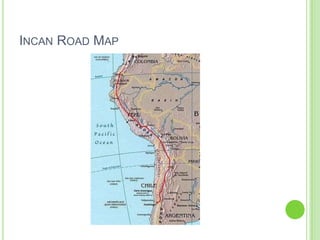
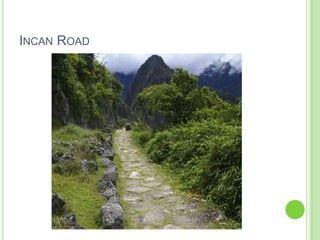
 They also created one of the greatest road systems
of history
 It wound more than 12,000 miles through
mountains and deserts
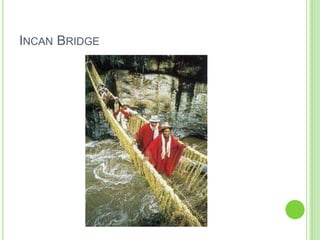
 Hundreds of bridges spanned rivers and deep
gorges
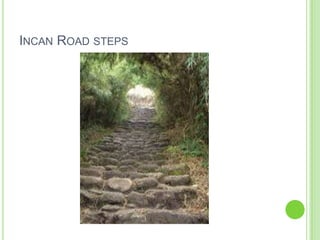
 Steps were cut into steep slopes and tunnels dug
though hillsides

INCAN ROAD MAP
INCAN ROAD
INCAN BRIDGE
INCAN ROAD STEPS
INCAN ROADS AND RUNNERS
The roads allowed armies and news to move
rapidly throughout the empire
 At regular stations, runners waited to carry
messages
 Relays of runners could carry news of a revolt
swiftly from a distant province to the capital
 The Incas kept soldiers at outposts throughout the
empire to quickly crush any rebellions
 Ordinary people, though, were restricted from using
the roads at all

CUZCO
All roads led through Cuzco
 In the heart of the city stood the great Temple of the
Sun, its interior walls lined with gold
 Like Incan palaces and forts, the temple was made
of enormous stone blocks, each polished and
carved to fit exactly in place
 The engineering was so precise that, although no
mortar was used to hold the stones together, Incan
buildings have survived severe earthquakes

DAILY LIFE
The Incas strictly regulated the lives of millions of
people within their empire
 People lived in close-knit communities, called ayllus
 Leaders of each ayllu carried out government
orders, assigning jobs to each family and
organizing the community to work the land
 Government officials arranged marriages to ensure
that men and women were settled at a certain age

FARMING










Farmers expanded the step terraces built by earlier
peoples
On steep hillsides, they carved out strips of land to be
held in place by stone walls
These terraces kept rains from washing away the soil
and made farming possible in places where flat land
was scarce
Farmers had to spend part of each year working land for
the emperor and the temples as well as for their own
communities
All the land belonged to the Inca, but cultivation and
crops were allotted to specific groups of people
The government took possession of each
harvest, dividing it up among the people and storing part
of it in case of famine
METALWORKING
The Incas were the best metalworkers of the
Americas
 They learned to work and alloy (blend)
copper, tin, bronze, silver, and gold
 While they employed copper and bronze for useful
objects, they used precious metals for statues of
gods and goddesses, eating utensils for the
aristocracy, and decorations

MEDICAL ADVANCES
The Incas developed some important medical
practices, including surgery on the human skull
 In such operations, they first cleaned the operating
area and then made the patient unconscious with a
drug---procedures much closer to the use of
modern antiseptics and anesthesia than anything
practiced in Europe at the time

RELIGION
The Incas were polytheistic, worshipping many
gods linked to the forces of nature
 People offered food, clothing, and drink to the
guardian spirits of the home and village
 Religion was tied to the routines of life
 Each month had its own festival, from the great
ripening and the dance of the young maize to the
festival of the water
 Festivals were celebrated with
ceremonies, sports, and games
 A powerful class of priests served the
gods, celebrating their special festivals and tending
to their needs

RELIGION
Chief among the gods was Inti, the sun god
 His special attendants, the “Chosen Women,” were
selected from each region of the empire
 During years of training, they studied the mysteries
of the religion, learned to prepare ritual food and
drink, and made the elaborate wool garments worn
by the Sapa Inca and Coya
 At the end of their training, most of the Chosen
Women continued to serve the sun god; others
joined the Inca’s court or married nobles

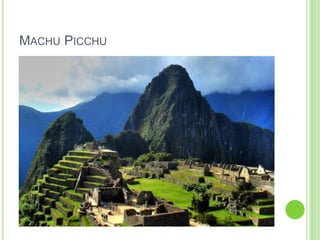
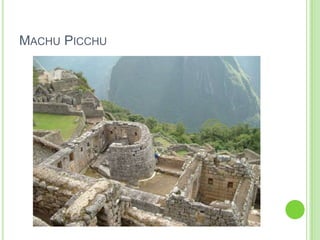
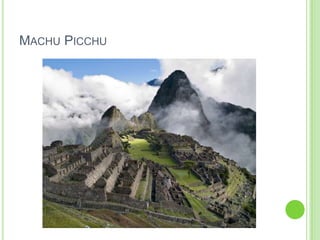
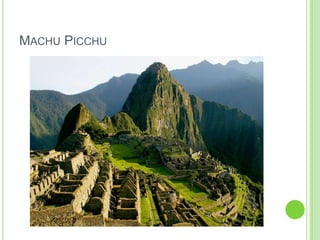
MACHU PICCHU
Machu Picchu lies some 7,000 feet above sea level
high in the Andes
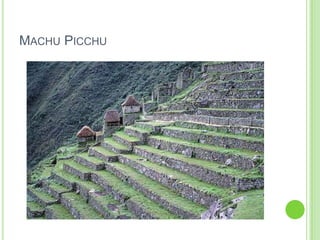
 The sturdy walls have withstood centuries of
earthquakes
 Incan workers cut and fitted the stones together
without using mortar
 Abandoned for some 300 years, the ruins of Machu
Picchu were rediscovered in 1911

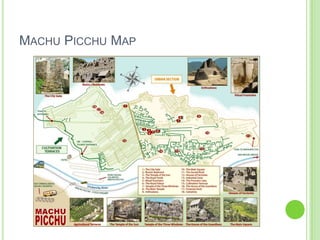
MACHU PICCHU MAP
MACHU PICCHU
MACHU PICCHU
MACHU PICCHU
MACHU PICCHU
MACHU PICCHU
END OF THE EMPIRE
At its height, the Incan civilization was a center of
learning and political power
 Then, in 1525, the emperor Huayna Capac died
suddenly of an unknown plague that swept across
the land
 He did not name a successor and soon civil war
broke out between two of his sons
 The fighting weakened the empire at a crucial time
because soon the Spanish conquistadors would
bring down the empire

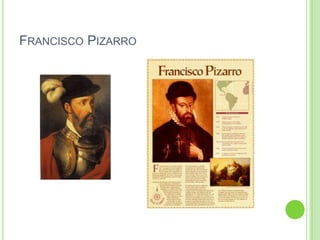
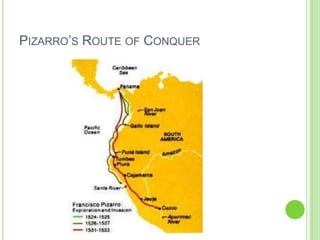
FRANCISCO PIZARRO
PIZARRO’S ROUTE OF CONQUER

WH Chapter 7 Incas

  • 1.
  • 2.
    EARLY PEOPLES OFPERU Western South America includes a wide variety of climates and terrains:  Narrow coastal plain that turns into a dry, lifeless desert with occasional river valleys  Snow-capped Andes Mountains  High plateau  Jungles inland 
  • 3.
  • 4.
    EARLY PEOPLES OFPERU Native American peoples developed many different styles of life across South America  Hunters/gatherers, farmers, fishermen  Farmers used irrigation methods to grow corn, beans, squash, and cotton  Potatoes were also grown and included over 700 different varieties  Domestication of the llama and alpaca 
  • 5.
    CHAVIN PEOPLE Earliest culturein Peru  Around 850 BC, built a huge temple complex in the Andes  Stone carvings and pottery show that the Chavin people worshiped a ferocious-looking god, part jaguar and part human with grinning catlike features 
  • 6.
    MAP OF THECHAVIN PEOPLE
  • 7.
  • 8.
    MOHICA PEOPLE Between 100-700AD, the Mohica people forged an empire along the arid north coast of Peru  The Mohicas were skilled farmers who developed new methods of terracing, irrigation, and fertilization of the soil  Their leaders built roads and organized networks of relay runners to carry messages---ideas the Incas would later use 
  • 9.
    MOHICA PEOPLE Remains ofMohica cities and temples dot the land  To build one temple, workers had to produce 130 MILLION sun-dried adobe bricks  The people perfected skills in textile production, goldwork, and woodcarving  They produced remarkable pots decorated with realistic scenes of daily life 
  • 10.
    NAZCA PEOPLE In southernPeru, the Nazca people etched glyphs in the desert  Glyph---pictograph or other symbol carved into a surface  Nazca glyphs include straight lines that run for miles, as well as giant figures of birds, whales, and other creatures 
  • 11.
  • 12.
  • 13.
  • 14.
    THE INCAN EMPIRE Pachacuti,a skilled warrior and leader, was the founder of the Incan empire  In 1438, he proclaimed himself Sapa Inca (emperor) and set out on a policy of conquest  He and later his son were able to extend Incan rule from Ecuador in the north to Chile in the South  He made Cuzco the capital of the Incan empire 
  • 15.
  • 16.
  • 17.
  • 18.
  • 19.
  • 20.
    INCAN GOVERNMENT The SapaInca exercised absolute power over the empire  Claiming that he was divine, he was also the chief religious leader  His symbol was gold aka “sweat of the sun”  He lived in splendor, eating from golden plates and dressing in richly embroidered clothes  In fact, the Sapa Inca never wore the same clothes twice!!!  His queen, the Coya, carried out important religious duties and sometimes governed when the Sapa Inca was absent 
  • 21.
    INCAN GOVERNMENT From Cuzco,the Incas ran an efficient government with a chain of command reaching into every village  Nobles ruled the provinces along with local chieftains whom the Incas had conquered  Below them, officials carried out the day-to-day business of collecting taxes and enforcing laws  Specially trained officials kept records on a quipu, a collection of knotted, colored strings  Modern scholars think that the quipus noted dates and events as well as statistics on population and crops 
  • 22.
  • 23.
    INCAN ROADS ANDRUNNERS To unite their empire, the Incas imposed their own language, Quechua, and religion on the people  They also created one of the greatest road systems of history  It wound more than 12,000 miles through mountains and deserts  Hundreds of bridges spanned rivers and deep gorges  Steps were cut into steep slopes and tunnels dug though hillsides 
  • 24.
  • 25.
  • 26.
  • 27.
  • 28.
    INCAN ROADS ANDRUNNERS The roads allowed armies and news to move rapidly throughout the empire  At regular stations, runners waited to carry messages  Relays of runners could carry news of a revolt swiftly from a distant province to the capital  The Incas kept soldiers at outposts throughout the empire to quickly crush any rebellions  Ordinary people, though, were restricted from using the roads at all 
  • 29.
    CUZCO All roads ledthrough Cuzco  In the heart of the city stood the great Temple of the Sun, its interior walls lined with gold  Like Incan palaces and forts, the temple was made of enormous stone blocks, each polished and carved to fit exactly in place  The engineering was so precise that, although no mortar was used to hold the stones together, Incan buildings have survived severe earthquakes 
  • 30.
    DAILY LIFE The Incasstrictly regulated the lives of millions of people within their empire  People lived in close-knit communities, called ayllus  Leaders of each ayllu carried out government orders, assigning jobs to each family and organizing the community to work the land  Government officials arranged marriages to ensure that men and women were settled at a certain age 
  • 31.
    FARMING       Farmers expanded thestep terraces built by earlier peoples On steep hillsides, they carved out strips of land to be held in place by stone walls These terraces kept rains from washing away the soil and made farming possible in places where flat land was scarce Farmers had to spend part of each year working land for the emperor and the temples as well as for their own communities All the land belonged to the Inca, but cultivation and crops were allotted to specific groups of people The government took possession of each harvest, dividing it up among the people and storing part of it in case of famine
  • 32.
    METALWORKING The Incas werethe best metalworkers of the Americas  They learned to work and alloy (blend) copper, tin, bronze, silver, and gold  While they employed copper and bronze for useful objects, they used precious metals for statues of gods and goddesses, eating utensils for the aristocracy, and decorations 
  • 33.
    MEDICAL ADVANCES The Incasdeveloped some important medical practices, including surgery on the human skull  In such operations, they first cleaned the operating area and then made the patient unconscious with a drug---procedures much closer to the use of modern antiseptics and anesthesia than anything practiced in Europe at the time 
  • 34.
    RELIGION The Incas werepolytheistic, worshipping many gods linked to the forces of nature  People offered food, clothing, and drink to the guardian spirits of the home and village  Religion was tied to the routines of life  Each month had its own festival, from the great ripening and the dance of the young maize to the festival of the water  Festivals were celebrated with ceremonies, sports, and games  A powerful class of priests served the gods, celebrating their special festivals and tending to their needs 
  • 35.
    RELIGION Chief among thegods was Inti, the sun god  His special attendants, the “Chosen Women,” were selected from each region of the empire  During years of training, they studied the mysteries of the religion, learned to prepare ritual food and drink, and made the elaborate wool garments worn by the Sapa Inca and Coya  At the end of their training, most of the Chosen Women continued to serve the sun god; others joined the Inca’s court or married nobles 
  • 36.
    MACHU PICCHU Machu Picchulies some 7,000 feet above sea level high in the Andes  The sturdy walls have withstood centuries of earthquakes  Incan workers cut and fitted the stones together without using mortar  Abandoned for some 300 years, the ruins of Machu Picchu were rediscovered in 1911 
  • 37.
  • 38.
  • 39.
  • 40.
  • 41.
  • 42.
  • 43.
    END OF THEEMPIRE At its height, the Incan civilization was a center of learning and political power  Then, in 1525, the emperor Huayna Capac died suddenly of an unknown plague that swept across the land  He did not name a successor and soon civil war broke out between two of his sons  The fighting weakened the empire at a crucial time because soon the Spanish conquistadors would bring down the empire 
  • 44.
  • 45.