Ancient Art Latin America – Mayan History By Janelle Moskalyk
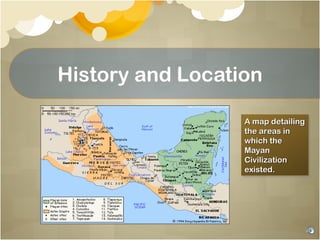
History and Location A map detailing the areas in which the Mayan Civilization existed.
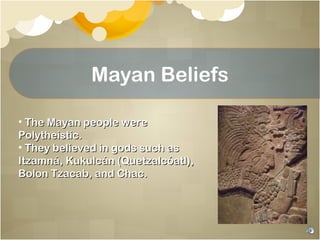
Mayan Beliefs The Mayan people were Polytheistic. They believed in gods such as Itzamná, Kukulcán (Quetzalcóatl), Bolon Tzacab, and Chac.
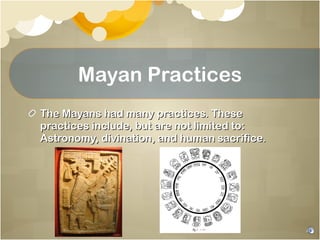
Mayan Practices The Mayans had many practices. These practices include, but are not limited to: Astronomy, divination, and human sacrifice.
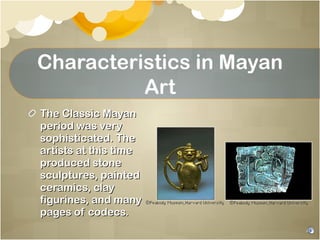
Characteristics in Mayan Art The Classic Mayan period was very sophisticated. The artists at this time produced stone sculptures, painted ceramics, clay figurines, and many pages of codecs.
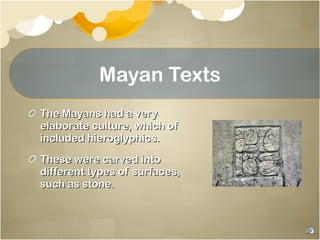
Mayan Texts The Mayans had a very elaborate culture, which of included hieroglyphics. These were carved into different types of surfaces, such as stone.
Important Mayan Texts
Mayan Sculptures  A common form in Mayan sculptures was called ‘stela’. Artists would take massive stones and carve them into intricate pieces of work using rudimentary tools. They often included hieroglyphics.
Mayan Ceramics Ceramic pieces were anecdotal, unlike the large sculptures. These were usually made with clay and volcanic ash.
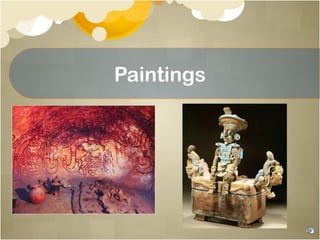
Mayan Paintings Mayan paintings and drawings usually possess very rich colours.
Paintings
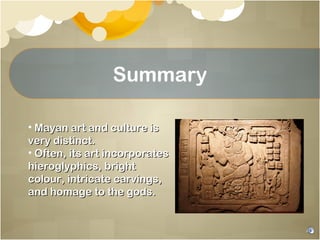
Summary Mayan art and culture is very distinct. Often, its art incorporates hieroglyphics, bright colour, intricate carvings, and homage to the gods.
Quiz When did Mayan culture originate? The Mayan culture worshipped many gods. This made them __________. What colours did they incorporate into their art? What did name was given to large sculptures? How many pages did the Madrid Codex contain?
Answers 2600 B.C. Polytheistic Black, blue, red, and yellow Stela 112 pages
The End
References 1.  http://www.lost-civilizations.net/mayan-history.html 2.  http://www.digitalmeesh.com/maya/history.htm 3.  http://en.wikipedia.org/wiki/Maya_civilization 4.  http://www.religionfacts.com/mayan_religion/index.htm 5.  http://en.wikipedia.org/wiki/Maya_codices#Background 6.  http://en.wikipedia.org/wiki/Sacrifice_in_Maya_culture 7.  http://www.authenticmaya.com/maya_art.htm

Ancient Art - The Maya

  • 1.
    Ancient Art LatinAmerica – Mayan History By Janelle Moskalyk
  • 2.
    History and LocationA map detailing the areas in which the Mayan Civilization existed.
  • 3.
    Mayan Beliefs TheMayan people were Polytheistic. They believed in gods such as Itzamná, Kukulcán (Quetzalcóatl), Bolon Tzacab, and Chac.
  • 4.
    Mayan Practices TheMayans had many practices. These practices include, but are not limited to: Astronomy, divination, and human sacrifice.
  • 5.
    Characteristics in MayanArt The Classic Mayan period was very sophisticated. The artists at this time produced stone sculptures, painted ceramics, clay figurines, and many pages of codecs.
  • 6.
    Mayan Texts TheMayans had a very elaborate culture, which of included hieroglyphics. These were carved into different types of surfaces, such as stone.
  • 7.
  • 8.
  • 9.
    Mayan Sculptures A common form in Mayan sculptures was called ‘stela’. Artists would take massive stones and carve them into intricate pieces of work using rudimentary tools. They often included hieroglyphics.
  • 10.
    Mayan Ceramics Ceramicpieces were anecdotal, unlike the large sculptures. These were usually made with clay and volcanic ash.
  • 11.
    Mayan Paintings Mayanpaintings and drawings usually possess very rich colours.
  • 12.
  • 13.
    Summary Mayan artand culture is very distinct. Often, its art incorporates hieroglyphics, bright colour, intricate carvings, and homage to the gods.
  • 14.
    Quiz When didMayan culture originate? The Mayan culture worshipped many gods. This made them __________. What colours did they incorporate into their art? What did name was given to large sculptures? How many pages did the Madrid Codex contain?
  • 15.
    Answers 2600 B.C.Polytheistic Black, blue, red, and yellow Stela 112 pages
  • 16.
  • 17.
    References 1. http://www.lost-civilizations.net/mayan-history.html 2. http://www.digitalmeesh.com/maya/history.htm 3. http://en.wikipedia.org/wiki/Maya_civilization 4. http://www.religionfacts.com/mayan_religion/index.htm 5. http://en.wikipedia.org/wiki/Maya_codices#Background 6. http://en.wikipedia.org/wiki/Sacrifice_in_Maya_culture 7. http://www.authenticmaya.com/maya_art.htm

Editor's Notes

  • #3 The Maya are one of the most prominent civilizations in South America. They originated around 2600 BC in Yucatan, and lasted around 900 AD, which is when the civilization began to crumble. The Mayan Civilization was at its peak by 250 A.D., primarily in modern day Southern Mexico, as well as western Honduras, El Salvador, and Northern Belize.
  • #4 Itzamna was the creator god. Kukulcan, otherwise known as Quetzalcoatl, was the Feathered Serpent. Bolon Tzacab was thought to be the god of royal descent. Chac was the god of rain and lightning.
  • #5 The Mayans were very interested in astrology, and had created calendars and mathematical techniques to predict solar activity. They also believed in pleasing the gods by means of sacrificial rituals. The picture on the left depicts Lady Xoc putting a barbed rope through her toungue. The picture to left is the Mayan Calendar.
  • #6 The art produced in the Classic Mayan period was intricate, and throughout it, many differente mediums were practiced, such as painting, sculpting, drawing, and ceramic work. The art you see in this includes a golden monkey bell, and to the right is a jade pendant.
  • #7 The Mayans carved into many different types of surfaces, not limited to stone. They did work on pieces of bone, pottery, and wrote on books (or codices) of bark paper. To the right is an example of the a Mayan heiroglyph.
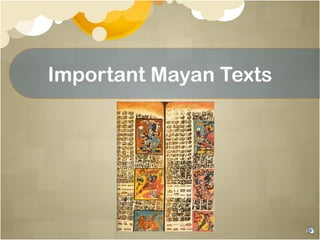
  • #8 This is the Dresden Codex. It contains a description of predicting solar eclipses. It was writing before the Spanish conquest and is 74 pages. The colours were made from vegetable dyes, and primarily consisted of red, black and blue.
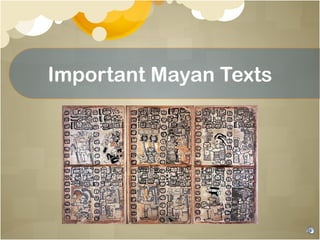
  • #9 This is the Madrid Codex. This piece of work was written after the Spanish conquest, most likely. Not much is known about its meaning, but it spans 112 pages, splitting into two parts named the Troano Codex, and the Cortesanius Codex.
  • #10 Mayan sculptures called ‘stela’ were created. These could be as big as 65 tonnes, and have a length of 10.5 meters. This is one of the sculptures, which is located in Quiriguá . There is no evidence that points to artists using animals or special contraptions in order to cart these massive pieces of stone around.
  • #11 Ceramics pieces in Mayan culture gave the artist free reign to do what they like, and wasn’t necessarily an exact reflection of their culture. This medium encouraged originality. The picture to the left is a small monkey. It’s arms and legs have movement. It comes from the Pacific Lowlands. The picture to the left is a flask, and carved into it are two gods.
  • #12 This piece is a representation of musicians in Xibalba. The characteristics in Mayan paintings include very bright colours, such as red, blue, black, and yellow.
  • #13 The Mayans chemistry and mineralogy to create specific colours. Just recently, the Mayan blue color was replicated. The picture on the left is an old cave painting in a Rio Azul tomb. The one on the right depicts a Maya man on a throne.
  • #14 Mayan art and culture is something that will stand out in modern society for many years to come. Its artistic style is defined by its beautiful carvings, religious themes, not to mention its bright use of color using black, yellow, blue, and red. Mayan artists were masters of calligraphy, painting, and ceramic work.