Section 2 Notes






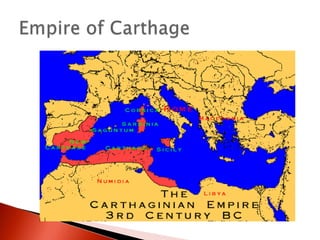
Rome’s conquest of the Italian peninsula
brought it into contact with Carthage, a citystate on the northern coast of Africa
Settled by North Africans and Phoenician
traders, Carthage ruled over an empire that
stretched across North Africa and the western
Mediterranean
As Rome began to expand westward, conflict
between the two powers was inevitable





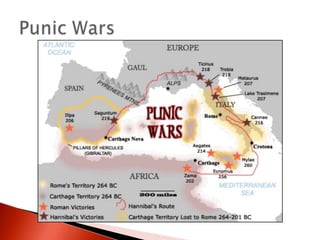
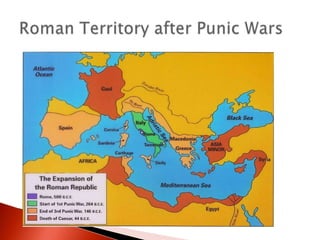
Between 264 BC and 146 BC, Rome fought
three wars against Carthage
They are known as the Punic Wars
In the first Punic War, Rome defeated
Carthage and won Sicily, Corsica, and Sardinia







The Carthaginians sought revenge in the
Second Punic War
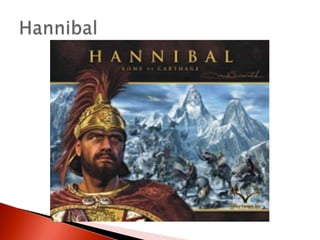
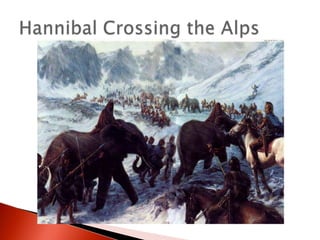
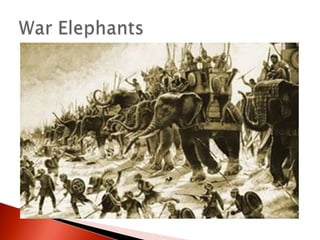
In 218 BC, Carthaginian general Hannibal led
his army, including war elephants, across the
Pyrenees, through France, and over the Alps
into Italy---this cost Hannibal half of his
army
He then surprised the Romans who expected
an invasion from the south
For 15 years, Hannibal and his army moved
across Italy winning battle after battle









The Carthaginians failed to capture Rome
In the end, Rome sent an army to attack Carthage
and Hannibal returned to defend his
homeland, where he was defeated by the Romans
Carthage then had to give up all of its lands
except those in Africa
Many Romans still saw Carthage as a rival and
wanted revenge for the destruction Hannibal’s
army caused in Italy
For years, Cato, a wealthy senator, ended every
speech he gave with the words “Carthage must
be destroyed”







Rome finally destroyed Carthage in the Third
Punic War
Survivors were killed or sold into slavery
The Romans poured salt over the earth so
that nothing would grow there again
Finally, the Romans were now masters of the
western Mediterranean







Rome was committed to a policy of
imperialism---establishing control over
foreign lands and peoples
Rome also was expanding into the eastern
Mediterranean where they confronted
Hellenistic rulers who had divided up the
empire of Alexander the Great
Macedonia, Greece, and parts of Asia Minor
surrendered and became Roman provinces
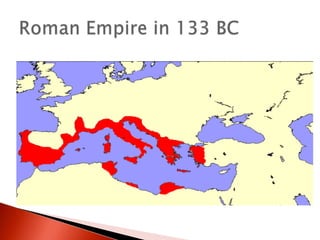
By 133 BC, Roman power extended from
Spain to Egypt









Conquests and control of busy trade routes
brought incredible riches into Rome
A new class of wealthy Romans emerged
Wealthy families bought up huge estates,
called latifundia
People captured in war were forced to work
on the latifundia
The widespread use of slave labor hurt small
farmers, who were unable to produce food as
cheaply as the latifundia could







The farmers’ problems were compounded when
huge quantities of grain coming in from
conquered lands drove down grain prices
Many farmers fell into debt and had to sell their
land
Landless farmers flocked to Rome and joined
more unemployed people---as the gap between
rich and poor widened angry mobs sprang up
The new wealth also increased corruption--greed and self-interest replaced virtues such as
simplicity, hard work, and devotion to duty so
prized in the early republic









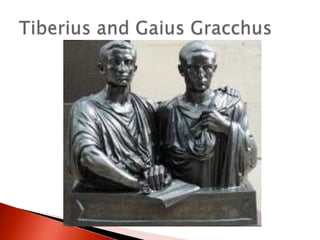
Two young patrician brothers, Tiberius and Gaius
Gracchus were among the first to attempt reform
Tiberius, who was elected a tribune, called on the
state to distribute land to poor farmers
Gaius, elected a tribune 10 years later, sought a
wider range of reforms including the use of
public funds to buy grain to feed the poor
The reforms of the Gracchus brothers angered
the senate, which saw them as a threat to its
power
The brothers, along with thousands of their
followers, were killed in waves of street violence
set off by senators and their hired thugs








Rome was plunged into a series of civil wars
At issue was who should hold power----the
senate, which wanted to govern as it had in the
past, or popular political leaders, who wanted to
weaken the senate and enact reforms
The turmoil sparked slave uprisings and revolts
among Rome’s allies
Old legions of Roman citizen-soldiers became
professional armies whose first loyalty was to
their commanders
Rival generals marched their armies into Rome to
advance their ambitions









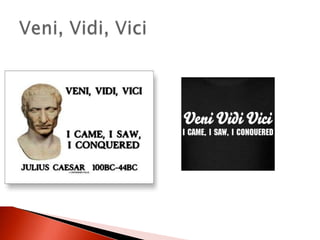
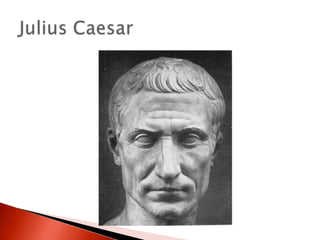
Julius Caesar, an ambitious military
commander, emerged from this chaos
Julius conquered Gaul (France) after a nineyear battle
Julius crushed his former ally Pompey and
then put down rebellions around the
Mediterranean
“Veni, Vidi, Vici”
He then returned to Rome and forced the
senate to make him dictator








Between 48 and 44 BC, Caesar pushed
through a number of reforms to deal with
Rome’s many problems
Public works programs employed the jobless
and gave public land to the poor
His most lasting reform was the introduction
of a new calendar
The Julian calendar was used in western
Europe for over 1,600 years (it is still our
calendar today with only minor changes)






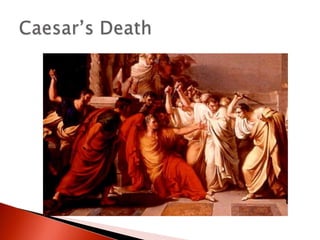
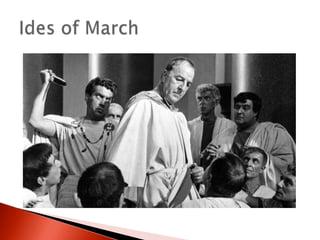
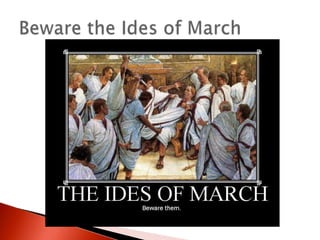
Caesar’s enemies worried that he planned to
make himself king of Rome
In March 44 BC, as Caesar arrived in the
senate, his enemies stabbed him to death
Ides of March---March 15---day that Caesar
was stabbed to death in the back








The death of Julius Caesar plunged Rome into
a new round of civil wars
Mark Antony, Caesar’s chief general, and
Octavian, Caesar’s grand nephew, joined
forces to hunt down the murderers
The two men soon quarreled, however,
setting off a bitter power struggle
In 31 BC, Ocatvian finally defeated Antony
and his ally Queen Cleopatra








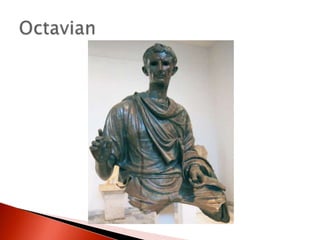
Octavian was given the title of Augustus
meaning “Exalted One” and became the first
emperor of the Roman empire
Augustus laid the foundation for a stable
government
He created an efficient, well-trained civil
service to enforce the laws (high level jobs
were open to all men regardless of class)
He gave self-government to many cities and
provinces










Economic reforms also followed
The tax system was made more fair by
undertaking a census in the empire
Census---count of the population
He set up a postal service and issued new
coins to make trade easier
People without jobs built roads and temples
and sent others to farm land
The government that Augustus organized
functioned well for 200 years





Two of Augustus’ successors were crazy
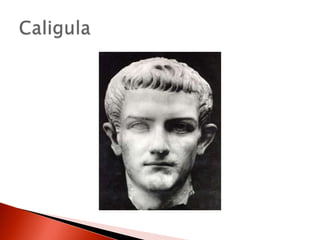
Caligula---had a relationship with one of his
sisters and appointed his favorite horse as a
consul
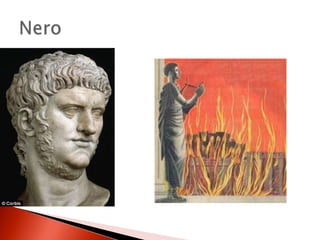
Nero---persecuted Christians and was
blamed for setting a great fire that destroyed
much of Rome (“Nero fiddled while Rome
burned”)





There were also two good emperors
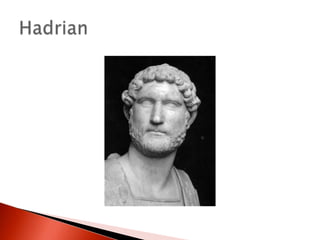
Hadrian---codified Roman law making it the
same for all provinces-he also had soldiers
build a wall across Britain to hold back
attackers from the non-Roman north
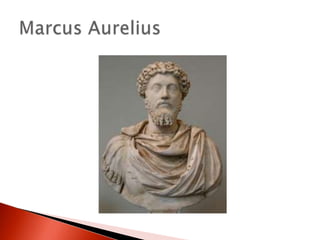
Marcus Aurelius---read philosophy while he
was on military campaigns and was a
philosopher-king




The two hundred year span that began with
Augustus and ended with Marcus Aurelius
was known as the Pax Romana i.e. “Roman
Peace”
Roman rule brought peace, order, unity, and
prosperity to lands stretching from the
Euphrates River in the east to Britain in the
west, an area approximately the size of the
continental United States






Roman legions maintained and protected the
roads, and Roman fleets chased pirates from
the seas
Trade flowed freely to and from distant lands
in Africa and Asia
Trade caravans traveled along the great Silk
Road bringing silk and other goods from
China






Throughout the empire, rich and poor alike
loved spectacular entertainments
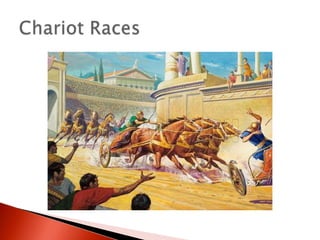
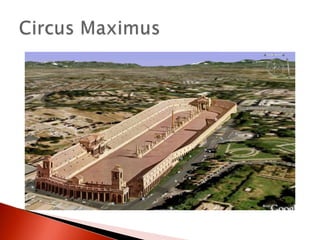
At the Circus Maximus, Rome’s largest race
course, chariots thundered around an oval
course, making dangerously tight turns at
either end
Fans bet on their favorite teams-Reds,
Greens, Blues, or Whites-and successful
charioteers were hailed as heroes







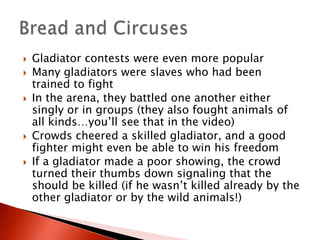
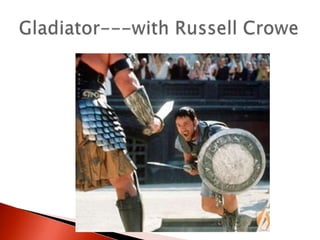
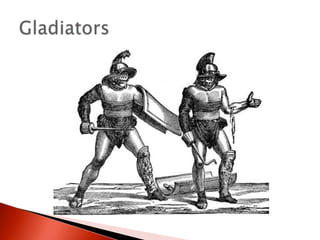
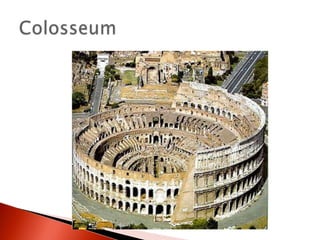
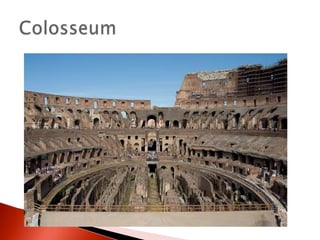
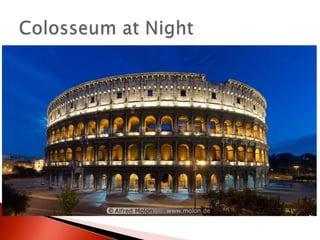
Gladiator contests were even more popular
Many gladiators were slaves who had been
trained to fight
In the arena, they battled one another either
singly or in groups (they also fought animals of
all kinds…you’ll see that in the video)
Crowds cheered a skilled gladiator, and a good
fighter might even be able to win his freedom
If a gladiator made a poor showing, the crowd
turned their thumbs down signaling that the
should be killed (if he wasn’t killed already by the
other gladiator or by the wild animals!)






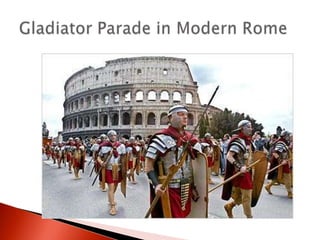
These amusements were a way to pacify the city
of Rome’s restless mobs---but the emperors had
to pay for them with the taxes they collected
from the empire
In much the same spirit, the government
provided free grain to feed the poor
Critics warned against this policy of “bread and
circuses” but few listened
During the Pax Romana, the general prosperity
hid underlying social and economic problems
that later emperors could not fix with “bread and
circuses”


http://youtu.be/8KIXbrTcf-k

WH Chapter 6 Section 2 Notes

  • 1.
  • 2.
       Rome’s conquest ofthe Italian peninsula brought it into contact with Carthage, a citystate on the northern coast of Africa Settled by North Africans and Phoenician traders, Carthage ruled over an empire that stretched across North Africa and the western Mediterranean As Rome began to expand westward, conflict between the two powers was inevitable
  • 4.
       Between 264 BCand 146 BC, Rome fought three wars against Carthage They are known as the Punic Wars In the first Punic War, Rome defeated Carthage and won Sicily, Corsica, and Sardinia
  • 5.
        The Carthaginians soughtrevenge in the Second Punic War In 218 BC, Carthaginian general Hannibal led his army, including war elephants, across the Pyrenees, through France, and over the Alps into Italy---this cost Hannibal half of his army He then surprised the Romans who expected an invasion from the south For 15 years, Hannibal and his army moved across Italy winning battle after battle
  • 11.
         The Carthaginians failedto capture Rome In the end, Rome sent an army to attack Carthage and Hannibal returned to defend his homeland, where he was defeated by the Romans Carthage then had to give up all of its lands except those in Africa Many Romans still saw Carthage as a rival and wanted revenge for the destruction Hannibal’s army caused in Italy For years, Cato, a wealthy senator, ended every speech he gave with the words “Carthage must be destroyed”
  • 12.
        Rome finally destroyedCarthage in the Third Punic War Survivors were killed or sold into slavery The Romans poured salt over the earth so that nothing would grow there again Finally, the Romans were now masters of the western Mediterranean
  • 14.
        Rome was committedto a policy of imperialism---establishing control over foreign lands and peoples Rome also was expanding into the eastern Mediterranean where they confronted Hellenistic rulers who had divided up the empire of Alexander the Great Macedonia, Greece, and parts of Asia Minor surrendered and became Roman provinces By 133 BC, Roman power extended from Spain to Egypt
  • 16.
         Conquests and controlof busy trade routes brought incredible riches into Rome A new class of wealthy Romans emerged Wealthy families bought up huge estates, called latifundia People captured in war were forced to work on the latifundia The widespread use of slave labor hurt small farmers, who were unable to produce food as cheaply as the latifundia could
  • 17.
        The farmers’ problemswere compounded when huge quantities of grain coming in from conquered lands drove down grain prices Many farmers fell into debt and had to sell their land Landless farmers flocked to Rome and joined more unemployed people---as the gap between rich and poor widened angry mobs sprang up The new wealth also increased corruption--greed and self-interest replaced virtues such as simplicity, hard work, and devotion to duty so prized in the early republic
  • 18.
         Two young patricianbrothers, Tiberius and Gaius Gracchus were among the first to attempt reform Tiberius, who was elected a tribune, called on the state to distribute land to poor farmers Gaius, elected a tribune 10 years later, sought a wider range of reforms including the use of public funds to buy grain to feed the poor The reforms of the Gracchus brothers angered the senate, which saw them as a threat to its power The brothers, along with thousands of their followers, were killed in waves of street violence set off by senators and their hired thugs
  • 20.
         Rome was plungedinto a series of civil wars At issue was who should hold power----the senate, which wanted to govern as it had in the past, or popular political leaders, who wanted to weaken the senate and enact reforms The turmoil sparked slave uprisings and revolts among Rome’s allies Old legions of Roman citizen-soldiers became professional armies whose first loyalty was to their commanders Rival generals marched their armies into Rome to advance their ambitions
  • 21.
         Julius Caesar, anambitious military commander, emerged from this chaos Julius conquered Gaul (France) after a nineyear battle Julius crushed his former ally Pompey and then put down rebellions around the Mediterranean “Veni, Vidi, Vici” He then returned to Rome and forced the senate to make him dictator
  • 24.
        Between 48 and44 BC, Caesar pushed through a number of reforms to deal with Rome’s many problems Public works programs employed the jobless and gave public land to the poor His most lasting reform was the introduction of a new calendar The Julian calendar was used in western Europe for over 1,600 years (it is still our calendar today with only minor changes)
  • 25.
       Caesar’s enemies worriedthat he planned to make himself king of Rome In March 44 BC, as Caesar arrived in the senate, his enemies stabbed him to death Ides of March---March 15---day that Caesar was stabbed to death in the back
  • 29.
        The death ofJulius Caesar plunged Rome into a new round of civil wars Mark Antony, Caesar’s chief general, and Octavian, Caesar’s grand nephew, joined forces to hunt down the murderers The two men soon quarreled, however, setting off a bitter power struggle In 31 BC, Ocatvian finally defeated Antony and his ally Queen Cleopatra
  • 30.
        Octavian was giventhe title of Augustus meaning “Exalted One” and became the first emperor of the Roman empire Augustus laid the foundation for a stable government He created an efficient, well-trained civil service to enforce the laws (high level jobs were open to all men regardless of class) He gave self-government to many cities and provinces
  • 32.
          Economic reforms alsofollowed The tax system was made more fair by undertaking a census in the empire Census---count of the population He set up a postal service and issued new coins to make trade easier People without jobs built roads and temples and sent others to farm land The government that Augustus organized functioned well for 200 years
  • 33.
       Two of Augustus’successors were crazy Caligula---had a relationship with one of his sisters and appointed his favorite horse as a consul Nero---persecuted Christians and was blamed for setting a great fire that destroyed much of Rome (“Nero fiddled while Rome burned”)
  • 36.
       There were alsotwo good emperors Hadrian---codified Roman law making it the same for all provinces-he also had soldiers build a wall across Britain to hold back attackers from the non-Roman north Marcus Aurelius---read philosophy while he was on military campaigns and was a philosopher-king
  • 39.
      The two hundredyear span that began with Augustus and ended with Marcus Aurelius was known as the Pax Romana i.e. “Roman Peace” Roman rule brought peace, order, unity, and prosperity to lands stretching from the Euphrates River in the east to Britain in the west, an area approximately the size of the continental United States
  • 40.
       Roman legions maintainedand protected the roads, and Roman fleets chased pirates from the seas Trade flowed freely to and from distant lands in Africa and Asia Trade caravans traveled along the great Silk Road bringing silk and other goods from China
  • 41.
       Throughout the empire,rich and poor alike loved spectacular entertainments At the Circus Maximus, Rome’s largest race course, chariots thundered around an oval course, making dangerously tight turns at either end Fans bet on their favorite teams-Reds, Greens, Blues, or Whites-and successful charioteers were hailed as heroes
  • 44.
         Gladiator contests wereeven more popular Many gladiators were slaves who had been trained to fight In the arena, they battled one another either singly or in groups (they also fought animals of all kinds…you’ll see that in the video) Crowds cheered a skilled gladiator, and a good fighter might even be able to win his freedom If a gladiator made a poor showing, the crowd turned their thumbs down signaling that the should be killed (if he wasn’t killed already by the other gladiator or by the wild animals!)
  • 51.
        These amusements werea way to pacify the city of Rome’s restless mobs---but the emperors had to pay for them with the taxes they collected from the empire In much the same spirit, the government provided free grain to feed the poor Critics warned against this policy of “bread and circuses” but few listened During the Pax Romana, the general prosperity hid underlying social and economic problems that later emperors could not fix with “bread and circuses”
  • 52.