Section 4 Notes








Europe’s economic recovery was symbolized by
the appearance of new towns
The revival period from 1000-1300 is known as
the High Middle Ages
The iron plow was created which made it easier
to plow the heavy soil of northern Europe
A new harness allowed for the use of horses to
pull plows rather than oxen
Windmills allowed the use of wind power to grind
grain into flour---towns no longer needed to be
located next to a swift water source in order to
get their grain ground









Feudal lords who wanted to boost their incomes
pushed peasants to clear forests, drain
swamps, and reclaim wasteland for farming and
grazing animals
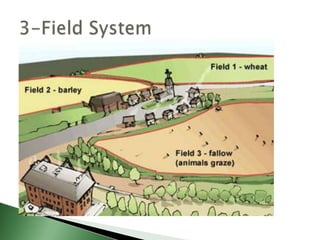
Peasants adopted the three-field system
One field planted with grains, one with
legumes, one left fallow (unplanted)
Legumes---helped restore soil fertility
This new method left only 1/3 of land unplanted
Farmers produced more food---population
grows
Between 1000-1300 Europe’s population doubles






The growing population demanded more goods
which helped bring trade back
Trade routes brought goods from Asia and the
Middle East
Northern Europeans paid for goods with products
such as honey, furs, cloth, tin, and lead








Yearly trade fairs took place near navigable rivers
or where busy trade routes met
People flocked to these fairs and traded farm
goods and animals
Besides eating and drinking, they enjoyed the
antics of jugglers, acrobats, or even dancing
bears
Peasants had no money to buy goods such as
swords, sugar, and silks---these goods were
purchased by feudal rulers, nobles, and wealthy
churchmen
http://www.youtube.com/watch?v=8YSTeJOxia
w









Small centers of trade developed into real medieval
cities
Some had populations of 10,000 and a few had
populations over 100,000---towns of this size were
not seen since Roman times
The richest cities were in northern Italy and Flanders
Merchants who set up new towns wanted a charter in
order to protect their interests
Charter---written document that set out the rights
and privileges of the town
Charters let townspeople choose their own leaders
and control their own affairs---also had clauses that
benefitted runaway serfs (year and a day)








Banking houses were created in order to lend
merchants capital to start businesses
Partnerships began to become common--this let several investors pool their money
together to start a business
Insurance system was developed to help
reduce business risks and insure goods being
transported
Bills of exchange allowed merchants to travel
without carrying money









The use of money undermined serfdom
Many peasants began selling farm products
to townspeople and paying their rent to their
lords in cash rather than in labor
By 1300, most peasants were tenant farmers
or hired farm laborers
By 1000, a middle class began to emerge in
society
Anti-Semitism began to rise against
Jews…why?









Medieval guilds were equivalent to our
modern-day unions
Each guild represented workers in a specific
occupation--merchants, weavers, bakers, brewers, goldsm
iths, etc.
Becoming a guild member was hard
At the age of 7 or 8 a child worked as an
apprentice to a guild master for seven years
and then went on to become a journeyman
Women either had their own guilds, were
guild masters, or worked as apprentices






Medieval towns and cities were surrounded
by high, protective walls
As the city grew, space within the walls filled
to overflowing, and newcomers had to settle
in the fields outside the walls
Every few years the city might have to rebuild
its walls farther and farther out








A typical medieval city was a jumble of
narrow streets lined with tall houses
Upper floors hung over the streets, making
those below dark even in daytime
Large cities had great cathedrals or a
magnificent guild hall
During the day, the streets echoed with the
cries of hawkers selling their goods, at night
the streets were deserted








Even rich towns did not have garbage
collection or sewer systems
Residents simply flung their wastes into the
street below
Larger cities might pass laws, such as one
requiring butchers to dump their garbage on
the edge of town
However, towns remained
filthy, smelly, noisy, and crowded places (bad
idea…you’ll see why in Chapter 9)

Chapter 8 Section 4 Notes

  • 1.
  • 2.
         Europe’s economic recoverywas symbolized by the appearance of new towns The revival period from 1000-1300 is known as the High Middle Ages The iron plow was created which made it easier to plow the heavy soil of northern Europe A new harness allowed for the use of horses to pull plows rather than oxen Windmills allowed the use of wind power to grind grain into flour---towns no longer needed to be located next to a swift water source in order to get their grain ground
  • 8.
           Feudal lords whowanted to boost their incomes pushed peasants to clear forests, drain swamps, and reclaim wasteland for farming and grazing animals Peasants adopted the three-field system One field planted with grains, one with legumes, one left fallow (unplanted) Legumes---helped restore soil fertility This new method left only 1/3 of land unplanted Farmers produced more food---population grows Between 1000-1300 Europe’s population doubles
  • 11.
       The growing populationdemanded more goods which helped bring trade back Trade routes brought goods from Asia and the Middle East Northern Europeans paid for goods with products such as honey, furs, cloth, tin, and lead
  • 12.
        Yearly trade fairstook place near navigable rivers or where busy trade routes met People flocked to these fairs and traded farm goods and animals Besides eating and drinking, they enjoyed the antics of jugglers, acrobats, or even dancing bears Peasants had no money to buy goods such as swords, sugar, and silks---these goods were purchased by feudal rulers, nobles, and wealthy churchmen
  • 16.
  • 17.
          Small centers oftrade developed into real medieval cities Some had populations of 10,000 and a few had populations over 100,000---towns of this size were not seen since Roman times The richest cities were in northern Italy and Flanders Merchants who set up new towns wanted a charter in order to protect their interests Charter---written document that set out the rights and privileges of the town Charters let townspeople choose their own leaders and control their own affairs---also had clauses that benefitted runaway serfs (year and a day)
  • 18.
        Banking houses werecreated in order to lend merchants capital to start businesses Partnerships began to become common--this let several investors pool their money together to start a business Insurance system was developed to help reduce business risks and insure goods being transported Bills of exchange allowed merchants to travel without carrying money
  • 20.
         The use ofmoney undermined serfdom Many peasants began selling farm products to townspeople and paying their rent to their lords in cash rather than in labor By 1300, most peasants were tenant farmers or hired farm laborers By 1000, a middle class began to emerge in society Anti-Semitism began to rise against Jews…why?
  • 21.
         Medieval guilds wereequivalent to our modern-day unions Each guild represented workers in a specific occupation--merchants, weavers, bakers, brewers, goldsm iths, etc. Becoming a guild member was hard At the age of 7 or 8 a child worked as an apprentice to a guild master for seven years and then went on to become a journeyman Women either had their own guilds, were guild masters, or worked as apprentices
  • 22.
       Medieval towns andcities were surrounded by high, protective walls As the city grew, space within the walls filled to overflowing, and newcomers had to settle in the fields outside the walls Every few years the city might have to rebuild its walls farther and farther out
  • 26.
        A typical medievalcity was a jumble of narrow streets lined with tall houses Upper floors hung over the streets, making those below dark even in daytime Large cities had great cathedrals or a magnificent guild hall During the day, the streets echoed with the cries of hawkers selling their goods, at night the streets were deserted
  • 33.
        Even rich townsdid not have garbage collection or sewer systems Residents simply flung their wastes into the street below Larger cities might pass laws, such as one requiring butchers to dump their garbage on the edge of town However, towns remained filthy, smelly, noisy, and crowded places (bad idea…you’ll see why in Chapter 9)