
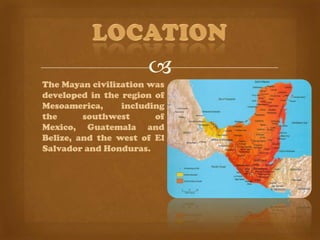
The Mayan civilization was
developed in the region of
Mesoamerica,     including
the      southwest      of
Mexico, Guatemala and
Belize, and the west of El
Salvador and Honduras.

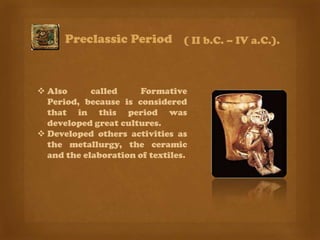
Preclassic Period ( II b.C. – IV a.C.).


 Also      called     Formative
  Period, because is considered
  that in this period was
  developed great cultures.
 Developed others activities as
  the metallurgy, the ceramic
  and the elaboration of textiles.
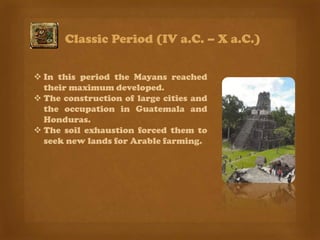
Classic Period (IV a.C. – X a.C.)

 In this period the Mayans reached
  their maximum developed.
 The construction of large cities and
  the occupation in Guatemala and
  Honduras.
 The soil exhaustion forced them to
  seek new lands for Arable farming.
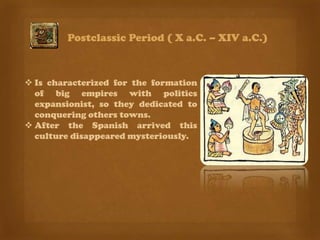
Postclassic Period ( X a.C. – XIV a.C.)


 Is characterized for the formation
  of big empires with politics
  expansionist, so they dedicated to
  conquering others towns.
 After the Spanish arrived this
  culture disappeared mysteriously.

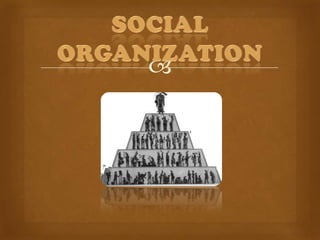
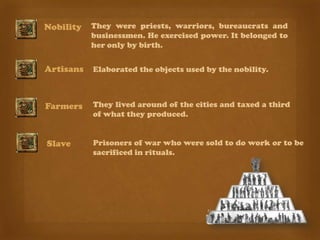
Nobility   They were priests, warriors, bureaucrats and
           businessmen. He exercised power. It belonged to
           her only by birth.


Artisans   Elaborated the objects used by the nobility.


Farmers    They lived around of the cities and taxed a third
           of what they produced.


Slave      Prisoners of war who were sold to do work or to be
           sacrificed in rituals.

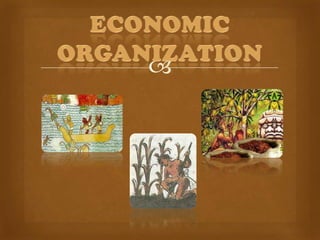
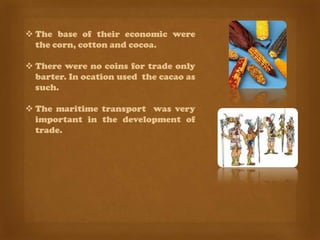
 The base of their economic were
  the corn, cotton and cocoa.

 There were no coins for trade only
  barter. In ocation used the cacao as
  such.

 The maritime transport was very
  important in the development of
  trade.

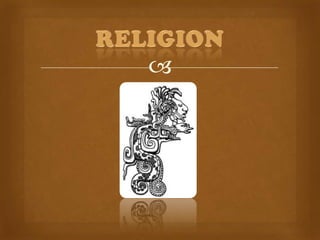
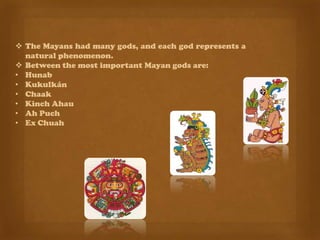
 The Mayans had many gods, and each god represents a
  natural phenomenon.
 Between the most important Mayan gods are:
• Hunab
• Kukulkán
• Chaak
• Kinch Ahau
• Ah Puch
• Ex Chuah
 They made ​sacrifices in honor of
  their gods.
 Initially they   made sacrifice
  with animal but later with
  humans.
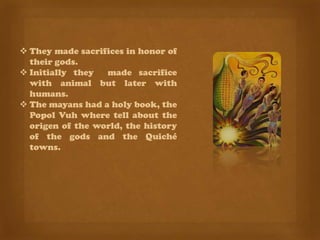
 The mayans had a holy book, the
  Popol Vuh where tell about the
  origen of the world, the history
  of the gods and the Quiché
  towns.

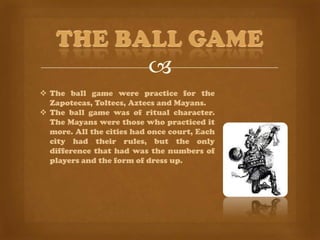
 The ball game were practice for the
  Zapotecas, Toltecs, Aztecs and Mayans.
 The ball game was of ritual character.
  The Mayans were those who practiced it
  more. All the cities had once court, Each
  city had their rules, but the only
  difference that had was the numbers of
  players and the form of dress up.

 The game consisted in pass a ball of rubber for a rings
  that was located in the highest on the walls of the
  stadium.
 For example in Chinchén Itzá was played for two teams
  formatted for seven players included the captain.
  Something people think when finished the game the
  capitain of the loser team was sacrificed. Also during
  the game the players can't use their hands and feet, only
  the hips, knees, elbows, shoulders and ankles.



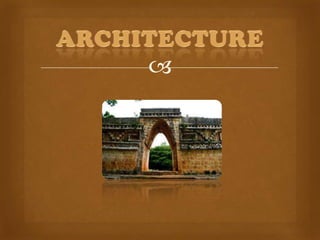
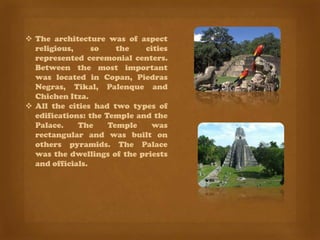
 The architecture was of aspect
  religious,     so    the   cities
  represented ceremonial centers.
  Between the most important
  was located in Copan, Piedras
  Negras, Tikal, Palenque and
  Chichen Itza.
 All the cities had two types of
  edifications: the Temple and the
  Palace.    The     Temple   was
  rectangular and was built on
  others pyramids. The Palace
  was the dwellings of the priests
  and officials.

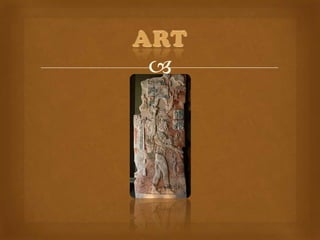
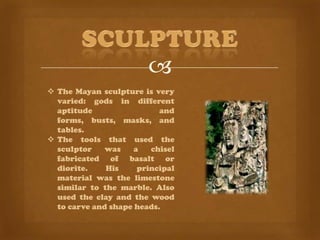
 The Mayan sculpture is very
  varied: gods in different
  aptitude                 and
  forms, busts, masks, and
  tables.
 The tools that used the
  sculptor    was    a   chisel
  fabricated of basalt or
  diorite.    His     principal
  material was the limestone
  similar to the marble. Also
  used the clay and the wood
  to carve and shape heads.

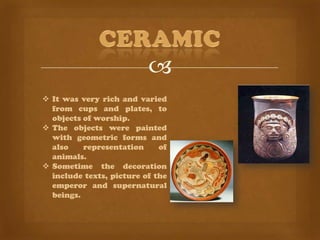
 It was very rich and varied
  from cups and plates, to
  objects of worship.
 The objects were painted
  with geometric forms and
  also    representation     of
  animals.
 Sometime the decoration
  include texts, picture of the
  emperor and supernatural
  beings.

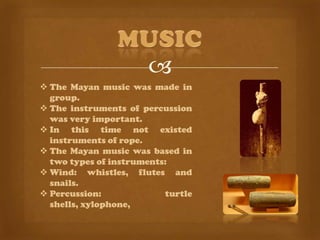
 The Mayan music was made in
  group.
 The instruments of percussion
  was very important.
 In this time not existed
  instruments of rope.
 The Mayan music was based in
  two types of instruments:
 Wind: whistles, flutes and
  snails.
 Percussion:             turtle
  shells, xylophone,


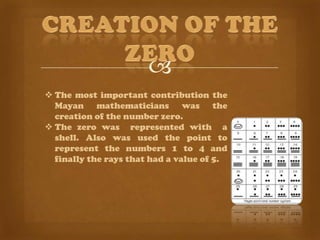
 The most important contribution the
  Mayan mathematicians was the
  creation of the number zero.
 The zero was represented with a
  shell. Also was used the point to
  represent the numbers 1 to 4 and
  finally the rays that had a value of 5.

 Describing the positions of the Sun, Moon and Mars.
 Known phases of the moon, the lunar year duration
  and setting of the solar year.
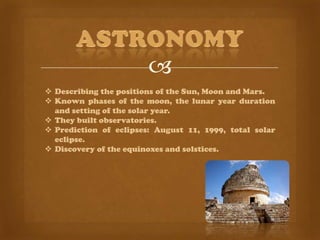
 They built observatories.
 Prediction of eclipses: August 11, 1999, total solar
  eclipse.
 Discovery of the equinoxes and solstices.

 Determined the causes of
  diseases were able to describe
  them, classify them according
  to their symptoms, cure and
  even prevent them.
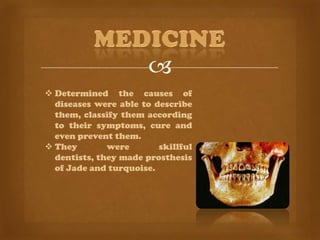
 They        were       skillful
  dentists, they made prosthesis
  of Jade and turquoise.
Maya civilization

Maya civilization

  • 2.
     The Mayan civilizationwas developed in the region of Mesoamerica, including the southwest of Mexico, Guatemala and Belize, and the west of El Salvador and Honduras.
  • 3.
  • 4.
    Preclassic Period (II b.C. – IV a.C.).  Also called Formative Period, because is considered that in this period was developed great cultures.  Developed others activities as the metallurgy, the ceramic and the elaboration of textiles.
  • 5.
    Classic Period (IVa.C. – X a.C.)  In this period the Mayans reached their maximum developed.  The construction of large cities and the occupation in Guatemala and Honduras.  The soil exhaustion forced them to seek new lands for Arable farming.
  • 6.
    Postclassic Period (X a.C. – XIV a.C.)  Is characterized for the formation of big empires with politics expansionist, so they dedicated to conquering others towns.  After the Spanish arrived this culture disappeared mysteriously.
  • 7.
  • 8.
    Nobility They were priests, warriors, bureaucrats and businessmen. He exercised power. It belonged to her only by birth. Artisans Elaborated the objects used by the nobility. Farmers They lived around of the cities and taxed a third of what they produced. Slave Prisoners of war who were sold to do work or to be sacrificed in rituals.
  • 9.
  • 10.
     The baseof their economic were the corn, cotton and cocoa.  There were no coins for trade only barter. In ocation used the cacao as such.  The maritime transport was very important in the development of trade.
  • 11.
  • 12.
     The Mayanshad many gods, and each god represents a natural phenomenon.  Between the most important Mayan gods are: • Hunab • Kukulkán • Chaak • Kinch Ahau • Ah Puch • Ex Chuah
  • 13.
     They made​sacrifices in honor of their gods.  Initially they made sacrifice with animal but later with humans.  The mayans had a holy book, the Popol Vuh where tell about the origen of the world, the history of the gods and the Quiché towns.
  • 14.
      The ballgame were practice for the Zapotecas, Toltecs, Aztecs and Mayans.  The ball game was of ritual character. The Mayans were those who practiced it more. All the cities had once court, Each city had their rules, but the only difference that had was the numbers of players and the form of dress up.
  • 15.
      The gameconsisted in pass a ball of rubber for a rings that was located in the highest on the walls of the stadium.  For example in Chinchén Itzá was played for two teams formatted for seven players included the captain. Something people think when finished the game the capitain of the loser team was sacrificed. Also during the game the players can't use their hands and feet, only the hips, knees, elbows, shoulders and ankles.
  • 16.
  • 17.
  • 18.
  • 19.
     The architecturewas of aspect religious, so the cities represented ceremonial centers. Between the most important was located in Copan, Piedras Negras, Tikal, Palenque and Chichen Itza.  All the cities had two types of edifications: the Temple and the Palace. The Temple was rectangular and was built on others pyramids. The Palace was the dwellings of the priests and officials.
  • 20.
      The Mayansculpture is very varied: gods in different aptitude and forms, busts, masks, and tables.  The tools that used the sculptor was a chisel fabricated of basalt or diorite. His principal material was the limestone similar to the marble. Also used the clay and the wood to carve and shape heads.
  • 21.
      It wasvery rich and varied from cups and plates, to objects of worship.  The objects were painted with geometric forms and also representation of animals.  Sometime the decoration include texts, picture of the emperor and supernatural beings.
  • 22.
      The Mayanmusic was made in group.  The instruments of percussion was very important.  In this time not existed instruments of rope.  The Mayan music was based in two types of instruments:  Wind: whistles, flutes and snails.  Percussion: turtle shells, xylophone,
  • 23.
  • 24.
      The mostimportant contribution the Mayan mathematicians was the creation of the number zero.  The zero was represented with a shell. Also was used the point to represent the numbers 1 to 4 and finally the rays that had a value of 5.
  • 25.
      Describing thepositions of the Sun, Moon and Mars.  Known phases of the moon, the lunar year duration and setting of the solar year.  They built observatories.  Prediction of eclipses: August 11, 1999, total solar eclipse.  Discovery of the equinoxes and solstices.
  • 26.
      Determined thecauses of diseases were able to describe them, classify them according to their symptoms, cure and even prevent them.  They were skillful dentists, they made prosthesis of Jade and turquoise.