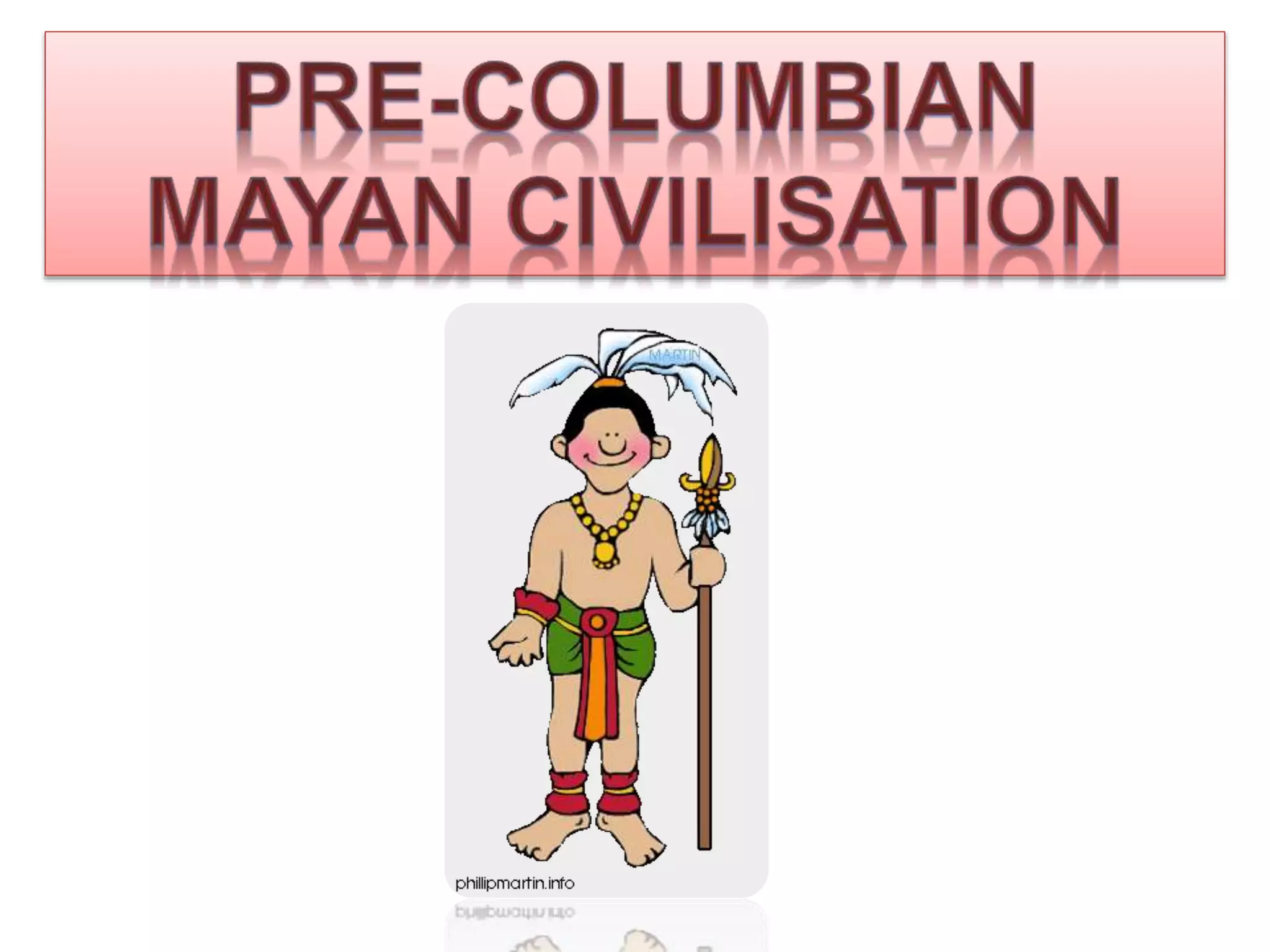
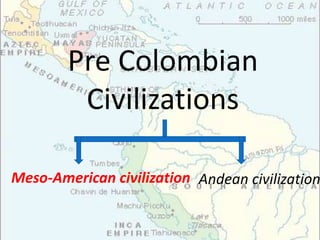

Pre Colombian
Civilizations
Meso-American civilization Andean civilization
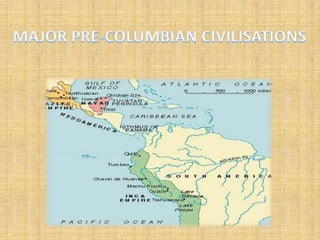
Meso-American civilizations
CULTURE LOCATION DATES
Olmec
Gulf coast of southern
Mexico
1150 BCE–800 BCE
Zapotec
Oaxaca, particularly Monte
Albán
500 BCE–900 CE
Totonac east-central Mexico 500 BCE–900 CE
Teotihuacán central Mexico 400–600 CE
Mayan (Maya)
Southern Mexico and
Guatemala
250–900
Toltec central Mexico 900–1200
Aztec
central and southern
Mexico
1400–early 1500s
• Evolved in Meso-America (part of Mexico
and Central America) and the Andean
region (western South America)
• These were extraordinary developments in
human society and culture
• The Mesoamerican scripts deciphered to date are logo
syllabic
• often called hieroglyphic scripts.
• Five or six different scripts have been documented in
Mesoamerica but archaeological dating methods and a
certain degree of self-interest, create difficulties in
establishing priority
• Mesoamerican writing is found in a
number of different mediums
• The Mesoamerican book was typically
written with brush and colored inks on a
paper prepared from the inner bark of the
ficus amacus.
• it's located in the mid-latitudes (between 10° and 22° N)
of the Americas in the southern portion of North America,
encompassing much of the isthmus that joins it
with South America. Situated within the wider region
known as Middle America,
• lowlands (those areas between sea level and 1000
meters) and altiplanos or highlands (those situated
between 1000 and 2000 meters above sea level).
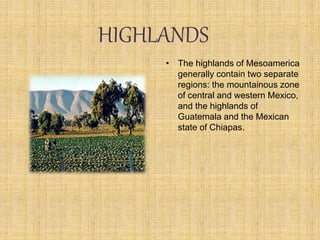
HIGHLANDS
• The highlands of Mesoamerica
generally contain two separate
regions: the mountainous zone
of central and western Mexico,
and the highlands of
Guatemala and the Mexican
state of Chiapas.
LOWLANDS
• On the southeast coast of the Gulf of Mexico, in Belize, and in
southern Campeche and Quintana Roo, rainfall can be quite heavy.
• The lowlands, however, offered a great degree of variability
usable flora and fauna resources.
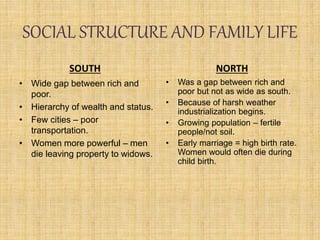
SOCIAL STRUCTURE AND FAMILY LIFE
SOUTH
• Wide gap between rich and
poor.
• Hierarchy of wealth and status.
• Few cities – poor
transportation.
• Women more powerful – men
die leaving property to widows.
NORTH
• Was a gap between rich and
poor but not as wide as south.
• Because of harsh weather
industrialization begins.
• Growing population – fertile
people/not soil.
• Early marriage = high birth rate.
Women would often die during
child birth.
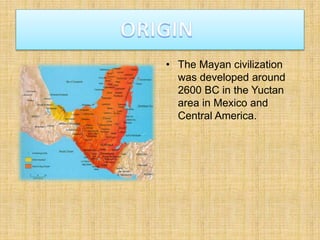
• The Mayan civilization
was developed around
2600 BC in the Yuctan
area in Mexico and
Central America.
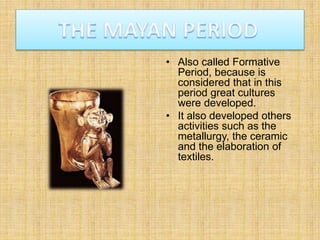
• Also called Formative
Period, because is
considered that in this
period great cultures
were developed.
• It also developed others
activities such as the
metallurgy, the ceramic
and the elaboration of
textiles.
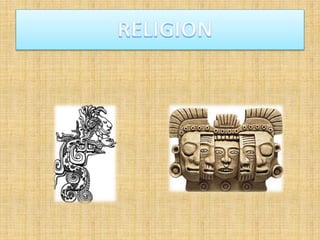
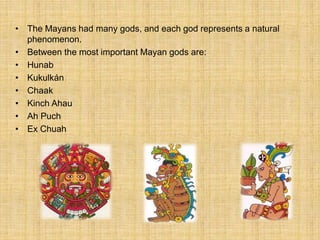
• The Mayans had many gods, and each god represents a natural
phenomenon.
• Between the most important Mayan gods are:
• Hunab
• Kukulkán
• Chaak
• Kinch Ahau
• Ah Puch
• Ex Chuah
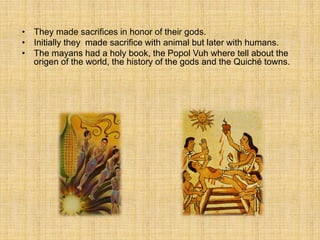
• They made ​​sacrifices in honor of their gods.
• Initially they made sacrifice with animal but later with humans.
• The mayans had a holy book, the Popol Vuh where tell about the
origen of the world, the history of the gods and the Quiché towns.
• God controlled everything.
• Priests had great influence because mayans thought priests could
talk to gods.
• GOD HAD CREATED HUMAN BEING FROM MAIZE AND WATER.
• GODS KEPT THE WORLD IN ORDER AND MAINTAINED THE
AGRICULTURAL CYCLE IN EXCHANGE FOR HONOUR AND
SACRIFICE.
Rain God Snake
Sun God Jaguar
Death God Bat
• The Maya economic system was largely based on agriculture, craft
production, and trade.
• The backbone of the Maya economy was a middle class made up
the workers and artisans who produced goods that the trade
networks required.
• Through farming, domestication of animals,and the development of
personal employment through acquiring sought after skills the
middle class of the Maya developed an extremely complex trade
network that was overseen by an elite class that made up the
governing party.
• Trade was the main factor that kept Maya cities growing economically.
• In summary, the economy of the ancient Mayas was running by a
middle class under the supervision of the elite class. Resources from all
over the geographic regions of the Maya world and beyond made up
the economy of the Maya.
• This system was a form of free market trade, except in the major cities
in which the local government had direct control over the trade
networks and economy.
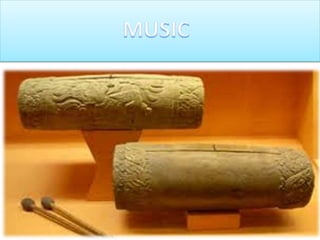
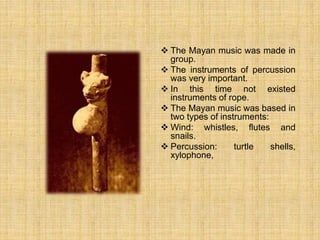
 The Mayan music was made in
group.
 The instruments of percussion
was very important.
 In this time not existed
instruments of rope.
 The Mayan music was based in
two types of instruments:
 Wind: whistles, flutes and
snails.
 Percussion: turtle shells,
xylophone,
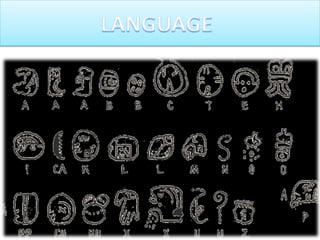
• A family of American Indian languages spoken by Mayas
• 6 million indigenous Mayans still speak Mayan language.
• Most of them live in Belize, Guatemala, Honduras and Mexico.
• Guatemala consists 21 known Mayan languages and Mexico
consists 8 known Mayan languages.
• Most of these are derived from 5000 years old language PROTO-
MAYAN.
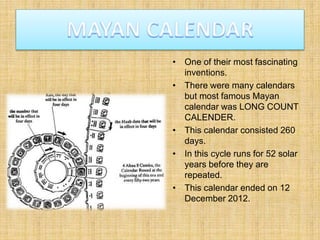
• One of their most fascinating
inventions.
• There were many calendars
but most famous Mayan
calendar was LONG COUNT
CALENDER.
• This calendar consisted 260
days.
• In this cycle runs for 52 solar
years before they are
repeated.
• This calendar ended on 12
December 2012.
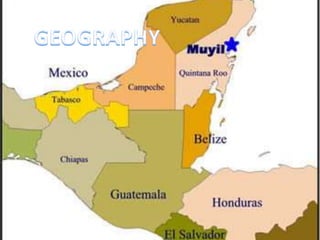
• The region is generally divided into three loosely defined zones: the
southern Maya highlands, the southern (or central) Maya lowlands,
and the northern Maya lowlands.
• The southern Maya highlands include all of elevated terrain in
Guatemala and the Chiapas highlands
• The northern lowlands cover the remainder of the Yucatán
Peninsula, including the Puuc hills.
• The southern maya highlands are at an elevation of 4,220 m
(13,845 ft).
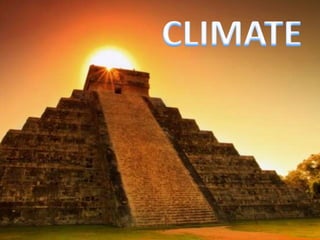
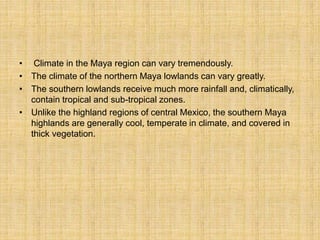
• Climate in the Maya region can vary tremendously.
• The climate of the northern Maya lowlands can vary greatly.
• The southern lowlands receive much more rainfall and, climatically,
contain tropical and sub-tropical zones.
• Unlike the highland regions of central Mexico, the southern Maya
highlands are generally cool, temperate in climate, and covered in
thick vegetation.
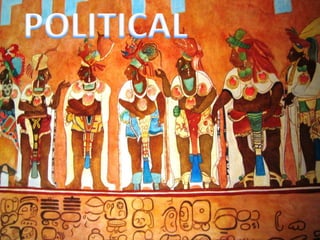
• Ruled by powerful semi-devine kings called Halach Uinic. Highest
authority in maya city centre.
• Chiefs and Priests: served as advisers to help carry our government
functions.
• Priests: lead rural practices including sacrifice and offerings.
• Population largely rural used cities for primarily religious centres.
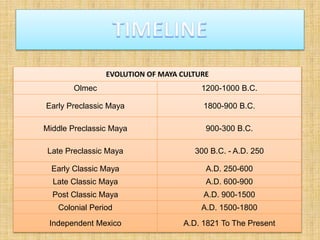
EVOLUTION OF MAYA CULTURE
Olmec 1200-1000 B.C.
Early Preclassic Maya 1800-900 B.C.
Middle Preclassic Maya 900-300 B.C.
Late Preclassic Maya 300 B.C. - A.D. 250
Early Classic Maya A.D. 250-600
Late Classic Maya A.D. 600-900
Post Classic Maya A.D. 900-1500
Colonial Period A.D. 1500-1800
Independent Mexico A.D. 1821 To The Present
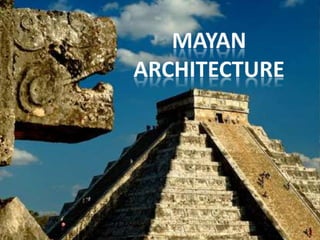
• The architecture was of aspect religious, so the cities
represented ceremonial centers. Between the most
important was located in Copan, Piedras Negras, Tikal,
Palenque and Chichen Itza.
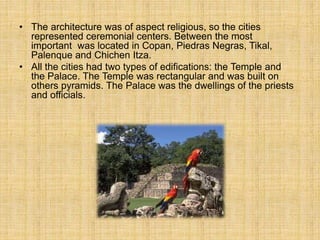
• All the cities had two types of edifications: the Temple and
the Palace. The Temple was rectangular and was built on
others pyramids. The Palace was the dwellings of the priests
and officials.
Decline
• No one really knows what the cause of the Mayan's
decline.
• What they do know is that over population occured
as well as over use of land. Therefore less crops
grew each year. This period also consisted of warfare
of the city states. This disrupted their trade.
• There could have been a possible drout and as a
result, there was movement to a better location.
• In the late 800's, the most Mayans abandoned their
cities.
• There were very few cities left, but they managed to
servive.
• Eventually though, the Toltecs attacked the Mayans
A SHORT VIDEO ON MAYAN
CIVILISATION
• www.wikipedia.com
• www.britainica.com
• www.history.com
• www.googleimages.com
• www.timemaps.com
• www.maya.blogspot.com
• www.americanscientist.org

Mayans

  • 2.
  • 3.
    Meso-American civilizations CULTURE LOCATIONDATES Olmec Gulf coast of southern Mexico 1150 BCE–800 BCE Zapotec Oaxaca, particularly Monte Albán 500 BCE–900 CE Totonac east-central Mexico 500 BCE–900 CE Teotihuacán central Mexico 400–600 CE Mayan (Maya) Southern Mexico and Guatemala 250–900 Toltec central Mexico 900–1200 Aztec central and southern Mexico 1400–early 1500s
  • 5.
    • Evolved inMeso-America (part of Mexico and Central America) and the Andean region (western South America) • These were extraordinary developments in human society and culture
  • 9.
    • The Mesoamericanscripts deciphered to date are logo syllabic • often called hieroglyphic scripts. • Five or six different scripts have been documented in Mesoamerica but archaeological dating methods and a certain degree of self-interest, create difficulties in establishing priority
  • 10.
    • Mesoamerican writingis found in a number of different mediums • The Mesoamerican book was typically written with brush and colored inks on a paper prepared from the inner bark of the ficus amacus.
  • 12.
    • it's locatedin the mid-latitudes (between 10° and 22° N) of the Americas in the southern portion of North America, encompassing much of the isthmus that joins it with South America. Situated within the wider region known as Middle America, • lowlands (those areas between sea level and 1000 meters) and altiplanos or highlands (those situated between 1000 and 2000 meters above sea level).
  • 13.
    HIGHLANDS • The highlandsof Mesoamerica generally contain two separate regions: the mountainous zone of central and western Mexico, and the highlands of Guatemala and the Mexican state of Chiapas.
  • 14.
    LOWLANDS • On thesoutheast coast of the Gulf of Mexico, in Belize, and in southern Campeche and Quintana Roo, rainfall can be quite heavy. • The lowlands, however, offered a great degree of variability usable flora and fauna resources.
  • 15.
    SOCIAL STRUCTURE ANDFAMILY LIFE SOUTH • Wide gap between rich and poor. • Hierarchy of wealth and status. • Few cities – poor transportation. • Women more powerful – men die leaving property to widows. NORTH • Was a gap between rich and poor but not as wide as south. • Because of harsh weather industrialization begins. • Growing population – fertile people/not soil. • Early marriage = high birth rate. Women would often die during child birth.
  • 17.
    • The Mayancivilization was developed around 2600 BC in the Yuctan area in Mexico and Central America.
  • 18.
    • Also calledFormative Period, because is considered that in this period great cultures were developed. • It also developed others activities such as the metallurgy, the ceramic and the elaboration of textiles.
  • 20.
    • The Mayanshad many gods, and each god represents a natural phenomenon. • Between the most important Mayan gods are: • Hunab • Kukulkán • Chaak • Kinch Ahau • Ah Puch • Ex Chuah
  • 21.
    • They made​​sacrifices in honor of their gods. • Initially they made sacrifice with animal but later with humans. • The mayans had a holy book, the Popol Vuh where tell about the origen of the world, the history of the gods and the Quiché towns.
  • 22.
    • God controlledeverything. • Priests had great influence because mayans thought priests could talk to gods. • GOD HAD CREATED HUMAN BEING FROM MAIZE AND WATER. • GODS KEPT THE WORLD IN ORDER AND MAINTAINED THE AGRICULTURAL CYCLE IN EXCHANGE FOR HONOUR AND SACRIFICE. Rain God Snake Sun God Jaguar Death God Bat
  • 23.
    • The Mayaeconomic system was largely based on agriculture, craft production, and trade. • The backbone of the Maya economy was a middle class made up the workers and artisans who produced goods that the trade networks required. • Through farming, domestication of animals,and the development of personal employment through acquiring sought after skills the middle class of the Maya developed an extremely complex trade network that was overseen by an elite class that made up the governing party.
  • 24.
    • Trade wasthe main factor that kept Maya cities growing economically. • In summary, the economy of the ancient Mayas was running by a middle class under the supervision of the elite class. Resources from all over the geographic regions of the Maya world and beyond made up the economy of the Maya. • This system was a form of free market trade, except in the major cities in which the local government had direct control over the trade networks and economy.
  • 26.
     The Mayanmusic was made in group.  The instruments of percussion was very important.  In this time not existed instruments of rope.  The Mayan music was based in two types of instruments:  Wind: whistles, flutes and snails.  Percussion: turtle shells, xylophone,
  • 28.
    • A familyof American Indian languages spoken by Mayas • 6 million indigenous Mayans still speak Mayan language. • Most of them live in Belize, Guatemala, Honduras and Mexico. • Guatemala consists 21 known Mayan languages and Mexico consists 8 known Mayan languages. • Most of these are derived from 5000 years old language PROTO- MAYAN.
  • 29.
    • One oftheir most fascinating inventions. • There were many calendars but most famous Mayan calendar was LONG COUNT CALENDER. • This calendar consisted 260 days. • In this cycle runs for 52 solar years before they are repeated. • This calendar ended on 12 December 2012.
  • 32.
    • The regionis generally divided into three loosely defined zones: the southern Maya highlands, the southern (or central) Maya lowlands, and the northern Maya lowlands. • The southern Maya highlands include all of elevated terrain in Guatemala and the Chiapas highlands • The northern lowlands cover the remainder of the Yucatán Peninsula, including the Puuc hills. • The southern maya highlands are at an elevation of 4,220 m (13,845 ft).
  • 34.
    • Climate inthe Maya region can vary tremendously. • The climate of the northern Maya lowlands can vary greatly. • The southern lowlands receive much more rainfall and, climatically, contain tropical and sub-tropical zones. • Unlike the highland regions of central Mexico, the southern Maya highlands are generally cool, temperate in climate, and covered in thick vegetation.
  • 36.
    • Ruled bypowerful semi-devine kings called Halach Uinic. Highest authority in maya city centre. • Chiefs and Priests: served as advisers to help carry our government functions. • Priests: lead rural practices including sacrifice and offerings. • Population largely rural used cities for primarily religious centres.
  • 37.
    EVOLUTION OF MAYACULTURE Olmec 1200-1000 B.C. Early Preclassic Maya 1800-900 B.C. Middle Preclassic Maya 900-300 B.C. Late Preclassic Maya 300 B.C. - A.D. 250 Early Classic Maya A.D. 250-600 Late Classic Maya A.D. 600-900 Post Classic Maya A.D. 900-1500 Colonial Period A.D. 1500-1800 Independent Mexico A.D. 1821 To The Present
  • 39.
    • The architecturewas of aspect religious, so the cities represented ceremonial centers. Between the most important was located in Copan, Piedras Negras, Tikal, Palenque and Chichen Itza. • All the cities had two types of edifications: the Temple and the Palace. The Temple was rectangular and was built on others pyramids. The Palace was the dwellings of the priests and officials.
  • 40.
    Decline • No onereally knows what the cause of the Mayan's decline. • What they do know is that over population occured as well as over use of land. Therefore less crops grew each year. This period also consisted of warfare of the city states. This disrupted their trade. • There could have been a possible drout and as a result, there was movement to a better location. • In the late 800's, the most Mayans abandoned their cities. • There were very few cities left, but they managed to servive. • Eventually though, the Toltecs attacked the Mayans
  • 41.
    A SHORT VIDEOON MAYAN CIVILISATION
  • 42.
    • www.wikipedia.com • www.britainica.com •www.history.com • www.googleimages.com • www.timemaps.com • www.maya.blogspot.com • www.americanscientist.org