© Teaching Packs - Ancient Maya - Page 1
By Helen and Mark Warner
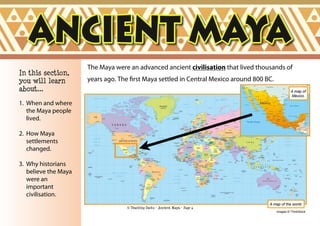
The Maya were an advanced ancient civilisation that lived thousands of
years ago. The first Maya settled in Central Mexico around 800 BC.
© Teaching Packs - Ancient Maya - Page 4
In this section,
you will learn
about...
1. When and where
the Maya people
lived.
2. How Maya
settlements
changed.
3. Why historians
believe the Maya
were an
important
civilisation.
A map of the world.
Images © ThinkStock
A map of
Mexico.
© Teaching Packs - Ancient Maya - Page 9
Palaces and temples
At the heart of each city usually stood
palaces and temples. These buildings were
built on raised ground so that they towered
above the surrounding city. Buildings were
carefully planned by skilled architects and
built out of strong stone by labourers. Only
the most important people in the city lived
in this area.
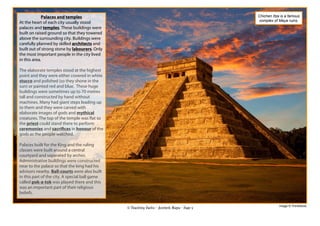
The elaborate temples stood at the highest
point and they were either covered in white
stucco and polished (so they shone in the
sun) or painted red and blue. These huge
buildings were sometimes up to 70 metres
tall and constructed by hand without
machines. Many had giant steps leading up
to them and they were carved with
elaborate images of gods and mythical
creatures. The top of the temple was flat so
the priest could stand there to perform
ceremonies and sacrifices in honour of the
gods as the people watched.
Palaces built for the King and the ruling
classes were built around a central
courtyard and separated by arches.
Administrative buildings were constructed
near to the palace so that the king had his
advisors nearby. Ball-courts were also built
in this part of the city. A special ball game
called pok-a-tok was played there and this
was an important part of their religious
beliefs.
Image © ThinkStock
Chichen Itza is a famous
complex of Maya ruins.
© Teaching Packs - Ancient Maya - Page 15
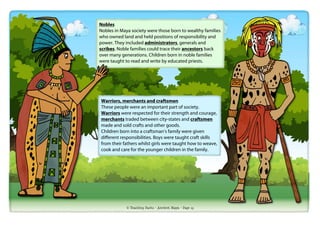
Nobles
Nobles in Maya society were those born to wealthy families
who owned land and held positions of responsibility and
power. They included administrators, generals and
scribes. Noble families could trace their ancestors back
over many generations. Children born in noble families
were taught to read and write by educated priests.
Warriors, merchants and craftsmen
These people were an important part of society.
Warriors were respected for their strength and courage,
merchants traded between city-states and craftsmen
made and sold crafts and other goods.
Children born into a craftsman’s family were given
different responsibilities. Boys were taught craft skills
from their fathers whilst girls were taught how to weave,
cook and care for the younger children in the family.
© Teaching Packs - Ancient Maya - Page 23
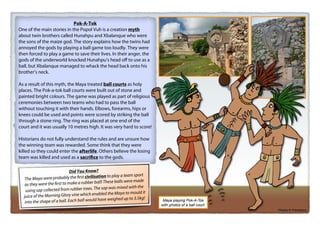
Pok-A-Tok
One of the main stories in the Popol Vuh is a creation myth
about twin brothers called Hunahpu and Xbalanque who were
the sons of the maize god. The story explains how the twins had
annoyed the gods by playing a ball game too loudly. They were
then forced to play a game to save their lives. In their anger, the
gods of the underworld knocked Hunahpu’s head off to use as a
ball, but Xbalanque managed to whack the head back onto his
brother’s neck.
As a result of this myth, the Maya treated ball courts as holy
places. The Pok-a-tok ball courts were built out of stone and
painted bright colours. The game was played as part of religious
ceremonies between two teams who had to pass the ball
without touching it with their hands. Elbows, forearms, hips or
knees could be used and points were scored by striking the ball
through a stone ring. The ring was placed at one end of the
court and it was usually 10 metres high. It was very hard to score!
Historians do not fully understand the rules and are unsure how
the winning team was rewarded. Some think that they were
killed so they could enter the afterlife. Others believe the losing
team was killed and used as a sacrifice to the gods.
Did You Know?
The Maya were probably the first civilisation to play a team sport
as they were the first to make a rubber ball! These balls were made
using sap collected from rubber trees. The sap was mixed with the
juice of the Morning Glory vine which enabled the Maya to mould it
into the shape of a ball. Each ball would have weighed up to 3.5kg!
Photos © ThinkStock
Maya playing Pok-A-Tok
with photos of a ball court.
© Teaching Packs - Ancient Maya - Page 55
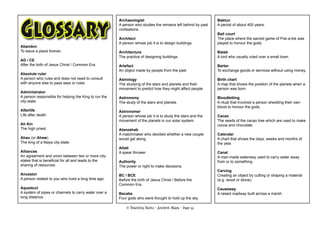
Abandon
To leave a place forever.
AD / CE
After the birth of Jesus Christ / Common Era.
Absolute ruler
A person who rules and does not need to consult
with anyone else to pass laws or rules.
Administrator
A person responsible for helping the King to run the
city-state.
Afterlife
Life after death.
Ah Kin
The high priest.
Ahau (or Ahaw)
The king of a Maya city-state.
Alliances
An agreement and union between two or more city-
states that is beneficial for all and leads to the
sharing of resources.
Ancestor
A person related to you who lived a long time ago.
Aqueduct
A system of pipes or channels to carry water over a
long distance.
Archaeologist
A person who studies the remains left behind by past
civilisations.
Architect
A person whose job it is to design buildings.
Architecture
The practice of designing buildings.
Artefact
An object made by people from the past.
Astrology
The studying of the stars and planets and their
movement to predict how they might affect people.
Astronomy
The study of the stars and planets.
Astronomer
A person whose job it is to study the stars and the
movement of the planets in our solar system.
Atanzahab
A matchmaker who decided whether a new couple
would get along.
Atlatl
A spear thrower.
Authority
The power or right to make decisions.
BC / BCE
Before the birth of Jesus Christ / Before the
Common Era.
Bacabs
Four gods who were thought to hold up the sky.
Baktun
A period of about 400 years.
Ball court
The place where the sacred game of Pok-a-tok was
played to honour the gods.
Batab
A lord who usually ruled over a small town.
Barter
To exchange goods or services without using money.
Birth chart
A map that shows the position of the planets when a
person was born.
Bloodletting
A ritual that involved a person shedding their own
blood to honour the gods.
Cacao
The seeds of the cacao tree which are used to make
cocoa and chocolate.
Calendar
A chart that shows the days, weeks and months of
the year.
Canal
A man-made waterway used to carry water away
from or to something.
Carving
Creating an object by cutting or shaping a material
(e.g. wood or stone).
Causeway
A raised roadway built across a marsh.


www.teachingpacks.co.uk
Images: © ThinkStock
©
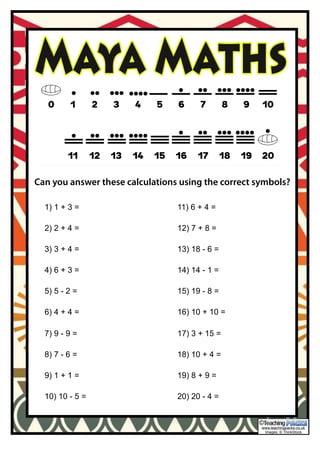
Can you answer these calculations using the correct symbols?
1) 1 + 3 = 11) 6 + 4 =
2) 2 + 4 = 12) 7 + 8 =
3) 3 + 4 = 13) 18 - 6 =
4) 6 + 3 = 14) 14 - 1 =
5) 5 - 2 = 15) 19 - 8 =
6) 4 + 4 = 16) 10 + 10 =
7) 9 - 9 = 17) 3 + 15 =
8) 7 - 6 = 18) 10 + 4 =
9) 1 + 1 = 19) 8 + 9 =
10) 10 - 5 = 20) 20 - 4 =
www.teachingpacks.co.uk
©
www.teachingpacks.co.uk
Images: © ThinkStock
©
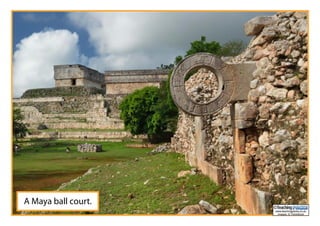
A Maya ball court.
www.teachingpacks.co.uk
Images: © ThinkStock
©
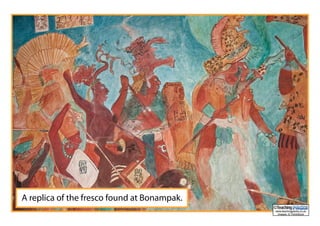
A replica of the fresco found at Bonampak.
Untitled Puzzle
Header Info 1
Header Info 2
etc...
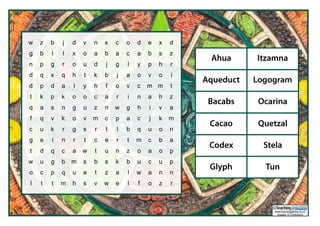
w z b j d v n x c o d e x d
g b l l x o a b a c a b s z
n p g r o u d j g l y p h r
d q x q h t k b j a o v o i
d p d a l y h f o v c m m t
t k p k o o c a r i n a h z
q a s n g u z n w g h i v a
f q v k o v m c p a c j k m
c u k r g s r t l b q u o n
g e i n r t c e r t m c b a
t d q c a w t u n z o a o p
w u g b m s b s k b u c u p
o c p q u e t z a l w a n n
l t t m h s v w e l f o z r
ahua aqueduct bacabs cacao codex glyph itzamna logogram ocarina
quetzal stela tun www.teachingpacks.co.uk
Images: © ThinkStock
©
Ahua Itzamna
Aqueduct Logogram
Bacabs Ocarina
Cacao Quetzal
Codex Stela
Glyph Tun
Thank you for looking at
our preview resources.
We hope that they are useful to you.
Join us today to download
thousands of resources from
our popular Teaching Packs!
Mark and Helen
www.teachingpacks.co.uk

The Ancient Maya Pack

  • 1.
    © Teaching Packs- Ancient Maya - Page 1 By Helen and Mark Warner
  • 2.
    The Maya werean advanced ancient civilisation that lived thousands of years ago. The first Maya settled in Central Mexico around 800 BC. © Teaching Packs - Ancient Maya - Page 4 In this section, you will learn about... 1. When and where the Maya people lived. 2. How Maya settlements changed. 3. Why historians believe the Maya were an important civilisation. A map of the world. Images © ThinkStock A map of Mexico.
  • 3.
    © Teaching Packs- Ancient Maya - Page 9 Palaces and temples At the heart of each city usually stood palaces and temples. These buildings were built on raised ground so that they towered above the surrounding city. Buildings were carefully planned by skilled architects and built out of strong stone by labourers. Only the most important people in the city lived in this area. The elaborate temples stood at the highest point and they were either covered in white stucco and polished (so they shone in the sun) or painted red and blue. These huge buildings were sometimes up to 70 metres tall and constructed by hand without machines. Many had giant steps leading up to them and they were carved with elaborate images of gods and mythical creatures. The top of the temple was flat so the priest could stand there to perform ceremonies and sacrifices in honour of the gods as the people watched. Palaces built for the King and the ruling classes were built around a central courtyard and separated by arches. Administrative buildings were constructed near to the palace so that the king had his advisors nearby. Ball-courts were also built in this part of the city. A special ball game called pok-a-tok was played there and this was an important part of their religious beliefs. Image © ThinkStock Chichen Itza is a famous complex of Maya ruins.
  • 4.
    © Teaching Packs- Ancient Maya - Page 15 Nobles Nobles in Maya society were those born to wealthy families who owned land and held positions of responsibility and power. They included administrators, generals and scribes. Noble families could trace their ancestors back over many generations. Children born in noble families were taught to read and write by educated priests. Warriors, merchants and craftsmen These people were an important part of society. Warriors were respected for their strength and courage, merchants traded between city-states and craftsmen made and sold crafts and other goods. Children born into a craftsman’s family were given different responsibilities. Boys were taught craft skills from their fathers whilst girls were taught how to weave, cook and care for the younger children in the family.
  • 5.
    © Teaching Packs- Ancient Maya - Page 23 Pok-A-Tok One of the main stories in the Popol Vuh is a creation myth about twin brothers called Hunahpu and Xbalanque who were the sons of the maize god. The story explains how the twins had annoyed the gods by playing a ball game too loudly. They were then forced to play a game to save their lives. In their anger, the gods of the underworld knocked Hunahpu’s head off to use as a ball, but Xbalanque managed to whack the head back onto his brother’s neck. As a result of this myth, the Maya treated ball courts as holy places. The Pok-a-tok ball courts were built out of stone and painted bright colours. The game was played as part of religious ceremonies between two teams who had to pass the ball without touching it with their hands. Elbows, forearms, hips or knees could be used and points were scored by striking the ball through a stone ring. The ring was placed at one end of the court and it was usually 10 metres high. It was very hard to score! Historians do not fully understand the rules and are unsure how the winning team was rewarded. Some think that they were killed so they could enter the afterlife. Others believe the losing team was killed and used as a sacrifice to the gods. Did You Know? The Maya were probably the first civilisation to play a team sport as they were the first to make a rubber ball! These balls were made using sap collected from rubber trees. The sap was mixed with the juice of the Morning Glory vine which enabled the Maya to mould it into the shape of a ball. Each ball would have weighed up to 3.5kg! Photos © ThinkStock Maya playing Pok-A-Tok with photos of a ball court.
  • 6.
    © Teaching Packs- Ancient Maya - Page 55 Abandon To leave a place forever. AD / CE After the birth of Jesus Christ / Common Era. Absolute ruler A person who rules and does not need to consult with anyone else to pass laws or rules. Administrator A person responsible for helping the King to run the city-state. Afterlife Life after death. Ah Kin The high priest. Ahau (or Ahaw) The king of a Maya city-state. Alliances An agreement and union between two or more city- states that is beneficial for all and leads to the sharing of resources. Ancestor A person related to you who lived a long time ago. Aqueduct A system of pipes or channels to carry water over a long distance. Archaeologist A person who studies the remains left behind by past civilisations. Architect A person whose job it is to design buildings. Architecture The practice of designing buildings. Artefact An object made by people from the past. Astrology The studying of the stars and planets and their movement to predict how they might affect people. Astronomy The study of the stars and planets. Astronomer A person whose job it is to study the stars and the movement of the planets in our solar system. Atanzahab A matchmaker who decided whether a new couple would get along. Atlatl A spear thrower. Authority The power or right to make decisions. BC / BCE Before the birth of Jesus Christ / Before the Common Era. Bacabs Four gods who were thought to hold up the sky. Baktun A period of about 400 years. Ball court The place where the sacred game of Pok-a-tok was played to honour the gods. Batab A lord who usually ruled over a small town. Barter To exchange goods or services without using money. Birth chart A map that shows the position of the planets when a person was born. Bloodletting A ritual that involved a person shedding their own blood to honour the gods. Cacao The seeds of the cacao tree which are used to make cocoa and chocolate. Calendar A chart that shows the days, weeks and months of the year. Canal A man-made waterway used to carry water away from or to something. Carving Creating an object by cutting or shaping a material (e.g. wood or stone). Causeway A raised roadway built across a marsh.
  • 7.
    
 www.teachingpacks.co.uk Images: © ThinkStock © Canyou answer these calculations using the correct symbols? 1) 1 + 3 = 11) 6 + 4 = 2) 2 + 4 = 12) 7 + 8 = 3) 3 + 4 = 13) 18 - 6 = 4) 6 + 3 = 14) 14 - 1 = 5) 5 - 2 = 15) 19 - 8 = 6) 4 + 4 = 16) 10 + 10 = 7) 9 - 9 = 17) 3 + 15 = 8) 7 - 6 = 18) 10 + 4 = 9) 1 + 1 = 19) 8 + 9 = 10) 10 - 5 = 20) 20 - 4 =
  • 8.
  • 9.
  • 10.
    www.teachingpacks.co.uk Images: © ThinkStock © Areplica of the fresco found at Bonampak.
  • 11.
    Untitled Puzzle Header Info1 Header Info 2 etc... w z b j d v n x c o d e x d g b l l x o a b a c a b s z n p g r o u d j g l y p h r d q x q h t k b j a o v o i d p d a l y h f o v c m m t t k p k o o c a r i n a h z q a s n g u z n w g h i v a f q v k o v m c p a c j k m c u k r g s r t l b q u o n g e i n r t c e r t m c b a t d q c a w t u n z o a o p w u g b m s b s k b u c u p o c p q u e t z a l w a n n l t t m h s v w e l f o z r ahua aqueduct bacabs cacao codex glyph itzamna logogram ocarina quetzal stela tun www.teachingpacks.co.uk Images: © ThinkStock © Ahua Itzamna Aqueduct Logogram Bacabs Ocarina Cacao Quetzal Codex Stela Glyph Tun
  • 12.
    Thank you forlooking at our preview resources. We hope that they are useful to you. Join us today to download thousands of resources from our popular Teaching Packs! Mark and Helen www.teachingpacks.co.uk