Wet services


Water supply and drainage
Fundamental source of modern standards of public health


• Water supply:
  – Public mains
  – Private boreholes
  – Private reservoirs
• Drainage:
  – Domestic drainage
  – Public sewerage and waste
    treatment
  – Private sewage treatment
Sources of water


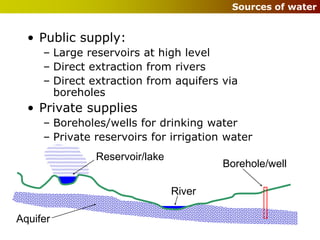
  • Public supply:
     – Large reservoirs at high level
     – Direct extraction from rivers
     – Direct extraction from aquifers via
       boreholes
  • Private supplies
     – Boreholes/wells for drinking water
     – Private reservoirs for irrigation water
               Reservoir/lake
                                        Borehole/well

                                River

Aquifer
Water distribution


• Water moved from source to outlet
  by gravity when ever possible.
• Water moved from primary source
  to local reservoir/water tower
  storage for local distribution
• Water treated by filtration,
  aeration and chlorination.
  Fluoridation controversial, but
  proved to aid tooth health.
Local water distribution


  • Groups of buildings supplied from
    a local reservoir or water tower
  • Pipes under ground for mechanical
    and frost protection
  • Pipes laid in a grid linked to more
    than one supply to aid continuity
    of supply                     Local tower
               Local reservoir


Main supply
Water supply information


• Water supply pipes
  are now made of
  high density
  polythene and are
  buried at least
  0.75m below ground
  for protection
• Older pipe work is
  steel, iron and lead.
  Its replacement is a
  major industrial cost
• Up to 25% of water
  is lost through
  supply pipe leakage
Hard and soft water


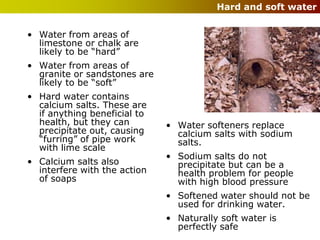
• Water from areas of
  limestone or chalk are
  likely to be “hard”
• Water from areas of
  granite or sandstones are
  likely to be “soft”
• Hard water contains
  calcium salts. These are
  if anything beneficial to
  health, but they can        • Water softeners replace
  precipitate out, causing      calcium salts with sodium
  “furring” of pipe work        salts.
  with lime scale
                              • Sodium salts do not
• Calcium salts also            precipitate but can be a
  interfere with the action     health problem for people
  of soaps                      with high blood pressure
                              • Softened water should not be
                                used for drinking water.
                              • Naturally soft water is
                                perfectly safe
Domestic water supply 1: entry of water supply
Domestic water supply 2: rising cold water main

Overflow to                            Cold water storage
noticeable                             tank. Float valve stops
location                               over filling


          “Rising main”
          inside the
          building for frost
          protection                          Position of
                                              water softener
                                              (if fitted)
               Direct feed to                          Water
               kitchen for                             company
               drinking                                stop tap
Internal water pipework


• Internal water supply pipes
  generally made of copper
  – Corrosion resistance
  – Ease of jointing
• Pipes and fittings like taps can be
  joined by
  – screw compression fittings, strong
    but expensive
  – Soldered fittings, much quicker and
    quite adequate if well made
Compression joints and soldered joints
Domestic water supply 3: cold water distribution


                                   Stored cold
                                   water supply
                                   pipe

                                   Feeds to
                                   upstairs
                                   sanitary units

Feed to                            Feeds to
bottom of hot                      downstairs
water storage                      sanitary units,
tank                               but not to
                                   kitchen sink
Domestic water supply 3: cold water distribution

Cold tank is kept
on warm side of
roof insulation
                                         Stored cold
                                         water supply
                                         pipe

                                         Feeds to
                                         upstairs
                                         sanitary units

     Feed to                             Feeds to
     bottom of hot                       downstairs
     water storage                       sanitary units,
     tank                                but not to
                                         kitchen sink
Hot water distribution

                             Safety expansion
Hot water out at             pipe rises above
the top of the hot           tank
water tank

 Hot water to        Cold water in at
 first floor         the bottom of the
                     hot water tank


   Hot water
   to ground
   floor
Hot water distribution

                             Safety expansion
Hot water out at             pipe rises above
the top of the hot           tank
water tank

 Hot water to        Cold water in at
 first floor         the bottom of the
                     hot water tank


                         Hot water boiler
   Hot water             heating tank water
   to ground             indirectly. Should
   floor                 be fitted with
                         safety expansion
                         valve
Hot water, cold water and central heating

Safety expansion                     Header tank to
pipes                                keep heating
                                     system full of
                                     water


                                          Pumps to force
                                          heating water
                                          around the system


                                          Rotary valve
                                          directs water from
                                          boiler to radiators
Final points on water supply


• All fittings should have their own
  isolation valves so they can be
  removed without draining the
  system
• All pipework should be ventilated
  to a high point for safety
• There must be a drain point at all
  low points in the system
• All pipework must be protected
  from freezing

Wet services water

  • 1.
  • 2.
    Fundamental source ofmodern standards of public health • Water supply: – Public mains – Private boreholes – Private reservoirs • Drainage: – Domestic drainage – Public sewerage and waste treatment – Private sewage treatment
  • 3.
    Sources of water • Public supply: – Large reservoirs at high level – Direct extraction from rivers – Direct extraction from aquifers via boreholes • Private supplies – Boreholes/wells for drinking water – Private reservoirs for irrigation water Reservoir/lake Borehole/well River Aquifer
  • 4.
    Water distribution • Watermoved from source to outlet by gravity when ever possible. • Water moved from primary source to local reservoir/water tower storage for local distribution • Water treated by filtration, aeration and chlorination. Fluoridation controversial, but proved to aid tooth health.
  • 5.
    Local water distribution • Groups of buildings supplied from a local reservoir or water tower • Pipes under ground for mechanical and frost protection • Pipes laid in a grid linked to more than one supply to aid continuity of supply Local tower Local reservoir Main supply
  • 6.
    Water supply information •Water supply pipes are now made of high density polythene and are buried at least 0.75m below ground for protection • Older pipe work is steel, iron and lead. Its replacement is a major industrial cost • Up to 25% of water is lost through supply pipe leakage
  • 7.
    Hard and softwater • Water from areas of limestone or chalk are likely to be “hard” • Water from areas of granite or sandstones are likely to be “soft” • Hard water contains calcium salts. These are if anything beneficial to health, but they can • Water softeners replace precipitate out, causing calcium salts with sodium “furring” of pipe work salts. with lime scale • Sodium salts do not • Calcium salts also precipitate but can be a interfere with the action health problem for people of soaps with high blood pressure • Softened water should not be used for drinking water. • Naturally soft water is perfectly safe
  • 8.
    Domestic water supply1: entry of water supply
  • 9.
    Domestic water supply2: rising cold water main Overflow to Cold water storage noticeable tank. Float valve stops location over filling “Rising main” inside the building for frost protection Position of water softener (if fitted) Direct feed to Water kitchen for company drinking stop tap
  • 10.
    Internal water pipework •Internal water supply pipes generally made of copper – Corrosion resistance – Ease of jointing • Pipes and fittings like taps can be joined by – screw compression fittings, strong but expensive – Soldered fittings, much quicker and quite adequate if well made
  • 11.
    Compression joints andsoldered joints
  • 12.
    Domestic water supply3: cold water distribution Stored cold water supply pipe Feeds to upstairs sanitary units Feed to Feeds to bottom of hot downstairs water storage sanitary units, tank but not to kitchen sink
  • 13.
    Domestic water supply3: cold water distribution Cold tank is kept on warm side of roof insulation Stored cold water supply pipe Feeds to upstairs sanitary units Feed to Feeds to bottom of hot downstairs water storage sanitary units, tank but not to kitchen sink
  • 14.
    Hot water distribution Safety expansion Hot water out at pipe rises above the top of the hot tank water tank Hot water to Cold water in at first floor the bottom of the hot water tank Hot water to ground floor
  • 15.
    Hot water distribution Safety expansion Hot water out at pipe rises above the top of the hot tank water tank Hot water to Cold water in at first floor the bottom of the hot water tank Hot water boiler Hot water heating tank water to ground indirectly. Should floor be fitted with safety expansion valve
  • 16.
    Hot water, coldwater and central heating Safety expansion Header tank to pipes keep heating system full of water Pumps to force heating water around the system Rotary valve directs water from boiler to radiators
  • 17.
    Final points onwater supply • All fittings should have their own isolation valves so they can be removed without draining the system • All pipework should be ventilated to a high point for safety • There must be a drain point at all low points in the system • All pipework must be protected from freezing