Building Drainage System
& Traps
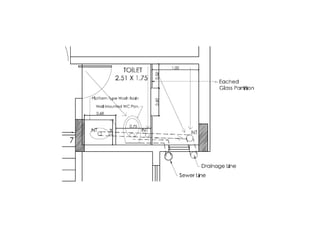
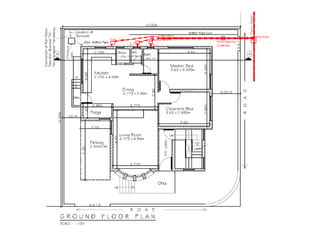
 All Sanitary fixtures generates waste water. The system
of pipes which is laid and connected to the sanitary
fixtures and discharge is taken to the public sewer by
gravity is called as a building drainage system.
General Principles for the design of building drainage
 For easy maintenance pipes should be laid along the
walls or accommodate in the shaft.
 Drains should be laid straight - All sharp bends and
junctions which tends to become dead ends should be
avoided - except through manhole.
 The entire system should be properly ventilated from the
start to end.
 Outfall of the house sewer should be higher than the
water level in the public sewer to avoid backflow
 Enough traps should be provided at suitable points for
efficient functioning and avoid evolution of fouls smell.
 Intercepting/Disconnecting trap should be provided
before connecting to the public sewer so as not to allow
foul gases from the public sewer.
 Lateral sewer should be laid at sufficient slopes for self
cleaning
1:40 for 100mm,
1:60 for 150mm,
1:75 for 200mm
& 1:100 for 250mm Diameter pipes.
 Plumbing system should permit easy cleaning as far as
possible
 High Quality Sewer pipes should be used in the system.
 Formation of air locks, Siphonage, undue deposits
should be properly studied and avoided.
Traps in Sanitary Appliances
 A Trap is a fitting, device or a part of sanitary appliance,
which is design to hold some quantity of water. This
water is called as trap seal acts as a barrier to prevent
back flow of flow of air (foul gases), odours, and vermin
from the waste pipe into the room.
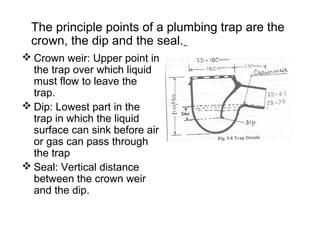
The principle points of a plumbing trap are the
crown, the dip and the seal.
 Crown weir: Upper point in
the trap over which liquid
must flow to leave the
trap.
 Dip: Lowest part in the
trap in which the liquid
surface can sink before air
or gas can pass through
the trap
 Seal: Vertical distance
between the crown weir
and the dip.
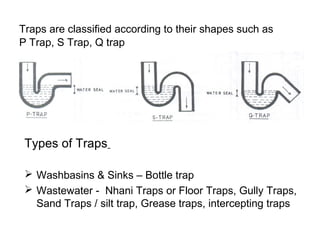
Traps are classified according to their shapes such as
P Trap, S Trap, Q trap
Types of Traps
 Washbasins & Sinks – Bottle trap
 Wastewater - Nhani Traps or Floor Traps, Gully Traps,
Sand Traps / silt trap, Grease traps, intercepting traps
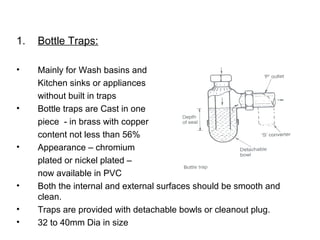
1. Bottle Traps:
• Mainly for Wash basins and
Kitchen sinks or appliances
without built in traps
• Bottle traps are Cast in one
piece - in brass with copper
content not less than 56%
• Appearance – chromium
plated or nickel plated –
now available in PVC
• Both the internal and external surfaces should be smooth and
clean.
• Traps are provided with detachable bowls or cleanout plug.
• 32 to 40mm Dia in size
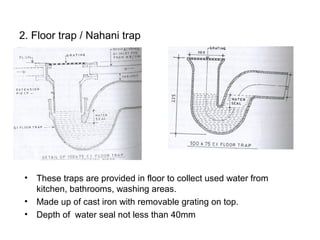
2. Floor trap / Nahani trap
• These traps are provided in floor to collect used water from
kitchen, bathrooms, washing areas.
• Made up of cast iron with removable grating on top.
• Depth of water seal not less than 40mm
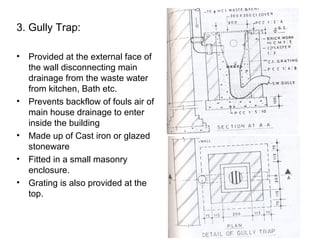
3. Gully Trap:
• Provided at the external face of
the wall disconnecting main
drainage from the waste water
from kitchen, Bath etc.
• Prevents backflow of fouls air of
main house drainage to enter
inside the building
• Made up of Cast iron or glazed
stoneware
• Fitted in a small masonry
enclosure.
• Grating is also provided at the
top.
4. Intercepting /
Disconnecting Trap
• This trap is provided at the
junction of the house drain and
street (public) sewer.
• This trap is provided to
disconnect house drain from
the public sewer.
• Made up of glazed stoneware
and has an opening at top
called Rodding Arm or
Cleaning Eye.
• This Cleaning eye is closed
with tight fitting plug – opened
only in case of cleaning of the
trap.
• Has a deeper seal than normal
(less than 100mm)
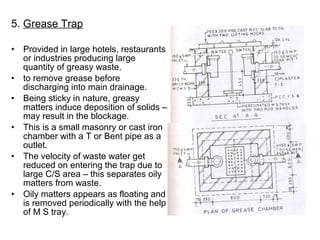
5. Grease Trap
• Provided in large hotels, restaurants
or industries producing large
quantity of greasy waste.
• to remove grease before
discharging into main drainage.
• Being sticky in nature, greasy
matters induce deposition of solids –
may result in the blockage.
• This is a small masonry or cast iron
chamber with a T or Bent pipe as a
outlet.
• The velocity of waste water get
reduced on entering the trap due to
large C/S area – this separates oily
matters from waste.
• Oily matters appears as floating and
is removed periodically with the help
of M S tray.
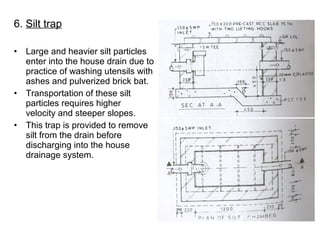
6. Silt trap
• Large and heavier silt particles
enter into the house drain due to
practice of washing utensils with
ashes and pulverized brick bat.
• Transportation of these silt
particles requires higher
velocity and steeper slopes.
• This trap is provided to remove
silt from the drain before
discharging into the house
drainage system.
REQUIREMENT OR IDEAL TRAP
 Allow wastewater to pass freely without mechanical aid
 Prevent passage or backflow of foul air.
 Must be self Cleansing
 Must have seal of min 50mm
 Leak-proof for gases as well as liquid.
 Free from any internal projections
 Where ever necessary it must be back vented.
 Provide with the suitable means of access for cleaning
purpose.
Causes of loss of breaking of water seal
 Evaporation of water due to non use for long time
 Crakes in Trap due to faulty installation
 Creation of partial Vacuum caused due to discharge of
another fitting – siphonage action.
 Build up of back pressure of sewer gas in the drain
 Pressure on seal due to sudden discharge of water in
large quantity – self siphonage
 Due to capillary action caused by the piece of some
porous material getting struck at the outlet of the trap.

Building drainage system

  • 1.
  • 2.
     All Sanitaryfixtures generates waste water. The system of pipes which is laid and connected to the sanitary fixtures and discharge is taken to the public sewer by gravity is called as a building drainage system.
  • 5.
    General Principles forthe design of building drainage  For easy maintenance pipes should be laid along the walls or accommodate in the shaft.  Drains should be laid straight - All sharp bends and junctions which tends to become dead ends should be avoided - except through manhole.  The entire system should be properly ventilated from the start to end.  Outfall of the house sewer should be higher than the water level in the public sewer to avoid backflow  Enough traps should be provided at suitable points for efficient functioning and avoid evolution of fouls smell.  Intercepting/Disconnecting trap should be provided before connecting to the public sewer so as not to allow foul gases from the public sewer.
  • 6.
     Lateral sewershould be laid at sufficient slopes for self cleaning 1:40 for 100mm, 1:60 for 150mm, 1:75 for 200mm & 1:100 for 250mm Diameter pipes.  Plumbing system should permit easy cleaning as far as possible  High Quality Sewer pipes should be used in the system.  Formation of air locks, Siphonage, undue deposits should be properly studied and avoided.
  • 7.
    Traps in SanitaryAppliances  A Trap is a fitting, device or a part of sanitary appliance, which is design to hold some quantity of water. This water is called as trap seal acts as a barrier to prevent back flow of flow of air (foul gases), odours, and vermin from the waste pipe into the room.
  • 8.
    The principle pointsof a plumbing trap are the crown, the dip and the seal.  Crown weir: Upper point in the trap over which liquid must flow to leave the trap.  Dip: Lowest part in the trap in which the liquid surface can sink before air or gas can pass through the trap  Seal: Vertical distance between the crown weir and the dip.
  • 9.
    Traps are classifiedaccording to their shapes such as P Trap, S Trap, Q trap Types of Traps  Washbasins & Sinks – Bottle trap  Wastewater - Nhani Traps or Floor Traps, Gully Traps, Sand Traps / silt trap, Grease traps, intercepting traps
  • 10.
    1. Bottle Traps: •Mainly for Wash basins and Kitchen sinks or appliances without built in traps • Bottle traps are Cast in one piece - in brass with copper content not less than 56% • Appearance – chromium plated or nickel plated – now available in PVC • Both the internal and external surfaces should be smooth and clean. • Traps are provided with detachable bowls or cleanout plug. • 32 to 40mm Dia in size
  • 11.
    2. Floor trap/ Nahani trap • These traps are provided in floor to collect used water from kitchen, bathrooms, washing areas. • Made up of cast iron with removable grating on top. • Depth of water seal not less than 40mm
  • 12.
    3. Gully Trap: •Provided at the external face of the wall disconnecting main drainage from the waste water from kitchen, Bath etc. • Prevents backflow of fouls air of main house drainage to enter inside the building • Made up of Cast iron or glazed stoneware • Fitted in a small masonry enclosure. • Grating is also provided at the top.
  • 13.
    4. Intercepting / DisconnectingTrap • This trap is provided at the junction of the house drain and street (public) sewer. • This trap is provided to disconnect house drain from the public sewer. • Made up of glazed stoneware and has an opening at top called Rodding Arm or Cleaning Eye. • This Cleaning eye is closed with tight fitting plug – opened only in case of cleaning of the trap. • Has a deeper seal than normal (less than 100mm)
  • 14.
    5. Grease Trap •Provided in large hotels, restaurants or industries producing large quantity of greasy waste. • to remove grease before discharging into main drainage. • Being sticky in nature, greasy matters induce deposition of solids – may result in the blockage. • This is a small masonry or cast iron chamber with a T or Bent pipe as a outlet. • The velocity of waste water get reduced on entering the trap due to large C/S area – this separates oily matters from waste. • Oily matters appears as floating and is removed periodically with the help of M S tray.
  • 15.
    6. Silt trap •Large and heavier silt particles enter into the house drain due to practice of washing utensils with ashes and pulverized brick bat. • Transportation of these silt particles requires higher velocity and steeper slopes. • This trap is provided to remove silt from the drain before discharging into the house drainage system.
  • 16.
    REQUIREMENT OR IDEALTRAP  Allow wastewater to pass freely without mechanical aid  Prevent passage or backflow of foul air.  Must be self Cleansing  Must have seal of min 50mm  Leak-proof for gases as well as liquid.  Free from any internal projections  Where ever necessary it must be back vented.  Provide with the suitable means of access for cleaning purpose.
  • 17.
    Causes of lossof breaking of water seal  Evaporation of water due to non use for long time  Crakes in Trap due to faulty installation  Creation of partial Vacuum caused due to discharge of another fitting – siphonage action.  Build up of back pressure of sewer gas in the drain  Pressure on seal due to sudden discharge of water in large quantity – self siphonage  Due to capillary action caused by the piece of some porous material getting struck at the outlet of the trap.