HOUSE PLUMBING…
SUBMITTED BY :
LOBSANG JAMPA
AR/15/1112
TRAPS:
• Foul gases produced in the sewers , drains , waste-pipes may cause
nuisance by entering In houses through house-connecting pipes ,
if there passage is not checked by some suitable devices.
• The efficiency of the traps depends on the deeper the seal more
efficient will be the trap.
• The following are the requirements of a good trap:
1. It should be made of non-absorbent material.
2. It should provided sufficient depth of water seal all times(about 50mm)
having large surface area.
3.It should be self-cleaning and should not obstruct the flow of sewage.
4.It should be provided with access door for cleaning.
THE WATER SEAL OF THE TRAP CAN BREAK UNDER
THE FOLLOWING CONDITIONS:
1. If there is any crake in the bottom of seal or the joint is faulty.
2. If for a long time the seal or the joint is faulty.
3. If due to blockage or any other reason there is increase in the pressure
of the sewer gases , it will pass through the water of seal.
4. If partial vacuum is created in the sewer fittings , it will suck up the
seal water . To avoid the breakage due to this reason,
the portion between the trap and the soil pipe should be connected
to the vent pipe.
TYPE OF TRAPS:
1. P , Q and S-types.
2. Gully – traps.
3. An intercepting traps.
4. Anti- D trap.
5. Anti- siphon trap.
1.P , Q and S-Trap:
these traps are classified according to there shape .
they essentially consist of a u-tube which
retains water acting as a seal between the
foul gas atmosphere.
2. Gully – traps :
this trap is provided at different place in the drain pipes.
Waste water from sinks, bath etc.
enters in through back inlet and unfoul water form
the sweeping of rooms, courtyards etc.
enters from he top , where a coarser screen
grating is fitted to check the matter.
3. An intercepting trap:
the sewage from every house goes in street
sewers which carry it away from the city .
the street sewers contain foul
gases in it and if there passage are not
checked from street sewer to the house.
4. Anti-D Trap:
P , Q and S trap are largely used for baths ,
sinks and lavatories. In such cases, they are
made with enlarged mouth so that waste pipe
may be thoroughly flushed out. But in this
trap full bore of trap is not interfered with
by the discharge.
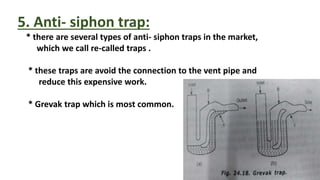
5. Anti- siphon trap:
* there are several types of anti- siphon traps in the market,
which we call re-called traps .
* these traps are avoid the connection to the vent pipe and
reduce this expensive work.
* Grevak trap which is most common.
SYSTEM OF PLAMBING :
SANITARY FITTINGS…
IN THE BUILDING THEY HAVE VARIOUS TYPE OF SANITARY FITTINGS
ARE REQUIRED TO COLLECT THE WASTE WATER.
1.ABLUTION FITTING:
A.Wash basins.
B.Sinks.
C.Bath tubes.
D.Flushing cisterns.
E.Drinking fountations.
2. SOIL FITTING:
A. Water closets.
B. urinals.
C. Slop sinks.
WASH BASIN :
the wash basins are available in various
patterns and size in market .
there are mostly two patterns:
1. Flat back for mounting on walls
size: (630*450) and (550*400)
2.Angle back for fixing at the
junction of two walls
size: (600*480) and (400*400)
SINKS:
• there are rectangular shallow receptacles suitable
for kitchen or laboratory.
* Kitchen sink which is mostly used.
Its of one piece construction, provided with or without rim.
KITCHEN SINK :
(600*450*150)mm
(600*450*250)mm
(750*450*250)mm
LABORATORY SINK :
(400*250*150)mm
(450*300*150)mm
(500*350*150)mm
(600*400*200)mm
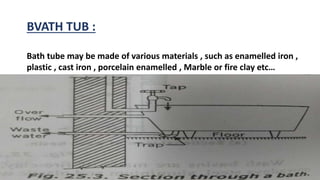
BVATH TUB :
Bath tube may be made of various materials , such as enamelled iron ,
plastic , cast iron , porcelain enamelled , Marble or fire clay etc…
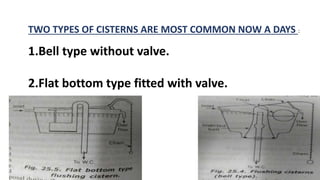
FLUSHING CISTERNS :
• These are used for flushing water closets and urinals after use .
there are several Varieties of flushing cisterns.
• high-level cisterns are interned to operate with a minimum
height of 125 cm between the top of the pan and the
underside of the cistern.
• low-level cisterns are intended to operate at a height not more
then 30 cm between the top the pan and underside of the cistern.
TWO TYPES OF CISTERNS ARE MOST COMMON NOW A DAYS :
1.Bell type without valve.
2.Flat bottom type fitted with valve.
URINALS :
S.N.o PATTERN SIZE
1 BOWL SHAPE (430*260)mm Min.
2 1. Flat back , 2. Angle back. (340*430*265)mm , *350 Min.
3 slab Slab:(450*1000)mm , (600*1000)
4 Stall Single:(1140*460*400)mm
5 Squatting plate (600*350)mm and (450*350)mm
WATER-CLOSET :
This is a sanitary appliance to receive the
human excreta directly and is connect to
soil pipe by means of a trap.
THE WATER-CLOSET ARE CLASSIFIED AS FOLLOWING :
1. SQUATTING TYPE OR INDIAN TYPE :
A. long pan pattern
( length 450,580,680 mm)
B. Orissa pattern
(length 580,630,680 mm)
C. Rural pattern (length 420 mm)
2. WASH-DOWN, PEDESTRAL OR
EUROPEAN TYPE:
AH LE KA THO……

House plumbing

  • 1.
    HOUSE PLUMBING… SUBMITTED BY: LOBSANG JAMPA AR/15/1112
  • 2.
    TRAPS: • Foul gasesproduced in the sewers , drains , waste-pipes may cause nuisance by entering In houses through house-connecting pipes , if there passage is not checked by some suitable devices. • The efficiency of the traps depends on the deeper the seal more efficient will be the trap. • The following are the requirements of a good trap: 1. It should be made of non-absorbent material. 2. It should provided sufficient depth of water seal all times(about 50mm) having large surface area. 3.It should be self-cleaning and should not obstruct the flow of sewage. 4.It should be provided with access door for cleaning.
  • 3.
    THE WATER SEALOF THE TRAP CAN BREAK UNDER THE FOLLOWING CONDITIONS: 1. If there is any crake in the bottom of seal or the joint is faulty. 2. If for a long time the seal or the joint is faulty. 3. If due to blockage or any other reason there is increase in the pressure of the sewer gases , it will pass through the water of seal. 4. If partial vacuum is created in the sewer fittings , it will suck up the seal water . To avoid the breakage due to this reason, the portion between the trap and the soil pipe should be connected to the vent pipe.
  • 4.
    TYPE OF TRAPS: 1.P , Q and S-types. 2. Gully – traps. 3. An intercepting traps. 4. Anti- D trap. 5. Anti- siphon trap.
  • 5.
    1.P , Qand S-Trap: these traps are classified according to there shape . they essentially consist of a u-tube which retains water acting as a seal between the foul gas atmosphere. 2. Gully – traps : this trap is provided at different place in the drain pipes. Waste water from sinks, bath etc. enters in through back inlet and unfoul water form the sweeping of rooms, courtyards etc. enters from he top , where a coarser screen grating is fitted to check the matter.
  • 6.
    3. An interceptingtrap: the sewage from every house goes in street sewers which carry it away from the city . the street sewers contain foul gases in it and if there passage are not checked from street sewer to the house. 4. Anti-D Trap: P , Q and S trap are largely used for baths , sinks and lavatories. In such cases, they are made with enlarged mouth so that waste pipe may be thoroughly flushed out. But in this trap full bore of trap is not interfered with by the discharge.
  • 7.
    5. Anti- siphontrap: * there are several types of anti- siphon traps in the market, which we call re-called traps . * these traps are avoid the connection to the vent pipe and reduce this expensive work. * Grevak trap which is most common.
  • 8.
  • 10.
    SANITARY FITTINGS… IN THEBUILDING THEY HAVE VARIOUS TYPE OF SANITARY FITTINGS ARE REQUIRED TO COLLECT THE WASTE WATER. 1.ABLUTION FITTING: A.Wash basins. B.Sinks. C.Bath tubes. D.Flushing cisterns. E.Drinking fountations. 2. SOIL FITTING: A. Water closets. B. urinals. C. Slop sinks.
  • 11.
    WASH BASIN : thewash basins are available in various patterns and size in market . there are mostly two patterns: 1. Flat back for mounting on walls size: (630*450) and (550*400) 2.Angle back for fixing at the junction of two walls size: (600*480) and (400*400)
  • 12.
    SINKS: • there arerectangular shallow receptacles suitable for kitchen or laboratory. * Kitchen sink which is mostly used. Its of one piece construction, provided with or without rim. KITCHEN SINK : (600*450*150)mm (600*450*250)mm (750*450*250)mm LABORATORY SINK : (400*250*150)mm (450*300*150)mm (500*350*150)mm (600*400*200)mm
  • 13.
    BVATH TUB : Bathtube may be made of various materials , such as enamelled iron , plastic , cast iron , porcelain enamelled , Marble or fire clay etc…
  • 14.
    FLUSHING CISTERNS : •These are used for flushing water closets and urinals after use . there are several Varieties of flushing cisterns. • high-level cisterns are interned to operate with a minimum height of 125 cm between the top of the pan and the underside of the cistern. • low-level cisterns are intended to operate at a height not more then 30 cm between the top the pan and underside of the cistern.
  • 15.
    TWO TYPES OFCISTERNS ARE MOST COMMON NOW A DAYS : 1.Bell type without valve. 2.Flat bottom type fitted with valve.
  • 16.
    URINALS : S.N.o PATTERNSIZE 1 BOWL SHAPE (430*260)mm Min. 2 1. Flat back , 2. Angle back. (340*430*265)mm , *350 Min. 3 slab Slab:(450*1000)mm , (600*1000) 4 Stall Single:(1140*460*400)mm 5 Squatting plate (600*350)mm and (450*350)mm
  • 17.
    WATER-CLOSET : This isa sanitary appliance to receive the human excreta directly and is connect to soil pipe by means of a trap. THE WATER-CLOSET ARE CLASSIFIED AS FOLLOWING : 1. SQUATTING TYPE OR INDIAN TYPE : A. long pan pattern ( length 450,580,680 mm) B. Orissa pattern (length 580,630,680 mm) C. Rural pattern (length 420 mm) 2. WASH-DOWN, PEDESTRAL OR EUROPEAN TYPE:
  • 19.
    AH LE KATHO……