National Consultation on Strengthening
Climate Resilience (SCR) Initiative
A “Climate Smart Approach to Disaster Risk Management”


                   May 18-19, 2010

     SEAMEO INNOTECH, Quezon City, Philippines
Overview of the Strengthening
Climate Resilience (SCR) Initiative
                   (    )
A “Climate Smart Approach to Disaster Risk Management”


Presented by
Atiq Kainan Ahmed
 tq a a          ed
Regional Climate and Disaster Resilience Specialist
Plan International (Asia Regional Office), Thailand
Email: atiq.ahmed@plan-international.org

National Consultation – Philippines May 18 – 19 2010.
         C                   pp       y 8     9 0 0
Strengthening Climate Resilience: A new initiative

•   Strengthening Climate Resilience (SCR) is a two year DFID funded programme
    that began in October 2009.

•   The programme is led by a consortium which includes the Institute of
    Development Studies (lead agency), Christian Aid and Plan International.

•   Initially, the Strengthening Climate Resilience programme is focusing on 10
    countries across 3 regions:

      South-East Asia: Cambodia, Indonesia, Philippines (led by Plan International)

      East Africa: Kenya, Tanzania, Sudan (led by Christian Aid)

      South Asia: Bangladesh, India, Nepal, Sri Lanka (led by Christian Aid)
Generic Goal

•   To enhance the ability of governments and civil societies to reduce disaster
    losses by strengthening the resilience to current and future disaster risks
    and climatic changes.

•   To enable the DRM community to become more effective by integrating
    existing approaches including climate change adaptation and development
    approaches.

•   To facilitate the achievement of the two above goals through the
    development, field-testing and promotion of a “climate-smart approach to
    disaster risk management”.
“Climate smart approach to DRM”

•   A “climate smart approach to DRM” involves the integration of three
               p
    main components:
      - Tackling exposure to changing hazards and disaster impacts (i.e. DRR).
     - Enhancing adaptive capacity (i.e. CCA)
     - Addressing poverty, vulnerability and their causes (i.e. Dev).


•   Based on an analysis of existing empirical cases and literature
    associated with disasters and development approaches, a framework
    is under development which outlines a “climate smart approach to
                                            climate
    DRM”. This framework integrates these three components.

•   Over the next two years time this framework/approach will be refined
    through an iterative process of field testing, feedback through
    consultations and in-depth research.
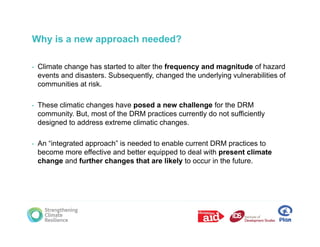
Why is a new approach needed?

•   Climate change has started to alter the frequency and magnitude of hazard
    events and disasters. Subsequently, changed the underlying vulnerabilities of
               disasters Subsequently
    communities at risk.

•   These climatic changes have posed a new challenge for the DRM
                       g         p                    g
    community. But, most of the DRM practices currently do not sufficiently
    designed to address extreme climatic changes.

•   An “integrated approach” is needed to enable current DRM practices to
    become more effective and better equipped to deal with present climate
    change and further changes that are likely to occur in the future.
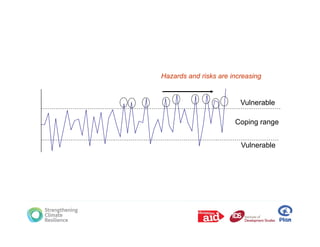
Hazards and risks are increasing


                         Vulnerable

                       Coping range


                         Vulnerable
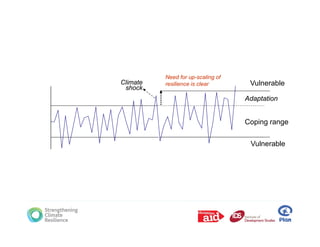
Need for up scaling of
                    up-scaling
Climate   resilience is clear       Vulnerable
 shock
                                   Adaptation


                                   Coping range


                                    Vulnerable
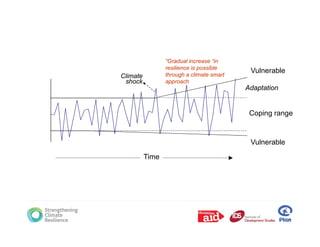
“Gradual increase “in
                 resilience is possible
                 through a climate smart
                       g
                                            Vulnerable
Climate
 shock           approach
                                           Adaptation


                                            Coping range


                                            Vulnerable

          Time
Integration to build resilience

•   The Strengthening Climate Resilience (SCR) programme seeks to
    increase the resilience of communities to disasters climate change and
                                               disasters,
    the broader causes of poverty and vulnerability.

•   As a starting p
                g point, it aims to do this by improving the q
                        ,                    y p       g     quality, relevance
                                                                   y,
    and suitability of approaches adopted by the DRM community.

•   Interventions that consider disasters, development and climate change
    dimensions together are expected to enhance the resilience of
    communities.
“Act Now” to tackle future changes!

   In order to be effective, the current practices of DRM
    cannot continue without incorporating “futuristic
            perspectives of changing climate”.


         A “climate smart approach to DRM” is
                             pp
                    critically needed
to address the challenges of disasters in a changing and
                     uncertain climate.
Key outputs of SCR in year-one

•   A framework outlining “climate smart approach to DRM” will be developed,
    field tested and operationalised to inform the development of programmes,
    projects and policies across the 3 regions.

•   A body of evidence exploring the concept of “climate smart” will be
    developed based on existing literature, expert knowledge and selected
    empirical case studies.

•   A set of summary case studies will be researched exploring the relevance,
    use and added value of a ‘climate smart approach to disaster risk
    management’ from each of our 10 focus countries.

•   In-depth case studies drawing on rigorous methodological and analytical
    techniques based on literature reviews and field research will be conducted.

•   A set of national and regional consultations will be held, bringing together
            f
    different communities of practice to explore experiences and share ideas on
    how best to achieve a “climate smart approach to DRM”’.
Why should you be interested in SCR?

You can become an active part of:

•   the iterative process of developing the “climate smart approach to DRM”
    e.g. by participating in consultations, or recommending policies or projects as
    case studies for further research.

•   the development of an evidence base of “climate smart DRM” approaches
    that can inform (to improve) the way people design, implement and monitor
    future works.

•   The consultations that will provide a space for learning and exchange of
    ideas between different communities of practice e.g. between the disasters
    and adaptation communities, and between practitioners policy makers and
                   communities                 practitioners, policy-makers
    academics.
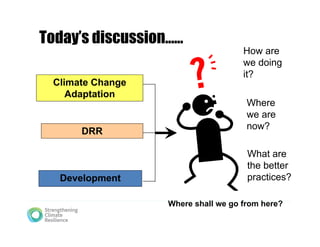
Today’s discussion......
                                       How are
                                       we doing
                                       it?
  Climate Change
     Adaptation
                                        Where
                                        we are
                                        now?
       DRR

                                        What are
                                        the better
   Development                          practices?

                     Where shall we go from here?
                     Wh     h ll       f    h   ?
Thanks!

Philippines- strengthening climate resilience

  • 1.
    National Consultation onStrengthening Climate Resilience (SCR) Initiative A “Climate Smart Approach to Disaster Risk Management” May 18-19, 2010 SEAMEO INNOTECH, Quezon City, Philippines
  • 2.
    Overview of theStrengthening Climate Resilience (SCR) Initiative ( ) A “Climate Smart Approach to Disaster Risk Management” Presented by Atiq Kainan Ahmed tq a a ed Regional Climate and Disaster Resilience Specialist Plan International (Asia Regional Office), Thailand Email: atiq.ahmed@plan-international.org National Consultation – Philippines May 18 – 19 2010. C pp y 8 9 0 0
  • 3.
    Strengthening Climate Resilience:A new initiative • Strengthening Climate Resilience (SCR) is a two year DFID funded programme that began in October 2009. • The programme is led by a consortium which includes the Institute of Development Studies (lead agency), Christian Aid and Plan International. • Initially, the Strengthening Climate Resilience programme is focusing on 10 countries across 3 regions: South-East Asia: Cambodia, Indonesia, Philippines (led by Plan International) East Africa: Kenya, Tanzania, Sudan (led by Christian Aid) South Asia: Bangladesh, India, Nepal, Sri Lanka (led by Christian Aid)
  • 4.
    Generic Goal • To enhance the ability of governments and civil societies to reduce disaster losses by strengthening the resilience to current and future disaster risks and climatic changes. • To enable the DRM community to become more effective by integrating existing approaches including climate change adaptation and development approaches. • To facilitate the achievement of the two above goals through the development, field-testing and promotion of a “climate-smart approach to disaster risk management”.
  • 5.
    “Climate smart approachto DRM” • A “climate smart approach to DRM” involves the integration of three p main components: - Tackling exposure to changing hazards and disaster impacts (i.e. DRR). - Enhancing adaptive capacity (i.e. CCA) - Addressing poverty, vulnerability and their causes (i.e. Dev). • Based on an analysis of existing empirical cases and literature associated with disasters and development approaches, a framework is under development which outlines a “climate smart approach to climate DRM”. This framework integrates these three components. • Over the next two years time this framework/approach will be refined through an iterative process of field testing, feedback through consultations and in-depth research.
  • 6.
    Why is anew approach needed? • Climate change has started to alter the frequency and magnitude of hazard events and disasters. Subsequently, changed the underlying vulnerabilities of disasters Subsequently communities at risk. • These climatic changes have posed a new challenge for the DRM g p g community. But, most of the DRM practices currently do not sufficiently designed to address extreme climatic changes. • An “integrated approach” is needed to enable current DRM practices to become more effective and better equipped to deal with present climate change and further changes that are likely to occur in the future.
  • 7.
    Hazards and risksare increasing Vulnerable Coping range Vulnerable
  • 8.
    Need for upscaling of up-scaling Climate resilience is clear Vulnerable shock Adaptation Coping range Vulnerable
  • 9.
    “Gradual increase “in resilience is possible through a climate smart g Vulnerable Climate shock approach Adaptation Coping range Vulnerable Time
  • 10.
    Integration to buildresilience • The Strengthening Climate Resilience (SCR) programme seeks to increase the resilience of communities to disasters climate change and disasters, the broader causes of poverty and vulnerability. • As a starting p g point, it aims to do this by improving the q , y p g quality, relevance y, and suitability of approaches adopted by the DRM community. • Interventions that consider disasters, development and climate change dimensions together are expected to enhance the resilience of communities.
  • 11.
    “Act Now” totackle future changes! In order to be effective, the current practices of DRM cannot continue without incorporating “futuristic perspectives of changing climate”. A “climate smart approach to DRM” is pp critically needed to address the challenges of disasters in a changing and uncertain climate.
  • 12.
    Key outputs ofSCR in year-one • A framework outlining “climate smart approach to DRM” will be developed, field tested and operationalised to inform the development of programmes, projects and policies across the 3 regions. • A body of evidence exploring the concept of “climate smart” will be developed based on existing literature, expert knowledge and selected empirical case studies. • A set of summary case studies will be researched exploring the relevance, use and added value of a ‘climate smart approach to disaster risk management’ from each of our 10 focus countries. • In-depth case studies drawing on rigorous methodological and analytical techniques based on literature reviews and field research will be conducted. • A set of national and regional consultations will be held, bringing together f different communities of practice to explore experiences and share ideas on how best to achieve a “climate smart approach to DRM”’.
  • 13.
    Why should yoube interested in SCR? You can become an active part of: • the iterative process of developing the “climate smart approach to DRM” e.g. by participating in consultations, or recommending policies or projects as case studies for further research. • the development of an evidence base of “climate smart DRM” approaches that can inform (to improve) the way people design, implement and monitor future works. • The consultations that will provide a space for learning and exchange of ideas between different communities of practice e.g. between the disasters and adaptation communities, and between practitioners policy makers and communities practitioners, policy-makers academics.
  • 14.
    Today’s discussion...... How are we doing it? Climate Change Adaptation Where we are now? DRR What are the better Development practices? Where shall we go from here? Wh h ll f h ?
  • 15.